


 by Tom Gurney
Tom Gurney BSc (Hons) is an art history expert with over 20 years experience
Published on June 19, 2020 / Updated on November 29, 2026
Email: tomgurney1@gmail.com / Phone: +44 7429 011000
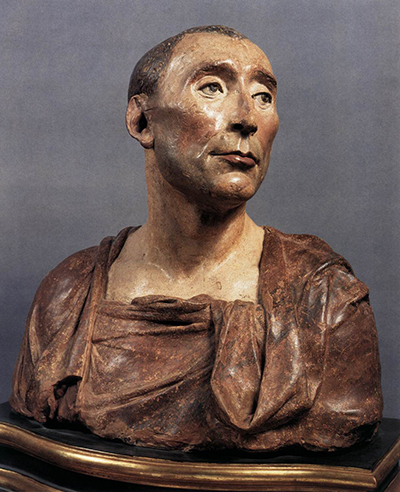
The man in this painted terracotta bust has already turned his head by the time we meet his gaze. His shoulders still face broadly forward, while his eyes look out to his left. Above the neckline, the turn brings one side of his neck into tension. The man seems to have been caught attending to something just outside our field of view. The bust, 46 centimetres high and 44 wide, is in Florence’s Museo Nazionale del Bargello. It has long been called a portrait of the Florentine statesman Niccolò da Uzzano and attributed to Donatello. Both names have been questioned. One concerns whose face we see. The other concerns who gave that face a body, a gesture and a place in the history of Florentine portraiture. [1] [2] [3]
How the bust came to bear Uzzano’s name
Niccolò da Uzzano was a diplomat and served repeatedly as Florence’s gonfaloniere of justice, a leading magistrate of the republic. Documentary records place his death in April 1431. The palace on the Via de’ Bardi that he built and occupied eventually passed to a branch of the Capponi family, and the bust is recorded in that palace before its purchase for the Bargello in 1881. The house made the identification plausible. It also passed through generations of people whose portraits could have been collected or displayed there. [1] [4] [5] [6]
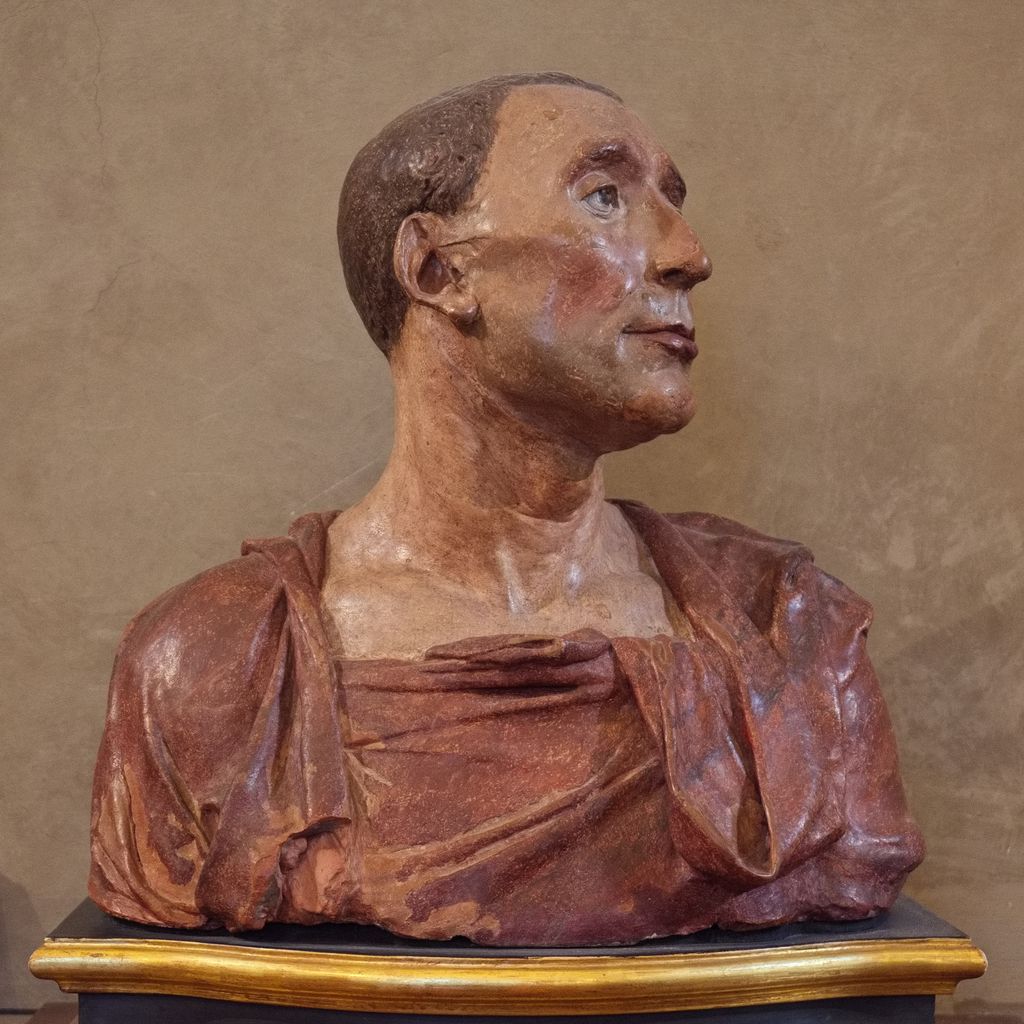
The painted Bargello bust traditionally identified as Niccolò da Uzzano. Armin Kleiner. Image source. CC BY-SA 4.0. Resized for the web.
The name had already circulated in another medium. Cristofano dell’Altissimo’s oil portrait of Uzzano in the Uffizi, delivered and paid for on 13 October 1588, names him in painted capitals. It belongs to the Florentine collection of portraits of celebrated people begun by Cosimo I de’ Medici. The national catalogue links Cristofano’s likeness to the Bargello bust. If the painter drew on this sculpture, his panel shows that the face was understood as Uzzano’s by the late sixteenth century. The panel would then be a record of the bust’s identification in that period, with the two works carrying the same likeness through different media. [1] [7]
The sculpture acquired a more explicit label in the eighteenth century. Cristina De Benedictis publishes an account from the records of the Accademia Colombaria that places the antiquarian Anton Francesco Gori in the middle of a transaction in 1736. As she reconstructs it, Gori helped arrange the acquisition for the Capponi household. The society’s notes describe the bust being shown in the Via de’ Bardi house and record that Senator Ferrante Capponi had it set on a base bearing an inscription composed by Gori. It honours Uzzano as the founder of the house and calls him Ferrante’s ancestor. Carlo Carlieri’s guide to Florence gave the identification and the attribution to Donatello wider currency in 1745. The base recorded a claim made for the sculpture centuries after its creation. [8]
Art historian Francesco Caglioti points to a late fifteenth-century medal bearing Uzzano’s name. He finds the features compatible with the bust, allowing for the headgear that covers the receding hairline on the medal. Other scholars have proposed Neri Capponi, comparing the bust with a funerary profile and a figure in a fresco in the Sassetti Chapel. Caglioti treats the similarities as features that could recur in portraits of comparable men. A resemblance between two portraits can reflect conventions shared by their makers. The Fondazione Federico Zeri indexes the sculpture under the more open description Ritratto maschile, or male portrait, while retaining the traditional name in its record. [4] [9] [14]
What the clay and colour reveal
Paint picks out the eyes and lips, while the reddish brown of the garment sets off the bare neck. Along the throat and jaw, the sculptor had to make the head’s turn work through the whole figure. From an oblique angle, the folds of the garment lead the eye towards the shoulder as the head pulls away from it. The broad, antique-looking drapery gives this specific-looking face the bearing of a Roman civic portrait. Caglioti notes that some observers were drawn far enough by that association to propose Cicero as the subject. He reads the costume in the context of Renaissance interest in ancient busts and the use of classical dress for more recent sitters. [1] [4]
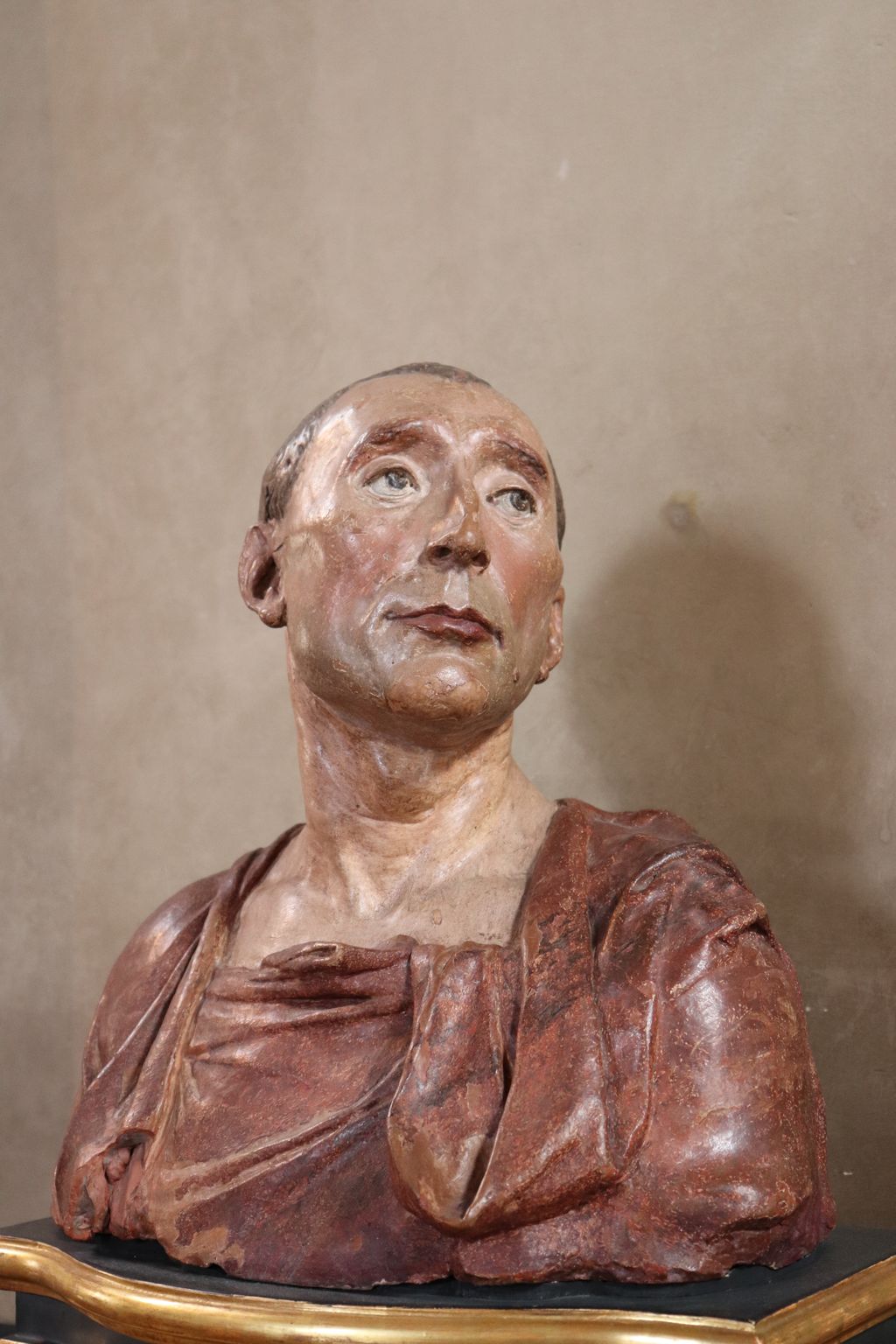
An oblique view shows the turn of the head above the broad painted folds at the chest. HuthBerlin. Image source. CC BY 4.0. Resized for the web.
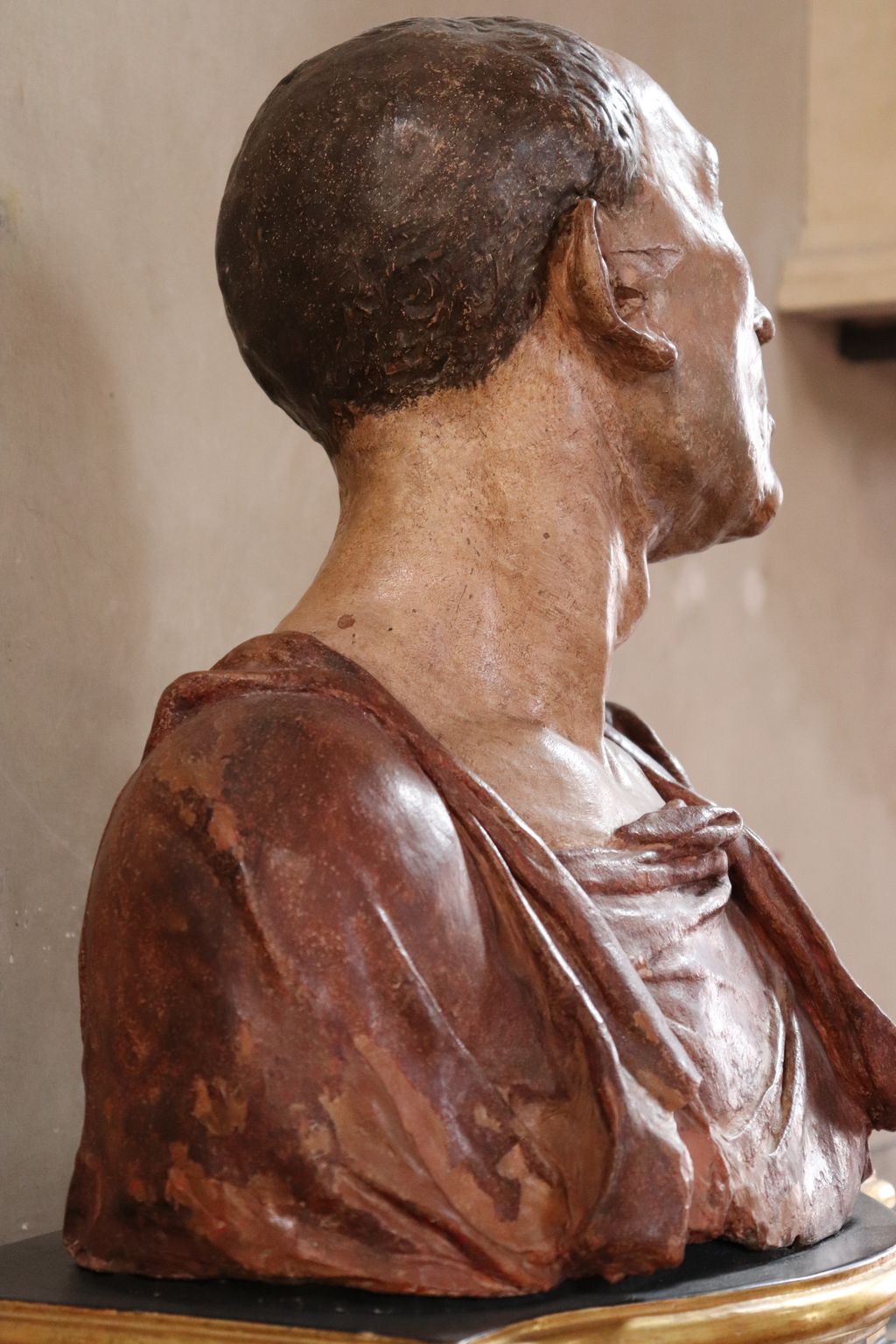
The rear three-quarter view shows the hairline, the turn of the neck and the edge of the clay garment. HuthBerlin. Image source. CC BY 4.0. Resized for the web.
The bust’s lifelike appearance prompted suggestions that a mould taken from a face had been used. The treatment of 1984–85 gave the idea more substantial support. Drawing on the conservation findings, Moritz Siebert describes evidence revealed as the earlier paint finish was uncovered. One seam runs from the upper neck towards the hairline, and another follows the contour of the skull towards the nape. He reads these marks as evidence of the assembly involved in incorporating a facial cast into the sculpture. The national catalogue likewise reports that restoration confirmed the use of a cast and presents a death mask as a possibility. Siebert distinguishes the seams from features such as the deep eye sockets and pronounced cheekbones, which a sculptor could also achieve by modelling. The open eyes can be understood as part of the work done to bring a cast likeness to life. They tell us little about whether the mould was taken before or after death. [1] [9]
The surface seen today has a treatment history of its own. The uncovering of an earlier finish means that the colour visible at different moments in the bust’s history may have differed. The force of the paint also divided viewers. Writing in 1903, Lord Balcarres regarded the colour as suspect and preferred the form visible in an unpainted cast. The restoration findings give a firmer basis for attending to the surviving colour as part of the object. They leave room for caution about which individual passages preserve the earliest paint. [9] [10]
Annotated Details from the Bust traditionally called Niccolò da Uzzano
Select a number to jump to a detail of the sculpture.
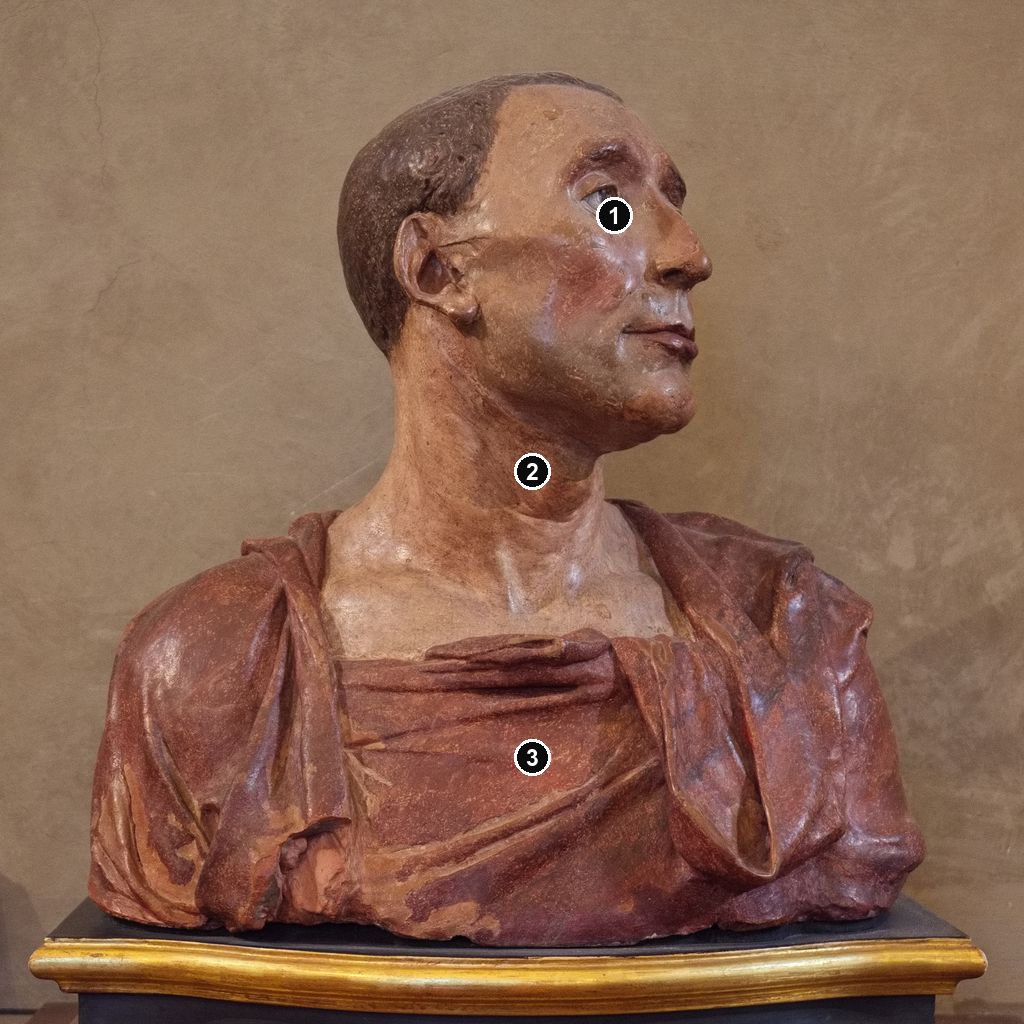
Details from THE BUST TRADITIONALLY CALLED NICCOLÒ DA UZZANO
Open a detail image to examine the surface more closely.
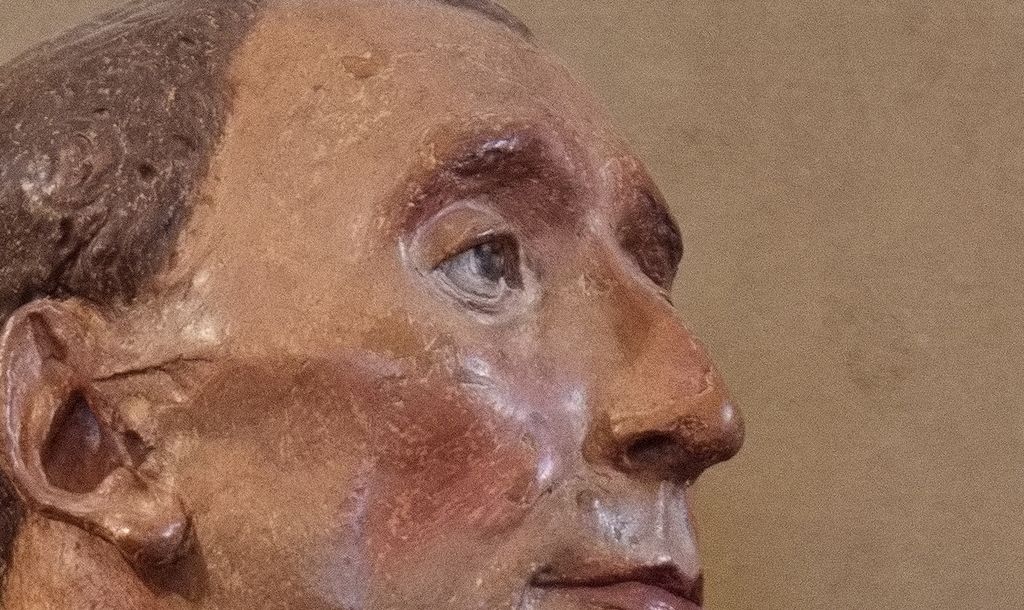
Turn of the head
The eyes, brow and nose are seen in three-quarter view even though the chest faces more squarely forwards.
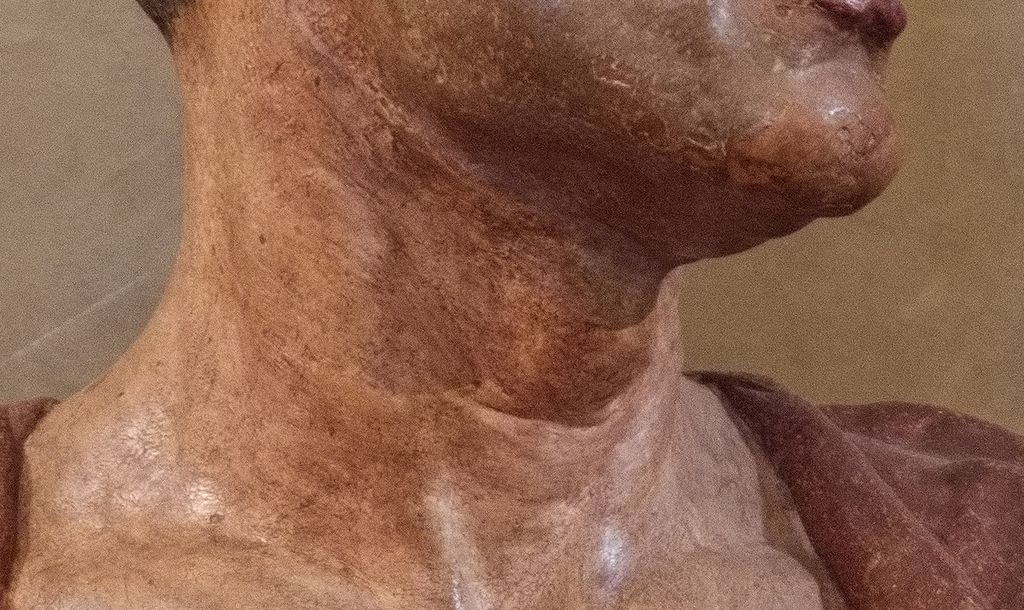
Colour at the neck
Variations of colour trace the transition from the jaw to the long neck. Painted surface and modelling work together in this passage.
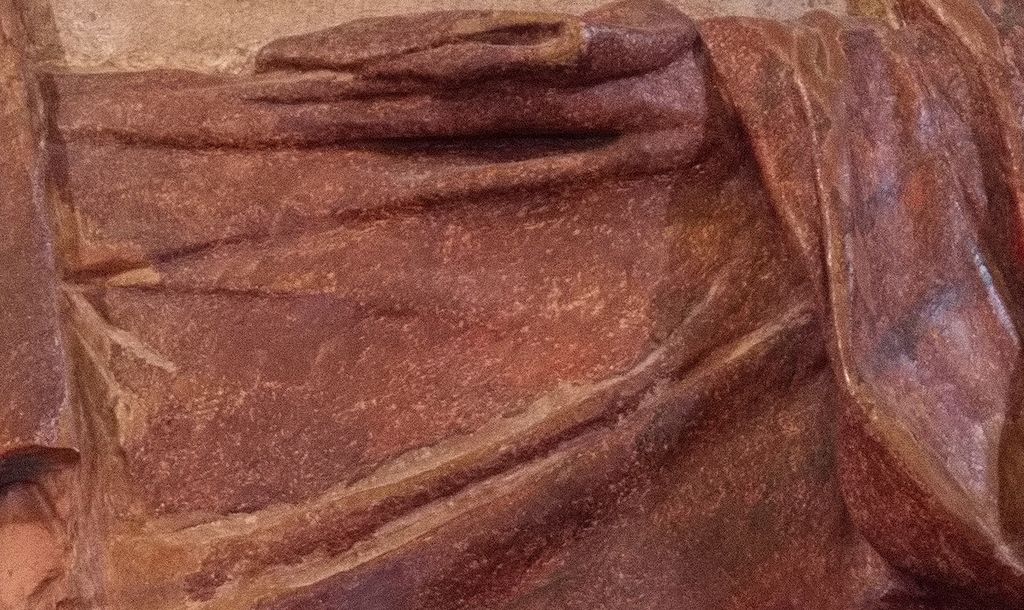
Cloth across the chest
A long folded strip crosses the opening of the garment. Its raised edge casts a deeper shadow than the shallower ridges beside it.
Annotated photograph and detail crops. Armin Kleiner. Image source. CC BY-SA 4.0. Resized, annotated and cropped from the original photograph.
Donatello or Desiderio’s workshop?
The Italian national record, compiled in 1989 and updated in 2005 and 2006, retains Donatello and gives 1432 in its main fields. Its historical entry sets out several objections, including a date after 1450 and a connection with Desiderio da Settignano, as well as a late fifteenth-century attribution to Pietro Torrigiano proposed by Maria Grazia Ciardi Dupré. The Donatello argument draws on the force of the modelling in his marble prophets Habakkuk and Jeremiah for Florence Cathedral’s bell tower. Those faces likewise show how strongly bone structure, the turn of a head and the fall of light can give character to a figure. Their relationship to this bust is a comparison of style. [1]
In his entry for the 2011 Berlin and Metropolitan Museum of Art portrait exhibition, Caglioti placed the bust in Desiderio’s workshop around 1450–55. He gave special weight to the direction of the turn and to the handling of the drapery, which he compared with Desiderio’s carving in marble. This approach considers the parts of the sculpture that show the maker’s choices most directly, especially if some of the facial contours were inherited from a cast. Caglioti still favoured the identification as Uzzano. A moulded likeness could have been preserved and used years after the sitter’s death, so a mid-century date for the sculpture can coexist with that identification. [4]
The 2023 Victoria and Albert Museum exhibition in London included the bust with a question mark after Donatello’s name. It had been absent from the related Donatello exhibitions in Florence and Berlin. In his 2024 review of the exhibitions, Caglioti renewed his attribution to Desiderio’s workshop. These catalogues give an idea of how differently specialists weigh the same surviving evidence. [3] [4]
The portrait bust and its afterlife
The date matters to the history of the portrait bust. An origin in the early 1430s would place this independent likeness unusually early among surviving Florentine Renaissance examples. A date in the 1450s puts it alongside the development of the format by sculptors such as Mino da Fiesole, whose securely dated marble portrait of Piero de’ Medici was made in 1453. Donatello’s reliquary bust of Saint Rossore offers a different comparison. It gives a saint an alert, particular presence in the same general format, but its purpose was to hold a relic. The Bargello terracotta invites us to consider how that concentration on the head and shoulders could serve the memory of a Florentine citizen. [4] [9] [11]
The museum acquisition in 1881 fixed the original’s public home in Florence. Wilhelm von Bode had tried to acquire it for Berlin in 1878, and Caglioti connects the Italian state’s eventual purchase to competition for the work. The likeness kept travelling. An 1884 drawing by Nicolaas van der Waay, now at the Rijksmuseum, carries both names, Uzzano and Donatello, in a handwritten inscription. [4] [15] [16]
A painted terracotta version at Princeton University Art Museum is explicitly catalogued as a work after the Bargello bust, and the Italian national catalogue records a later plaster cast made in Tuscany. The latter record notes that versions were ordered from within Italy and abroad. These copies carried the turning head and its familiar name into other collections. In the original, the sweep of the neck into the drapery still rewards moving from one side of the bust to the other. This is the part of the portrait that a likeness taken from a face alone could never supply. [1] [12] [13]
Donatello sculpture directory
| Name | Date | Medium and record |
|---|---|---|
| Marble David | 1408–09, adapted 1416 | Carved Carrara marble Catalogue. |
| Saint John the Evangelist | c. 1409–15 | Carved marble Catalogue. |
| Saint Mark | 1411–13 | Carved Carrara marble Catalogue. |
| Saint George and its dragon relief | c. 1415–17 | Marble statue and marble relief Catalogue. |
| Marzocco | c. 1417–20 | Carved sandstone Catalogue. |
| Saint Louis of Toulouse, Florence | 1418–25 | Gilt bronze and mixed media Catalogue. |
| Pazzi Madonna | c. 1420s | Marble relief Catalogue. |
| Reliquary Bust of Saint Rossore | c. 1420s | Gilt bronze Catalogue. |
| The Prophet Jeremiah | 1420s–30s, disputed | Marble Catalogue. |
| Zuccone | c. 1420s–30s | Marble Catalogue. |
| Feast of Herod, Siena | 1420s | Gilded bronze relief Catalogue. |
| Ascension with Christ Giving the Keys to Saint Peter | c. 1428–30 | Marble relief Catalogue. |
| Cantoria | 1433–39 | Marble and mosaic Catalogue. |
| Amor-Atys | c. 1435–40 | Partly gilded bronze Catalogue. |
| Bronze David | c. 1435–40, disputed | Partly gilded bronze Catalogue. |
| Gattamelata | Installation agreement, 1453 | Bronze and stone Catalogue. |
| Santo altar | Mid-fifteenth century | Bronze and limestone ensemble Catalogue. |
| Chellini Madonna | Given in 1456 | Partly gilded bronze tondo Catalogue. |
| Penitent Magdalene | c. 1453–55 (Opera) | Poplar, stucco, pigments and gold Catalogue. |
| Judith and Holofernes | Late 1450s–early 1460s | Bronze with surviving gilding Catalogue. |
| Pulpit of the Passion | Late work and later assembly | Bronze reliefs, Donatello and collaborators Catalogue. |
| Bust traditionally called Niccolò da Uzzano | Fifteenth century | Painted terracotta, attribution disputed Catalogue. |
| Prato Cathedral exterior pulpit | Commissioned 1428; carved 1430s | Marble reliefs, Donatello and Michelozzo Catalogue. |
| Cavalcanti Annunciation | c. 1433–35 | Gilded sandstone and terracotta Catalogue. |
| Crucifix at Santa Croce | Early fifteenth century | Painted wood Catalogue. |
| Madonna of the Clouds | c. 1425–35 | Marble relief Catalogue. |
| Old Sacristy Doors | Fifteenth century | Two paired bronze doors Catalogue. |
| Resurrection Pulpit | Late work and later assembly | Bronze reliefs, Donatello and collaborators Catalogue. |
| Brancaccio tomb | 1420s | Donatello, Michelozzo and assistants, mixed materials Catalogue. |
| Saint John the Baptist, Venice | 1438 | Polychromed and gilded wood Catalogue. |
| Sacrifice of Isaac | Early fifteenth century | Donatello and Nanni di Bartolo, marble Catalogue. |
| Madonna of Via Pietrapiana | Mid-fifteenth century | Terracotta Catalogue. |
| Miracle of the Mule | Mid-fifteenth century | Gilded bronze panel for the Santo altar Catalogue. |
| Padua Crucifix | Mid-fifteenth century | Cast bronze Catalogue. |
| Dancing Spiritello, Bargello | Fifteenth century | Bronze Catalogue. |
| Young Prophet from the Porta della Mandorla | c. 1404–09 | White marble, attributed to Donatello Catalogue. |
| Prophet or Apostle from the Duomo north tribune | Early fifteenth century | White marble, possibly Donatello Catalogue. |
| Beardless Prophet | 1415–18 | White marble Catalogue. |
| Sibyl and Prophet of the Porta della Mandorla | 1422 | Carved marble heads for the portal Catalogue. |
| Faith, Siena baptismal font | 1420s | Gilded bronze figure Catalogue. |
| Hope, Siena baptismal font | 1420s | Gilded bronze figure Catalogue. |
| Feast of Herod, Lille | c. 1430 | Carrara marble relief Catalogue. |
| Piot Madonna | c. 1440–60 | Polychrome terracotta with glass and wax inlays Catalogue. |
| Carafa Horse Head | c. 1456–58 | Cast bronze Catalogue. |
| Pazzi Madonna workshop version, Louvre | c. 1450 | Polychrome gesso, Donatello’s workshop Catalogue. |
| Pazzi Madonna tondo, Rijksmuseum | c. 1425–50 | Plaster and stucco, after Donatello Catalogue. |
| Sprite | c. 1430–40 | Bronze, sculptor or metalsmith close to Donatello Catalogue. |
Discussion
Look again at the images and ideas explored in The Uzzano Bust. These editorial prompts invite your observations.
Reader Insights
Which details of the pose and paint affect how directly the bust seems to address you?
What would you need to know about the early history of the object before using it as a likeness of Uzzano?
Join the Conversation
Share a detail, comparison or question about The Uzzano Bust below.
References
- Catalogo Generale dei Beni Culturali, Ritratto di Niccolò da Uzzano, record 0900287031, Bargello Maioliche 179. View source.
- Istituto Nazionale di Studi sul Rinascimento, Busto di Niccolò da Uzzano?, Fototeca, photograph inventory 897. View source.
- Francesco Caglioti, “Le mostre donatelliane del 2022 e i mal di pancia della critica accademica austro-tedesca,” Studi di Scultura 6 (2024), p. 12 and note 5. View source.
- Francesco Caglioti, “Niccolò da Uzzano,” in Keith Christiansen and Stefan Weppelmann, eds., The Renaissance Portrait from Donatello to Bellini, The Metropolitan Museum of Art, 2011, cat. 22, pp. 126–128. View source.
- Sepoltuario Fiorentino, University of Virginia, Da Uzzano, Niccolò di Giovanni di Alessandro, individual record 3794. View source.
- Istituto della Enciclopedia Italiana, “Uzzano, Niccolò da,” Enciclopedia machiavelliana. View source.
- Catalogo Generale dei Beni Culturali, Ritratto di Niccolò da Uzzano, Cristofano dell’Altissimo, Uffizi, record 0900292417. View source.
- Cristina De Benedictis, “Contributo alla conoscenza del «Museo Gorio»,” in L’epistolario di Anton Francesco Gori, Firenze University Press, p. 5. View source.
- Moritz Siebert, Totenmaske und Porträt. Der Gesichtsabguss in der Kunst, pp. 126–130 and 137. View source.
- Lord Balcarres, Donatello, 1903, “Niccolò da Uzzano and Polychromacy.” View source.
- Arnold Victor Coonin, “Portrait Busts of Children in Quattrocento Florence,” Metropolitan Museum Journal 30 (1995), note 48. View source.
- Princeton University Art Museum, After the bust in the Bargello Museum, Florence, attributed to Donatello, traditionally identified as Niccolo da Uzzano, object y1987-9. View source.
- Catalogo Generale dei Beni Culturali, Busto ritratto di Niccolò da Uzzano, Tuscan plaster cast, record 0900445547. View source.
- Fondazione Federico Zeri, Ritratto maschile, catalogue record 66131. View source.
- Neville Rowley, Johannes der Täufer, Staatliche Museen zu Berlin, catalogue commentary on Wilhelm von Bode and the Uzzano bust. View source.
- Rijksmuseum, Buste van Niccolò da Uzzano, Nicolaas van der Waay, 1884, object RP-T-1949-604. View source.
- Victoria and Albert Museum, Donatello’s David. View source
- Opera del Duomo, Donatello and the Opera del Duomo. View source
- Ministero della Cultura, David with the Head of Goliath, Bargello bronze. View source
- Save Venice, Donatello’s Equestrian Monument to Gattamelata. View source
- Opificio delle Pietre Dure, L’ultimo Donatello. View source
More DONATELLO Sculptures
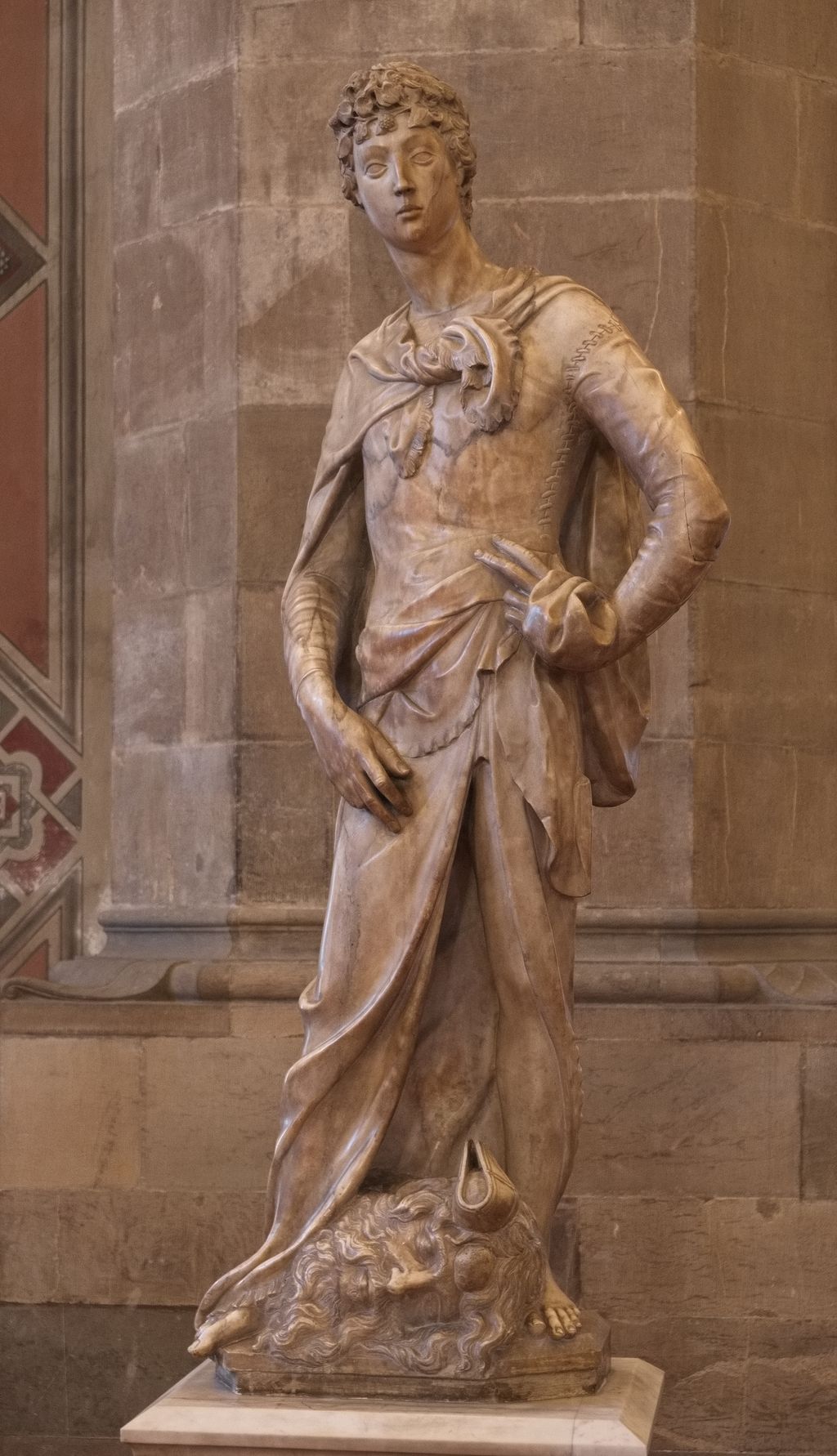
Marble David
Armin Kleiner. Image source. CC BY-SA 4.0. Resized for the web.
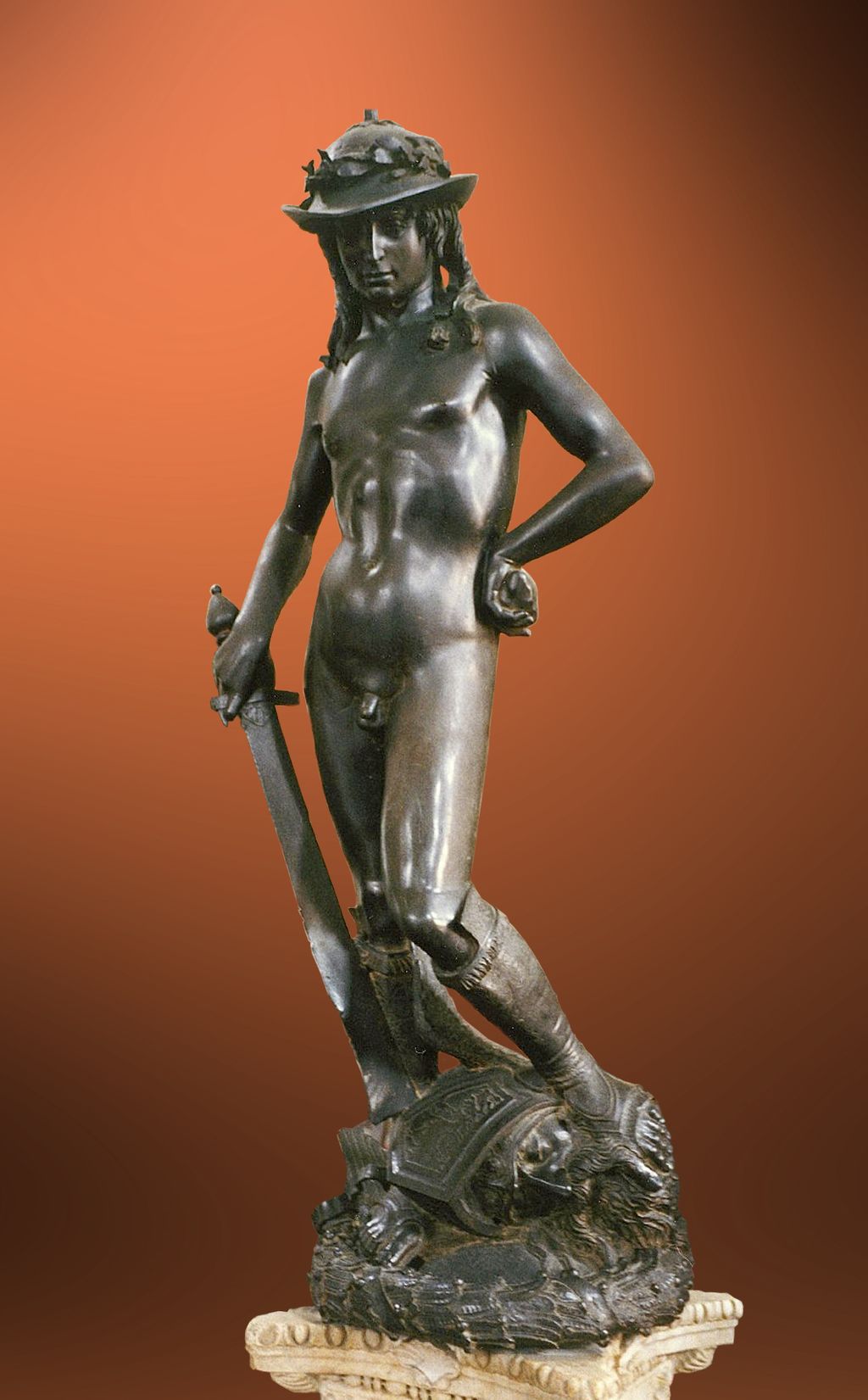
Bronze David
Patrick A. Rodgers. Image source. CC BY-SA 2.0. Resized for the web.
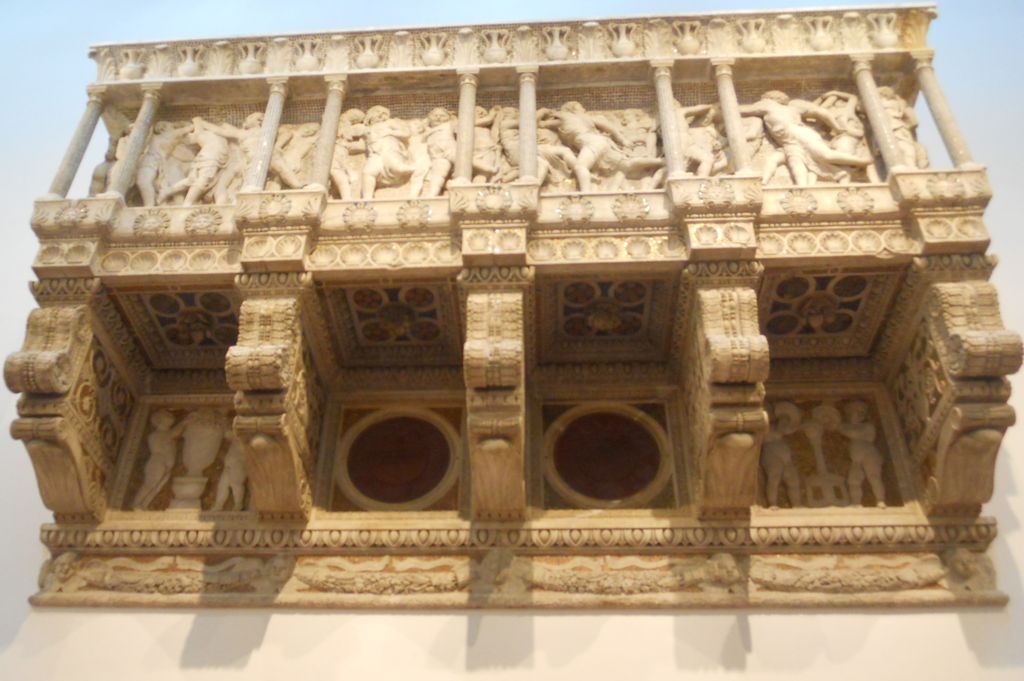
Cantoria
Erik Drost. Image source. CC BY 2.0. Resized for the web.
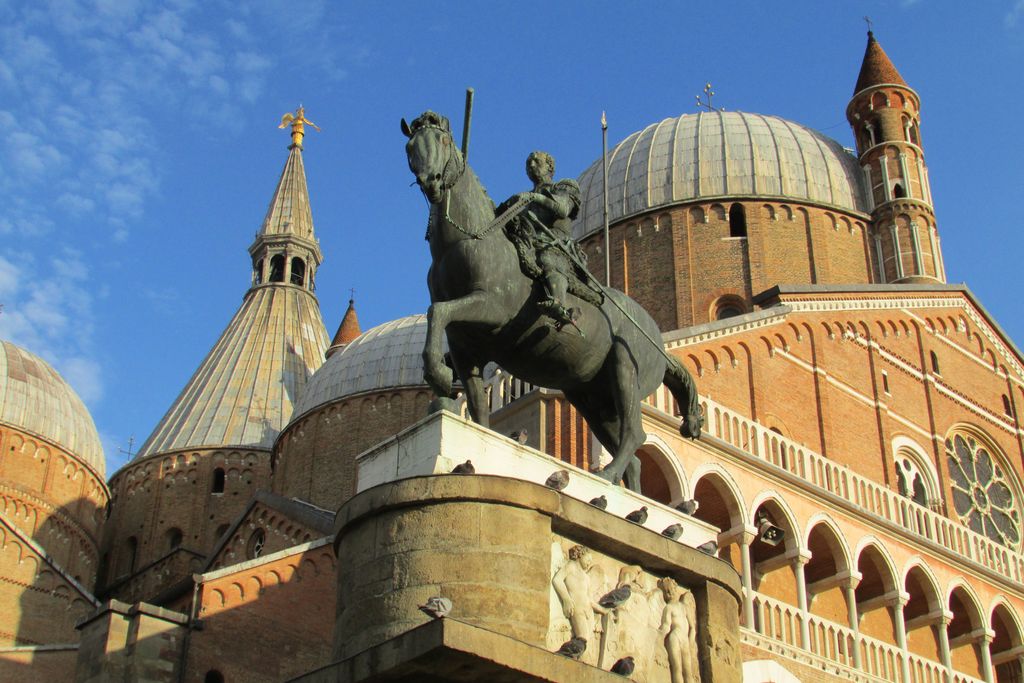
Gattamelata
Chris Light. Image source. CC BY-SA 4.0. Resized for the web.
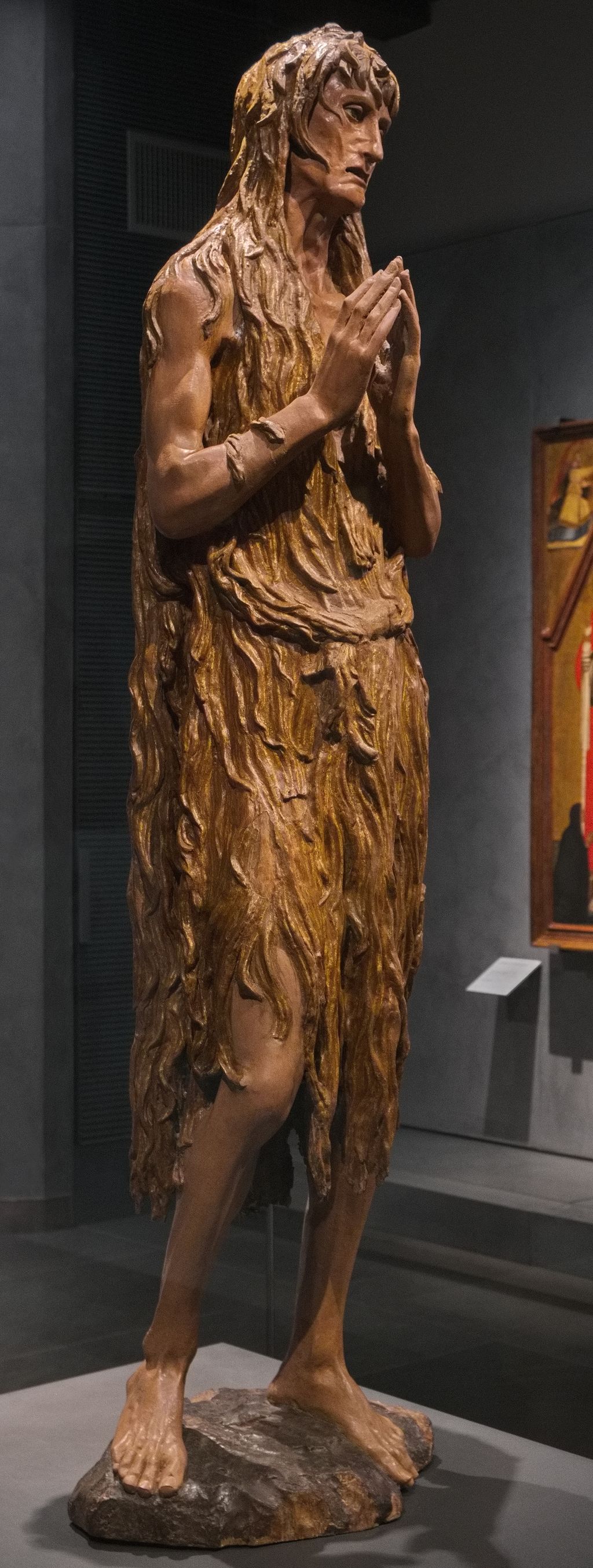
Penitent Magdalene
Armin Kleiner. Image source. CC BY-SA 4.0. Resized for the web.
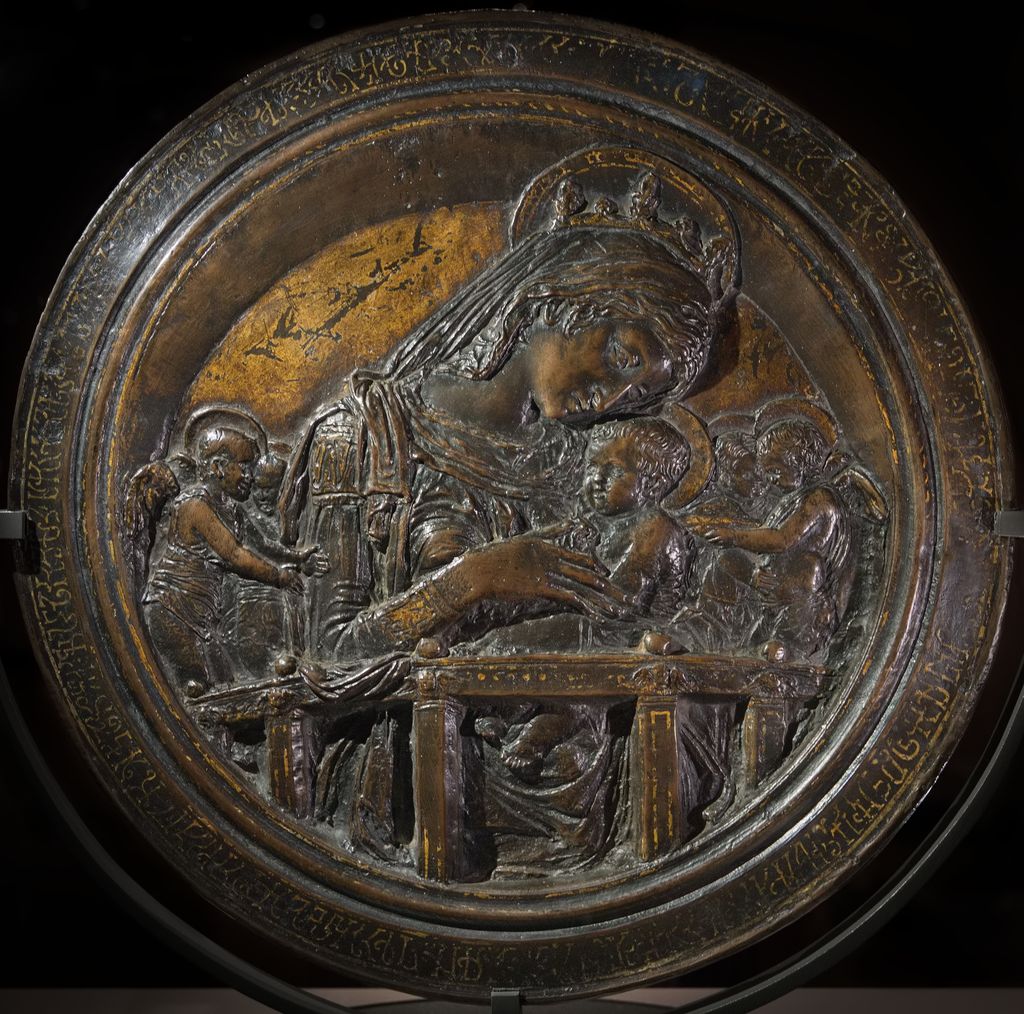
Chellini Madonna
Armin Kleiner. Image source. CC BY-SA 4.0. Resized for the web.
