


 by Tom Gurney
Tom Gurney BSc (Hons) is an art history expert with over 20 years experience
Published on June 19, 2020 / Updated on November 29, 2026
Email: tomgurney1@gmail.com / Phone: +44 7429 011000
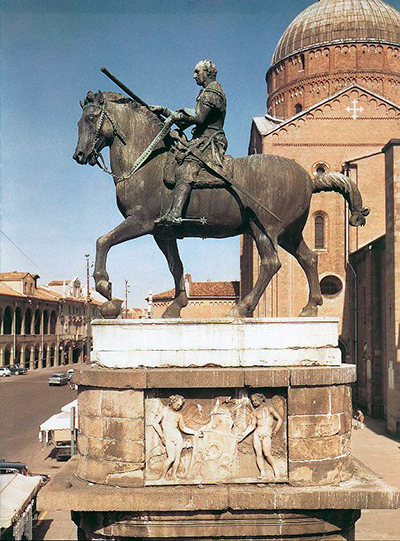
Donatello balances the raised forehoof of a bronze horse on a small sphere. Far above it sits Erasmo da Narni, the Venetian commander known as Gattamelata. His right hand holds a baton, his left gathers the reins, and his unhelmeted head looks ahead. From the paving of Padua’s Piazza del Santo, where the monument historically stood, the sphere is easy to miss. Yet it joins the shape of the horse’s stride to the stone beneath it. You can read the bronze as a picture of command and, at the same time, see how Donatello made that picture stand up. [1]
The horse and rider rise about 3.4 metres above a stone podium approximately 7.8 metres high, according to Save Venice. They form the earliest surviving monumental bronze equestrian statue cast since antiquity. The project took shape in the 1440s, with foundry work documented in 1447 and installation generally dated to 1453. The bronze stood outside the Basilica of Saint Anthony, usually called the Santo, until its removal for conservation in October 2025. Its towering base, with the family arms and two carved doors, belongs to the story just as much as the man and horse. [1] [2] [3] [4] [5]
A family commission with the Senate’s approval
Gattamelata was a condottiere, a military captain who contracted his services to a state or other employer. He fought for the papacy before entering Venetian service in 1434, as Venice and Milan competed for power in northern Italy. His 1438 campaign included the withdrawal of Venetian troops from a precarious position near Lake Garda across the mountains to Verona. The feat helped secure his standing with Venice, where he rose to supreme command. He died in Padua in 1443 and received a state funeral attended by Doge Francesco Foscari. Save Venice relates the baton in the sculpture to the silver-gilt baton Gattamelata received on his appointment. [1] [6]
The Senate authorised the monument and the family commissioned and paid for it. Gattamelata’s son Giovanni Antonio is identified with the commission, and his representatives negotiated with Donatello over the work in 1453. His widow, Giacoma da Leonessa, would establish the family’s funerary chapel in the basilica. Historian Giovanna Baldissin Molli places the choice of a Florentine sculptor within a network that included Foscari and Cosimo de’ Medici. Seen in that light, the memorial drew its authority from more than the visual language of ancient Rome. It depended on a family able to recruit Donatello and on a republic willing to let the family claim such a prominent place for the commander’s image. [2] [3] [6] [7]
That distinction matters in Padua. The city had come under Venetian rule in 1405, and the site chosen for the monument was cemetery ground at a major Paduan shrine. At the funeral, the Venetian government had publicly honoured a man in its service. For the family, the square offered a lasting, visible place to commemorate him in the city where he died. The monument could carry those interests together. Its armour and baton identify the soldier through rank and service, while the carved shield below insists on family identity. Neither message requires the passer-by to be able to read Latin. [1] [3] [5] [7]
From foundry accounts to the piazza
The dates can be pinned to different sorts of work. The accounts for May and June 1447 record the purchase of copper and tin for the horse’s body, the transport of models of the rider and the horse from Donatello’s house to the foundry, and the return of a cast section of the horse’s hindquarters. They name the founder Andrea delle Caldiere and record a material transformation in the language of transport. Models went one way and at least one section of the horse came back in metal. Stonework was also being paid for that year, so the pedestal and the casting were both substantial concerns early in the project. [3]
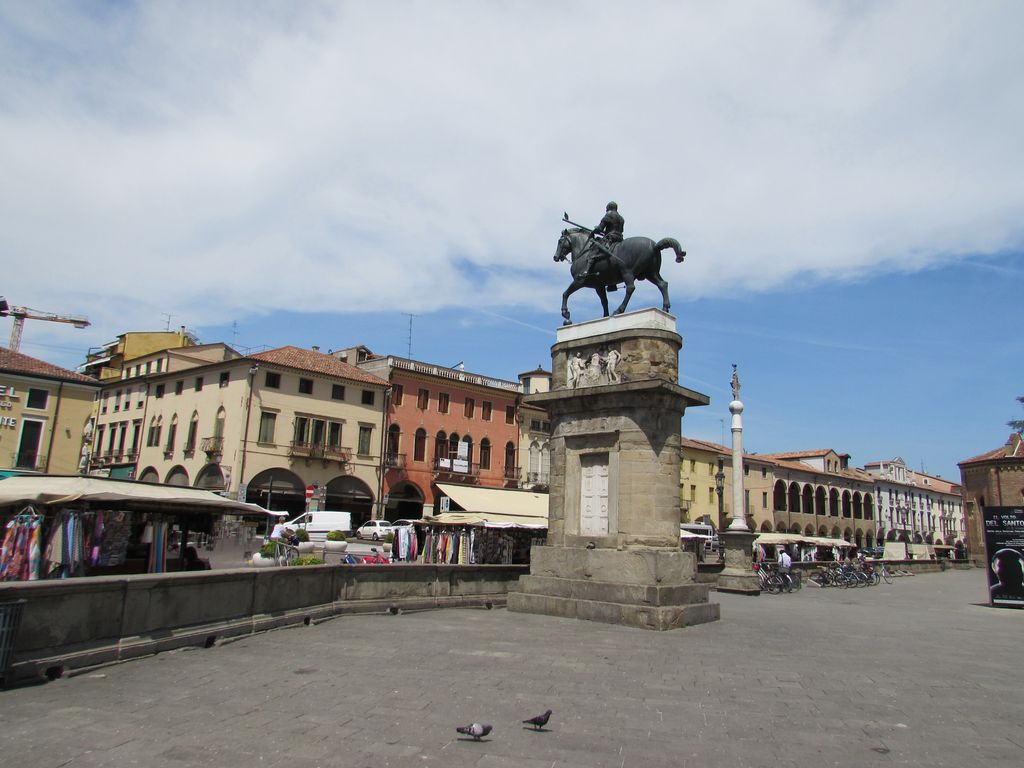
A view of the monument from the piazza before the bronze was taken down for conservation in 2025. Cezar Suceveanu. Image source. CC BY-SA 4.0. Resized for the web.
In 1453 Donatello and the representatives of Giovanni Antonio agreed to have the work appraised to settle the sculptor’s compensation. He undertook to put the horse and rider on the base by the end of September. Anne Markham Schulz identifies the appraisers from the family’s side as a woodcarver, two goldsmiths and the painter Michele Giambono. The range of trades suggests how many kinds of judgment went into pricing the work. Daniel Michael Zolli and Francesco Caglioti give 1453 for the installation, as does Save Venice. The basilica’s 2025 account gives an approximate date of 1457 for the placement. The 1453 agreement provides direct evidence of when Donatello promised to mount the group. The precise day of installation is harder to establish. [1] [2] [3] [4] [5]
What occupied the intervening years is harder to pin down. Caglioti points to a competing call on Donatello’s time in the same precinct. The officials responsible for the Santo’s high altar pressed him and his assistants in 1447 to concentrate on their work. In June they stipulated continuing attention to it and reserved the right to entrust the figures and narrative scenes to someone else if progress fell short. The Santo altar was a separate undertaking for the church interior, where figures of the Virgin and saints and reliefs of Saint Anthony’s miracles served a liturgical setting. Its administrators had their own deadlines. The outdoor monument and the altar belong to the same period in Donatello’s career, and the archive shows how their demands could collide. [5] [8]
What the stone says
A view from across the piazza takes in the contours of the podium, the horse’s forward reach and the rider’s upright torso. At the foot of the monument, the angle changes. The top surfaces of the horse and saddle recede, the undercut forms grow more conspicuous, and carvings on the pedestal are easier to attend to than the face overhead. The height makes the condottiere visible across the forecourt, but it also asks viewers to assemble the work from more than one distance. A close photograph of the bronze can recover a buckle or a face. It can also make the formidable amount of stone below them disappear. [1]
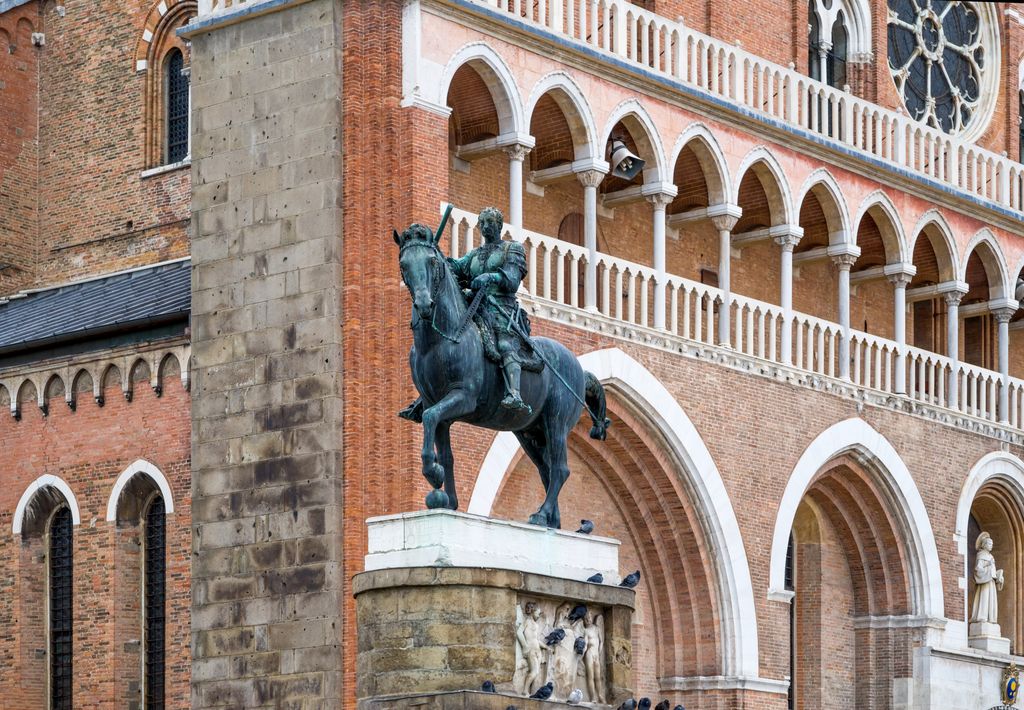
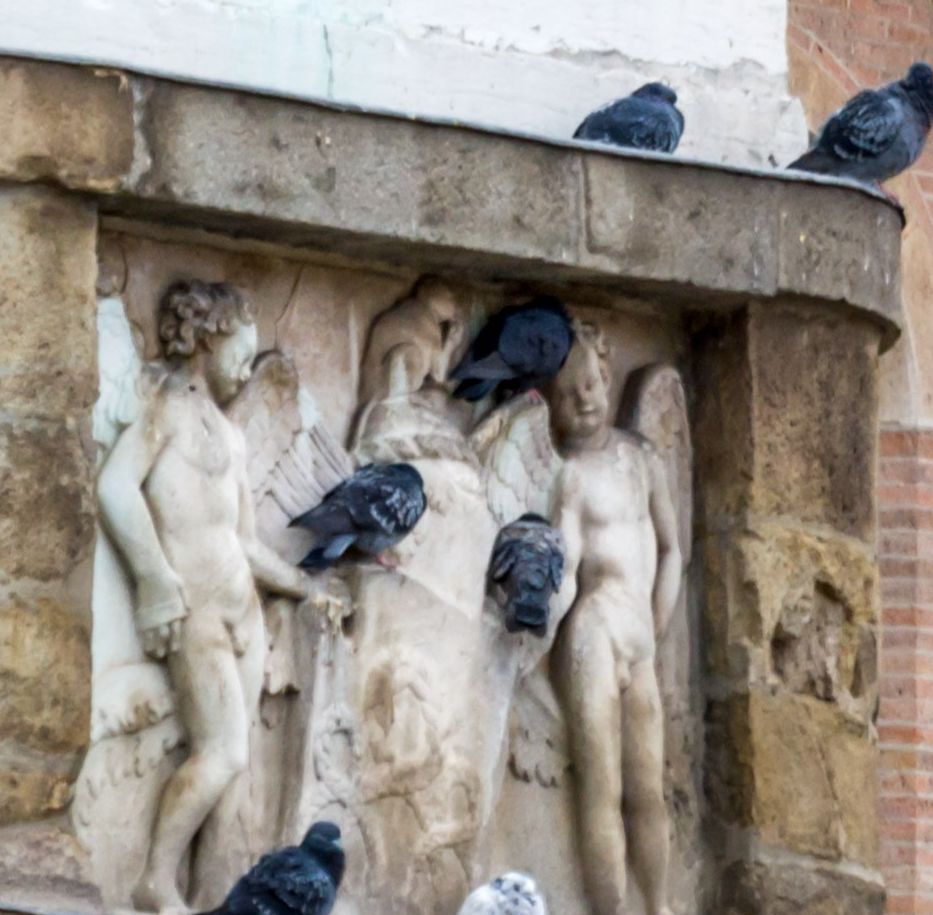
The armorial relief occupies a separate field on the stone podium below the horse. joergens.mi. Image source. CC BY-SA 3.0. Resized for the web.
The podium combines trachyte with Istrian stone. Winged figures on the upper section hold a shield with Gattamelata’s arms. Lower down, Donatello’s monument presents two false doors, one closed to the west and the other shown ajar to the east. They take their imagery from ancient funerary sculpture, where a carved doorway can give the solid face of a tomb the suggestion of depth and passage. Even a slight turn of a carved door changes the effect. The closed one gives the eye a flat stop. At the open one, the edge seems to lead into the stone. Because the doors face different ways, a person walking round the monument discovers the pair in succession. [1]
Their presence helps explain a question the documents leave open. The site was burial ground, and the family chapel was built only in the later 1450s. Save Venice and Schulz allow for the possibility that the monument began as a tomb, or was intended as one. It is uncertain whether the base actually held Gattamelata’s remains before burial in the chapel. The chapel establishes a separate place for the family dead inside the church. Outside, the combination of heraldry, the doors and the commanding figure makes the monument both a memorial of the dead and a statement about the standing of his surviving house. [1] [3]
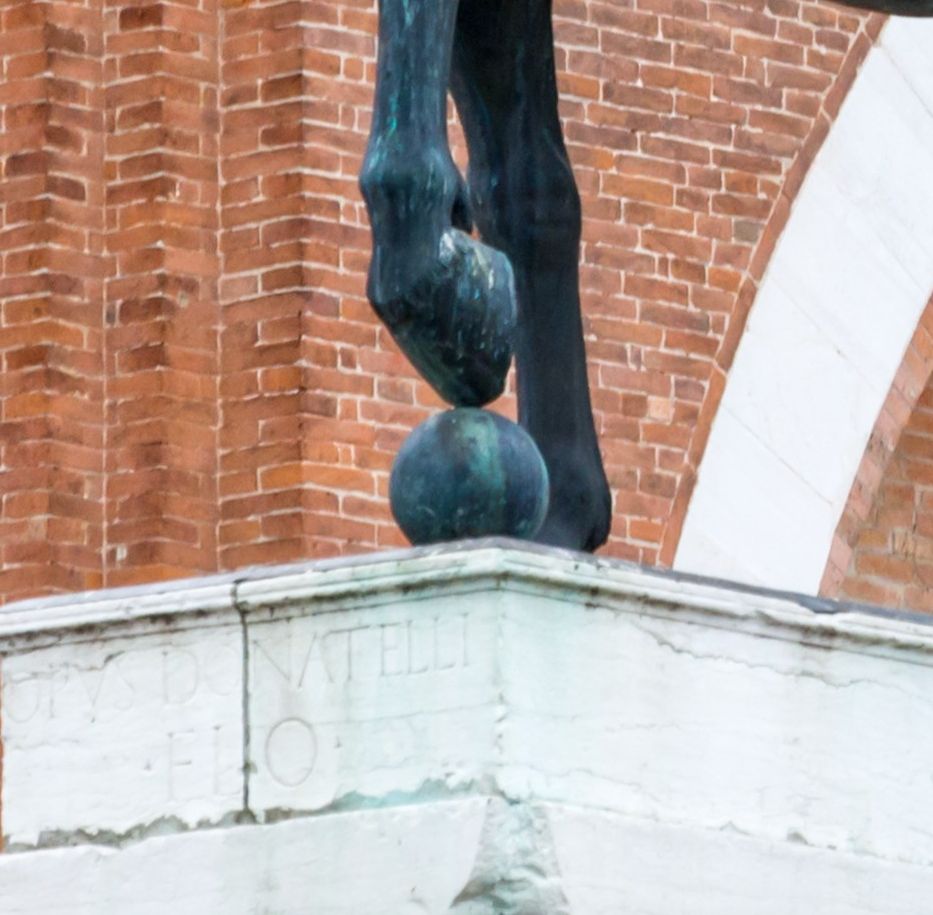
The words cut into the Istrian stone on the side facing today’s Via del Santo identify the sculptor. The epigrapher Giulia Foladore reads the two lines as Opus Donatelli Florentini, “the work of Donatello the Florentine.” From the street side, the cut Roman capitals catch shadows in the pale stone below the projecting bronze. On one part of the base the rider is identified through the family’s arms. On another Donatello names his own work and his city of origin. For a monument very publicly made in Padua, the word Florentini places its maker in a different city and bears witness to the distance the commission travelled. [1] [9]
How the horse carries its rider
Look first at the legs in profile. The horse projects one foreleg ahead and folds the other, as the animation of the stride moves from shoulder to knee to hoof. The raised left hoof comes down on the sphere, commonly read as a cannonball. The curve shows through beneath the hoof, making the contact look small enough to preserve the impression that the animal is taking a step. The meeting of hoof and sphere also gives the lifted leg a support. The possible allusion to artillery suits an armed commander. [1] [10]
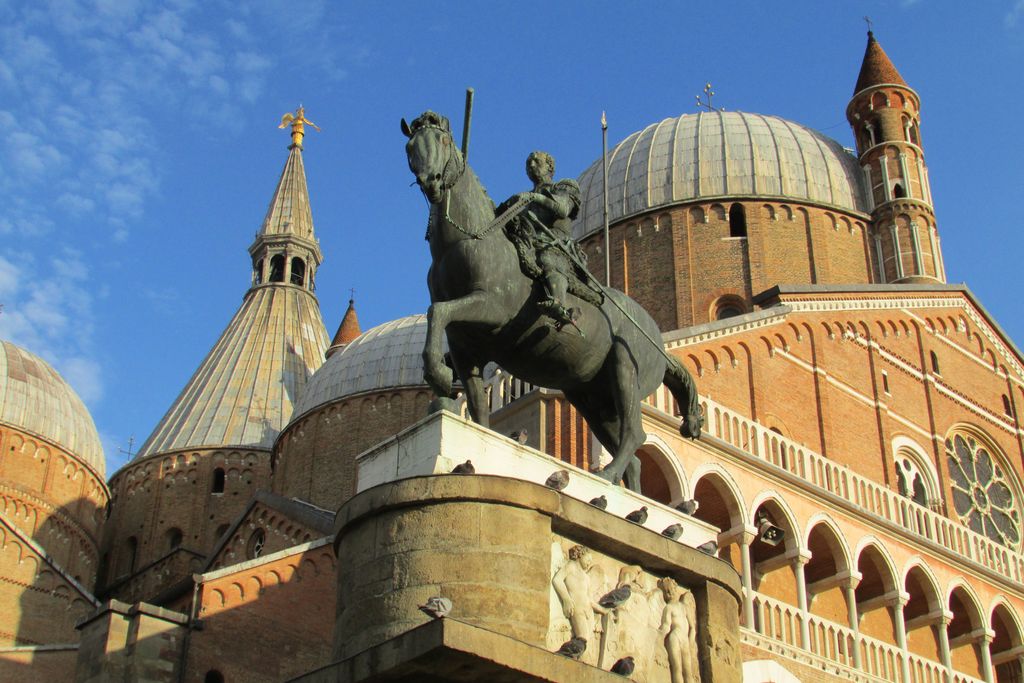
The horse and rider above the people crossing the piazza, photographed before the 2025 conservation move. Chris Light. Image source. CC BY-SA 4.0. Resized for the web.
The motion continues through the horse’s head. The ears prick up, the mouth parts around the bit, and skin gathers beneath the neck as the head bends. The tack gives the animal’s response a cause a rider would recognise. The Metropolitan Museum’s account identifies a curb bit and a saddle with a high pommel and cantle, offering support in front of and behind the rider. Gattamelata stretches his feet forward in the stirrups, with spurs at his heels. In a close side view the tack and the rider’s seat explain what the broad profile first suggests. The man can carry the sign of command because his other hand, legs and seat are occupied with the business of riding. [1] [10]
His torso rises squarely above the saddle. The horse’s long, rounded body carries the eye back towards the rump, while the baton brings it forward again. From nearer the front, the horse’s chest takes over the composition. The rider seems to emerge above its shoulders, and the gap around the cropped hair and bare head makes the face stand out. A profile reveals more of the sword and how low it hangs at the left thigh. Those changes of emphasis are one reason to look at both angles. The horse and man remain intelligible at the height of the podium because the equipment, the broad masses and the few shapes that project into space are held in clear relation. [1] [10]
At close range Gattamelata’s appearance has two distinct kinds of specificity. Close-cropped hair, a firm mouth and a prominent brow make the face recognisable, but the commander died years before the foundry work. We can describe the force of the portrait without treating it as a record of his appearance in life. His armour gives it a second character. The breastplate carries a Medusa head and the costume takes details from ancient Roman dress, while the sword, bridle and spurs evoke equipment used by a mounted commander. Armour becomes the place where a fifteenth-century soldier can appear in the guise of an ancient exemplar. The architect Filarete took issue with that very choice. In his treatise he argued that a man of their own time should appear in contemporary dress. What brought gravity and imposing detail to the portrait for some critics could make it seem inappropriately dressed to others. [1] [4] [10]
Smaller allusions are much harder to make out from below. Mary Bergstein drew attention to two little nude horsemen in the decoration and proposed that a drawing or an engraved gem made available through the antiquarian Ciriaco d’Ancona might account for their resemblance to riders in the Parthenon frieze. She also identifies Ciriaco and Francesco Barbaro as authors of dedicatory texts for the monument and proposes an exchange of ideas between the bronze and Leon Battista Alberti’s contemporary writing on the horse. That is a case for a learned audience and possible channels of exchange. The group thus offers different things to an antiquarian studying the details and to a passer-by who can see little more than the line of the baton. [11]
Annotated Details from Gattamelata
Select a number to jump to a detail of the sculpture.
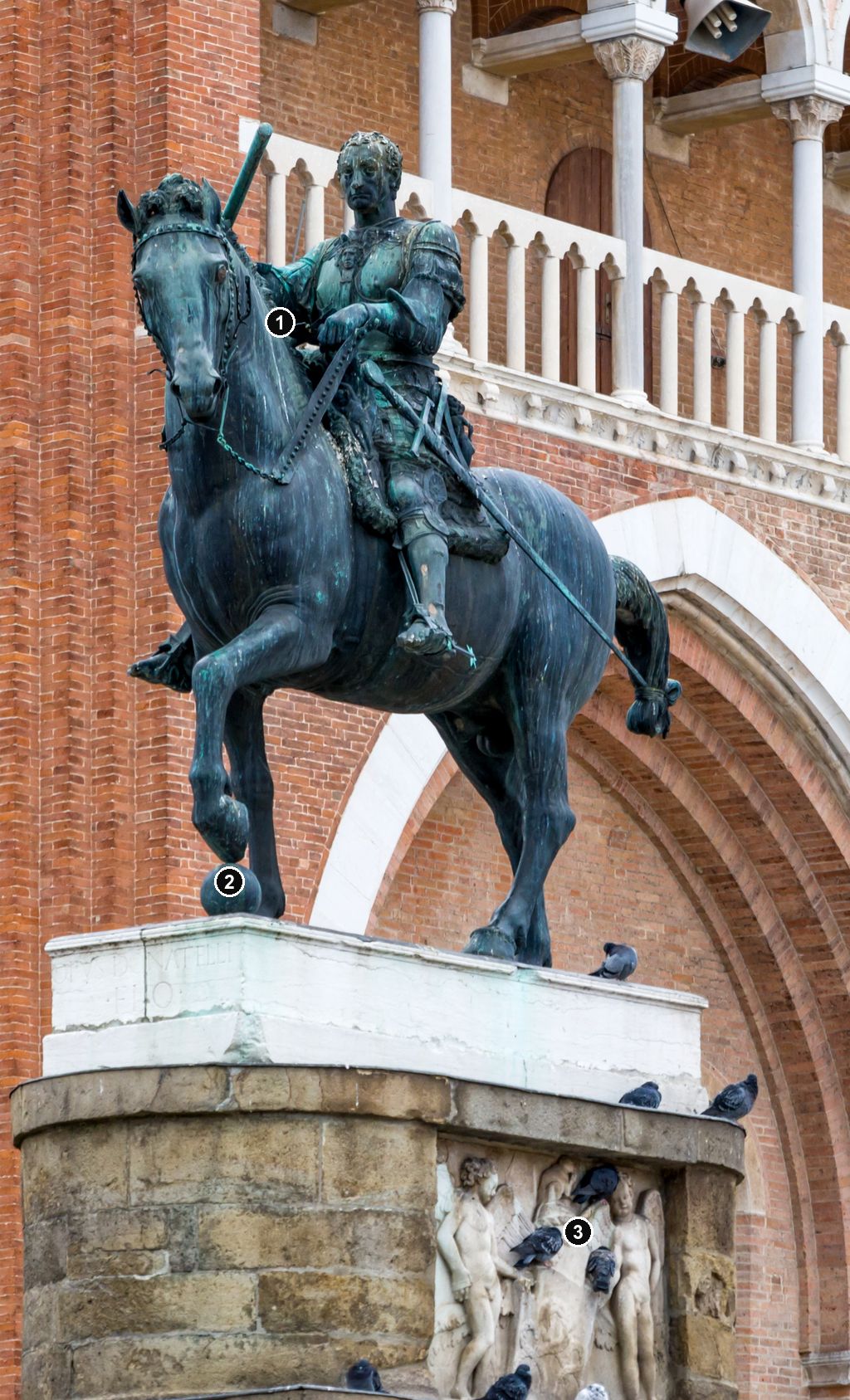
Details from GATTAMELATA
Open a detail image to examine the surface more closely.
Horse and rider
The horse raises its head as the rider stays upright. The two forms read as separate silhouettes even when the sculptural detail is hard to see from the ground.
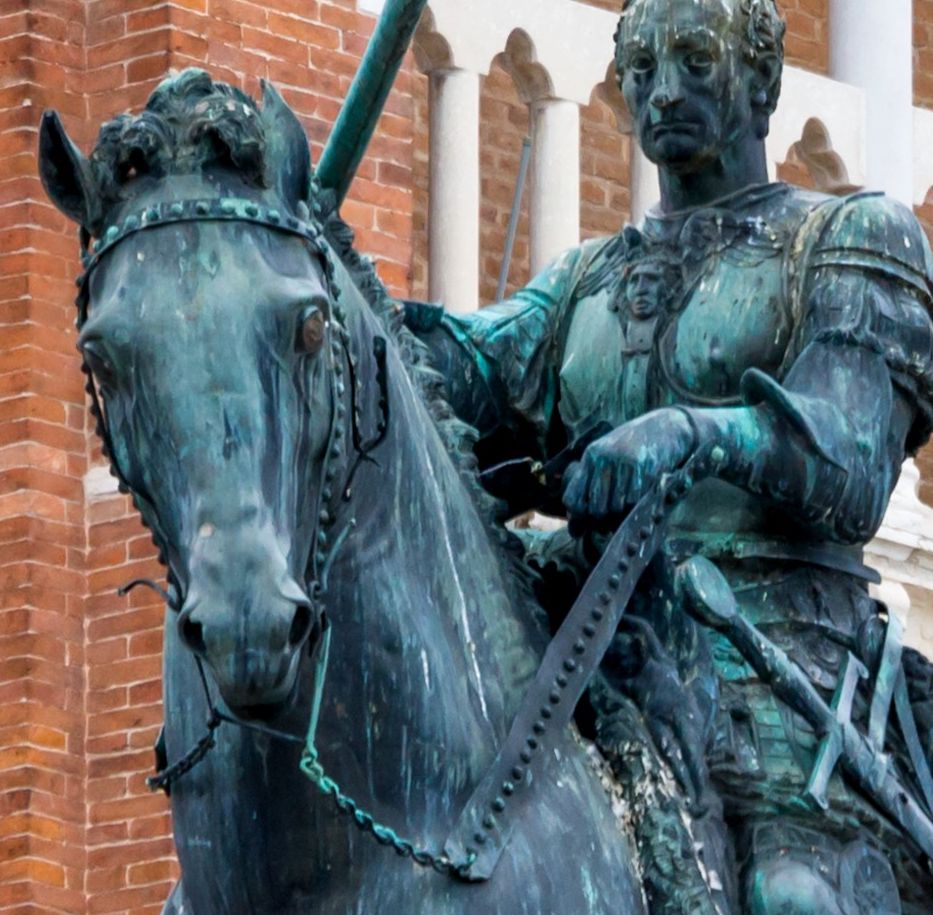
Lifted foreleg
The hoof meets a sphere below the shoulder. The curved support creates a point of contact between the raised foot and the plinth.
Carved stone base
The stone figures on the flank of the base are much lower than the bronze. They occupy a distinct field beneath the plinth that supports the horse.
Annotated photograph and detail crops. joergens.mi. Image source. CC BY-SA 3.0. Resized, annotated and cropped from the original photograph.
Casting and assembling a monument
The equestrian group was made by lost-wax casting. In that process, molten metal takes the place of wax inside a mould. A core can occupy the space within the wax form so that the bronze cools as a shell. Making a hollow bronze horse and rider at this size meant planning how to produce forms as different as the great curve of the horse’s flank and the relatively narrow sections of the legs. The 2024 conservation report identifies 36 bronze elements made in separate moulds. The account for the horse’s hindquarters gives a human-scale detail of that division. Someone had to convey even that single piece back for the next stage of work. [3] [12] [13]
Casting created the pieces. Bringing them into alignment created the sight of one animal carrying a man. On the horse, the eye follows rounded masses from head to hindquarters with little reason to stop at the workshop’s divisions. That continuous surface depended on fitting the pieces securely. The load of the rider has to pass through the assembled horse. The narrow limbs have to carry it down to the base. Beneath the bent foreleg, the sphere is one unusually legible meeting between the shape the sculptor wanted and the support available to him. Other critical connections sit out of sight, including the attachments in the hooves that anchor the horse to the stone structure. [1] [13] [14]
Donatello’s signature gives the ensemble one name. The foundry and installation records reveal the different kinds of expertise needed to make it. They include buying metal and paying for transport, casting sections to fit, and valuing the finished work before it was placed on the base. Later removals altered some of the anchoring hardware. That means a joint or fitting exposed by conservators can belong to the casting, the assembly or a later attempt to secure the bronze. Examining the way the horse was built also entails examining the ways it has been handled since. [3] [13] [14]
Other horses, other kinds of authority
Donatello could look to surviving ancient equestrian sculpture for what bronze could do at public scale. The best-known comparison is the second-century bronze of Marcus Aurelius, which stood at the Lateran in Rome in Donatello’s day. The ancient rider extends an open hand across the space in front of him. Gattamelata keeps his baton closer to the horse and over its neck, with a more compact outline. The Roman emperor’s projecting arm makes his authority visible from front and side. Gattamelata’s gesture depends more on the object gripped in his hand and on the deliberate set of his body. The original Marcus Aurelius is now in the Capitoline Museums, and the bronze in the outdoor Piazza del Campidoglio is a modern copy. [1] [15] [16]
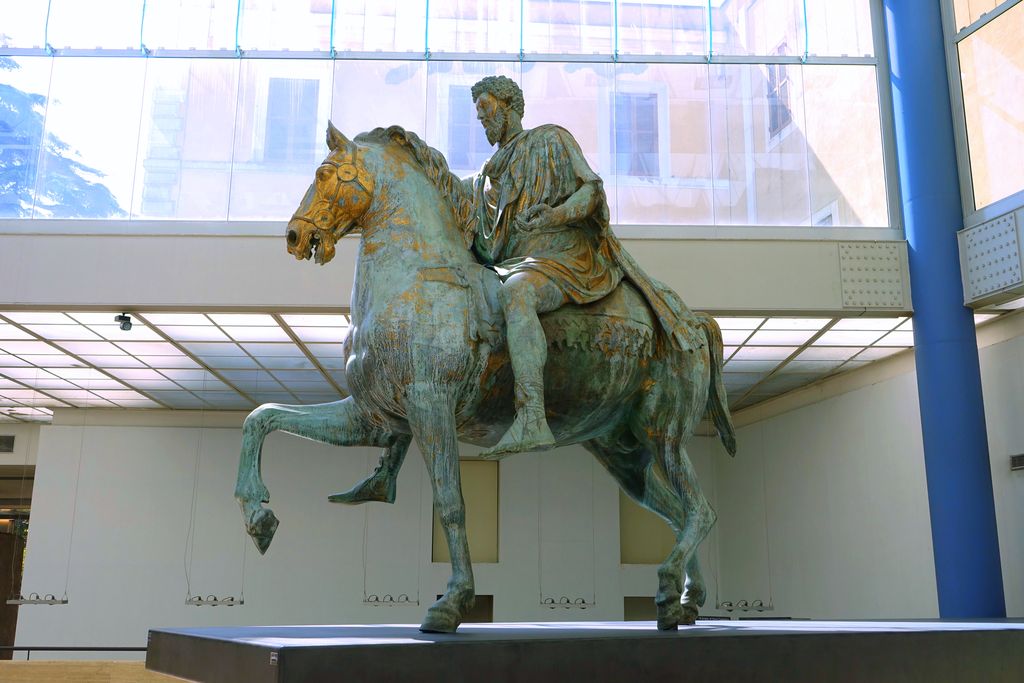
The Roman equestrian bronze of Marcus Aurelius in the Capitoline Museums. Daderot. Image source. CC0 / Public domain. Resized for the web.
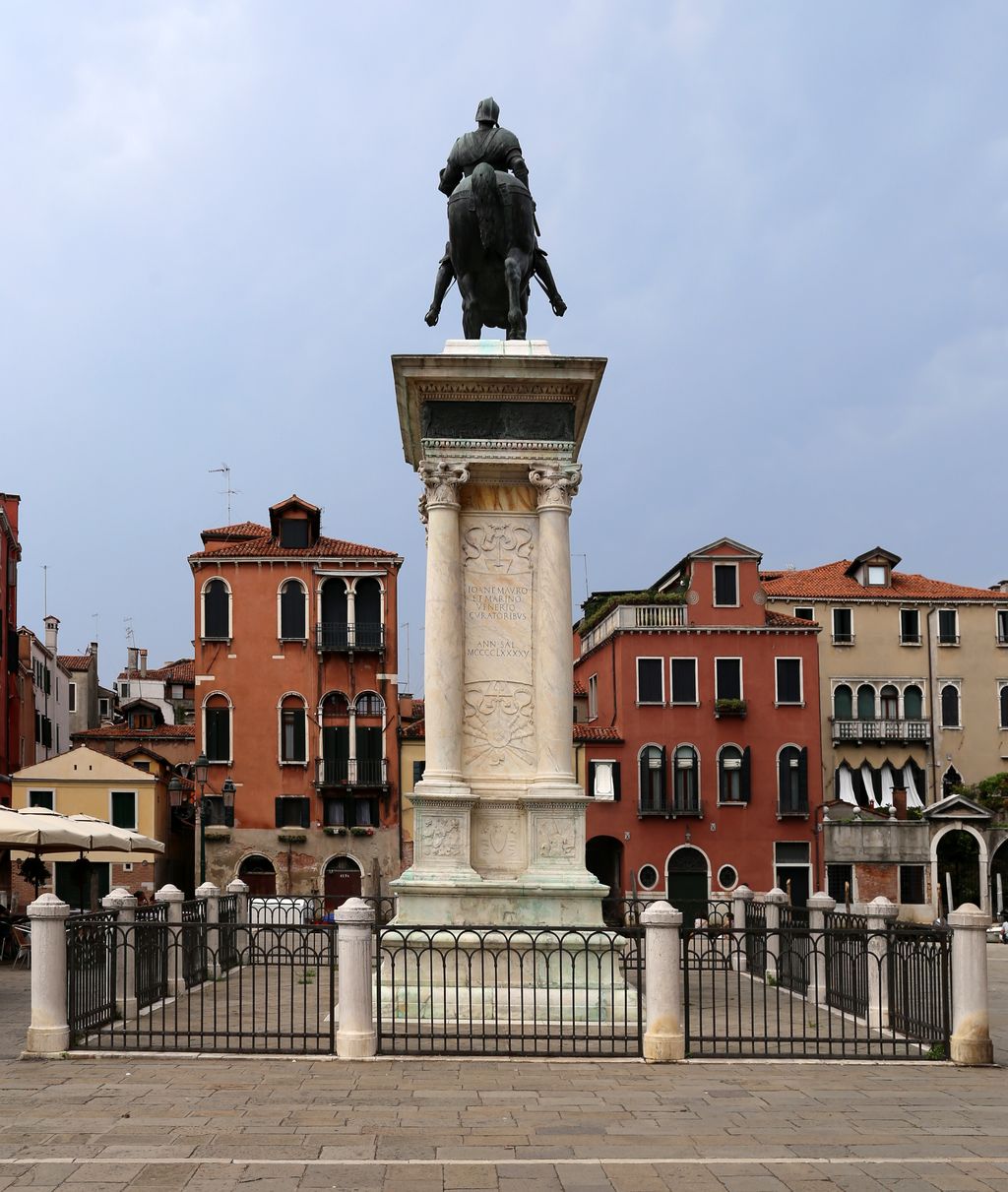
The later monument to Bartolomeo Colleoni in Venice. The horse’s raised hoof is free of the base. Sailko. Image source. CC BY 3.0. Resized for the web.
Mounted commanders were already a subject for Italian memorials. In 1436 Paolo Uccello painted Sir John Hawkwood, another hired captain, high on a wall in Florence Cathedral. His monument to Hawkwood presents the image of a mounted man over a tomb-like support. Uccello used one vanishing point for the sarcophagus and another for the horse and rider, giving a view from below of the base and a more level view of the mounted captain. A painted wall can give those angles to the viewer at once. In Padua a passer-by has to move to see the horse in profile and then see its chest from the front. Both works exploit elevation, one through a painter’s control of the image and the other through the way the figure, base and viewer occupy the square. [17]
Gattamelata himself had already made use of the mounted image. Schulz records that he gave a silver image of himself on horseback as a devotional offering at the Santissima Annunziata in Florence. In Padua the increase in scale, the cost of bronze and the height of the platform changed the terms of the image. An anonymous satire dated 1454 made ancient Rome reproach Venice for lavishing the honours of Roman heroes on a man whose famous campaign involved retreat. The satirist’s attack on Venice is evidence of how provocative the honour could look, even though the family bore its costs. [3] [4]
The phrase “earliest surviving” leaves room for monuments that have been lost. The bronze equestrian monument to Niccolò III d’Este in Ferrara was inaugurated in 1451, two years before the usual date for the installation at Padua, and destroyed in 1796. The Ferrara bronze was part of the same fifteenth-century recovery of the public equestrian image. Padua preserves the unusually instructive combination of the horse and rider, the base designed for them, accounts recording their production and a documented history of their fittings. [18]
The closest evidence of a later patron explicitly asking for something like the Gattamelata comes from Donatello’s own career. Alfonso of Aragon wanted a work akin to the Padua bronze, as Daniel Michael Zolli notes. In a letter of May 1452, the king pressed for Donatello to be paid what he was owed for the Gattamelata so he could leave for Naples. Scholars associate the great Carafa Horse Head with that separate, unfinished project. The Naples archaeological museum measures it at 1.75 metres and connects the projected royal monument with the triumphal entrance to Castel Nuovo. The Naples archaeological museum records the transfer of the head from Lorenzo de’ Medici to Diomede Carafa in 1471. It stood in the Carafa palace courtyard and was long taken for an antique. The resemblance to ancient bronze could be persuasive even without a rider. [4] [19]
The subsequent bronze of the Venetian commander Bartolomeo Colleoni offers a direct visual comparison. Andrea del Verrocchio modelled the group. After his death the bronze was cast by Alessandro Leopardi, whose own signature appears on a strap on the horse. In Venice the lifted foreleg reaches clear of the base. The rider projects forward, with his head turned, and the horse’s weight seems to shift much more forcefully from one stride to the next. The contrast is particularly clear in profile, where the open space beneath the lifted leg is part of the silhouette. Gattamelata’s sphere, upright seat and held-in gesture bind his action more tightly to the upright mass of the pedestal. [1] [20]
Watch the sculpture in context
See Donatello’s equestrian monument in its historic Padua setting.
TheHistoryOfArt.org. See Donatello’s equestrian monument in its historic Padua setting. Watch on YouTube.
War, weather and the return to ground level
In November 1917 the bronze was taken down and sent to Palazzo Venezia in Rome for protection. It was back on the forecourt in July 1919. In October 1940 it was removed again and stored at the Abbey of Carceri d’Este, where it remained until June 1945. The two journeys helped protect the object from wartime damage. They also meant undoing and reinstating the connection between horse and podium. The Istituto Centrale per il Restauro identifies parts of the altered anchoring system inside the hooves. Here the history of safeguarding the monument is physically present in the work the current conservators must understand. [2] [14]
Prolonged outdoor exposure has left other traces. Save Venice reports active chloride-related corrosion on parts of the bronze, often called bronze disease, in which damp conditions can renew the corrosive reaction. The conservators have to determine where the corrosion is active and how it relates to the metal beneath the surface. The base presents a separate set of problems. Its stone faces, joints and old repairs have experienced weather and deterioration while supporting the comparatively slender horse legs above. Reading the surface of the sculpture and judging its stability therefore call for different kinds of evidence. [1] [21]
By 26 July 2023 the regional heritage authority presented the first phase of the investigation at Palazzo Folco. Scaffolding had made close examination possible and also offered visitors at that stage an unusual view near the level of the rider. Nicola Salvioli’s team examined and photographed the bronze, inspected interior spaces with an endoscope and mapped findings on three-dimensional models. A three-dimensional record gives a team a shared location for a patch of corrosion, a join or a sampling point that could be hard for a second examiner to find from a written description alone. [1] [21] [22]
In the next phase, specialists assessed the stone, salts, deposits and previous fills, and used sonic tests and radar to study parts of the base that surface examination could not reach. Researchers also used gamma radiography on parts of the horse’s legs and modelled the monument’s structural response. A leg can retain a convincing contour in a profile photograph even where the condition of the metal wall inside is cause for concern. The tests helped the team judge both what it would take to move the bronze safely and what questions needed further study once it was down. The University of Padua worked with the regional heritage authority and the Istituto Centrale per il Restauro. Save Venice and Friends of Florence supported the conservation. [1] [13] [21] [23]
On 8 October 2025 the rider was lifted down. The horse followed on 9 October. They were moved to the entrance hall of the former Civic Museum, the Boito building in Piazzetta Kolbe, for examination in a sheltered space. On 13 November, specialists from the Istituto Centrale per il Restauro, the Opificio delle Pietre Dure and the regional Soprintendenza inspected the separated bronzes and the stone podium, which remained at the basilica. They could inspect the rider’s interior and the horse’s hooves on supports set up for the purpose. The documented move explains why historical views show a bronze in the square and photographs from the conservation campaign show two objects standing apart. [1] [2] [14] [23]
There are other ways to come close to the modelling. The Museo Omero in Ancona catalogues a life-size plaster cast of the commander’s head, about 36 centimetres high. The face alone brings the brow, mouth and planes of the cheeks within reach, while photographs from the piazza recover the distance Donatello placed between viewer and rider. A full-size plaster replica in Moscow has served a practical purpose of a different kind. In 2021, after the spurs were stolen from a bronze copy in Montevideo, Pushkin Museum specialists scanned the lower legs and spurs of their plaster and sent the data to the Uruguayan conservators making replacements. The cast could preserve information precise enough to help repair a bronze across the Atlantic. [24] [25]
The photographs from Padua’s conservation campaign return attention to the whole monument. With the rider on his own support, it takes an effort to imagine how far above ground those spurs once hung. A wide photograph of the old setting restores the distance, and a closer view of the horse restores the detail that distance costs. Put the two views alongside each other and the scale of Donatello’s decision becomes clear. From the forecourt, a sphere small enough to sit beneath a hoof could carry part of the illusion of a horse in motion. The metal and the stone had to do their work together. [1] [14]
Donatello sculpture directory
| Name | Date | Medium and record |
|---|---|---|
| Marble David | 1408–09, adapted 1416 | Carved Carrara marble Catalogue. |
| Saint John the Evangelist | c. 1409–15 | Carved marble Catalogue. |
| Saint Mark | 1411–13 | Carved Carrara marble Catalogue. |
| Saint George and its dragon relief | c. 1415–17 | Marble statue and marble relief Catalogue. |
| Marzocco | c. 1417–20 | Carved sandstone Catalogue. |
| Saint Louis of Toulouse, Florence | 1418–25 | Gilt bronze and mixed media Catalogue. |
| Pazzi Madonna | c. 1420s | Marble relief Catalogue. |
| Reliquary Bust of Saint Rossore | c. 1420s | Gilt bronze Catalogue. |
| The Prophet Jeremiah | 1420s–30s, disputed | Marble Catalogue. |
| Zuccone | c. 1420s–30s | Marble Catalogue. |
| Feast of Herod, Siena | 1420s | Gilded bronze relief Catalogue. |
| Ascension with Christ Giving the Keys to Saint Peter | c. 1428–30 | Marble relief Catalogue. |
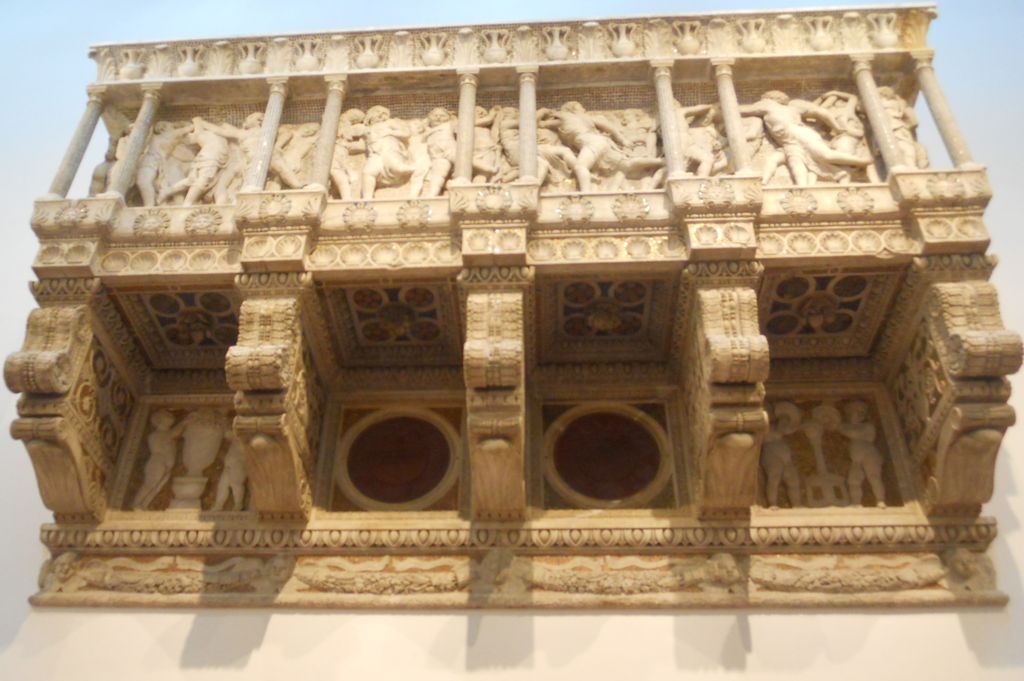
| Cantoria | 1433–39 | Marble and mosaic Catalogue. |
| Amor-Atys | c. 1435–40 | Partly gilded bronze Catalogue. |
| Bronze David | c. 1435–40, disputed | Partly gilded bronze Catalogue. |
| Gattamelata | Installation agreement, 1453 | Bronze and stone Catalogue. |
| Santo altar | Mid-fifteenth century | Bronze and limestone ensemble Catalogue. |
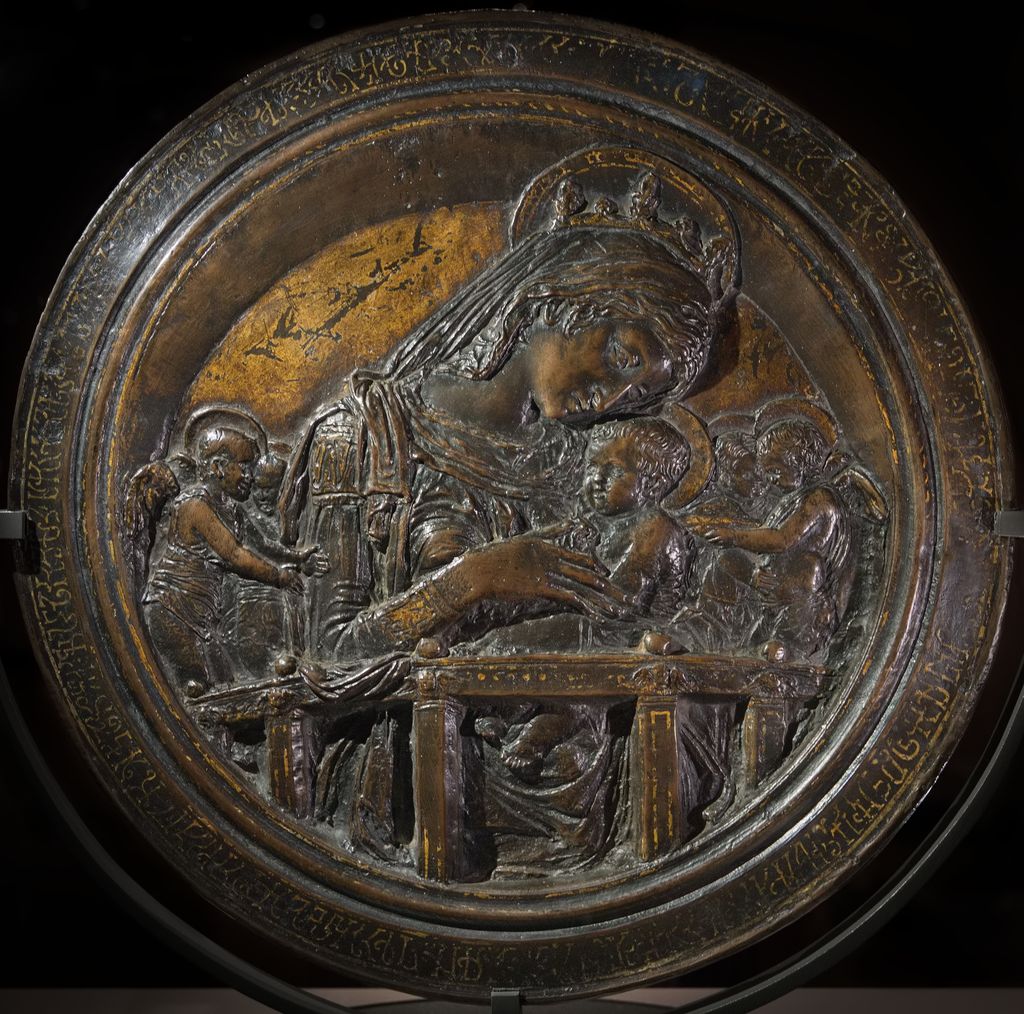
| Chellini Madonna | Given in 1456 | Partly gilded bronze tondo Catalogue. |
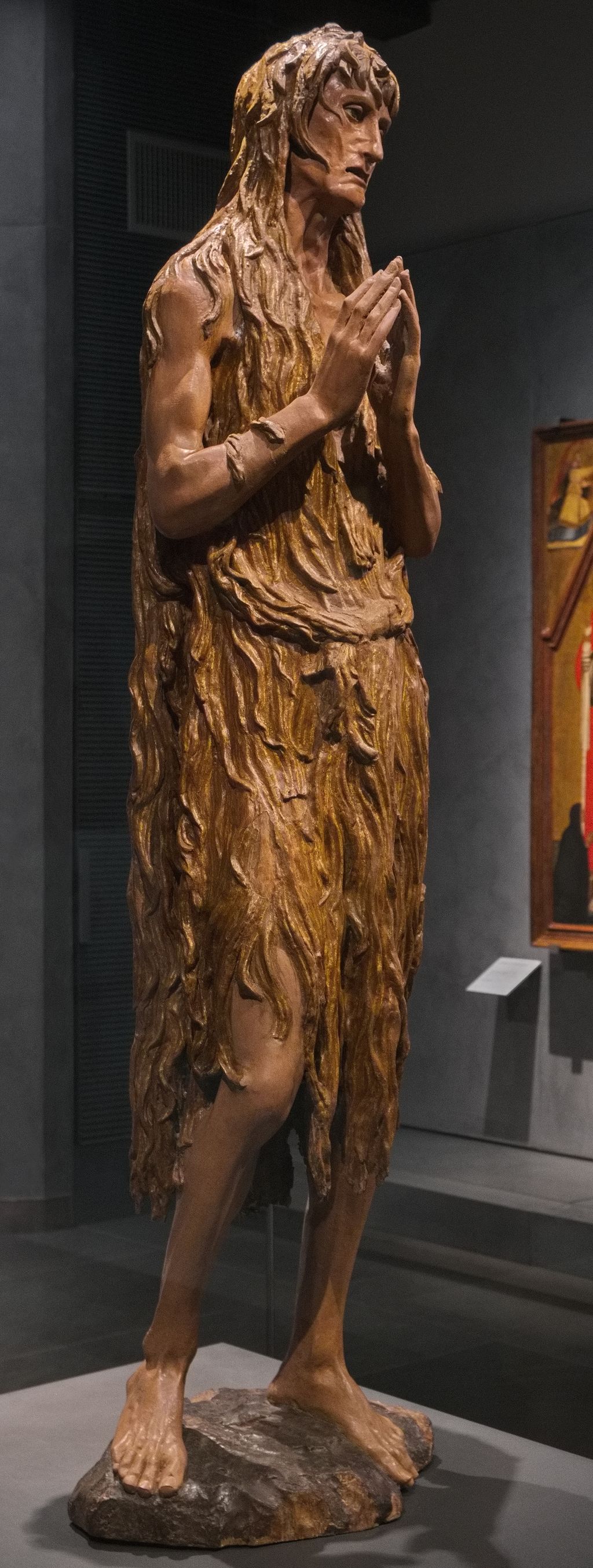
| Penitent Magdalene | c. 1453–55 (Opera) | Poplar, stucco, pigments and gold Catalogue. |
| Judith and Holofernes | Late 1450s–early 1460s | Bronze with surviving gilding Catalogue. |
| Pulpit of the Passion | Late work and later assembly | Bronze reliefs, Donatello and collaborators Catalogue. |
| Bust traditionally called Niccolò da Uzzano | Fifteenth century | Painted terracotta, attribution disputed Catalogue. |
| Prato Cathedral exterior pulpit | Commissioned 1428; carved 1430s | Marble reliefs, Donatello and Michelozzo Catalogue. |
| Cavalcanti Annunciation | c. 1433–35 | Gilded sandstone and terracotta Catalogue. |
| Crucifix at Santa Croce | Early fifteenth century | Painted wood Catalogue. |
| Madonna of the Clouds | c. 1425–35 | Marble relief Catalogue. |
| Old Sacristy Doors | Fifteenth century | Two paired bronze doors Catalogue. |
| Resurrection Pulpit | Late work and later assembly | Bronze reliefs, Donatello and collaborators Catalogue. |
| Brancaccio tomb | 1420s | Donatello, Michelozzo and assistants, mixed materials Catalogue. |
| Saint John the Baptist, Venice | 1438 | Polychromed and gilded wood Catalogue. |
| Sacrifice of Isaac | Early fifteenth century | Donatello and Nanni di Bartolo, marble Catalogue. |
| Madonna of Via Pietrapiana | Mid-fifteenth century | Terracotta Catalogue. |
| Miracle of the Mule | Mid-fifteenth century | Gilded bronze panel for the Santo altar Catalogue. |
| Padua Crucifix | Mid-fifteenth century | Cast bronze Catalogue. |
| Dancing Spiritello, Bargello | Fifteenth century | Bronze Catalogue. |
| Young Prophet from the Porta della Mandorla | c. 1404–09 | White marble, attributed to Donatello Catalogue. |
| Prophet or Apostle from the Duomo north tribune | Early fifteenth century | White marble, possibly Donatello Catalogue. |
| Beardless Prophet | 1415–18 | White marble Catalogue. |
| Sibyl and Prophet of the Porta della Mandorla | 1422 | Carved marble heads for the portal Catalogue. |
| Faith, Siena baptismal font | 1420s | Gilded bronze figure Catalogue. |
| Hope, Siena baptismal font | 1420s | Gilded bronze figure Catalogue. |
| Feast of Herod, Lille | c. 1430 | Carrara marble relief Catalogue. |
| Piot Madonna | c. 1440–60 | Polychrome terracotta with glass and wax inlays Catalogue. |
| Carafa Horse Head | c. 1456–58 | Cast bronze Catalogue. |
| Pazzi Madonna workshop version, Louvre | c. 1450 | Polychrome gesso, Donatello’s workshop Catalogue. |
| Pazzi Madonna tondo, Rijksmuseum | c. 1425–50 | Plaster and stucco, after Donatello Catalogue. |
| Sprite | c. 1430–40 | Bronze, sculptor or metalsmith close to Donatello Catalogue. |
Discussion
Look again at the images and ideas explored in Gattamelata. These editorial prompts invite your observations.
Reader Insights
Which part of the horse and rider remains clearest when you imagine looking up from the piazza?
How does the raised hoof change the impression of the horse when you compare it with the Colleoni monument?
Join the Conversation
Share a detail, comparison or question about Gattamelata below.
References
- Save Venice, Donatello’s Equestrian Monument to Gattamelata, Padua. View source.
- Basilica of Saint Anthony, report on the removal of horse and rider to the former Civic Museum, October 2025. View source.
- Anne Markham Schulz, review of Baldissin Molli, Erasmo da Narni, “Gattamelata” e Donatello, Il Santo 52, 2012, with the account evidence published by Edoardo Demo and the installation agreement. View source.
- Daniel Michael Zolli, Donatello’s Promiscuous Technique, Harvard University dissertation, 2017, chapter 3, figs. 3.11–3.12 and notes 54 and 65–70. View source.
- Francesco Caglioti, Donatello e Padova, Padova e il suo territorio, no. 202, 2019. View source.
- Antonio Menniti Ippolito, Erasmo da Narni, detto il Gattamelata, Dizionario Biografico degli Italiani, vol. 43, 1993. View source.
- Giovanna Baldissin Molli, Erasmo da Narni, “Gattamelata” e Donatello. Storia di una statua equestre, Padua, 2011, University of Padua research record and abstract. View source.
- Basilica of Saint Anthony, Presbiterio e altare maggiore. View source.
- Giulia Foladore, Il ricordo della vita e la memoria della morte nel corpus epigrafico della basilica di Sant’Antonio di Padova (secoli XIII–XV), University of Padua dissertation, 2009, vol. 1. View source.
- Metropolitan Museum of Art, Man and the Horse, section on equestrian portraits. View source.
- Mary Bergstein, Donatello’s “Gattamelata” and Its Humanist Audience, Renaissance Quarterly 55, no. 3, 2002, pp. 833–868. View source.
- Museum of Fine Arts, Budapest, Gattemelata, the bronze original and the museum’s commissioned plaster cast. View source.
- Soprintendenza Archeologia, Belle Arti e Paesaggio, Padova, Monumento equestre al Gattamelata, the 2024 diagnostic campaign. View source.
- Istituto Centrale per il Restauro, Sopralluogo congiunto al cantiere della Statua equestre del Gattamelata, 13 November 2025. View source.
- Capitoline Museums, Statua equestre di Marco Aurelio, catalogue and history of the monument. View source.
- Steven Zucker and Beth Harris, Donatello, Equestrian Monument of Gattamelata, Smarthistory. View source.
- Opera del Duomo, Florence, Paolo Uccello, Monumento a Giovanni Acuto, 1436. View source.
- H. W. Janson, Bardi, Donato, detto Donatello, Dizionario Biografico degli Italiani, vol. 6, 1964. View source.
- National Archaeological Museum, Naples, 2016 annual report, history of the Carafa Horse Head, pp. 38–39. View source.
- City of Venice, Corte del Cavallo, on the modelling and casting of the Colleoni monument. View source.
- Vincenzo Tinè, Un progetto diagnostico intensivo, introduction to the Soprintendenza’s 2024 diagnostic dossier. View source.
- Soprintendenza Archeologia, Belle Arti e Paesaggio, presentation on the first diagnostic phase at Palazzo Folco, 26 July 2023. View source.
- Soprintendenza Archeologia, Belle Arti e Paesaggio, notice of the transfer from Piazza del Santo for diagnostic and conservation work, 8 October 2025. View source.
- Museo Tattile Statale Omero, Testa del Gattamelata, plaster cast. View source.
- Pushkin State Museum of Fine Arts, conservation collaboration on the Montevideo copy of the Gattamelata, 2022. View source.
- Victoria and Albert Museum, Donatello’s David. View source
- Opera del Duomo, Donatello and the Opera del Duomo. View source
- Ministero della Cultura, David with the Head of Goliath, Bargello bronze. View source
- Opificio delle Pietre Dure, L’ultimo Donatello. View source
More DONATELLO Sculptures
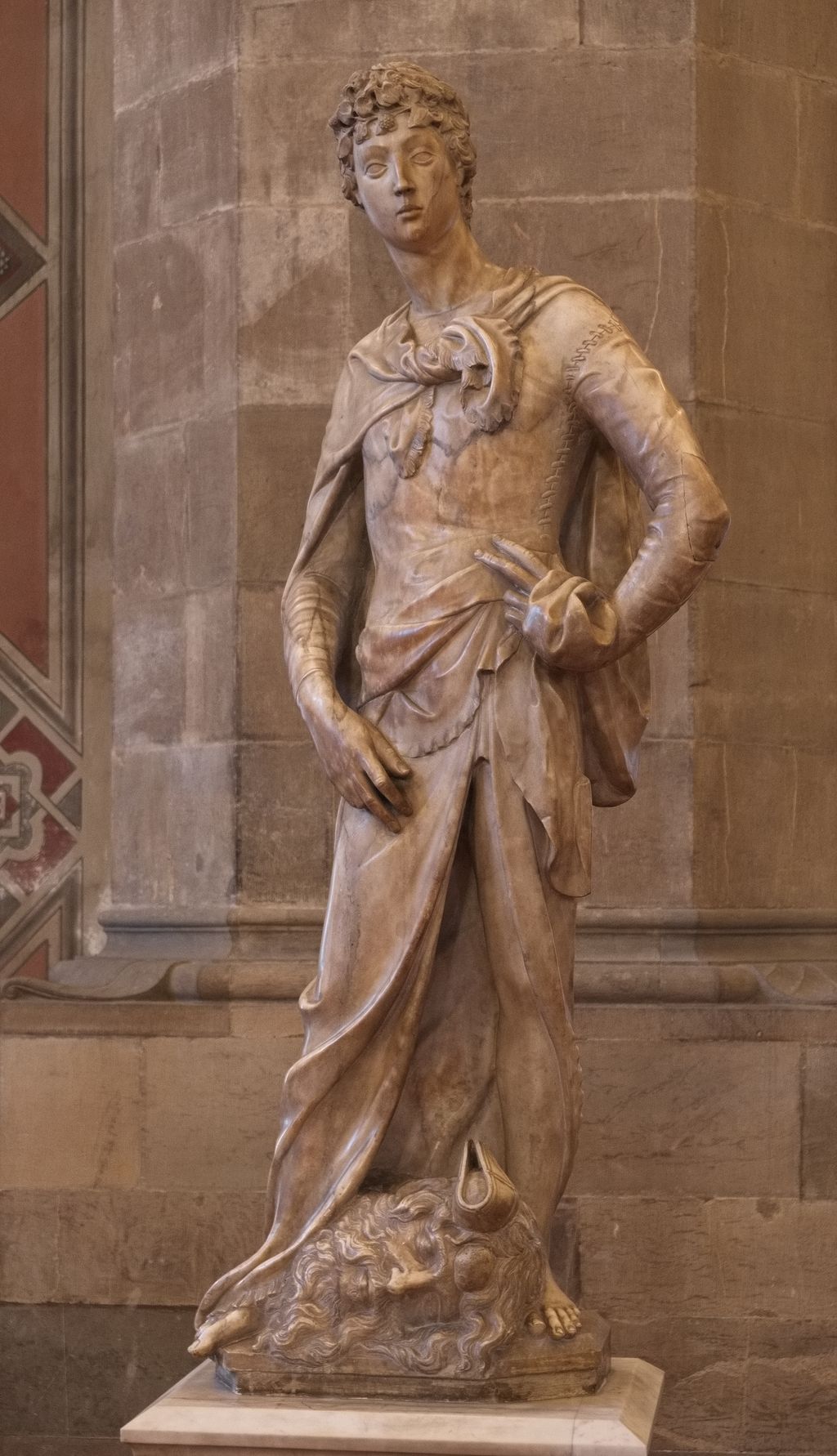
Marble David
Armin Kleiner. Image source. CC BY-SA 4.0. Resized for the web.
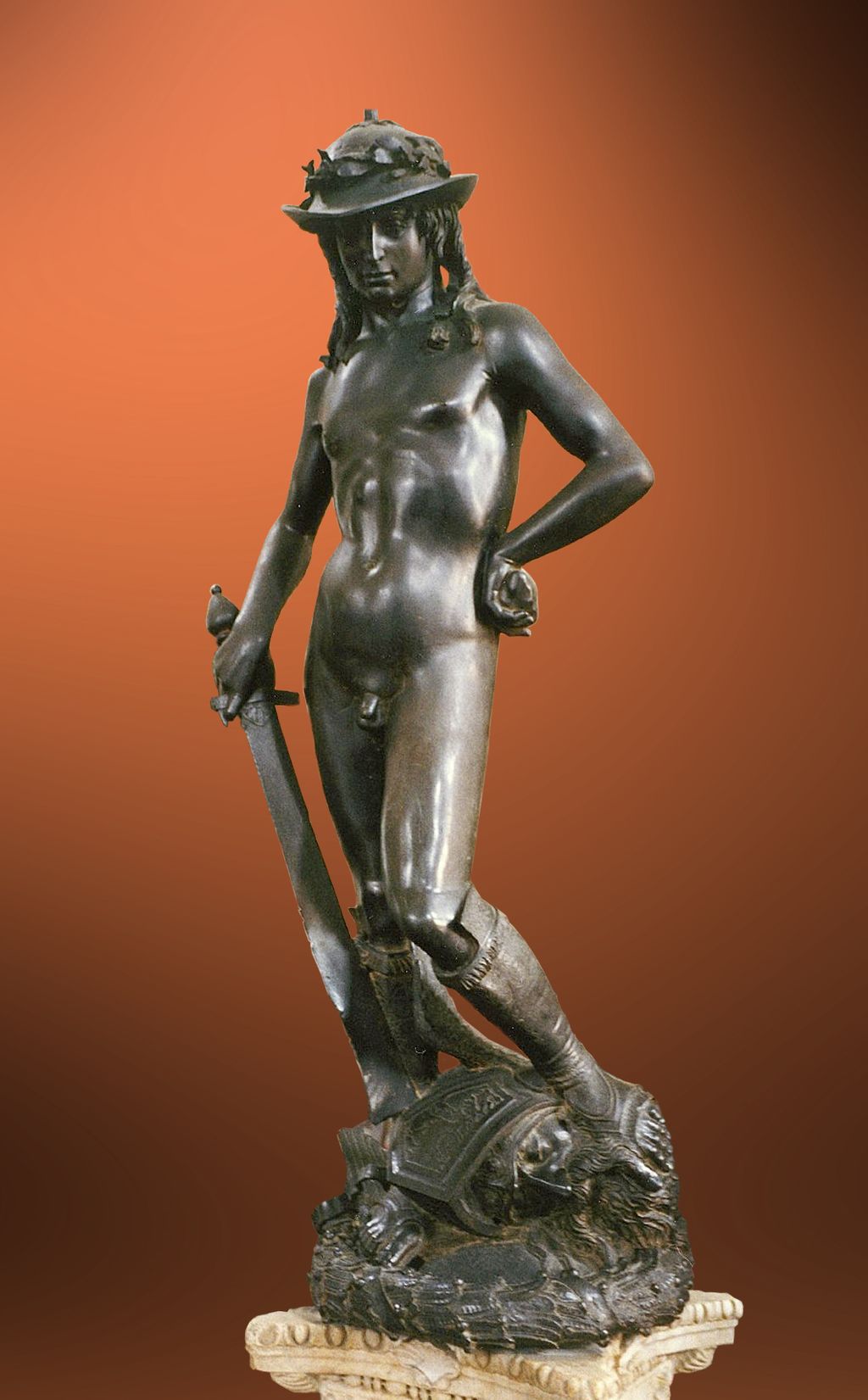
Bronze David
Patrick A. Rodgers. Image source. CC BY-SA 2.0. Resized for the web.
Cantoria
Erik Drost. Image source. CC BY 2.0. Resized for the web.
Gattamelata
Chris Light. Image source. CC BY-SA 4.0. Resized for the web.
Penitent Magdalene
Armin Kleiner. Image source. CC BY-SA 4.0. Resized for the web.
Chellini Madonna
Armin Kleiner. Image source. CC BY-SA 4.0. Resized for the web.
