


 by Tom Gurney
Tom Gurney BSc (Hons) is an art history expert with over 20 years experience
Published on June 19, 2020 / Updated on November 29, 2026
Email: tomgurney1@gmail.com / Phone: +44 7429 011000
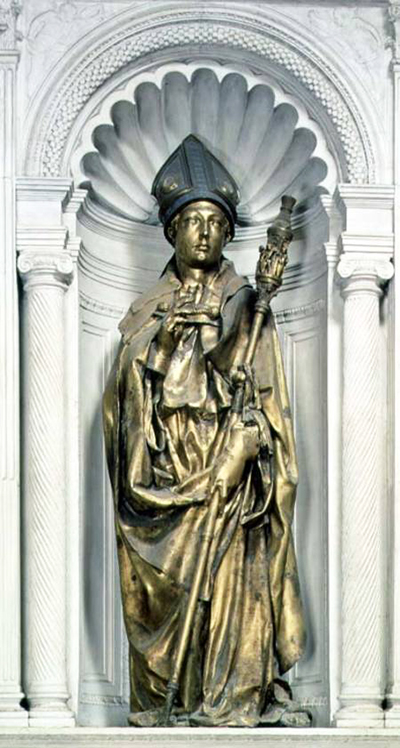
A gloved hand rises in blessing from the folds of an enormous gold cope. Above it, a young bishop looks out from under a mitre set with blue enamel and rock crystal. Donatello made this nearly three-metre figure for a niche on the outside of Orsanmichele in Florence, where its gilding caught the light on a busy street. The original survives in the refectory of the Museo dell’Opera di Santa Croce. The museum dates it to 1418–1425 and gives its height, including the mitre, as 285 centimetres. [1] [2]
A patron saint for the Parte Guelfa
Orsanmichele began as a grain market. By Donatello’s time, the building housed an oratory on the ground floor and grain stores above. The tabernacles on its outer walls gave Florence’s guilds and other patrons a public place to honour their saints. Donatello already knew what it meant to set a figure into this façade. His marble Saint Mark stood for the linen-drapers and dealers in second-hand goods, and his marble Saint George for the armourers and swordmakers. For Louis he worked on a larger scale, in metal, and for a different sort of patron. [1] [3]
The Parte Guelfa was a Florentine political body with a long tradition of allegiance to the papacy. Its central niche on the east façade overlooked what is now Via dei Calzaiuoli, the street between the cathedral and the seat of city government. By placing its protector there, the Parte asserted a presence among the city’s trades in a particularly conspicuous spot. Alison Wright reads the costly gold surface as part of that assertion. Ghiberti’s bronze Saint Matthew for the bankers’ guild had already shown what a large metal figure could do on the same building. Louis was the only statue gilded over its entire figure. Wright points out that the east-facing niche caught the morning light. On a walk past the church, the gold could draw attention to the saint and his patrons before any of the smaller details came into view. [4] [5]
The saint gave the Parte a connection to the royal house of Anjou. Louis was a son of Charles II of Naples. He gave up his claim to the throne, which passed to his younger brother Robert, and entered the Franciscan order. He became bishop of Toulouse, died in 1297 and was canonised in 1317. An earlier work makes the dynastic side of his story explicit. In Simone Martini’s altarpiece at Capodimonte, Louis places a crown on Robert’s head. Donatello’s standing figure addresses an audience in the street below. The raised fingers perform a bishop’s blessing, while the lilies on the mitre carry the family connection into a detail of his dress. [1] [6]
The young bishop inside the robes
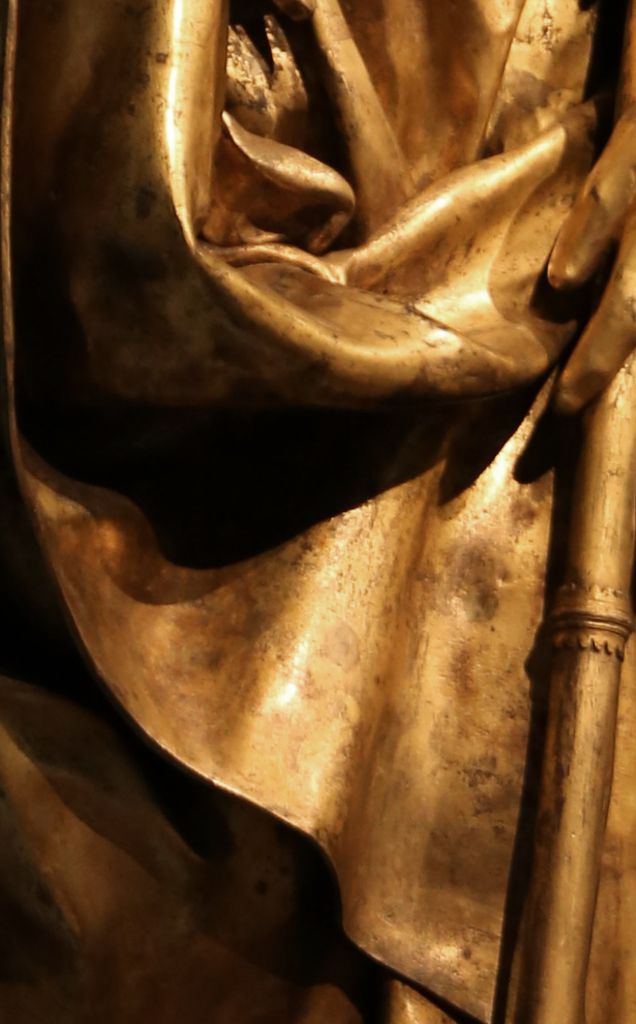
From the front, the cope describes an arc from one shoulder down around the front of the body and back up towards the staff. The layers turn sharply towards the light, then disappear into pockets of shadow. At pavement distance, the sweep of the outer garment and the upright crosier would have made the figure easy to pick out. Closer in, the edges take on the character of cloth. Fringe catches the light at the shoulder, and the long hem bunches over the sandalled feet. Beneath the cope, the friar’s habit retains a place in the image of the bishop. His Franciscan vocation and his episcopal rank are both legible in what he wears. [1] [2]
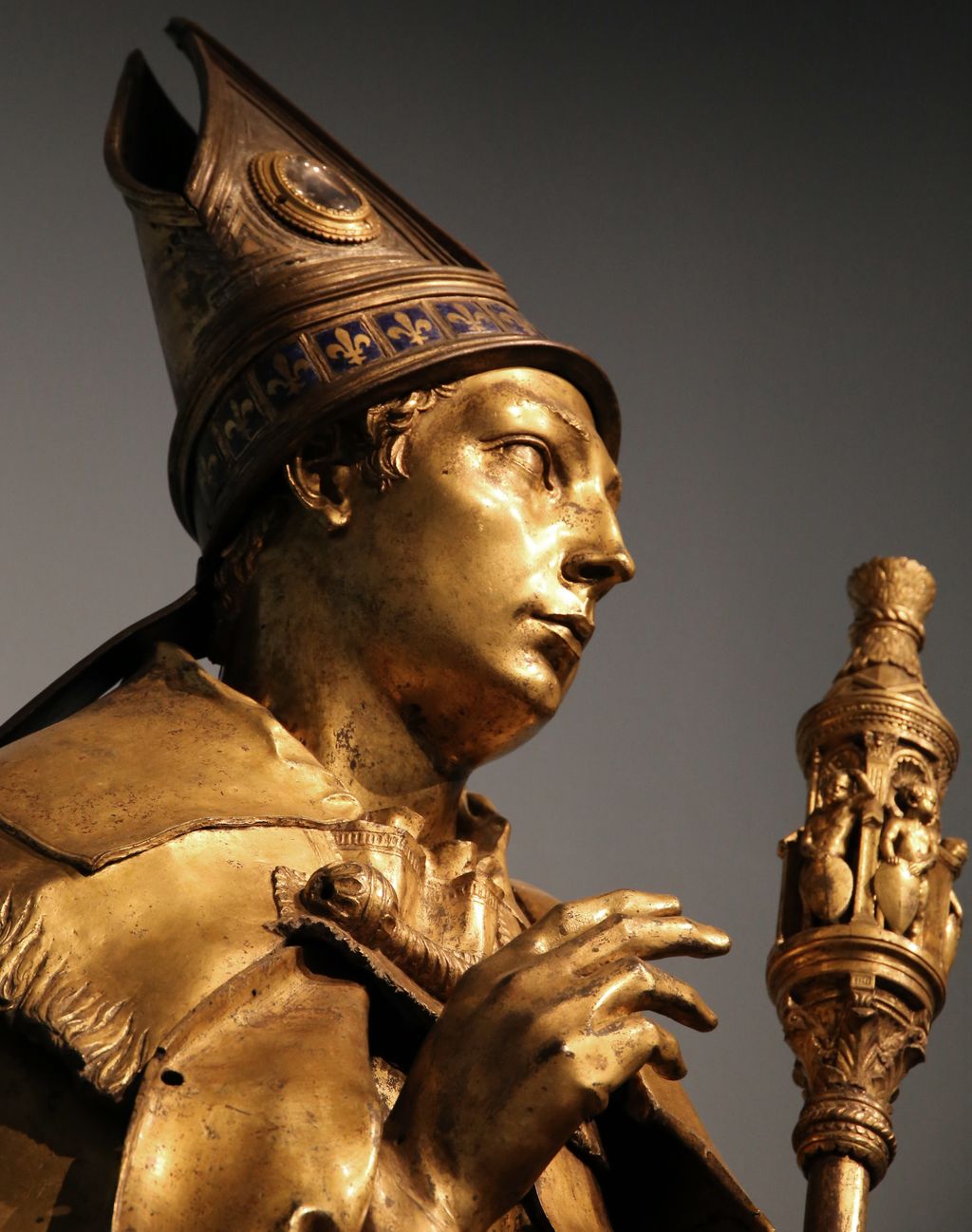
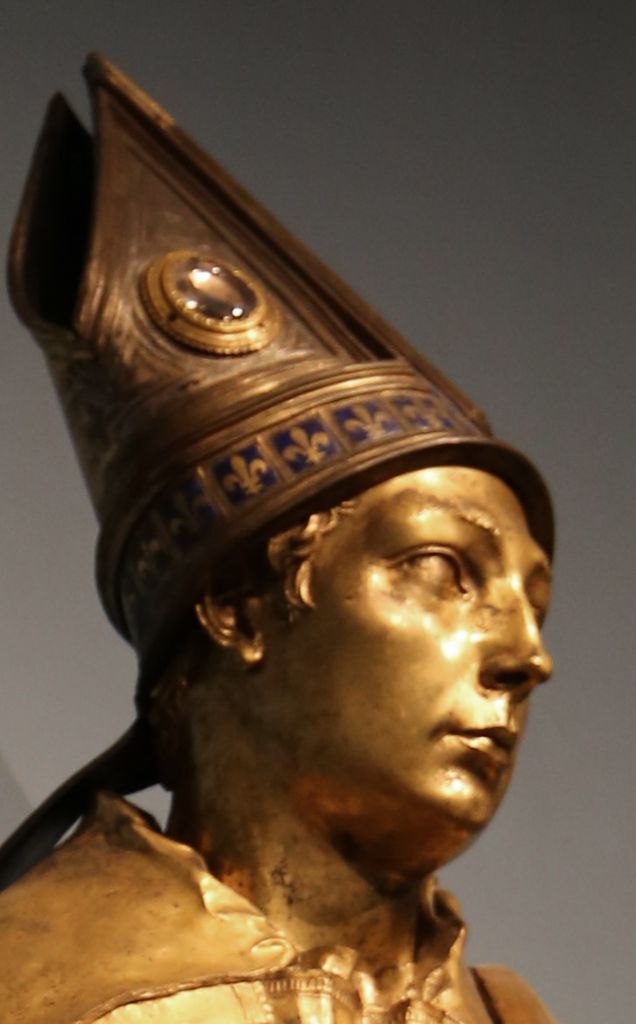
The young bishop’s face and mitre above the gloved hand. Francesco Bini. Image source. CC BY-SA 4.0. Resized for the web.
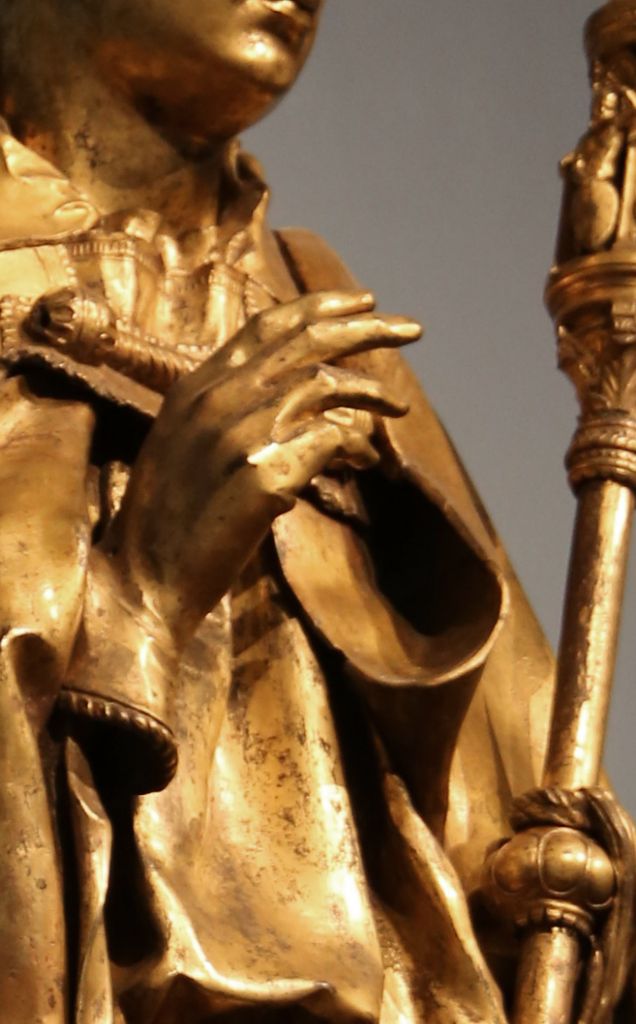
The right hand is raised close to the body. Two fingers extend, the others rest in a curve, and small folds mark the glove. The left hand closes around the staff below a heavy roll of fabric. The face above is quiet and conspicuously young. Its smooth cheeks and slightly parted lips draw attention after the eye has followed the broad shoulders and billowing folds. Vasari, writing long afterwards, told a story in which Donatello made Louis awkward on purpose and defended himself with a joke about a prince who surrendered a kingdom to become a friar. The story preserves a response to the disproportion between the slight face and the ample clothing. In the work itself, that disproportion allows the costume to announce the bishop’s office at a distance while the face and hand soften the encounter. [1] [2]
The mitre rewards a much closer view. The restorer Ludovica Nicolai describes shaped metal sheets joined at the sides, small blue enamel plaques with gilded fleurs-de-lis, silver inlay and two ovals of rock crystal in worked settings. Rivets and screws secure elements that appear as a continuous design from the front. The crosier’s surviving upper section resembles a tiny building, with winged children grouped around it. Its curved tip is lost, so the miniature figures now sit just below the end of the staff. These fittings bring the scale of a goldsmith’s work into a statue intended to be seen from the street. Wright compares the shining face and ornament with precious-metal reliquaries of saints. Donatello’s reliquary bust of Saint Rossore, made in the same decade to house sacred remains, gives a sense of the kinds of devotional objects familiar to viewers who looked up at Louis. [1] [2] [4]
How the metal became cloth
The sculpture’s construction took advantage of the way one garment covers another. Donatello cast ten main parts separately, gilded them with a mercury amalgam and assembled them. Large rivets fasten much of the structure. Where a layer of drapery seems to turn over another, its edge can also cover a join. The blessing glove is a separate fitting inserted among the folds. Nicolai identified assembly marks near the forearm that suggest an additional feature may once have helped conceal the fitting. Its precise shape remains uncertain. [2] [7]
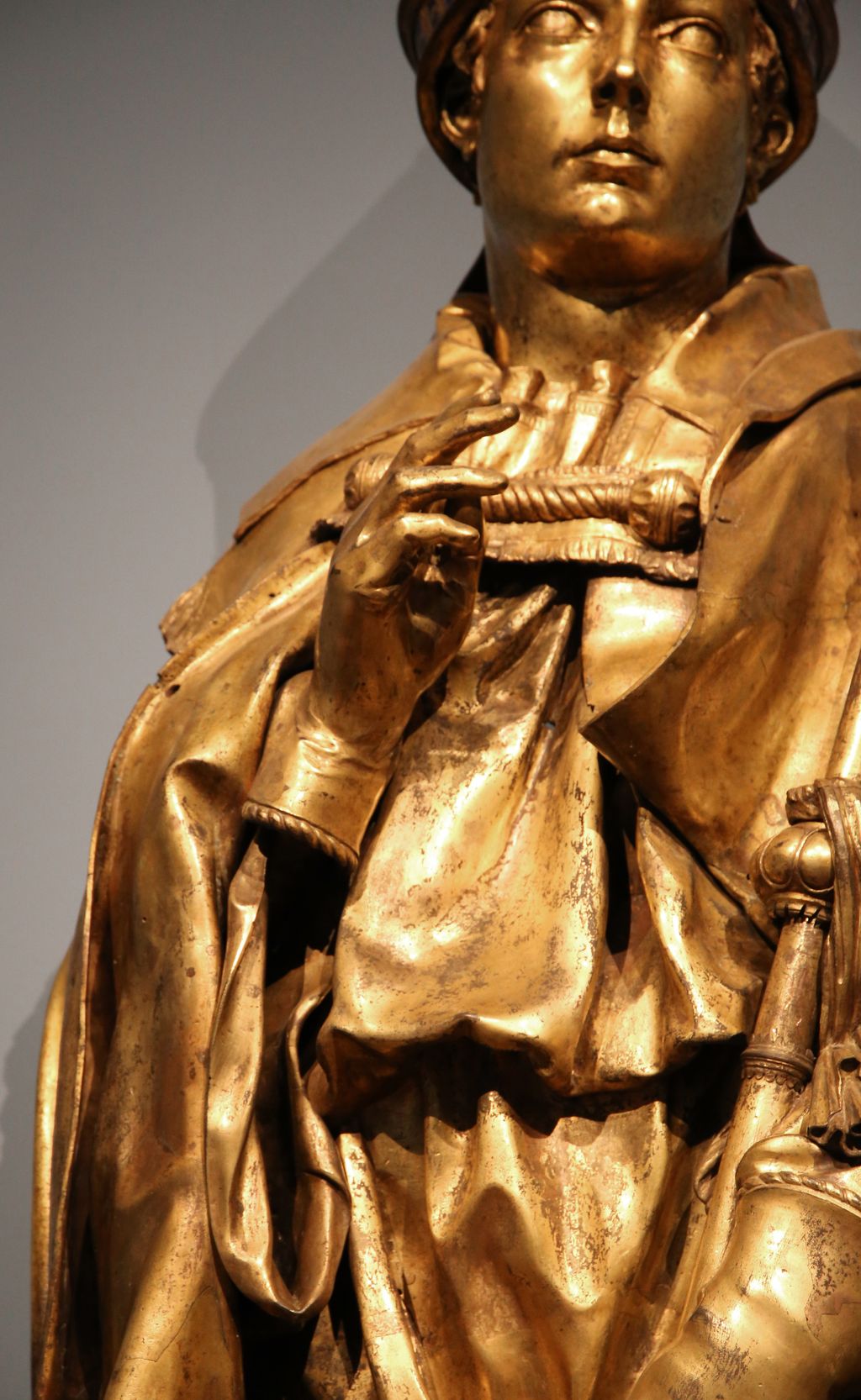
The raised gloved hand and the gilded folds at the chest in the Florence figure. Francesco Bini. Image source. CC BY-SA 4.0. Resized for the web.
The surviving gold preserves the sequence of the work. The cast pieces received their gold surface before they were put together, a procedure that made gilding a figure on this scale more manageable. At the back, the metal is rougher and an opening gives access to the interior. The niche would have screened these areas from the street. That opening now gives researchers a view of fastenings and casting repairs which would be hard to recognise from the front. Siano and Agresti found metal plugs and patches used to fill casting flaws. They also distinguished those repairs and fills from the mechanical fastenings that hold the major sections together. [2] [7]
The same team used portable laser spectroscopy to investigate the metal at points on the exterior and inside the shell. The compositions varied between parts. The principal alloys fell into two broadly similar groups, with zinc contributing enough for the authors to describe the overall material as a low-zinc brass. The customary museum term gilded bronze identifies the work in the gallery, while the analysis supplies a more precise account of the copper alloy under the gold. It also shows what an object built up in sections can reveal. One reading on a convenient surface might describe that particular section, but the figure as a whole preserves evidence from several pours and different kinds of repair. [1] [7]
Annotated Details from Saint Louis of Toulouse
Select a number to jump to a detail of the sculpture.
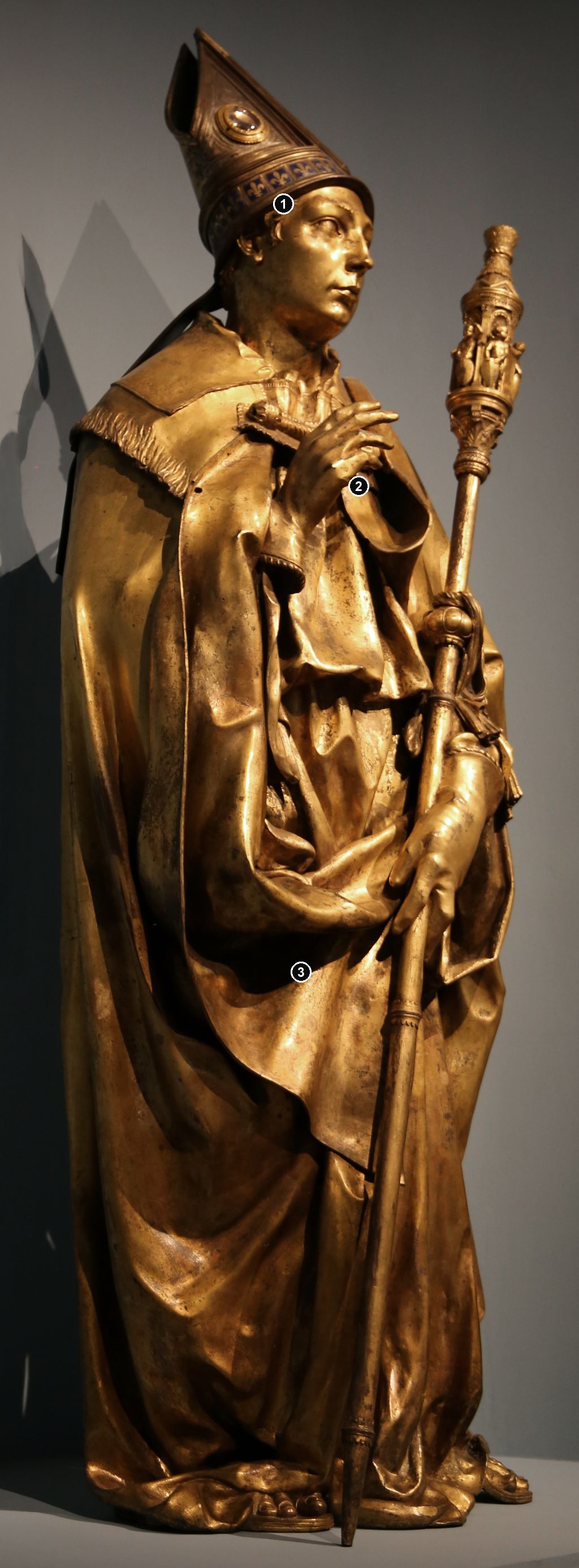
Details from SAINT LOUIS OF TOULOUSE
Open a detail image to examine the surface more closely.
Mitre and face
The decorated mitre rises above the plain outline of the young face. The two surfaces reflect the light differently.
Raised gloved hand
The hand emerges from the folds of the sleeve. The projecting fingers and rich glove separate the gesture from the expanse of the cloak.
The deep folds of the cloak
Loops and ridges alternate with deeply shadowed openings. Their depth gives substance to the front of the gilded bronze.
Annotated photograph and detail crops. Francesco Bini. Image source. CC BY-SA 4.0. Resized, annotated and cropped from the original photograph.
The niche and its second commission
The original stone tabernacle remains at Orsanmichele. Its columns and rounded arch frame a recess proportioned for a single standing figure. With Louis in place, the ribs of the carved shell above him could suggest a halo, as Wright observes. Her account also notes the gilding on parts of the marble frame. The gold on the figure would once have had an echo in the architecture around it. Santa Croce credits the tabernacle to Donatello. Scholarship on the architecture has also considered the roles of Michelozzo and Brunelleschi, and a separate conservation study examined changes to its fabric across the two commissions. When the statue moved, the bronze and its architectural setting began separate histories. What frames the figure in the Santa Croce refectory is a plaster cast of the Orsanmichele tabernacle. [1] [4] [5] [8] [9]
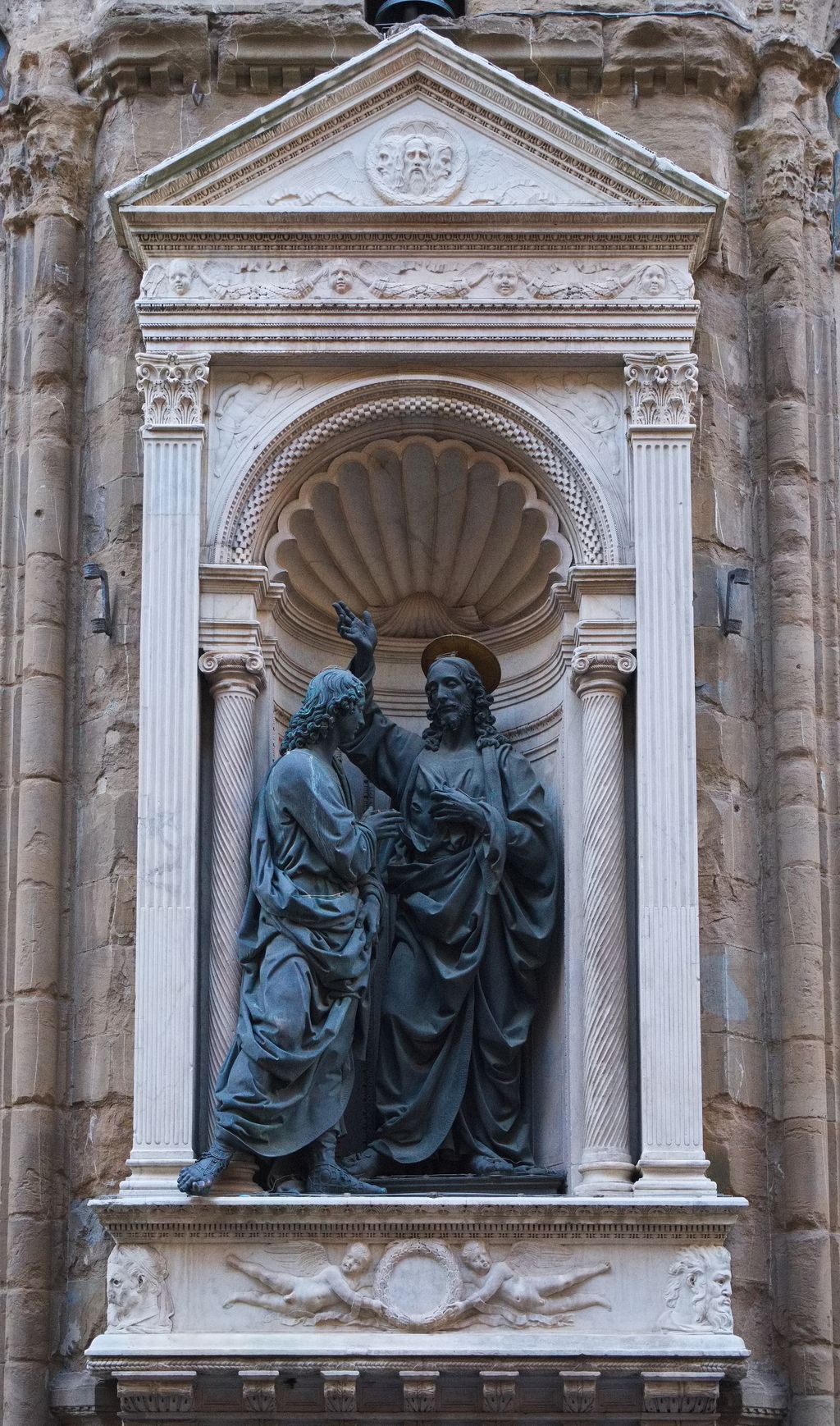
The Orsanmichele niche once occupied by Saint Louis now contains a copy of Verrocchio’s Christ and Saint Thomas. Armin Kleiner. Image source. CC BY-SA 4.0. Resized for the web.
Santa Croce places the removal of Saint Louis before 1460. The merchants’ tribunal, which adjudicated commercial disputes, acquired the niche in 1463 and commissioned Andrea del Verrocchio in 1467 to make Christ and Saint Thomas, in which the risen Christ shows his wound to the doubting apostle. The bronze group went into the niche in June 1483. Christ stands inside the recess, while Thomas approaches from the side and brings a foot forward of the frame. Where Donatello had fitted one gold figure into the opening, Verrocchio used the threshold to accommodate a meeting between two figures. The group seen outdoors today is a copy. Verrocchio’s original is housed in the Museo di Orsanmichele. [1] [3] [5]
The fit of Donatello’s bronze also supplied evidence about its history. Once it had spent centuries at Santa Croce, recollection of its first home became uncertain. Hans Semper proposed the link with the Parte Guelfa’s commission in 1875. When the statue was temporarily returned to the niche in the 1940s, the conservator Bruno Bearzi identified a small recess in the floor of the tabernacle that matched the base of the crosier. The relationship could be tested in stone and metal as well as traced in written records. [8] [9]
How Santa Croce recovered the gold
By 1510, the figure stood above the central entrance to the Franciscan church of Santa Croce. It remained there for centuries, then moved to the inner face of the entrance wall in 1859 during work on the new façade. In 1908 it entered the museum. A photograph of the older façade reproduced by Santa Croce shows Louis high over the doors, where his outline and gesture mattered at least as much as the minute details. [1]
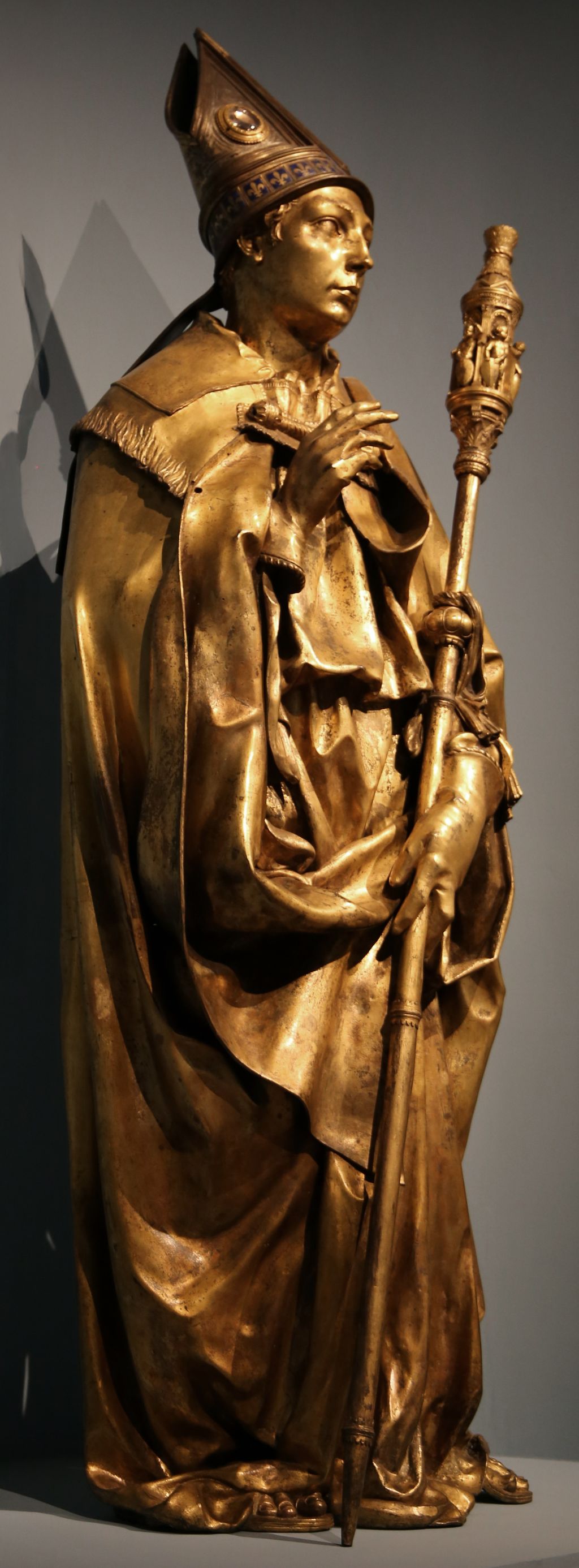
The Florence Saint Louis with its gilded surfaces, photographed at the 2022 exhibition. Francesco Bini. Image source. CC BY-SA 4.0. Resized for the web.
Years in the open air left the surface green and encrusted. Bearzi’s treatment in 1946–1948 exposed much of the gold that observers had assumed was lost and documented how the separately gilded pieces were fastened. The newly visible finish attracted enough interest for the statue to travel to museums in the United States between 1948 and 1950. When the November 1966 flood reached the refectory, deposits again had to be removed with care for the surviving gold. Bearzi worked on the statue again in 1967. The recovery of its original finish and the treatment after the disaster are two episodes in the work’s conservation history. [2] [10]
During the 2011–2012 campaign, Nicolai worked where visitors to the museum could see the treatment. Analyses helped the team distinguish old protective coatings, accumulated deposits and products of corrosion on the gilding. In the deepest folds and around the feet, where stubborn material survived earlier treatment, the conservator used fine tools for local cleaning. Laser cleaning was used selectively to deal with reddish surface deposits from an earlier treatment. Some dark areas mark losses in the gold, while others are associated with alteration of the underlying metal. The resulting surface still records centuries of exposure. The uneven gold remains visible even where the blue of the enamel and the shine of the rock crystal come through clearly. [2] [7]
Donatello represented Louis of Toulouse again in the 1440s for the high altar of the Basilica of Saint Anthony in Padua, where the bishop belongs to a group of saints around the Madonna and Child. The Florentine commission was made to stand alone above street level. At Santa Croce, the line of the mitre, the young face and the blessing hand can be seen together at close range, while the cast niche gives a sense of how the bishop once occupied his place on the wall of Orsanmichele. [1] [5] [11]
Donatello sculpture directory
| Name | Date | Medium and record |
|---|---|---|
| Marble David | 1408–09, adapted 1416 | Carved Carrara marble Catalogue. |
| Saint John the Evangelist | c. 1409–15 | Carved marble Catalogue. |
| Saint Mark | 1411–13 | Carved Carrara marble Catalogue. |
| Saint George and its dragon relief | c. 1415–17 | Marble statue and marble relief Catalogue. |
| Marzocco | c. 1417–20 | Carved sandstone Catalogue. |
| Saint Louis of Toulouse, Florence | 1418–25 | Gilt bronze and mixed media Catalogue. |
| Pazzi Madonna | c. 1420s | Marble relief Catalogue. |
| Reliquary Bust of Saint Rossore | c. 1420s | Gilt bronze Catalogue. |
| The Prophet Jeremiah | 1420s–30s, disputed | Marble Catalogue. |
| Zuccone | c. 1420s–30s | Marble Catalogue. |
| Feast of Herod, Siena | 1420s | Gilded bronze relief Catalogue. |
| Ascension with Christ Giving the Keys to Saint Peter | c. 1428–30 | Marble relief Catalogue. |
| Cantoria | 1433–39 | Marble and mosaic Catalogue. |
| Amor-Atys | c. 1435–40 | Partly gilded bronze Catalogue. |
| Bronze David | c. 1435–40, disputed | Partly gilded bronze Catalogue. |
| Gattamelata | Installation agreement, 1453 | Bronze and stone Catalogue. |
| Santo altar | Mid-fifteenth century | Bronze and limestone ensemble Catalogue. |
| Chellini Madonna | Given in 1456 | Partly gilded bronze tondo Catalogue. |
| Penitent Magdalene | c. 1453–55 (Opera) | Poplar, stucco, pigments and gold Catalogue. |
| Judith and Holofernes | Late 1450s–early 1460s | Bronze with surviving gilding Catalogue. |
| Pulpit of the Passion | Late work and later assembly | Bronze reliefs, Donatello and collaborators Catalogue. |
| Bust traditionally called Niccolò da Uzzano | Fifteenth century | Painted terracotta, attribution disputed Catalogue. |
| Prato Cathedral exterior pulpit | Commissioned 1428; carved 1430s | Marble reliefs, Donatello and Michelozzo Catalogue. |
| Cavalcanti Annunciation | c. 1433–35 | Gilded sandstone and terracotta Catalogue. |
| Crucifix at Santa Croce | Early fifteenth century | Painted wood Catalogue. |
| Madonna of the Clouds | c. 1425–35 | Marble relief Catalogue. |
| Old Sacristy Doors | Fifteenth century | Two paired bronze doors Catalogue. |
| Resurrection Pulpit | Late work and later assembly | Bronze reliefs, Donatello and collaborators Catalogue. |
| Brancaccio tomb | 1420s | Donatello, Michelozzo and assistants, mixed materials Catalogue. |
| Saint John the Baptist, Venice | 1438 | Polychromed and gilded wood Catalogue. |
| Sacrifice of Isaac | Early fifteenth century | Donatello and Nanni di Bartolo, marble Catalogue. |
| Madonna of Via Pietrapiana | Mid-fifteenth century | Terracotta Catalogue. |
| Miracle of the Mule | Mid-fifteenth century | Gilded bronze panel for the Santo altar Catalogue. |
| Padua Crucifix | Mid-fifteenth century | Cast bronze Catalogue. |
| Dancing Spiritello, Bargello | Fifteenth century | Bronze Catalogue. |
| Young Prophet from the Porta della Mandorla | c. 1404–09 | White marble, attributed to Donatello Catalogue. |
| Prophet or Apostle from the Duomo north tribune | Early fifteenth century | White marble, possibly Donatello Catalogue. |
| Beardless Prophet | 1415–18 | White marble Catalogue. |
| Sibyl and Prophet of the Porta della Mandorla | 1422 | Carved marble heads for the portal Catalogue. |
| Faith, Siena baptismal font | 1420s | Gilded bronze figure Catalogue. |
| Hope, Siena baptismal font | 1420s | Gilded bronze figure Catalogue. |
| Feast of Herod, Lille | c. 1430 | Carrara marble relief Catalogue. |
| Piot Madonna | c. 1440–60 | Polychrome terracotta with glass and wax inlays Catalogue. |
| Carafa Horse Head | c. 1456–58 | Cast bronze Catalogue. |
| Pazzi Madonna workshop version, Louvre | c. 1450 | Polychrome gesso, Donatello’s workshop Catalogue. |
| Pazzi Madonna tondo, Rijksmuseum | c. 1425–50 | Plaster and stucco, after Donatello Catalogue. |
| Sprite | c. 1430–40 | Bronze, sculptor or metalsmith close to Donatello Catalogue. |
Discussion
Look again at the images and ideas explored in Saint Louis of Toulouse. These editorial prompts invite your observations.
Reader Insights
How do the bishop’s mitre and glove draw attention to the head and raised hand?
Compare the bronze in the museum and the group in the niche today. How does their treatment of the space differ?
Join the Conversation
Share a detail, comparison or question about Saint Louis of Toulouse below.
References
- Opera di Santa Croce, San Ludovico di Tolosa. Object record and historic views. View source.
- Brunella Teodori and Ludovica Nicolai, object entry and conservation report for San Ludovico di Tolosa, in La primavera del Rinascimento. La scultura e le arti a Firenze 1400–1460, Palazzo Strozzi and Musée du Louvre, 2013. View source.
- Musei del Bargello, Orsanmichele. History of the building and its sculpture collection. View source.
- Alison Wright, “The Politics of the Gilded Body in Early Florentine Statuary,” Sculpture Journal 29, no. 2 (2020), pp. 131–158. View source.
- Fondazione Palazzo Strozzi and Museo Nazionale del Bargello, “Chiesa e Museo di Orsanmichele,” in the exhibition itinerary for Verrocchio, il maestro di Leonardo, 2019. View source.
- Museo e Real Bosco di Capodimonte, Il restauro del “San Ludovico da Tolosa” di Simone Martini. Il cantiere didattico. View source.
- Salvatore Siano and Juri Agresti, “Archaeometallurgical Characterisation of Donatello’s Florentine Copper Alloy Masterpieces Using Portable Laser-Induced Plasma Spectroscopy and Traditional Techniques,” Studies in Conservation 60, supplement 1 (2015), especially the section “San Ludovico” and figures 1–3. View source.
- Antonio Godoli, Gabriele Morolli and Camilla Mancini, “Il restauro del tabernacolo della Parte Guelfa (poi del Tribunale della Mercanzia) di Orsanmichele a Firenze,” Bollettino d’Arte, no. 6 (2010). View source.
- Catalogo Generale dei Beni Culturali, San Ludovico di Tolosa, record 0900284190. View source.
- Opera di Santa Croce, Altre opere altre risposte. The treatment of artworks damaged in the 1966 flood. View source.
- Fondazione Federico Zeri, Altare maggiore nella basilica di S. Antonio a Padova. Records of the altar figures, including the Paduan Saint Louis of Toulouse. View source.
- Victoria and Albert Museum, Donatello’s David. View source
- Opera del Duomo, Donatello and the Opera del Duomo. View source
- Ministero della Cultura, David with the Head of Goliath, Bargello bronze. View source
- Save Venice, Donatello’s Equestrian Monument to Gattamelata. View source
- Opificio delle Pietre Dure, L’ultimo Donatello. View source
More DONATELLO Sculptures
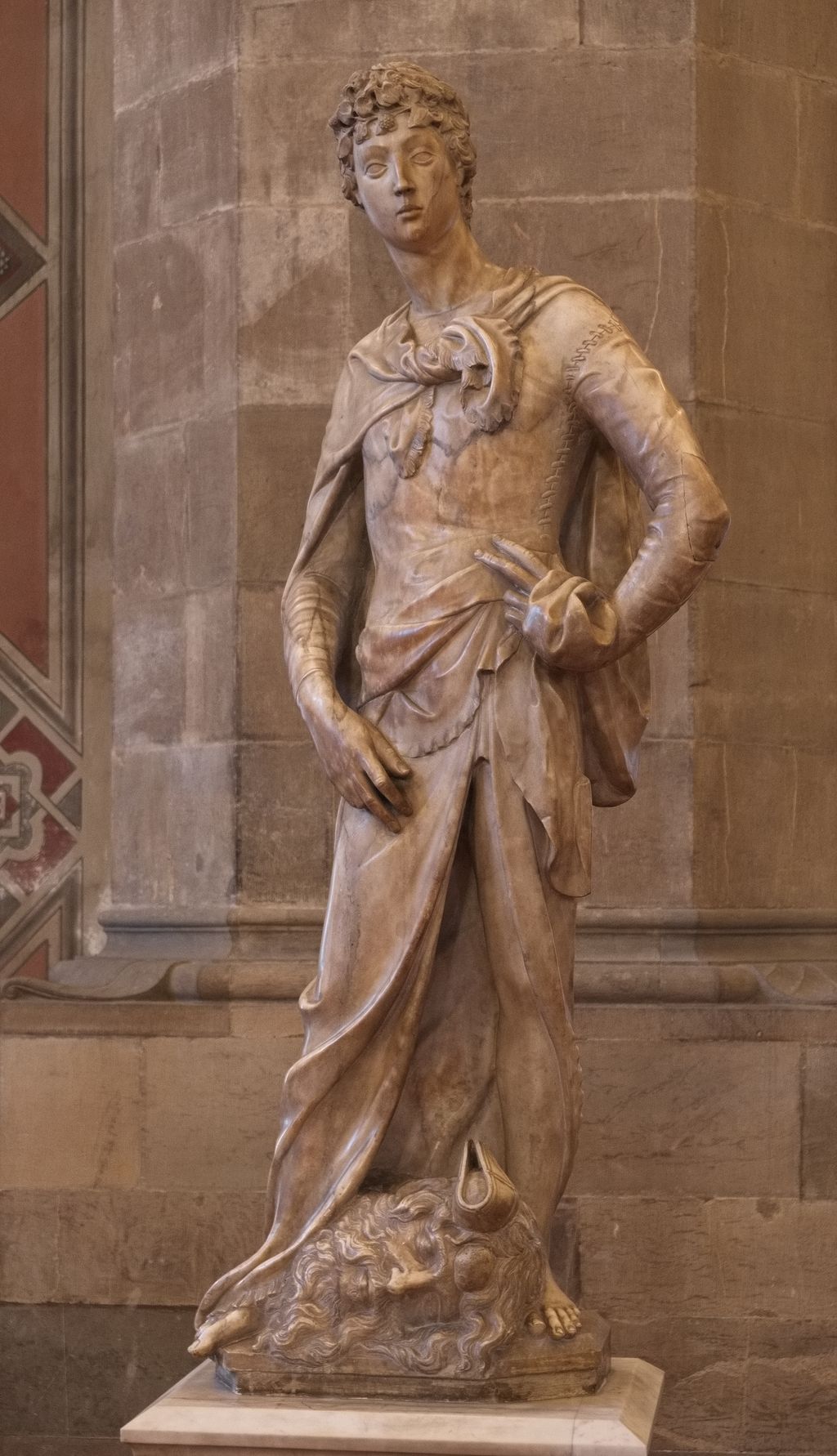
Marble David
Armin Kleiner. Image source. CC BY-SA 4.0. Resized for the web.
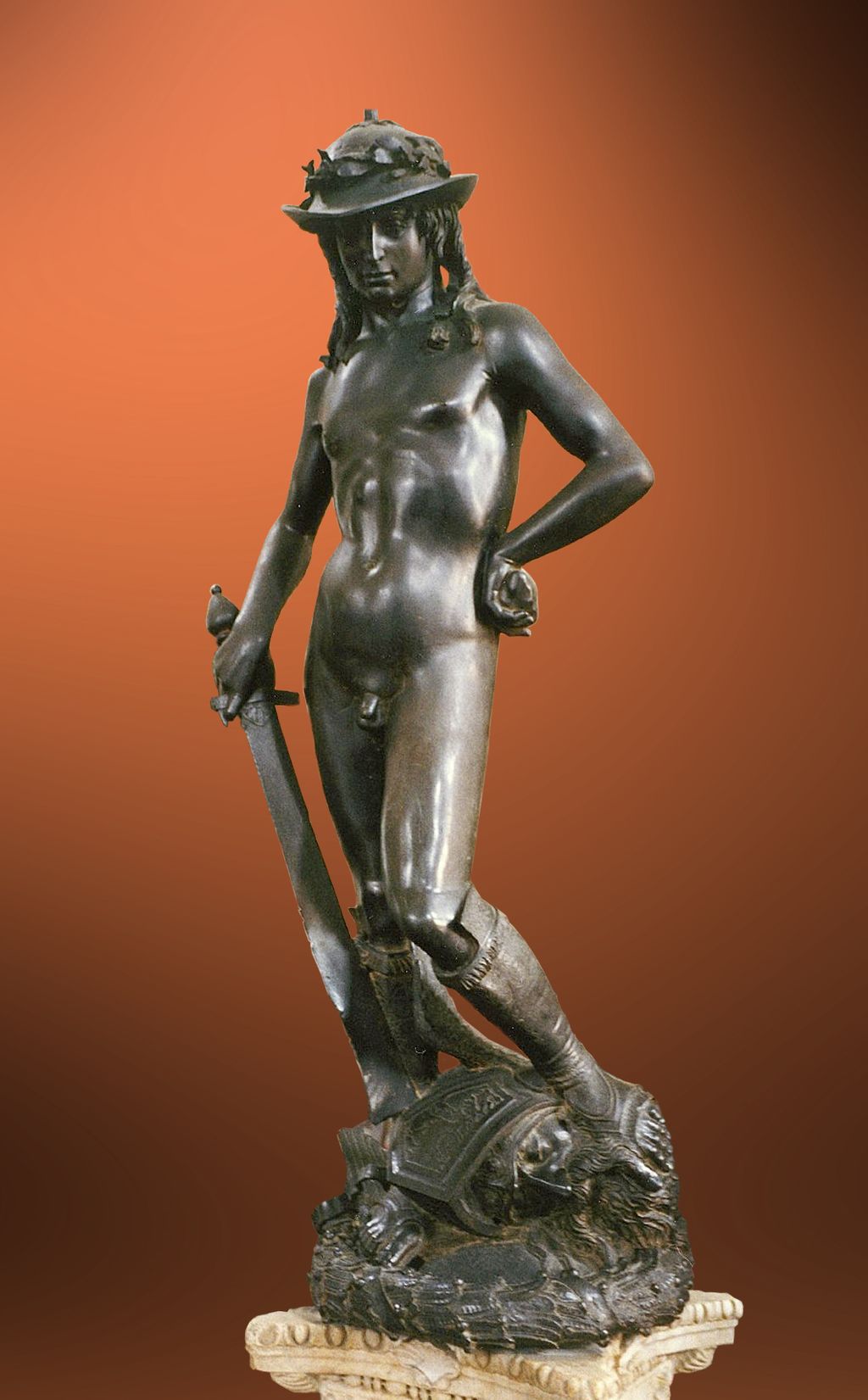
Bronze David
Patrick A. Rodgers. Image source. CC BY-SA 2.0. Resized for the web.
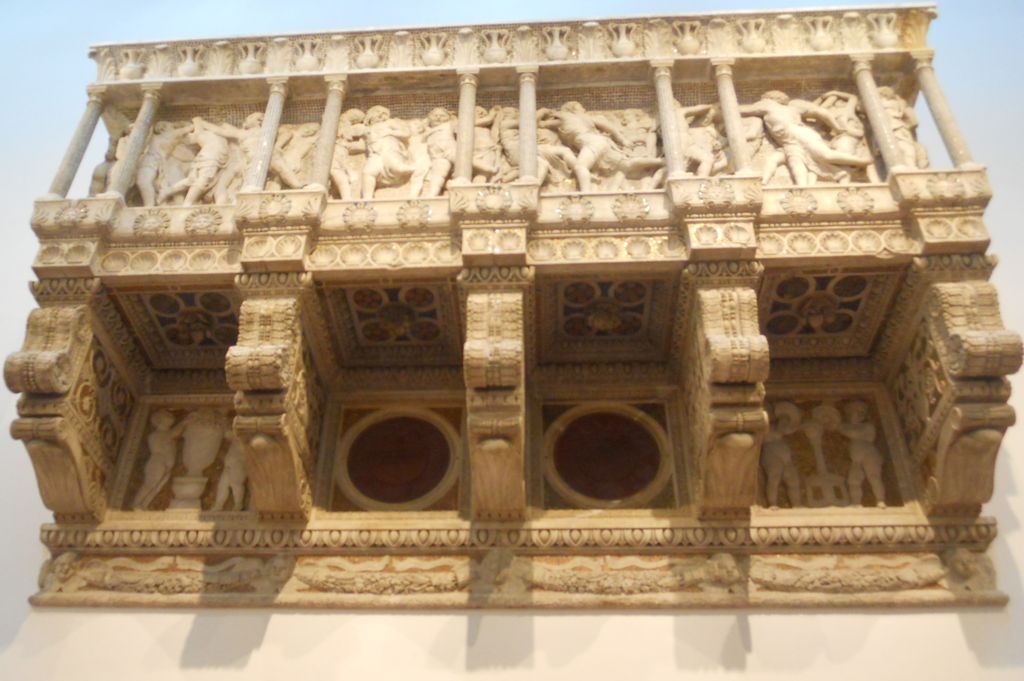
Cantoria
Erik Drost. Image source. CC BY 2.0. Resized for the web.
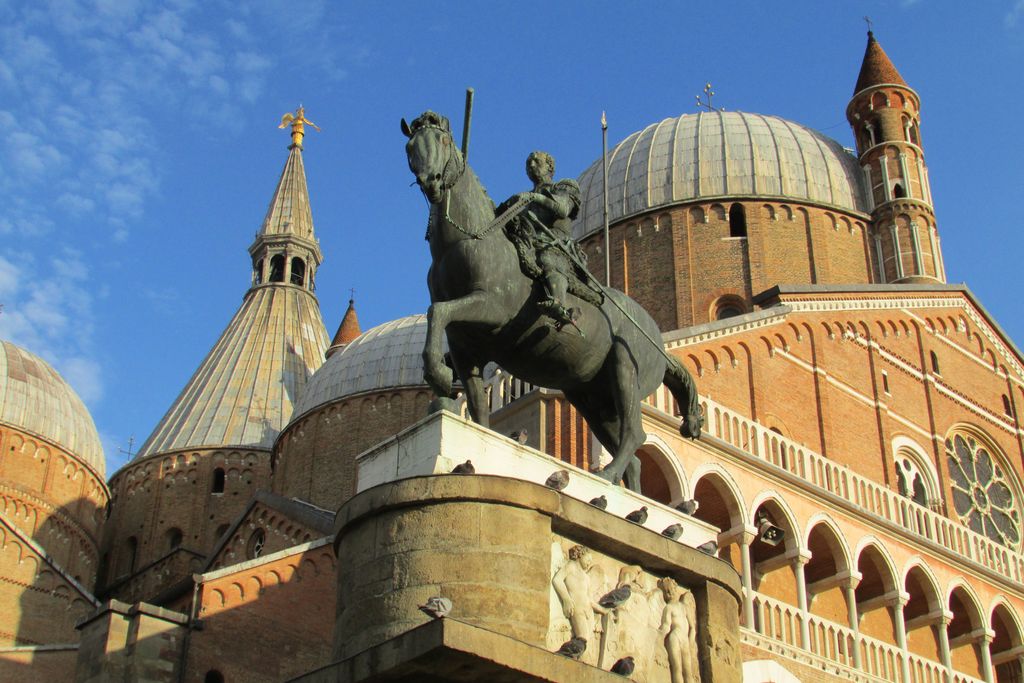
Gattamelata
Chris Light. Image source. CC BY-SA 4.0. Resized for the web.
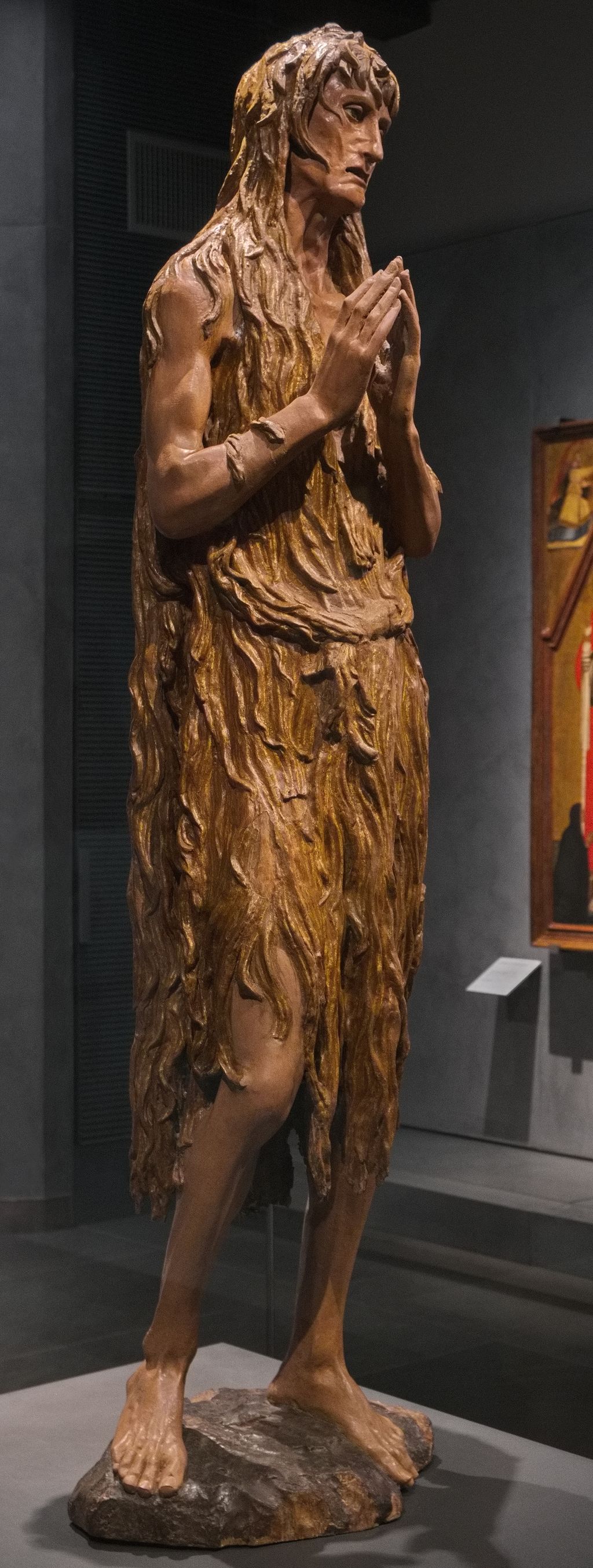
Penitent Magdalene
Armin Kleiner. Image source. CC BY-SA 4.0. Resized for the web.
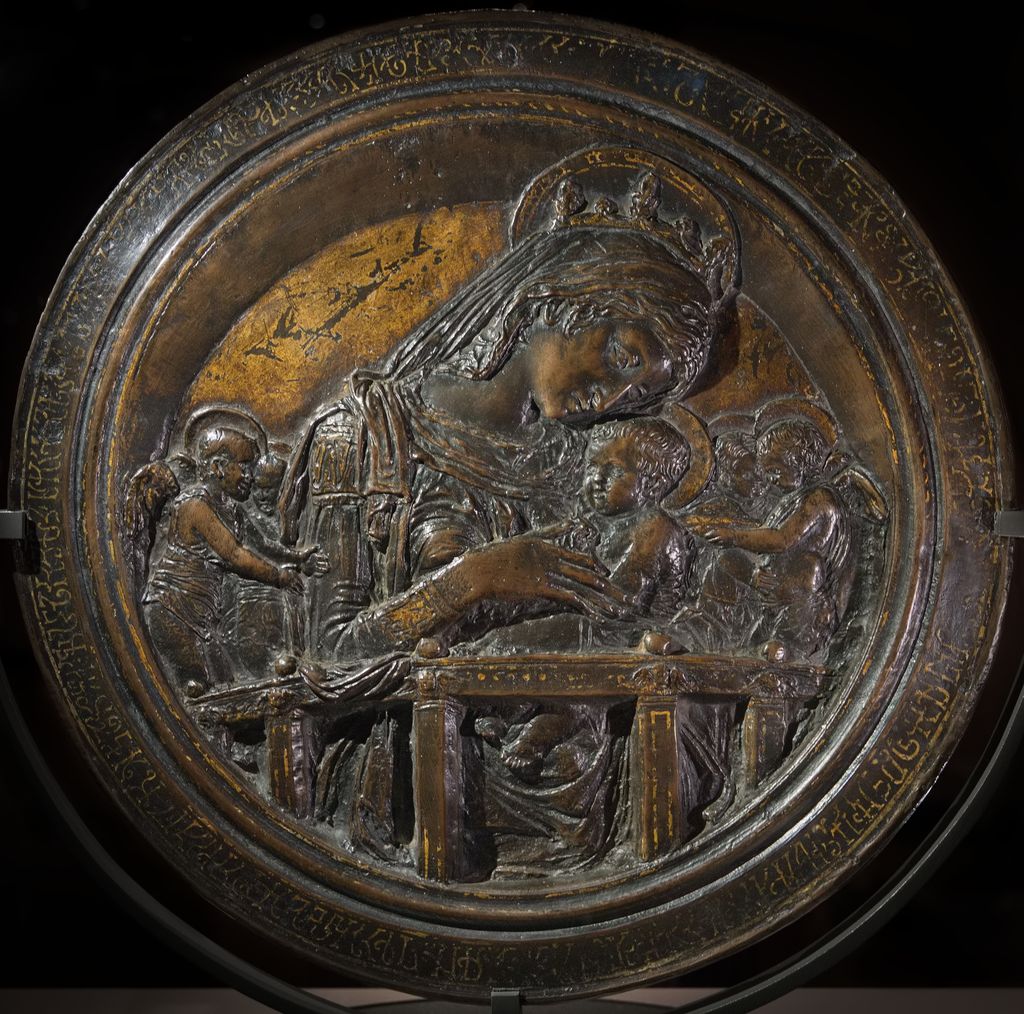
Chellini Madonna
Armin Kleiner. Image source. CC BY-SA 4.0. Resized for the web.
