


 by Tom Gurney
Tom Gurney BSc (Hons) is an art history expert with over 20 years experience
Published on June 19, 2020 / Updated on November 29, 2026
Email: tomgurney1@gmail.com / Phone: +44 7429 011000
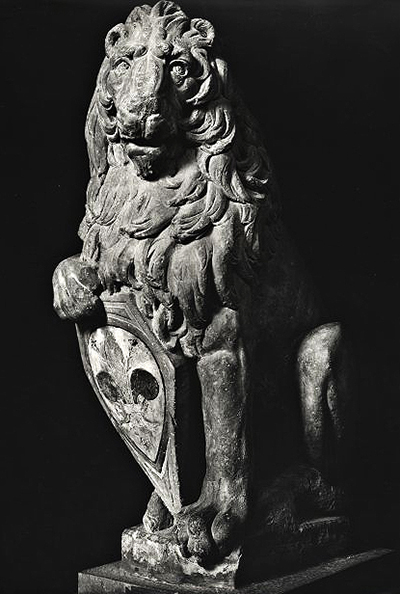
Donatello’s lion sits upright with its right forepaw hooked over the shield of Florence. Its heavy mane falls in locks over its chest, its muzzle turns to one side and its mouth opens just enough to catch a shadow. Beneath the paw, a red marble lily stands out against a pale field. The sandstone lion was made for the staircase to a pope’s lodgings at Santa Maria Novella. It spent part of the nineteenth century in Piazza della Signoria and is now in the Museo Nazionale del Bargello. The lion seen outside Palazzo Vecchio today is a replica. [1] [2] [3]
The paw and the shield
Seen from the front, the lion’s head rises above a roughly triangular mass of mane and body. The two forelegs break that symmetry. One descends almost straight to the ground, while the raised paw bends over the top of the shield. Follow the carving round and the seated animal comes into focus. The haunch rises beside the belly, with the body’s weight gathered low at the back. The head turns above that firm seat. Donatello used the posture of a resting animal to give a civic emblem the air of a watchful guard. [1] [2]
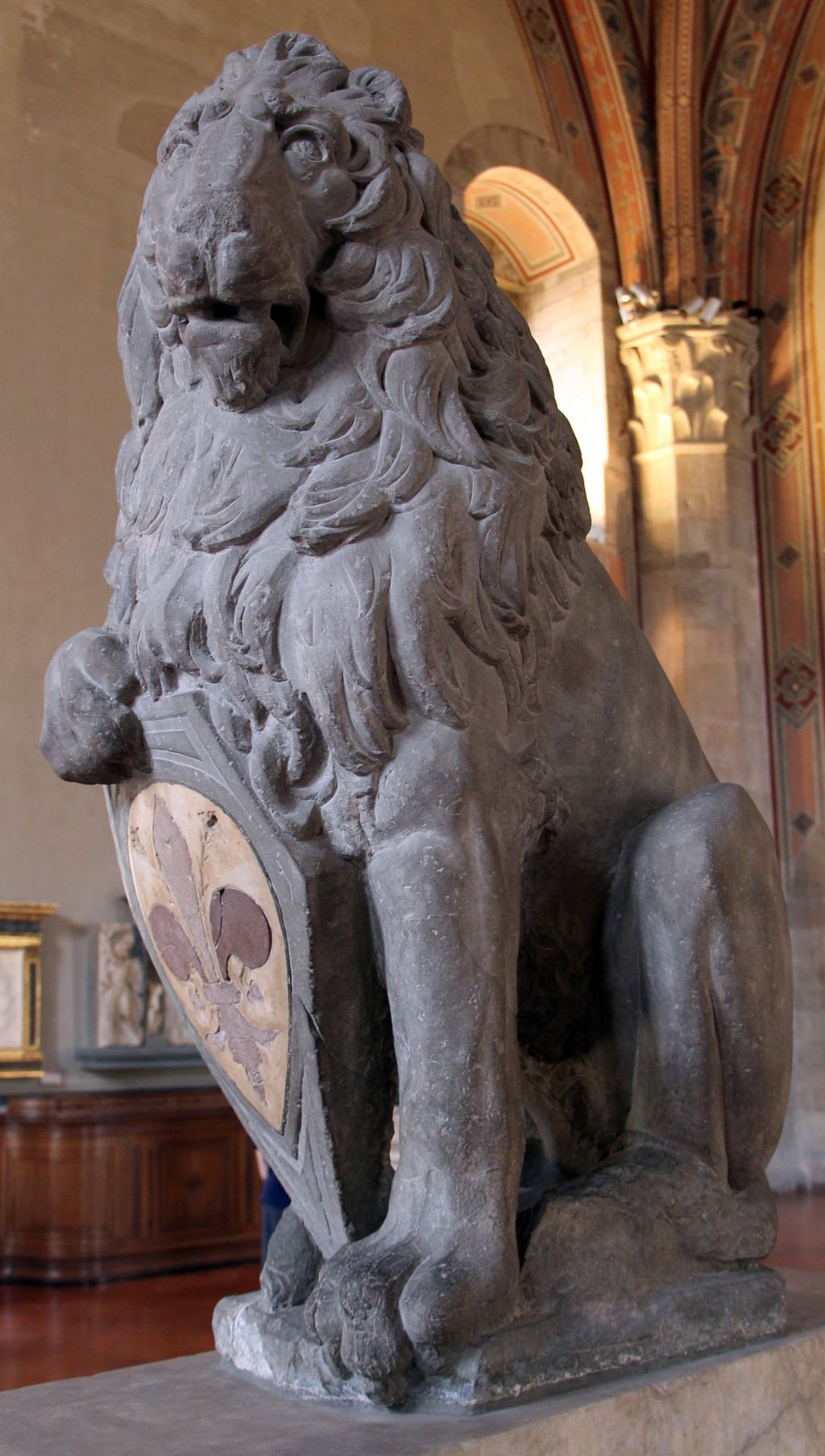
The Bargello’s stone original, with the lily shield beside the lion’s front paws. Francesco Bini. Image source. CC BY-SA 4.0. Resized for the web.
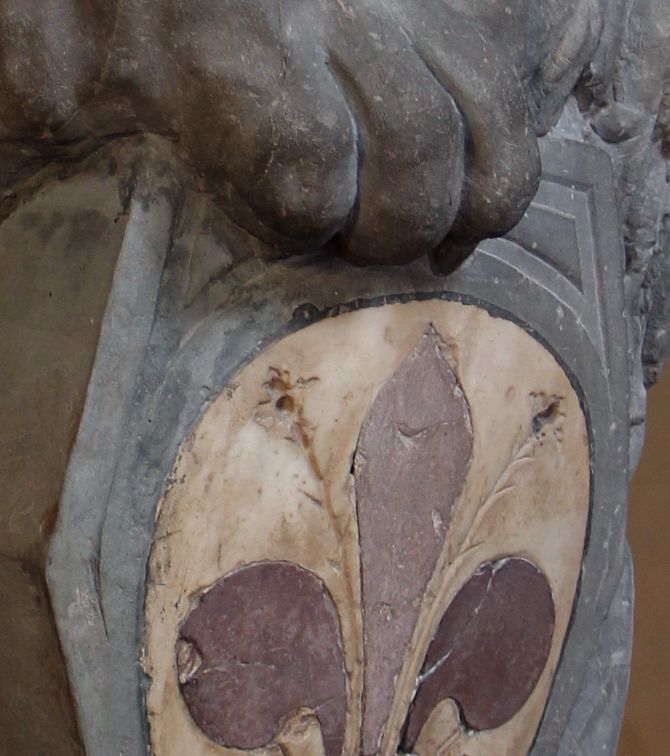
The shield has its own physical presence. Its pointed outline and flat face interrupt the mane’s overlapping ridges. The paw seems to grip the rim, and from an oblique view the shield and the leg behind it read as separate planes. A similar interest in how a shield shapes a figure appears in Saint George, also at the Bargello. The standing saint braces his shield before him. The lion steadies its shield to one side, where the coat of arms remains visible beneath the sweep of the mane. [1] [2]
The lion is 135.5 centimetres high. The Opera del Duomo accounts describe its stone as macigno, a sandstone associated with the material Florentines call pietra serena. That blue-grey stone also had a long life in the city’s buildings. Here it gives the mane a broad, shadowed surface against which the inlay reads clearly. The national catalogue identifies the shield’s materials as antique red and white marble and records losses in the inlay. The object still shows how Donatello used colour as part of the design. Separate pieces of stone carry the heraldic colours into the sculpture itself. [1] [4] [5]
The flower is Florence’s giglio, a red heraldic lily on a silver or white field. The two small forms between the main petals give it the appearance of an iris. The Museo dell’Opera del Duomo points out the same distinctive feature on a marble city shield combined with the emblems of the wool guild. That comparison helps when looking at the Marzocco’s worn shield. Its flower belongs to a civic design that could be recognised on a building, a painted sign or a lion’s shield. [1] [6]
Annotated Details from the Marzocco
Select a number to jump to a detail of the sculpture.
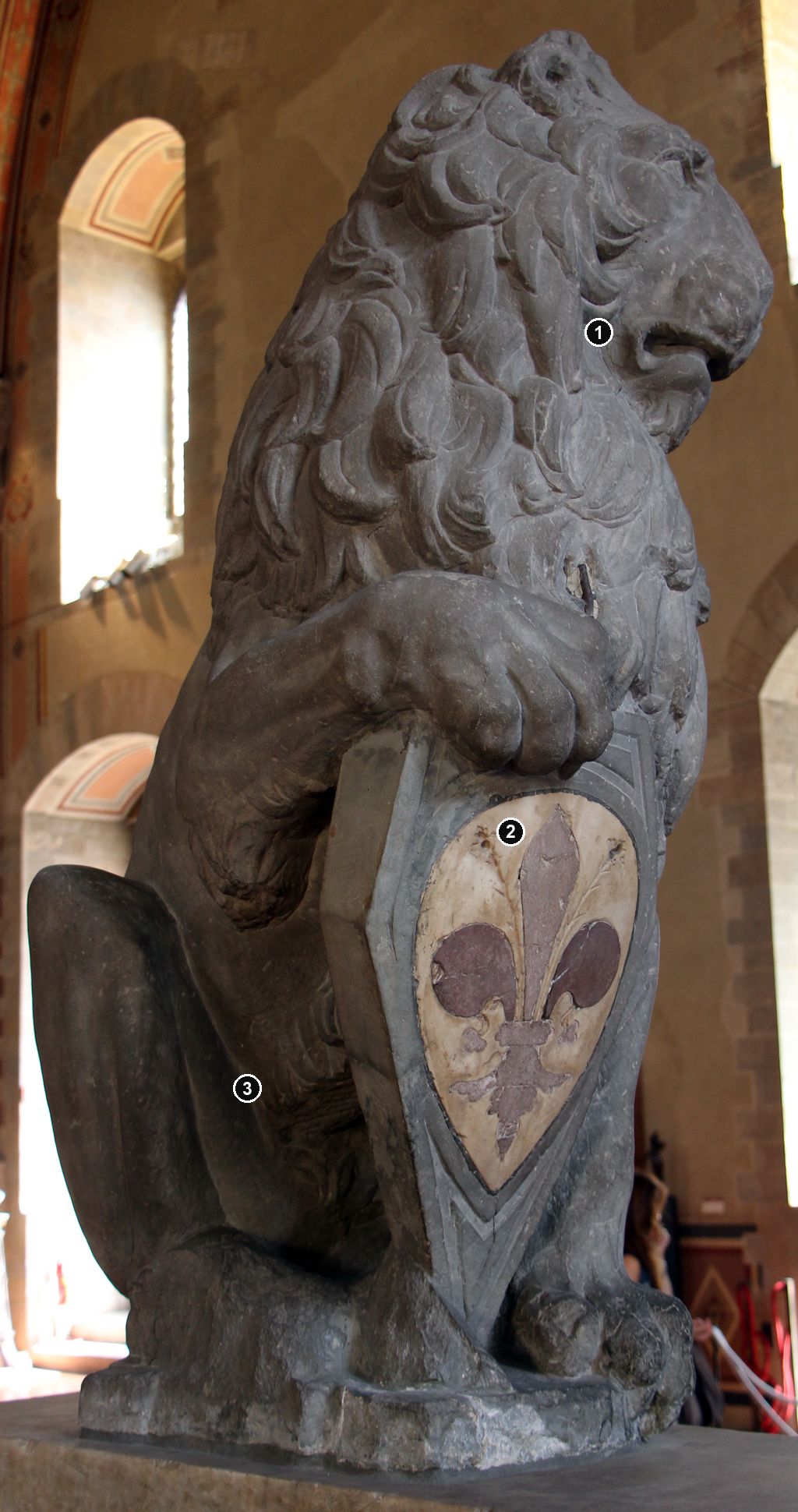
Details from THE MARZOCCO
Open a detail image to examine the surface more closely.
The head and mane
The head projects beyond a cluster of carved locks. Weathering softens some of their edges while larger contours still read in side light.
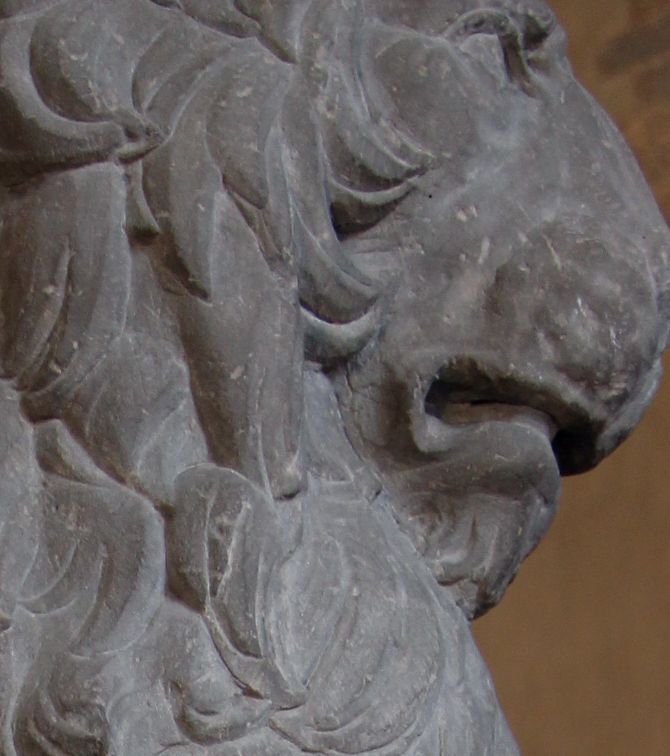
Paw and shield
The lion steadies the shield just above the Florentine lily. The two forms meet at the change from the animal’s body to the field of the arms.
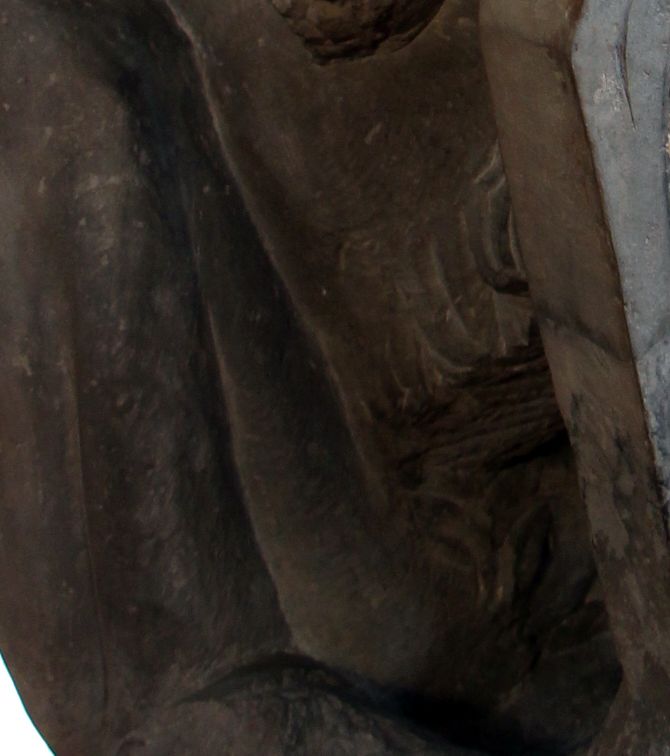
The compact body
The haunch sits low and close to the stone below it. The seated profile gathers much of the lion’s mass behind the upright shield.
Annotated photograph and detail crops. Francesco Bini. Image source. CC BY-SA 4.0. Resized, annotated and cropped from the original photograph.
A lion for the papal staircase
Florence commissioned the Marzocco in 1418 for the lodgings prepared for Pope Martin V. He came to the city in 1419, on his way back to Rome after his election at the Council of Constance. The lodgings occupied an upper floor of the Dominican complex of Santa Maria Novella, by the great cloister. An Opera del Duomo entry for January 1420 records an advance of five florins to Donato di Niccolò di Betto Bardi for carving a sandstone lion to go on a column of the courtyard stairs. In February the wardens authorised a further seven gold florins as the balance for his work. The national catalogue dates the sculpture to 1420 on the evidence of the payments. The entries tie the carving to Martin’s stay, although they leave the day of installation unresolved. [1] [3] [4] [7] [17]
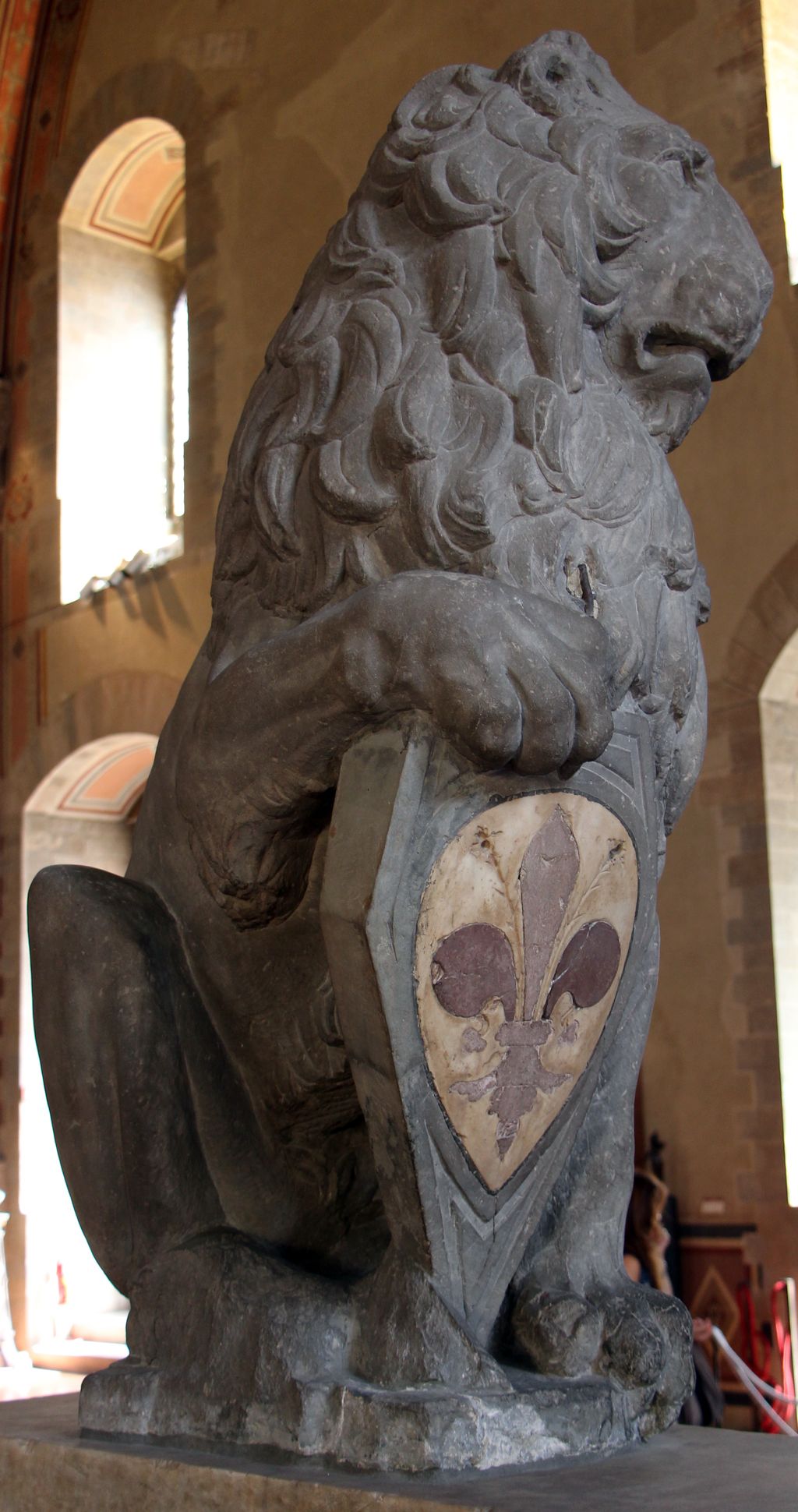
The compact profile of the Bargello lion, whose shield remains visible through the turn. Francesco Bini. Image source. CC BY-SA 4.0. Resized for the web.
The staircase was itself part of the reception. An account from February 1419 records the fitting of shields with the arms of the Florentine commune in the papal lodging, and a payment that June covered the carving of civic arms for a wall of the pope’s hall. On the way upstairs, a visitor would have met the same lily held up by an animal. The figure can be read as a welcome with an unmistakable signature. The city had prepared the rooms, and it marked the approach in its own arms. [4] [7]
That message was spelled out during a later papal stay. On 17 May 1435 the cathedral wardens resolved to gild the lion at the corner of the stairs to the rooms of Pope Eugenius IV. The resolution put the cost on the Opera and named the honour of the Florentine commune as the purpose. Art historian Alison Wright identifies the lion in that order as Donatello’s. The decision shows what the Florentine authorities wanted gold to do in this setting. How much of the stone was gilded, and what the finished surface looked like, are harder questions than the wording of the decision can answer. [8] [9]
Why Florence had a lion
A marzocco was already a recognisable figure in Florence before Donatello received his commission. Two surviving versions of the civic lion date from 1383 and are credited to Jacopo di Piero Guidi and Francesco Neri, known as il Sellaio. Palazzo Vecchio also had an entirely different kind of lion on its premises. From the middle of the fourteenth century until 1550, it housed a menagerie, one of several sites where the city kept live lions. The name of Via dei Leoni, the street behind the palace, still recalls the enclosure. [10]
A great cat was an expensive and imposing animal for a government to keep. Spectators could see a living expression of the power that stone lions represented. Florence also put the animal to work on a much smaller scale. A Florentine maiolica dish of about 1430–50 in the Cleveland Museum of Art bears a lion rearing on its hind legs in thick cobalt decoration. The museum suggests the decoration probably refers to the city’s emblem. Its upright, clawing animal and Donatello’s seated shield-bearer show how readily the motif could change with its setting. It could fill the circle of a dish or preside over the foot of a staircase. [10] [11]
A tradition recorded by the city links the name to Mars and tells of a weathered statue by the old bridge that disappeared in the flood of 1333. The story belongs to Florence’s lore about the emblem. The surviving medieval lions, the evidence for the menagerie and the cathedral accounts tell us how the image actually circulated. The animal might be shown alone, or associated with the lily, which fixed its identity as the lion of Florence. [3] [4] [10]
The lion in the square and the marble beneath it
The staircase at Santa Maria Novella appears to have been demolished in the early sixteenth century. The sculpture’s whereabouts between that period and the early nineteenth century are poorly documented. In 1812 the architect Giuseppe del Rosso, working on Palazzo Vecchio, put Donatello’s Marzocco in front of the palace in place of an older and badly worn stone lion. It took over a position on the raised approach known as the ringhiera or arengario. The monument now greeted people coming to the seat of city government. The marble David offers another example of a Donatello sculpture acquiring a civic setting after being made for a different site. [1] [10]
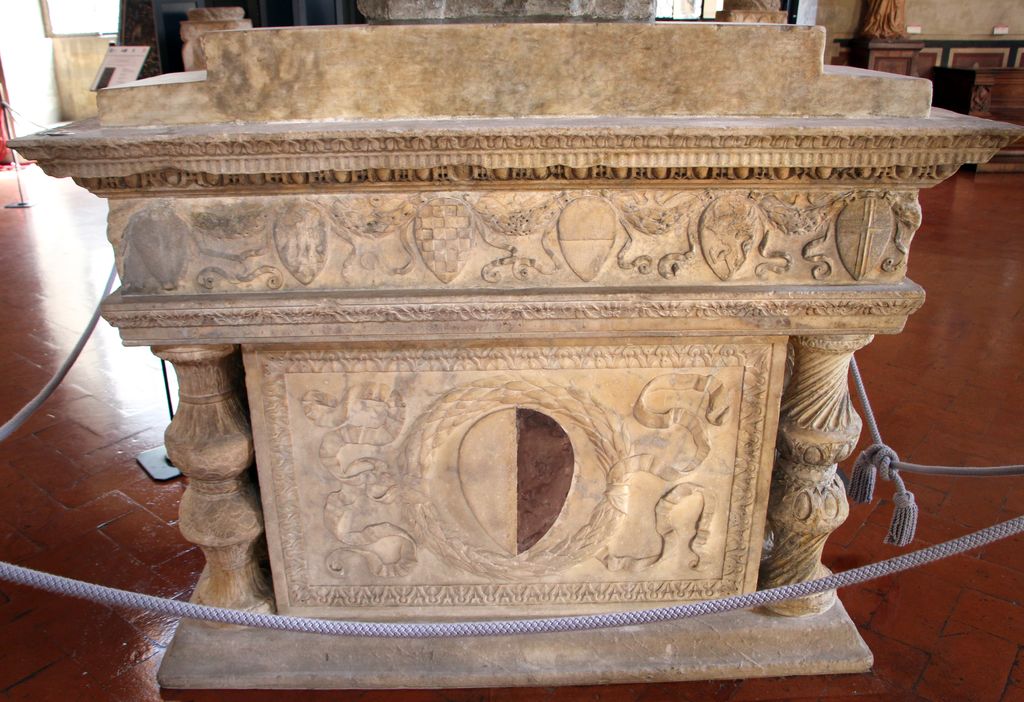
The marble pedestal associated with Benedetto da Maiano, distinct from Donatello’s sandstone lion. Francesco Bini. Image source. CC BY-SA 4.0. Resized for the web.
Del Rosso reused the older lion’s white marble pedestal. Look below the shield in the lion’s paw and the pedestal opens up another register of heraldry. Four baluster supports rise from a moulded foot towards a band with coats of arms. The separate catalogue record dates the carving to about 1480–85 and credits Benedetto da Maiano on the strength of Alessandro Cecchi’s comparison with other works, including a marble doorway in Palazzo Vecchio. A scene in the Sassetti Chapel at Santa Trinita provides a visual check on its date. The pedestal can be recognised in the painted view of the square completed by 1485, more than three centuries before it was paired with Donatello’s lion. [12]
Condition drove the next move. The stone original was taken indoors to the Uffizi in 1847 and later entered the Bargello, where it is listed in the Salone di Donatello. The marble pedestal remained outdoors for much longer. It came to the Bargello in 1999, and a copy took its place beside the Neptune Fountain. In the museum the work is an assembly of a sandstone lion, a thin marble base and the taller carved pedestal. A 2025 engineering study surveyed those three components separately to model how they might rock or slide in an earthquake. The support that once lifted the lion above a crowd now matters to how it can be safely displayed indoors. [1] [2] [12] [13]
What a replica can do
There is more than one replica. Florence’s civic collection includes a bronze version by Clemente Papi made for Piazza della Signoria. Berlin’s Bode-Museum has a nineteenth-century sandstone version, and Italy’s national catalogue records a late nineteenth-century plaster cast that reproduced the lion and copied the ornamented base. The lion in front of Palazzo Vecchio today has a stone surface, as documented by the team that restored it for the city in 2016. [3] [10] [14] [15] [18]
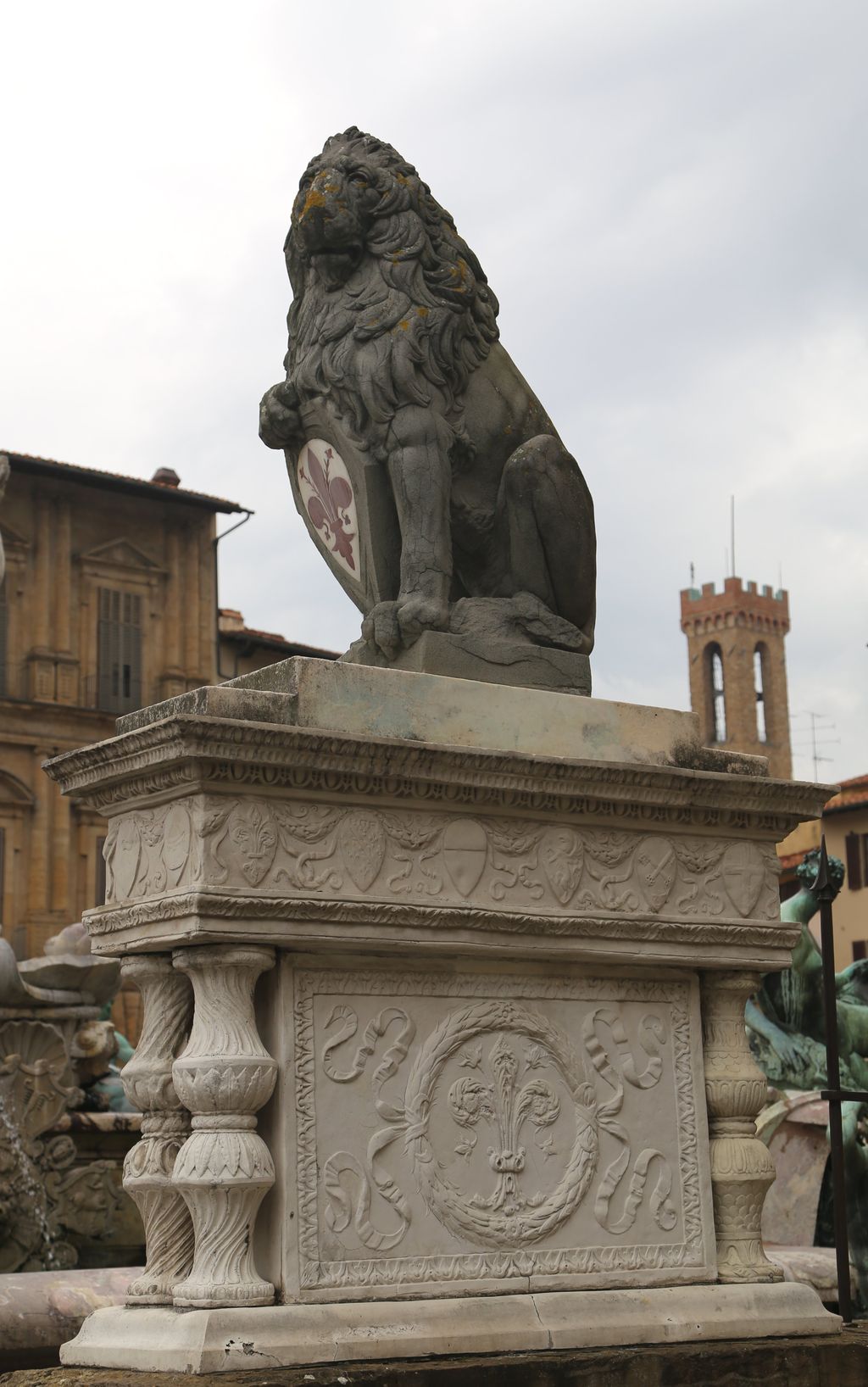
The current copy of the Marzocco outside Palazzo Vecchio. Rufus46. Image source. CC BY-SA 3.0. Resized for the web.
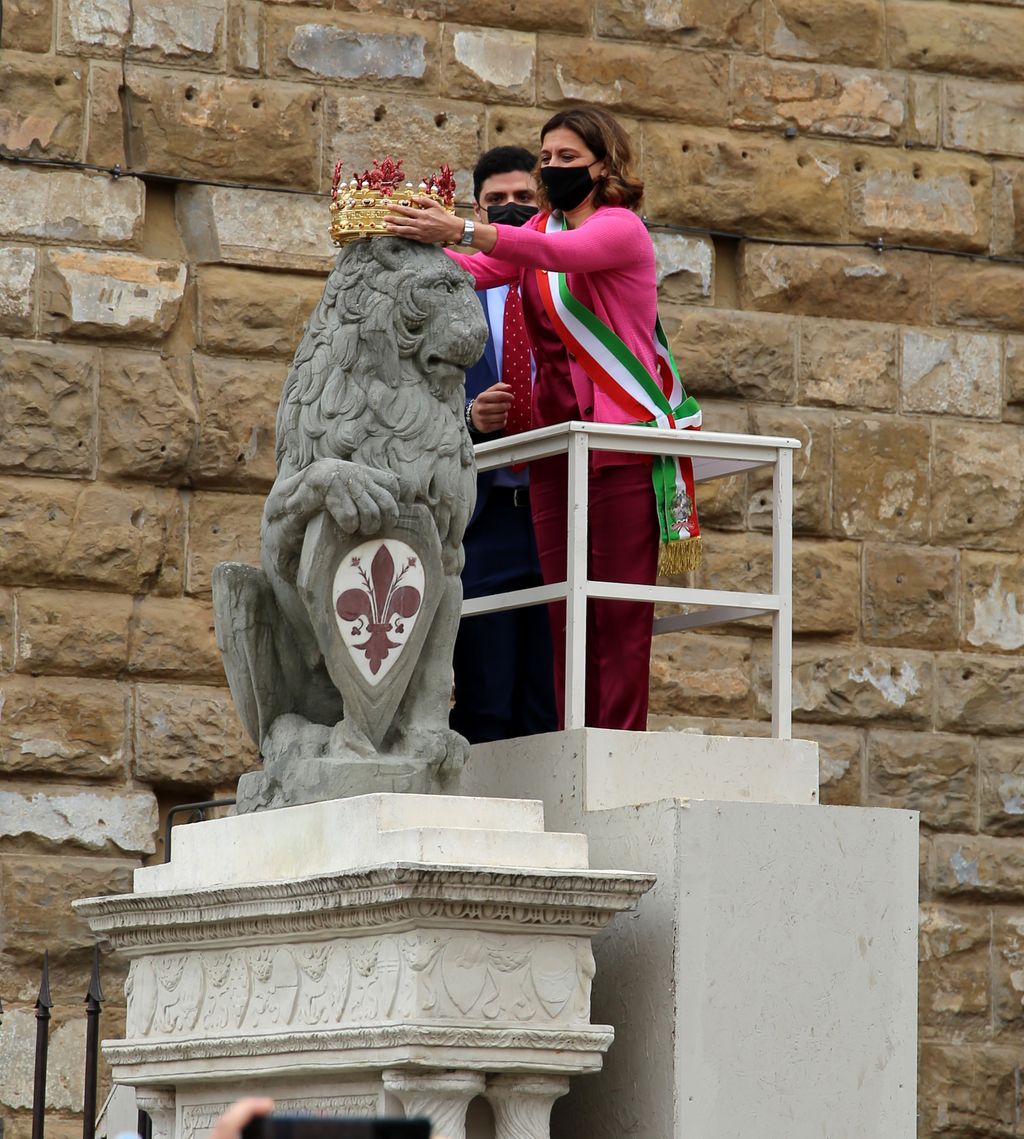
The outdoor replica during the coronation ceremony on 20 June 2021. Francesco Bini. Image source. CC BY-SA 4.0. Resized for the web.
In June 2021 Florence revived the crowning of the Marzocco around the feast of its patron, Saint John the Baptist. Participants in the historic procession assembled in the piazza, and a crown was placed on the head of the outdoor lion. The city announced the ceremony again in 2026. In the square the crown draws the eye to the figure high above the crowd. At the Bargello it is easier to see where the red stone meets the white, or to follow the curve of a claw over the shield. [2] [3] [16]
Donatello sculpture directory
| Name | Date | Medium and record |
|---|---|---|
| Marble David | 1408–09, adapted 1416 | Carved Carrara marble Catalogue. |
| Saint John the Evangelist | c. 1409–15 | Carved marble Catalogue. |
| Saint Mark | 1411–13 | Carved Carrara marble Catalogue. |
| Saint George and its dragon relief | c. 1415–17 | Marble statue and marble relief Catalogue. |
| Marzocco | c. 1417–20 | Carved sandstone Catalogue. |
| Saint Louis of Toulouse, Florence | 1418–25 | Gilt bronze and mixed media Catalogue. |
| Pazzi Madonna | c. 1420s | Marble relief Catalogue. |
| Reliquary Bust of Saint Rossore | c. 1420s | Gilt bronze Catalogue. |
| The Prophet Jeremiah | 1420s–30s, disputed | Marble Catalogue. |
| Zuccone | c. 1420s–30s | Marble Catalogue. |
| Feast of Herod, Siena | 1420s | Gilded bronze relief Catalogue. |
| Ascension with Christ Giving the Keys to Saint Peter | c. 1428–30 | Marble relief Catalogue. |
| Cantoria | 1433–39 | Marble and mosaic Catalogue. |
| Amor-Atys | c. 1435–40 | Partly gilded bronze Catalogue. |
| Bronze David | c. 1435–40, disputed | Partly gilded bronze Catalogue. |
| Gattamelata | Installation agreement, 1453 | Bronze and stone Catalogue. |
| Santo altar | Mid-fifteenth century | Bronze and limestone ensemble Catalogue. |
| Chellini Madonna | Given in 1456 | Partly gilded bronze tondo Catalogue. |
| Penitent Magdalene | c. 1453–55 (Opera) | Poplar, stucco, pigments and gold Catalogue. |
| Judith and Holofernes | Late 1450s–early 1460s | Bronze with surviving gilding Catalogue. |
| Pulpit of the Passion | Late work and later assembly | Bronze reliefs, Donatello and collaborators Catalogue. |
| Bust traditionally called Niccolò da Uzzano | Fifteenth century | Painted terracotta, attribution disputed Catalogue. |
| Prato Cathedral exterior pulpit | Commissioned 1428; carved 1430s | Marble reliefs, Donatello and Michelozzo Catalogue. |
| Cavalcanti Annunciation | c. 1433–35 | Gilded sandstone and terracotta Catalogue. |
| Crucifix at Santa Croce | Early fifteenth century | Painted wood Catalogue. |
| Madonna of the Clouds | c. 1425–35 | Marble relief Catalogue. |
| Old Sacristy Doors | Fifteenth century | Two paired bronze doors Catalogue. |
| Resurrection Pulpit | Late work and later assembly | Bronze reliefs, Donatello and collaborators Catalogue. |
| Brancaccio tomb | 1420s | Donatello, Michelozzo and assistants, mixed materials Catalogue. |
| Saint John the Baptist, Venice | 1438 | Polychromed and gilded wood Catalogue. |
| Sacrifice of Isaac | Early fifteenth century | Donatello and Nanni di Bartolo, marble Catalogue. |
| Madonna of Via Pietrapiana | Mid-fifteenth century | Terracotta Catalogue. |
| Miracle of the Mule | Mid-fifteenth century | Gilded bronze panel for the Santo altar Catalogue. |
| Padua Crucifix | Mid-fifteenth century | Cast bronze Catalogue. |
| Dancing Spiritello, Bargello | Fifteenth century | Bronze Catalogue. |
| Young Prophet from the Porta della Mandorla | c. 1404–09 | White marble, attributed to Donatello Catalogue. |
| Prophet or Apostle from the Duomo north tribune | Early fifteenth century | White marble, possibly Donatello Catalogue. |
| Beardless Prophet | 1415–18 | White marble Catalogue. |
| Sibyl and Prophet of the Porta della Mandorla | 1422 | Carved marble heads for the portal Catalogue. |
| Faith, Siena baptismal font | 1420s | Gilded bronze figure Catalogue. |
| Hope, Siena baptismal font | 1420s | Gilded bronze figure Catalogue. |
| Feast of Herod, Lille | c. 1430 | Carrara marble relief Catalogue. |
| Piot Madonna | c. 1440–60 | Polychrome terracotta with glass and wax inlays Catalogue. |
| Carafa Horse Head | c. 1456–58 | Cast bronze Catalogue. |
| Pazzi Madonna workshop version, Louvre | c. 1450 | Polychrome gesso, Donatello’s workshop Catalogue. |
| Pazzi Madonna tondo, Rijksmuseum | c. 1425–50 | Plaster and stucco, after Donatello Catalogue. |
| Sprite | c. 1430–40 | Bronze, sculptor or metalsmith close to Donatello Catalogue. |
Discussion
Look again at the images and ideas explored in Marzocco. These editorial prompts invite your observations.
Reader Insights
Where does the lion touch the shield, and how does that small gesture change the way you read the emblem?
Compare the sandstone in the Bargello with the lion outdoors. What does each display tell you about how the city used the sculpture?
Join the Conversation
Share a detail, comparison or question about Marzocco below.
References
- Musei del Bargello and Catalogo generale dei Beni Culturali, Marzocco con lo stemma della città di Firenze, national catalogue 0900287038, Bargello Sculture 133, full record. View source.
- Musei del Bargello, Museo Nazionale del Bargello: riapre al pubblico il Salone di Donatello. View source.
- Comune di Firenze, L’incoronazione del Marzocco, 18 June 2021. View source.
- Archivio dell’Opera di Santa Maria del Fiore, Gli anni della Cupola, civic shields and Marzocco accounts including II 1 77, fols. 55 and 58v. View source.
- International Union of Geological Sciences, Pietra Serena, IUGS Heritage Stone record. View source.
- Opera di Santa Maria del Fiore, Lastra con stemma della città di Firenze ed emblemi dell’Arte della Lana, Museo dell’Opera del Duomo catalogue. View source.
- Walter and Elisabeth Paatz, Santa Maria Novella, from Die Kirchen von Florenz, vols. III–IV, translated by Florence As It Was, Washington and Lee University. View source.
- Archivio dell’Opera di Santa Maria del Fiore, deliberation to gild the lion on the staircase of the papal residence, 17 May 1435, II 2 1, fol. 234. View source.
- Alison Wright, ‘The Politics of the Gilded Body in Early Florentine Statuary’, Sculpture Journal 29, no. 2 (2020), pp. 131–158. View source.
- Fondazione MUS.E and Musei Civici Fiorentini, I leoni di Firenze, Palazzo Vecchio exhibition. View source.
- Cleveland Museum of Art, Dish with a Lion, c. 1430–50, collection 1966.19. View source.
- Catalogo generale dei Beni Culturali, Stemmi civili, sculpture pedestal attributed to Benedetto da Maiano, national catalogue 0900293845, Bargello Sculture 530 bis. View source.
- Marco Tanganelli, Stefania Viti, Francesco Trovatelli and Riccardo M. Azzara, ‘Dynamic Response of Marzocco by Donatello to Seismic Excitation’, Heritage 8, no. 9 (2025), 367. View source.
- Staatliche Museen zu Berlin, Lion (“Marzocco”), Bode-Museum object sheet, inventory AE 38. View source.
- Catalogo generale dei Beni Culturali, Marzocco, plaster cast, 1890–99, national catalogue 0900229283. View source.
- Comune di Firenze, La cerimonia di incoronazione del Marzocco in piazza della Signoria a Firenze, June 2026. View source.
- Thomas Frenz, L’introduzione della scrittura umanistica nei documenti e negli atti della Curia pontificia del secolo XV, Italian ed. Marco Maiorino (Vatican City, 2005), p. 12. View source.
- Impresa Cellini, Copia Marzocco, Piazza Signoria, Firenze, 2016 restoration project record, p. 34. View source.
- Victoria and Albert Museum, Donatello’s David. View source
- Opera del Duomo, Donatello and the Opera del Duomo. View source
- Ministero della Cultura, David with the Head of Goliath, Bargello bronze. View source
- Save Venice, Donatello’s Equestrian Monument to Gattamelata. View source
- Opificio delle Pietre Dure, L’ultimo Donatello. View source
More DONATELLO Sculptures
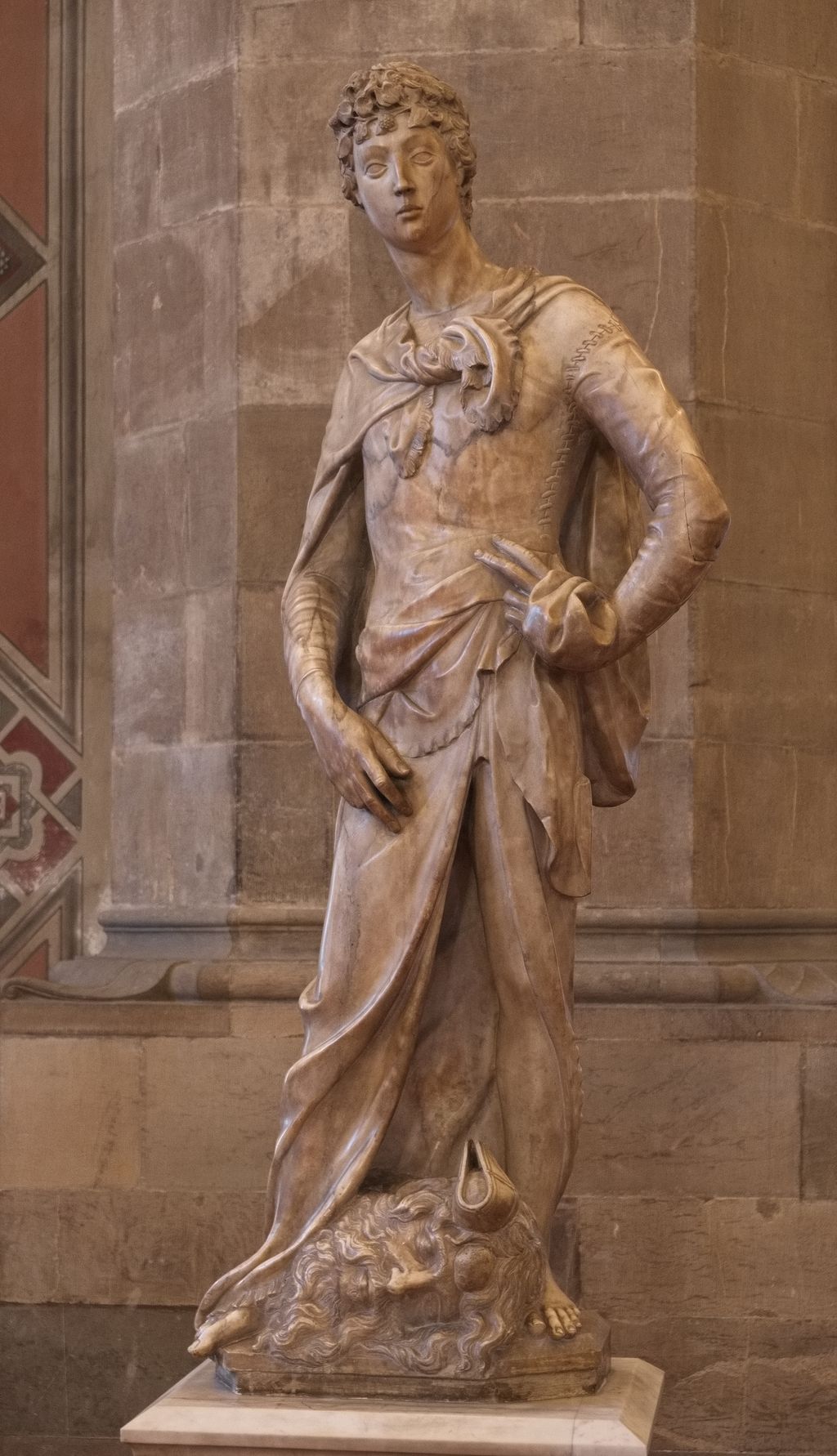
Marble David
Armin Kleiner. Image source. CC BY-SA 4.0. Resized for the web.
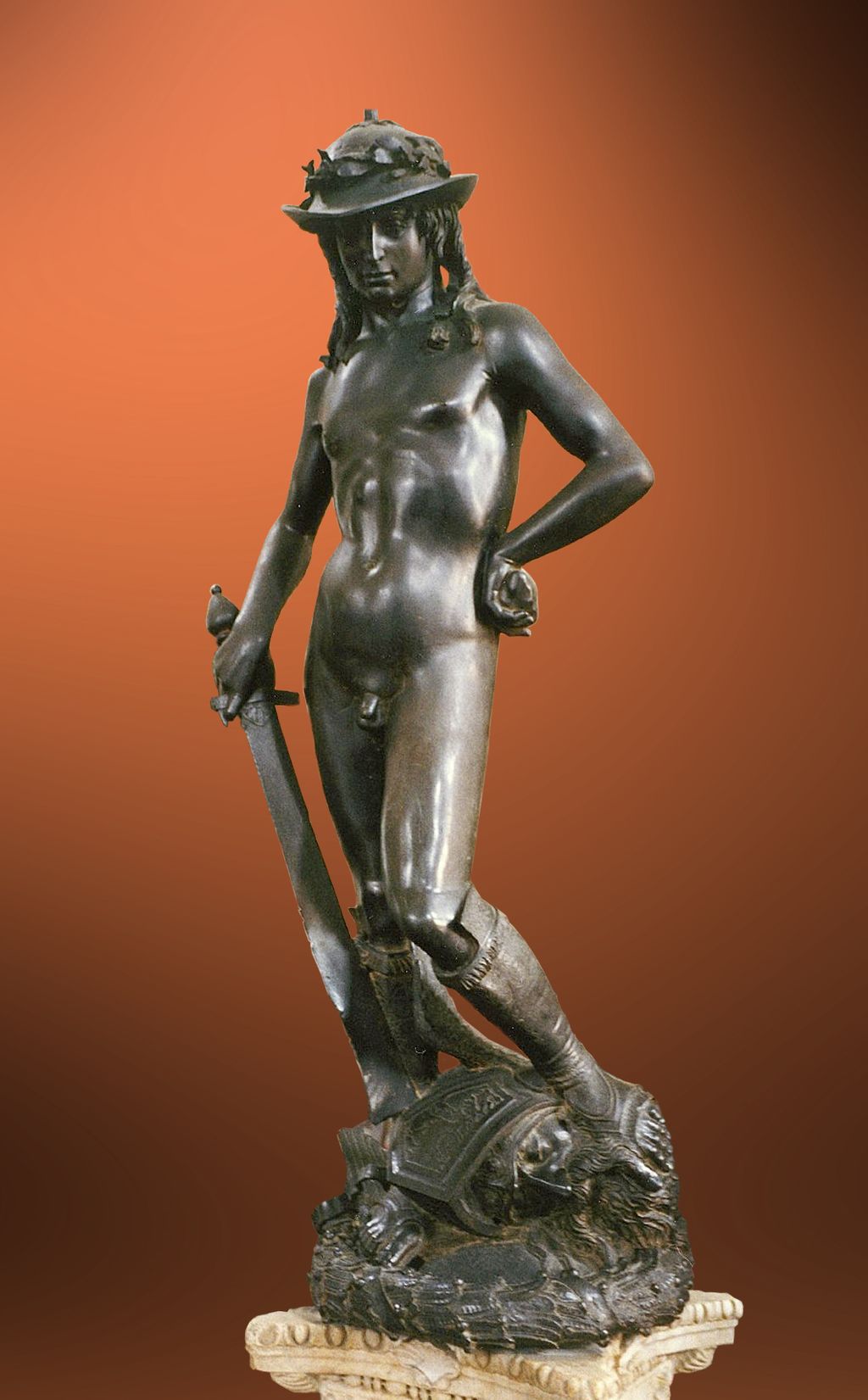
Bronze David
Patrick A. Rodgers. Image source. CC BY-SA 2.0. Resized for the web.
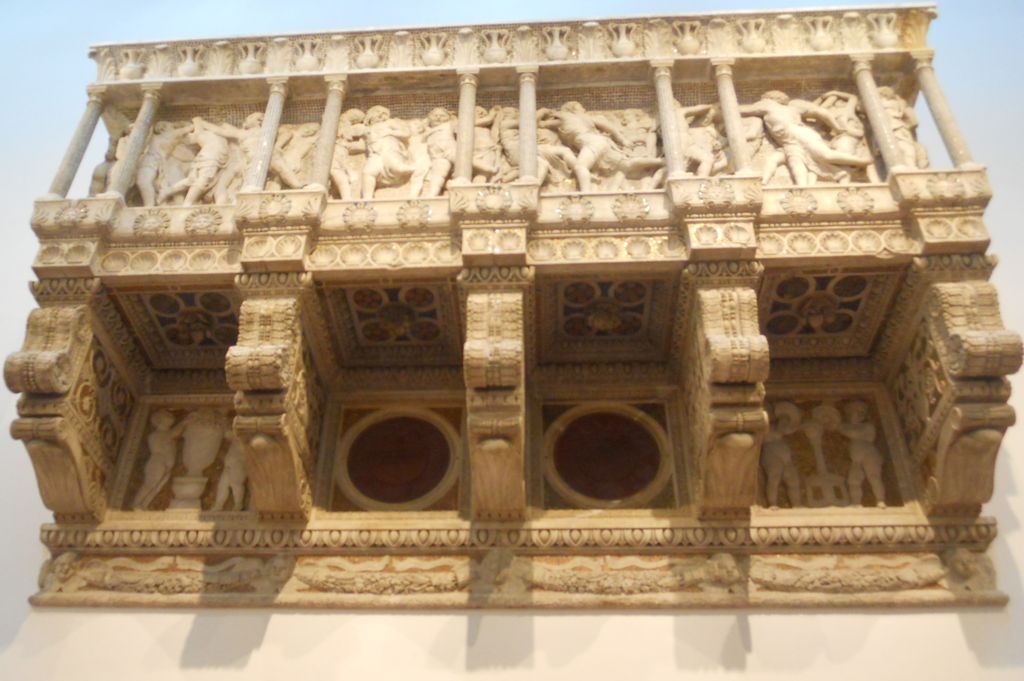
Cantoria
Erik Drost. Image source. CC BY 2.0. Resized for the web.
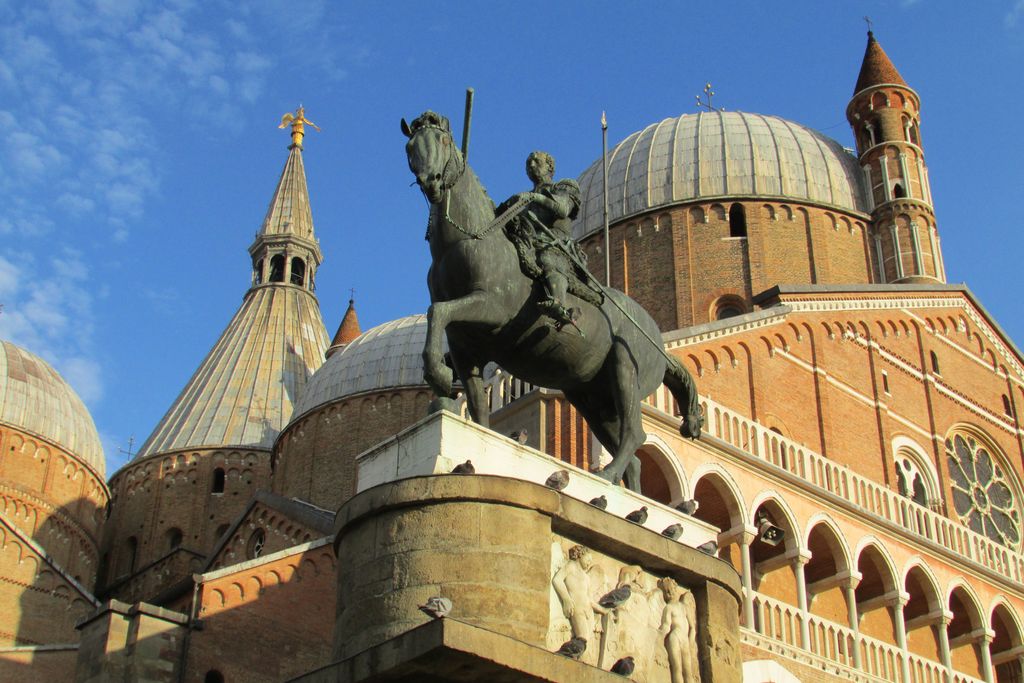
Gattamelata
Chris Light. Image source. CC BY-SA 4.0. Resized for the web.
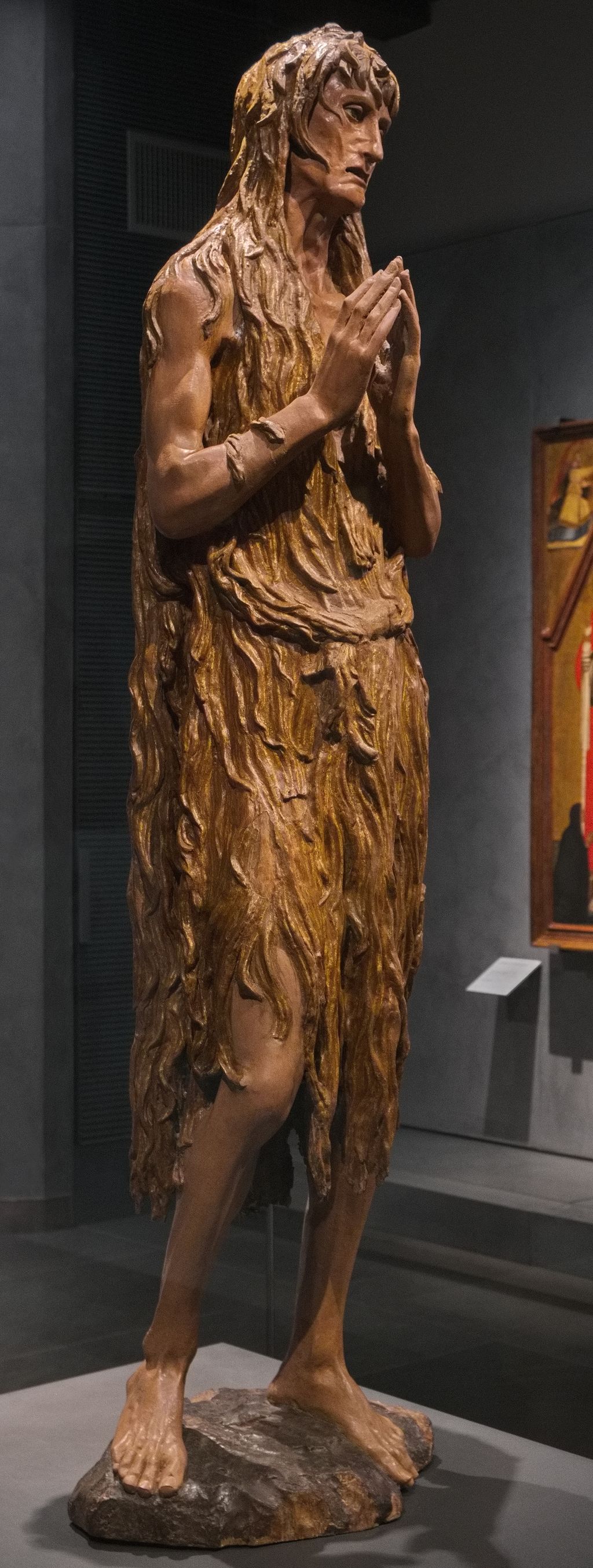
Penitent Magdalene
Armin Kleiner. Image source. CC BY-SA 4.0. Resized for the web.
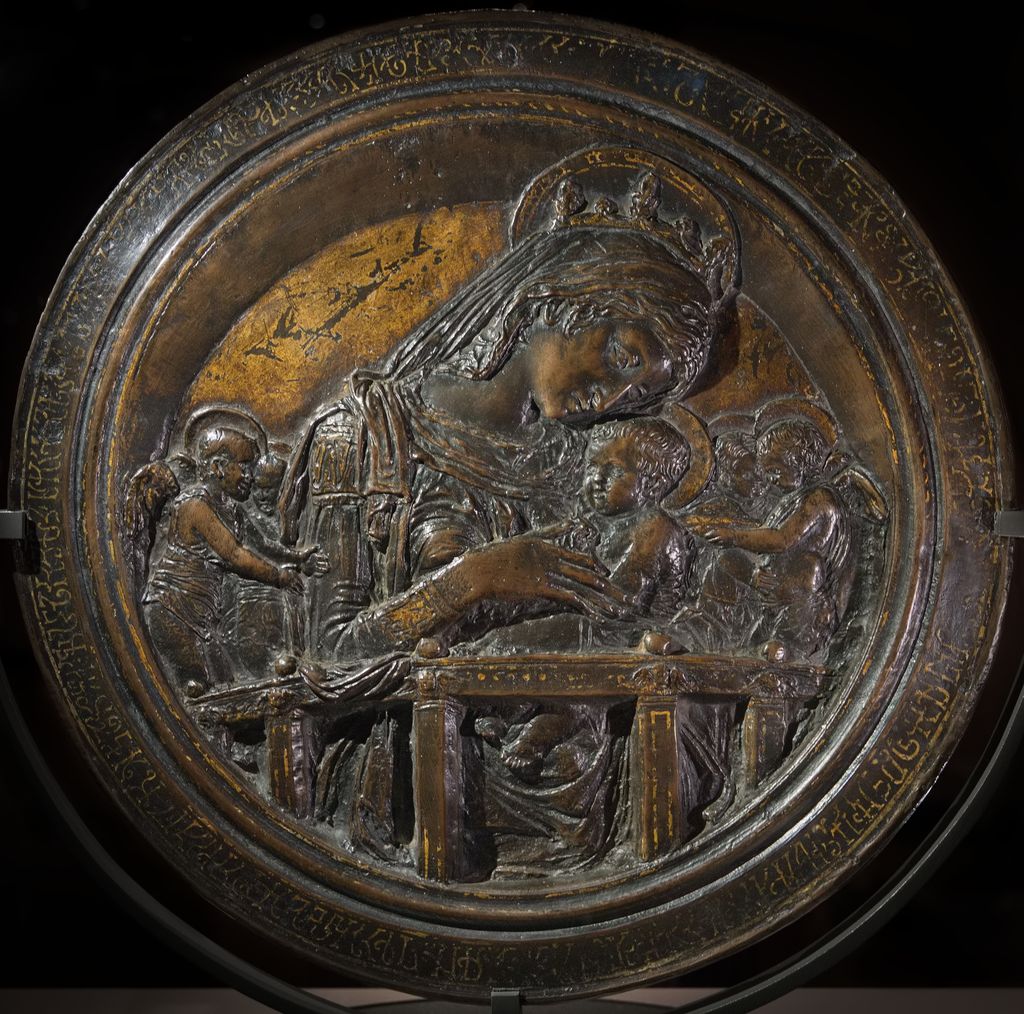
Chellini Madonna
Armin Kleiner. Image source. CC BY-SA 4.0. Resized for the web.
