


 by Tom Gurney
Tom Gurney BSc (Hons) is an art history expert with over 20 years experience
Published on June 19, 2020 / Updated on November 29, 2026
Email: tomgurney1@gmail.com / Phone: +44 7429 011000
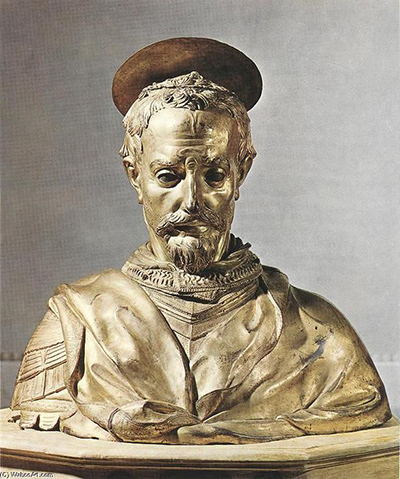
A seam runs through the bronze locks at the crown of Saint Rossore’s head. Donatello worked the break into the hair because the top of the head had to open. He made the bust for the friars of Ognissanti in Florence to house a relic venerated as the skull of Saint Rossore, a soldier and martyr also known as Saint Lussorio. Seen from the front, the figure has a furrowed brow and a downcast gaze, as if he were concentrating on something below him. The bust is in the Museo Nazionale di San Matteo in Pisa. The Victoria and Albert Museum dates it to about 1422–25 and describes it as cast, chased, gilded and silvered bronze. [1] [2]
How a Pisan relic acquired a Florentine face
In the tradition of his martyrdom, Lussorio served in the Roman army and was beheaded in Sardinia during the persecutions under Diocletian. His cult took root across the island and in Pisa, where a medieval church and monastery dedicated to him stood in the coastal woodland. By the early fifteenth century Florence ruled Pisa, and the two cities shared houses of the religious order known as the Humiliati. In May 1422 the Florentine friars brought the relic from Pisa to their church of Ognissanti. An early Florentine account describes its solemn entry through the gate of San Frediano. It also records the friars’ intention to commemorate the arrival each year on the Sunday after Ascension. [3] [4]
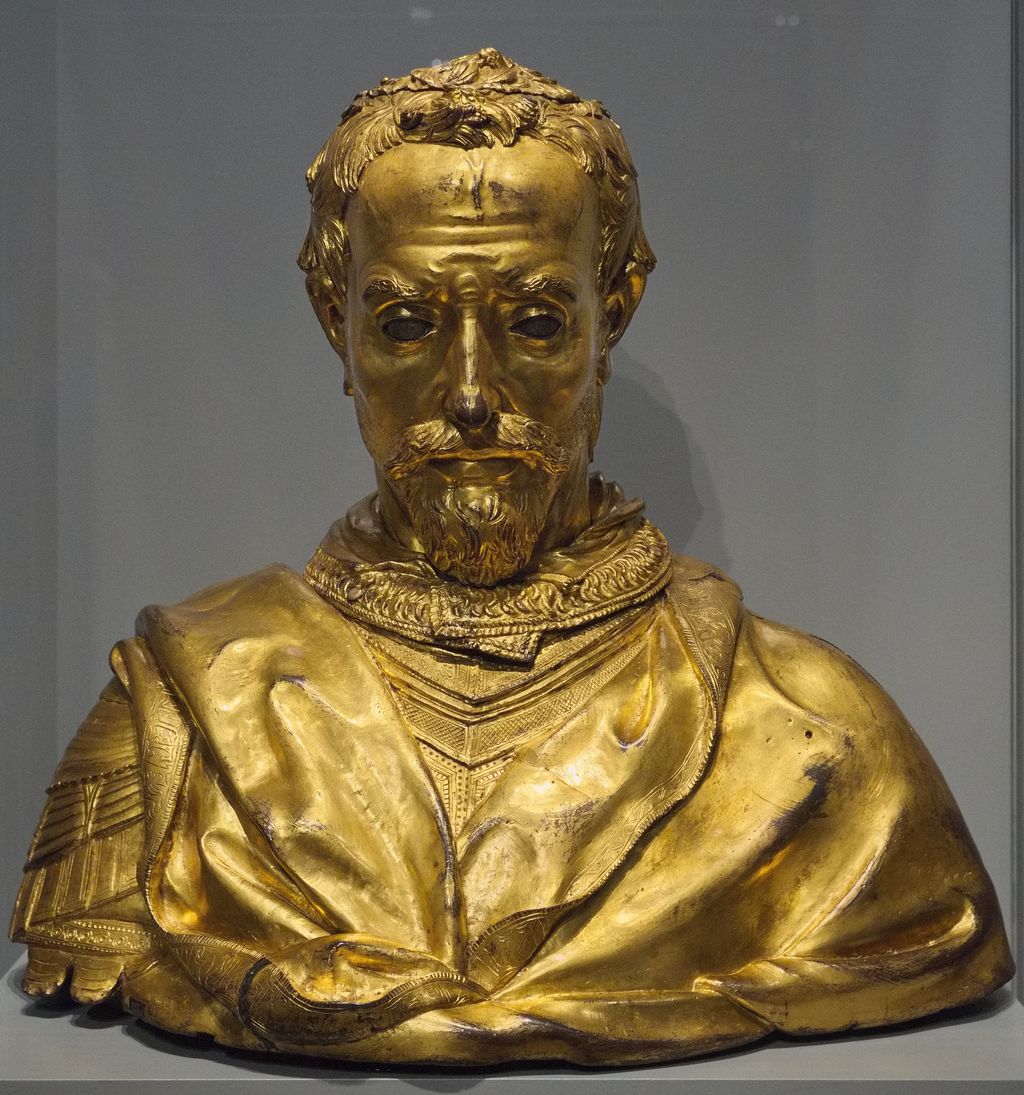
The gilt bronze reliquary from Pisa, seen face-on while on exhibition. Armin Kleiner. Image source. CC BY-SA 4.0. Resized for the web.
That arrival explains the commission, but the work itself appears in a different kind of document. In his 1427 tax declaration, Donatello counted the friars of Ognissanti among those who owed him money for a bronze figure of Saint Rossore. He in turn owed fifteen florins to Giovanni di Jacopo degli Strozzi for casting work. The entry records outstanding debts and establishes that casting had already taken place. It gives no exact date for the completion of the bust. The earlier range of about 1422–25 used in recent exhibitions and the traditional dating of about 1424–27 both place the sculpture within the same early period of Donatello’s work in bronze. The account also restores a second name to that history. The account names Donatello and identifies Giovanni as a specialist who helped turn the model into bronze. [1] [4] [5]
The face, the lid and the bronze
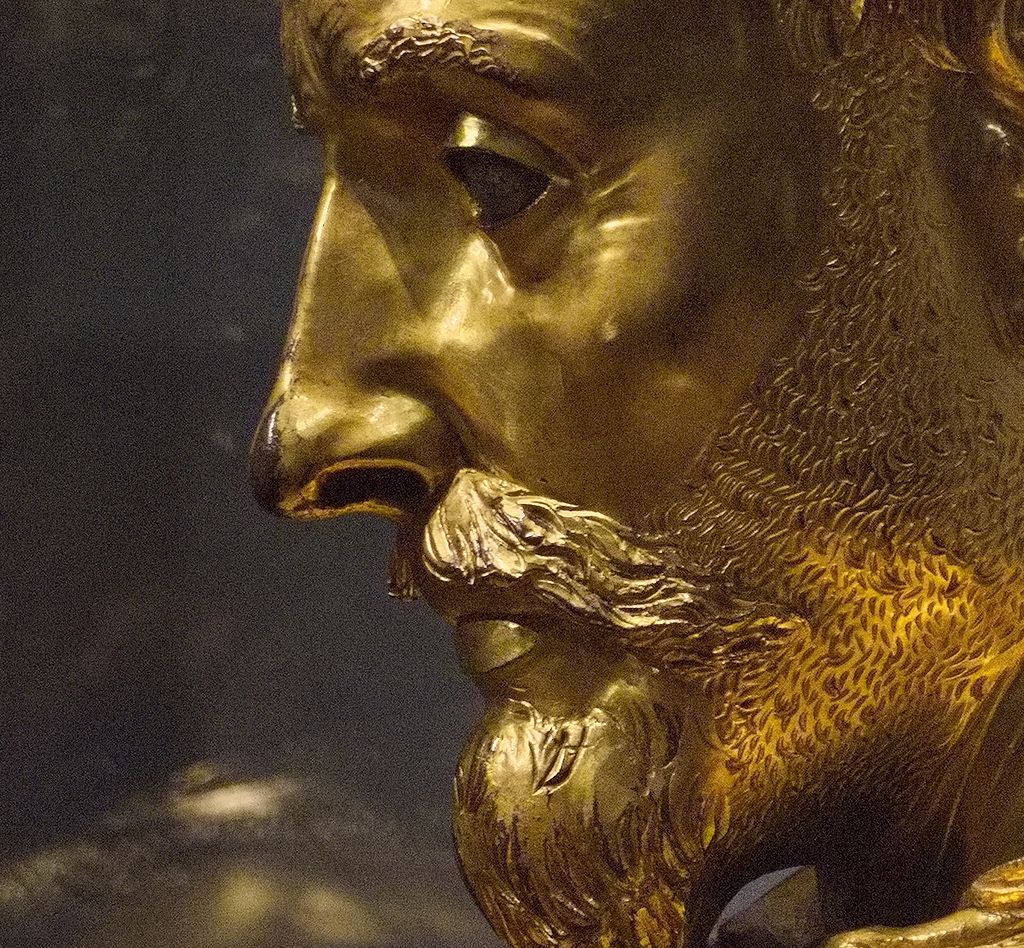
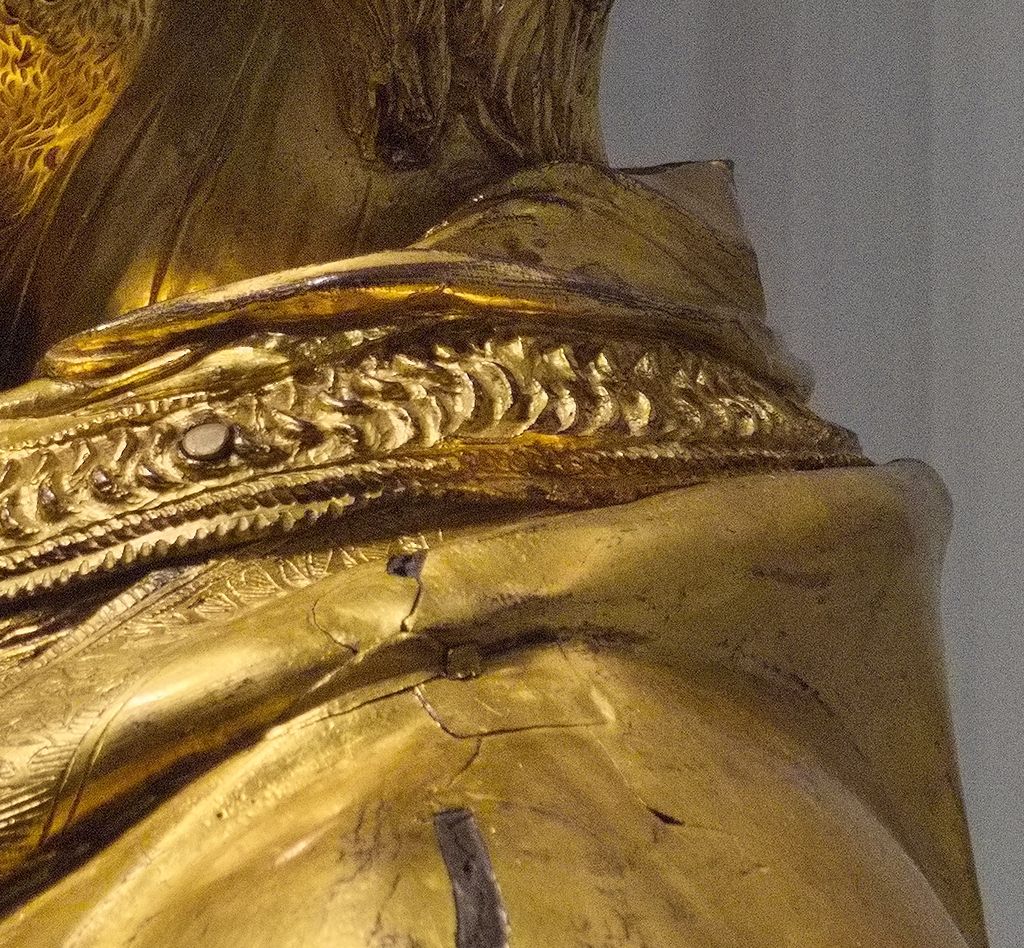
The head takes on a different character as you move around it. From the front, the creases between the brows and the heavy upper lids give the face its concentration. In profile, the forehead seems to tip forward over the cheek, and the nose and beard stand out sharply. Tiny curling marks fill the space between the ear and the much longer hair around the mouth and chin. Below the head, the edges of the cloak form broad, light-catching folds. The small repeated patterns on the collar and the armour under the cloak give the eye a finer set of details to follow. The more closely you look, the easier it is to see how many kinds of surface the sculptor made in a single material. [1] [5]
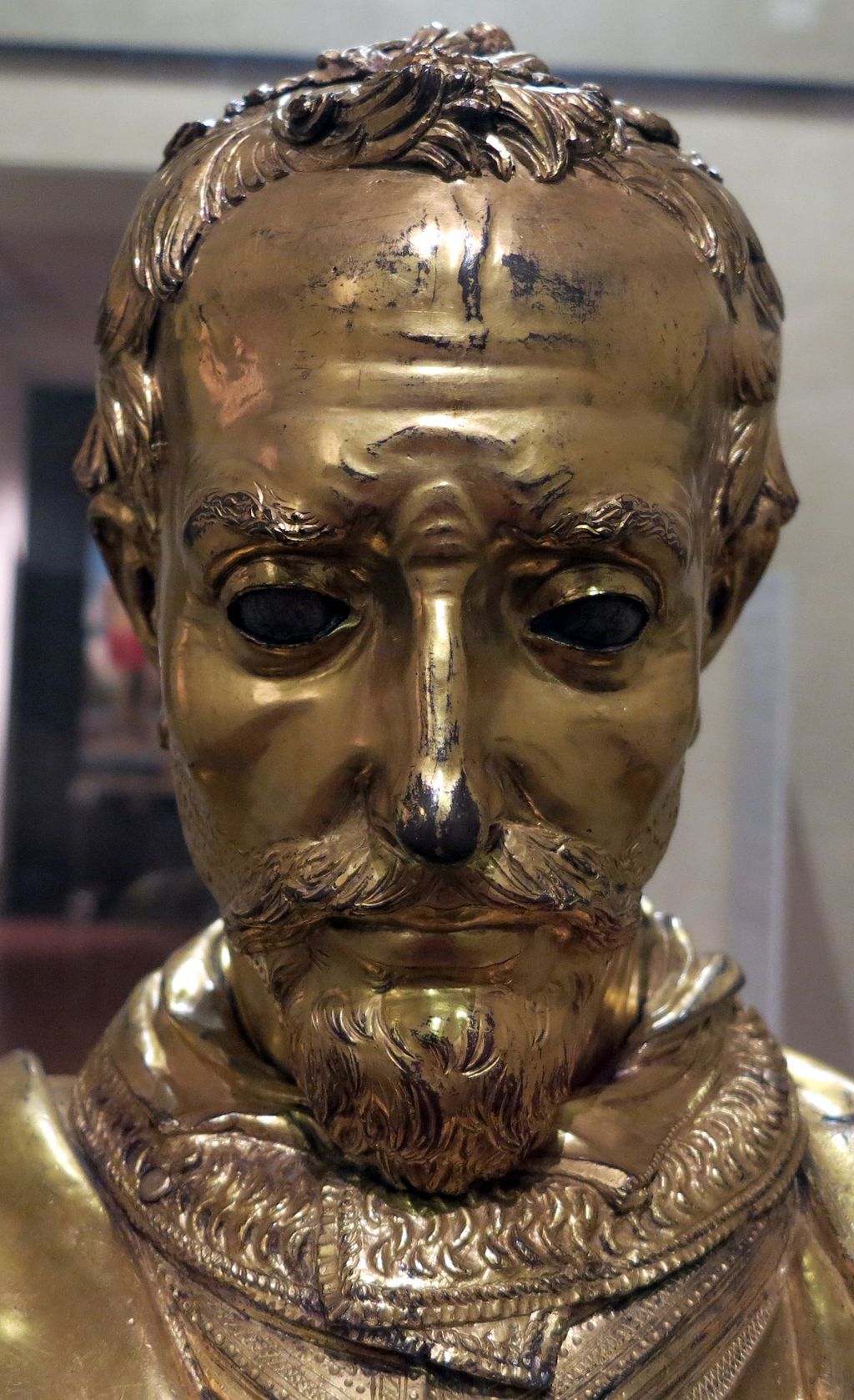
A closer frontal view of the face, brow and closely worked beard. Francesco Bini. Image source. CC BY-SA 4.0. Resized for the web.
The museum guide identifies the casting as lost-wax work. In that process a wax form is encased in a mould and melted out, leaving a space for molten bronze. Chasing then allows details in the cast metal to be sharpened or worked further with tools. Gilding gives the mantle and the skin a shared glow, while the silvering recorded at the eyes brings a second metal into an area already marked by deep shadow. Donatello was making his much larger gilt-bronze Saint Louis of Toulouse for Orsanmichele in roughly the same years. Its bishop’s robes and ceremonial ornaments called for a different play of surfaces. Here those effects are concentrated within a bust about 55 centimetres high and serve an object that had to open. [1] [2] [5] [6]
The opening at the crown gave access to the hollow interior. The sculpted head thus held the very part of the saint’s body that it represented. A comparison with the earlier Reliquary Bust of Saint Juliana, made around 1376 and now at the Metropolitan Museum of Art, brings out what Donatello kept from the medieval tradition. Juliana’s skull was also received in procession and housed in a bust. An inscription along its lower edge identifies the relic inside. At the bottom of Donatello’s bronze, the cloak spreads across the surface on which the sculpture rests. Irving Lavin drew attention to the way that edge lets the viewer see the figure and the object supporting itself at the same time. Another comparison at the Met, the later Netherlandish Reliquary Bust of Saint Balbina, uses painted and gilded oak. The painted oak of Balbina and the gilded copper of Juliana show the range of materials that could give a relic a recognisable human form. [2] [7] [8] [9]
Annotated Details from the Saint Rossore Reliquary
Select a number to jump to a detail of the sculpture.
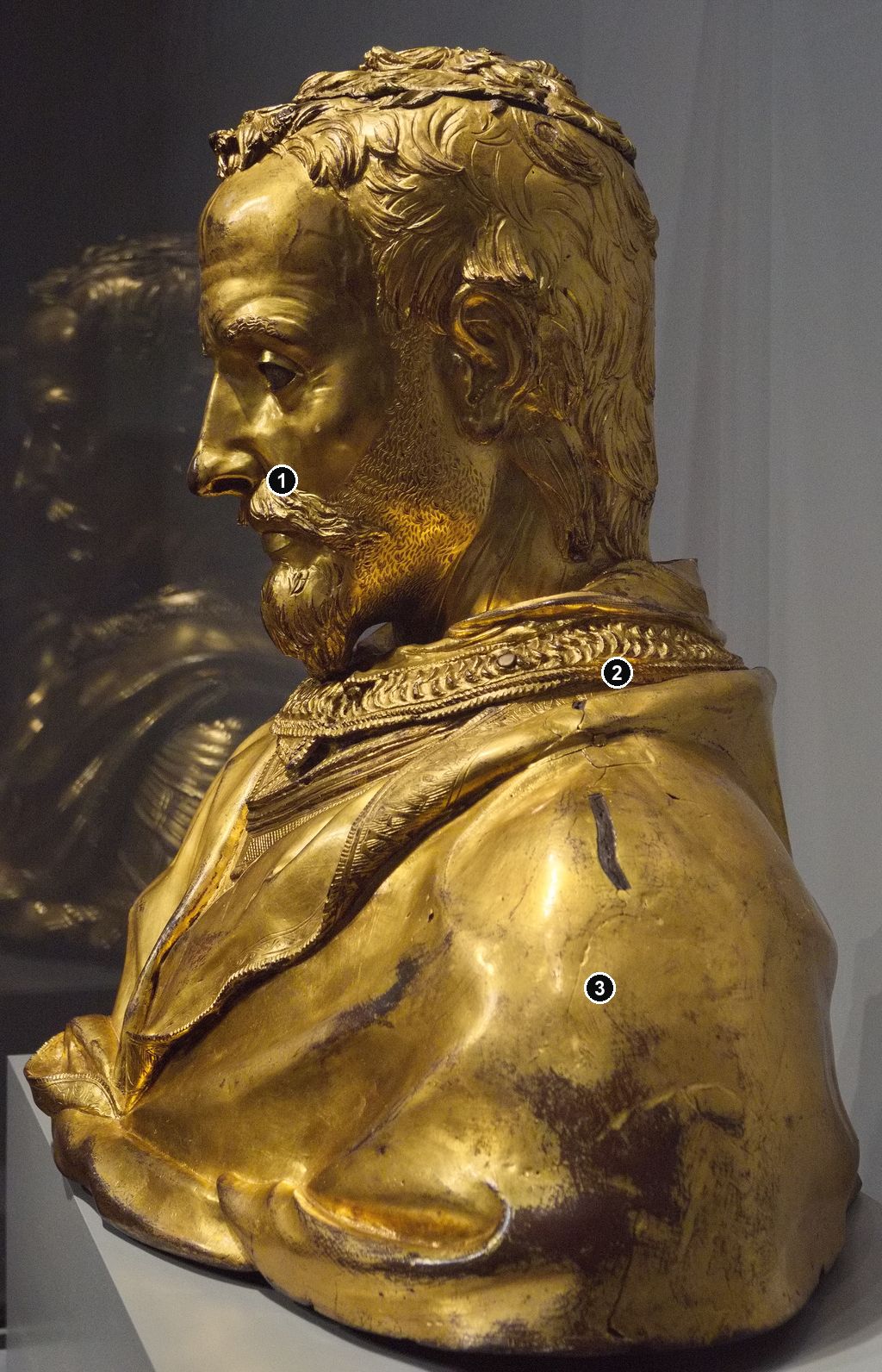
Details from THE SAINT ROSSORE RELIQUARY
Open a detail image to examine the surface more closely.
Profile of the saint
The forehead, nose and beard form a continuous profile, while gilded passages make the small features readable in side light.
The decorated collar
The narrow collar follows the neck across the shoulders. Close-set details here have a different scale from the broad curve of the chest.
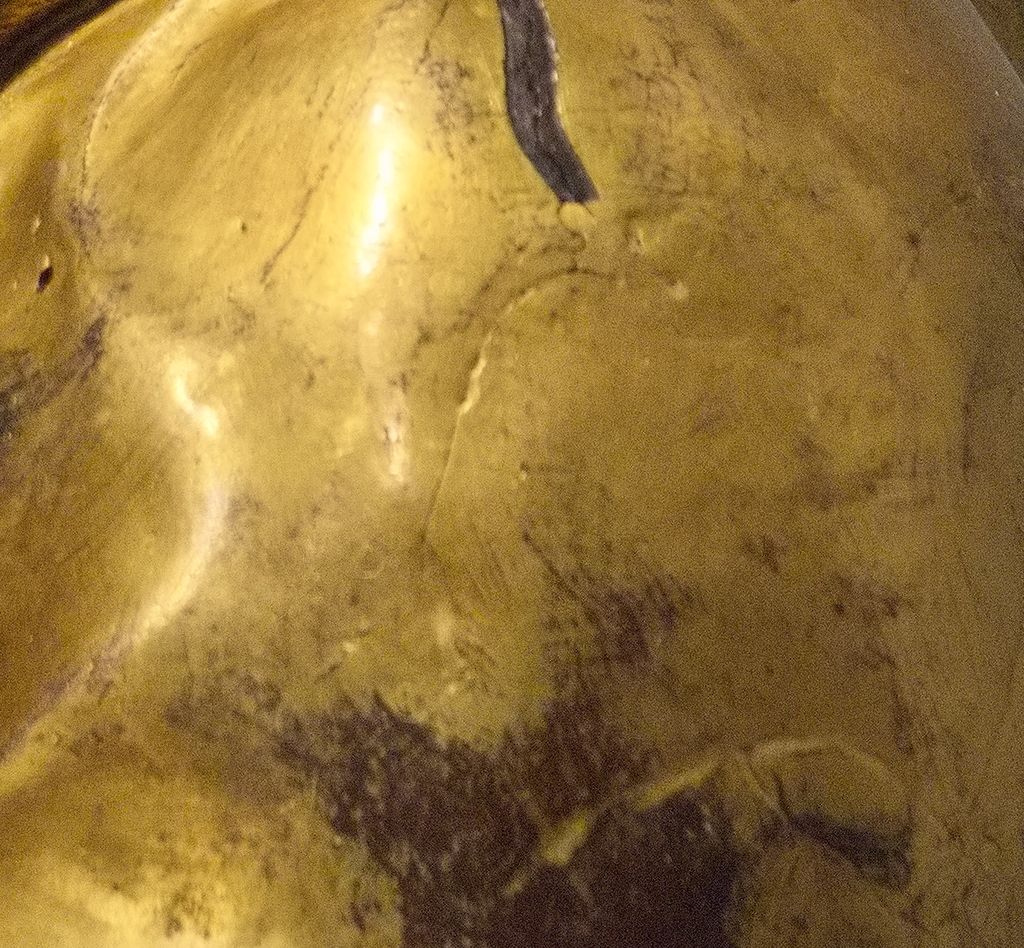
The turned shoulder
Light pools on the large surface of the shoulder, then breaks along the edge of the garment and the smaller features toward the front.
Annotated photograph and detail crops. Armin Kleiner. Image source. CC BY-SA 4.0. Resized, annotated and cropped from the original photograph.
A soldier at the altar
The reliquary was made for an altar at the inner front wall of Ognissanti, to the right of the entrance. The art historian Floriana Conte found that looking up at the bust from a kneeling position during the 2022 exhibition altered the effect of the sculpture. The downturned face drew nearer to the viewer’s line of sight. That experiment recovers something of the encounter a worshipper might have had at an altar, even though the modern display cannot reproduce the original position and lighting exactly. It also gives the tightly gathered brow a purpose beyond suggesting the character of a Roman soldier. From below, the face can appear to attend to the person looking up at it. [2] [10]
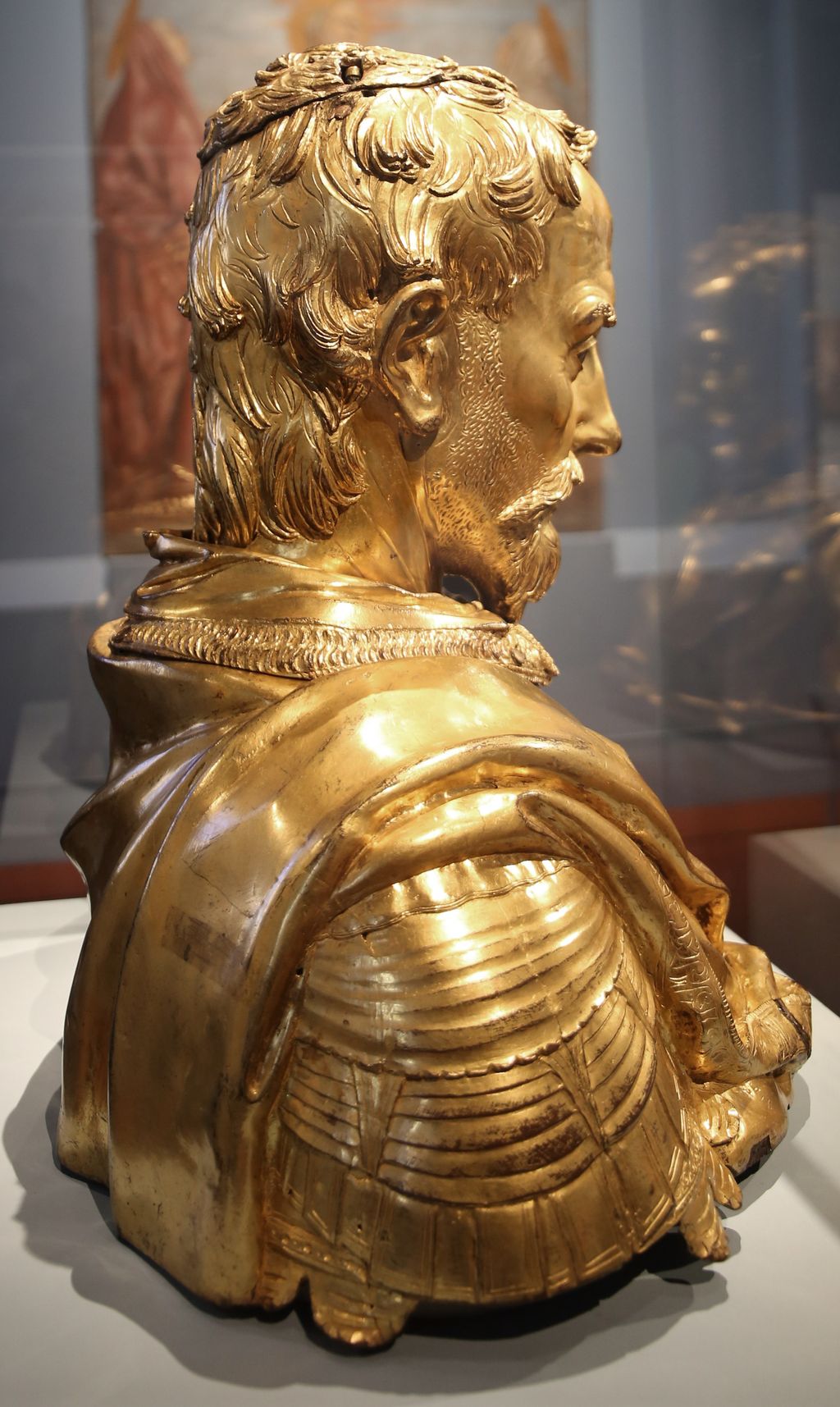
The armoured shoulder and profile show how the bronze was worked in the round. Francesco Bini. Image source. CC BY-SA 4.0. Resized for the web.
The expressive face, the format and the military dress invite comparison with ancient Roman busts. The resemblance concerns the kind of presence that a sculptured head can convey, and it leaves open how Donatello devised these particular features. A likeness of the martyr from his own lifetime is unknown. Suggestions that the saint has Donatello’s features, or that his lowered eyes capture the precise moment of his conversion, belong to the work’s history of interpretation. The armour provides a firmer clue to the intended figure. Donatello gave his earlier marble Saint George a soldier’s equipment too, but there the shield, stance and outward gaze make the saint appear ready to act. Rossore’s lowered eyes put the emphasis on a quieter kind of resolve. [2] [3] [8] [11]
The Florentine victory and the return to Pisa
On 1 June 1432 the Florentines won the Battle of San Romano, later painted by Paolo Uccello. That year the Sunday after Ascension, when Ognissanti celebrated the relic’s arrival, fell on the day of the battle. A ruling of the Florentine government published by historians Julia Miller and Laurie Taylor-Mitchell credits the victory to the saint’s intercession. It also provides for procession and offerings at Ognissanti by officials connected with the city’s guilds. A relic brought into Florence by a religious order had become part of the city’s public commemoration of a military victory. The sculpted armour now had an association that the friars could scarcely have anticipated when they commissioned the bust a decade earlier. [4] [12]
The end of the Humiliati in the sixteenth century set the bust and its contents moving again. After the order was suppressed, its property passed into new hands. The historian Giampaolo Mele records that Ludovico Covi donated the bust with the head relic in April 1591. After a stay in the Pisan monastery of San Benedetto, it was taken in solemn procession in November to Santo Stefano dei Cavalieri, the church of the Order of Saint Stephen. The bronze was new to Pisa, but the relic had come home. [3] [13] [14]
After the bust was stolen and recovered in 1977, it was moved to the Museo Nazionale di San Matteo for security. The Italian heritage catalogue records restoration in 1984. In 2022–23 the bronze travelled to exhibitions in Florence, Berlin and London before returning to the Pisan museum. [2] [5] [13] [14]
The Pisa museum and recent exhibition catalogues identify the bronze as the original made for Ognissanti. Reviewing the 2022 shows, Volker Herzner took the unusually high forehead, heavy moustache and distinctive lower edge as reasons to ask whether a later bust could have replaced Donatello’s documented work. He proposed the possibility on stylistic grounds. Francesco Caglioti, curator of the Florence show, rejected the suggestion. [1] [2] [6] [15] [16]
A frontal view brings out the symmetry of the face and the contrasting fall of the cloak over the shoulders. The side view shows the break across the hair most clearly. Once you have seen it, the gaze and the lid hold your attention together. Donatello used some of the bronze’s most intricate modelling to give the saint a convincing physical presence and to accommodate the purpose for which the friars commissioned him. [2] [5] [13]
Donatello sculpture directory
| Name | Date | Medium and record |
|---|---|---|
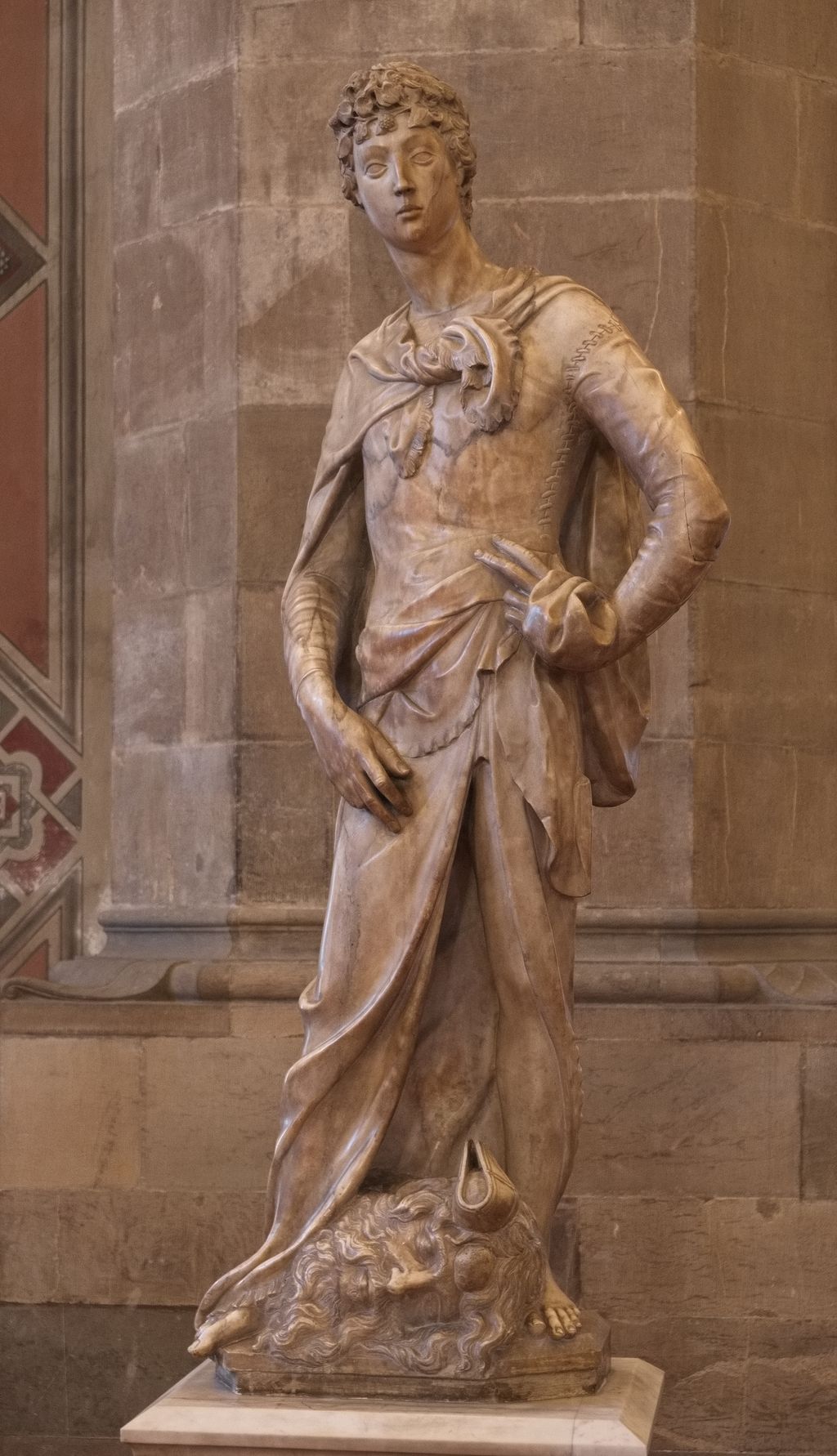
| Marble David | 1408–09, adapted 1416 | Carved Carrara marble Catalogue. |
| Saint John the Evangelist | c. 1409–15 | Carved marble Catalogue. |
| Saint Mark | 1411–13 | Carved Carrara marble Catalogue. |
| Saint George and its dragon relief | c. 1415–17 | Marble statue and marble relief Catalogue. |
| Marzocco | c. 1417–20 | Carved sandstone Catalogue. |
| Saint Louis of Toulouse, Florence | 1418–25 | Gilt bronze and mixed media Catalogue. |
| Pazzi Madonna | c. 1420s | Marble relief Catalogue. |
| Reliquary Bust of Saint Rossore | c. 1420s | Gilt bronze Catalogue. |
| The Prophet Jeremiah | 1420s–30s, disputed | Marble Catalogue. |
| Zuccone | c. 1420s–30s | Marble Catalogue. |
| Feast of Herod, Siena | 1420s | Gilded bronze relief Catalogue. |
| Ascension with Christ Giving the Keys to Saint Peter | c. 1428–30 | Marble relief Catalogue. |
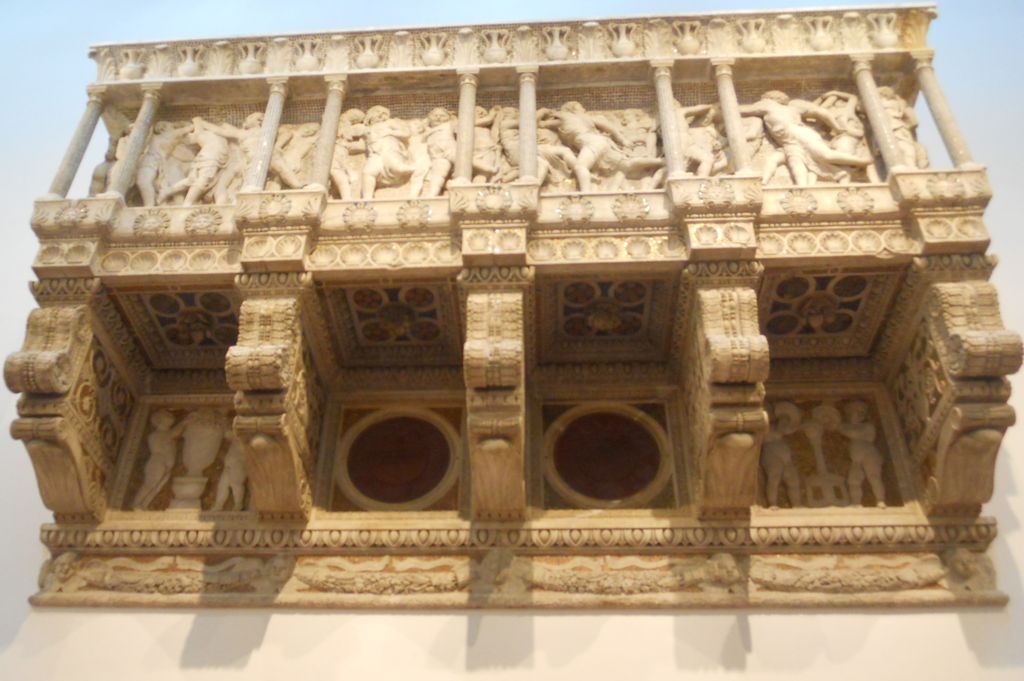
| Cantoria | 1433–39 | Marble and mosaic Catalogue. |
| Amor-Atys | c. 1435–40 | Partly gilded bronze Catalogue. |
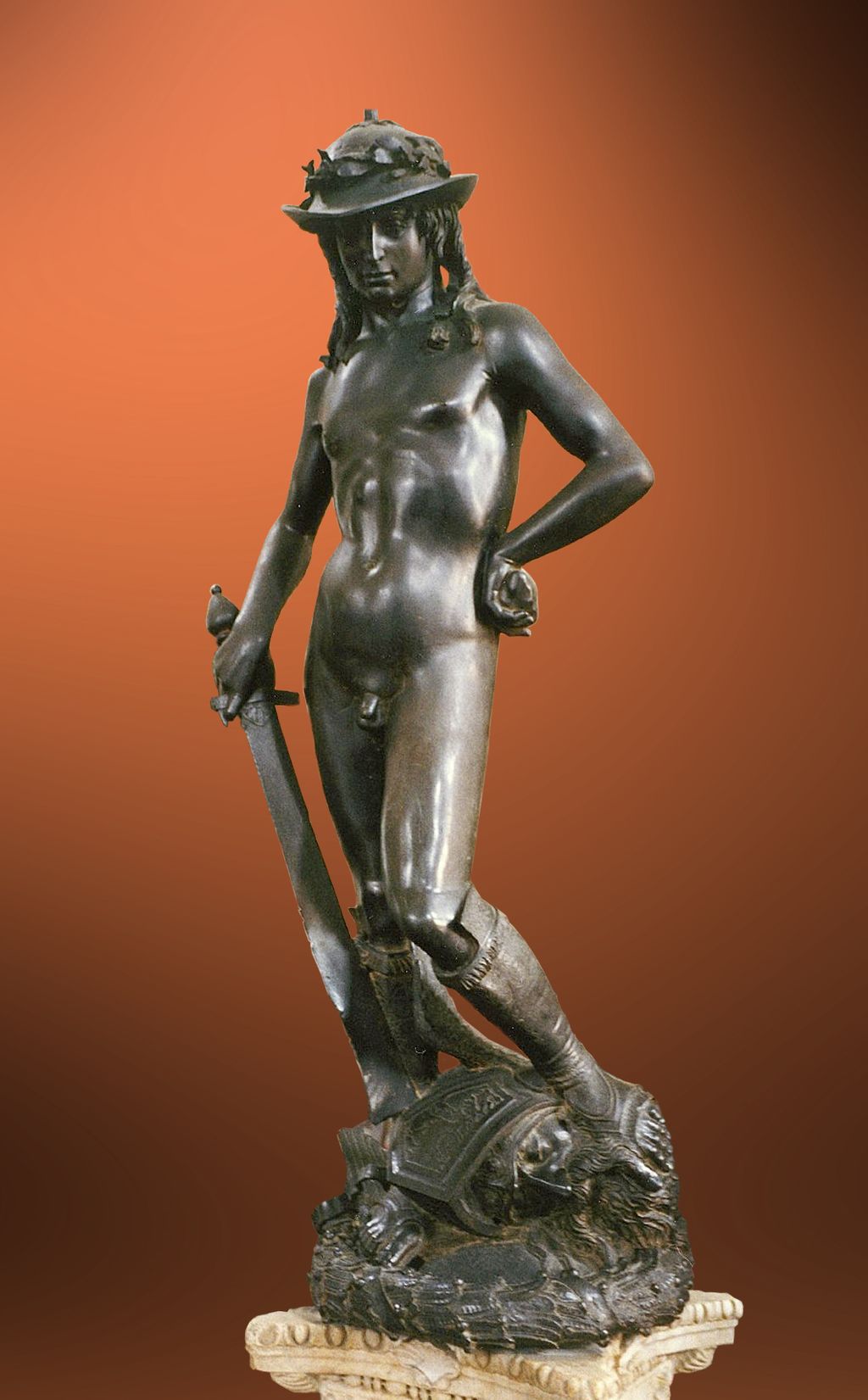
| Bronze David | c. 1435–40, disputed | Partly gilded bronze Catalogue. |
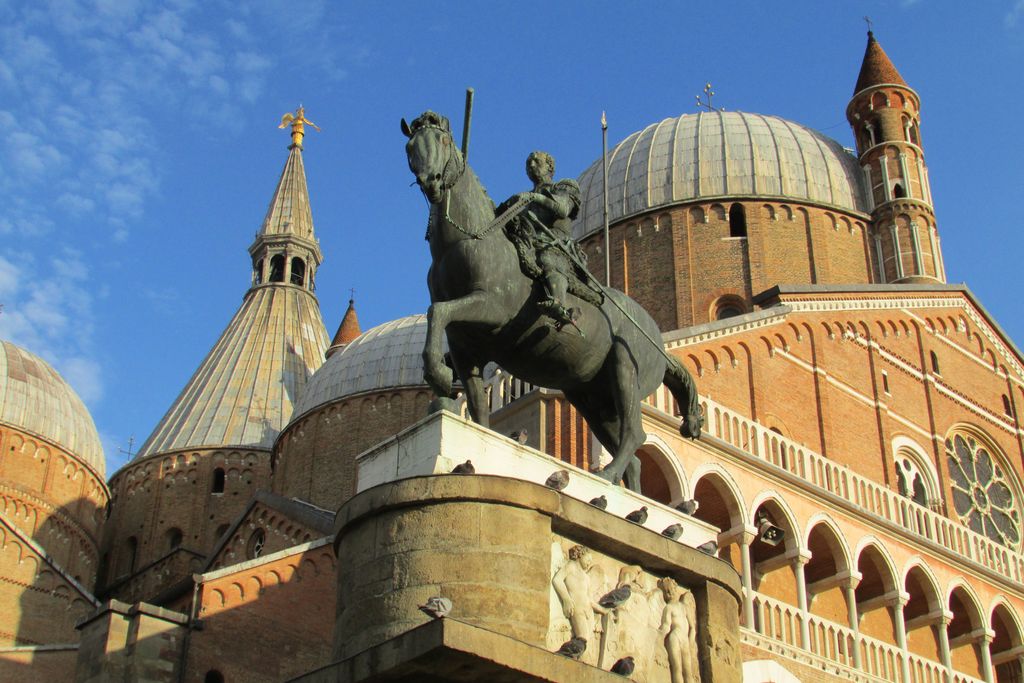
| Gattamelata | Installation agreement, 1453 | Bronze and stone Catalogue. |
| Santo altar | Mid-fifteenth century | Bronze and limestone ensemble Catalogue. |
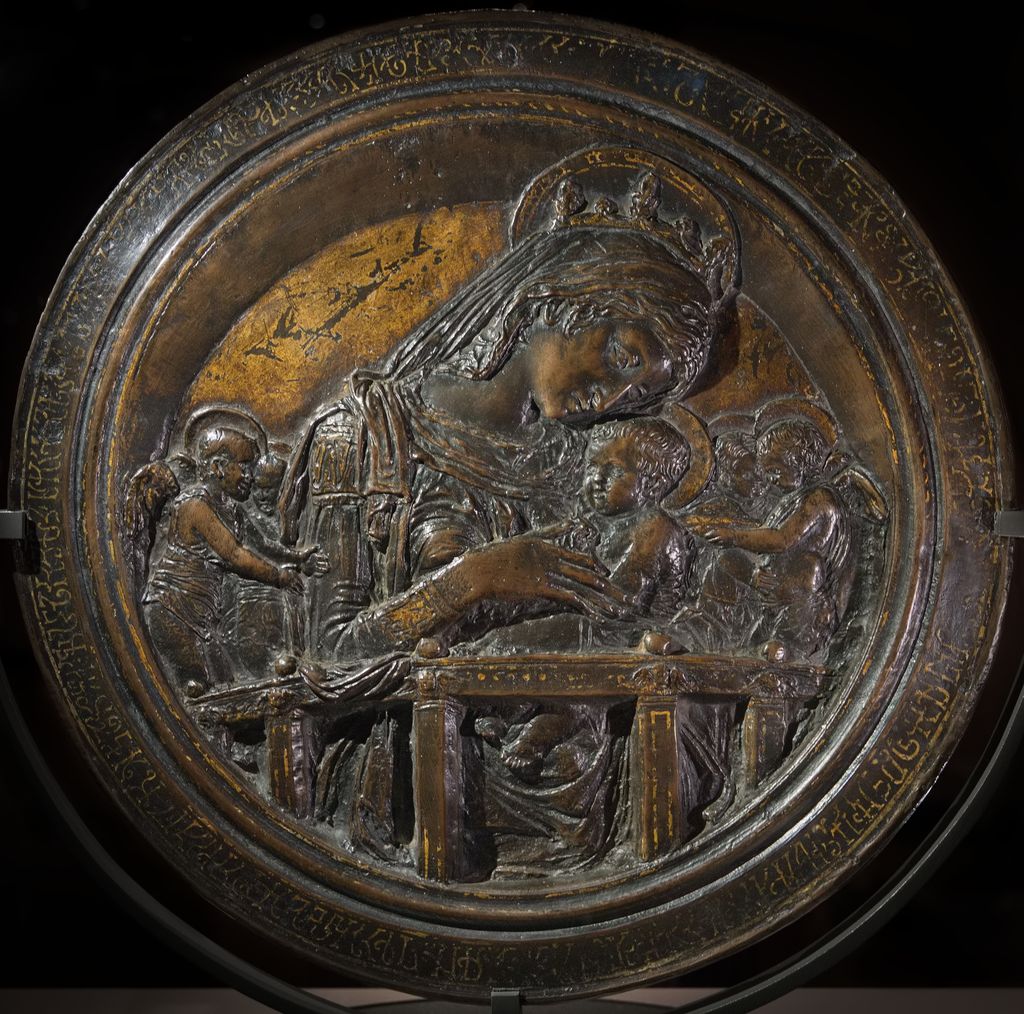
| Chellini Madonna | Given in 1456 | Partly gilded bronze tondo Catalogue. |
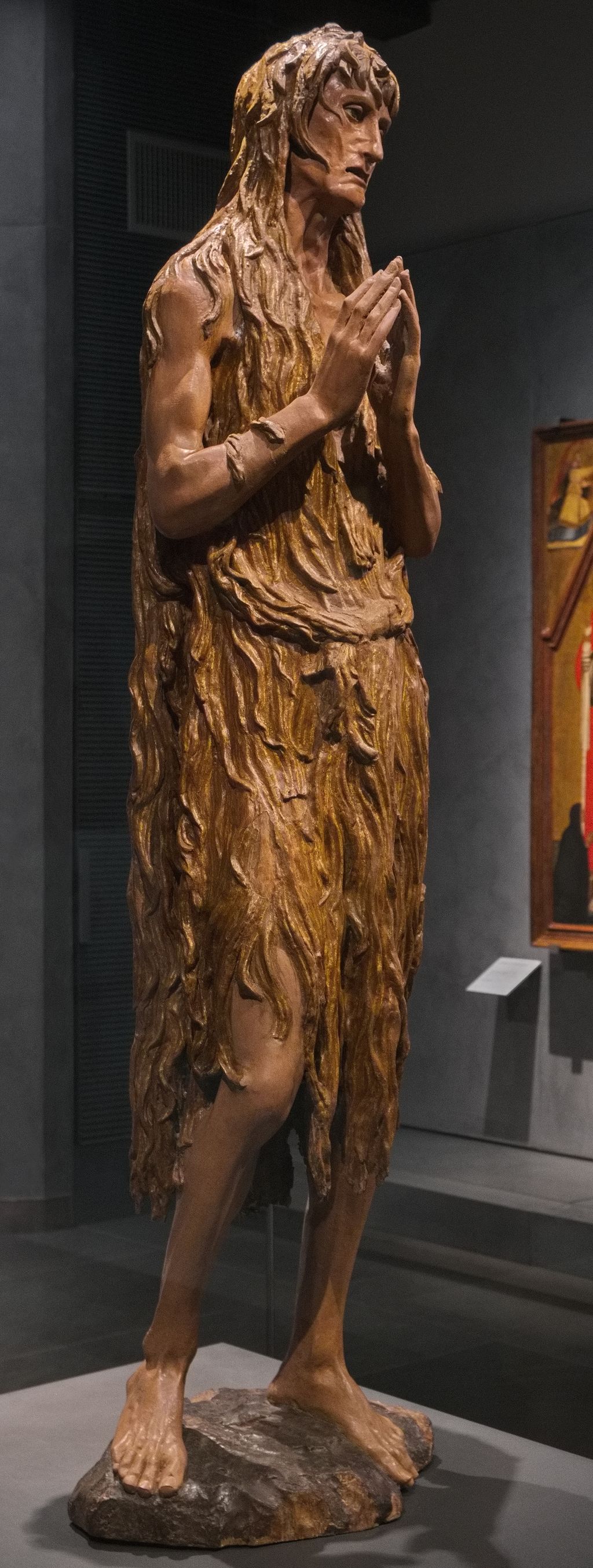
| Penitent Magdalene | c. 1453–55 (Opera) | Poplar, stucco, pigments and gold Catalogue. |
| Judith and Holofernes | Late 1450s–early 1460s | Bronze with surviving gilding Catalogue. |
| Pulpit of the Passion | Late work and later assembly | Bronze reliefs, Donatello and collaborators Catalogue. |
| Bust traditionally called Niccolò da Uzzano | Fifteenth century | Painted terracotta, attribution disputed Catalogue. |
| Prato Cathedral exterior pulpit | Commissioned 1428; carved 1430s | Marble reliefs, Donatello and Michelozzo Catalogue. |
| Cavalcanti Annunciation | c. 1433–35 | Gilded sandstone and terracotta Catalogue. |
| Crucifix at Santa Croce | Early fifteenth century | Painted wood Catalogue. |
| Madonna of the Clouds | c. 1425–35 | Marble relief Catalogue. |
| Old Sacristy Doors | Fifteenth century | Two paired bronze doors Catalogue. |
| Resurrection Pulpit | Late work and later assembly | Bronze reliefs, Donatello and collaborators Catalogue. |
| Brancaccio tomb | 1420s | Donatello, Michelozzo and assistants, mixed materials Catalogue. |
| Saint John the Baptist, Venice | 1438 | Polychromed and gilded wood Catalogue. |
| Sacrifice of Isaac | Early fifteenth century | Donatello and Nanni di Bartolo, marble Catalogue. |
| Madonna of Via Pietrapiana | Mid-fifteenth century | Terracotta Catalogue. |
| Miracle of the Mule | Mid-fifteenth century | Gilded bronze panel for the Santo altar Catalogue. |
| Padua Crucifix | Mid-fifteenth century | Cast bronze Catalogue. |
| Dancing Spiritello, Bargello | Fifteenth century | Bronze Catalogue. |
| Young Prophet from the Porta della Mandorla | c. 1404–09 | White marble, attributed to Donatello Catalogue. |
| Prophet or Apostle from the Duomo north tribune | Early fifteenth century | White marble, possibly Donatello Catalogue. |
| Beardless Prophet | 1415–18 | White marble Catalogue. |
| Sibyl and Prophet of the Porta della Mandorla | 1422 | Carved marble heads for the portal Catalogue. |
| Faith, Siena baptismal font | 1420s | Gilded bronze figure Catalogue. |
| Hope, Siena baptismal font | 1420s | Gilded bronze figure Catalogue. |
| Feast of Herod, Lille | c. 1430 | Carrara marble relief Catalogue. |
| Piot Madonna | c. 1440–60 | Polychrome terracotta with glass and wax inlays Catalogue. |
| Carafa Horse Head | c. 1456–58 | Cast bronze Catalogue. |
| Pazzi Madonna workshop version, Louvre | c. 1450 | Polychrome gesso, Donatello’s workshop Catalogue. |
| Pazzi Madonna tondo, Rijksmuseum | c. 1425–50 | Plaster and stucco, after Donatello Catalogue. |
| Sprite | c. 1430–40 | Bronze, sculptor or metalsmith close to Donatello Catalogue. |
Discussion
Look again at the images and ideas explored in Saint Rossore Reliquary. These editorial prompts invite your observations.
Reader Insights
How does the direction of the gaze change when you compare the front and profile views?
What would the bronze shoulders and the enclosed relic have meant to a viewer who saw the bust at an altar?
Join the Conversation
Share a detail, comparison or question about Saint Rossore Reliquary below.
References
- Victoria and Albert Museum, “Donatello – a Master at Work,” introductory caption and section on bronze. View source.
- Laura Cavazzini, “Reliquary Bust of Saint Rossore,” in Neville Rowley, ed., Donatello: Inventor of the Renaissance, 2022, cat. 50, pp. 232–33. View source.
- Giampaolo Mele, San Lussorio nella storia: culto e canti. Origini. Medioevo. Età spagnola, 2005, especially the Pisan and Florentine history and the notes on the return. View source.
- Julia Miller and Laurie Taylor-Mitchell, “Donatello’s ‘S. Rossore’, the Battle of San Romano and the Church of Ognissanti,” The Burlington Magazine 148, no. 1243, 2006, pp. 685–88. View source.
- Istituto Nazionale di Studi sul Rinascimento, “Busto-reliquiario di San Rossore,” Fototeca, front view, with date and material description. View source.
- Museo Nazionale di San Matteo, general guide, entry 19, “Donatello, Reliquary of San Lussorio.” View source.
- The Metropolitan Museum of Art, “Reliquary Bust of Saint Juliana,” collection entry 471908. View source.
- Irving Lavin, “On the Sources and Meaning of the Renaissance Portrait Bust,” The Art Quarterly 33, no. 3, 1970, especially p. 212 and fig. 14. View source.
- The Metropolitan Museum of Art, “Reliquary Bust of Saint Balbina,” collection entry 468720. View source.
- Floriana Conte, “Un viatico per due secoli di fortuna di Donatello,” Predella 53, 2023, pp. 198–99 and fig. 12. View source.
- Jeanette Kohl, “No One in Particular. Donatello’s San Rossore,” in Inventing Faces: Rhetorics of Portraiture Between Renaissance and Modernism, 2013, pp. 15–28. View source.
- Dillian Gordon, “The Battle of San Romano,” National Gallery catalogue, The Fifteenth Century Italian Paintings, vol. 1, 2003, entry NG583. View source.
- Ministero della Cultura, “Busto reliquiario di San Rossore di Donatello,” announcement of the bust’s return to Pisa, 27 June 2023. View source.
- Soprintendenza Archeologia, belle arti e paesaggio per le province di Pisa e Livorno, “San Rossore,” Catalogo generale dei Beni Culturali, record 0900670448. View source.
- Volker Herzner, “Wie forschen, wie argumentieren? Kontexterschließung und Stilgeschichte versus Quellenexegese,” Kunstchronik, 2023, pp. 121–22 and fig. 4. View source.
- Francesco Caglioti, “Le mostre donatelliane del 2022 e i mal di pancia della critica accademica austro-tedesca,” Studi di Scultura 6, 2024, pp. 13–14 and n. 13. View source.
- Victoria and Albert Museum, Donatello’s David. View source
- Opera del Duomo, Donatello and the Opera del Duomo. View source
- Ministero della Cultura, David with the Head of Goliath, Bargello bronze. View source
- Save Venice, Donatello’s Equestrian Monument to Gattamelata. View source
- Opificio delle Pietre Dure, L’ultimo Donatello. View source
More DONATELLO Sculptures
Marble David
Armin Kleiner. Image source. CC BY-SA 4.0. Resized for the web.
Bronze David
Patrick A. Rodgers. Image source. CC BY-SA 2.0. Resized for the web.
Cantoria
Erik Drost. Image source. CC BY 2.0. Resized for the web.
Gattamelata
Chris Light. Image source. CC BY-SA 4.0. Resized for the web.
Penitent Magdalene
Armin Kleiner. Image source. CC BY-SA 4.0. Resized for the web.
Chellini Madonna
Armin Kleiner. Image source. CC BY-SA 4.0. Resized for the web.
