


 by Tom Gurney
Tom Gurney BSc (Hons) is an art history expert with over 20 years experience
Published on June 19, 2020 / Updated on November 29, 2026
Email: tomgurney1@gmail.com / Phone: +44 7429 011000
The Battle of San Romano: Introduction
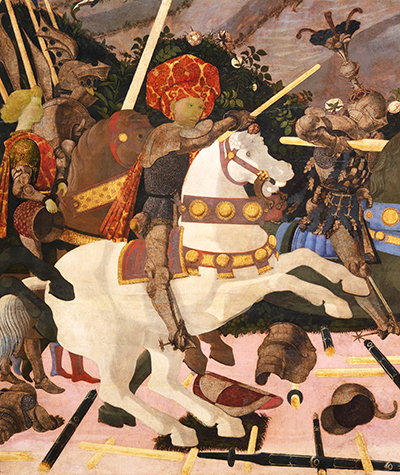
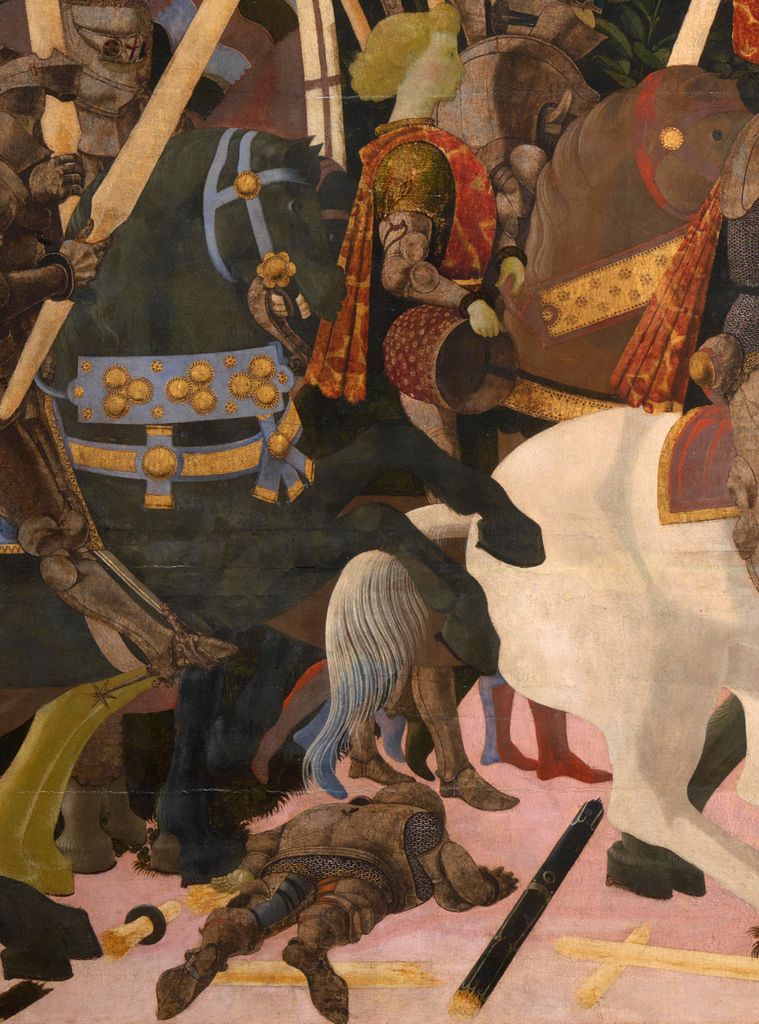
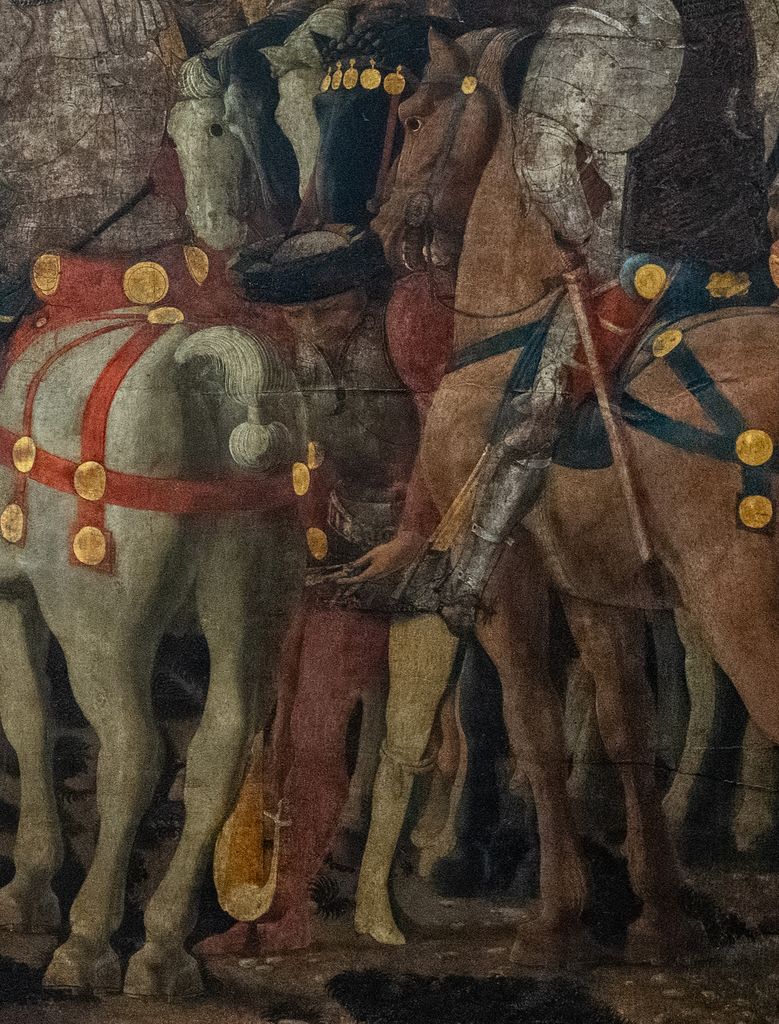
A broken lance lies beneath a dark horse in Paolo Uccello’s London panel of The Battle of San Romano. Its yellow shaft ends in a pale pink tip. Uccello drew and edged the tip, leaving off the silver leaf that gave other lance heads their shine. Just above this small piece of unfinished work, the Florentine commander Niccolò da Tolentino rides into the scene on a white horse. His raised baton sets the troops in motion. The fragments underfoot lead the eye into the picture, where a fallen man lies with his feet pointing towards us. Uccello gives a quiet patch of trampled ground almost as much to do as the charge behind it. [1] [2]
The fighting took place on 1 June 1432 in the Arno valley. Uccello’s three painted episodes belong to the National Gallery in London, the Uffizi in Florence and the Louvre in Paris. Seen together, they give three very different forms to the same victory. First comes an advance that can still be followed from rider to rider. Then the fighting closes around a man falling from his horse. Finally a screen of upright lances begins to tip as reinforcements enter. The sequence also preserves traces of two Florentine interiors. Follow the shape of a corner or the direction of a lance and the pictures tell a story about their life on the wall as well as their subject. [1] [3] [4]
At a Glance
- Battle1 June 1432
- FormatThree painted wooden panels
- CollectionsNational Gallery, Uffizi Galleries and Musée du Louvre
This work across Paolo Uccello’s career
Battle of San Romano (current article)
Probably c.1438–40 · GordonResurrection glass
1443–44The Hunt in the Forest
c.1465–70The Urbino predella
1467–68Saint George and the Dragon · London
About 1470Contents
- The battle and its public memory
- The three episodes in order
- When the panels were painted
- From the Bartolini Salimbeni to Lorenzo de’ Medici
- How the paintings fitted two different rooms
- What survives of the original surfaces
- Perspective, armour and the movement of the eye
- Dispersal and the announced reunion
- Annotated details
The battle and its public memory
San Romano was one encounter in Florence’s war against Lucca, which lasted from 1429 to 1433. Control of access to the port of Pisa was at stake. Lucca had allies in Genoa, Milan and Siena, and the Sienese forces at San Romano were led by Bernardino della Carda, who had previously fought for Florence. Niccolò da Tolentino was cut off from the main body of his troops during the fighting. Micheletto Attendolo da Cotignola came to his aid. The Florentines celebrated a victory, although the Sienese also held thanksgiving services and accounts disagreed on the outcome. The diplomatic settlement came the following year, when Cosimo de’ Medici met representatives of the Visconti in April 1433. The pictures give a decisive shape to an encounter whose meaning was disputed from the start. [1] [5]
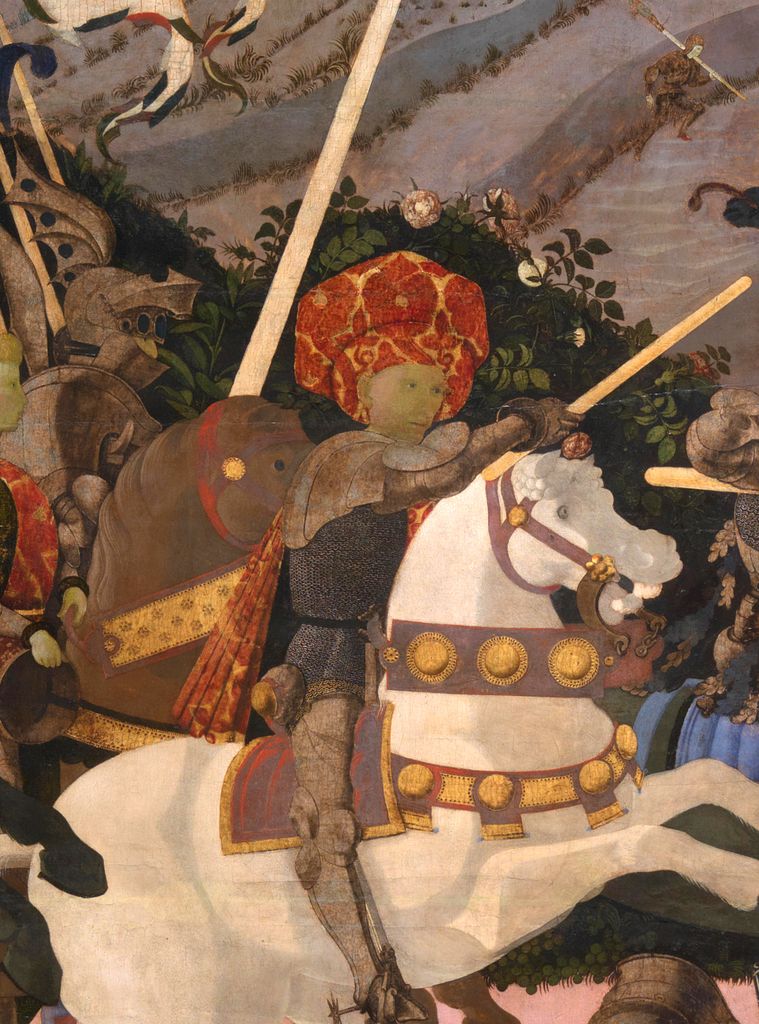
Florence turned Tolentino’s exploits into a public ceremony. On the feast of Saint John the Baptist in June 1433, the humanist Leonardo Bruni delivered an oration in his honour. The Signoria presented the commander with a decorated helmet, a horse with rich purple and gold coverings, and a baton signifying authority. Uccello’s Tolentino carries a baton and wears an elaborately patterned hat. His page carries his helmet. The painting brings the signs of civic honour into the midst of battle, where they make the commander recognisable across a crowded room. Wendy Wegener, as discussed by Dillian Gordon, connects the raised horse and its composed rider with the equestrian honours Bruni invoked from ancient Rome. Tolentino died a prisoner in Milan in 1435. Florence brought back his body for burial in the cathedral, where Andrea del Castagno later painted his equestrian memorial. [1]
The written accounts and paintings can be compared closely without expecting an exact match. The record includes an eyewitness account by Maso degli Albizzi and a narrative in Matteo Palmieri’s Annales. The vines, brambles and figures cresting the hill in the Uffizi panel have been linked to Palmieri. Petra Pertici saw a closer match between the London landscape and Albizzi’s account of the terrain. Gordon finds no single surviving text that accounts for the series as a whole. Even an apparently small motif can serve several purposes. Trumpeters with puffed cheeks belong to the world of military signals, but they also ask us to imagine the sound reaching the men around them. Hannah Baader brings the trumpets and open mouths into her reading of how the paintings evoke noise and shock, despite the rich pageantry of their surfaces. [1] [5]
The three episodes in order
London. Tolentino leads the Florentines
In Niccolò Mauruzi da Tolentino at the Battle of San Romano, the white horse and the commander’s patterned headgear make a clear interval amid the dark horses and repeated metal surfaces. The device known as Solomon’s knot identifies him. Behind him the greenery is thick with fruit and blossom. The broken weapons seem to have settled into an order of their own across the foreground, sending the eye back towards the horses. In the distance the forms grow small quickly. The flat profile of the horse and the sharply foreshortened figure below it let us take in the display at a glance and then discover how steeply the ground recedes. The National Gallery catalogues NG583 as probably about 1438–40. The poplar panel measures 182 × 320 cm and is painted mainly in egg tempera, with some oil. [1] [6]
Florence. A commander falls from his horse
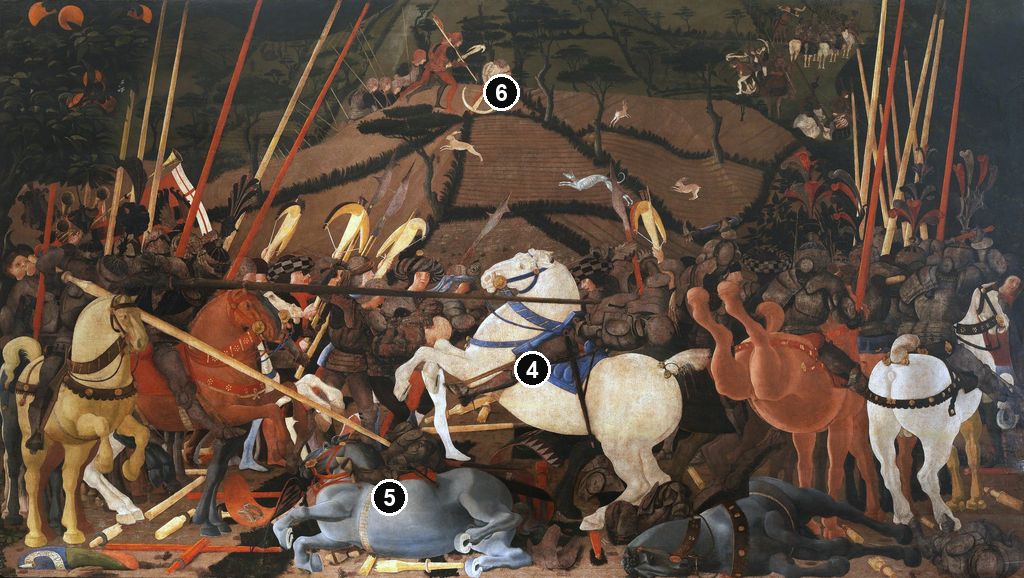
In the Uffizi panel of the unhorsing, a long lance crosses towards the rider tipping from the saddle. Behind that action, the forest of shafts and crossbows makes direction matter. Daniela Parenti notes that the slight forward tilt of the Florentine weapons and the backward tilt on the opposing side anticipate the result. Higher up, field boundaries and small figures give the eye a way through to an occupied landscape beyond the fighting. The Uffizi identifies the fallen rider as Bernardino della Carda and the attacker as Tolentino. Pietro Roccasecca, whose argument Gordon discusses, understood the fall as an enactment of the enemy’s defeat and pointed to accounts in which Bernardino retreated. The picture makes the unhorsing unmistakable. The personal identification depends on how the image is read alongside the written evidence. The Uffizi gives a date of about 1435–40 and records the tempera on wood as 1890 n. 479, 182 × 323 cm. This panel carries the signature PAULI UGIELI OPUS at lower left. [1] [3]
Paris. Micheletto’s mounted men enter the fight
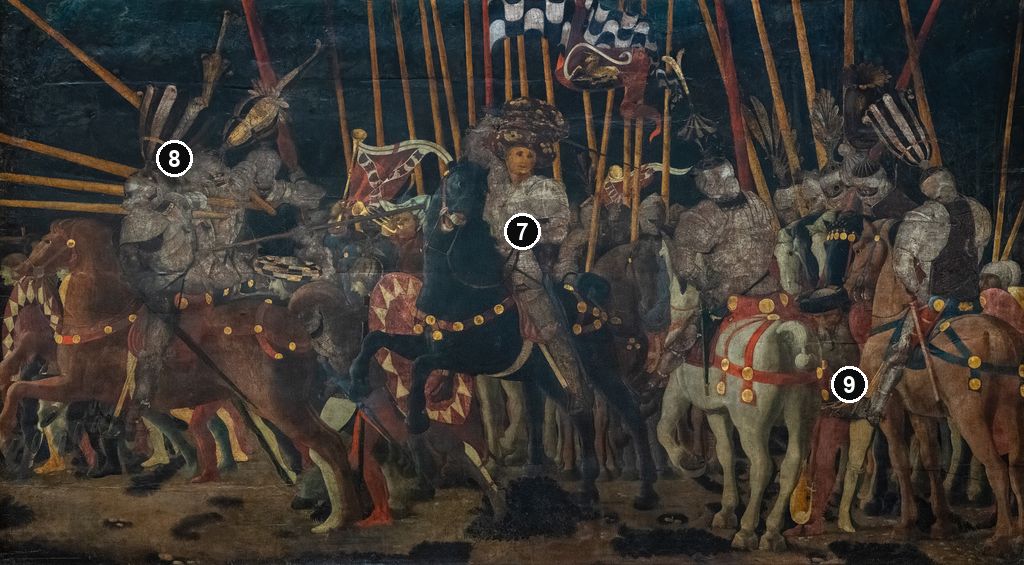
In the Louvre panel of Micheletto Attendolo’s counterattack, the barefaced commander stands out among helmets, a rearing horse and an array of shafts poised at different angles. Compare the waiting lances with the group to the left, where they are already lowering. The movement travels across the picture through that change of angle. The riders fill more of the surface than in the earlier episodes, and their overlapping bodies replace the distant landscape that opens up behind the fighting in London and Florence. Roccasecca proposed a different subject for this panel, the Battle of Anghiari. Gordon points out that the 1495 claim describes three San Romano panels and gives no separate Anghiari subject. The Louvre identifies its work as the counterattack at San Romano and catalogues MI 469, 182 × 317 cm, broadly to 1450–75. Its medium is given as possibly tempera on wood. [1] [4]
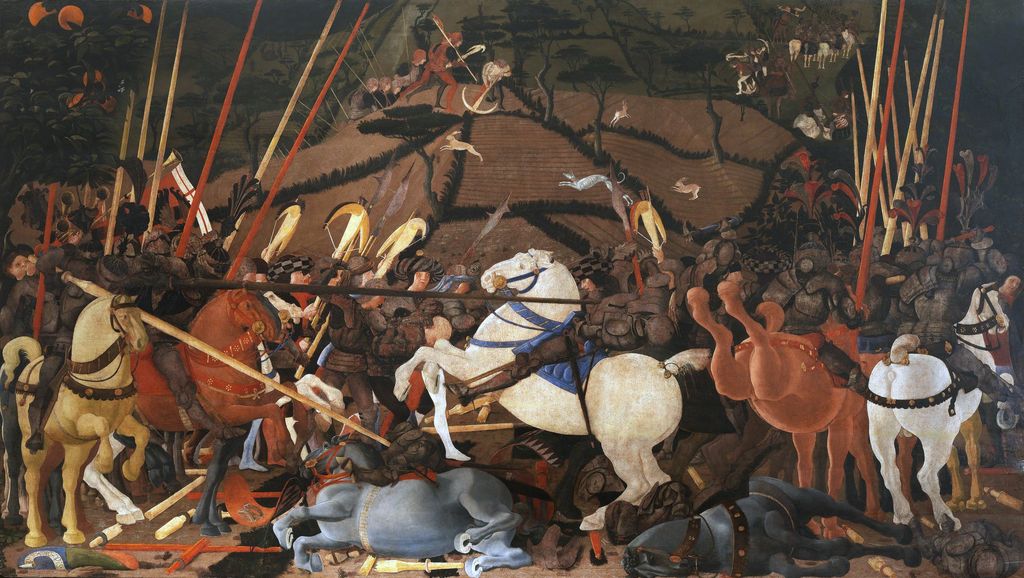
The Florence San Romano panel, with the fall of Bernardino della Carda at the centre. Image source. Public domain.
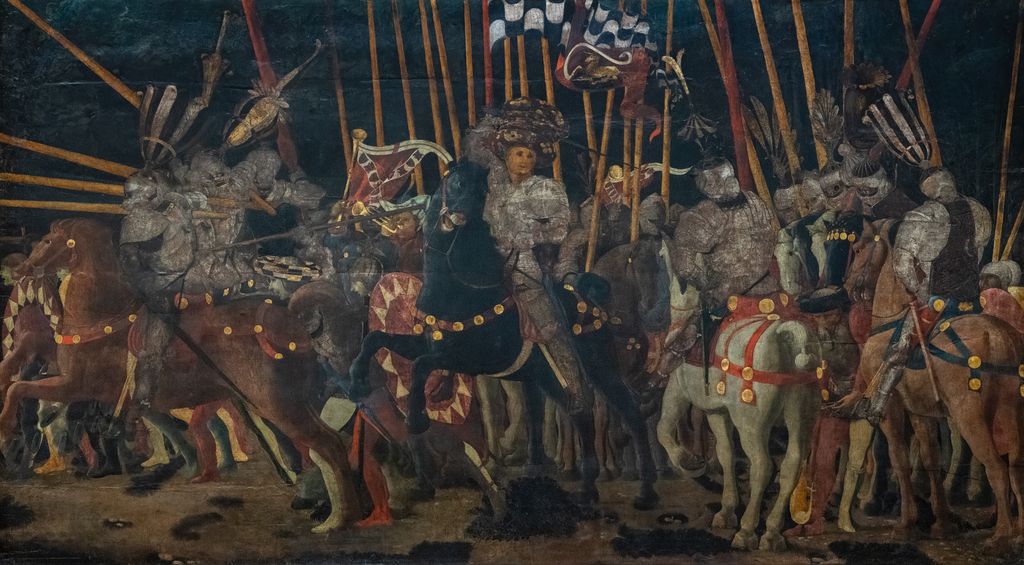
The Paris San Romano panel, Musée du Louvre MI 469, with Micheletto da Cotignola leading the counterattack. Image source. CC0 / Public domain.
When the panels were painted
The museum dates answer a different question from the date of the battle. The London and Florence ranges overlap near the end of the 1430s. The Louvre’s date band falls later, even though the same dossier places the work in a probable Bartolini commission and includes a date of around 1438 in its provenance account. The sequence is easy to follow as a story. The manufacturing chronology depends on what weight is given to the original patron, shifts in composition and materials, and what Uccello took from armour of the period. Caglioti placed the three around 1438, and paintings conservator Muriel Vervat also reads the shared material practices as evidence of one coordinated project around 1438–40. The archival record of ownership comes well after both proposed periods. [1] [3] [4] [7] [8]
Lionello Boccia found that the armour belongs to types used in the 1430s. Karen Watts independently recognised equipment in use between 1430 and 1440 in all three scenes, including Paris. Some of it would have looked dated by the 1450s. That fit helps explain the attraction of an early date for the suite. It leaves open the possibility that the painter knew or retained older models. Boccia himself found differences in the bridles of the Paris horses and put that painting about 1440. Gordon weighs the differently constructed space, larger figures and a difference in the greens as reasons to consider the Paris painting a later addition. Earlier scholars also proposed still different sequences of manufacture. The strongest agreement concerns the order in which the scenes can be read. [1] [2] [4]
From the Bartolini Salimbeni to Lorenzo de’ Medici
The first known record of the three paintings places them in 1480 in the large room of the Bartolini Salimbeni town house between Via Porta Rossa and what is now Via Monalda. Francesco Caglioti’s work on the family records changed the history of the commission. Older proposals had started from a later fact, the presence of the paintings in the Medici palace, and looked to Cosimo or his family for the original order. Even researchers who thought the series had been painted for the Medici had doubts about its architectural fit. Some looked to Cosimo’s earlier family house, the Casa Vecchia, to explain the shapes of the panels. The 1480 record relocates that problem to a different household. [1] [7]
Lionardo Bartolini Salimbeni, who died in 1479, was a senior figure in Florentine government and a supervisor for the council directing the war against Lucca. The commission would have given his household a place in the memory of a campaign with which he had an official connection. Caglioti suggested 1438, the year of Lionardo’s second marriage, to Maddalena di Giovanni Baroncelli. A furnishing project connected with a marriage would explain why the series was made for a prominent room in the town house several years after the battle. The family documentation establishes who had the panels in 1480, after Uccello’s death. The commission, its timing and the occasion remain matters of inference. [1] [3] [4] [7]
Lionardo’s heirs disputed his will. An arbitration in 1483 required his sons Damiano and Andrea to give up the town house to their brothers. Damiano moved the paintings with other furnishings to the family villa at Santa Maria a Quinto. On 30 July 1495, after the Medici had been expelled from Florence, he brought a claim before the officials administering their estate. According to Damiano, Lorenzo had persuaded Andrea, a Medici financial agent in Milan, to give up his half-share. Damiano said he refused to surrender his own share. By his account, he had brought the paintings back from the villa to his Florentine house when Lorenzo sent the woodworker Francione to take them against his wishes. Caglioti identified 1484 as the likely date of the transfer, helped by a letter in which Andrea asked from Milan whether it had happened. [1] [7]
The Uffizi’s collection entry describes a sale by Lionardo’s heirs. Gordon gives Damiano’s allegation of a forced removal, and Roccasecca has questioned how much his testimony and the surviving correspondence can establish. The request came more than a decade after the proposed date and after the deaths of Andrea and Lorenzo. Even the subject occurs under two labels in the proceedings, the rout at the tower of San Romano and the rout of Niccolò Piccinino. The latter was a commander of the anti-Florentine alliance but was absent from the encounter. Caglioti treats the name as a lapse in the memory of the event. By 1492 all three works were in the Medici palace on Via Larga, now Palazzo Medici Riccardi. The Louvre’s provenance allows for the possibility that the paintings went back to Damiano for a time after the dispute. The 1492 inventory is the clearest evidence of where they were during Lorenzo’s lifetime. [1] [3] [4] [7] [9]
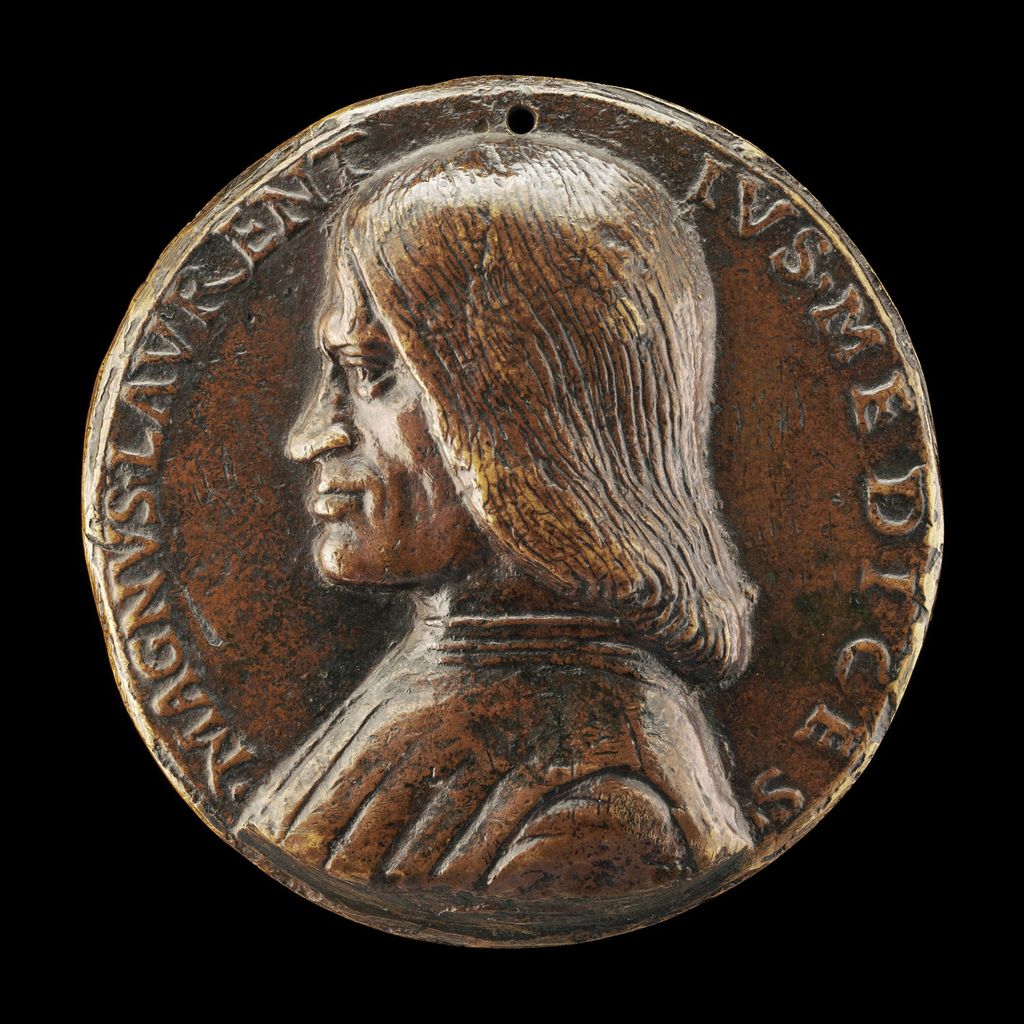
Niccolò Fiorentino’s medal of Lorenzo de’ Medici, who had all three San Romano panels installed in the family palace. Image source. Public domain.
How the paintings fitted two different rooms
Radiographs help recover a shape the painted surface alone barely suggests. Gordon and Ashok Roy discuss the evidence that the originals rose into arches and had cuts at the shoulders to fit around corbels, the projections supporting the vault of a room. A curved incision in the Florence panel appears where the original lances stop short of a corner addition. In Paris the linen itself retains a curved edge on the left. Measurements from a Bartolini document help suggest what was lost. In 1483 the three panels were described as covering 72 square braccia, an old Florentine measure. Dividing the area by three gives 24 square braccia per panel, considerably more than the surviving rectangles. In Caglioti’s reconstruction, extending the curves restores much of that missing area. The arches were cut down horizontally, and pieces of wood regularised the upper corners. At the lower left of the Paris panel there was an additional cut-out, later filled with a rectangle of wood. It may have accommodated a doorway. The rearing horse on that side has plenty of room above it, even when the corner is imagined empty. [1] [2] [4] [7]
The shapes of the shoulder cuts also offer a clue to how a visitor might have moved through the Bartolini room. In Gordon’s reconstruction, the broad shapes between London and Florence fit around a corbel on one wall. Between Florence and Paris, the narrower corresponding cuts would have left space at the junction with another wall. The signature now low on the left of the Uffizi panel would then have sat near the centre of the wall shared with London. The wider cut at the far end of the Paris panel would have left the sequence terminating partway along a wall. Gordon considered that a later addition to the programme might account for this. The layout is an inference from the panels, and its significance is practical. A viewer turning a corner would meet the dense Paris riders at a different angle from the first two scenes. [1] [2]
The inventory after Lorenzo’s death lists six framed and gilded paintings in the large ground-floor room called the Camera di Lorenzo. Alongside the three battle scenes were a picture of fighting dragons and lions and a story of Paris by Uccello, and a hunt by Francesco di Pesello. They were hung above a wood wall lining called a spalliera and a daybed. The room looks towards the garden and had space for daytime rest as well as for receiving guests. The inventory describes seven brass candlesticks and names tournament trophies among the furnishings. The painted gold and silver belonged in an interior already full of things that caught the light. Several scholars have proposed the east wall for the Battle. At one proposed height, the space between corbels is narrower than any of the panels, implying that they would have needed to lean forward of the stonework. Even the height of the furnishing below them is missing from the inventory. By 1598 an inventory describes the battle paintings near the chapel, apparently framed together by then. [1] [7] [10]
Reshaping the panels around the time of the transfer would fit the evidence for their Medici display. Tests on the London additions identified a simpler gypsum ground and linseed oil in the paint mixture, where the main panel has two ground layers and some walnut oil. Caglioti proposed that Francione carried out the woodwork and Gordon saw grounds for the suggestion in the materials. The Uffizi suggests that Uccello himself may have been called on to change the format, connecting that possibility with the signature, and identifies sour-orange foliage in the Florence additions with the Medici. If the alterations coincided with the likely 1484 transfer, the carpentry would postdate Uccello’s death in 1475. The signature gives us the painter’s name, while the added wood and different grounds help establish a later phase of work. [1] [2] [3] [7]
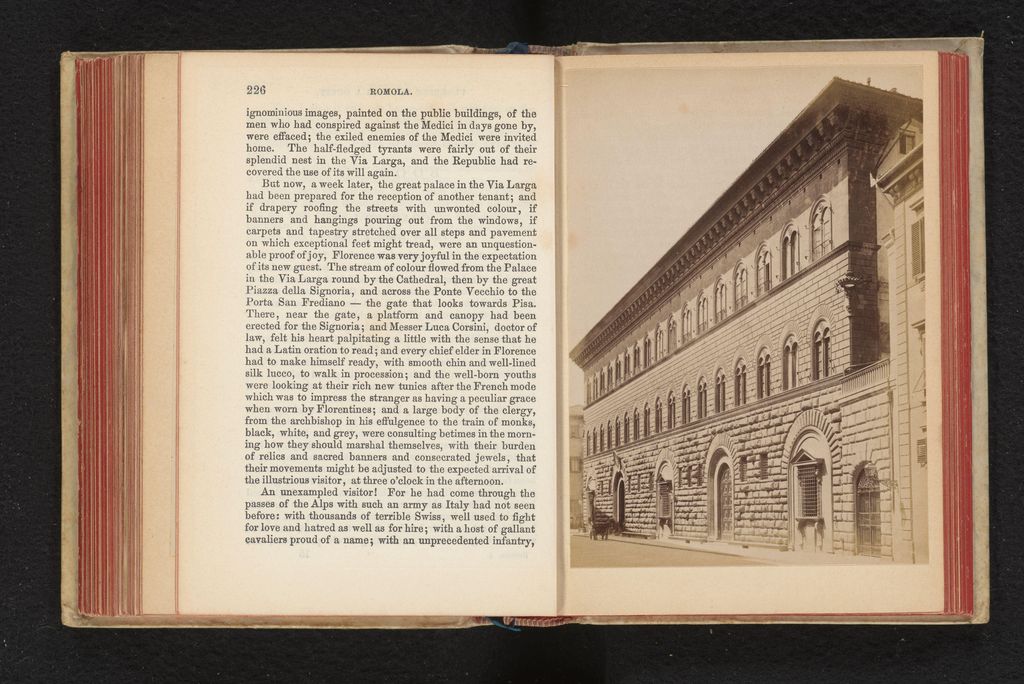
Giacomo Brogi’s photograph of the Palazzo Medici-Riccardi in a nineteenth-century volume of Romola, Rijksmuseum RP-F-F25436-AH. Image source. Public domain.
What survives of the original surfaces
Although three metres wide, each panel was assembled from relatively ordinary pieces of wood. The Florence panel has eight horizontal poplar boards with four vertical strips of canvas laid over them. Similar strips cross the boards in London, where splits make the original board count harder to establish. In Paris, conservators Daniel Jaunard and Patrick Mandron established a count of seven boards. The radiograph records a different pattern of linen strips, including a narrow fifth one at the far right. In London, traces of metal attachments near the top suggest that the panel was secured against the wall, with the weight probably supported below. In the Paris additions the painters extended the lances to new edges. The yellow shafts at the left change their mixture and lose their incised outlines at the join. At the right, red shafts continue in vermilion without the black underpaint used for the same forms on the older surface. In the Paris foreground, the brownish grass of the lower insert is a mixture of yellow and black. The adjoining green of the older panel contains artificial malachite. London has that pigment in its additions, while the main foliage relies on other copper greens. [1] [2]
The metal leaf itself carried colour. On the London panel a deeper reddish-brown clay ground took the silver, and coloured glazes over the silver helped distinguish armour and trappings. A red glaze survives on details such as the helmet carried by the page. A darker glaze mixed with walnut oil modelled some silvered plate. Fingerprints left in it on Tolentino’s leg are among the smallest records of the making of the series. Punched marks enliven gold on the bridles and trumpets. Silver has tarnished unevenly and some modelling has worn away, especially around the grey horses and faces in London. Parts of the fallen knight’s silvered torso preserve their original glaze, giving a better indication of how the tones once varied. Vermilion darkened too, notably in some of the harnesses, and green glazes on foliage lost brightness. In Florence the Uffizi points to extensive metal leaf on armour and tack. The effect would have changed with the light and with the viewer’s position. Comparing samples and records from all three collections, Vervat found silver no more than five microns thick in the samples, with dark paint used over the silver to give the armour volume. On a knight above a red horse in Florence, traces of a finger survive where the paint was softened into the light. Some coloured plumes were made by scratching through an applied layer of paint to expose the metal below. The repeated combination of painted shadow, reflection and incision gives the panels a common technique even where the composition differs. [1] [2] [3] [8]
Changes intended to repair or update a painting could also change what it seemed to depict. The London panel once showed a broad addition of blue sky over part of the landscape. Analysis found blue and white pigment in oil and resin on top of an older layer of varnish. The National Gallery removed the later sky during its twentieth-century treatment and recovered the landscape underneath. Gordon discusses a similar overpaint removed in Florence in 1954. The London panel had also been thinned, and rigid battens glued across the back restricted the movement of the wood and contributed to cracking. The twentieth-century treatment secured the split and lifting areas and removed the restraining battens. In Florence, Vervat records that the back was taken down from about four centimetres to little more than one in the nineteenth century. The National Gallery’s documentation of Paul Ackroyd’s later treatment describes whites and surviving silver details emerging from discoloured varnish. The old sky, the thinned boards and the discoloured coating each changed a different part of the picture’s appearance or structure. [1] [2] [8] [11]
Perspective, armour and the movement of the eye
The plate armour gives Uccello shapes that can be studied from several directions. An armet is a compact helmet with hinged parts that close around the head. Uccello paints visors open and shut, and shows projecting discs on the backs of some helmets. An early surviving example at the Metropolitan Museum of Art, stamped with the armourer’s name Lionardo and dated about 1440, offers a close look at the rounded shell and tightly fitted components of the type. In London, the strap joining sections of a backplate gives one rider’s turned back a recognisable structure. A saddle and long stirrup leathers help account for the extended legs of a rider who otherwise looks almost pinned to the horse’s side. Beside this accurately observed equipment are prominent crests more at home in a tournament. They help pick out individual riders in the crush. [1] [12]
The ways those components recede change from painting to painting. Massimo Becattini’s analysis finds a common level for the central vanishing points in London and Florence, as well as an off-centre point to the right in London. The weapons in London can lead the eye off the edge towards the next episode. Florence keeps the strongest movement around the falling rider and draws the eye back up through fields and smaller figures. Paris uses a different main vanishing point with two others within the picture, and larger figures crowd the space. Compare the pattern on Tolentino’s hat, which Gordon describes as spreading across the shape with little adjustment for the curve, with the pattern on Micheletto’s hat, which follows its recession. Uccello varies the relationship between the effect of a material and the volume of the person wearing it. [1] [2]
There are smaller decisions buried in the geometry. In London, a compass left points in the roundels on the bridles. Some other circles and incisions remained beneath the final arrangement, including one beside the fallen man. Near Tolentino’s white horse, the painted legs behind it follow an altered drawing. The outline of a banner shaft was drawn, incised and then reinforced with paint, making it hold its edge against the surrounding detail. The incisions occur across the series. Vervat argues that the similar positions of horses’ legs seen at different angles in Florence might reflect the use of small models. The poses are evidence of how carefully Uccello studied forms in the round. The method he used to obtain those views is open to interpretation. [1] [2] [8]
Annotated Details from The Battle of San Romano
The numbered points identify visible features discussed in this article. Return from each detail to the numbered overview. Each caption identifies the work shown.
Niccolò da Tolentino at San Romano
Niccolò da Tolentino rides a white horse in the London San Romano panel, National Gallery NG583. Image source. Public domain.
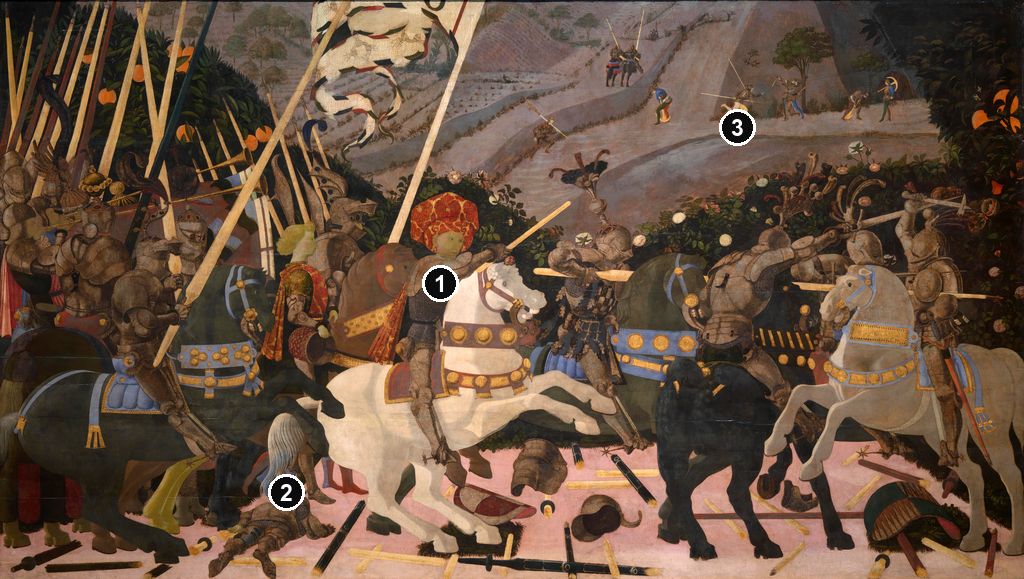
The Unhorsing of Bernardino della Carda
The Florence San Romano panel, with the fall of Bernardino della Carda at the centre. Image source. Public domain.
The Counterattack of Micheletto da Cotignola
The Paris San Romano panel, Musée du Louvre MI 469, with Micheletto da Cotignola leading the counterattack. Image source. CC0 / Public domain.
Details from THE BATTLE OF SAN ROMANO
Compare the cropped details with the source images above. Notice how their colours, shapes and positions contribute to the larger compositions.
Niccolò da Tolentino at San Romano
The red headgear and white horse
Niccolò’s headgear rises above the angled neck of the white horse. The decorated bridle leads the eye back toward his hand and the pale lance behind him.
The fallen figure and broken weapons
A fallen figure lies among scattered lance shafts. Their angled lines suggest depth in the shallow foreground, where the horses’ legs overlap them.
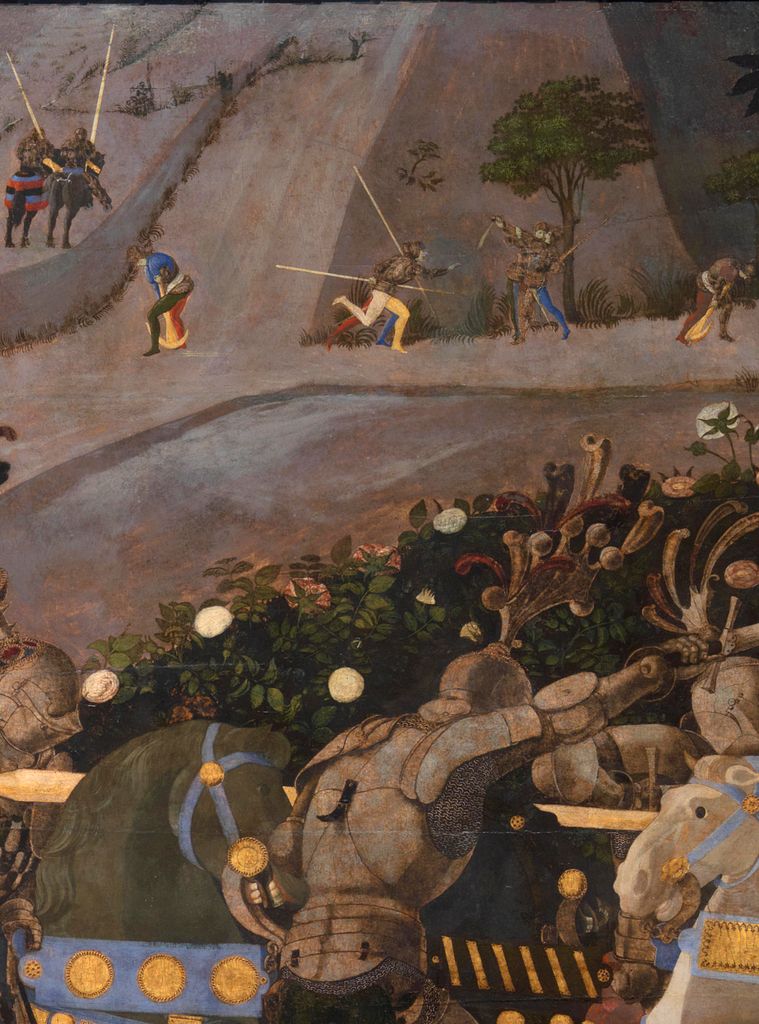
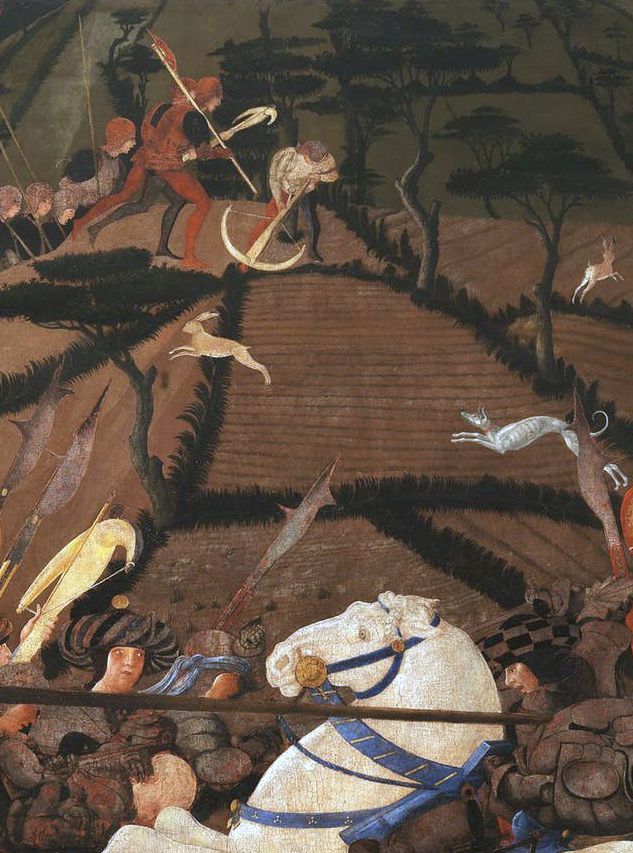
The hedge and distant hunt
Small figures and riders appear beyond the hedge. Their scale opens up a distant view across the press of the foreground cavalry.
The Unhorsing of Bernardino della Carda
The unhorsing
The horizontal lance leads towards the central tangle of bodies. The horse’s raised white forelegs pick out the point where the ranks break.
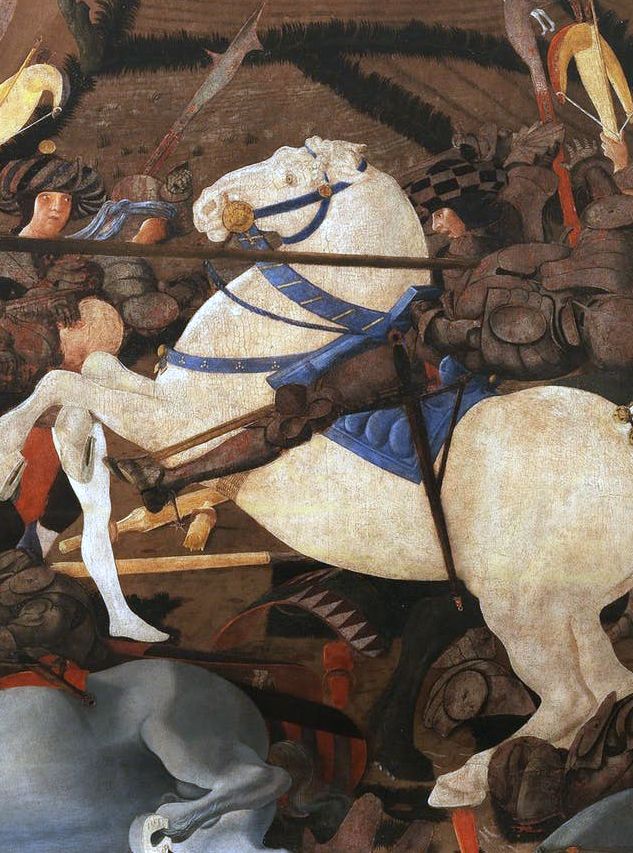
The fallen blue-grey horse
The blue-grey horse lies almost parallel to the edge of the panel. Its lowered body makes the white horse’s lift and turn appear more abrupt.
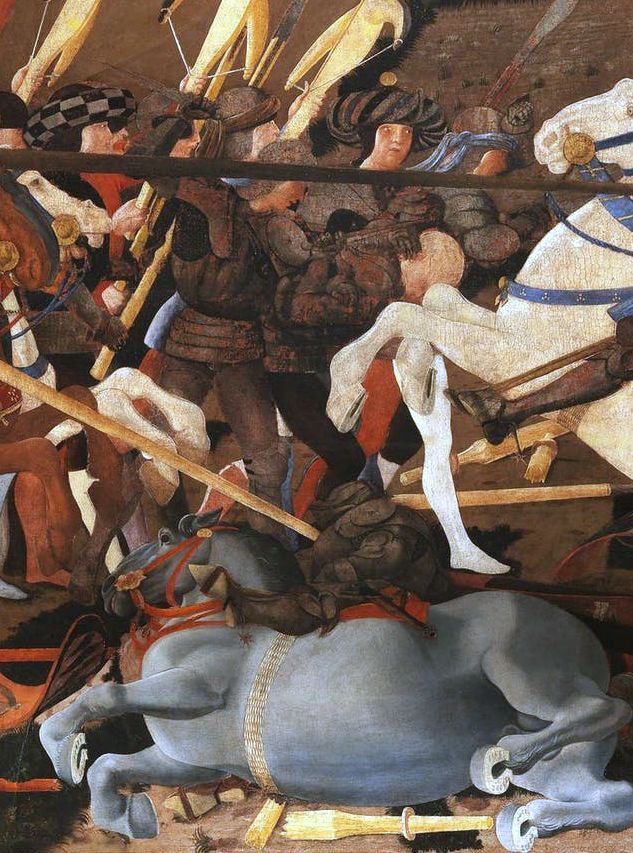
Hunting figures beyond the cavalry
Small people and animals move through the hills above the crowded horses. The spaces between them differ sharply from the tightly overlapping forms below.
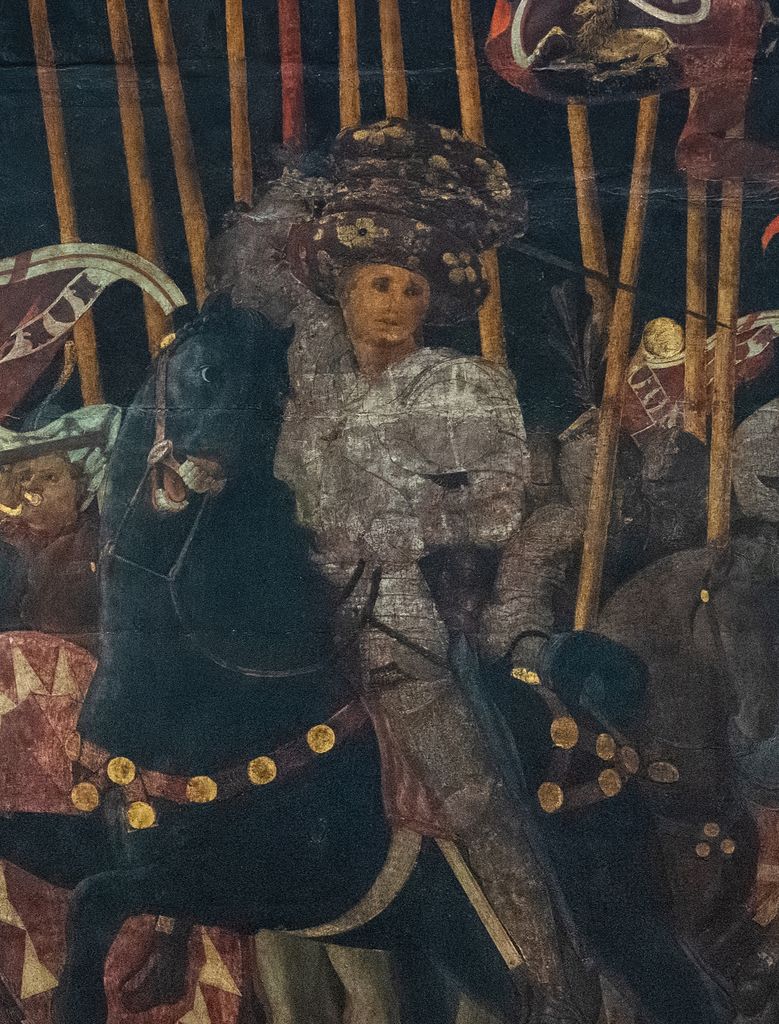
The Counterattack of Micheletto da Cotignola
The turn of the commander
Micheletto’s uncovered face turns to the right as his dark horse moves left. The accented harness and overlapping lances make the opposed directions easier to follow.
The lowered lances
Lances drop to a diagonal above the left-hand riders. Alongside the upright shafts further right, they show different stages of the cavalry movement.
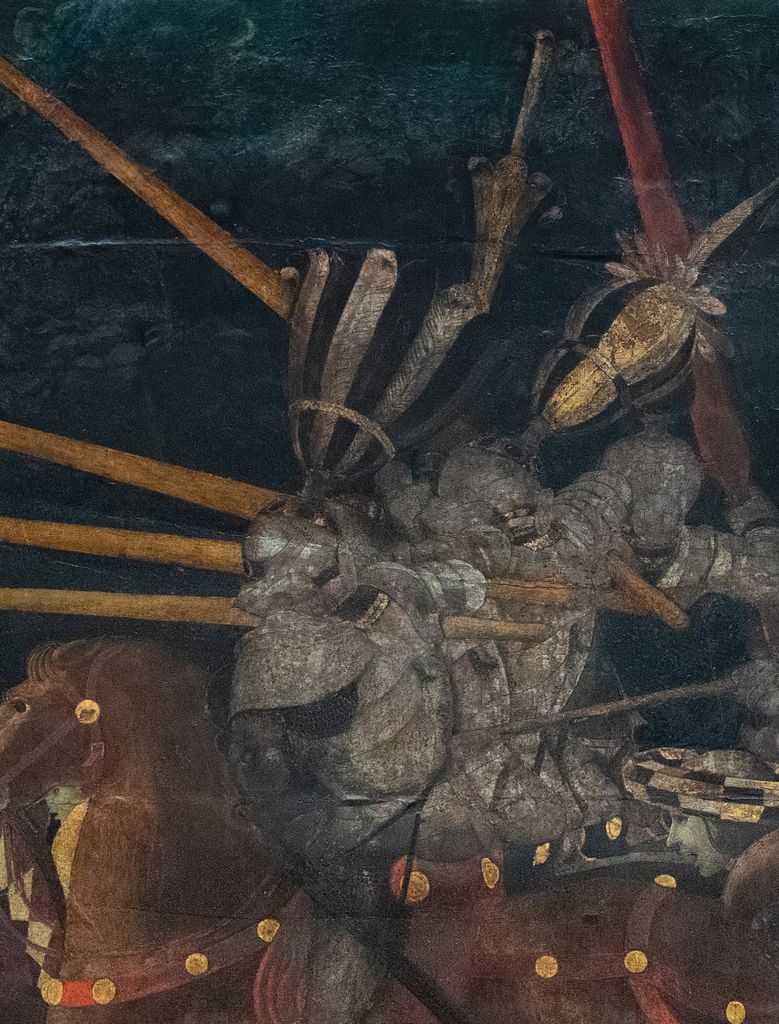
Red and blue harness straps
Bright straps cross the backs of the horses in the right-hand group. The view from behind sets their direction against the lateral charge at the left.
Dispersal and the announced reunion
The three pictures remained in Medici and then grand-ducal collections long after Lorenzo’s death. The Florence panel was exhibited at the Uffizi in 1784. The other two were with the restorer Carlo Magni and recorded back in the grand-ducal collection by 1787. In the nineteenth century their paths divided. The London painting passed through the Florentine dealers Lombardi and Baldi, from whom the National Gallery acquired it in 1857. The Paris panel entered the French national collections through the purchase of the Campana collection in 1861 and entered the Louvre in 1863. Each museum has preserved one part of a series whose most telling transitions take place between the panels. [1] [2] [3] [4]
On 2 November 2026 the Uffizi announced that all three panels were scheduled to be shown together at Magnifico 1492 in the Treasury of the Grand Dukes at Palazzo Pitti, from 3 December 2026 to 1 March 2027. The exhibition gathers works from Lorenzo’s collection. It offers a rare opportunity to compare three pictures at their full scale and to see which details become clear across the room. The white horse and broad landscape of the London panel, the interrupted balance at the centre of the Florence panel and the closing ranks of the Paris panel are distinct views. Placed within one field of vision, they let the sequence unfold at the speed of a visitor turning to look. [1] [13]
Watch the London and Florence panels
The two galleries explain the panels in their own collections.
Paolo Uccello, ‘The Battle of San Romano’
Caroline Campbell discusses the London panel and the ways it depicts the battle.
Watch on YouTubeArtworks directory
Browse paintings, drawings, stained-glass designs and other objects connected with Uccello. Cycles and their surviving components may have separate entries. The collection or catalogue’s wording is retained where a date, attribution or subject is debated.
| Name | Date | Medium, attribution and collection |
|---|---|---|
| Niccolò da Tolentino at the Battle of San Romano · London | Probably c.1438–40 | Tempera and oil on wood, with metallic decoration · National Gallery Catalogue. |
| Bernardino della Carda Unhorsed · Florence | c.1435–40 | Tempera on panel · Uffizi Galleries Catalogue. |
| The Counterattack of Micheletto da Cotignola · Paris | 1450–75 in the Louvre catalogue | Tempera (possibly) on wood · Musée du Louvre Catalogue. |
| The Hunt in the Forest | c.1465–70 | Tempera and oil with traces of gold on panel · Ashmolean Catalogue. |
| Saint George and the Dragon · London | c.1470 | Oil on canvas · National Gallery Catalogue. |
| Saint George Slaying the Dragon · Melbourne | c.1430 | Oil, tempera and silver leaf on wood · National Gallery of Victoria Catalogue. |
| Saint George and the Dragon · Paris | 1430–35 in the museum catalogue | Painted wood panel · Musée Jacquemart-André Catalogue. |
| Equestrian Monument to John Hawkwood | 1436 | Transferred wall painting · Florence Cathedral Catalogue. |
| Study for the John Hawkwood Monument | 1436 | Study on prepared paper · Uffizi Catalogue. |
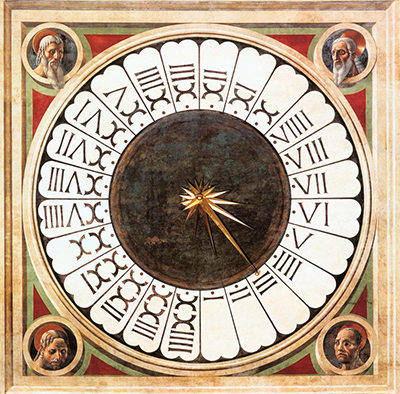
| Monumental Clock Face | 1443 | Painted dial · Florence Cathedral Catalogue. |
| Resurrection of Christ | 1443–44 | Stained glass · Uccello design · Florence Cathedral Catalogue. |
| Nativity | 1440s | Stained glass · Uccello design · Florence Cathedral Catalogue. |
| Creation of the Animals and Creation of Adam | Third to fourth decade of the 15th century | Detached fresco · Green Cloister, Santa Maria Novella Catalogue. |
| Creation of Eve and the Fall | Third to fourth decade of the 15th century | Detached fresco · Green Cloister, Santa Maria Novella Catalogue. |
| Flood and Recession of the Waters | 15th century; dating debated | Detached fresco · Green Cloister, Santa Maria Novella Catalogue. |
| Sacrifice and Drunkenness of Noah | 15th century; dating debated | Detached fresco · Green Cloister, Santa Maria Novella Catalogue. |
| Stories of the Virgin and Saint Stephen · Assunta Chapel | 1430s, with later completion | Fresco cycle · Paolo Uccello and Andrea di Giusto · Prato Cathedral Catalogue. |
| Blessed Jacopone da Todi | 1436 in the diocesan museum | Detached fresco · Museo dell’Opera del Duomo, Prato Catalogue. |
| Adoration of the Child · Bologna | 1430s; inscription incomplete | Detached fresco · San Martino Maggiore, Bologna Catalogue. |
| Adoration of the Christ Child · Karlsruhe | c.1436 | Painted panel · Attribution to Uccello · Staatliche Kunsthalle Karlsruhe Catalogue. |
| Annunciation · Oxford | Early 15th century | Tempera and gilding on panel · Ashmolean Catalogue. |
| Allegory of Monastic Life (Thebaid) | c.1460–65 | Tempera on canvas · Galleria dell’Accademia, Florence Catalogue. |
| Miracle of the Profaned Host | 1467–68 | Tempera on wood · Galleria Nazionale delle Marche, Urbino Catalogue. |
| Triumphal Entry into Rome of Titus and Vespasian(?) | c.1430–35 | Tempera, gold and silver on panel · Yale University Art Gallery Catalogue. |
| Crucifixion with the Virgin and Saints | c.1460–65 | Painted panel · Museo Nacional Thyssen-Bornemisza Catalogue. |
| The Crucifixion · Met triptych | Probably mid-1450s | Tempera on wood with gold ground · Metropolitan Museum of Art Catalogue. |
| Perspective Study of a Chalice | 1450–75 | Pen, ink and stylus on paper · Attributed to Uccello · Uffizi Catalogue. |
| Study of a Mazzocchio | 15th century | Perspective study · Attributed to Uccello · Uffizi Catalogue. |
| Mazzocchio Seen in Perspective | Uncertain | Drawing · Attribution debated · Musée du Louvre Catalogue. |
| Head of a Man in Profile | 15th century | Pen, ink and wash · Musée du Louvre Catalogue. |
| Five Masters of the Florentine Renaissance | 1500–50 | Oil on wood · Anonymous Florentine school · Musée du Louvre Catalogue. |
| Madonna and Child from the Del Beccuto House | 15th century | Detached fresco · Museo di San Marco, Florence Catalogue. |
| Man of Sorrows with the Virgin and Saint John · Avane Predella | 15th century | Predella · Museo di San Marco, Florence Catalogue. |
| Calling of Saint Paul the Hermit · San Miniato | After 1447 to c.1454 in state catalogue | Sinopia · Attributed to Uccello or collaborator Catalogue. |
| The host changes hands · Urbino predella, scene 1 | 1467–68 | Tempera on wood · Component of DE 231 · Galleria Nazionale delle Marche Catalogue. |
| The figures at the door · Urbino predella, scene 2 | 1467–68 | Tempera on wood · Component of DE 231 · Galleria Nazionale delle Marche Catalogue. |
| The procession approaches the altar · Urbino predella, scene 3 | 1467–68 | Tempera on wood · Component of DE 231 · Galleria Nazionale delle Marche Catalogue. |
| The condemned woman and the ladders · Urbino predella, scene 4 | 1467–68 | Tempera on wood · Component of DE 231 · Galleria Nazionale delle Marche Catalogue. |
| Persecution of the family · Urbino predella, scene 5 | 1467–68 | Tempera on wood · Component of DE 231 · Galleria Nazionale delle Marche Catalogue. |
| Angels and demons at the bier · Urbino predella, scene 6 | 1467–68 | Tempera on wood · Component of DE 231 · Galleria Nazionale delle Marche Catalogue. |
| Birth of the Virgin · Prato Cathedral | 1430s; dating debated | Fresco · Assunta Chapel, Prato Cathedral Catalogue. |
| Presentation of the Virgin · Prato Cathedral | 1430s; dating debated | Fresco · Assunta Chapel, Prato Cathedral Catalogue. |
Discussion
Look again at the images and ideas explored in The Battle of San Romano. These editorial prompts invite your observations.
Reader Insights
Which detail most changes your reading of the battle when you see it across all three panels?
When you look across the three panels, where does the repeated rhythm of lances give way to a sense of movement?
Join the Conversation
Share a detail, comparison or question about The Battle of San Romano below.
References
- Dillian Gordon. Niccolò Mauruzi da Tolentino at the Battle of San Romano. The National Gallery, The Fifteenth Century Italian Paintings, Volume I, 2003, online edition 2025. Technical notes, chronology, armour, archives, and reconstruction of the two interiors. View source.
- Ashok Roy and Dillian Gordon. Uccello’s Battle of San Romano. National Gallery Technical Bulletin 22, 2001, pp. 4–17. Examination of the London panel, comparison with the other two and conservation evidence. View source.
- Daniela Parenti, Uffizi Galleries. Battle of San Romano. Collection record 1890 n. 479, with the Florence panel’s date, measurements, signature and account of the commission and transfer. View source.
- Musée du Louvre. La Bataille de San Romano, la contre-attaque de Micheletto Attendolo da Cotignola. Collection record MI 469, with date range, physical description and provenance. View source.
- Hannah Baader. Aufprall, Schock, Geschichte. Paolo Uccellos Schlacht von San Romano. In Uwe Fleckner, ed., Bilder machen Geschichte, De Gruyter, 2014, pp. 53–72, especially p. 60 on battle accounts, sound and commemoration. View source.
- The National Gallery, London. The Battle of San Romano. Collection record NG583 with date, medium, size and acquisition. View source.
- Francesco Caglioti. Nouveautés sur la Bataille de San Romano de Paolo Uccello. La Revue du Louvre et des musées de France 51, no. 4, 2001, pp. 37–54. Archival evidence on the Bartolini Salimbeni, the Medici transfer and the alterations. View source.
- Muriel Vervat. An ARCHLAB project: researches on the painting technique of the three panels of the Battle of San Romano by Paolo Uccello. Technè 43, 2016, pp. 110–113. Cross-panel study of paint layers and incisions, including the Uffizi panel’s treatment history. View source.
- Pietro Roccasecca. La Rotta di San Romano e la Rotta di Niccolò Piccinino. Paolo Uccello e i Bartolini. Bulletin de l’Association des Historiens de l’Art Italien 11, 2005. The paintings’ early titles and a critical reading of the 1495 claim. View source.
- Palazzo Medici Riccardi. La camera grande terrena. Mediateca account of the room, furnishings, measurements, and reconstruction from the 1492 inventory and 1650 plan. View source.
- The National Gallery, London. Behind the scenes in Conservation: Uccello’s The Battle of San Romano. Account of Paul Ackroyd’s conservation of NG583 and the effect of varnish removal. View source.
- The Metropolitan Museum of Art. Armet. Object 42.50.2, stamped Lionardo, probably Milan, about 1440. View source.
- Uffizi Galleries. Tickets now online for Magnifico 1492. Announcement of 2 November 2026, with the exhibition dates, venue and planned reunion of the panels. View source.
More PAOLO UCCELLO Artworks

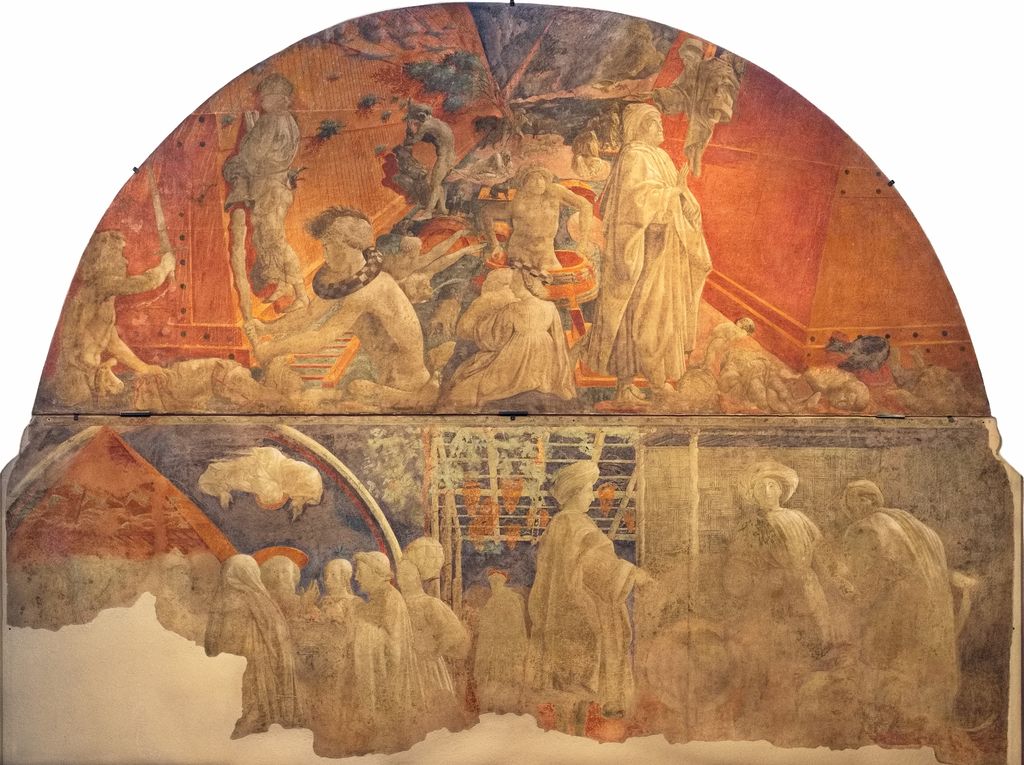
Noah and the Flood
The Flood and Recession of the Waters above the lower episodes from Noah’s story, Santa Maria Novella. Photograph by Armin Kleiner. Image source. CC BY-SA 4.0. Resized for the web. This derivative is available under the same licence.
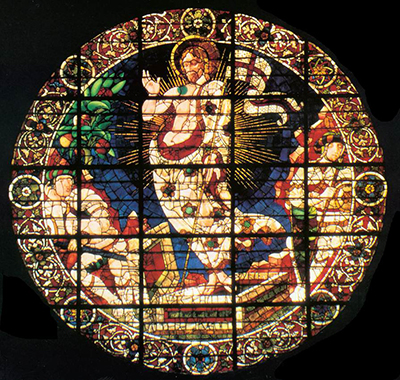
The Resurrection of Christ Stained Glass Window
The Resurrection window in Florence Cathedral, designed by Paolo Uccello and made by Bernardo di Francesco. Photograph by Sailko. Image source. CC BY 3.0. Resized for the web.