


 by Tom Gurney
Tom Gurney BSc (Hons) is an art history expert with over 20 years experience
Published on June 19, 2020 / Updated on November 29, 2026
Email: tomgurney1@gmail.com / Phone: +44 7429 011000
The Resurrection of Christ Stained Glass Window: Introduction
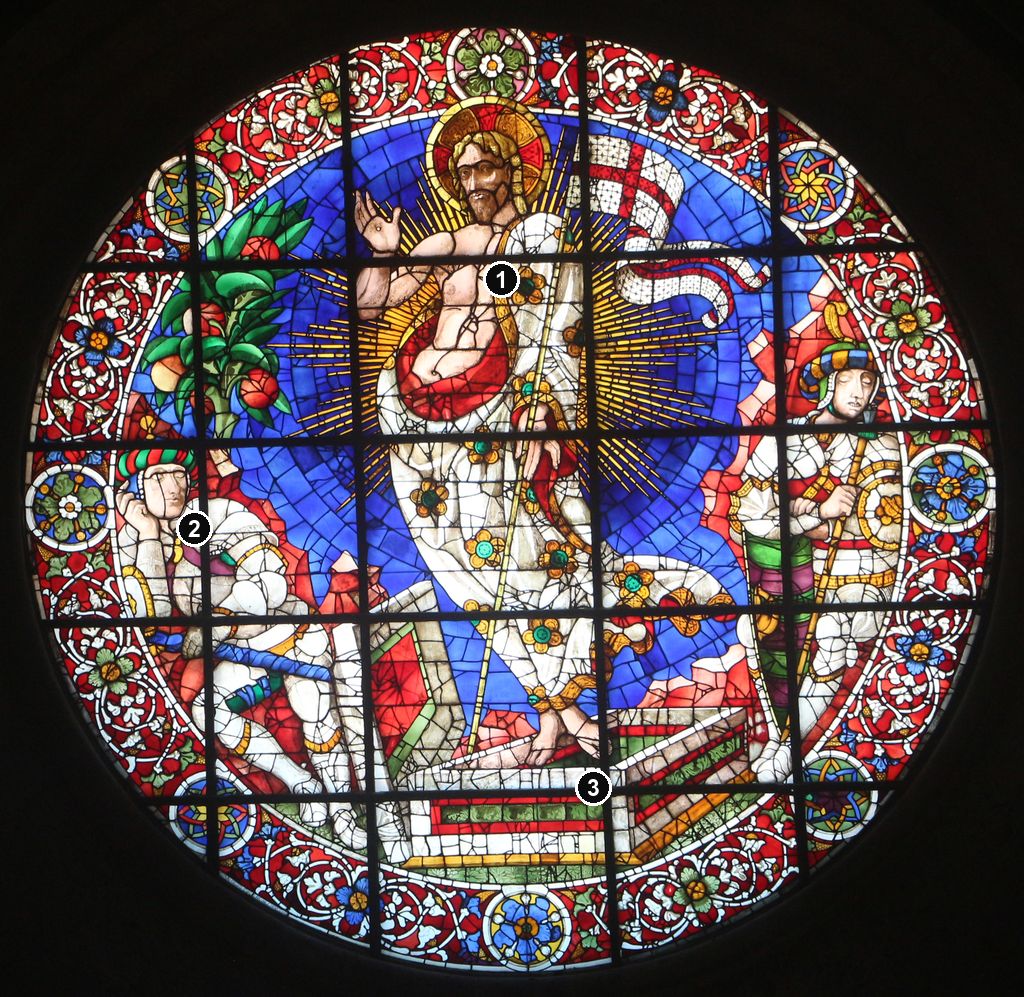
A band of blue glass curls round the risen Christ in Florence Cathedral. He bows slightly to one side as he lifts his right hand in blessing. His banner streams the other way, and fine rays spread out from behind him. Below, two sleeping soldiers lean into the curved sides of the window, leaving the centre clear for the figure they were there to guard. At nearly five metres across, the circle gives the tomb, the soldiers and the flowered mantle room to register from the floor, high in the drum beneath Brunelleschi’s dome. [1] [2] [3]
The cathedral’s Opera di Santa Maria del Fiore catalogues the window as Cristo risorto, number 5663, dated 1443–44. The national catalogue records the twenty-five-panel window under 0900188137. It is still in its original opening on the north-east side, above the Sacristy of the Masses. The cathedral accounts document a design by Paolo Uccello in 1443. Bernardo di Francesco is credited with making the window in glass, and a separate payment suggests that Uccello may also have helped paint the glass. The documents give those two kinds of work different names and different prices. [1] [2] [3] [4]
At a Glance
- Date1443–44
- Medium and sizeStained glass with lead and painted details, approximately 4.8 m in diameter
- LocationNorth-east oculus above the Sacristy of the Masses, Florence Cathedral
This work across Paolo Uccello’s career
Battle of San Romano
Probably c.1438–40 · GordonThe Hunt in the Forest
c.1465–70The Urbino predella
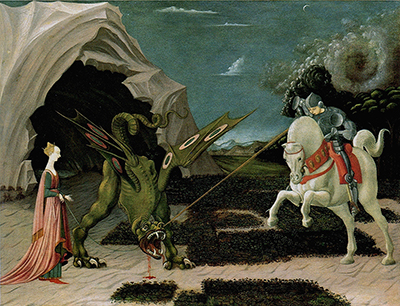
1467–68Saint George and the Dragon · London
About 1470Contents
- From the tomb to the rim of the circle
- What lead and light contribute
- What the cathedral paid for
- A window among eight
- The glass that survives
- Annotated details
From the tomb to the rim of the circle
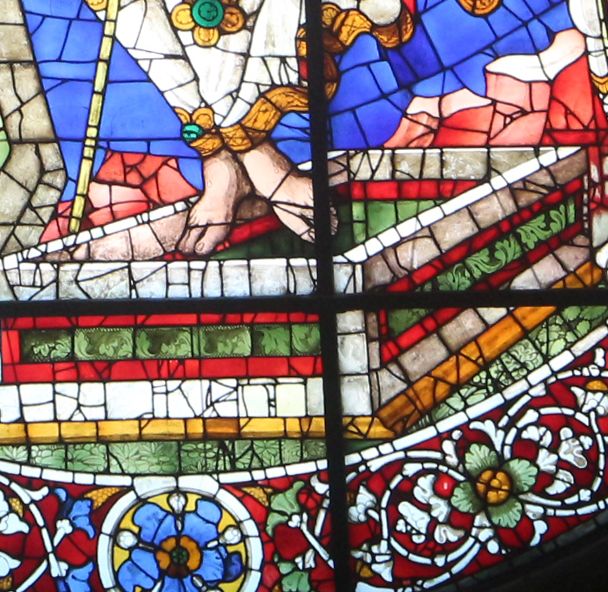
It is easy to start with the raised hand and miss the little account of weight and balance at the foot of the window. The lid has lifted from the tomb and its long edge runs across the lower part of the circle. The rectangular panels of colour along the stone box give the eye a way to judge its turn into depth. The tomb seems curiously compact under so large a figure. Takuma Ito suggests that its scale makes sense within the round composition. A tomb large enough to hold this Christ would occupy much of the ground the soldiers now have to themselves. [1] [3] [5]
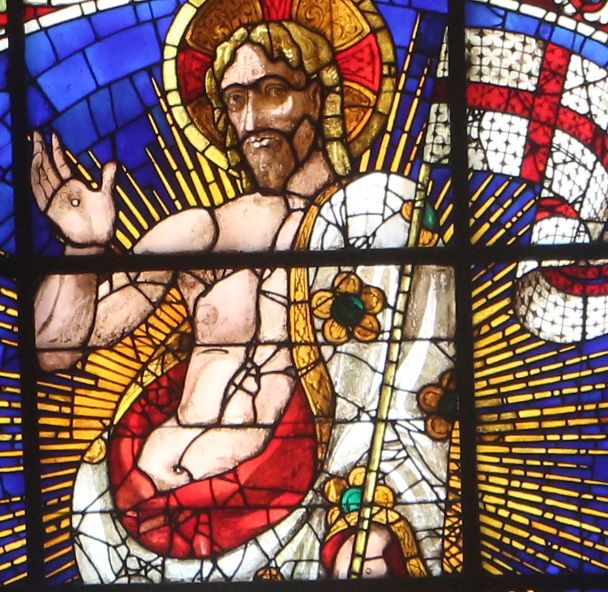
The men fold into that ground in different ways. Their slumped poses send the eye back towards the tomb, but their closed eyes leave Christ without a witness within the picture. His face is framed by the halo and sits high in the circle, just above the hand raised in blessing. From below, the pale mantle and the movement of the banner can register before the expression on his face. The latter is especially difficult to judge as evidence of Uccello’s handling, since the head includes a conspicuous later replacement. [1] [3] [5]
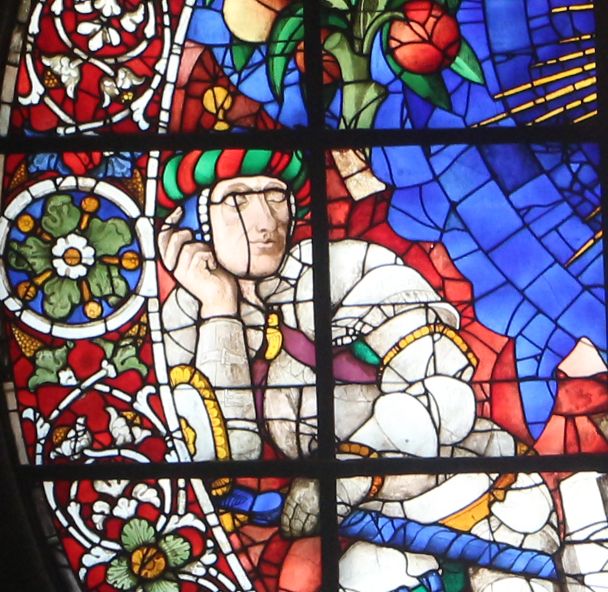
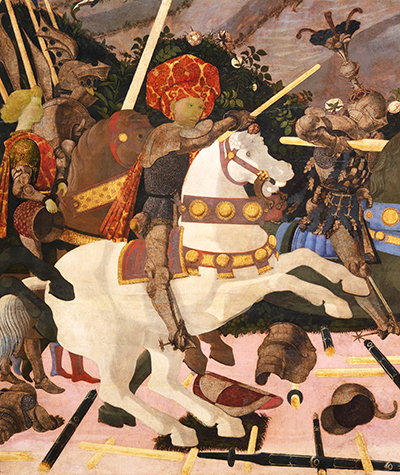
Each soldier wears a mazzocchio, a ring-shaped headdress whose changing faces are picked out in different colours. It gives the composition a small, practical demonstration of Uccello’s interest in solid forms. Even with the face harder to distinguish, the coloured segments turn the hat round the skull. The soldiers’ armour and the fruiting plant on the left have prompted a comparison with the Uffizi panel of The Battle of San Romano. The comparison is most telling in the way a few curved surfaces give armour bulk, and in how a spot of warm fruit catches the eye on either side of a larger human action. It establishes an affinity across media and leaves the direction of any borrowing open. [1] [3]
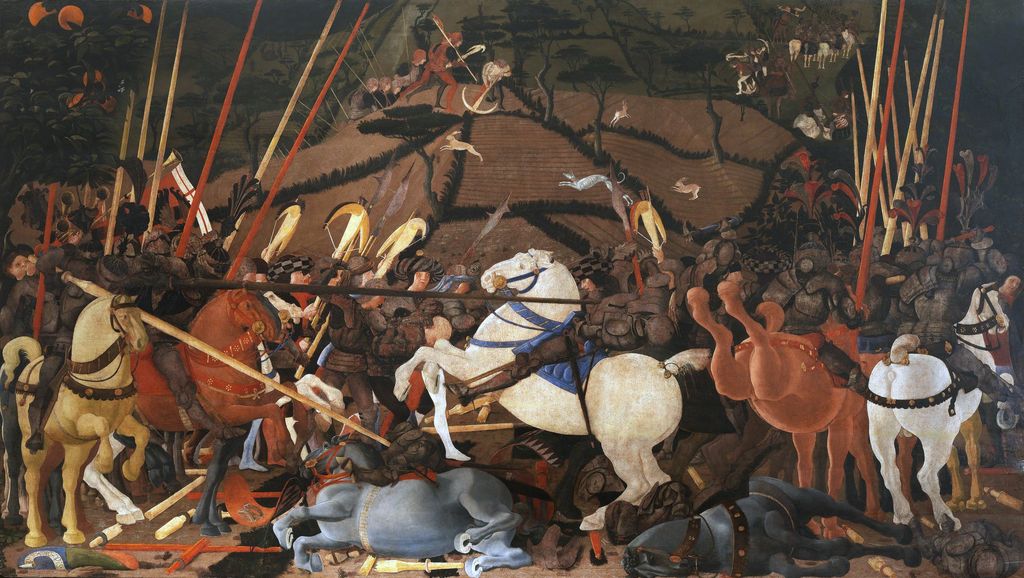
The Florence San Romano panel, with the fall of Bernardino della Carda at the centre. Image source. Public domain.
What lead and light contribute
Follow the edge of the mantle on the side towards the tomb. The pale fabric breaks at intervals into strong folds of red lining, and the black seams in those turns do much of the work of drawing them. Up close, yellow and blue flowers interrupt the pale areas. With distance the small forms merge, and the red and white shape remains distinct against the deep blue. Ito points out that the window uses lead to give such forms clear edges, with less reliance on dark painted shading that would have reduced the light through the glass. The window still makes use of grisaille, a dark paint that supplies finer lines and shades on the glass itself. [1] [3] [5]
There is also a larger relationship between curved lines. The sky is assembled in arcs, while the white and blue scrolls and the little flower and star medallions run round the border. The inner curves gather around the body and the outer ones return the eye to the edge of the opening. Diego Suárez Quevedo reads the figure as the focus from which the window’s light seems to radiate. The effect is especially clear where the narrow rays cross dark blue close to the body. At the tomb, the converging edges still suggest a solid object in space. Those two kinds of geometry let the same scene suggest a place on earth and an event that changes the appearance of the sky around it. [1] [5] [6]
Annotated Details from The Resurrection of Christ Stained Glass Window
The numbered points identify visible features discussed in this article. Return from each detail to the numbered overview. The Resurrection window in Florence Cathedral, designed by Paolo Uccello and made by Bernardo di Francesco. Photograph by Sailko. Image source. CC BY 3.0. Numbered overview and cropped details from the original photograph. This overview and these details are available under CC BY 3.0.
Details from THE RESURRECTION OF CHRIST STAINED GLASS WINDOW
Compare the cropped details with the source images above. Notice how their colours, shapes and positions contribute to the larger compositions.
The figure and the rays
The small sun-like lines cross pieces of blue glass. Christ’s raised hand and the folds of his mantle make larger shapes that can be followed from the floor.
The left soldier’s headdress
Alternating green, red and white sections turn the ring around the sleeping soldier’s head.
The painted and joined pieces of the tomb
The coloured rectangles follow the edges of the box as it turns into depth. Wide structural bars cross the thinner leading between the pieces of glass.
What the cathedral paid for
In February 1443 the officers of the Opera commissioned two designs from Uccello for the dome windows. The surviving summary leaves their subjects unstated. On 8 July he was paid forty lire for a second design of the Resurrection. The word “second” matters because the entry for 2 May names the Ascension. Giovanni Poggi read that title as a notarial slip and identified the May payment as the first Resurrection design. The Opera’s object catalogue adopts his reading. The Corpus Vitrearum and the Opera’s account of the whole glazing programme allow for a genuine Ascension proposal by Uccello in May. In either reading, the Ascension actually installed was designed by Lorenzo Ghiberti, who counted it among his cathedral works in his Commentaries. The July entry gives the firm evidence for Uccello’s Resurrection design. [1] [3] [5] [7] [8]
A further entry sets aside fifty lire due to Uccello for painting an eye made by Bernardo di Francesco. An “eye” here means the round window, from the Italian occhio. The record specifies the work and the glazier but leaves the subject unnamed. The Opera associates it with the Resurrection, since Angelo di Lippo made the Nativity and the Annunciation enters the records later. Ito also considers the Resurrection the likely candidate. He distinguishes the language of painting from the usual language of paying for a design and proposes that Bernardo engaged Uccello to apply grisaille. That would give the artist a hand in making some of the details the light passes through, though it leaves the assignment of particular pieces open. Ito renders the account as a December 1443 entry, while the Opera places the payment in January 1444. It belongs to the period of work following the design payment in July. [1] [5] [9]
The cathedral’s surviving records show how seriously the Opera took the appearance of the glass. For the Coronation of Mary, it asked Donatello and Ghiberti for coloured designs at full scale to compare in position. The scale of Uccello’s fees has likewise led scholars to propose a full-size design for his windows. The documents for the Resurrection distinguish designs from work on the glass more clearly than they establish the dimensions and degree of finish of the drawings. Years later Uccello’s 1458 tax declaration records a debt owed by Bernardo and his associates for window painting carried out in 1456. The collaboration at the cathedral belonged to a working relationship that continued beyond this commission. [3] [5] [10]
Before Poggi published the accounts in 1909, the clarity of the design could point to more than one artist. Allan Marquand considered Uccello in 1900 but found the window strongly reminiscent of Ghiberti. Their work in Florence already overlapped, since Uccello had assisted in Ghiberti’s workshop. Later, Heinrich van Straelen doubted Bernardo’s role on stylistic grounds, finding a clarity and harmony of colour unusual for him. With a glazier and a designer both involved, and successive restorations evident in the glass, it is difficult to assign a colour or line to a single hand by comparing styles alone. [1] [4]
A window among eight
The Resurrection belongs to a ring of eight openings and to a larger glazing programme that extends through the cathedral. The drum includes episodes from the lives of Christ and Mary. A visitor looking up from the crossing sees only those openings their position allows. The Opera points out that opposite scenes can be read in relation to one another. Uccello’s Nativity to the north-west faces Ghiberti’s Ascension to the south-east, pairing Christ’s birth and return to heaven. Ghiberti’s Christ appears above apostles who look up towards him, while Uccello’s risen Christ is watched by the congregation below and the guards in his own scene sleep on. [7] [8] [11]
Uccello’s three known designs for the drum depict the Resurrection, the Nativity and the Annunciation. The surviving birth scene is the Nativity, with its timber shelter and the heads of the ox and the donkey. The Baptism is a separate episode and has no place among the three commissions. The original Annunciation was destroyed by lightning in 1828. [7] [9] [10]
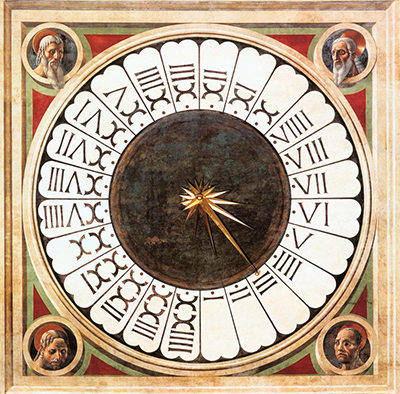
The cathedral offers another way to see what Uccello could do with the circle. His painted clock face, dated 1443, sits high over the entrance. Its four heads occupy the corners beyond a ring of numbers. Up in the Resurrection the figures lie within the circle, and the dark surround helps bring the central light into focus. The clock’s turning hand gives the viewer a reason to follow the circumference. Its present star-shaped hand owes something to the glazing, too. The restorers took the Bethlehem star in Uccello’s Nativity window as a visual guide. [1] [12]
Nearer the floor, above the door of the Sacristy of the Masses, Luca della Robbia made a Resurrection in glazed terracotta in 1442–44. There, too, the soldiers are asleep in the company of a standing Christ. Their bodies project from the relief and catch the light inside the church. In the window above, daylight passes through patches of coloured glass. A dark join along an arm or shoulder can give a soldier some of the bulk that Luca could model in clay. [1] [5] [13]
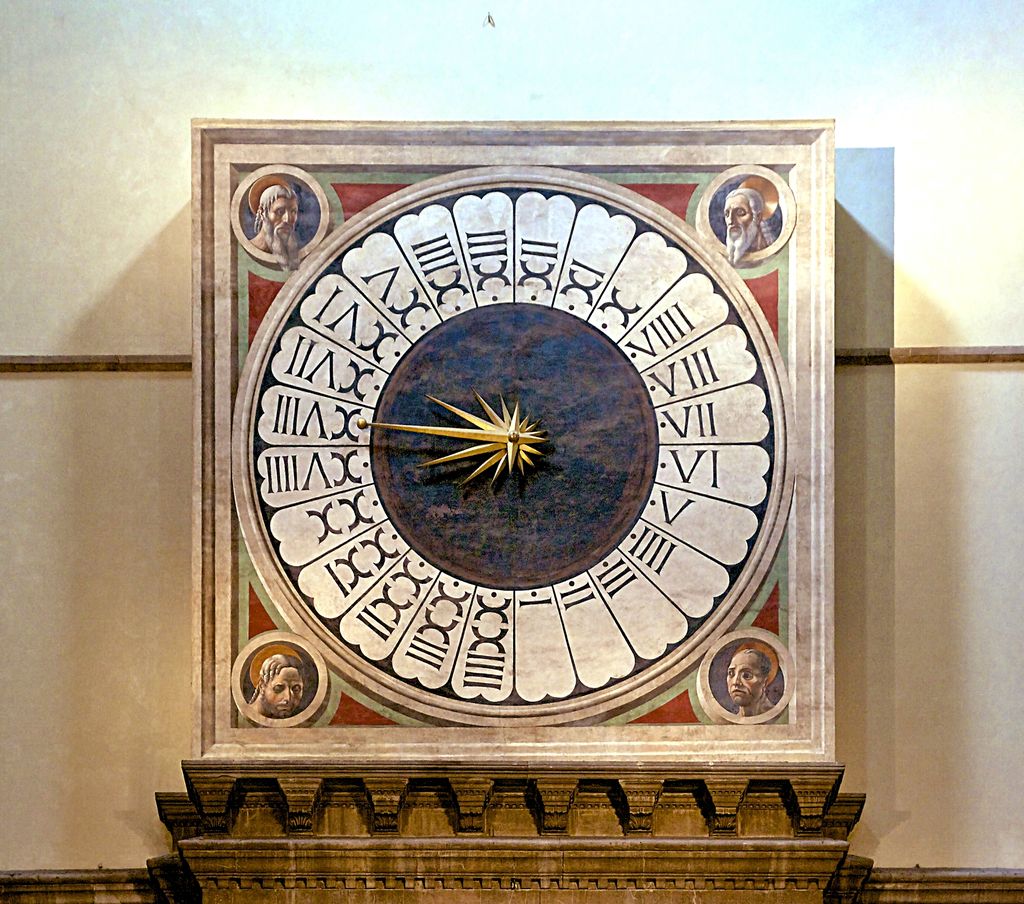
The 24-hour dial on the inner façade of Florence Cathedral. Four painted heads fill its corners. Image source. CC0 / Public domain.
The glass that survives
The head of Christ is among the most visible changes made in the twentieth century. Corpus Vitrearum also records replacement glass and renewal of the lead in the workshops that worked on the cathedral’s windows before the 1999 conservation. In that campaign, the restorers lifted the panels from a cement mounting and found damage on the outside from corrosion, while deposits on the inside had to be removed with attention to the surviving paint. Some heads retained thin painted layers of glass added in earlier repairs. Dirt trapped between the layers darkened the detail they were meant to recover. The team cleaned them separately and put the supplementary glass back because it still served a purpose and formed part of the history of the window. [3]
Before reinstallation, the glass went on temporary display inside the cathedral in autumn 1999, with photographs showing stages of the work. A protective glazing system was fitted to shield the historic glass from exterior moisture. In its opening again, the window is seen under the conditions that give the design its force. At a distance the seams that define the red lining and the rays that surround the figure gather into a few strong movements. A closer view gives those movements quite a different texture, down to little patches of blue of unequal shape within the same band of sky. [1] [3] [5]
Artworks directory
Browse paintings, drawings, stained-glass designs and other objects connected with Uccello. Cycles and their surviving components may have separate entries. The collection or catalogue’s wording is retained where a date, attribution or subject is debated.
| Name | Date | Medium, attribution and collection |
|---|---|---|
| Niccolò da Tolentino at the Battle of San Romano · London | Probably c.1438–40 | Tempera and oil on wood, with metallic decoration · National Gallery Catalogue. |
| Bernardino della Carda Unhorsed · Florence | c.1435–40 | Tempera on panel · Uffizi Galleries Catalogue. |
| The Counterattack of Micheletto da Cotignola · Paris | 1450–75 in the Louvre catalogue | Tempera (possibly) on wood · Musée du Louvre Catalogue. |
| The Hunt in the Forest | c.1465–70 | Tempera and oil with traces of gold on panel · Ashmolean Catalogue. |
| Saint George and the Dragon · London | c.1470 | Oil on canvas · National Gallery Catalogue. |
| Saint George Slaying the Dragon · Melbourne | c.1430 | Oil, tempera and silver leaf on wood · National Gallery of Victoria Catalogue. |
| Saint George and the Dragon · Paris | 1430–35 in the museum catalogue | Painted wood panel · Musée Jacquemart-André Catalogue. |
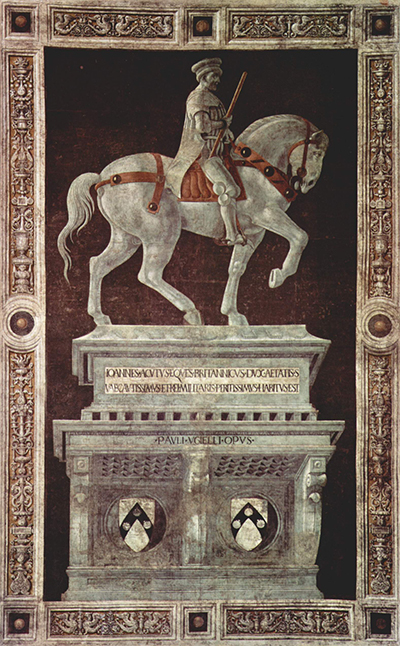
| Equestrian Monument to John Hawkwood | 1436 | Transferred wall painting · Florence Cathedral Catalogue. |
| Study for the John Hawkwood Monument | 1436 | Study on prepared paper · Uffizi Catalogue. |
| Monumental Clock Face | 1443 | Painted dial · Florence Cathedral Catalogue. |
| Resurrection of Christ | 1443–44 | Stained glass · Uccello design · Florence Cathedral Catalogue. |
| Nativity | 1440s | Stained glass · Uccello design · Florence Cathedral Catalogue. |
| Creation of the Animals and Creation of Adam | Third to fourth decade of the 15th century | Detached fresco · Green Cloister, Santa Maria Novella Catalogue. |
| Creation of Eve and the Fall | Third to fourth decade of the 15th century | Detached fresco · Green Cloister, Santa Maria Novella Catalogue. |
| Flood and Recession of the Waters | 15th century; dating debated | Detached fresco · Green Cloister, Santa Maria Novella Catalogue. |
| Sacrifice and Drunkenness of Noah | 15th century; dating debated | Detached fresco · Green Cloister, Santa Maria Novella Catalogue. |
| Stories of the Virgin and Saint Stephen · Assunta Chapel | 1430s, with later completion | Fresco cycle · Paolo Uccello and Andrea di Giusto · Prato Cathedral Catalogue. |
| Blessed Jacopone da Todi | 1436 in the diocesan museum | Detached fresco · Museo dell’Opera del Duomo, Prato Catalogue. |
| Adoration of the Child · Bologna | 1430s; inscription incomplete | Detached fresco · San Martino Maggiore, Bologna Catalogue. |
| Adoration of the Christ Child · Karlsruhe | c.1436 | Painted panel · Attribution to Uccello · Staatliche Kunsthalle Karlsruhe Catalogue. |
| Annunciation · Oxford | Early 15th century | Tempera and gilding on panel · Ashmolean Catalogue. |
| Allegory of Monastic Life (Thebaid) | c.1460–65 | Tempera on canvas · Galleria dell’Accademia, Florence Catalogue. |
| Miracle of the Profaned Host | 1467–68 | Tempera on wood · Galleria Nazionale delle Marche, Urbino Catalogue. |
| Triumphal Entry into Rome of Titus and Vespasian(?) | c.1430–35 | Tempera, gold and silver on panel · Yale University Art Gallery Catalogue. |
| Crucifixion with the Virgin and Saints | c.1460–65 | Painted panel · Museo Nacional Thyssen-Bornemisza Catalogue. |
| The Crucifixion · Met triptych | Probably mid-1450s | Tempera on wood with gold ground · Metropolitan Museum of Art Catalogue. |
| Perspective Study of a Chalice | 1450–75 | Pen, ink and stylus on paper · Attributed to Uccello · Uffizi Catalogue. |
| Study of a Mazzocchio | 15th century | Perspective study · Attributed to Uccello · Uffizi Catalogue. |
| Mazzocchio Seen in Perspective | Uncertain | Drawing · Attribution debated · Musée du Louvre Catalogue. |
| Head of a Man in Profile | 15th century | Pen, ink and wash · Musée du Louvre Catalogue. |
| Five Masters of the Florentine Renaissance | 1500–50 | Oil on wood · Anonymous Florentine school · Musée du Louvre Catalogue. |
| Madonna and Child from the Del Beccuto House | 15th century | Detached fresco · Museo di San Marco, Florence Catalogue. |
| Man of Sorrows with the Virgin and Saint John · Avane Predella | 15th century | Predella · Museo di San Marco, Florence Catalogue. |
| Calling of Saint Paul the Hermit · San Miniato | After 1447 to c.1454 in state catalogue | Sinopia · Attributed to Uccello or collaborator Catalogue. |
| The host changes hands · Urbino predella, scene 1 | 1467–68 | Tempera on wood · Component of DE 231 · Galleria Nazionale delle Marche Catalogue. |
| The figures at the door · Urbino predella, scene 2 | 1467–68 | Tempera on wood · Component of DE 231 · Galleria Nazionale delle Marche Catalogue. |
| The procession approaches the altar · Urbino predella, scene 3 | 1467–68 | Tempera on wood · Component of DE 231 · Galleria Nazionale delle Marche Catalogue. |
| The condemned woman and the ladders · Urbino predella, scene 4 | 1467–68 | Tempera on wood · Component of DE 231 · Galleria Nazionale delle Marche Catalogue. |
| Persecution of the family · Urbino predella, scene 5 | 1467–68 | Tempera on wood · Component of DE 231 · Galleria Nazionale delle Marche Catalogue. |
| Angels and demons at the bier · Urbino predella, scene 6 | 1467–68 | Tempera on wood · Component of DE 231 · Galleria Nazionale delle Marche Catalogue. |
| Birth of the Virgin · Prato Cathedral | 1430s; dating debated | Fresco · Assunta Chapel, Prato Cathedral Catalogue. |
| Presentation of the Virgin · Prato Cathedral | 1430s; dating debated | Fresco · Assunta Chapel, Prato Cathedral Catalogue. |
Discussion
Look again at the images and ideas explored in The Resurrection of Christ Stained Glass Window. These editorial prompts invite your observations.
Reader Insights
From far below the dome, which would draw your eye first, the pale shape of Christ’s mantle or the lines that radiate into the blue?
How do the angles of the tomb and the curved lines of the sky lead your eye in different directions?
Join the Conversation
Share a detail, comparison or question about The Resurrection of Christ Stained Glass Window below.
References
- Opera di Santa Maria del Fiore. Cristo risorto, catalogue 5663. Object description, date, location, records and critical history. View source.
- Istituto Centrale per il Catalogo e la Documentazione. Resurrezione di Cristo, Italian national cultural heritage catalogue 0900188137. View source.
- Caterina Pirina, Corpus Vitrearum Italia. Florence Cathedral 7: Resurrection, Ta8, February 2001. Dimensions, glazing authorship, comparisons and conservation. View source.
- Giovanni Poggi. Il Duomo di Firenze: documenti sulla decorazione della chiesa e del campanile, tratti dall’archivio dell’Opera, 1909, documents 747, 749–750 and 757, as cited by the Opera catalogue and Takuma Ito. View source.
- Takuma Ito. La vetrata nella Toscana del Quattrocento, Scuola Normale Superiore, 2007, vol. 1, pp. 169–172 and plate A.18. Circular design, lead and grisaille, and interpretation of the Opera’s payment records. View source.
- Diego Suárez Quevedo. “En los inicios del Renacimiento. La cúpula brunelleschiana y reflexiones sobre Paolo Uccello”, Anales de Historia del Arte 25, 2015, pp. 93–94. The figure of Christ as a focus of light. View source.
- Opera di Santa Maria del Fiore. The stained glass windows of the drum of the dome of Santa Maria del Fiore. The iconographic arrangement, designers and the loss of the Annunciation. View source.
- Opera di Santa Maria del Fiore. Ascensione di Gesù, catalogue 5664. Ghiberti’s design, his Commentaries, Bernardo’s execution and Poggi’s argument concerning the May entry. View source.
- Opera di Santa Maria del Fiore. Natività di Gesù, catalogue 5659. The Nativity window and the work of Angelo di Lippo. View source.
- Lorenzo Sbaraglio. “Paolo di Dono, detto Paolo Uccello”, Dizionario Biografico degli Italiani, vol. 81, 2014. The cathedral work and Uccello’s 1458 tax declaration. View source.
- Opera di Santa Maria del Fiore. The stained glass windows of Santa Maria del Fiore. The wider programme across the cathedral. View source.
- Opera di Santa Maria del Fiore. Quadrante di orologio, catalogue 6785. Uccello’s clock face and the restoration of its star-shaped hand. View source.
- Opera di Santa Maria del Fiore. Lunetta Resurrezione di Cristo di Luca della Robbia, catalogue 6894. Date, medium, subject and location of the sacristy relief. View source.
More PAOLO UCCELLO Artworks

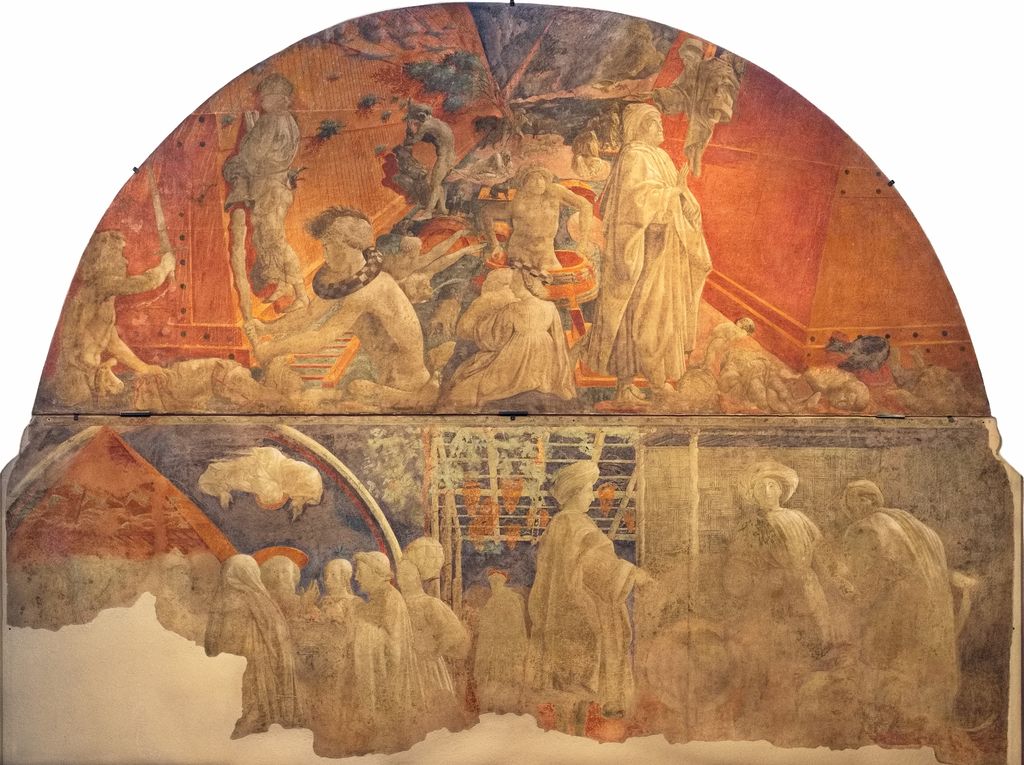
Noah and the Flood
The Flood and Recession of the Waters above the lower episodes from Noah’s story, Santa Maria Novella. Photograph by Armin Kleiner. Image source. CC BY-SA 4.0. Resized for the web. This derivative is available under the same licence.
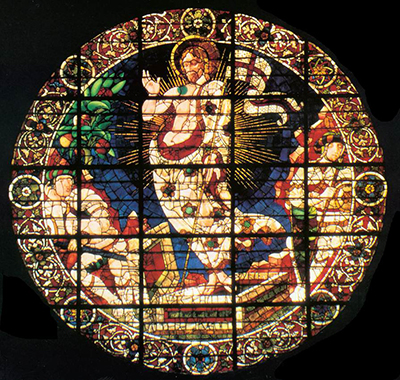
The Resurrection of Christ Stained Glass Window
The Resurrection window in Florence Cathedral, designed by Paolo Uccello and made by Bernardo di Francesco. Photograph by Sailko. Image source. CC BY 3.0. Resized for the web.