


 by Tom Gurney
Tom Gurney BSc (Hons) is an art history expert with over 20 years experience
Published on June 19, 2020 / Updated on November 29, 2026
Email: tomgurney1@gmail.com / Phone: +44 7429 011000
The Allegory of Monastic Life (Thebaid): Introduction
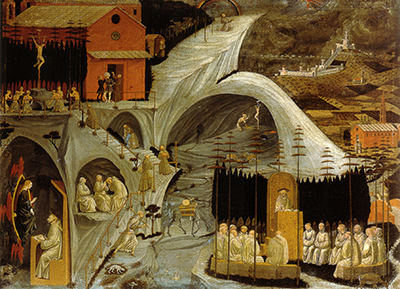
A stair cuts across a pale mountainside. Two friars climb it with loads on their shoulders, passing a cave where three men sit close together. Higher up, a saint kneels alone in the open, while at the foot of the hill a group of monks settle on curved benches to hear a reading. Paolo Uccello makes these activities seem close enough for one person to walk between them. They also belong to lives separated by centuries. The Galleria dell’Accademia in Florence calls the painting Allegory of Monastic Life and dates it to about 1460–65. Its familiar name, The Thebaid, comes from a tradition of picturing the early Christian hermits of the Egyptian desert. Uccello fills that kind of landscape with figures whose names and ways of life would have been familiar in fifteenth-century Florence. [1] [2] [3]
At a Glance
- DateAbout 1460–65
- Medium and dimensionsTempera on canvas, 83 × 118 cm (96 × 126 cm framed)
- CollectionGalleria dell’Accademia, Florence, inv. 1890 n. 5381
Contents
- At the foot of the hill
- The stair, the crucifixes and the summit
- How the mountain holds together
- A canvas from San Giorgio alla Costa
- Two other Florentine Thebaids
- Annotated details
At the foot of the hill
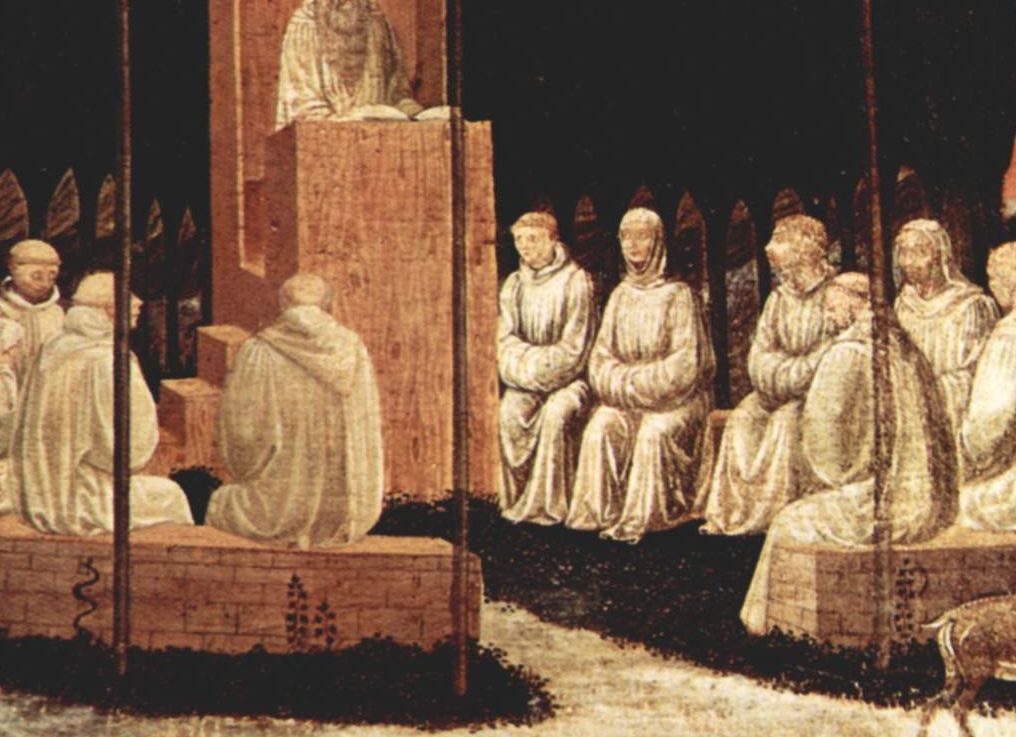
Begin in the lower right. A white-bearded monk sits high in a reddish pulpit with a book before him. Two low benches curve towards each other so that the seated men form a ring around him. At the back of this group, close-packed dark cypresses make something like the wall of a room. The slender trees in front mark the space with their trunks without closing off our view. Giovanni Vitolo reads the gathering as the kind of evening conference at which a religious community might hear the Lives of the Fathers read aloud. The Accademia leaves the reader’s name open between Saint Benedict, associated with the rule followed by many Western monasteries, and Saint Romuald, founder of Camaldoli. Vitolo favours Romuald in part because the Camaldolese made room in a single foundation for communities of monks and of hermits. That combination suits a landscape in which the place of assembly lies within easy reach of the caves. [1] [2] [3]
Across the stream in the lower left, Bernard of Clairvaux turns from an open book to see the Virgin. The mouth of the cave rises over them like a chapel vault. The painter has given the Virgin a seat inside the pointed oval of light that frames her body, while Bernard has a little desk and chair tucked against the rock. Valerio Mosso identifies a chained demon low down in the scene. It is easy to miss beside the luminous form overhead. The gesture of one reader looking up has as much room here as the assembly across the water. Above Bernard, a separate hollow shelters three men absorbed in meditation. Vitolo draws attention to the skull one holds and to the tears he sees on another’s face, a detail he relates to the place of weeping in traditions of monastic penitence. A smaller cavity higher up contains a single figure. Uccello can change the character of a space simply by making it large enough for several men to sit together or narrow enough for one to withdraw. [1] [2] [3]
The stair, the crucifixes and the summit
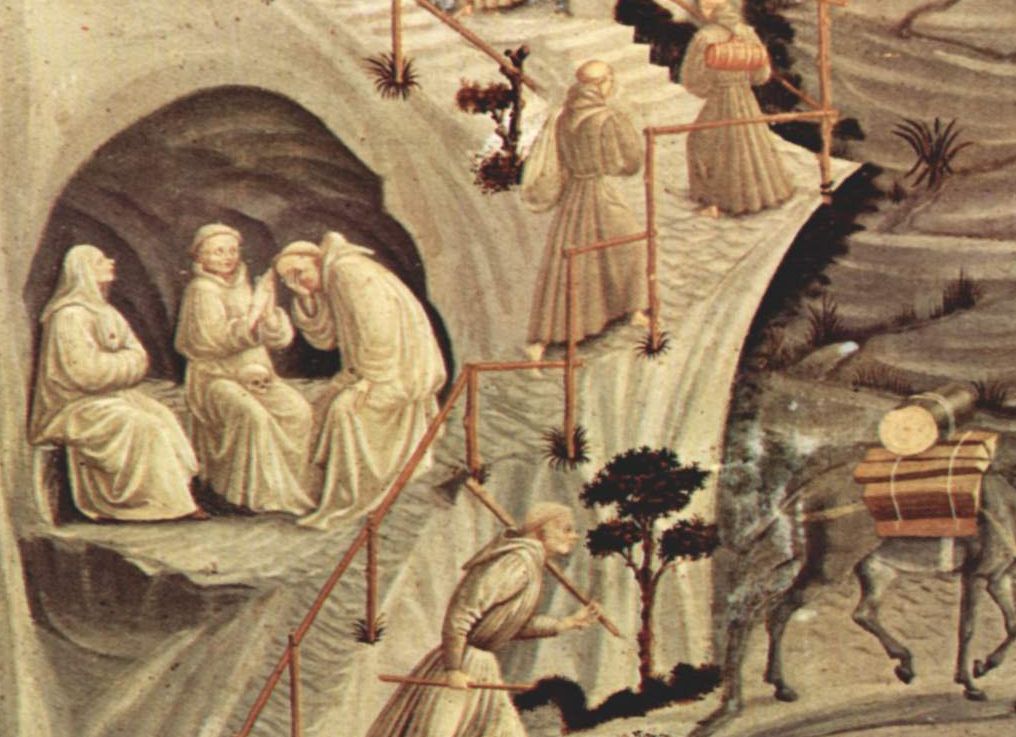
Follow the angled railing upwards. The staircase links the shore and the church terrace, and its turns let us see the climbers from different sides. Vitolo identifies their containers as the kind friars carried when collecting provisions. Below them a woodcutter with an axe approaches a loaded pack animal. A little farther away the painter supplies a crossing and another church, towards which the pair might be headed. These details give each task somewhere to begin and somewhere to end. Between the two foreground gatherings, a waterbird swims straight towards us. The pale shape is easy to pass over when following the diagonal of the stair, but it gives the stretch of water a direction of its own. [2] [3]
At the upper left a group kneels around a crucifix outside a red church. Look for the bare shoulders and lifted arms against the dark trees. The men are flagellating themselves as an act of penitence. A friar and two laymen stand at the doorway beside them. Above the doorway, the round emblem is identified with the devotion to the Holy Name promoted by Bernardino of Siena. Vitolo connects the men’s practice with Franciscan Observance, a movement for stricter religious life. The shape of their gathering also has a history in images. Vitolo cites Alessandra Malquori’s comparison to a circle of friars around a crucifix in the illustrated Franciscan chronicle known as the Franceschina. Raffaele Marrone reproduces this detail of Uccello’s canvas in his study of the relationship between hermit imagery and confraternal penance. The little scene could have been legible to people whose own religious practice was organised around a gathering of this kind. [2] [3] [4]
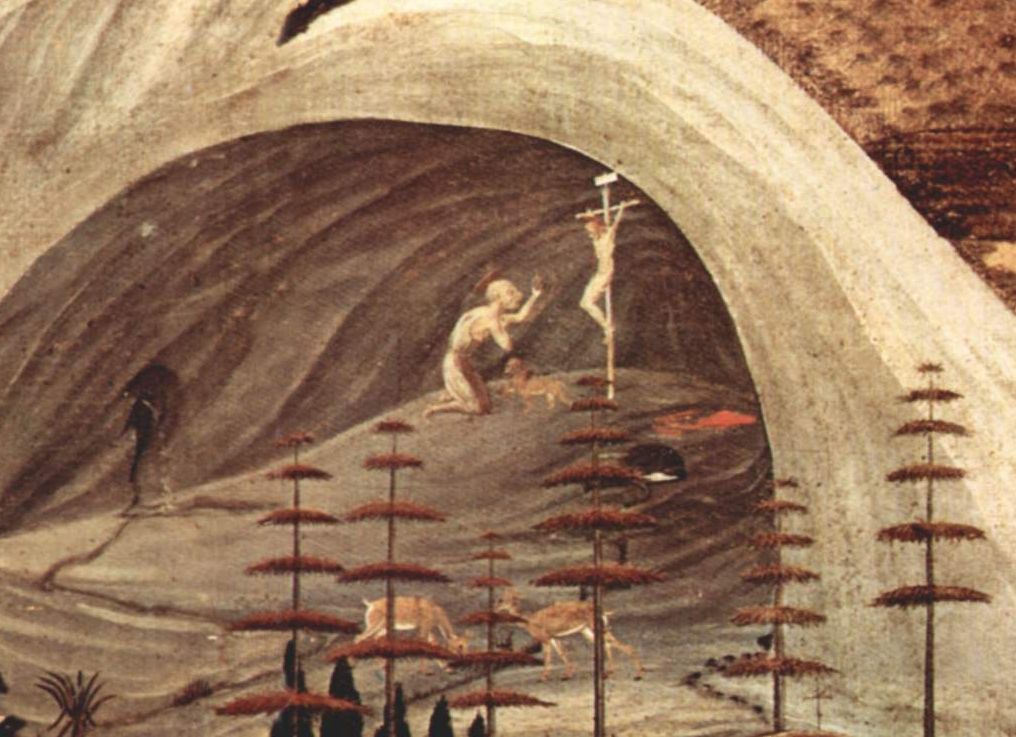
Find a second crucifix in the broad, dark cave near the centre. Here Jerome kneels alone, raising a stone to strike his breast. His lion and discarded red cardinal’s hat help identify him. The pale rim of the cave makes a sweeping arc above his figure, lifting the eye to the shelf where Francis of Assisi receives the stigmata. Francis kneels beneath a rainbow on a narrow outcrop, facing the airborne figure of Christ in seraphic form. Vitolo identifies the figure by a little shelter nearby as Brother Leo, the witness to the event. The two episodes bring bodily penance and bodily transformation into close view. In the cave Jerome has his stone and the image of Christ before him. On the high rock Francis receives the marks of Christ’s wounds. The change of setting, from a recess in the dark slope to an exposed lip against the sky, makes the ascent easy to see. [1] [2] [3]
Annotated Details from The Allegory of Monastic Life (Thebaid)
The numbered points identify visible features discussed in this article. Return from each detail to the numbered overview. Allegory of Monastic Life, also called the Thebaid, Galleria dell’Accademia inv. 1890 no. 5381. Image source. Public domain.
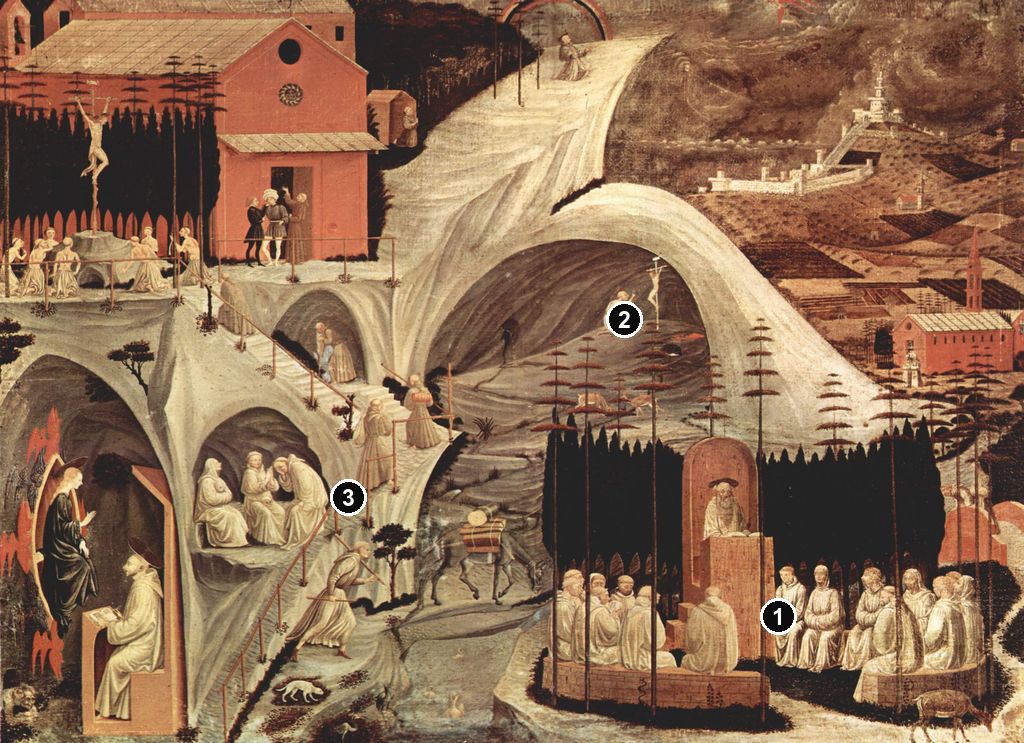
Details from THE ALLEGORY OF MONASTIC LIFE (THEBAID)
Compare the cropped details with the source images above. Notice how their colours, shapes and positions contribute to the larger compositions.
The brothers gathered outside
A clustered assembly in light-coloured habits circles the solitary speaking figure. Tall thin trunks set off the gathered figures from the rocky slope.
A saint at prayer under the arch of rock
A kneeling figure and a small cross occupy a deep hollow beneath the pale sweep of the rock. The broad surrounding shape gives the small act its own setting.
Road, stair and separate devotional scenes
Thin handrails run between caves and built settings. Tracing those lines connects the events while keeping each group distinct.
How the mountain holds together
The folds of pale rock keep several scenes in sight at once. The cave arches repeat one another with different widths and depths. Steps, a rail and a footpath draw lines between them. Near the pulpit, the arc of the planted trees answers the curve of the benches. To the right, rows of fields, a walled settlement and a road ascending towards a hilltop tower supply a different depth. Uccello sets those features out as though the viewer were looking down on the valley from high ground. The church on the left stands close enough for us to see people pausing on its doorstep. Each place has a viewpoint suited to the action it contains. The effect is especially clear if you follow the ridge from Jerome’s enormous cave to the minute structures on the far hillside. The right-hand valley stays visible as a world of farming, habitation and traffic, close to the places set aside for prayer. [2] [3] [5]
Malquori’s title The Way of Perfection picks up on the upward course of the scenes. Vitolo proposes three broad levels, from instruction and contemplation through the more demanding practices of penitence to Francis’s experience on the summit. The plan also leaves room for the daily traffic of people, food and firewood. Alessandro Parronchi proposed a different key, the medieval De oculo morali, in which Pierre Lacepierre of Limoges used examples from optics to teach religious truths. This accounts for another title in the Italian heritage catalogue, Perspectiva Religiosorum. The picture’s shifts of viewpoint make the proposal understandable. Its original instructions for viewing, if there were any, are unknown. The ascent remains readable through what Uccello shows, from the men sitting together with a book to the separate figure on the high ledge. [2] [3] [5] [6]
A canvas from San Giorgio alla Costa
The surviving work is tempera on canvas. The Accademia gives the framed size as 96 × 126 centimetres. The 2025 exhibition catalogue gives the canvas itself as 83 × 118 centimetres. Andrea Staderini reported that the edges appear to have been cut on all four sides and, citing conservator Rossella Lari, that there was no evidence for a transfer from wood. These observations leave the original dimensions open. Canvas was an unusual support for a Florentine Thebaid, a subject often painted on broad wooden panels. Uccello also used canvas for the London Saint George and the Dragon, another small painting where caves have a strong hold on the composition. An Accademia maintenance report records work on the Allegory’s climate frame in 2020. [1] [2] [5] [7] [8]
The painting came from San Giorgio alla Costa in Florence’s Oltrarno, a Vallombrosian monastery from 1448. The later account of its passage into the Florentine galleries connects it to the Napoleonic-era suppressions of 1810. It was in the Uffizi stores when Carlo Gamba published it in 1909. That history establishes a neighbourhood and a later institutional home, but leaves two plausible original audiences. The lay Buca di San Girolamo met in rooms at San Giorgio for nocturnal penance. Uccello’s membership in the confraternity is documented in 1438. The nearby house of Franciscan tertiaries, founded in the late fourteenth century, was dedicated to Jerome and Francis. Their prominence in the middle and upper part of the canvas and the Franciscan imagery beside the red church give that second proposal particular weight for Malquori and Vitolo. Either audience would have recognised the importance of the gathering around the crucifix. Medieval religious life on this part of the hill could bring lay confraternities, religious houses and the people who supplied them within a few doorways of each other. [1] [2] [3] [5] [6] [7]
The early photographs preserved by the Federico Zeri Foundation help document the picture and the history of its identification. Gamba assigned it to Uccello’s school, and Wilhelm Boeck subsequently argued for Uccello himself. Other names circulated, including the proposed Master of Karlsruhe and Master of Quarate. Roberto Longhi once favoured Giovanni di Francesco. The Accademia now displays it as Uccello, and the 2025 catalogue places it close in time to his San Miniato work and the Urbino predella. [1] [2] [6] [9]
Two other Florentine Thebaids
The Uffizi has a separate Thebaid, painted around 1420 in tempera on wood, now on loan to the Museo di San Marco. Its attribution to Fra Angelico remains debated. At 75 × 207 centimetres it is appreciably wider in proportion than Uccello’s canvas. The Uffizi identifies episodes from the lives of Saint Anthony and Saint Onuphrius in a landscape with a river opening into the sea. Those desert saints and the long horizontal format make a good comparison with the steep, closely packed mountain Uccello used to bring together Bernard, Jerome and Francis. The Uffizi also records the Medici ownership of two paintings of the subject. A Florentine viewer could have encountered these images in lay settings as well as in a monastery. [1] [2] [10]
Uccello’s own Stories of the Holy Fathers in the upper cloister of San Miniato al Monte present a different encounter with the subject. A later transcription of the commission points to 1461. The surviving fragments and preparatory drawings on plaster belong to a cycle devised for an Olivetan community, encountered across several walls as people passed through the cloister. The national catalogue identifies scenes of Paul the Hermit on the south side and distinguishes work associated with the master from sections that some scholars give to a collaborator. The little canvas from San Giorgio sets its scenes close enough for the eye to walk between them from a single standing place. At San Miniato a viewer actually had to move through the building. [11] [12]
Artworks directory
Browse paintings, drawings, stained-glass designs and other objects connected with Uccello. Cycles and their surviving components may have separate entries. The collection or catalogue’s wording is retained where a date, attribution or subject is debated.
| Name | Date | Medium, attribution and collection |
|---|---|---|
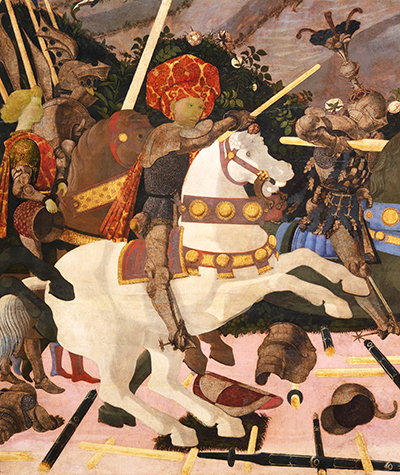
| Niccolò da Tolentino at the Battle of San Romano · London | Probably c.1438–40 | Tempera and oil on wood, with metallic decoration · National Gallery Catalogue. |
| Bernardino della Carda Unhorsed · Florence | c.1435–40 | Tempera on panel · Uffizi Galleries Catalogue. |
| The Counterattack of Micheletto da Cotignola · Paris | 1450–75 in the Louvre catalogue | Tempera (possibly) on wood · Musée du Louvre Catalogue. |
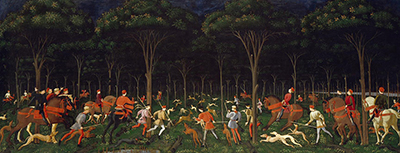
| The Hunt in the Forest | c.1465–70 | Tempera and oil with traces of gold on panel · Ashmolean Catalogue. |
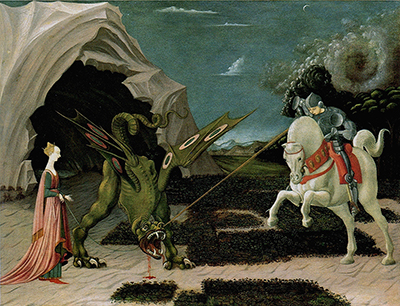
| Saint George and the Dragon · London | c.1470 | Oil on canvas · National Gallery Catalogue. |
| Saint George Slaying the Dragon · Melbourne | c.1430 | Oil, tempera and silver leaf on wood · National Gallery of Victoria Catalogue. |
| Saint George and the Dragon · Paris | 1430–35 in the museum catalogue | Painted wood panel · Musée Jacquemart-André Catalogue. |
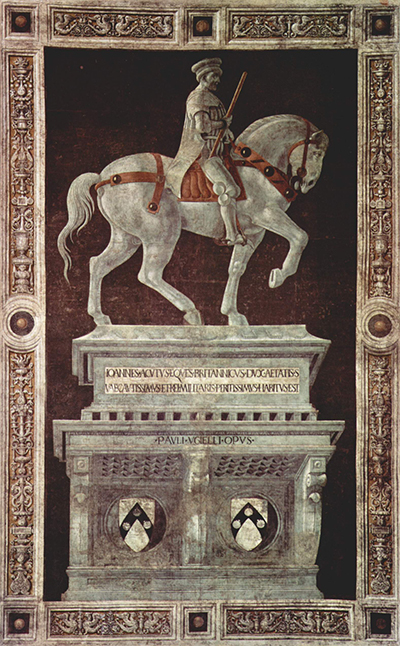
| Equestrian Monument to John Hawkwood | 1436 | Transferred wall painting · Florence Cathedral Catalogue. |
| Study for the John Hawkwood Monument | 1436 | Study on prepared paper · Uffizi Catalogue. |
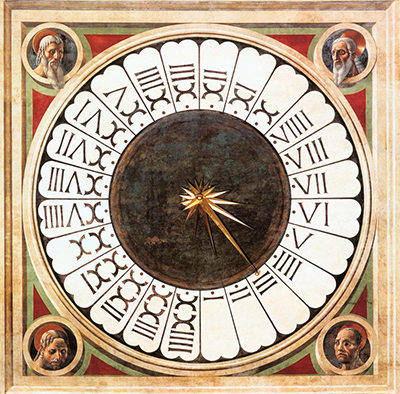
| Monumental Clock Face | 1443 | Painted dial · Florence Cathedral Catalogue. |
| Resurrection of Christ | 1443–44 | Stained glass · Uccello design · Florence Cathedral Catalogue. |
| Nativity | 1440s | Stained glass · Uccello design · Florence Cathedral Catalogue. |
| Creation of the Animals and Creation of Adam | Third to fourth decade of the 15th century | Detached fresco · Green Cloister, Santa Maria Novella Catalogue. |
| Creation of Eve and the Fall | Third to fourth decade of the 15th century | Detached fresco · Green Cloister, Santa Maria Novella Catalogue. |
| Flood and Recession of the Waters | 15th century; dating debated | Detached fresco · Green Cloister, Santa Maria Novella Catalogue. |
| Sacrifice and Drunkenness of Noah | 15th century; dating debated | Detached fresco · Green Cloister, Santa Maria Novella Catalogue. |
| Stories of the Virgin and Saint Stephen · Assunta Chapel | 1430s, with later completion | Fresco cycle · Paolo Uccello and Andrea di Giusto · Prato Cathedral Catalogue. |
| Blessed Jacopone da Todi | 1436 in the diocesan museum | Detached fresco · Museo dell’Opera del Duomo, Prato Catalogue. |
| Adoration of the Child · Bologna | 1430s; inscription incomplete | Detached fresco · San Martino Maggiore, Bologna Catalogue. |
| Adoration of the Christ Child · Karlsruhe | c.1436 | Painted panel · Attribution to Uccello · Staatliche Kunsthalle Karlsruhe Catalogue. |
| Annunciation · Oxford | Early 15th century | Tempera and gilding on panel · Ashmolean Catalogue. |
| Allegory of Monastic Life (Thebaid) | c.1460–65 | Tempera on canvas · Galleria dell’Accademia, Florence Catalogue. |
| Miracle of the Profaned Host | 1467–68 | Tempera on wood · Galleria Nazionale delle Marche, Urbino Catalogue. |
| Triumphal Entry into Rome of Titus and Vespasian(?) | c.1430–35 | Tempera, gold and silver on panel · Yale University Art Gallery Catalogue. |
| Crucifixion with the Virgin and Saints | c.1460–65 | Painted panel · Museo Nacional Thyssen-Bornemisza Catalogue. |
| The Crucifixion · Met triptych | Probably mid-1450s | Tempera on wood with gold ground · Metropolitan Museum of Art Catalogue. |
| Perspective Study of a Chalice | 1450–75 | Pen, ink and stylus on paper · Attributed to Uccello · Uffizi Catalogue. |
| Study of a Mazzocchio | 15th century | Perspective study · Attributed to Uccello · Uffizi Catalogue. |
| Mazzocchio Seen in Perspective | Uncertain | Drawing · Attribution debated · Musée du Louvre Catalogue. |
| Head of a Man in Profile | 15th century | Pen, ink and wash · Musée du Louvre Catalogue. |
| Five Masters of the Florentine Renaissance | 1500–50 | Oil on wood · Anonymous Florentine school · Musée du Louvre Catalogue. |
| Madonna and Child from the Del Beccuto House | 15th century | Detached fresco · Museo di San Marco, Florence Catalogue. |
| Man of Sorrows with the Virgin and Saint John · Avane Predella | 15th century | Predella · Museo di San Marco, Florence Catalogue. |
| Calling of Saint Paul the Hermit · San Miniato | After 1447 to c.1454 in state catalogue | Sinopia · Attributed to Uccello or collaborator Catalogue. |
| The host changes hands · Urbino predella, scene 1 | 1467–68 | Tempera on wood · Component of DE 231 · Galleria Nazionale delle Marche Catalogue. |
| The figures at the door · Urbino predella, scene 2 | 1467–68 | Tempera on wood · Component of DE 231 · Galleria Nazionale delle Marche Catalogue. |
| The procession approaches the altar · Urbino predella, scene 3 | 1467–68 | Tempera on wood · Component of DE 231 · Galleria Nazionale delle Marche Catalogue. |
| The condemned woman and the ladders · Urbino predella, scene 4 | 1467–68 | Tempera on wood · Component of DE 231 · Galleria Nazionale delle Marche Catalogue. |
| Persecution of the family · Urbino predella, scene 5 | 1467–68 | Tempera on wood · Component of DE 231 · Galleria Nazionale delle Marche Catalogue. |
| Angels and demons at the bier · Urbino predella, scene 6 | 1467–68 | Tempera on wood · Component of DE 231 · Galleria Nazionale delle Marche Catalogue. |
| Birth of the Virgin · Prato Cathedral | 1430s; dating debated | Fresco · Assunta Chapel, Prato Cathedral Catalogue. |
| Presentation of the Virgin · Prato Cathedral | 1430s; dating debated | Fresco · Assunta Chapel, Prato Cathedral Catalogue. |
Discussion
Look again at the images and ideas explored in The Allegory of Monastic Life (Thebaid). These editorial prompts invite your observations.
Reader Insights
Where does your eye first begin to climb the mountain, and which detail makes you stop on the way to Francis?
What changes when you look back and forth between Bernard alone in his cave and the monks gathered to hear the reader?
Join the Conversation
Share a detail, comparison or question about The Allegory of Monastic Life (Thebaid) below.
References
- Galleria dell’Accademia di Firenze, Allegory of Monastic Life, inv. 1890 n. 5381. View source.
- Valerio Mosso, La via di perfezione (Tebaide), cat. 02.2 in Fratello Sole, Sorella Luna. La natura nell’arte tra Beato Angelico, Leonardo e Corot, Perugia exhibition catalogue, 2025, pp. 220–221. View source.
- Giovanni Vitolo, Eremiti, monaci e città nell’esperienza religiosa dell’Italia medievale, Quellen und Forschungen aus italienischen Archiven und Bibliotheken 95, 2015, especially pp. 25–36. View source.
- Raffaele Marrone, Una lauda dipinta. Gli affreschi di Buffalmacco nel Camposanto di Pisa e la devozione dei disciplinati, Römisches Jahrbuch der Bibliotheca Hertziana 46, 2023, pp. 106–108, fig. 28. View source.
- Andrea Staderini, Scenes from the Lives of the Holy Hermits, cat. 1 in Botticelli to Titian. Two Centuries of Italian Masterpieces, Budapest exhibition catalogue, 2009, pp. 120–121. View source.
- Catalogo Generale dei Beni Culturali, Perspectiva Religiosorum o Tebaide, heritage record 0900159210. View source.
- Lorenzo Sbaraglio, Paolo di Dono, detto Paolo Uccello, Dizionario Biografico degli Italiani, vol. 81, 2014. View source.
- Galleria dell’Accademia di Firenze, Galleria Accademia Report 2024, maintenance record for inv. 1890 n. 5381. View source.
- Fondazione Federico Zeri, Paolo di Dono (Paolo Uccello), Tebaide, catalogue entry 13561. View source.
- Daniela Parenti, Uffizi Galleries, Thebaid, inv. 1890 n. 447, Florentine panel attributed to Fra Angelico. View source.
- Mauro Minardi, “In perfecta abstinentia”. I dipinti murali di Paolo Uccello nel chiostro superiore, in Cristina Acidini and Renzo Manetti, eds., San Miniato al Monte in Firenze. Mille anni di storia e bellezza, especially pp. 184–186. View source.
- Catalogo Generale dei Beni Culturali, Monaci a mensa, figura seminuda, San Miniato, detached mural and cycle record 0900291694. View source.
More PAOLO UCCELLO Artworks

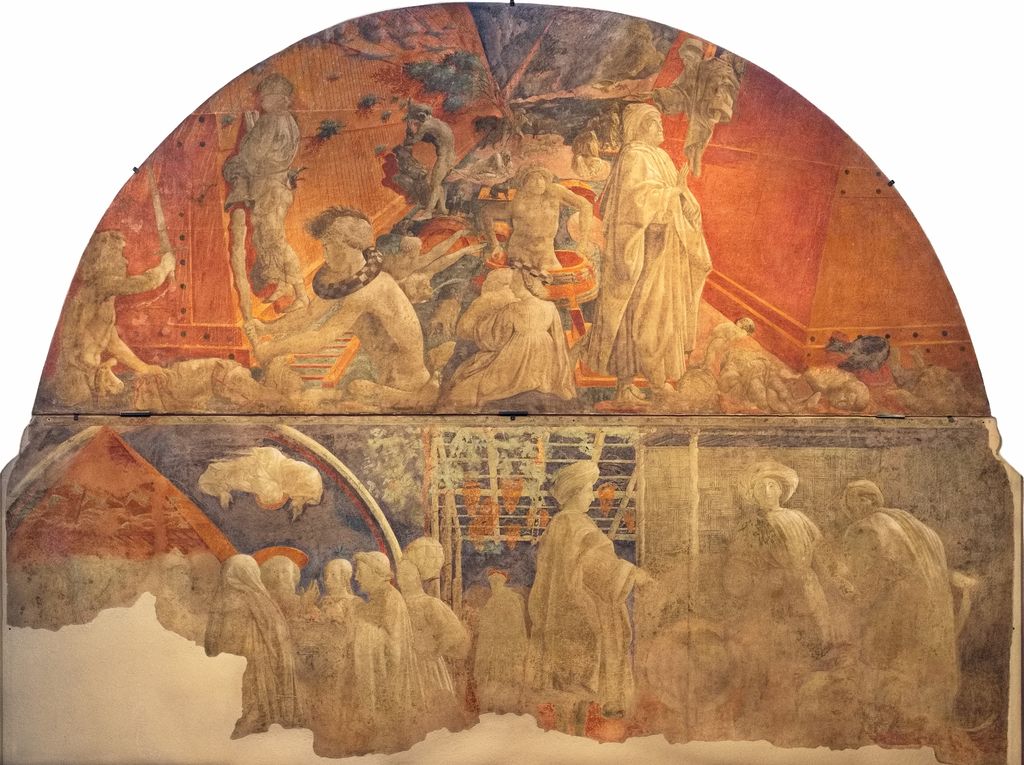
Noah and the Flood
The Flood and Recession of the Waters above the lower episodes from Noah’s story, Santa Maria Novella. Photograph by Armin Kleiner. Image source. CC BY-SA 4.0. Resized for the web. This derivative is available under the same licence.
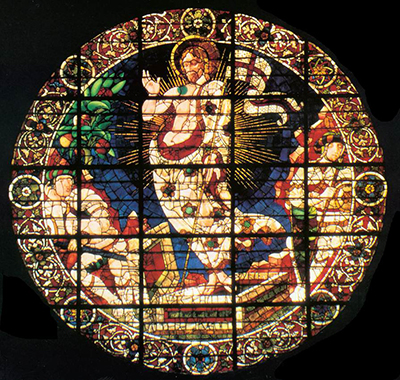
The Resurrection of Christ Stained Glass Window
The Resurrection window in Florence Cathedral, designed by Paolo Uccello and made by Bernardo di Francesco. Photograph by Sailko. Image source. CC BY 3.0. Resized for the web.