


 by Tom Gurney
Tom Gurney BSc (Hons) is an art history expert with over 20 years experience
Published on June 19, 2020 / Updated on November 29, 2026
Email: tomgurney1@gmail.com / Phone: +44 7429 011000
Annunciation: Introduction
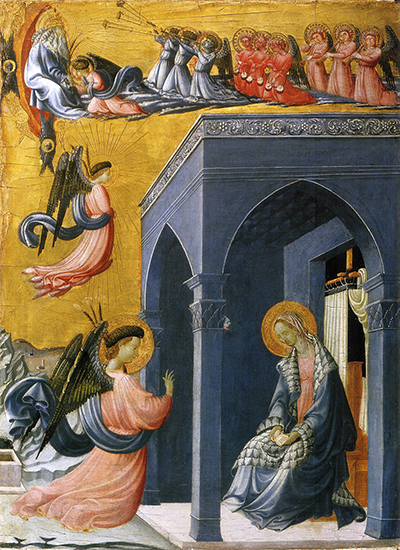
Gabriel appears three times in Paolo Uccello’s Annunciation. At the top of the panel, he bows low before God. Halfway down the left side, he descends in a sweep of pink and blue. At the bottom, he kneels at the entrance to Mary’s porch and raises a hand to speak. The painting follows the announcement from its beginnings in heaven to the quiet exchange at Mary’s door. The Ashmolean Museum in Oxford lists the work as tempera and gilding on panel from the early 1400s. It is about 65 centimetres high and 48 wide. [1] [2] [3]
At a Glance
- DateEarly 1400s
- MediumTempera and gilding on panel
- CollectionAshmolean Museum, Oxford, WA1850.7
Contents
- Gabriel’s journey to Mary
- An open porch and a private room
- What the infrared image reveals
- Gold, blue and the original setting
- Why the date is debated
- Annotated details
Gabriel’s journey to Mary
In Luke’s Gospel, God sends Gabriel to Nazareth to tell Mary that she will bear a son named Jesus. Mary is troubled by his greeting. She asks how this is possible, hears that the Holy Spirit will come upon her and gives her assent. Luke takes only a few words to dispatch the messenger. Uccello gives the departure its own scene, complete with three ranks of angels making music. Art historian Malena Rotter points out how unusual it is to find the sending of Gabriel and his greeting to Mary combined this way in a fifteenth-century panel. Earlier Italian painters had also represented the sending. In Spinello Aretino’s fresco in San Francesco, Arezzo, God gives Gabriel a palm branch. In Oxford the angel carries a lily. [3] [4]
Look at the blue cloth that trails behind the bowed angel. Its folds meet the long dark clouds under the musicians, which have pale crests like waves. Gabriel’s blue drapery curls again in mid-air, where it stands out against the gold, and reappears across his back when he kneels. The repetition makes the three figures easy to recognise as one person. He also grows larger as he approaches Mary, until the messenger who was one small figure among many is nearly as large as the woman he addresses. The change in scale gives his arrival the force of a figure coming into the foreground. [1] [3]
Mary lowers her head over the open book in her lap. Her arms gather close to her body while Gabriel’s raised hand opens into the space between them. The difference is small in the context of the busy upper scene, yet it lets us picture the stillness that follows the greeting. Look a little higher, beside the capital of the front column, for the small dove. It represents the Holy Spirit and makes the subject legible in a different way from the angel’s gesture. The hand marks the conversation. The dove makes visible what Gabriel tells Mary about the conception itself. [3] [4] [5]
An open porch and a private room
The porch stands at an angle to the picture’s lower edge. Its long cornice leads the eye from the landscape at the left to the front of the building, where it turns sharply and runs towards the right edge. The large front opening gives us a view under the porch roof. Small painted pyramids on the ceiling grow harder to distinguish as they recede into the blue. Behind Mary, light catches the gathered pale curtain at a rectangular doorway. That small passage suggests a room further back. Gabriel, by contrast, kneels on the open ground, with a strip of rocky landscape at his back. The free-standing column puts a boundary between the figures while leaving the space around their hands and faces open. [1] [5] [6]
The two levels of the picture meet along the roofline. The ranks of angels lie almost flush with the surface of the gold and extend to the right edge. Below, the porch has room for a body to sit, a roof to pass under and a door to go through. The gold gives Gabriel an open route between levels with little landscape to interrupt his descent. The visible porch, by comparison, lets us judge the distance he finally has to cross. [1] [3] [6]
Annotated Details from Annunciation
The numbered points identify visible features discussed in this article. Return from each detail to the numbered overview. The Annunciation, Ashmolean Museum WA1850.7. Image source. Public domain.
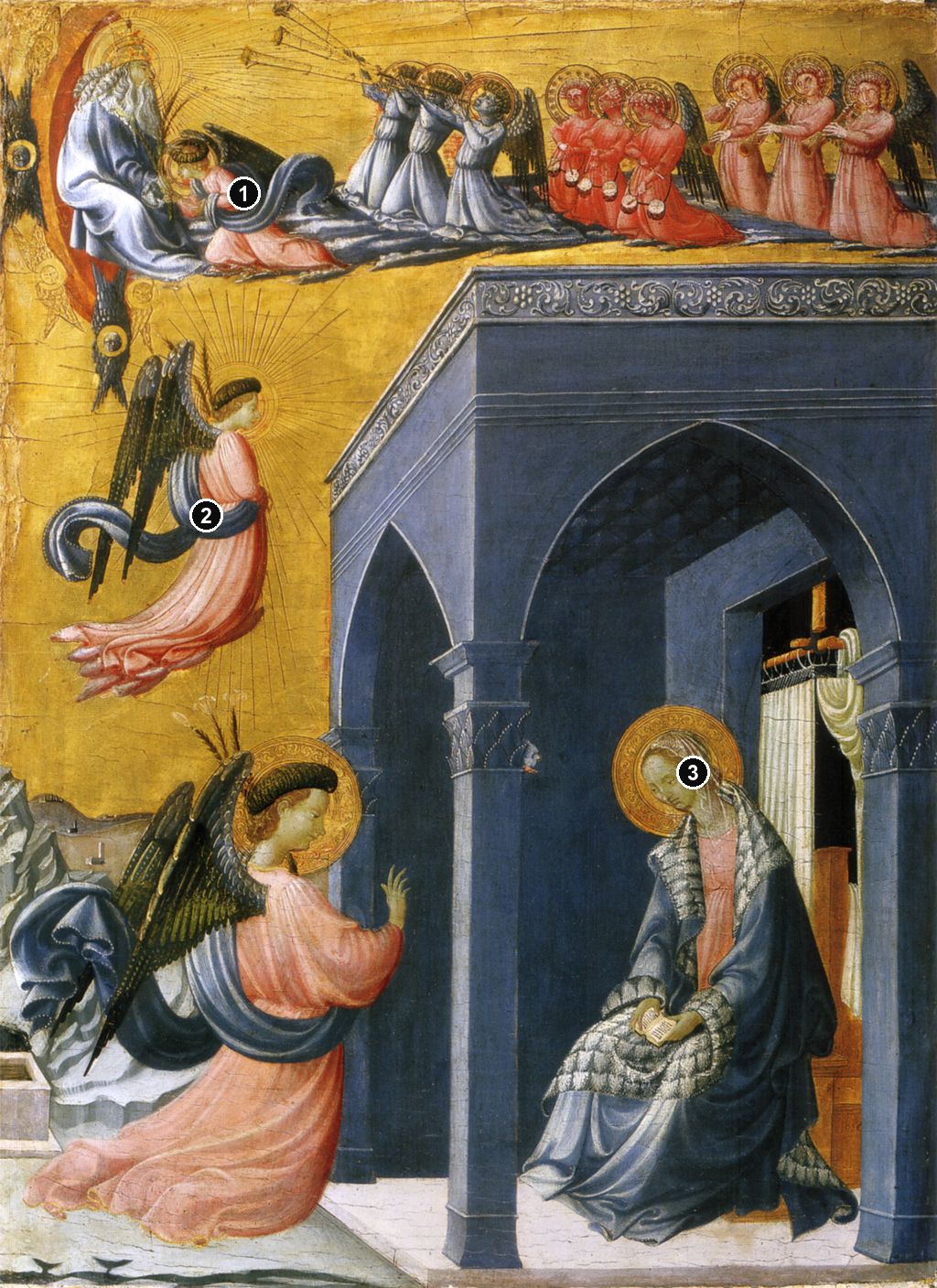
Details from ANNUNCIATION
Compare the cropped details with the source images above. Notice how their colours, shapes and positions contribute to the larger compositions.
Gabriel bows before God
Near the top edge Gabriel bows beside the seated figure of God. Three groups of angels fill the gold space to the right.
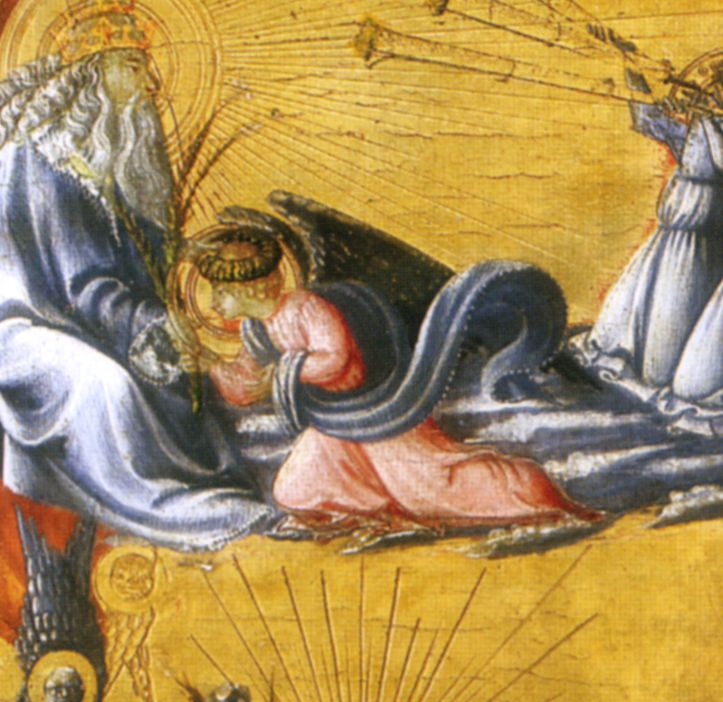
The flight towards Mary
The folds and curling blue cloth trail behind the descending angel. His direction is set against the rising edge of the porch.
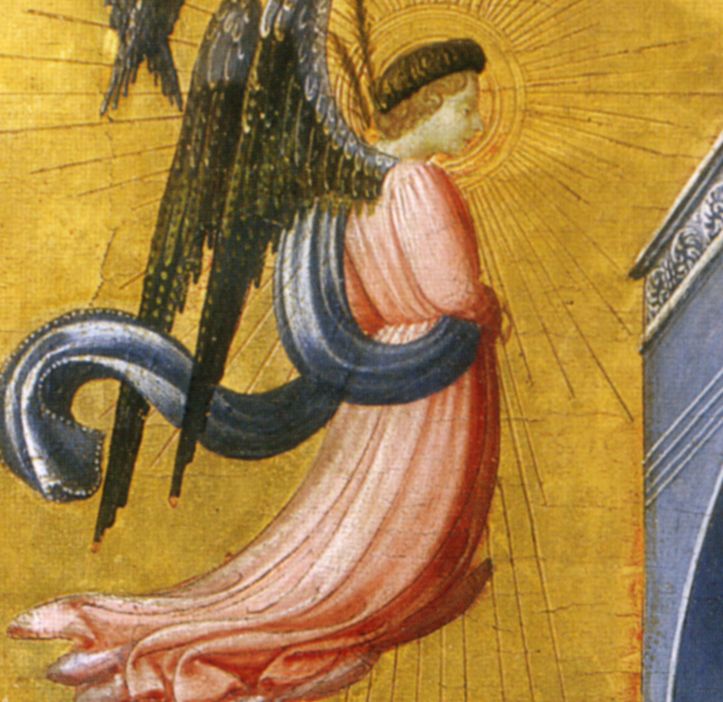
The doorway beside Mary
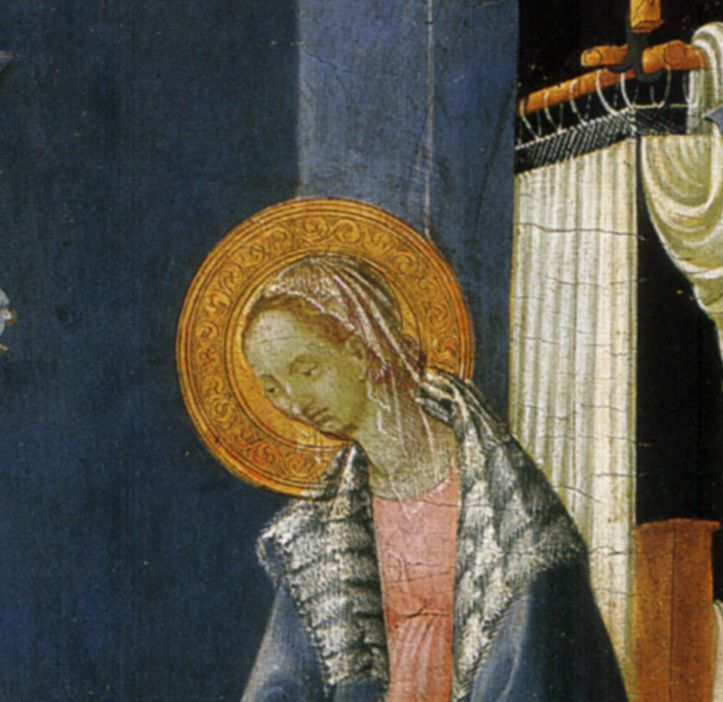
The large arch and its foremost column divide Gabriel from Mary. The curtained opening gives Mary’s side of the picture a further space of its own.
What the infrared image reveals
Infrared imaging examined by art historian Hugh Hudson and published in part by the Ashmolean shows how the painter worked out the porch. Straight lines for the back of the room continue through the area occupied by Mary’s sleeve and book. Hudson reads them as the edges of a box-like space drawn before the figures took shape. The figures and drapery were drawn freehand, while the building was largely ruled. The front opening was first drawn and incised as a round arch. During painting it became pointed. The doorway behind Mary was also planned as an arch and ended up rectangular. [5] [7] [8]
The ceiling is the clearest example of geometry at work. Hudson reconstructs an approximately square ceiling seen in depth. Diagonals between opposing corners locate its centre. Trials at dividing the area eventually produced eight subdivisions in each direction for the rows of pyramids. The painter drew and incised the part of that pattern the spectator would see through the arch. He used a related procedure at the front column, finding the corners, including one hidden from view, and extending guidelines across to align architectural features on the far side. Hudson compares the use of diagonals to fix a centre with evidence he found in the painted surround of Uccello’s Adoration mural at San Martino in Bologna. [5] [7]
Other changes are on the scale of a hand or a fold. The dove was drawn a little higher than where it landed in the finished design. The lower Gabriel’s left hand originally showed beneath his right sleeve, holding the stem of the lily. Uccello concealed the hand while painting. Hudson compares that earlier arrangement with a small Annunciation panel attributed to Fra Angelico, in which Gabriel’s hand and a similar branching lily emerge from behind his leg. On Mary’s garment, an S-shaped curve below the book was dropped altogether. These adjustments bring us close to decisions made on the board, from how much of a gesture to reveal to how far back a door should appear. [5] [9]
Gold, blue and the original setting
The gold is worked differently from one figure to the next. Lines radiate from God the Father, punches texture the musicians’ haloes, and the patterns on Mary’s and the kneeling Gabriel’s haloes were incised by hand. The Ashmolean also calls attention to the expense of the ultramarine. Hudson reports a different finding from a tiny sample of grey paint taken from the ground beside the porch. It contained lead white and a coarse dark pigment, probably a carbon black. He also notes traces of red glaze on the gilded bands of the Father’s tiara. That small detail has a counterpart in the tiara worn by God the Father in the Melbourne Saint George. The same materials could produce a gleaming surface, a coloured reflection or the texture of a halo, depending on how they were worked. [5] [7] [10]
Beneath the paint is one board with its grain running vertically. X-rays indicate what appears to be a fine layer of cloth across almost the whole panel. They also show worm channels in the wood, with comparatively little resulting damage to the paint surface. There are restorations around parts of the edge, where Hudson found no surviving trace of the original frame and no compelling evidence that the painted area was substantially reduced. He suggests that the small scale and expensive finish suit a commission for private devotion in a wealthy household. The surviving evidence leaves the first owner and the exact setting open. The panel entered the museum in 1850 with William Fox-Strangways’s gift, alongside Uccello’s Hunt in the Forest. Their arrival was part of a growing nineteenth-century British interest in early Italian painting. [5] [7] [11]
Why the date is debated
The attribution changed several times after the panel came to Oxford. An early Oxford catalogue records a former attribution to Pesello and identifies the picture as the one Gustav Friedrich Waagen apparently published under Benozzo Gozzoli in 1854. The Fondazione Federico Zeri’s archive records Bernard Berenson’s proposal of Pietro di Giovanni d’Ambrogio in 1932, Mario Salmi’s attribution to Dello Delli in 1934 and Alessandro Parronchi’s suggestion of an early Alesso Baldovinetti in his 1974 book on Uccello. Christopher Lloyd’s 1977 Ashmolean catalogue listed the work as anonymous Florentine. The Zeri database still indexes the painting under the Master of 1419 and records Uccello as an alternative. [11] [12]
In 1935 Georg Pudelko linked the Oxford picture to the panel now in Melbourne as the work of a single hand influenced by Uccello and Fra Angelico. John Pope-Hennessy in 1939 described that painter as a Florentine follower of Uccello. Roberto Longhi had separately reassigned the Melbourne picture to Uccello himself by 1968. Then in 1980 Carlo Volpe placed both paintings among Uccello’s early works and dated the Oxford panel to about 1420. The Ashmolean’s teaching notes favour the early 1420s. Miklós Boskovits placed both panels in the second half of that decade, while Hudson makes the case for about 1430 or the early 1430s. Volpe’s own reassessment began with the rediscovery of the Bologna mural. Its date, incised in plaster, securely begins with 143, giving him a point of reference in the 1430s for reconstructing Uccello’s early career. [6] [7] [9] [13]
Several of Hudson’s comparisons explain why. The Oxford painting and the Melbourne Saint George share gold grounds and use bands of contrasting colour to give even small passages of landscape a sense of recession. They also have costumes, profiles and curling drapery in the tradition of Lorenzo Ghiberti, in whose workshop Uccello trained. For Oxford, Hudson draws a specific parallel with the Stories of Jacob and Esau relief from Ghiberti’s gilded bronze doors for the Florence Baptistery. Both artists give narrative figures space to act around a portico and place God at an upper corner. Hudson also compares the soft fall of the curtain behind Mary with drapery hung over a beam in the relief. For Melbourne, he points to a different bronze, David and Goliath, where the fighting also takes place in the foreground below a rocky outcrop and a walled city. These are two comparisons based on different ways of arranging a story. The round arch found under the paint makes the resemblance to Ghiberti’s arcade closer than the visible, pointed opening suggests. Hudson argues that Uccello would most likely have seen the design after returning from Venice. Ghiberti received the commission for the doors in 1425, and the panels had been cast by 1437. The date of this particular design within that span is uncertain. The argument for a date after Venice therefore depends on the proposed connection to the relief. [5] [7] [14] [15]
A related comparison is the Virgin and Child from the Del Beccuto house in Florence. Volpe and Hudson connect its gilded field and rich blue to the Oxford panel. Anna Padoa Rizzo proposed that the mural might relate to money owed to Uccello by his kinsman Deo del Beccuto, recorded in tax returns from the early 1430s. The debt does not identify a commission, and Lorenzo Sbaraglio notes that the mural could account for only a small part of the sum. The relationship is evidence of a shared approach to colour and figure design, with less power to fix an exact year. [7] [13]
The contrast between fine gold work and measured space makes the painting belong in two conversations about the period. It appeared in a 2012 exhibition on Florentine Late Gothic art at the Uffizi, and the following year it was shown in Prato alongside the Melbourne panel and material from the Prato Cathedral frescoes. The Prado’s 2019 loan listed the date as about 1420. Exhibited among examples of early Florentine art, the work can illuminate both the persistence of gold-ground painting and the new ways artists built depth within it. [2] [16]
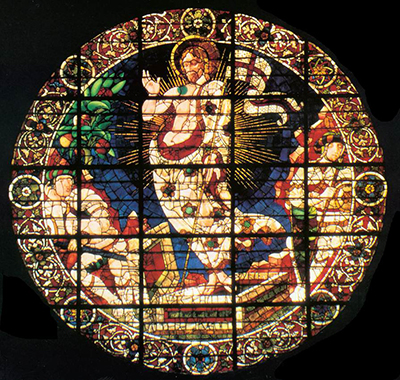
The Oxford panel is a surviving early work. Uccello also designed an Annunciation in stained glass for the drum of Florence Cathedral in the 1440s. The Opera del Duomo records that lightning destroyed the window in 1828. The separate surviving Resurrection window gives an idea of the much larger scale at which Uccello designed for the cathedral. [17]
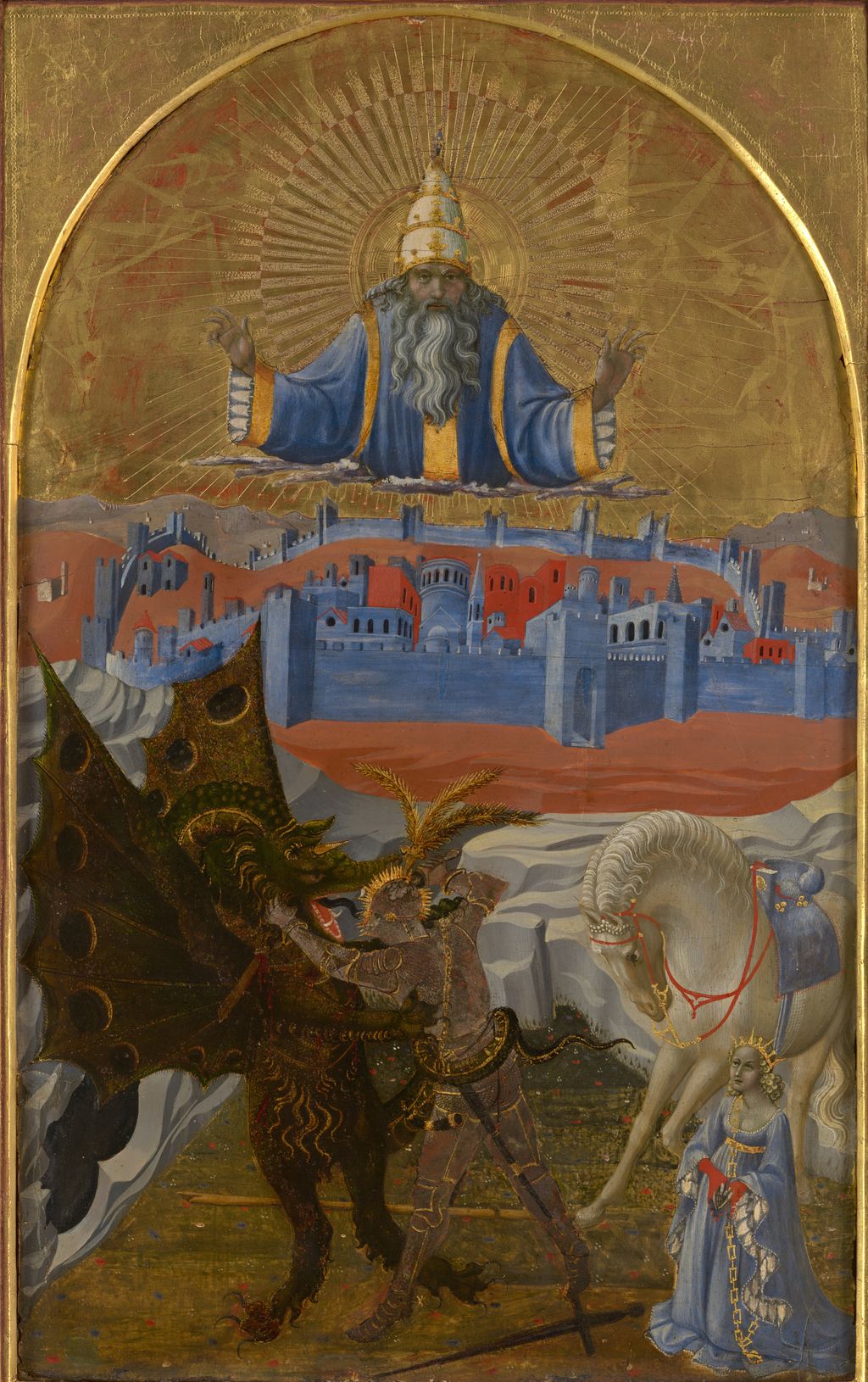
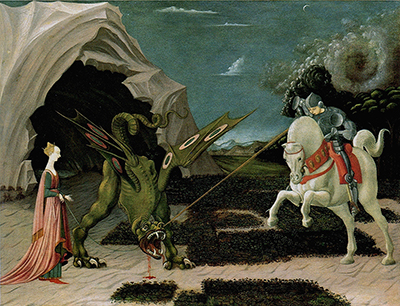
Saint George Slaying the Dragon, National Gallery of Victoria 2124-4. Image source. Public domain.
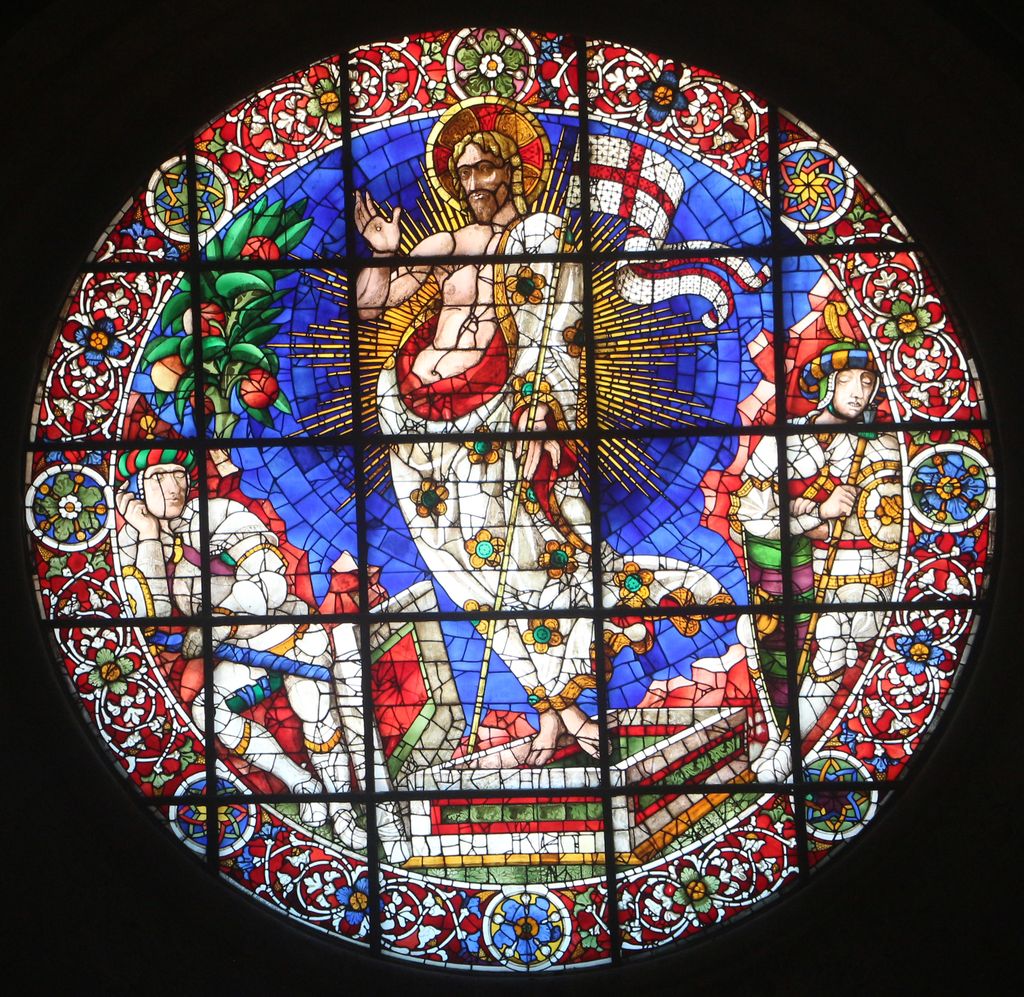
The Resurrection window in Florence Cathedral, designed by Paolo Uccello and made by Bernardo di Francesco. Photograph by Sailko. Image source. CC BY 3.0. Resized for the web.
Artworks directory
Browse paintings, drawings, stained-glass designs and other objects connected with Uccello. Cycles and their surviving components may have separate entries. The collection or catalogue’s wording is retained where a date, attribution or subject is debated.
| Name | Date | Medium, attribution and collection |
|---|---|---|
| Niccolò da Tolentino at the Battle of San Romano · London | Probably c.1438–40 | Tempera and oil on wood, with metallic decoration · National Gallery Catalogue. |
| Bernardino della Carda Unhorsed · Florence | c.1435–40 | Tempera on panel · Uffizi Galleries Catalogue. |
| The Counterattack of Micheletto da Cotignola · Paris | 1450–75 in the Louvre catalogue | Tempera (possibly) on wood · Musée du Louvre Catalogue. |
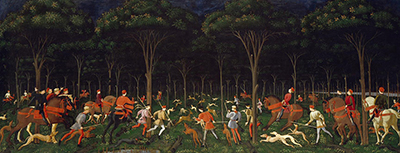
| The Hunt in the Forest | c.1465–70 | Tempera and oil with traces of gold on panel · Ashmolean Catalogue. |
| Saint George and the Dragon · London | c.1470 | Oil on canvas · National Gallery Catalogue. |
| Saint George Slaying the Dragon · Melbourne | c.1430 | Oil, tempera and silver leaf on wood · National Gallery of Victoria Catalogue. |
| Saint George and the Dragon · Paris | 1430–35 in the museum catalogue | Painted wood panel · Musée Jacquemart-André Catalogue. |
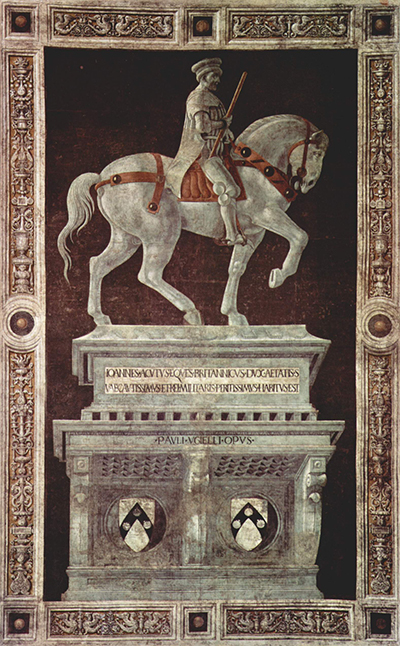
| Equestrian Monument to John Hawkwood | 1436 | Transferred wall painting · Florence Cathedral Catalogue. |
| Study for the John Hawkwood Monument | 1436 | Study on prepared paper · Uffizi Catalogue. |
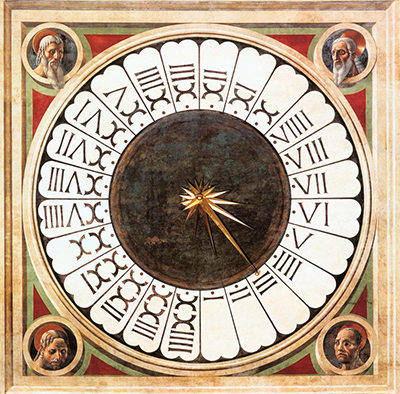
| Monumental Clock Face | 1443 | Painted dial · Florence Cathedral Catalogue. |
| Resurrection of Christ | 1443–44 | Stained glass · Uccello design · Florence Cathedral Catalogue. |
| Nativity | 1440s | Stained glass · Uccello design · Florence Cathedral Catalogue. |
| Creation of the Animals and Creation of Adam | Third to fourth decade of the 15th century | Detached fresco · Green Cloister, Santa Maria Novella Catalogue. |
| Creation of Eve and the Fall | Third to fourth decade of the 15th century | Detached fresco · Green Cloister, Santa Maria Novella Catalogue. |
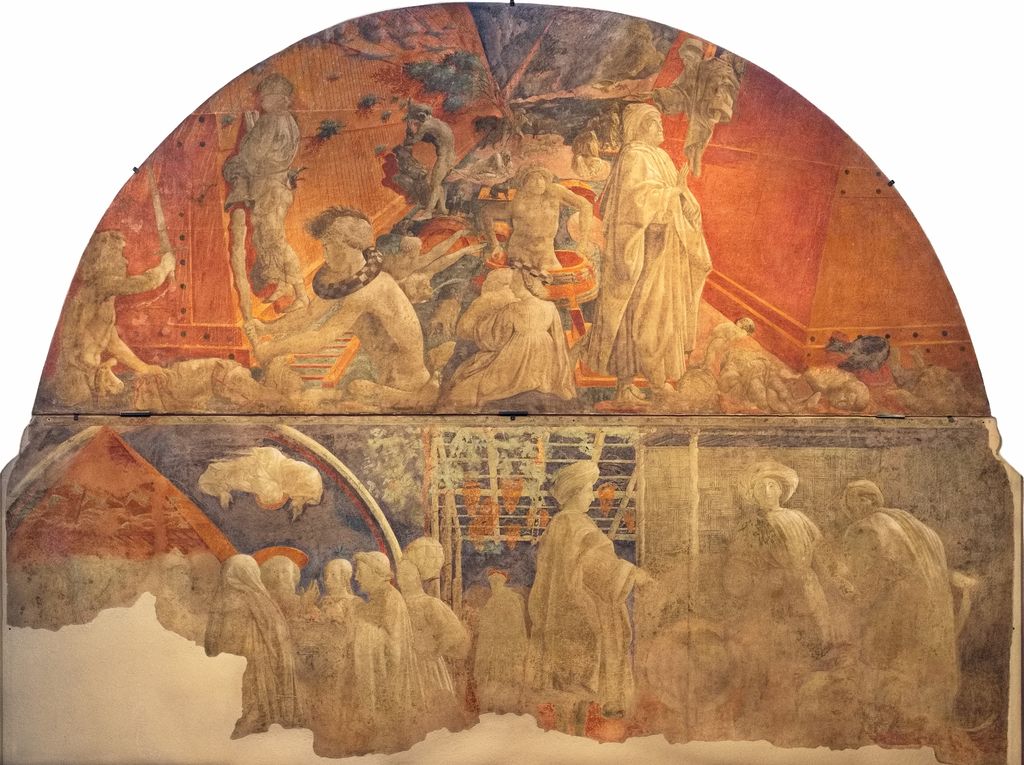
| Flood and Recession of the Waters | 15th century; dating debated | Detached fresco · Green Cloister, Santa Maria Novella Catalogue. |
| Sacrifice and Drunkenness of Noah | 15th century; dating debated | Detached fresco · Green Cloister, Santa Maria Novella Catalogue. |
| Stories of the Virgin and Saint Stephen · Assunta Chapel | 1430s, with later completion | Fresco cycle · Paolo Uccello and Andrea di Giusto · Prato Cathedral Catalogue. |
| Blessed Jacopone da Todi | 1436 in the diocesan museum | Detached fresco · Museo dell’Opera del Duomo, Prato Catalogue. |
| Adoration of the Child · Bologna | 1430s; inscription incomplete | Detached fresco · San Martino Maggiore, Bologna Catalogue. |
| Adoration of the Christ Child · Karlsruhe | c.1436 | Painted panel · Attribution to Uccello · Staatliche Kunsthalle Karlsruhe Catalogue. |
| Annunciation · Oxford | Early 15th century | Tempera and gilding on panel · Ashmolean Catalogue. |
| Allegory of Monastic Life (Thebaid) | c.1460–65 | Tempera on canvas · Galleria dell’Accademia, Florence Catalogue. |
| Miracle of the Profaned Host | 1467–68 | Tempera on wood · Galleria Nazionale delle Marche, Urbino Catalogue. |
| Triumphal Entry into Rome of Titus and Vespasian(?) | c.1430–35 | Tempera, gold and silver on panel · Yale University Art Gallery Catalogue. |
| Crucifixion with the Virgin and Saints | c.1460–65 | Painted panel · Museo Nacional Thyssen-Bornemisza Catalogue. |
| The Crucifixion · Met triptych | Probably mid-1450s | Tempera on wood with gold ground · Metropolitan Museum of Art Catalogue. |
| Perspective Study of a Chalice | 1450–75 | Pen, ink and stylus on paper · Attributed to Uccello · Uffizi Catalogue. |
| Study of a Mazzocchio | 15th century | Perspective study · Attributed to Uccello · Uffizi Catalogue. |
| Mazzocchio Seen in Perspective | Uncertain | Drawing · Attribution debated · Musée du Louvre Catalogue. |
| Head of a Man in Profile | 15th century | Pen, ink and wash · Musée du Louvre Catalogue. |
| Five Masters of the Florentine Renaissance | 1500–50 | Oil on wood · Anonymous Florentine school · Musée du Louvre Catalogue. |
| Madonna and Child from the Del Beccuto House | 15th century | Detached fresco · Museo di San Marco, Florence Catalogue. |
| Man of Sorrows with the Virgin and Saint John · Avane Predella | 15th century | Predella · Museo di San Marco, Florence Catalogue. |
| Calling of Saint Paul the Hermit · San Miniato | After 1447 to c.1454 in state catalogue | Sinopia · Attributed to Uccello or collaborator Catalogue. |
| The host changes hands · Urbino predella, scene 1 | 1467–68 | Tempera on wood · Component of DE 231 · Galleria Nazionale delle Marche Catalogue. |
| The figures at the door · Urbino predella, scene 2 | 1467–68 | Tempera on wood · Component of DE 231 · Galleria Nazionale delle Marche Catalogue. |
| The procession approaches the altar · Urbino predella, scene 3 | 1467–68 | Tempera on wood · Component of DE 231 · Galleria Nazionale delle Marche Catalogue. |
| The condemned woman and the ladders · Urbino predella, scene 4 | 1467–68 | Tempera on wood · Component of DE 231 · Galleria Nazionale delle Marche Catalogue. |
| Persecution of the family · Urbino predella, scene 5 | 1467–68 | Tempera on wood · Component of DE 231 · Galleria Nazionale delle Marche Catalogue. |
| Angels and demons at the bier · Urbino predella, scene 6 | 1467–68 | Tempera on wood · Component of DE 231 · Galleria Nazionale delle Marche Catalogue. |
| Birth of the Virgin · Prato Cathedral | 1430s; dating debated | Fresco · Assunta Chapel, Prato Cathedral Catalogue. |
| Presentation of the Virgin · Prato Cathedral | 1430s; dating debated | Fresco · Assunta Chapel, Prato Cathedral Catalogue. |
Discussion
Look again at the images and ideas explored in Annunciation. These editorial prompts invite your observations.
Reader Insights
Which detail first makes you feel that Gabriel has moved from the golden space above into Mary’s world?
How does the change from the planned round arch to the painted pointed opening affect the way you see the space around Mary?
Join the Conversation
Share a detail, comparison or question about Annunciation below.
References
- Ashmolean Museum. Early Italian Art Gallery, “The Annunciation (detail)”, WA1850.7. Collection identification, date and medium. View source.
- Boletín Oficial del Estado. Orden CUD/392/2019, 12 March 2019, published 4 April 2019. Spanish loan record for WA1850.7, dimensions, medium and exhibition dating. View source.
- Malena Rotter. Unsichtbares sichtbar machen, “Die Aussendung Gabriels”, Heidelberg, 2022, pp. 243–252 (in German). The three appearances of Gabriel and the tradition of depicting his dispatch. View source.
- Gospel of Luke. Luke 1:26–38, New American Bible, Revised Edition. The Annunciation. View source.
- Hugh Hudson. “The Materials and Technique of Two Panel Paintings Attributed to Paolo Uccello”, in La Peinture ancienne et ses procédés, Leuven, 2006, pp. 8–17. Technical examination of the Oxford panel and comparison with Melbourne. View source.
- Ashmolean Museum. Focus on Perspective in Art, teaching notes, WA1850.7. Early-1420s dating proposal. View source.
- Hugh Hudson. “A Knight in Shining Armour, a Virgin: Paolo Uccello’s Melbourne Saint George and the Dragon and Oxford Annunciation”, Art Bulletin of Victoria 46, 2006. Comparative attribution, dating, intended use and technical evidence. View source.
- Ashmolean Museum. The Secret Lives of Paintings, Jevon Thistlewood, 11 March 2026. Visible-light and infrared comparison of a detail of WA1850.7. View source.
- Hugh Hudson. “Paolo Uccello and Fra Angelico in the Early Quattrocento”, Melbourne Art Journal 9–10, 2007, pp. 17–33. The lily and hand in the Oxford underdrawing and the dating proposed by Boskovits. View source.
- Ashmolean Museum. World Religions, “The Annunciation”, zoomable images section. Gold and ultramarine. View source.
- University Galleries, Oxford. A Provisional Catalogue of the Paintings Exhibited in the University Galleries, Oxford, no. 18. Early attribution history, subject and donor. View source.
- Fondazione Federico Zeri. Maestro del 1419, Annunciazione, record 12103. Historical attributions and Everett Fahy’s annotated photograph. View source.
- Lorenzo Sbaraglio. “Paolo di Dono, detto Paolo Uccello”, Dizionario Biografico degli Italiani 81, 2014 (in Italian). Early chronology, Venice and the Del Beccuto records. View source.
- Dillian Gordon. “Paolo Uccello”, The Fifteenth Century Italian Paintings, National Gallery, London. Ghiberti’s workshop and the Venetian period. View source.
- Opera del Duomo, Florence. Formella con Storie di Giacobbe ed Esaù, catalogue no. 2779 (in Italian). Ghiberti’s gilded bronze relief and its architectural setting. View source.
- Giovanna Ragionieri. Review of Da Donatello a Lippi. Officina pratese, Predella 33, 2013 (in Italian). Prato exhibition checklist and previous Uffizi exhibition. View source.
- Opera del Duomo, Florence. “The Stained Glass Windows of Santa Maria del Fiore”. The lost Annunciation window in the drum. View source.
More PAOLO UCCELLO Artworks
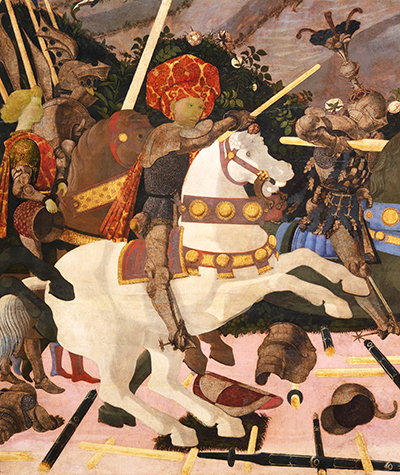

Noah and the Flood
The Flood and Recession of the Waters above the lower episodes from Noah’s story, Santa Maria Novella. Photograph by Armin Kleiner. Image source. CC BY-SA 4.0. Resized for the web. This derivative is available under the same licence.
The Resurrection of Christ Stained Glass Window
The Resurrection window in Florence Cathedral, designed by Paolo Uccello and made by Bernardo di Francesco. Photograph by Sailko. Image source. CC BY 3.0. Resized for the web.