


 by Tom Gurney
Tom Gurney BSc (Hons) is an art history expert with over 20 years experience
Published on June 19, 2020 / Updated on November 29, 2026
Email: tomgurney1@gmail.com / Phone: +44 7429 011000
Saint George Slaying the Dragon (Melbourne): Introduction
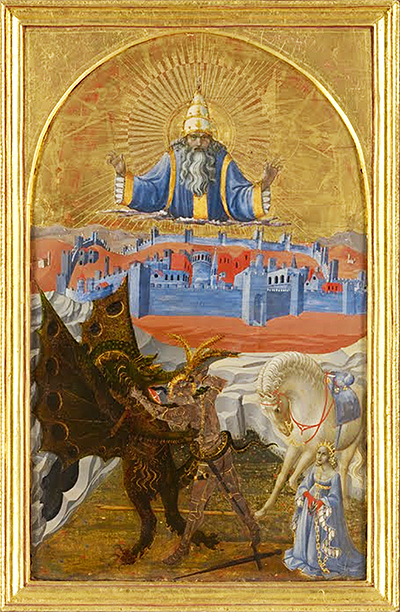
George fights on foot in the foreground of Paolo Uccello’s Melbourne panel. Behind him, his white horse pulls its head back, and the princess kneels close enough to see the dragon rear up against him. The National Gallery of Victoria dates the painting to about 1430. It measures 62.2 × 38.8 cm and is catalogued as oil, tempera and silver leaf on wood, accession 2124-4. [1]
At a Glance
- DateAbout 1430
- Medium and sizeOil, tempera and silver leaf on wood panel, 62.2 × 38.8 cm
- CollectionNational Gallery of Victoria, Melbourne, 2124-4, Felton Bequest, 1949
Contents
- George on foot
- What the princess is waiting to do
- Gold on the dragon, silver on the saint
- What lies beneath the panel
- Florence and Venice
- How an Orcagna became an Uccello
- Three pictures, three moments
- Annotated details
George on foot
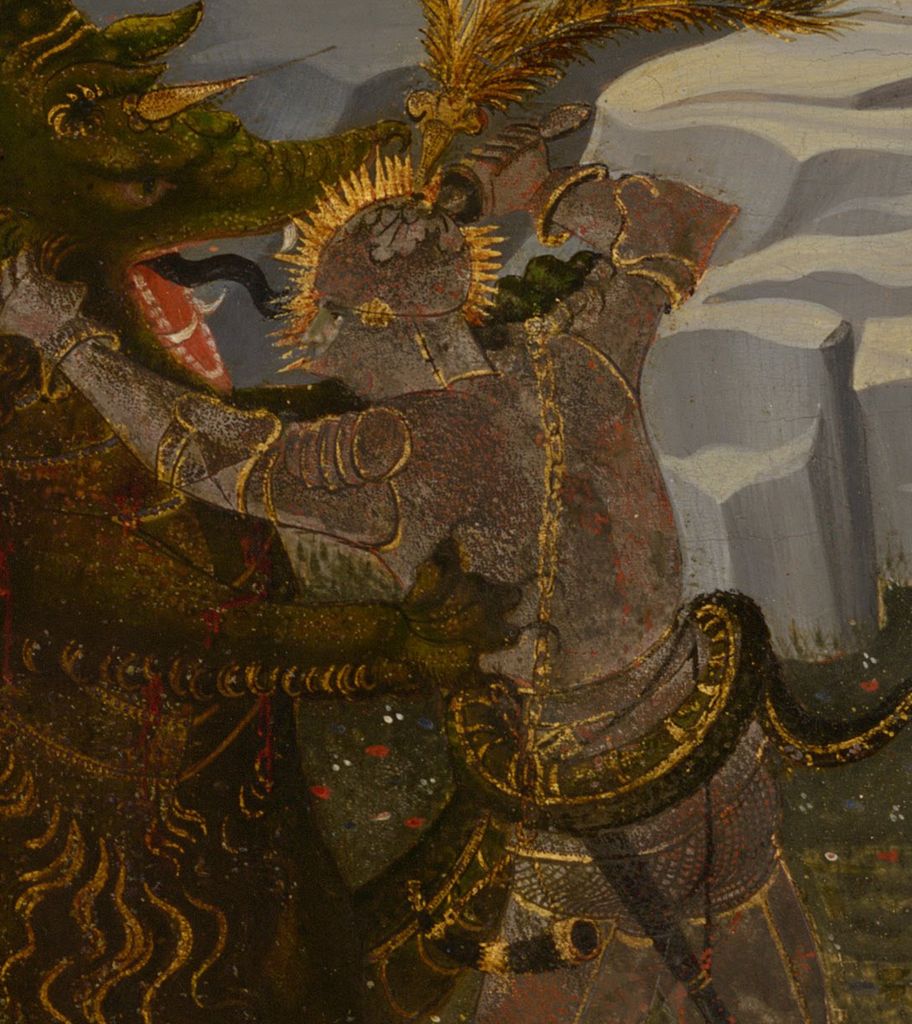
The dragon spreads its wings across the left of the picture. Its feet press into the ground, its neck curves back, and its mouth opens almost against George’s face. The saint plants one foot near the creature and stretches the other back. The space between his feet gives his body leverage, and the outline of his armour remains visible even where it meets the much darker monster. Above him, the horse’s pale flank and curved neck give the eye a moment of relief from the tangle of wings, claws and metal. Its red reins hang in a loop. With the rider out of the saddle, the horse helps us imagine a first charge that has already come apart. [1] [2] [3]
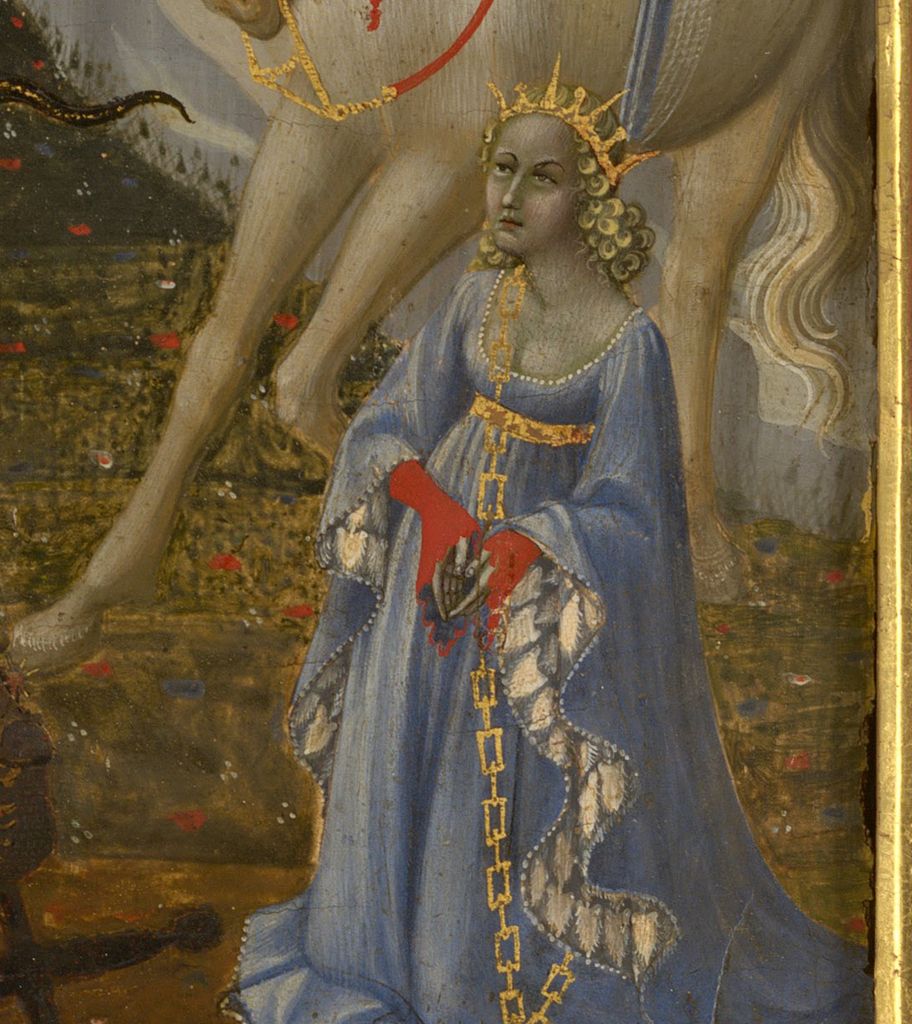
Uccello cuts down the space available to his figures. The sword lies almost at the lower edge, and the dragon’s raised wing comes close to the edge at left. The rocky ledges behind the combat turn up sharply from the ground and keep the action close to us. At lower right, the princess’s blue dress and the chain she holds are small enough to miss at first glance. Her position matters. If the chain is meant for the dragon, George has to hold it long enough for her to approach. The picture makes room for an act of courage that could follow his own. [1] [2]
What the princess is waiting to do
The museum’s title calls the episode a slaying. Curator Ted Gott, drawing on Ursula Hoff, relates it to Petrus de Natalibus’s account of about 1370, in which George beheads the dragon. The struggle at close quarters fits an emphasis on the killing. Hugh Hudson looks instead at the broken lance, the sword on the ground and the short blade in the knight’s hand, which he identifies as a dagger. The princess appears to have a collar attached to her chain. In the version told by Jacobus de Voragine, she leads the subdued creature back to the city before George kills it. Hudson proposes that Melbourne shows the instant before she can secure the dragon. [2] [3] [4]
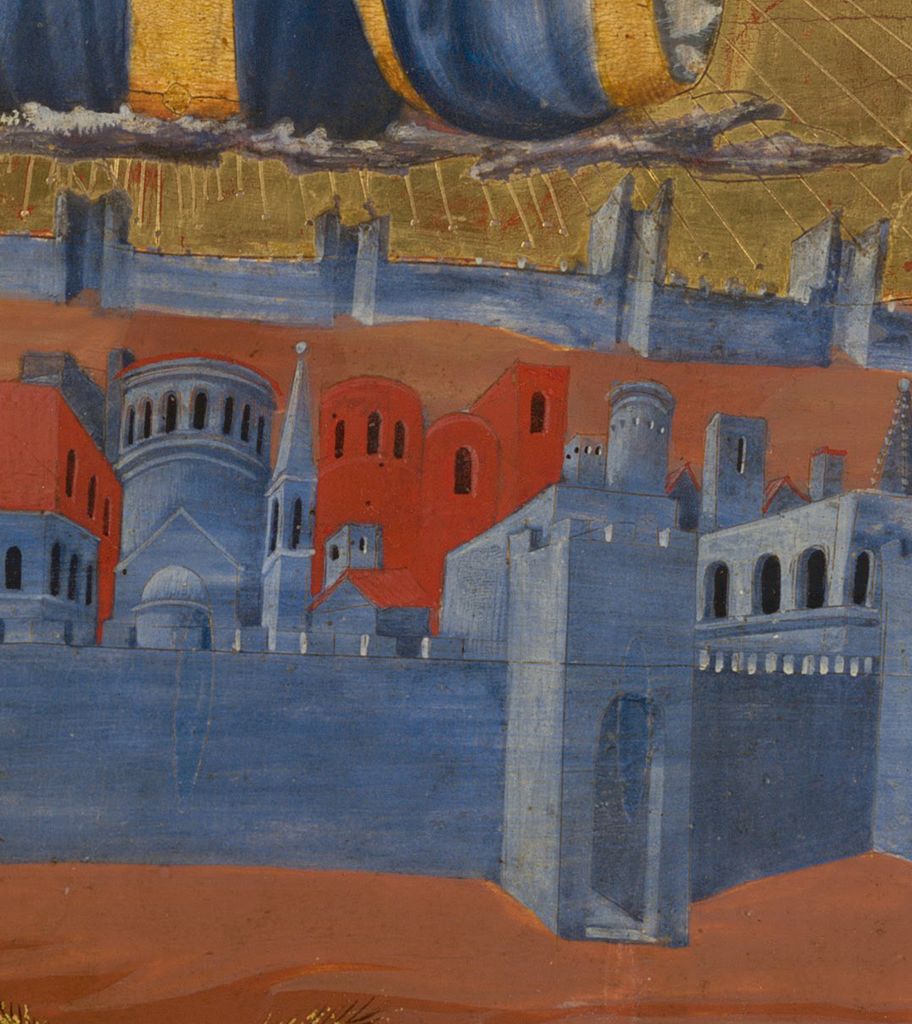
The two readings ask us to look at different parts of the painting. George’s outstretched arms and the dragon’s open mouth make the outcome of their struggle feel immediate. The curve of the chain asks what the princess intends to do next. The city, just across the rocks, is where that action could have consequences. Its gate and long blue wall are easy to pick out across the band of red earth. Above it, God the Father raises both hands against a field of golden rays. The townspeople’s conversion lies beyond the encounter, but the city and the figure over it give the battle a Christian significance within the picture. [1] [2] [3] [4]
Annotated Details from Saint George Slaying the Dragon (Melbourne)
The numbered points identify visible features discussed in this article. Return from each detail to the numbered overview. Saint George Slaying the Dragon, National Gallery of Victoria 2124-4. Image source. Public domain.
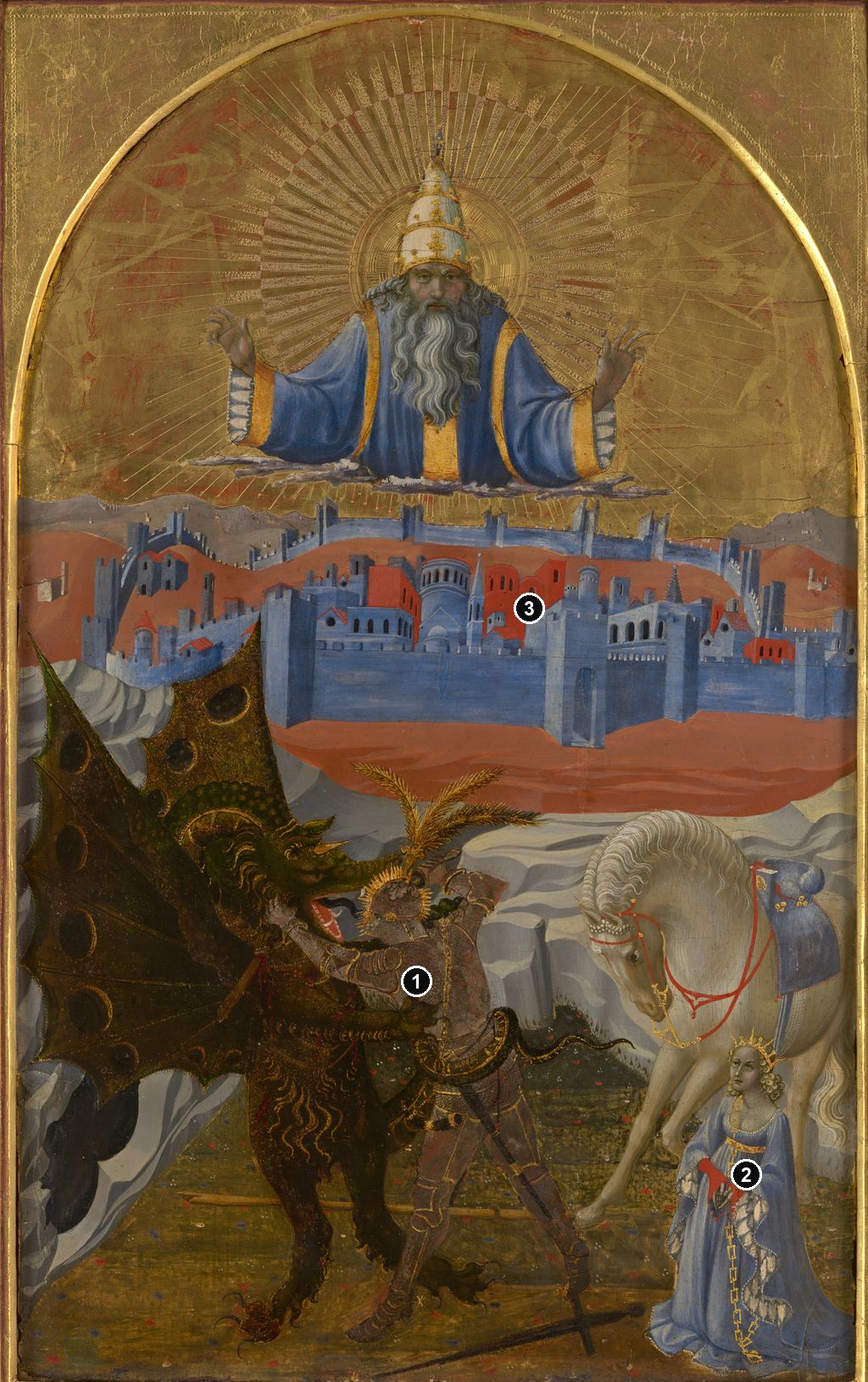
Details from SAINT GEORGE SLAYING THE DRAGON (MELBOURNE)
Compare the cropped details with the source images above. Notice how their colours, shapes and positions contribute to the larger compositions.
George on foot
George confronts the dragon at close quarters. The darkened metal decoration and the surrounding gold accents mark out armour and weapons against the two bodies.
The princess with a tether
The princess holds the gold-coloured chain while the horse bends down beside her. Her crouched posture differs from the upright witnesses in the London and Paris paintings.
The walled town below the gold ground
Towers ring the town across the middle of the panel, separating the figures below from the blessing figure above and dividing the vertical space into distinct registers.
Gold on the dragon, silver on the saint
The dragon’s dark appearance can hide the delicacy of its surface. Hudson found passages of translucent green over gold leaf on its wings and body, with black strokes deepening the shadows. Small crescents pick out darker circles in the wings. The horn has a scalloped base, as though someone had mounted it on the creature’s head like a piece of metalwork. George’s polished plates owe their appearance to silver leaf modelled in dark paint. Around God the Father, ruled lines spread from the halo, alternating with stippled passages made with a six-pointed punch. Red glaze survives on details of the tiara and the princess’s gilded girdle. The sense of something shining runs through the whole picture, from the saint’s equipment to the very creature he is trying to overcome. [2]
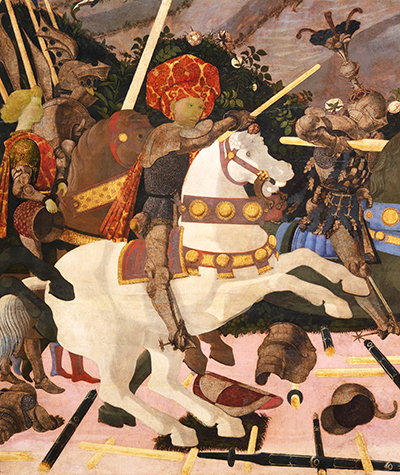
The treatment of armour gives Hudson a specific comparison with the London Battle of San Romano. The page behind Tolentino wears armour modelled with dark glaze over silver, while his green surcoat uses a glaze over gold. Technical examination of that panel also found finger and thumb impressions where the artist worked the dark glaze. Melbourne has partial fingerprints in the blue paint of a tower and the saddle. They are too smudged to match to the marks in London, and occur in different kinds of paint. The more persuasive comparison is how the painter modulated the metal beneath the colour to suggest rounded plates and different surfaces. That technique was known beyond Uccello’s workshop. Its significance here comes from the particular uses he made of it in the two paintings, from the glaze that rounds the armour to the way a punch textures the gold. Hudson finds a similar punch mark on Tolentino’s headdress in the battle panel. [2] [5]
What lies beneath the panel
X-rays reveal a sheet of fine cloth beneath the painted surface. The support itself is a single board with vertical grain. The cloth stops below the top of the arch, near the level of God’s tiara. Hudson considers the rounded top of the painted area likely to be original, a conclusion that fits the way the rays fill the arch. Small restorations near the points where the curve begins may mark places once overlapped by the capitals of an original frame. A tabernacle-style frame is plausible. An old photograph published by Van Marle shows paint losses in the wings that have since been filled. Agnew’s recorded a payment to restorer Horace Buttery, though the record gives no details of the work. The panel’s small scale and costly finish also support Hudson’s suggestion that it could have been made for a domestic setting. Its first owner and setting are unknown. [2]
Oxford’s Annunciation has a comparable fine cloth layer over a single board. Its architecture took considerable work to plan. Infrared images reveal ruled construction lines and revisions to the portico, including a round arch that became pointed in paint. In Melbourne, the same kinds of examination show freehand drawing and incision in parts of the city, a long ruled guide for the battlements, and changes to buildings as the design developed. The painter devoted greater geometric attention to the portico that contains Mary and the angel. Melbourne’s wall can be read at a glance across the picture and leaves the eye free to follow the figures below. The different shapes and dimensions of the panels also make it unlikely, in Hudson’s view, that they formed a single ensemble. The Fondazione Federico Zeri’s catalogue gives the Oxford painting to the Master of 1419, while the Ashmolean presents it as Uccello’s. The similarities in technique remain worth examining whichever attribution one accepts for Oxford. [2] [6] [7]
Hudson also sees an echo of Fra Angelico’s early work in the ground beneath the combatants. The irregular horizontal brushstrokes, fine upright blades of grass and small dots of flowers resemble the ground in a pair of painted quatrefoils attributed to Angelico. This comparison takes us away from diagrams of recession and back to the strokes that make a patch of earth feel alive. The delicate growth at the dragon’s feet also breaks up the dark foreground beneath the wings. [8]
Florence and Venice
Hudson compares the disposition of the combat, rocky ground and walled city to Lorenzo Ghiberti’s David and Goliath relief for the Florence Baptistery’s Gates of Paradise. In the Oxford picture he sees a parallel with Ghiberti’s Jacob and Esau, where a portico structures the episode. Oxford’s earlier, round-arched design strengthens that visual comparison. Uccello’s work as a young assistant in Ghiberti’s workshop is documented, which makes the relationship worth taking seriously. Hudson argues that Uccello may have encountered the designs for the later doors on his return to Florence, while the reliefs were in progress. A shared arrangement of foreground fight and distant city carries no exact date by itself, and we cannot establish when Uccello first saw those designs. [2] [9] [10]
The gallery’s description entertains a Venetian origin, pointing to Uccello’s documented work on mosaics at San Marco, while the same record lists Florence as the place of execution. Hudson argues for Florence after the artist’s return. He also compares the blue and gold of the two panels with the detached Virgin and Child formerly in a Del Beccuto house in Florence. The family’s tax declarations provide a context for the comparison. The debts recorded to Uccello in 1431 and 1433 do not specify any particular work. The Oxford panel is itself often dated earlier than Hudson’s proposal. The Ashmolean’s teaching notes favour the early 1420s, and Lorenzo Sbaraglio places the Melbourne and Oxford pictures near the end of an early group around 1420–25, acknowledging later proposals. The NGV’s date of about 1430 remains a practical way to identify the painting. Its precise date and location depend on how these comparisons are weighed. [1] [2] [6] [10] [11]
How an Orcagna became an Uccello
An early trace leads to the dealer Samuel Woodburn. Hudson identifies the panel with a Saint George listed as an Orcagna in Woodburn’s collection of early Italian pictures, probably among those offered to London’s National Gallery in 1846. It was sold as an Orcagna at Woodburn’s estate sale in 1860 to a buyer recorded as Campanari, probably Domenico Campanari, who had worked for the dealer. It passed through the 1863 sale of the Reverend Walter Davenport Bromley’s collection and was documented in the Earl of Southesk’s collection. After a fire at Kinnaird Castle, it went on loan to the National Gallery of Scotland from 1922. The painting reached Agnew’s in February 1949, and the Felton Bequest acquired it on 11 July. [2] [12]
Raimond van Marle had published the work in 1927 as a painting by Domenico di Bartolo. Kenneth Clark backed that attribution, and Felton adviser A. J. L. McDonnell recommended the purchase under the Sienese artist’s name. By then an alternative had long been in print. In 1928 Roberto Longhi assigned it to a close follower of Uccello. Georg Pudelko linked the Melbourne panel and the Oxford Annunciation in 1935. Longhi revised his view in 1968 and credited Uccello himself. In 1980 Carlo Volpe made a fuller case for the two panels as Uccello’s work, drawing on the rediscovered Adoration mural at San Martino Maggiore in Bologna to reconsider how much the painter had achieved by the 1430s. Volpe’s archive preserves a photograph of the Melbourne painting among his material on the Bologna mural. The present attribution brings together that reassessment of Uccello’s early style and the evidence of how the panel was made. [2] [3] [13]
Three pictures, three moments
The Paris panel sends George into the action on horseback. He drives his lance at the dragon while the princess stands nearby, and a broad landscape opens behind the encounter. The Musée Jacquemart-André dates it to 1430–35, and the Fondazione Giorgio Cini used about 1440 for the panel’s 2021 loan. Hudson compares the crescent markings on the Paris dragon’s wing to Melbourne’s, a detail that connects two pictures with very different arrangements. [2] [14] [15]
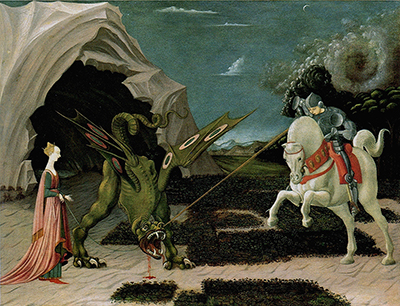
In the London canvas, dated about 1470 by the National Gallery, George is also mounted. There the carried lance and the princess’s tether are both already at work. The low, wide canvas has room for a cave and a bank of clouds beyond the figures. Melbourne makes the contest upright, close and crowded. Its painter asks us first to look at a knight in danger at the edge of the picture, then to look past him to a girl, a waiting city and the figure above it. That sequence leaves an opening for what the princess may do after the blow. [1] [2] [16]
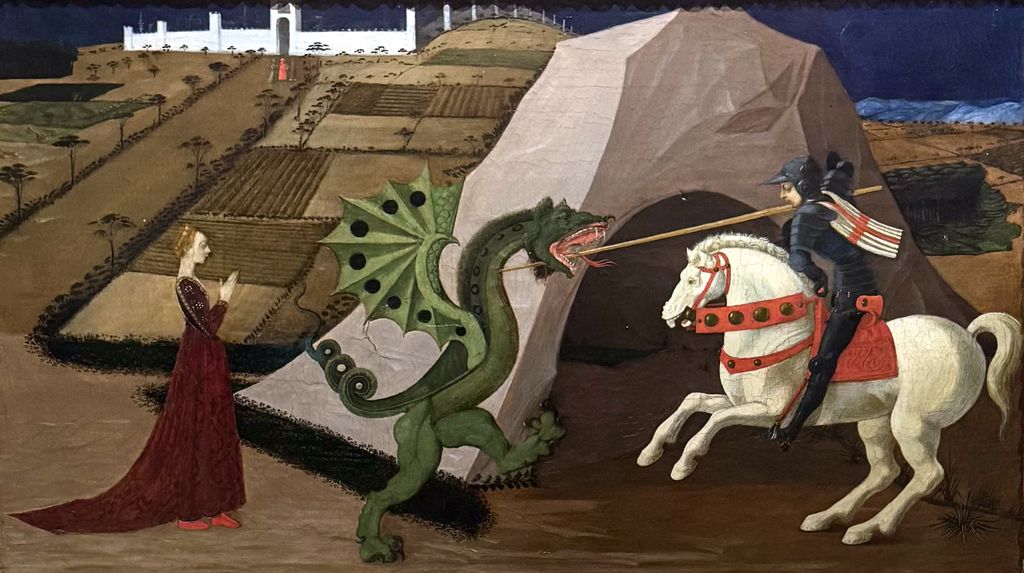
Saint George and the Dragon, Musée Jacquemart-André, MJAP-P 2248. Image source. Public domain.
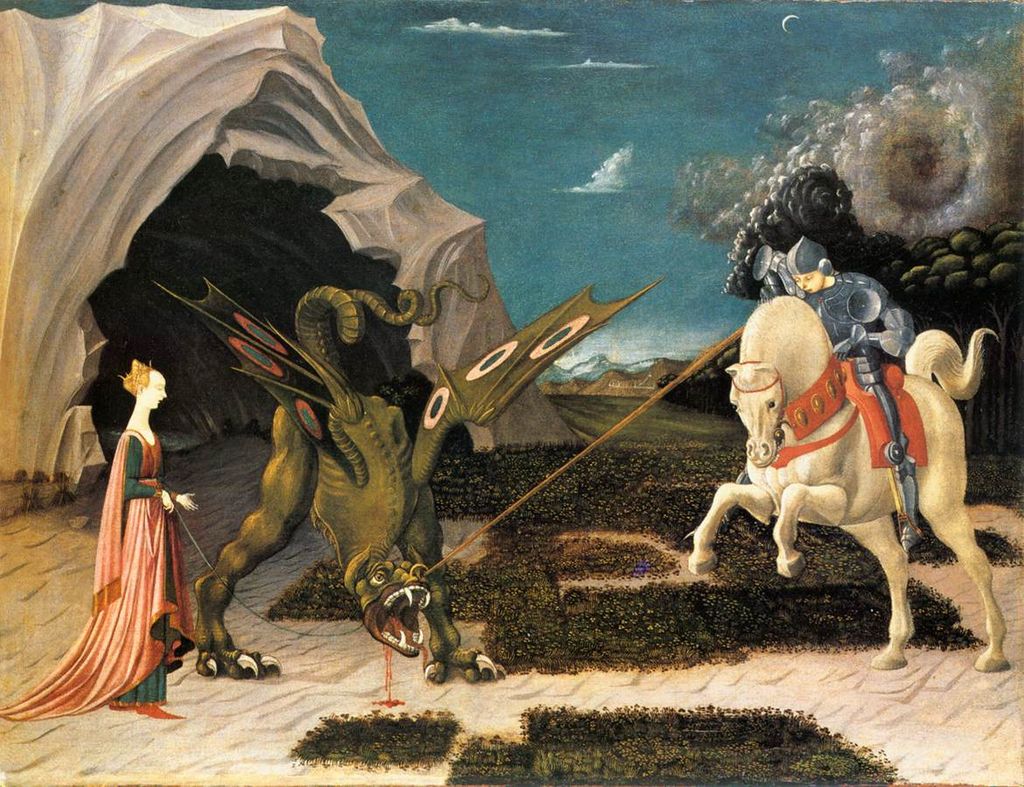
The London Saint George and the Dragon, National Gallery NG6294. Image source. Public domain.
Artworks directory
Browse paintings, drawings, stained-glass designs and other objects connected with Uccello. Cycles and their surviving components may have separate entries. The collection or catalogue’s wording is retained where a date, attribution or subject is debated.
| Name | Date | Medium, attribution and collection |
|---|---|---|
| Niccolò da Tolentino at the Battle of San Romano · London | Probably c.1438–40 | Tempera and oil on wood, with metallic decoration · National Gallery Catalogue. |
| Bernardino della Carda Unhorsed · Florence | c.1435–40 | Tempera on panel · Uffizi Galleries Catalogue. |
| The Counterattack of Micheletto da Cotignola · Paris | 1450–75 in the Louvre catalogue | Tempera (possibly) on wood · Musée du Louvre Catalogue. |
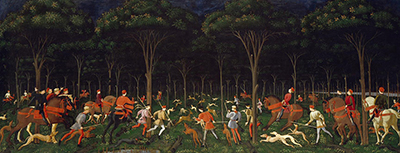
| The Hunt in the Forest | c.1465–70 | Tempera and oil with traces of gold on panel · Ashmolean Catalogue. |
| Saint George and the Dragon · London | c.1470 | Oil on canvas · National Gallery Catalogue. |
| Saint George Slaying the Dragon · Melbourne | c.1430 | Oil, tempera and silver leaf on wood · National Gallery of Victoria Catalogue. |
| Saint George and the Dragon · Paris | 1430–35 in the museum catalogue | Painted wood panel · Musée Jacquemart-André Catalogue. |
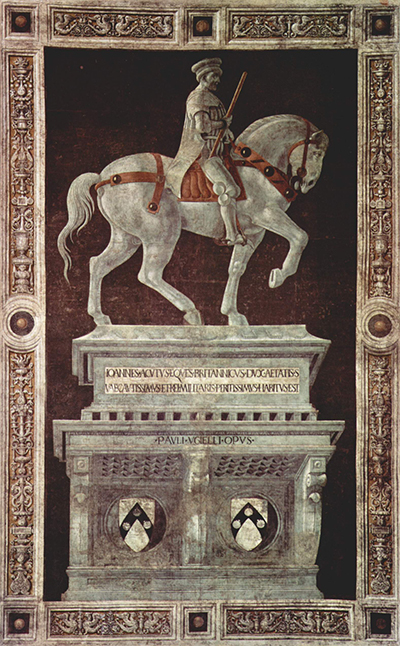
| Equestrian Monument to John Hawkwood | 1436 | Transferred wall painting · Florence Cathedral Catalogue. |
| Study for the John Hawkwood Monument | 1436 | Study on prepared paper · Uffizi Catalogue. |
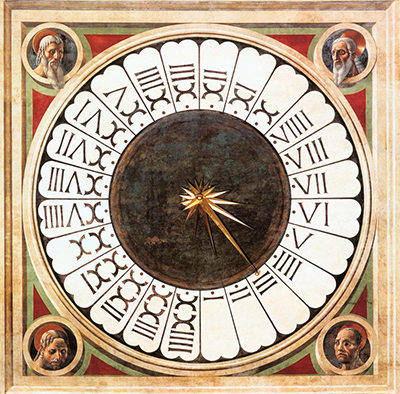
| Monumental Clock Face | 1443 | Painted dial · Florence Cathedral Catalogue. |
| Resurrection of Christ | 1443–44 | Stained glass · Uccello design · Florence Cathedral Catalogue. |
| Nativity | 1440s | Stained glass · Uccello design · Florence Cathedral Catalogue. |
| Creation of the Animals and Creation of Adam | Third to fourth decade of the 15th century | Detached fresco · Green Cloister, Santa Maria Novella Catalogue. |
| Creation of Eve and the Fall | Third to fourth decade of the 15th century | Detached fresco · Green Cloister, Santa Maria Novella Catalogue. |
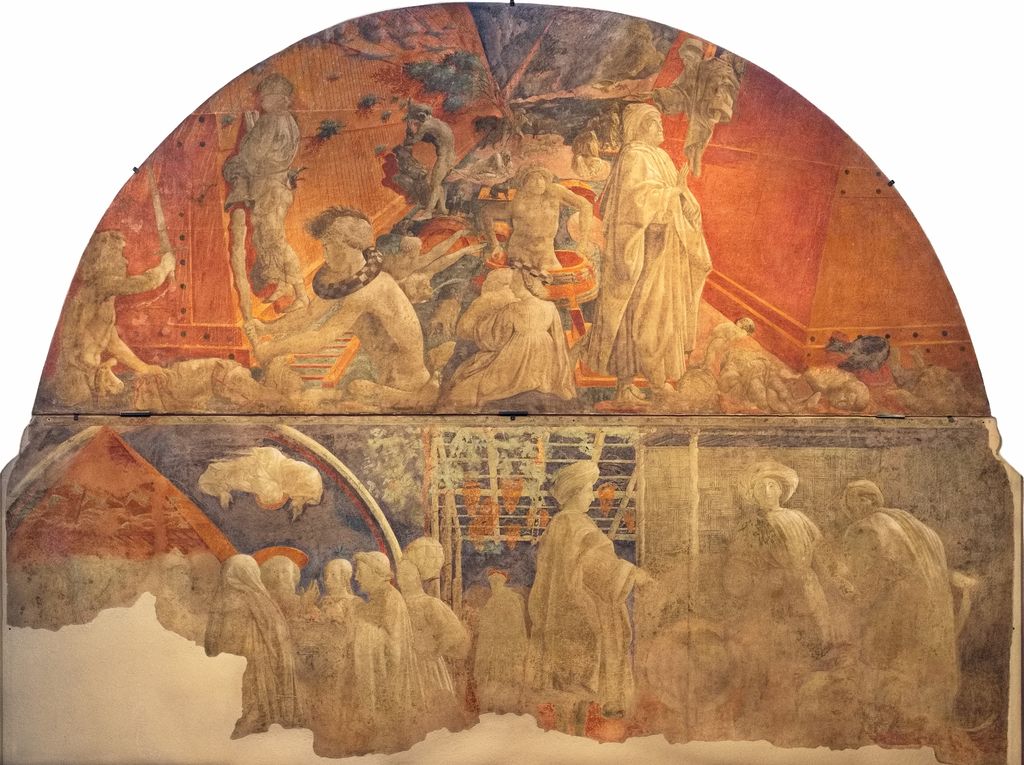
| Flood and Recession of the Waters | 15th century; dating debated | Detached fresco · Green Cloister, Santa Maria Novella Catalogue. |
| Sacrifice and Drunkenness of Noah | 15th century; dating debated | Detached fresco · Green Cloister, Santa Maria Novella Catalogue. |
| Stories of the Virgin and Saint Stephen · Assunta Chapel | 1430s, with later completion | Fresco cycle · Paolo Uccello and Andrea di Giusto · Prato Cathedral Catalogue. |
| Blessed Jacopone da Todi | 1436 in the diocesan museum | Detached fresco · Museo dell’Opera del Duomo, Prato Catalogue. |
| Adoration of the Child · Bologna | 1430s; inscription incomplete | Detached fresco · San Martino Maggiore, Bologna Catalogue. |
| Adoration of the Christ Child · Karlsruhe | c.1436 | Painted panel · Attribution to Uccello · Staatliche Kunsthalle Karlsruhe Catalogue. |
| Annunciation · Oxford | Early 15th century | Tempera and gilding on panel · Ashmolean Catalogue. |
| Allegory of Monastic Life (Thebaid) | c.1460–65 | Tempera on canvas · Galleria dell’Accademia, Florence Catalogue. |
| Miracle of the Profaned Host | 1467–68 | Tempera on wood · Galleria Nazionale delle Marche, Urbino Catalogue. |
| Triumphal Entry into Rome of Titus and Vespasian(?) | c.1430–35 | Tempera, gold and silver on panel · Yale University Art Gallery Catalogue. |
| Crucifixion with the Virgin and Saints | c.1460–65 | Painted panel · Museo Nacional Thyssen-Bornemisza Catalogue. |
| The Crucifixion · Met triptych | Probably mid-1450s | Tempera on wood with gold ground · Metropolitan Museum of Art Catalogue. |
| Perspective Study of a Chalice | 1450–75 | Pen, ink and stylus on paper · Attributed to Uccello · Uffizi Catalogue. |
| Study of a Mazzocchio | 15th century | Perspective study · Attributed to Uccello · Uffizi Catalogue. |
| Mazzocchio Seen in Perspective | Uncertain | Drawing · Attribution debated · Musée du Louvre Catalogue. |
| Head of a Man in Profile | 15th century | Pen, ink and wash · Musée du Louvre Catalogue. |
| Five Masters of the Florentine Renaissance | 1500–50 | Oil on wood · Anonymous Florentine school · Musée du Louvre Catalogue. |
| Madonna and Child from the Del Beccuto House | 15th century | Detached fresco · Museo di San Marco, Florence Catalogue. |
| Man of Sorrows with the Virgin and Saint John · Avane Predella | 15th century | Predella · Museo di San Marco, Florence Catalogue. |
| Calling of Saint Paul the Hermit · San Miniato | After 1447 to c.1454 in state catalogue | Sinopia · Attributed to Uccello or collaborator Catalogue. |
| The host changes hands · Urbino predella, scene 1 | 1467–68 | Tempera on wood · Component of DE 231 · Galleria Nazionale delle Marche Catalogue. |
| The figures at the door · Urbino predella, scene 2 | 1467–68 | Tempera on wood · Component of DE 231 · Galleria Nazionale delle Marche Catalogue. |
| The procession approaches the altar · Urbino predella, scene 3 | 1467–68 | Tempera on wood · Component of DE 231 · Galleria Nazionale delle Marche Catalogue. |
| The condemned woman and the ladders · Urbino predella, scene 4 | 1467–68 | Tempera on wood · Component of DE 231 · Galleria Nazionale delle Marche Catalogue. |
| Persecution of the family · Urbino predella, scene 5 | 1467–68 | Tempera on wood · Component of DE 231 · Galleria Nazionale delle Marche Catalogue. |
| Angels and demons at the bier · Urbino predella, scene 6 | 1467–68 | Tempera on wood · Component of DE 231 · Galleria Nazionale delle Marche Catalogue. |
| Birth of the Virgin · Prato Cathedral | 1430s; dating debated | Fresco · Assunta Chapel, Prato Cathedral Catalogue. |
| Presentation of the Virgin · Prato Cathedral | 1430s; dating debated | Fresco · Assunta Chapel, Prato Cathedral Catalogue. |
Discussion
Look again at the images and ideas explored in Saint George Slaying the Dragon (Melbourne). These editorial prompts invite your observations.
Reader Insights
Look from the sword on the ground to the chain in the princess’s hand. Which detail most affects your sense of what happens next?
Imagine the scene ending at the top of the city wall. How does seeing God the Father above it change your sense of what the people inside are waiting for?
Join the Conversation
Share a detail, comparison or question about Saint George Slaying the Dragon (Melbourne) below.
References
- National Gallery of Victoria. Saint George Slaying the Dragon, 2124-4. Collection record, medium, dimensions, dating and acquisition. View source.
- Hugh Hudson. “A Knight in Shining Armour, a Virgin – Uccello’s Melbourne Saint George and the Dragon and Oxford Annunciation”, Art Bulletin of Victoria 46, 2006. Comparative technical examination, provenance and attribution. View source.
- Ted Gott. “St George Slaying the Dragon”, National Gallery of Victoria, 2023. The two versions of the legend and the Felton purchase. View source.
- Jacobus de Voragine. The Golden Legend, chapter 58, “George”. English translation in Daniel Ogden’s University of Exeter source collection. View source.
- Ashok Roy and Dillian Gordon. “Uccello’s Battle of San Romano”, National Gallery Technical Bulletin 22, 2001, pp. 4–17, especially p. 10. Glazes over metal leaf and the handling of the armour in NG583. View source.
- Ashmolean Museum. Focus on Perspective in Art, teaching notes, Gallery 42, The Annunciation, WA1850.7. View source.
- Fondazione Federico Zeri. Maestro del 1419, Annunciazione, record 12103, Ashmolean WA1850.7. Alternative attribution and photo archive. View source.
- Hugh Hudson. “Paolo Uccello and Fra Angelico in the Early Quattrocento”, Melbourne Art Journal 9–10, 2007, pp. 17–33. Brushwork and the comparative treatment of the ground. View source.
- Opera del Duomo, Florence. Lorenzo Ghiberti, Gate of Paradise. Catalogue of the bronze doors and their reliefs. View source.
- Dillian Gordon. Paolo di Dono, called Uccello, in The Fifteenth Century Italian Paintings, 2003, online version 2025. Training and the documented Venetian period. View source.
- Lorenzo Sbaraglio. “Paolo di Dono, detto Paolo Uccello”, Dizionario Biografico degli Italiani 81, 2014 (in Italian). Early dating proposals and tax records. View source.
- Lucy Joy West. ‘A Great Commerce in Curious Pictures’: The Roles and Practices of Art Dealers and Agents in the Reception and Re-Evaluation of Pre-1500 European Paintings in Britain, c. 1800–53, doctoral thesis, University of Leeds, 2023, p. 248 and fig. 5.12. Woodburn, Campanari and the 1860 sale. View source.
- Università di Bologna, Biblioteca delle Arti. La fototeca di Carlo Volpe: l’officina del conoscitore, section “Paolo Uccello in San Martino a Bologna” (in Italian). Volpe’s reconstruction of Uccello’s early career and photograph 2258/57. View source.
- Musée Jacquemart-André. Saint George and the Dragon. Catalogue of the Paris panel and its date. View source.
- Fondazione Giorgio Cini. A Guest at the Palace | Saint George and the Dragon by Paolo Uccello, 2021. Loan and dating of the Paris panel. View source.
- National Gallery, London. Paolo Uccello, Saint George and the Dragon, NG6294. London canvas, subject and date. View source.
More PAOLO UCCELLO Artworks

Noah and the Flood
The Flood and Recession of the Waters above the lower episodes from Noah’s story, Santa Maria Novella. Photograph by Armin Kleiner. Image source. CC BY-SA 4.0. Resized for the web. This derivative is available under the same licence.
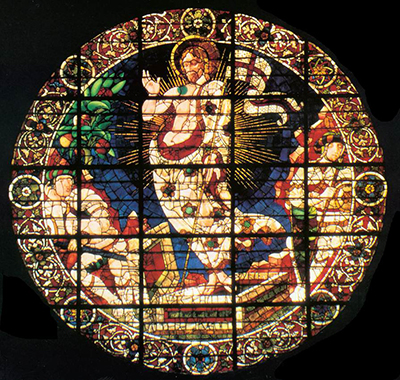
The Resurrection of Christ Stained Glass Window
The Resurrection window in Florence Cathedral, designed by Paolo Uccello and made by Bernardo di Francesco. Photograph by Sailko. Image source. CC BY 3.0. Resized for the web.