


 by Tom Gurney
Tom Gurney BSc (Hons) is an art history expert with over 20 years experience
Published on June 19, 2020 / Updated on November 29, 2026
Email: tomgurney1@gmail.com / Phone: +44 7429 011000
The Hunt in the Forest: Introduction
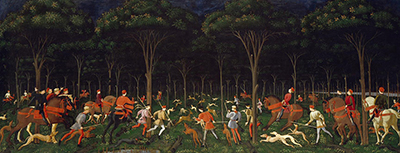
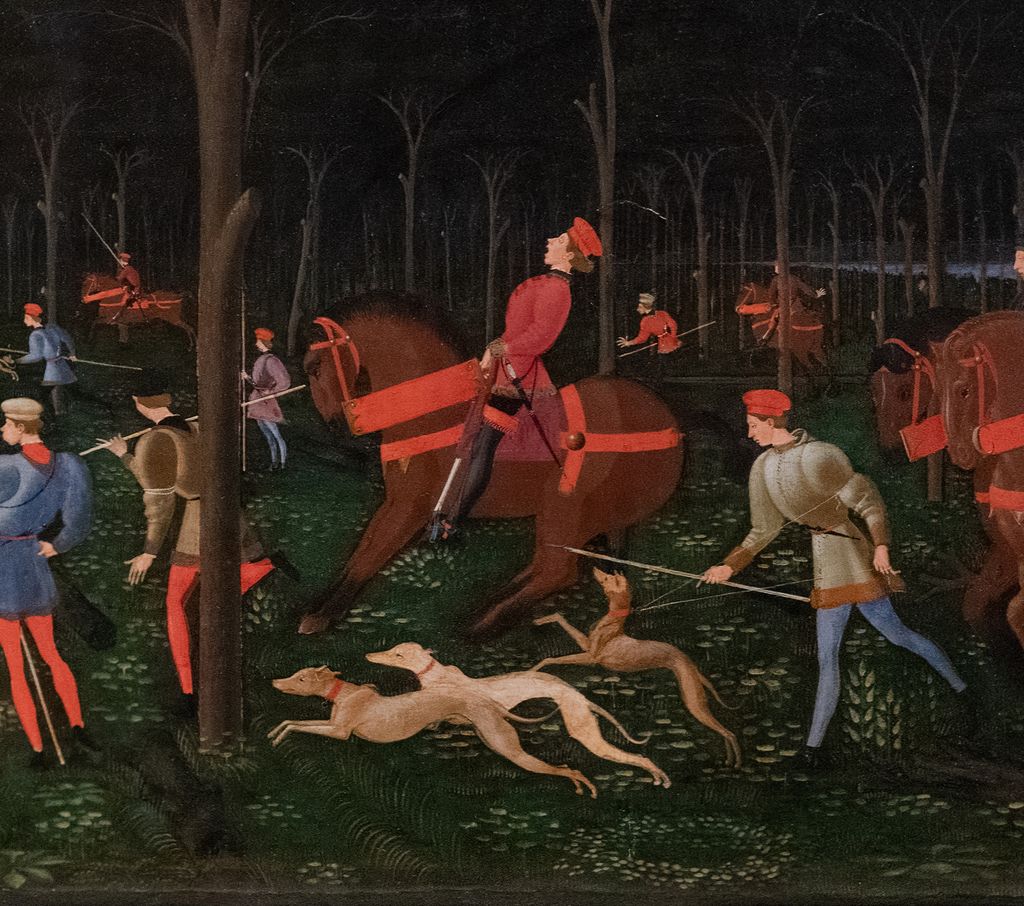
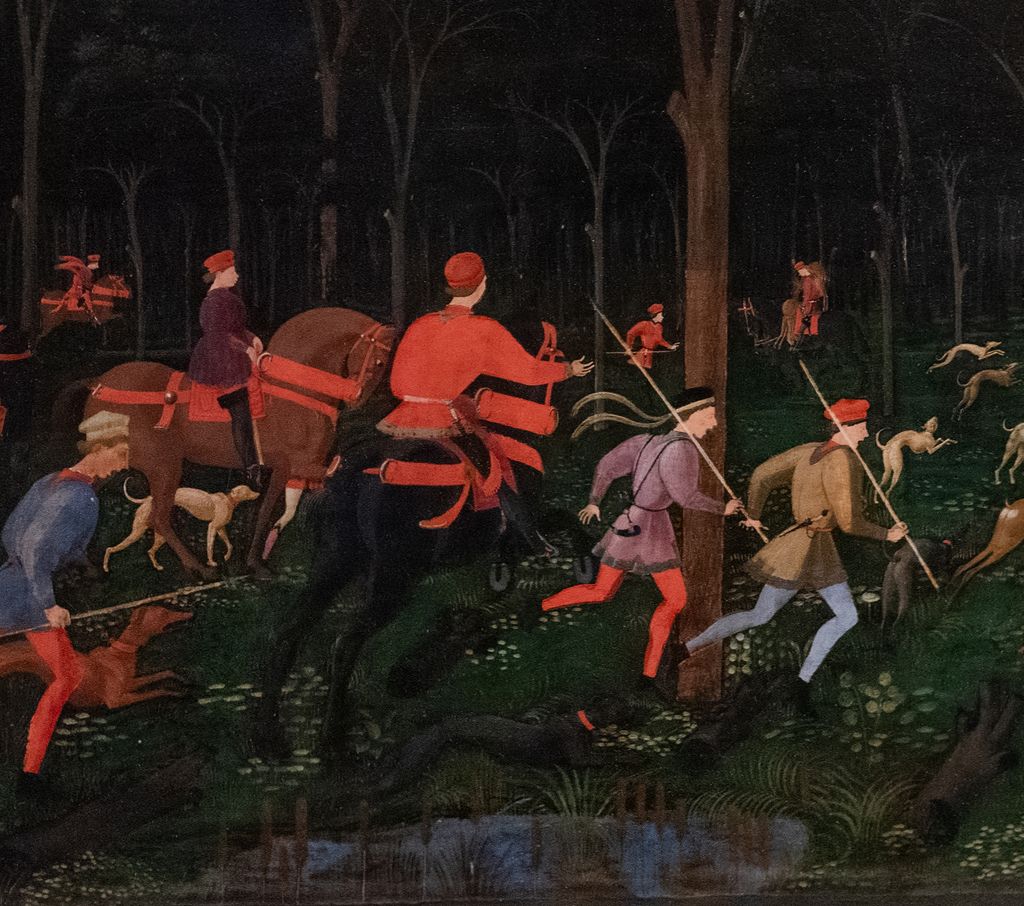
At the lower right, two pale hounds race past a man with a spear. The nearer dog is stretched so far that its legs scarcely seem to touch the grass. Follow its head towards the middle of the panel and the gaps between the tree trunks narrow. Pale dogs give way to smaller pale shapes, until the pursuit is difficult to distinguish from the undergrowth. Paolo Uccello painted The Hunt in the Forest around 1465–70 in tempera and oil on wood, with gold that survives in traces. The panel measures 73.3 × 177 cm and belongs to the Ashmolean Museum in Oxford, where it is catalogued as WA1850.31. [1]
At a Glance
- DateAbout 1465–70
- Medium and sizeTempera and oil on panel with traces of gold, 73.3 × 177 cm
- CollectionAshmolean Museum, Oxford, WA1850.31
This work across Paolo Uccello’s career
Battle of San Romano
Probably c.1438–40 · GordonResurrection glass
1443–44The Urbino predella
1467–68Saint George and the Dragon · London
About 1470Contents
- The chase at the edge of the trees
- The directions the forest gives us
- What conservation revealed
- Dark paint, bright cloth and gold
- A courtly hunt in an unusual light
- A painting made for a room?
- From an Oxford gift to an Uccello
- Annotated details
The chase at the edge of the trees
The two sides of the painting offer different entrances into the wood. At the left, horses press against one another and men on foot thread their way past them. A runner in red stockings bends forward low enough to come into the company of the dogs. The raised limbs of the horse near him and the downward pitch of his own body make those two figures read at different speeds. At the right, the pale dogs break into a stretch of open ground. Above them a rider in red sits almost erect even as his mount heads inward. Uccello gives the eye time to take in these separate incidents before the hunt becomes a mass of small figures. [1]
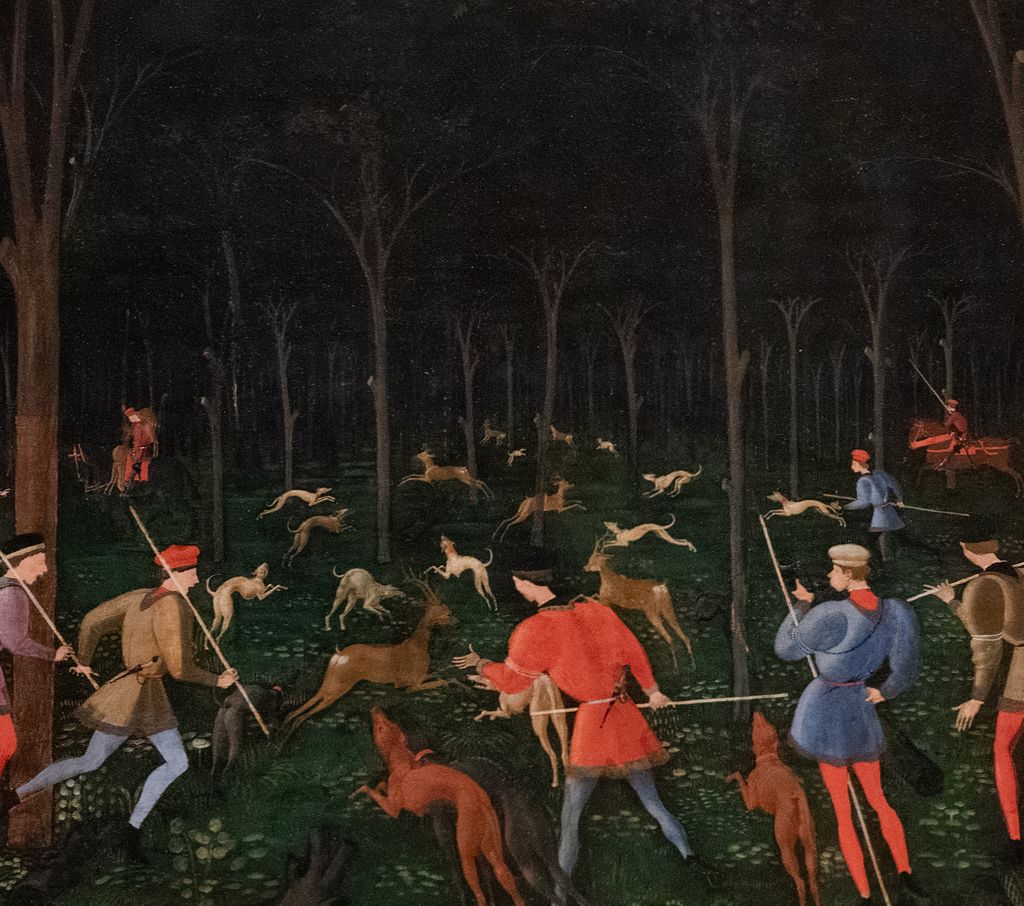
The animals themselves help tell us how far the chase has gone. Near the front, the bodies of the dogs are long enough for us to read the curve of a spine, the tucked legs of one animal and the forward extension of another. Farther in, a light back and a few strokes for legs will do. The deer leave a higher, thinner outline where they can still be picked out. Hunters, hounds and quarry overlap in places, while a trunk cuts across the body of a horse or hides part of a running figure. To follow a single animal for long is difficult. To follow the sweep of the pack is almost effortless. [1]
Near the centre, the two groups have narrowed to a passage through upright trunks. This is where the scale changes most dramatically. The coats of people on foot can still be picked out by colour for a while, as can the markings of the horses and dogs. Then the marks become too small for a viewer to read recognisable gestures. The hunters at the edges can be surveyed almost at leisure. Deep among the trees, we have to look for the movement that brought us there. [1] [2]
The directions the forest gives us
The tallest trunks divide the width of the painting into broad intervals. Successive trunks are thinner, stand closer together and can be seen through the gaps in front of them. Their crowns break into smaller patches of foliage. The whole arrangement has something of the effect of looking down a long hall between rows of columns, with the canopy taking the place of a ceiling. Low to the ground, spears, cut branches and fallen wood suggest oblique routes into the scene. One can trace a direction by moving from a hunter’s weapon to a log, even where trees and bodies interrupt the intervening stretch of grass. [1] [2]
The picture also gives us routes that turn aside. Look for the narrow strip of blue water among the right-hand trees. Its direction takes the eye away from the central channel of the chase. The Ashmolean’s teaching notes point out that the line of the water does not meet the central vanishing point. Some of the men are carrying weapons across their bodies, and some of the animals run almost across the surface of the picture. A pale hound that bounds sideways can momentarily arrest the inward sweep. It supplies an especially clear yardstick for the smaller hounds behind it. At the lower left a still pool fringed with plants provides another pause, an incident that art historian Diego Suárez Quevedo singles out along with the straight watercourse on the right. [1] [2] [3]
It helps to distinguish the paths through the forest from the place where the main directions meet. In a painting of a tiled floor, a set of lines representing edges parallel in the scene can appear to converge as they recede. The point at which these lines would meet is called a vanishing point. The Japanese geometry scholar Kiyoo Koyama pointed out that the painting conveys deep space even without a building whose edges would make the exact scheme plain. [4] In the Hunt, real things serve as clues in place of conspicuous paving. Branches and weapons belong naturally to the scene, and their angles steer a viewer who may never stop to extend any of them mentally. The farther trees confirm the depth by shrinking and crowding together even when the eye loses sight of those diagonals. [1] [2]
Annotated Details from The Hunt in the Forest
The numbered points identify visible features discussed in this article. Return from each detail to the numbered overview. The Hunt in the Forest, Ashmolean Museum WA1850.31. Image source. CC0 / Public domain.
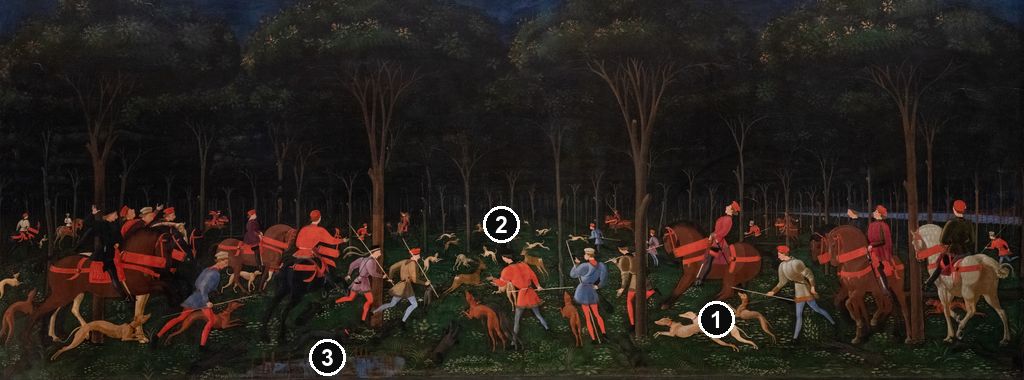
Details from THE HUNT IN THE FOREST
Compare the cropped details with the source images above. Notice how their colours, shapes and positions contribute to the larger compositions.
A lean hound in the foreground
The pale hound stretches low across the green foreground. The open space around its legs makes the direction of the leap easy to follow.
Small figures in the opening
The horses and figures diminish towards the narrow opening among the trees. Dark gaps between trunks take the eye beyond the larger hunters.
Water beside the hunt
A blue patch near the lower edge cuts across the foreground. Its low horizontal emphasis contrasts with the inward movement of the chase.
What conservation revealed
During conservation at the Hamilton Kerr Institute in Cambridge, the panel could be examined in ways unavailable to the casual viewer. The Ashmolean reports that infrared examination revealed charcoal marks for the horizon, a central line and receding lines from both sides of the central vanishing point. These directions belong to the planning beneath the paint. In the completed scene no horizon is drawn across the woods. The intersection is something we infer from the recession of the ground and the figures crossing it. [2] [5]
Technical evidence comes from several parts of the object. Ashok Roy and Dillian Gordon, drawing on the Oxford examination in their study of The Battle of San Romano, distinguish lines incised in the Hunt’s gesso, the pale preparation laid over the wood, from lines cut into finished paint. The former helped set out the design, including the vanishing point. Marks in finished paint show that incision also had a later use. The Oxford panel retains its original thickness and an unaltered reverse, which Roy and Gordon use to help readers imagine the rough, substantial backs of the battle panels before they were thinned or reinforced. The results clarify aspects of Uccello’s working process while leaving the separate histories of the panels intact. [5] [6]
Martin Kemp and Ann Massing’s study of the Hunt addressed how the planning helped vary the scale of the figures. Richard Talbot, discussing their measurements, notes a correspondence at a given depth between the height of a horse with its rider and the gap between the principal receding lines. Because that gap gets narrower as the lines approach the vanishing point, it could give Uccello a practical measure for reducing a mounted figure at the chosen depth. There is evidence for a lightly established pavement-like scheme, enough to set up spatial relationships without requiring Uccello to paint a continuous floor under the trees. [5] [7]
Talbot went further and drew a possible construction. The relation of the panel’s width to its height is very close to one plus the square root of two, or about 2.414 to one. The painted area is slightly smaller than the panel. Starting with square-based divisions, Talbot proposed that a network of lines could produce several centres of activity within the wide format, with the main recession still organised around one vanishing point. In this model, the way mounted figures diminish and the way their eye levels sit on the horizon follow from the same starting proportions. Talbot also suggested a way that tree heights could have been set by multiples of a unit. The proportions can be checked against the object and the drawing can be tested against the image. The choice of a square-derived network, and the steps by which Uccello would have laid it out, remain Talbot’s reconstruction. [7]
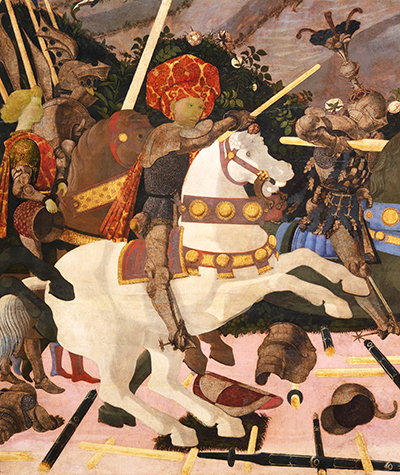
The London panel of the Battle of San Romano offers a comparison on a larger scale. Its broken lances lie in full view against pale ground, and the distribution of weapons has conspicuous consequences for how we see the space between the horses. In Oxford the slanting forms are dispersed among greenery and pools of dark colour. These are two ways Uccello made a change in direction or scale tell a story. His other uses of perspective help put the forest’s unusual combination of visible clues and underlying marks in context. [2] [6]
Dark paint, bright cloth and gold
The forest roof is so dense that only small openings admit the blue of the sky. Bright marks below it seem to travel by short jumps. Red caps answer red stockings and saddle gear across the grass. White flashes carry the eye between a horse, a sleeve and the dogs, then along the route of the chase. Uccello can let the legs and hooves of a dark horse all but disappear into the green beneath them and still keep the rider’s posture clear. Roy and Gordon note the use, in substantial parts of the landscape, of an artificial form of malachite over a black layer. The layering is one material counterpart to the effect we see when we move our attention from the surface of a leaf or branch into the darker wood around it. [1] [6]
Above the chase, the Ashmolean identifies remnants of gold in the foliage. Gold can catch the light differently from the surrounding paint as the angle of view changes. A person moving past the panel in a room lit with candles might have caught a glint in the canopy while the faces, bright clothes and dogs remained comparatively legible below. That possibility gives the upper half of the picture a liveliness easily missed when we concentrate on the action. The room and its lighting are unknown. Today we can see something of what the material would have contributed without recovering the original balance of colours and reflections. [1] [5]
A courtly hunt in an unusual light
Crescents appear on the horses’ trappings. The Ashmolean associates them with Diana, the goddess of the hunt. They bring the idea of the moon down from the sky into the equipment of the riders. Above them, the canopy shelters an action we can still see with remarkable clarity. The museum suggests the nocturnal setting could be playful or symbolic. The scene has richly dressed hunters and different kinds of attendants, familiar components of courtly hunting imagery. The hour makes their outing stranger. [1]
The Deer Hunt in the Devonshire Hunting Tapestries, probably made in Arras in about 1430–40, shows what another artist could make of the choice of quarry. Its lower register includes the cutting up and distribution of the deer, a ceremonial allocation in which even favoured dogs received particular shares. Falconry has its own register above. In the earlier Boar and Bear Hunt, another tapestry in the same set, the finely dressed couples and elaborate sleeves carry as much interest as the prey. Hunting afforded a place to show display and ritual in the same image. Uccello chooses a different instant. In Oxford the quarry is alive and still running, with the riders and their equipment slowly growing harder to follow. [1] [8]
In a Paris manuscript of Gaston Phébus’s Livre de chasse, a miniature on folio 67r shows the gathering before a deer hunt. Susan Crane describes how a huntsman presents droppings at the breakfast table so the assembled company can assess the stag. This is the hunt as a chance to put knowledge of animals and their habits on display. The illustrations in this early fifteenth-century copy open out the separate stages of the enterprise. Uccello gives the hounds and the deer room to demonstrate that expertise in action. The manuscript and tapestries show how varied the representation of hunting already was when he painted his panel. [9] [10]
A painting made for a room?
The Ashmolean describes the long panel as a spalliera, a type associated with furnishings around shoulder height. It may have formed a backboard above a decorated chest or been set into room panelling. At 177 centimetres wide it could have invited successive views as someone moved along the wall, first taking in one gathering of men and animals and then recognising how the two sides fit together. Florence around 1470 and Urbino, where Uccello worked in the later 1460s, are both possible settings for the commission. The original client, position and fitting remain unknown. Kemp and Massing point out that late fifteenth-century inventories suggest large secular panel paintings once decorated a fair number of Italian interiors. The scarcity of examples of comparable date and size makes the Oxford panel an important survival. [1] [5] [11]
An Italian document offers a warning about naming the patron too readily. Lorenzo Sbaraglio discusses Uccello’s claim in 1474 against the woodworker Domenico del Tasso for money owed on two paintings. This is evidence that the painter supplied work to a woodworker late in his career. Sbaraglio observes that the stated sum of three florins for two pictures seems low for an undertaking on the scale of the Hunt, unless it was only a partial payment. The document leaves the subjects of the two paintings open. A later inscription on the back associates the scene with the woods of Pisa and names Benozzo Gozzoli, according to Suárez Quevedo. He finds a setting at Federico da Montefeltro’s court in Urbino more plausible. The inscription records an interpretation made after the panel was painted, while the suggested Urbino setting depends in part on connecting it to a description in later inventories. The identification of a particular hunt remains open. [3] [11]
A later Florentine parallel helps show what the proportions can tell us. Piero di Cosimo’s A Hunting Scene at the Metropolitan Museum of Art is of comparable width and height. The Met brings it together with The Return from the Hunt and suggests the two long pictures belonged in a room intended for study and contemplation. Piero’s hunters exploit a forest fire in a story about the early history of humanity. Uccello’s wear the clothes of his own time. The comparison shows how a similar shape could give a privately viewed painting room to encompass a whole landscape and serve very different stories. [1] [12]
From an Oxford gift to an Uccello
The painting’s documented Oxford history begins in 1850, when William Fox-Strangways gave the University Galleries a group of pictures he had collected while serving as a diplomat in Italy. The Ashmolean’s published guide places the Hunt alongside works in that gift by painters including Bicci di Lorenzo, Pinturicchio and Bronzino. It was a donation with a pronounced interest in earlier Italian painting, bringing a woodland chase into a collection where it could be seen alongside devotional subjects and portraits. [5] [13]
National Portrait Gallery researchers identify the Hunt among the pictures Henry Merritt cleaned for the University Galleries in 1867. Its attribution also took shape in the nineteenth century. In 1896 Bernard Berenson listed the Oxford painting among Uccello’s works under the title Midnight Hunt. From that name to the one used by the Ashmolean today, the emphasis has moved from the hour to the setting. Both point to what makes the scene distinctive among Uccello’s paintings. The careful spacing of the trees leads the eye towards the quarry, and the deep shadow makes it wonderfully hard to tell where it has gone. [1] [14] [15]
Artworks directory
Browse paintings, drawings, stained-glass designs and other objects connected with Uccello. Cycles and their surviving components may have separate entries. The collection or catalogue’s wording is retained where a date, attribution or subject is debated.
| Name | Date | Medium, attribution and collection |
|---|---|---|
| Niccolò da Tolentino at the Battle of San Romano · London | Probably c.1438–40 | Tempera and oil on wood, with metallic decoration · National Gallery Catalogue. |
| Bernardino della Carda Unhorsed · Florence | c.1435–40 | Tempera on panel · Uffizi Galleries Catalogue. |
| The Counterattack of Micheletto da Cotignola · Paris | 1450–75 in the Louvre catalogue | Tempera (possibly) on wood · Musée du Louvre Catalogue. |
| The Hunt in the Forest | c.1465–70 | Tempera and oil with traces of gold on panel · Ashmolean Catalogue. |
| Saint George and the Dragon · London | c.1470 | Oil on canvas · National Gallery Catalogue. |
| Saint George Slaying the Dragon · Melbourne | c.1430 | Oil, tempera and silver leaf on wood · National Gallery of Victoria Catalogue. |
| Saint George and the Dragon · Paris | 1430–35 in the museum catalogue | Painted wood panel · Musée Jacquemart-André Catalogue. |
| Equestrian Monument to John Hawkwood | 1436 | Transferred wall painting · Florence Cathedral Catalogue. |
| Study for the John Hawkwood Monument | 1436 | Study on prepared paper · Uffizi Catalogue. |
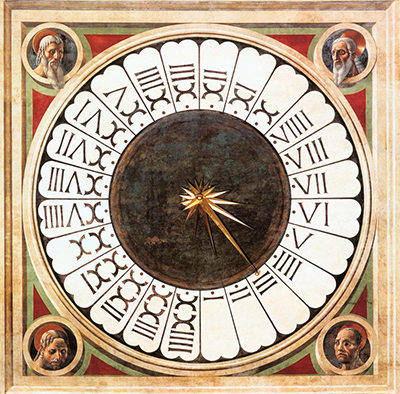
| Monumental Clock Face | 1443 | Painted dial · Florence Cathedral Catalogue. |
| Resurrection of Christ | 1443–44 | Stained glass · Uccello design · Florence Cathedral Catalogue. |
| Nativity | 1440s | Stained glass · Uccello design · Florence Cathedral Catalogue. |
| Creation of the Animals and Creation of Adam | Third to fourth decade of the 15th century | Detached fresco · Green Cloister, Santa Maria Novella Catalogue. |
| Creation of Eve and the Fall | Third to fourth decade of the 15th century | Detached fresco · Green Cloister, Santa Maria Novella Catalogue. |
| Flood and Recession of the Waters | 15th century; dating debated | Detached fresco · Green Cloister, Santa Maria Novella Catalogue. |
| Sacrifice and Drunkenness of Noah | 15th century; dating debated | Detached fresco · Green Cloister, Santa Maria Novella Catalogue. |
| Stories of the Virgin and Saint Stephen · Assunta Chapel | 1430s, with later completion | Fresco cycle · Paolo Uccello and Andrea di Giusto · Prato Cathedral Catalogue. |
| Blessed Jacopone da Todi | 1436 in the diocesan museum | Detached fresco · Museo dell’Opera del Duomo, Prato Catalogue. |
| Adoration of the Child · Bologna | 1430s; inscription incomplete | Detached fresco · San Martino Maggiore, Bologna Catalogue. |
| Adoration of the Christ Child · Karlsruhe | c.1436 | Painted panel · Attribution to Uccello · Staatliche Kunsthalle Karlsruhe Catalogue. |
| Annunciation · Oxford | Early 15th century | Tempera and gilding on panel · Ashmolean Catalogue. |
| Allegory of Monastic Life (Thebaid) | c.1460–65 | Tempera on canvas · Galleria dell’Accademia, Florence Catalogue. |
| Miracle of the Profaned Host | 1467–68 | Tempera on wood · Galleria Nazionale delle Marche, Urbino Catalogue. |
| Triumphal Entry into Rome of Titus and Vespasian(?) | c.1430–35 | Tempera, gold and silver on panel · Yale University Art Gallery Catalogue. |
| Crucifixion with the Virgin and Saints | c.1460–65 | Painted panel · Museo Nacional Thyssen-Bornemisza Catalogue. |
| The Crucifixion · Met triptych | Probably mid-1450s | Tempera on wood with gold ground · Metropolitan Museum of Art Catalogue. |
| Perspective Study of a Chalice | 1450–75 | Pen, ink and stylus on paper · Attributed to Uccello · Uffizi Catalogue. |
| Study of a Mazzocchio | 15th century | Perspective study · Attributed to Uccello · Uffizi Catalogue. |
| Mazzocchio Seen in Perspective | Uncertain | Drawing · Attribution debated · Musée du Louvre Catalogue. |
| Head of a Man in Profile | 15th century | Pen, ink and wash · Musée du Louvre Catalogue. |
| Five Masters of the Florentine Renaissance | 1500–50 | Oil on wood · Anonymous Florentine school · Musée du Louvre Catalogue. |
| Madonna and Child from the Del Beccuto House | 15th century | Detached fresco · Museo di San Marco, Florence Catalogue. |
| Man of Sorrows with the Virgin and Saint John · Avane Predella | 15th century | Predella · Museo di San Marco, Florence Catalogue. |
| Calling of Saint Paul the Hermit · San Miniato | After 1447 to c.1454 in state catalogue | Sinopia · Attributed to Uccello or collaborator Catalogue. |
| The host changes hands · Urbino predella, scene 1 | 1467–68 | Tempera on wood · Component of DE 231 · Galleria Nazionale delle Marche Catalogue. |
| The figures at the door · Urbino predella, scene 2 | 1467–68 | Tempera on wood · Component of DE 231 · Galleria Nazionale delle Marche Catalogue. |
| The procession approaches the altar · Urbino predella, scene 3 | 1467–68 | Tempera on wood · Component of DE 231 · Galleria Nazionale delle Marche Catalogue. |
| The condemned woman and the ladders · Urbino predella, scene 4 | 1467–68 | Tempera on wood · Component of DE 231 · Galleria Nazionale delle Marche Catalogue. |
| Persecution of the family · Urbino predella, scene 5 | 1467–68 | Tempera on wood · Component of DE 231 · Galleria Nazionale delle Marche Catalogue. |
| Angels and demons at the bier · Urbino predella, scene 6 | 1467–68 | Tempera on wood · Component of DE 231 · Galleria Nazionale delle Marche Catalogue. |
| Birth of the Virgin · Prato Cathedral | 1430s; dating debated | Fresco · Assunta Chapel, Prato Cathedral Catalogue. |
| Presentation of the Virgin · Prato Cathedral | 1430s; dating debated | Fresco · Assunta Chapel, Prato Cathedral Catalogue. |
Discussion
Look again at the images and ideas explored in The Hunt in the Forest. These editorial prompts invite your observations.
Reader Insights
Follow the pale hounds near the right edge into the forest. At what point do the trees tell you more about distance than the bodies of the animals?
If the blue water followed the same direction as the chase, how would it change the way you move your eyes across the forest?
Join the Conversation
Share a detail, comparison or question about The Hunt in the Forest below.
References
- Ashmolean Museum. The Hunt in the Forest by Uccello, WA1850.31. Object data, photographs, courtly imagery, surviving gold and possible original function. View source.
- Ashmolean Museum. Focus on Perspective in Art, p. 3. Infrared findings, painted directions and the water’s divergent line. View source.
- Diego Suárez Quevedo. “En los inicios del Renacimiento. La cúpula brunelleschiana y reflexiones sobre Paolo Uccello”, Anales de Historia del Arte 25, 2015, pp. 100–101. The later inscription, the Urbino hypothesis and the two water features. View source.
- Kiyoo Koyama. “Uccello and Perspective” [Japanese], Japanese Society for Graphic Science, 1985 conference abstracts, Journal of Graphic Science of Japan 19, no. 2, p. 46. Constructed and visible recession in Uccello’s paintings. View source.
- Martin Kemp and Ann Massing, with Nicola Christie and Karin Groen. “Paolo Uccello’s ‘Hunt in the Forest’”, The Burlington Magazine 133, no. 1056, 1991, pp. 164–178. Conservation at the Hamilton Kerr Institute, attribution history and early provenance. View source.
- Ashok Roy and Dillian Gordon. “Uccello’s ‘Battle of San Romano’”, National Gallery Technical Bulletin 22, 2001, pp. 4–17. Oxford panel thickness and reverse, incision and green paint. Comparison with the London battle panel. View source.
- Richard Talbot. “Speculations on the Origins of Linear Perspective”, Nexus Network Journal 5, no. 1, 2003, pp. 64–98, part III, figs. 23–24. Kemp and Massing’s observations and Talbot’s proposed reconstruction. View source.
- Victoria and Albert Museum. The Devonshire Hunting Tapestries. Deer Hunt, T.205-1957, and Boar and Bear Hunt, T.204-1957. Dates, dress and stages of the hunt. View source.
- Bibliothèque nationale de France. Le livre de chasse de Gaston Phébus, “Les manuscrits”. The copy Français 616 and its early fifteenth-century Paris illuminations. View source.
- Susan Crane. “The Noble Hunt as a Ritual Practice”, in Animal Encounters: Contacts and Concepts in Medieval Britain. University of Pennsylvania Press, 2012, pp. 116–118 and fig. 7. The gatherings and choice of quarry in Français 616, fol. 67r. View source.
- Lorenzo Sbaraglio. Paolo di Dono, detto Paolo Uccello, Dizionario Biografico degli Italiani, vol. 81, 2014. The Del Tasso claim and proposals for the Oxford painting’s date and destination. View source.
- Metropolitan Museum of Art. A Hunting Scene, Piero di Cosimo, 75.7.2. Format, narrative and proposed domestic use. View source.
- Ashmolean Museum. Paintings Selected from the Collections in the Ashmolean Museum, introductory section. The 1850 Fox-Strangways gift and its scope. View source.
- National Portrait Gallery. British Picture Restorers, 1600–1950, “Merritt, Henry”. Archival record of paintings treated for the University Galleries. View source.
- Bernard Berenson. The Florentine Painters of the Renaissance, first edition. G. P. Putnam’s Sons, 1896, p. 129. Index of works under Paolo Uccello. View source.
More PAOLO UCCELLO Artworks

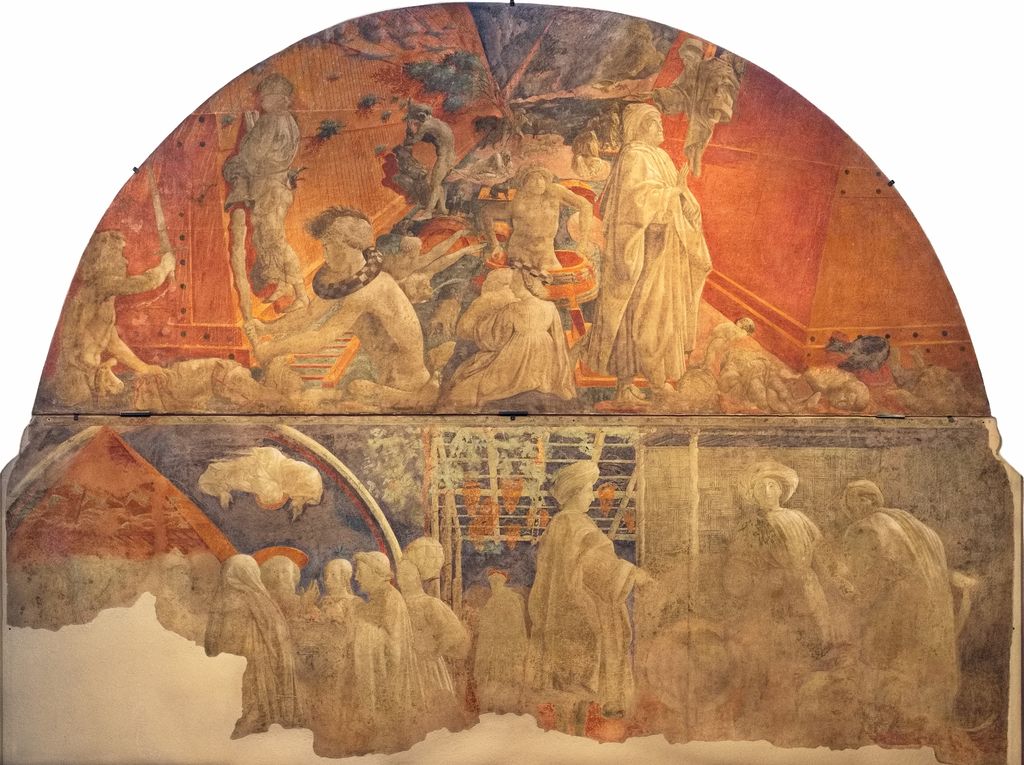
Noah and the Flood
The Flood and Recession of the Waters above the lower episodes from Noah’s story, Santa Maria Novella. Photograph by Armin Kleiner. Image source. CC BY-SA 4.0. Resized for the web. This derivative is available under the same licence.
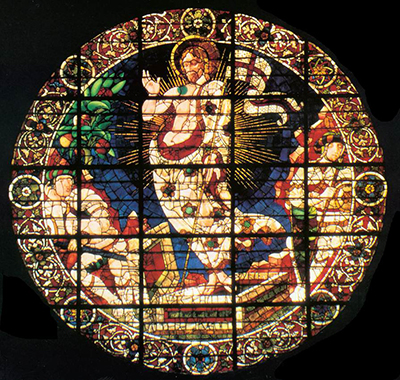
The Resurrection of Christ Stained Glass Window
The Resurrection window in Florence Cathedral, designed by Paolo Uccello and made by Bernardo di Francesco. Photograph by Sailko. Image source. CC BY 3.0. Resized for the web.