 by Tom Gurney
Tom Gurney BSc (Hons) is an art history expert with over 20 years experience
Published on June 19, 2020 / Updated on November 29, 2026
Email: tomgurney1@gmail.com / Phone: +44 7429 011000
Paolo Uccello Quotes and the Art of Perspective
“Oh, what a sweet thing this perspective is!”
The best-known saying associated with Paolo Uccello reaches us through Giorgio Vasari. In Vasari’s account, the painter’s wife calls him to bed while he remains absorbed in studying perspective, and the phrase is his answer. It is a reported remark in a later biography, not a surviving sentence in Uccello’s handwriting. That distinction matters, but it does not diminish the fascination of a story in which mathematical enquiry becomes a source of delight. [1]
The quotation is most useful when read beside the pictures. A broken lance, a receding horse or a complicated painted object can show why the arrangement of space might absorb an artist so completely. Yet Uccello’s work also includes colour, ornament, narrative and the observation of living things. The anecdote offers one route into that art, rather than a complete explanation of the man.
At a Glance
- Famous remarkThe sweetness of perspective
- SourceReported by Giorgio Vasari
- StatusLater biographical anecdote, not autograph writing
Contents
Who recorded the famous remark?
Giorgio Vasari published the first edition of his artists’ biographies in 1550 and an expanded edition in 1568. Uccello had died long before either appeared. Vasari’s text therefore belongs to the artist’s later reputation, assembling stories and judgments into an account of a life. The quoted words should retain that chain of transmission: Uccello, as reported by Vasari through a story about his wife. [1]
English translations vary. One may describe perspective as sweet, another as delightful. The variation is a reminder that an English quotation is already an interpretation of earlier wording. It is sensible to identify the translation being used rather than combine several attractive versions into a supposed original speech.
A reported saying can still be historically interesting without becoming a transcript. It tells us how a writer wanted readers to imagine artistic labour: private, prolonged and absorbing enough to compete with everyday obligations. The story makes an abstract intellectual enthusiasm memorable through a recognisable domestic exchange.
More than an obsession with mathematics
The National Gallery’s biography describes Uccello as an artist who combined decorative qualities associated with International Gothic painting with an unusually strong interest in linear perspective. It also records his training with Ghiberti and his work in mosaic design in Venice. This is a broader picture than the solitary mathematician of a familiar anecdote. [2]
The combination is visible in the competing pleasures of his paintings. A rider may occupy a carefully calculated space while his clothing creates a brilliant patch of pattern. A landscape may invite the eye into depth while its trees form a decorative rhythm across the surface. The viewer moves between the illusion of a world and awareness of an arranged image.
That movement helps explain the appeal of the quoted word sweet. Calculation need not mean emotional coldness. Solving a spatial problem can produce surprise, elegance and enjoyment. Equally, pleasure in a pattern does not make the artist’s interest in geometry superficial. The two can support each other within the same work.
The Battle of San Romano: experiment on a crowded field
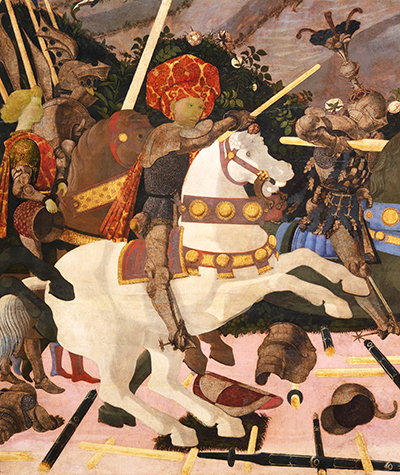
The National Gallery’s panel from The Battle of San Romano turns a military encounter into a remarkably organised field of objects. Its collection commentary points to broken lances laid out like a grid and pieces of armour shown at different angles. It also explains that the painting’s present darkness differs greatly from the effect of its original bright colours and metallic decoration. [3]
These details suggest a useful exercise. Instead of trying to understand every combatant immediately, follow the foreground objects. Their directions create order beneath the pressure of the crowded figures above. Then look at where that order stops or becomes difficult to follow. A painting can reveal experimentation without behaving like a flawless textbook diagram.
The famous saying should not be used to excuse every unusual form as a mathematical demonstration. The panel was also an image of military prestige, designed for an interior and changed by its subsequent history. Geometry is one of the means by which the event becomes a striking spectacle.
Three panels and changing viewpoints
The Uffizi’s account places its Battle of San Romano panel within the original three-part cycle and identifies the episodes now divided between Florence, London and Paris. It emphasises the ambitious foreshortening of bodies and the relationship between the pictures’ construction and their intended position in a palace. [4]
A quotation printed alone can make perspective seem like a purely private pursuit. The cycle reminds us that pictures were made for particular people and places. A figure seen from below, a horse turning in space or a long horizontal procession could respond to a viewer’s position within a room.
This changes the question from whether Uccello understood space to what he wanted painted space to accomplish. He could use it to organise confusion, display difficult forms or make an image commanding at a distance. Returning to the intended setting prevents a modern close-up from becoming the only standard by which the work is judged.
The Hunt in the Forest: depth as an invitation
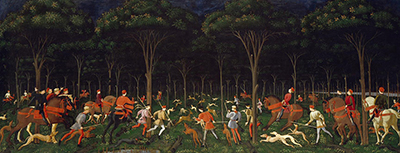
The Ashmolean’s Hunt in the Forest offers another way to test the quotation. Its account describes a central vanishing point and a measured construction that draws the eye between the figures and trees. At the same time, it treats the nocturnal hunt as an imaginative or symbolic scene rather than straightforward documentation of a real expedition. [5]
Perspective here becomes an invitation to enter. Spears, logs and running animals create a movement towards the distance, but the dark forest also limits what can be seen. The viewer follows the hunt while remaining aware that its destination is concealed. A convincing space can therefore increase uncertainty as well as explain an action.
The painting’s decorative details complicate any division between scientific construction and enchantment. The museum records traces of gold and considers how the picture might have appeared in a luxurious domestic setting. A spatial system and a glittering surface belong to the same encounter. Neither needs to cancel the other.
A religious picture beyond the famous story
Uccello’s Crucifixion in the Thyssen-Bornemisza collection gives the discussion a different emotional register. The museum dates it approximately 1460–65 and identifies its gathering of saints around the central event. Its commentary also reviews Vasari’s mixed portrait of an artist admired for certain achievements and criticised for others. [6]
This is a reminder that the celebrated anecdote does not exhaust the purposes of painting. A devotional panel asks how bodies, gestures and a central cross can organise a viewer’s attention. Its visual arrangement supports a religious encounter, not simply an opportunity to demonstrate skill.
When looking at it, distinguish a formal question from a biographical one. We may ask how an edge directs attention, or how the figures occupy the available space. Those observations do not entitle us to reconstruct Uccello’s private thoughts as he painted. The work gives us a precise field for looking; the biography offers a more indirect field for imagining a life.
Using the quotation with care
The strongest use of Uccello’s famous remark is as a question to bring to a picture: where does the pleasure of arranging space become visible? It may appear in a difficult turn of the body, in a measured sequence of trees or in the meeting of a surface pattern with an illusion of depth.
Keep the attribution beside the quotation, particularly when sharing it. The phrase is reported by Vasari, and its English wording belongs to a translation. That short explanation makes the saying more interesting because it connects the memorable voice with the story through which we know it.
Uccello’s pictures can then answer in their own medium. They offer something more complex than a slogan: fields of bodies, light, colour and ornament in which calculated relationships become part of an imaginative world. The sweetness of perspective remains an attractive idea, provided that we allow the paintings to give it several meanings.
Artworks directory
Browse paintings, drawings, stained-glass designs and other objects connected with Uccello. Cycles and their surviving components may have separate entries. The collection or catalogue’s wording is retained where a date, attribution or subject is debated.
| Name | Date | Medium, attribution and collection |
|---|---|---|
| Niccolò da Tolentino at the Battle of San Romano · London | Probably c.1438–40 | Tempera and oil on wood, with metallic decoration · National Gallery Catalogue. |
| Bernardino della Carda Unhorsed · Florence | c.1435–40 | Tempera on panel · Uffizi Galleries Catalogue. |
| The Counterattack of Micheletto da Cotignola · Paris | 1450–75 in the Louvre catalogue | Tempera (possibly) on wood · Musée du Louvre Catalogue. |
| The Hunt in the Forest | c.1465–70 | Tempera and oil with traces of gold on panel · Ashmolean Catalogue. |
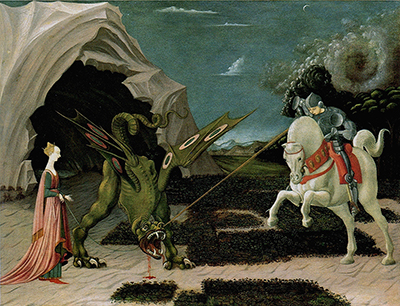
| Saint George and the Dragon · London | c.1470 | Oil on canvas · National Gallery Catalogue. |
| Saint George Slaying the Dragon · Melbourne | c.1430 | Oil, tempera and silver leaf on wood · National Gallery of Victoria Catalogue. |
| Saint George and the Dragon · Paris | 1430–35 in the museum catalogue | Painted wood panel · Musée Jacquemart-André Catalogue. |
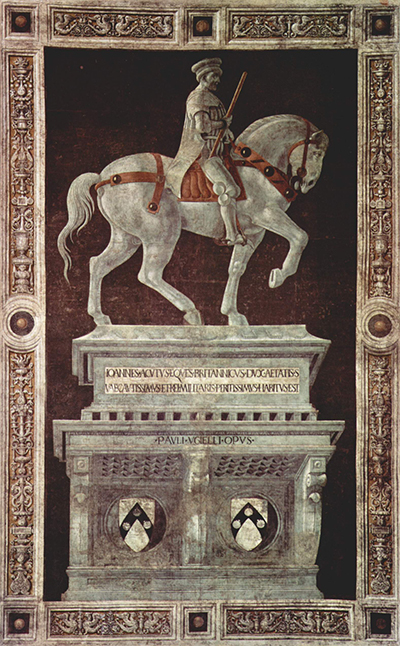
| Equestrian Monument to John Hawkwood | 1436 | Transferred wall painting · Florence Cathedral Catalogue. |
| Study for the John Hawkwood Monument | 1436 | Study on prepared paper · Uffizi Catalogue. |
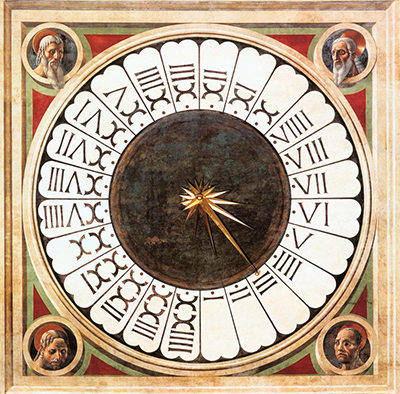
| Monumental Clock Face | 1443 | Painted dial · Florence Cathedral Catalogue. |
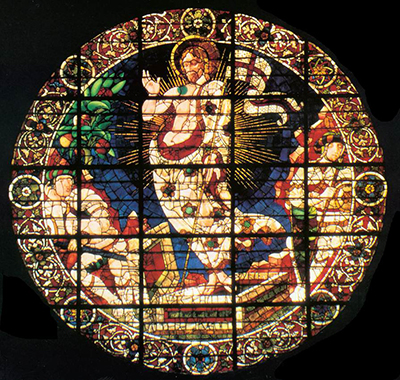
| Resurrection of Christ | 1443–44 | Stained glass · Uccello design · Florence Cathedral Catalogue. |
| Nativity | 1440s | Stained glass · Uccello design · Florence Cathedral Catalogue. |
| Creation of the Animals and Creation of Adam | Third to fourth decade of the 15th century | Detached fresco · Green Cloister, Santa Maria Novella Catalogue. |
| Creation of Eve and the Fall | Third to fourth decade of the 15th century | Detached fresco · Green Cloister, Santa Maria Novella Catalogue. |
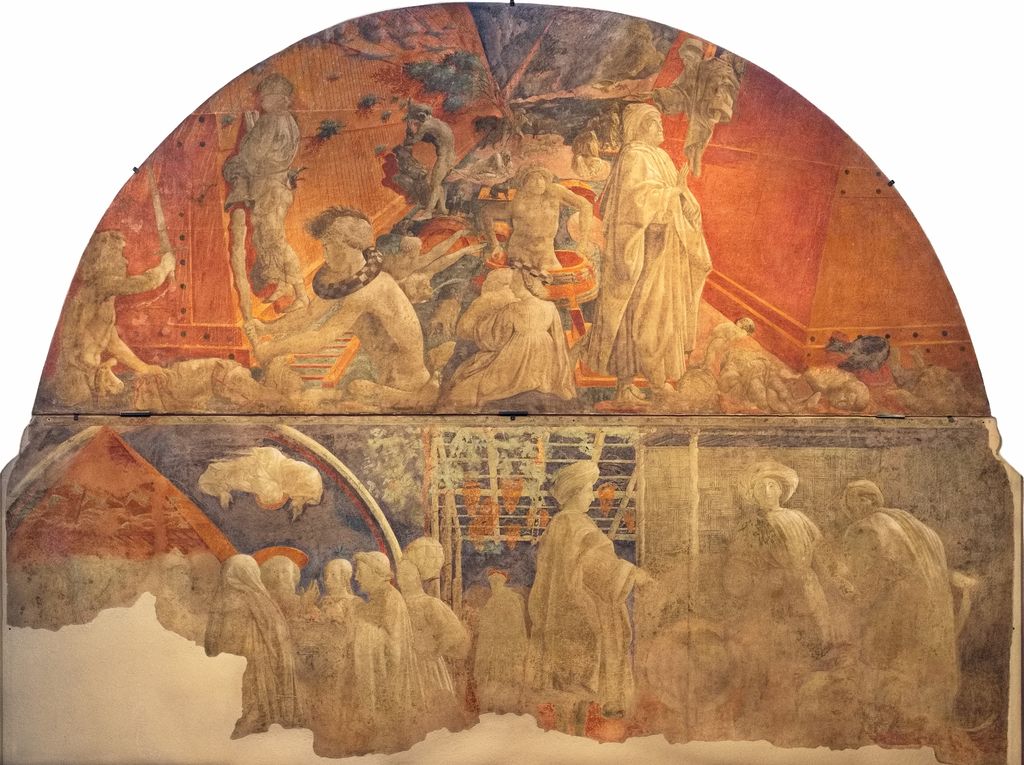
| Flood and Recession of the Waters | 15th century; dating debated | Detached fresco · Green Cloister, Santa Maria Novella Catalogue. |
| Sacrifice and Drunkenness of Noah | 15th century; dating debated | Detached fresco · Green Cloister, Santa Maria Novella Catalogue. |
| Stories of the Virgin and Saint Stephen · Assunta Chapel | 1430s, with later completion | Fresco cycle · Paolo Uccello and Andrea di Giusto · Prato Cathedral Catalogue. |
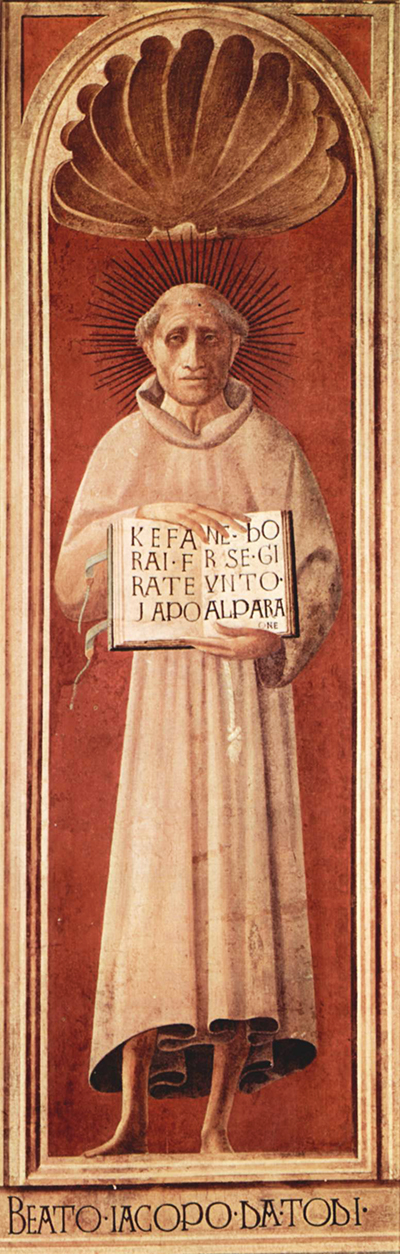
| Blessed Jacopone da Todi | 1436 in the diocesan museum | Detached fresco · Museo dell’Opera del Duomo, Prato Catalogue. |
| Adoration of the Child · Bologna | 1430s; inscription incomplete | Detached fresco · San Martino Maggiore, Bologna Catalogue. |
| Adoration of the Christ Child · Karlsruhe | c.1436 | Painted panel · Attribution to Uccello · Staatliche Kunsthalle Karlsruhe Catalogue. |
| Annunciation · Oxford | Early 15th century | Tempera and gilding on panel · Ashmolean Catalogue. |
| Allegory of Monastic Life (Thebaid) | c.1460–65 | Tempera on canvas · Galleria dell’Accademia, Florence Catalogue. |
| Miracle of the Profaned Host | 1467–68 | Tempera on wood · Galleria Nazionale delle Marche, Urbino Catalogue. |
| Triumphal Entry into Rome of Titus and Vespasian(?) | c.1430–35 | Tempera, gold and silver on panel · Yale University Art Gallery Catalogue. |
| Crucifixion with the Virgin and Saints | c.1460–65 | Painted panel · Museo Nacional Thyssen-Bornemisza Catalogue. |
| The Crucifixion · Met triptych | Probably mid-1450s | Tempera on wood with gold ground · Metropolitan Museum of Art Catalogue. |
| Perspective Study of a Chalice | 1450–75 | Pen, ink and stylus on paper · Attributed to Uccello · Uffizi Catalogue. |
| Study of a Mazzocchio | 15th century | Perspective study · Attributed to Uccello · Uffizi Catalogue. |
| Mazzocchio Seen in Perspective | Uncertain | Drawing · Attribution debated · Musée du Louvre Catalogue. |
| Head of a Man in Profile | 15th century | Pen, ink and wash · Musée du Louvre Catalogue. |
| Five Masters of the Florentine Renaissance | 1500–50 | Oil on wood · Anonymous Florentine school · Musée du Louvre Catalogue. |
| Madonna and Child from the Del Beccuto House | 15th century | Detached fresco · Museo di San Marco, Florence Catalogue. |
| Man of Sorrows with the Virgin and Saint John · Avane Predella | 15th century | Predella · Museo di San Marco, Florence Catalogue. |
| Calling of Saint Paul the Hermit · San Miniato | After 1447 to c.1454 in state catalogue | Sinopia · Attributed to Uccello or collaborator Catalogue. |
| The host changes hands · Urbino predella, scene 1 | 1467–68 | Tempera on wood · Component of DE 231 · Galleria Nazionale delle Marche Catalogue. |
| The figures at the door · Urbino predella, scene 2 | 1467–68 | Tempera on wood · Component of DE 231 · Galleria Nazionale delle Marche Catalogue. |
| The procession approaches the altar · Urbino predella, scene 3 | 1467–68 | Tempera on wood · Component of DE 231 · Galleria Nazionale delle Marche Catalogue. |
| The condemned woman and the ladders · Urbino predella, scene 4 | 1467–68 | Tempera on wood · Component of DE 231 · Galleria Nazionale delle Marche Catalogue. |
| Persecution of the family · Urbino predella, scene 5 | 1467–68 | Tempera on wood · Component of DE 231 · Galleria Nazionale delle Marche Catalogue. |
| Angels and demons at the bier · Urbino predella, scene 6 | 1467–68 | Tempera on wood · Component of DE 231 · Galleria Nazionale delle Marche Catalogue. |
| Birth of the Virgin · Prato Cathedral | 1430s; dating debated | Fresco · Assunta Chapel, Prato Cathedral Catalogue. |
| Presentation of the Virgin · Prato Cathedral | 1430s; dating debated | Fresco · Assunta Chapel, Prato Cathedral Catalogue. |
Frequently Asked Questions
The source used here is Vasari’s later biography, which reports it through an anecdote about Uccello’s wife. It is not presented as an autograph statement.
English translations render the reported Italian wording differently. This page follows the sweet wording in the Fordham-hosted translation.
Discussion
Consider how the documented words and objects change your understanding of the artist.
Reader Insights
Which source most changes the way you look at the works?
Which distinction between objects or speakers is most useful?
What would you like to compare next?
Join the Conversation
Share a detail, comparison or question about Paolo Uccello Quotes and the Art of Perspective below.
References
- Giorgio Vasari. Lives of the Artists: Paolo Uccello, English translation excerpt hosted by Fordham University, Internet History Sourcebooks. Reported perspective remark and biographical anecdote. View source.
- National Gallery, London. Paolo Uccello. Artist biography; accessed 5 November 2026. View source.
- National Gallery, London. Paolo Uccello, The Battle of San Romano, NG583. Collection commentary on construction, materials and changes in appearance. View source.
- Uffizi Galleries. Paolo Uccello, Battle of San Romano. Collection commentary on the three-panel cycle and perspective; accessed 5 November 2026. View source.
- Ashmolean Museum, University of Oxford. The Hunt in the Forest, WA1850.31. Collection essay on setting, perspective and materials. View source.
- Museo Nacional Thyssen-Bornemisza. Paolo Uccello, The Crucifixion with the Virgin, Saint John the Baptist, Saint John the Evangelist and Saint Francis, 1930.118. Collection commentary. View source.