



 by Tom Gurney
Tom Gurney BSc (Hons) is an art history expert with over 20 years experience
Published on June 19, 2020 / Updated on November 29, 2026
Email: tomgurney1@gmail.com / Phone: +44 7429 011000
The Miracle of the Desecrated Host: Introduction
Paolo Uccello’s The Miracle of the Desecrated Host gives a false antisemitic accusation the appearance of something seen. The legend, set in Paris in 1290, claims that a Jewish man tried to destroy a consecrated Communion wafer and that it bled. Uccello shows the episode from inside the man’s house, with the family on one side of the doorway and armed men gathering on the other. He then shows the family’s execution. What the painting records is how Christians pictured and circulated the libel. [1] [2] [3]
Uccello painted the six scenes in tempera on wood in 1467–68 for a church in Urbino. The Galleria Nazionale delle Marche, where the predella is now held as DE 231, lists it as 43 × 351 cm. The 2025 Perugia exhibition catalogue gives a height of 41.6 cm and the same length. From a few paces away, small red columns divide the long surface into readable intervals. Closer up, one door turns out to join two scenes. Colours and small changes in the position of figures draw the eye across other boundaries. [1] [4] [5]
At a Glance
- Date1467–68
- MaterialTempera on wood
- Original commissionPredella for the Corpus Domini confraternity’s high altarpiece in Urbino
This work across Paolo Uccello’s career
Battle of San Romano
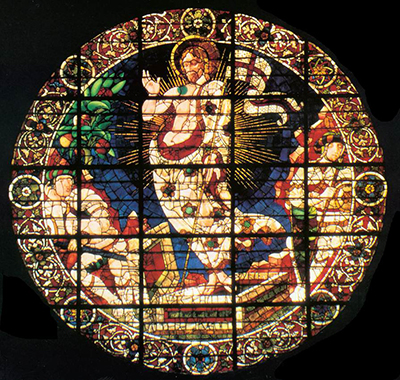
Probably c.1438–40 · GordonResurrection glass
1443–44The Hunt in the Forest
c.1465–70Saint George and the Dragon · London
About 1470Contents
- Two paintings for the high altar
- What the confraternity paid for
- Scene One — At the counter
- Scene Two — The line under the door
- Scene Three — A procession to the altar
- Scene Four — An angel at the tree
- Scene Five — A public burning
- Scene Six — Around the bier
- From the Billettes to Urbino
- Who lent money in Urbino
Two paintings for the high altar
A predella is the low section of an altarpiece. Its proportions give a painter room to tell a story in a row of closely spaced scenes. The Corpus Domini confraternity commissioned this strip for the high altar of Santa Maria di Pian di Mercato in Urbino. The large painting for the same altar was Justus of Ghent’s Communion of the Apostles. The museum dates it to 1473–74 and places completion in 1474. The Italian state catalogue allows a wider span. The connection between the two works is documented, although how they fitted together within the original structure remains uncertain. Their proximity in the gallery brings their subjects into view together. [1] [4] [6] [5]
In Justus’s painting, Christ gives Communion to the apostles. Catholic teaching holds that the consecrated bread is the body of Christ while retaining the appearance of bread. Uccello’s fiction imagines that presence becoming visible in a flow of blood. The two works thus approach the Eucharist from different directions. Justus puts its institution at the centre of a large sacred scene. The procession in Uccello’s third episode returns the wafer to the public rituals of the Church after the legend has placed it in a household. The different scales and styles of the two works make their shared subject particularly important to understanding the commission. [1] [4] [7] [8]
The confraternity’s first arrangement with Bartolomeo di Giovanni Corradini, the painter known as Fra Carnevale, fell through in 1456. Uccello took on the predella late in his career. After he had painted it, Piero della Francesca came to Urbino in 1469 to inspect a board already prepared for the large altarpiece. The visit puts an actual piece of wood at the centre of a commission often described through a succession of famous names. The board was ready to be looked at, but Piero never painted the picture. The evidence leaves open why neither he nor Uccello carried out the upper work. [1] [6] [5]
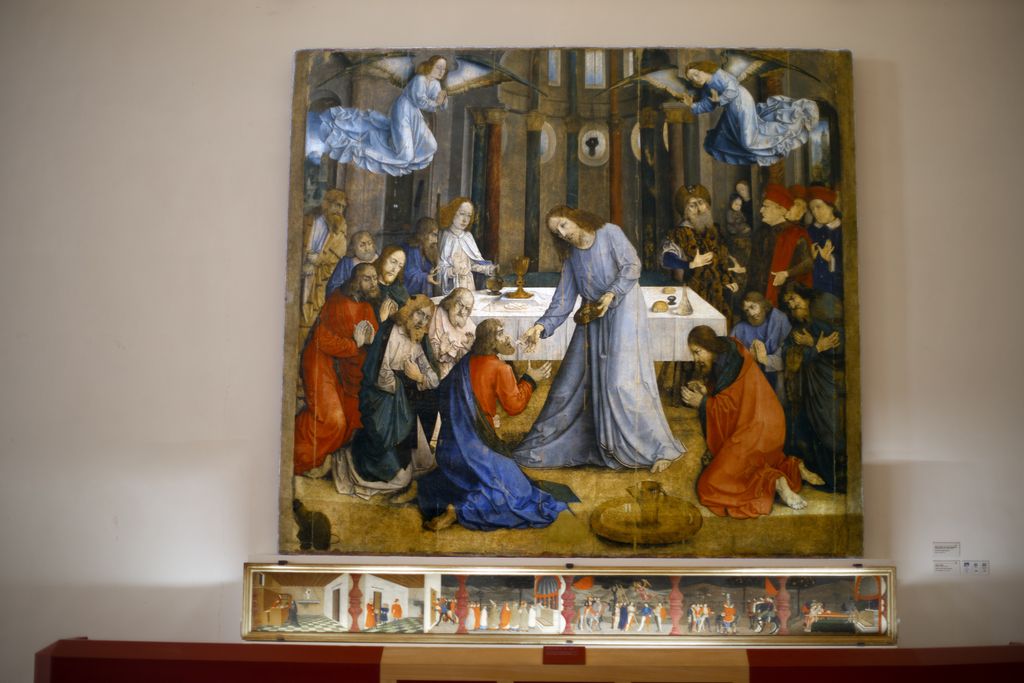
The Communion of the Apostles by Justus of Ghent with Uccello’s predella displayed below it in Urbino. Photograph by Fabrizio Garrisi. Image source. CC BY-SA 4.0. Resized for the web. This derivative is available under the same licence.
What the confraternity paid for
The confraternity’s income and expense book B 1 records the work needed around the painting. Its entries concern travel and transport, materials, woodworking, gilding, labour and cash. Ciambotti, Palazzi and Sgrò trace entries on nonconsecutive folios between 10 August 1467 and 2 December 1468. The gallery’s online exhibition records direct payments between August 1467 and October 1468. Lorenzo Sbaraglio’s Treccani biography identifies a wider sequence of payments concerning Paolo and his son Donato, from February 1467 to October 1469. Each span describes a different body of evidence. The presence of expenses in December, for example, leaves the date of the last brushstroke open. [6] [9] [10]
The entries dated 12 February to 2 December 1468 include the journey from Florence, clothing for Paolo and Donato, and paper to cover a window. Ciambotti, Palazzi and Sgrò give a subtotal of 40 florins and 17 bolognini for this group of cash payments and expenses credited to Battista di Maestro Agostino. [9]
Donato appears in the records, and the gallery’s online exhibition describes him as working with his father. His share in the finished object cannot be allocated scene by scene. The accounts make it possible to recognise more people and kinds of work than the name on the gallery label suggests. Some of the recorded activity belongs to preparing, moving and paying for the object, work that the finished scenes give the viewer little reason to imagine. [6] [9] [10]
Scene One — At the counter
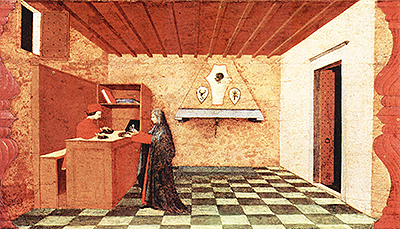
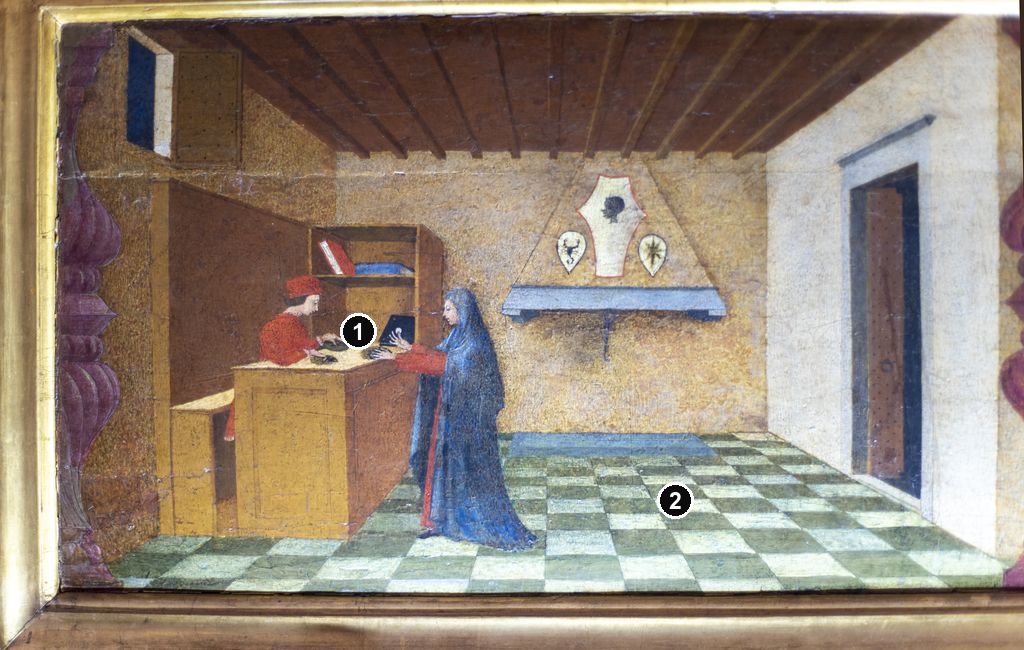
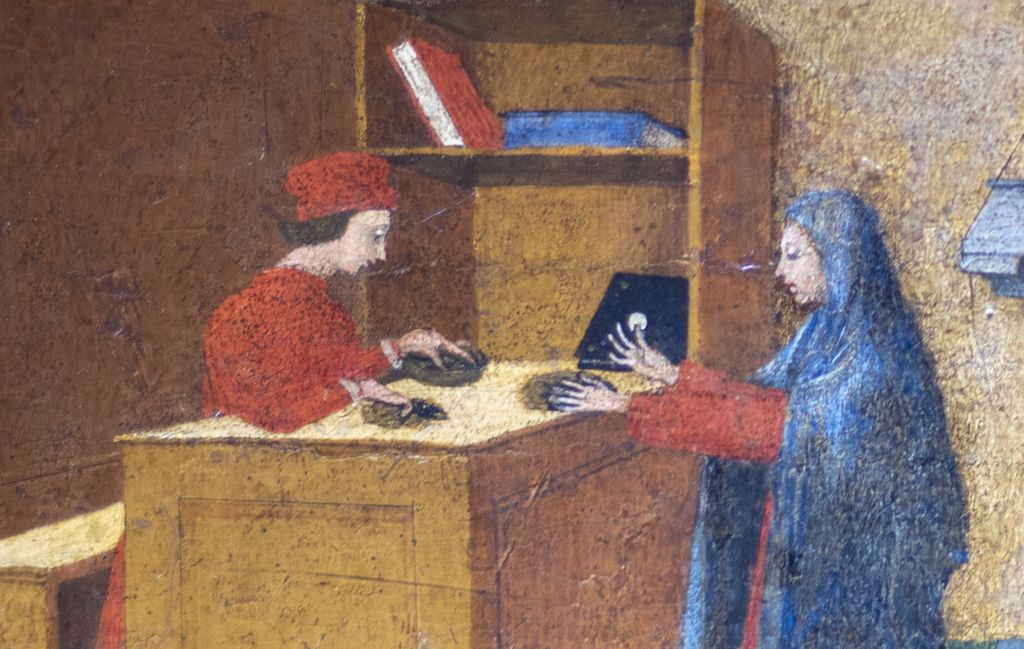
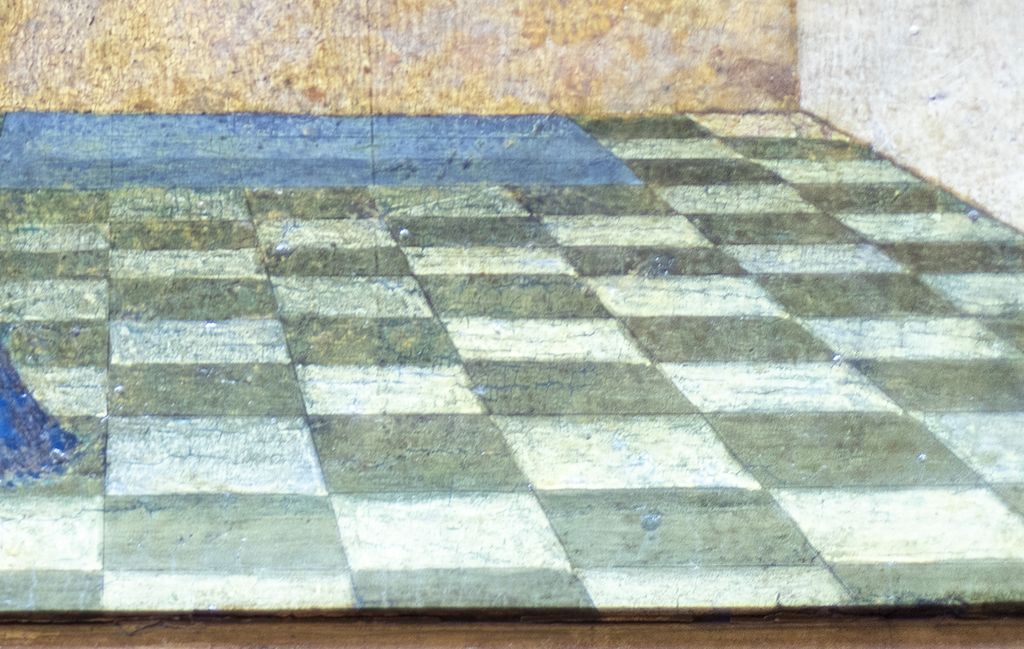
Start close to the centre of the first room, where two hands reach towards each other over a counter. The hands occupy much less space than the exchange seems to demand. The beams overhead and the squares on the floor direct the eye towards the back of the room, while the figures stand near the front. The scale of that interior makes the transaction look like one small event in the daily life of a recognisable place. A painted column ends the episode, but the opening at the back offers a way into the next one. [1] [5]
The story supplies the meaning of the gesture. A Christian woman hands a consecrated wafer to a Jewish lender. In some versions she is trying to recover a garment pledged against a loan. The garment is a detail of the texts rather than something a viewer has to identify in the painted exchange. Behind the lender, Capriotti and Ferrara draw attention to the shield with a scorpion on yellow, a hostile sign used against Jews in some Christian images of the period. The shop lends everyday credibility to the invented transaction. The emblem shows that Uccello’s room also carries a visual prejudice about the person behind the counter. [1] [7] [3]
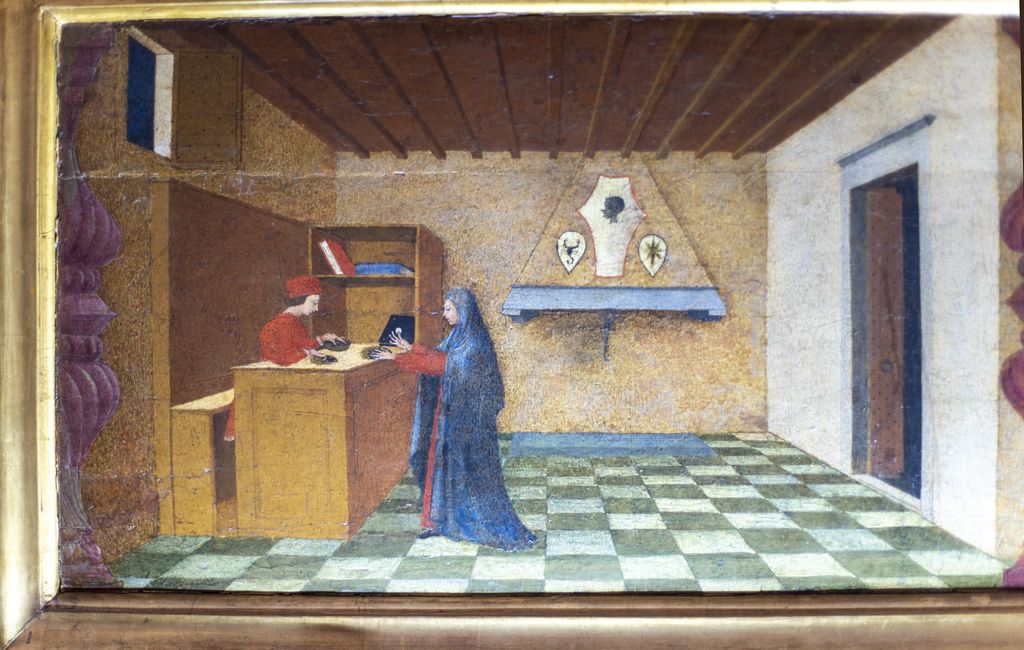
A woman exchanges the host at a shop counter in the false accusation pictured by the predella. Photograph by Fabrizio Garrisi. Image source. CC BY-SA 4.0. Resized for the web. This derivative is available under the same licence.
Scene Two — The line under the door
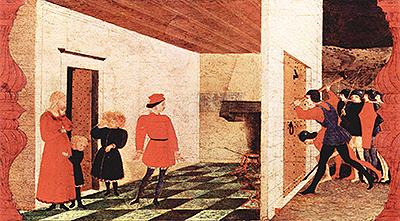
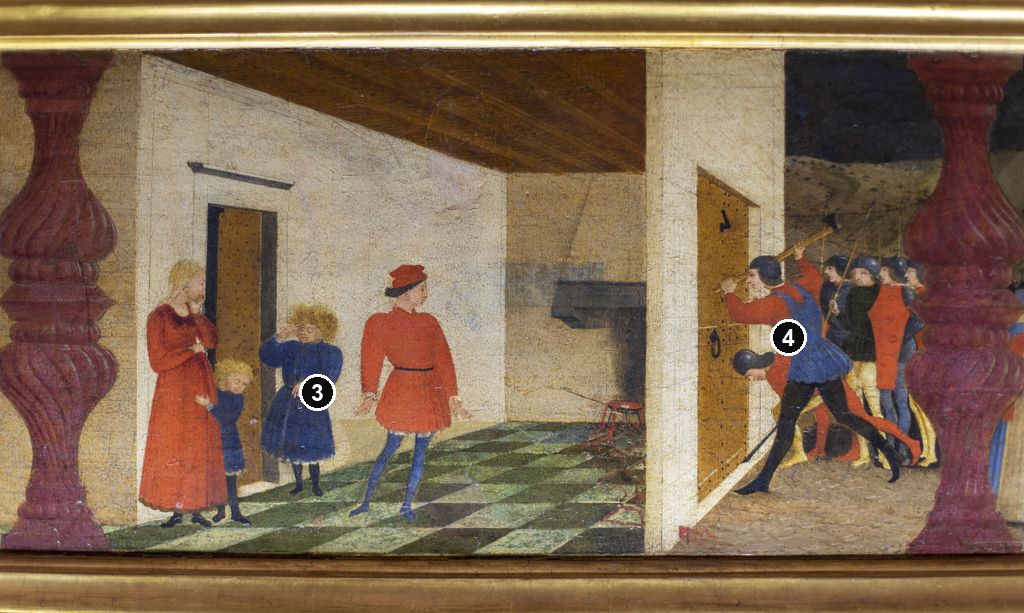
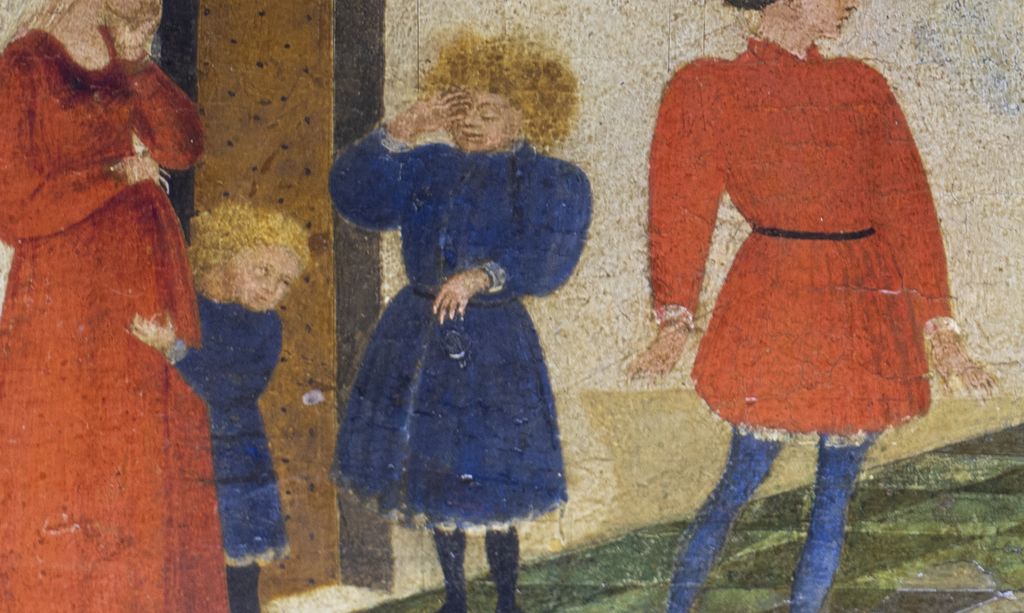
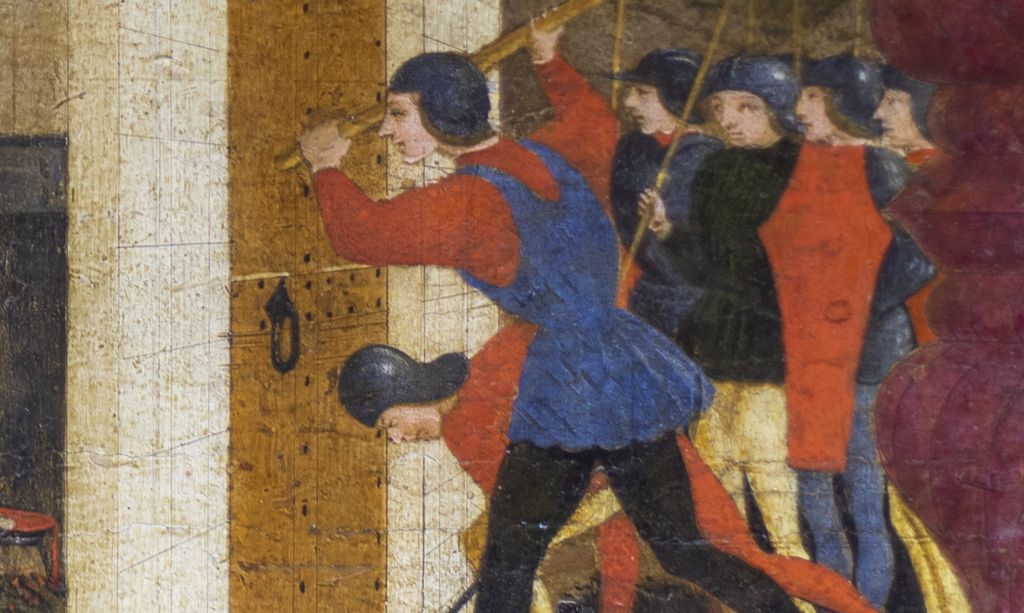
The second room can be seen as if its front wall had been lifted away. A person in red stands near the hearth. Other members of the household are grouped beside it. Armed figures gather at the door, which is set at an angle. Underfoot, the floor lines show how Uccello shifts the perspective between scenes, even as he makes the two rooms look adjacent. According to the legend, the host bleeds when it is put in a pan. Uccello gives the red mark a route through the house and out under the door. [1] [2] [5]
Follow that line from the hearth towards the guards. They are still outside, but the painting lets you look down on the floor where the blood has passed and see the family at the same time. This is privileged access invented by the painter. Heike Schlie reads the painted blood in relation to the problem of making sacramental presence visible. In this image, a physical trace that links two patches of space also makes characters inside the fiction act as though a charge has been proved. [8]
The sense that each part of the room is fixed in place is itself the result of revisions. In Umberto Baldini’s account of the 1954 treatment, technical photographs show an earlier fireplace slightly higher and farther left, alongside changes to the alignment of the wall. Those details belong to the evidence of how the work was made. A gallery visitor or a reader looking at a standard reproduction sees the room in its final design, with the doorway placed to bring the forces inside and outside into one view. [11]
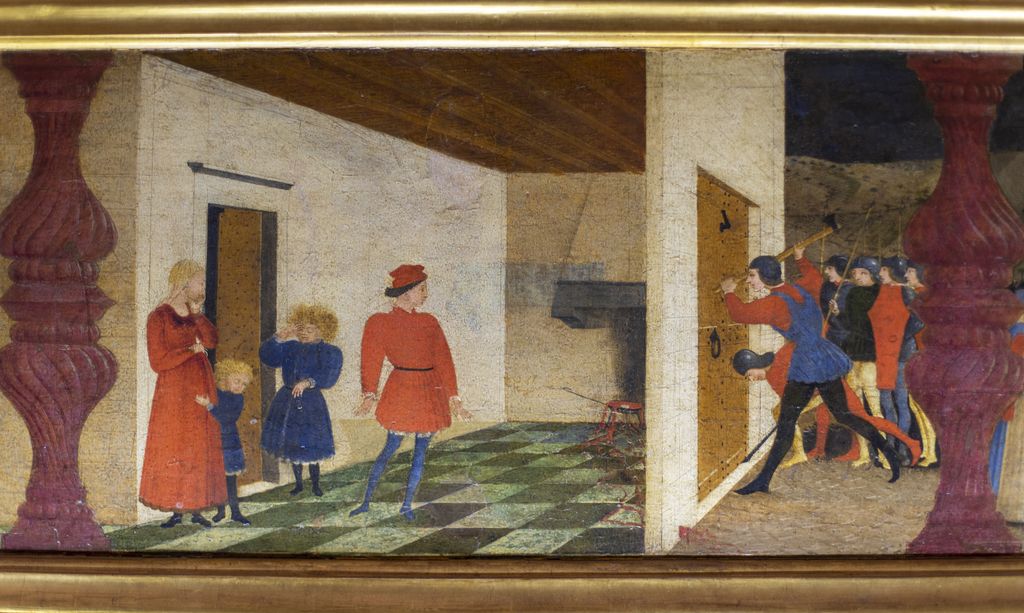
The interior and the figures at the door divide the predella’s second scene. Photograph by Fabrizio Garrisi. Image source. CC BY-SA 4.0. Resized for the web. This derivative is available under the same licence.
Scene Three — A procession to the altar
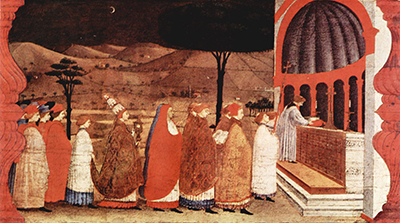
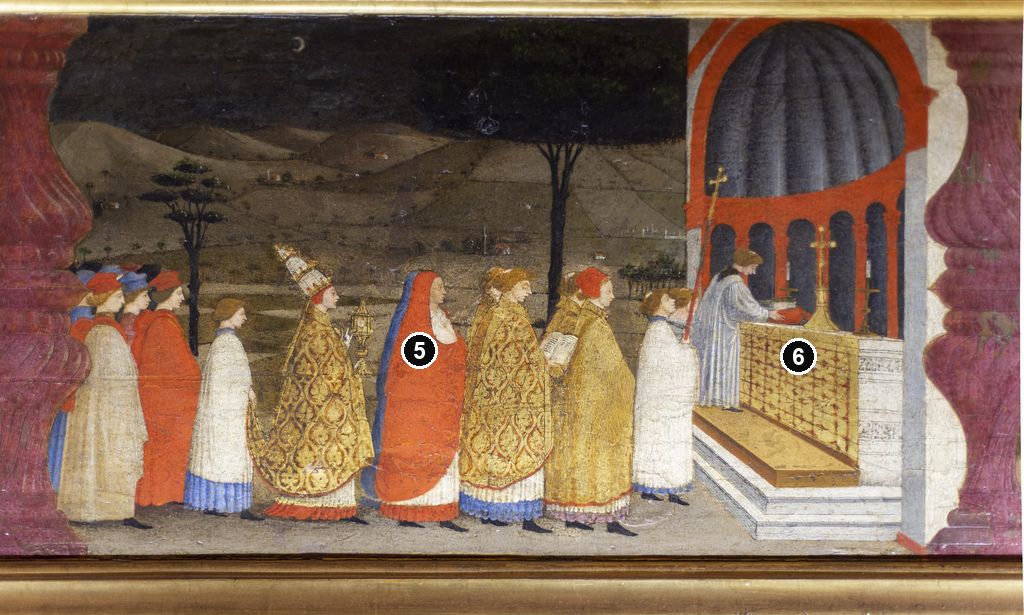
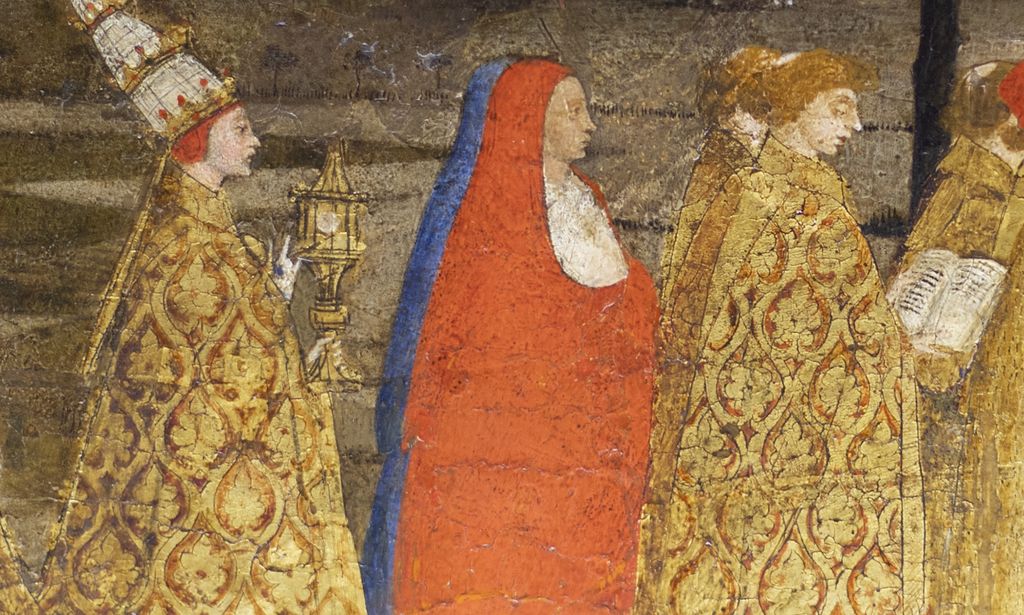
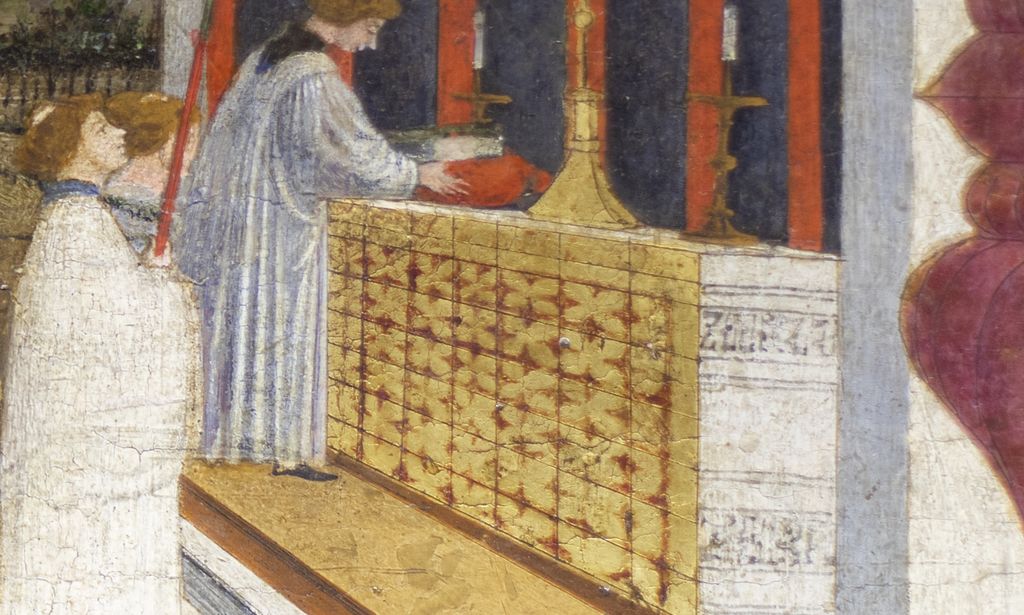
A curved red arcade marks out a ceremonial space. Alternating dress colours pick out the figures in the procession. Their arrangement and the steps carry attention towards the altar, where white cloth and gold distinguish the preparations for the rite. The relatively small vessel that carries the host gains prominence from the direction of the people around it. Here the architecture gives the procession an enclosure within the outdoor setting. Look beyond it and the hills continue towards the episodes on the right. Mosso notes that the people are more consistent in size once the story moves out of the two domestic interiors. You can follow the figures much as you would a frieze, with most of the action unfolding across the front of the picture. That continuity makes the shift from a ceremonial procession to the threatened hanging especially abrupt. [1] [5]
The Galleria Nazionale delle Marche describes the action as a reconsecration. The bearer’s three-tiered tiara marks the figure as a pope. The gallery’s catalogue links the figure to Boniface VIII on the strength of the legend’s later recognition, dated there to 1295. That is an identification by office and association. A painted tiara gives no evidence for a portrait likeness or for a pope’s presence at the alleged event in 1290. The movement from the household to the altar serves the story’s account of who has the right to handle the wafer and how it should be seen. [1] [7]
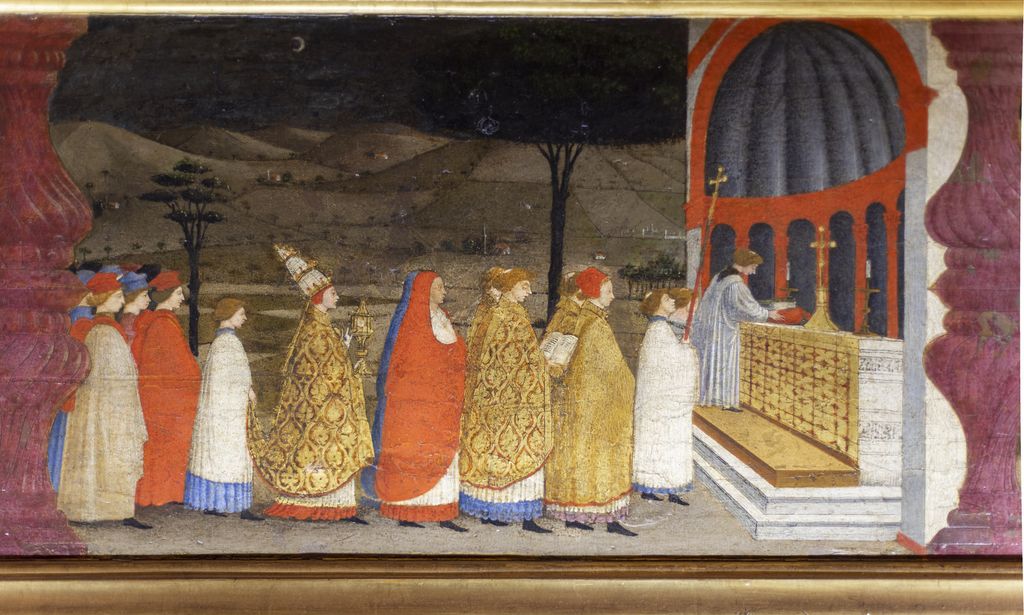
The procession approaches the steps and altar in the third scene. Photograph by Fabrizio Garrisi. Image source. CC BY-SA 4.0. Resized for the web. This derivative is available under the same licence.
Scene Four — An angel at the tree
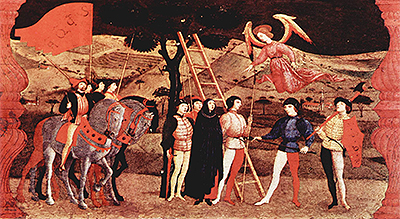
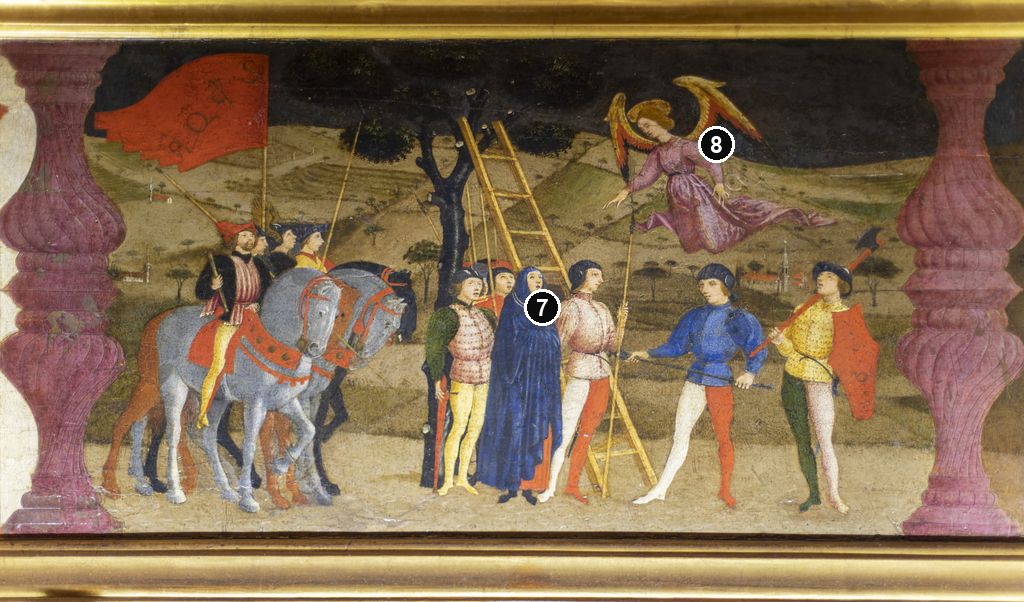
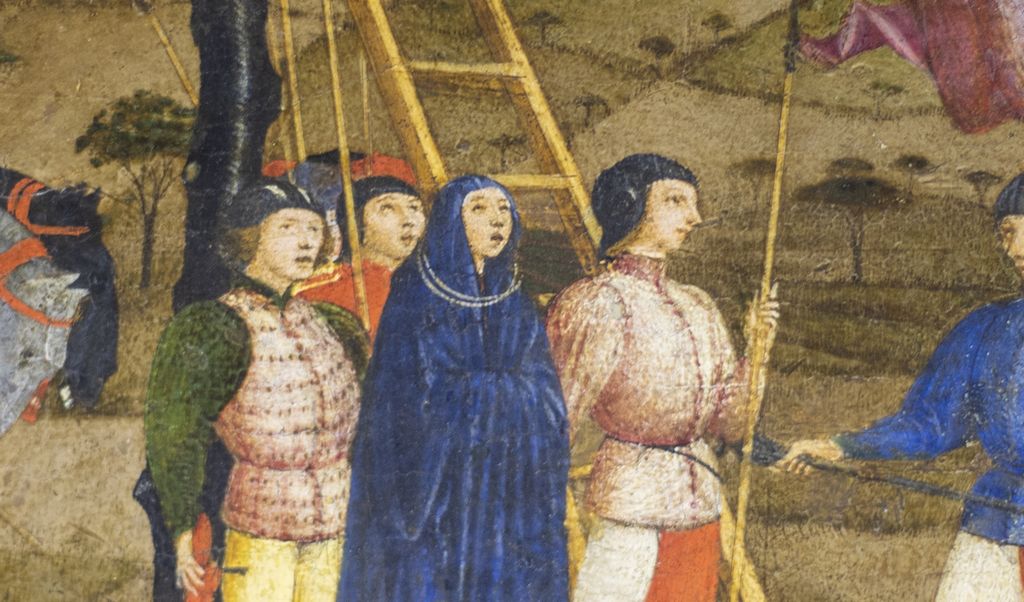
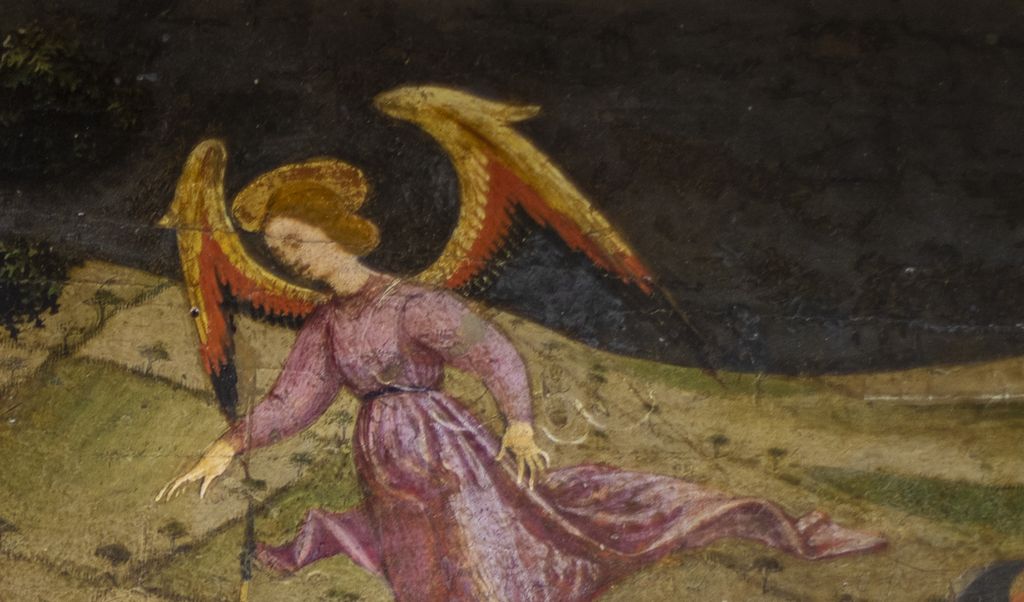
The Christian woman, in blue, is below a ladder raised against a tree. The ladder leads the eye up. An angel descends across it. That meeting of directions lets the viewer read an interruption before attending to the figures on the ground. The scene shows the woman facing a threatened hanging and intervention coming from above. It is generally read as a rescue or an act of mercy. [1] [12]
Atsushi Sakamoto sets Uccello’s tree beside an Italian stage version that calls for a gallows. He also compares the episode with paintings of saints rescuing people from hanging and images of Judas hanging from a living tree. The tree has a practical role in Uccello’s picture, supporting the ladder, and it could also prompt an audience to think about betrayal. The choices in the painting can be understood in light of those traditions without identifying a single image or script as the source. [12]
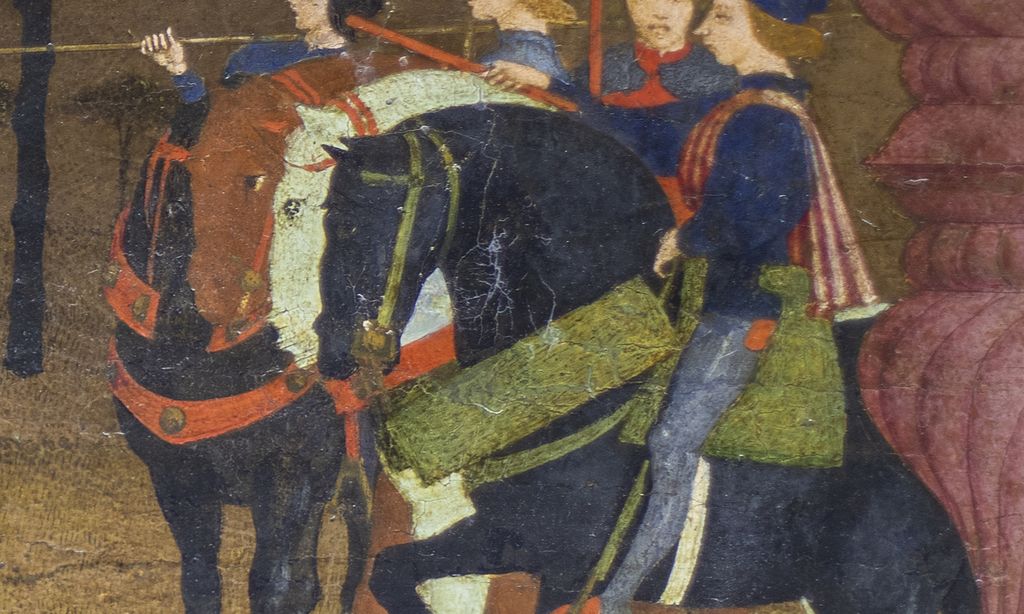
Turn briefly to the side of the scene with the mounted men. Their horses crowd together and the legs are hard to trace from one animal to the next. Valerio Mosso’s Perugia catalogue entry identifies the related group of four riders and horses at the far side of the following scene. Variations in colour help distinguish the overlapping horses, and the change in placement takes a formation seen on entering one episode and places it where the eye leaves the next. [5]
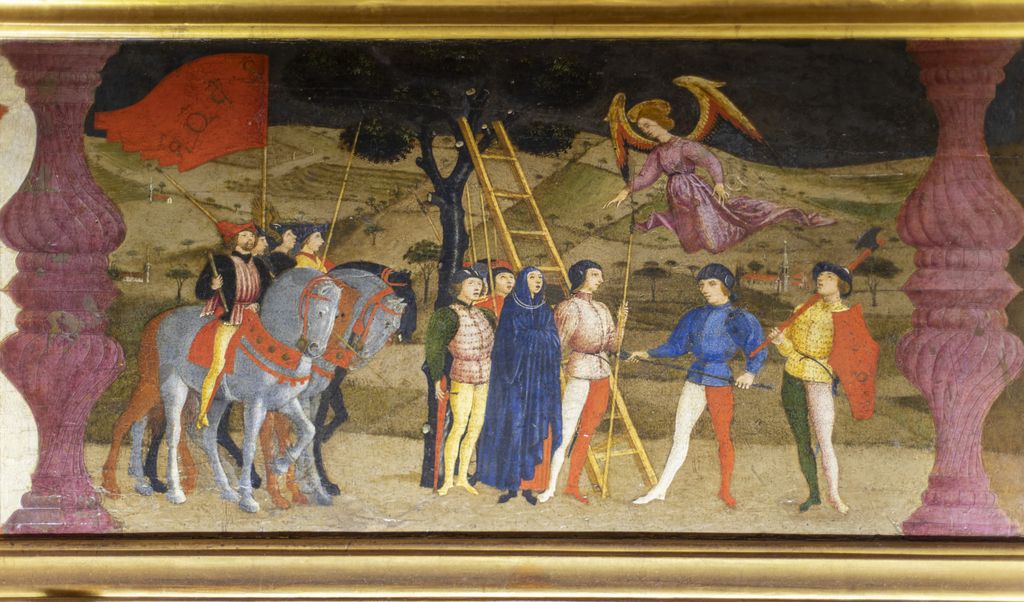
The fourth scene gathers figures around the condemned woman and the ladders. Photograph by Fabrizio Garrisi. Image source. CC BY-SA 4.0. Resized for the web. This derivative is available under the same licence.
Scene Five — A public burning
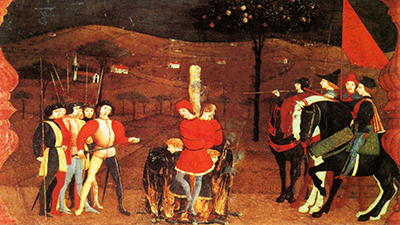
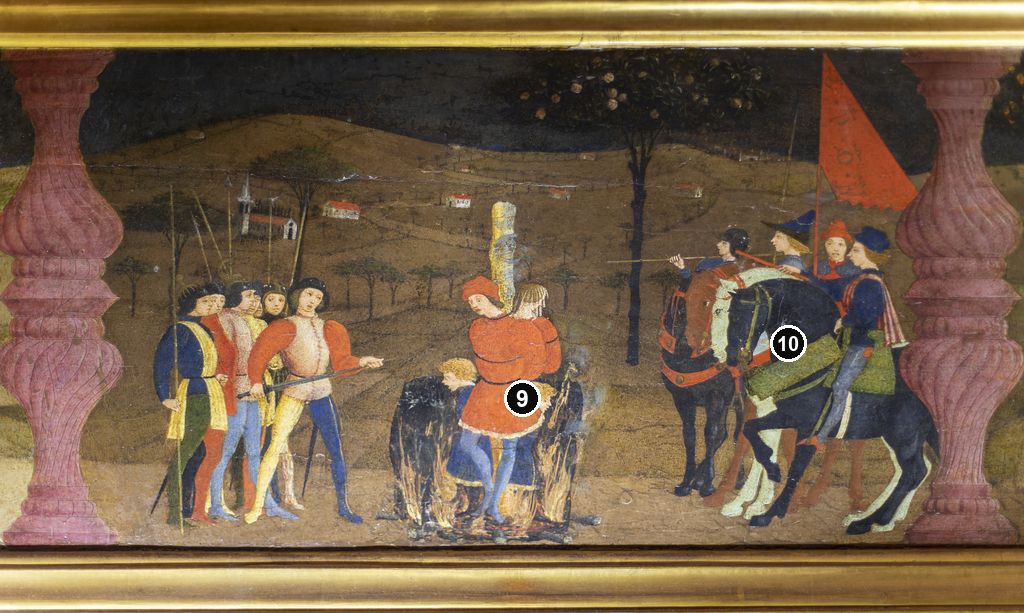
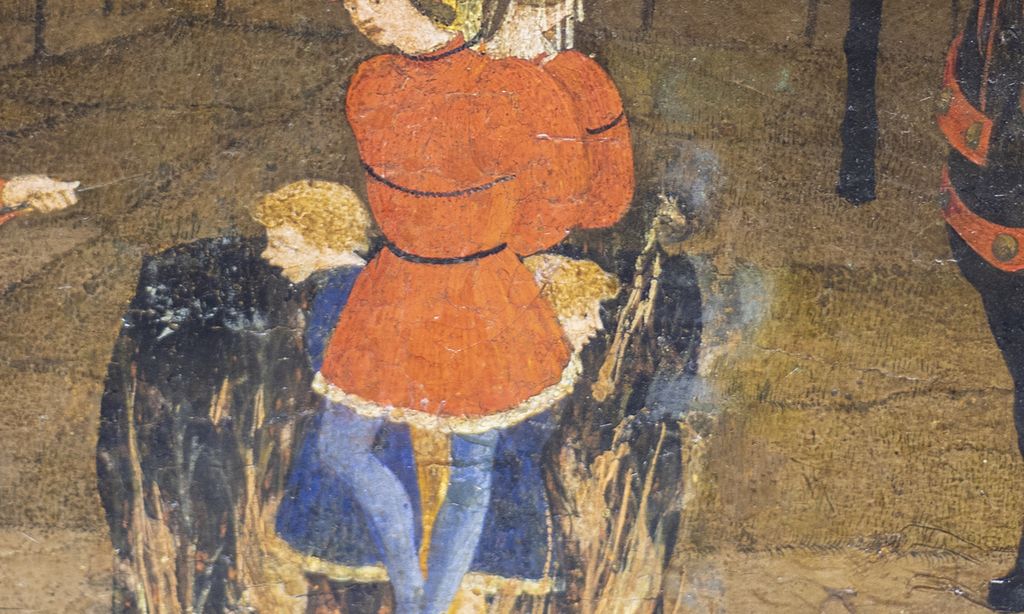
The fire and stake stand in the middle of the scene. The onlookers are distributed on either side, with a crush of spear shafts and mounted figures to the right. Within the false legend, the Jewish family is condemned to burn, including the children. The spacing turns the punishment into a public spectacle. The surrounding figures have room to witness the killing, while the people at the stake are pressed close together at the centre. [1] [5]
The neighbouring scene has already shown the angel arriving for the Christian woman. Here the picture offers the family no intercession. The parallel groups of horsemen and the continuity of the background bring the unequal treatment into a single view. It is specifically the painting’s version of the libel that condemns the whole family to the flames. Capriotti and Ferrara point out that related texts give the family different fates, including versions in which they convert and survive. That is a difference between versions of a fiction. The crowd, the stake and the guards give no historical evidence about a trial of this family in Paris. [7] [12] [5] [3]
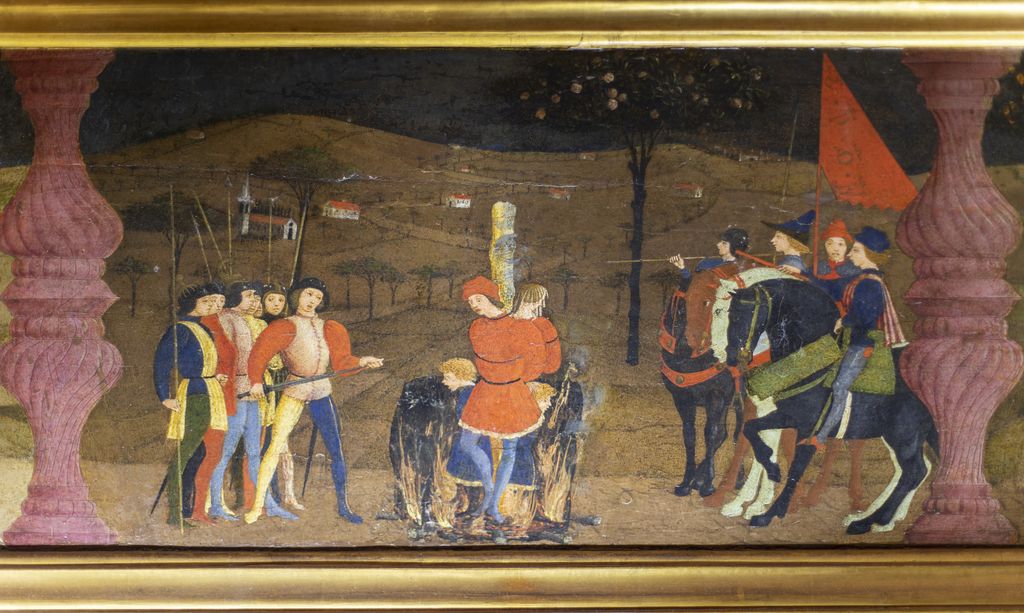
The fifth scene depicts the persecution of the Jewish family in the false story. Photograph by Fabrizio Garrisi. Image source. CC BY-SA 4.0. Resized for the web. This derivative is available under the same licence.
Scene Six — Around the bier
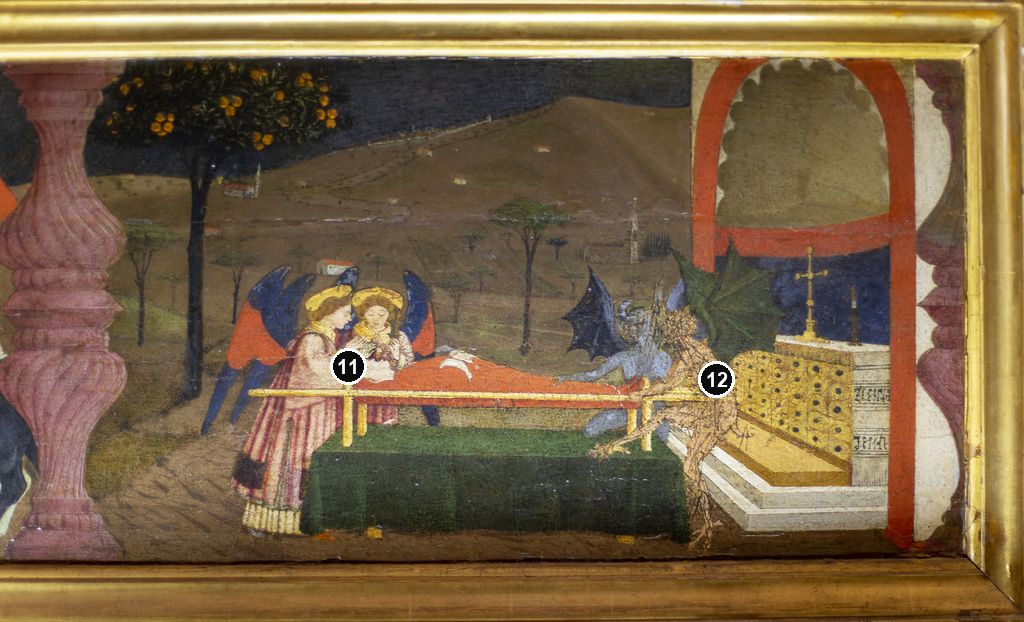
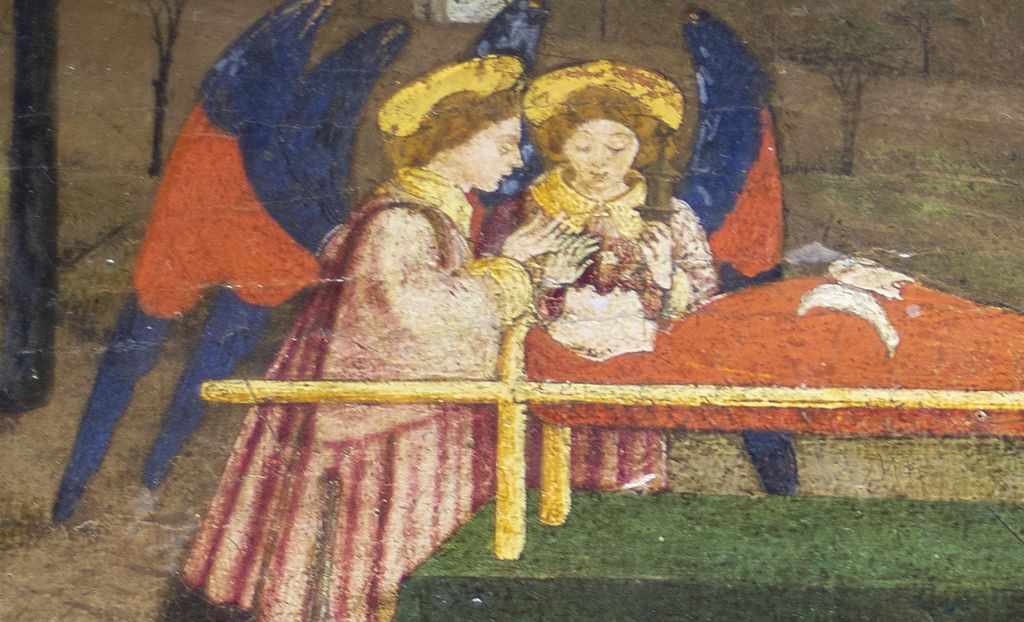
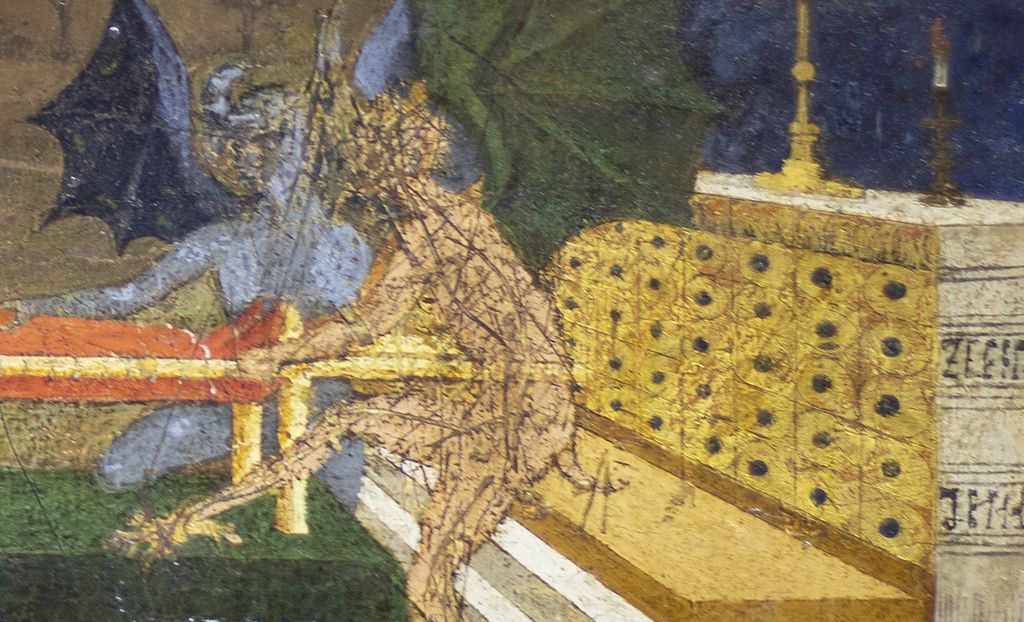
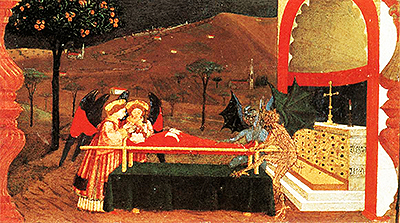
At the end of the strip the long horizontal of the woman’s bier steadies the scene. Figures bend and reach around it. Angels are near her head. Demons press in near her feet and the small altar. Mosso reads the angels as giving her the Eucharist, which would extend the subject of Communion into the final moments of her life. Whether read as an offering of the sacrament or as a contest for her soul, the gestures show that her fate is still being fought over. [1] [7] [5]
Scratches mark the painted demons. The gallery’s online exhibition interprets the damage as a devotional attempt to efface them. That interpretation identifies a possible action taken by earlier viewers, distinct from the actions Uccello painted. Looking back along the strip from here, the terrain links the threat at the tree, the public burning and this final encounter. The image gives their order without specifying how much time passes. It makes time for the Christian woman’s fate to be argued over at her bedside after the Jewish children and adults have disappeared from the story. [1] [6] [5]
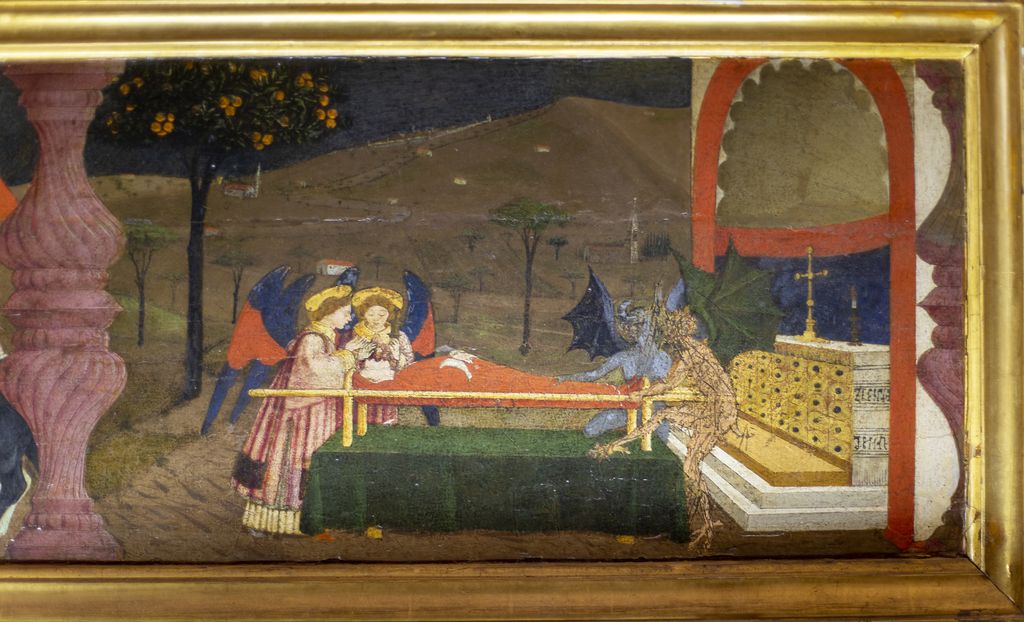
Angels and demons gather at the woman’s bier in the sixth scene. Photograph by Fabrizio Garrisi. Image source. CC BY-SA 4.0. Resized for the web. This derivative is available under the same licence.
Annotated Details from The Miracle of the Desecrated Host
The numbered points identify visible features discussed in this article. Return from each detail to the numbered overview. Each caption identifies the work shown.
The Exchange at the Counter
A woman exchanges the host at a shop counter in the false accusation pictured by the predella. Photograph by Fabrizio Garrisi. Image source. CC BY-SA 4.0. Numbered overview and cropped details from the original photograph. This overview and these details are available under CC BY-SA 4.0.
The Interior and the Door
The interior and the figures at the door divide the predella’s second scene. Photograph by Fabrizio Garrisi. Image source. CC BY-SA 4.0. Numbered overview and cropped details from the original photograph. This overview and these details are available under CC BY-SA 4.0.
The Procession
The procession approaches the steps and altar in the third scene. Photograph by Fabrizio Garrisi. Image source. CC BY-SA 4.0. Numbered overview and cropped details from the original photograph. This overview and these details are available under CC BY-SA 4.0.
The Condemned Woman
The fourth scene gathers figures around the condemned woman and the ladders. Photograph by Fabrizio Garrisi. Image source. CC BY-SA 4.0. Numbered overview and cropped details from the original photograph. This overview and these details are available under CC BY-SA 4.0.
The Persecution of the Family
The fifth scene depicts the persecution of the Jewish family in the false story. Photograph by Fabrizio Garrisi. Image source. CC BY-SA 4.0. Numbered overview and cropped details from the original photograph. This overview and these details are available under CC BY-SA 4.0.
The Bier
Angels and demons gather at the woman’s bier in the sixth scene. Photograph by Fabrizio Garrisi. Image source. CC BY-SA 4.0. Numbered overview and cropped details from the original photograph. This overview and these details are available under CC BY-SA 4.0.
Details from THE MIRACLE OF THE DESECRATED HOST
Compare the cropped details with the source images above. Notice how their colours, shapes and positions contribute to the larger compositions.
The Exchange at the Counter
Hands at the counter
The hands of the two figures meet across the counter. The gesture occupies a small position in a carefully drawn room.
The regular floor and ceiling
The square tiles and overhead beams guide the eye into the interior. Their clarity gives an invented scene a plausible everyday setting.
The Interior and the Door
People within the room
The woman and children group on one side of the room while the figure in red stands closer to the painted hearth. Their different viewpoints direct attention across the cutaway setting.
Armed men at the door
The doorway is painted at an angle. The wall lets us see the painted crowd at the threshold and the people inside at the same time.
The Procession
The patterned robes
The fabric of the procession is picked out in gold and white. Repetition along the lower edge gives the figures a slow, shared rhythm.
The altar and curved setting
The straight edge of the altar meets the steps below a curved red arcade. The change in shape marks the procession’s destination.
The Condemned Woman
Attendants at the ladders
The woman in blue stands among the attendants. The ladder and tree lead upwards from their level into the scene’s other register.
The descending angel
The angel’s descending gesture intersects the climbing line of the ladder. The hovering figure breaks the scale and pace of the people on the ground.
The Persecution of the Family
The figures tied to the stake
The central forms and painted flames divide the people to the left from the mounted witnesses at right. This violence belongs to the painted antisemitic legend.
The ranks of witnesses
Overlapping horses and tilted spears hold a dense group on the right. Their scale gives the painted act the character of a public spectacle.
The Bier
The angels at the woman’s head
The angels lean in at the left of the woman’s bier. Small gestures and the repeated gold haloes lead attention back to her face.
Demons and the altar
The demons crowd the other end of the bier, close to the altar. The contrast with the angels is carried by colour, stance and the way the bodies cross the painted furniture.
From the Billettes to Urbino
Giovanni Villani’s chronicle is evidence that the Billettes legend about Paris had reached Italy long before Uccello’s commission. The tale also circulated in French and Italian religious plays. Every form gave it different means of persuasion. A chronicle could give the lie a location and a date. A religious play presented a sequence of revelations, while public commemoration allowed scenes from the story to become familiar through repetition. Uccello’s picture gives the moments separate compartments and holds them together on a single surface. Its processional movement, from a few people at a doorway to larger assemblies, helps explain why scholars have looked to performances. [7] [2] [13] [3]
Pierre Francastel compared the predella closely with the Paris play and with the annual procession commemorating the Billettes story. Miri Rubin proposes another possible route to the workshop, from Villani through a lost earlier form of a surviving Italian play. Lavin’s comparisons, discussed by Capriotti and Ferrara, likewise show how details in the painting fail to line up with any one surviving text. A French version in their account drops the woman after the exchange. In a Tuscan play Thomas Aquinas intercedes for her. In Uccello the rescuer is an angel, and the woman appears again at the end. The comparisons establish a family of versions while leaving the route by which the story reached the commission uncertain. [14] [7] [13] [12] [3]
Rubin distinguishes the fantasy of desecration from the historical fact that it was alleged and people were persecuted. The host-desecration libel assigned to Jews an offence against a consecrated wafer. Ritual-murder libels accused Jews of killing people for supposed religious purposes. Both could be used against Jewish communities. The same charge could provoke violence in one place and fail to do so elsewhere. Familiar pictures and performances gave a false story a form in which it could be recognised and repeated long after its first telling. [2] [3]
Who lent money in Urbino
In 1468, while the predella was being made, Urbino founded a Monte di Pietà with the support of Battista Sforza. The Christian charitable institution offered small loans against items left as security. Capriotti and Ferrara connect its foundation with Franciscan preaching, including the arrival of Domenico da Leonessa, and specific competition with the established lender Venturello di Salomone. Venturello came from a Jewish family whose right to lend was formally granted and renewed. That civic record tells us something about how credit worked. The figure behind Uccello’s counter is a stereotype in a Christian legend. [1] [7]
Marilyn Aronberg Lavin links the choice of subject with the rise of the Monte di Pietà. An institution seeking to redirect borrowers could benefit from the distrust stirred by a story that put a Jewish lender at the centre of an offence against the Eucharist. The timing and the prominence given to credit support taking that connection seriously. The commission’s surviving evidence leaves the motives of the confraternity, the painter and named patrons open. [14] [7]
Dana E. Katz places the picture within Urbino’s policy of regulated toleration. Jewish lending was useful to the court. Authorities could protect Jewish residents or intervene to contain disturbances when anger threatened public order. A city governed in that way could still make room for a public religious image of violence against Jews. Katz’s argument helps explain why government protections, economic rivalry and a picture of persecution can all belong to the same civic history. It also gives the crowd at the stake a sharper significance. What authorities might restrain in the streets was given an audience in the church. [15]
What changed after the church
The gallery’s scientific catalogue traces the works from the old confraternity church to the Scolopi in 1708. The large panel went to the new church of Sant’Agata, while the detached predella disappeared from view. By September 1857 the strip had been found in an attic of the Scolopi college. It was flaking and had suffered damage from nails, lime and water. Mazzotti’s recorded intervention dates to 1861. The scientific catalogue places accession to the gallery’s predecessor in August 1866, with the Justus painting following about a year later. These are distinct stages in the rediscovery, repair and acquisition of an object that had already lost its original setting. [1] [6]
The long wood panel still had losses when Leonetto Tintori treated it in 1954. Baldini’s report describes how earlier restorations had clouded the surface with dense glazes and retouching in oil and tempera. Tintori removed later paint, including some landscape greens and much of the smoke over the stake. That work recovered visible ground around the fire and clarified how the land behind it continues into the last scene. It also recovered drapery on the descending angel. The photographs of changes to the hearth and wall document a different kind of discovery, an earlier phase of the design. An old photograph of the burning can show a more prominent smoke cloud because it records a different stage in the life of the paint. [11] [5]
The gallery’s exhibition record also traces how the predella came before audiences outside Urbino. It travelled to Burlington House in London for an exhibition of Italian art in 1929–30 and to the Petit Palais in Paris in 1935. The 1954 treatment was undertaken for an exhibition in Florence, where the Palazzo Strozzi displayed the predella in a show devoted to four early Renaissance painters. Exhibitions could change the surroundings in which the strip was read. The preparations for the Florence show also changed which details of the painting those visitors could see. [1] [11]
The format of the reproduction can change the encounter as well. Aby Warburg’s Mnemosyne Atlas, panel 28/29, puts the opening two scenes together in a photograph among images of chases, battles and other scenes of movement. The next predella photograph gives the fifth and sixth scenes, and the one after it the third and fourth. The whole work is there in three pairs. Their rearrangement allows a viewer to inspect Uccello’s handling of gesture across different works. It also disrupts the original progression from the private exchange to the public burning. [16]
The Perugia exhibition Fratello Sole, Sorella Luna in 2025 asked viewers to consider the work in the context of nature in art. Its catalogue locates the original church in the central square of Urbino and follows the painted hills from their first glimpse outside the house towards the final scene. In the original strip, the landscape and the recurrence of riders make it easy to look back from the stake to the angel at the tree. Both come into view as part of one sequence. Seeing how the picture holds the episodes together is also a way to see whose suffering the legend expects the viewer to accept. [1] [5]
Artworks directory
Browse paintings, drawings, stained-glass designs and other objects connected with Uccello. Cycles and their surviving components may have separate entries. The collection or catalogue’s wording is retained where a date, attribution or subject is debated.
| Name | Date | Medium, attribution and collection |
|---|---|---|
| Niccolò da Tolentino at the Battle of San Romano · London | Probably c.1438–40 | Tempera and oil on wood, with metallic decoration · National Gallery Catalogue. |
| Bernardino della Carda Unhorsed · Florence | c.1435–40 | Tempera on panel · Uffizi Galleries Catalogue. |
| The Counterattack of Micheletto da Cotignola · Paris | 1450–75 in the Louvre catalogue | Tempera (possibly) on wood · Musée du Louvre Catalogue. |
| The Hunt in the Forest | c.1465–70 | Tempera and oil with traces of gold on panel · Ashmolean Catalogue. |
| Saint George and the Dragon · London | c.1470 | Oil on canvas · National Gallery Catalogue. |
| Saint George Slaying the Dragon · Melbourne | c.1430 | Oil, tempera and silver leaf on wood · National Gallery of Victoria Catalogue. |
| Saint George and the Dragon · Paris | 1430–35 in the museum catalogue | Painted wood panel · Musée Jacquemart-André Catalogue. |
| Equestrian Monument to John Hawkwood | 1436 | Transferred wall painting · Florence Cathedral Catalogue. |
| Study for the John Hawkwood Monument | 1436 | Study on prepared paper · Uffizi Catalogue. |
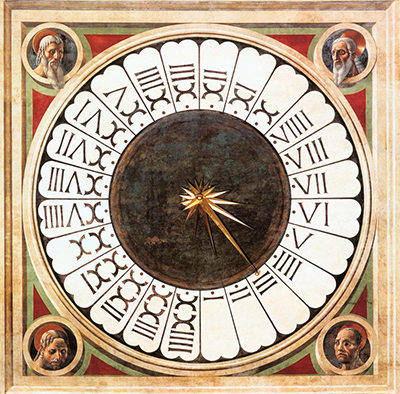
| Monumental Clock Face | 1443 | Painted dial · Florence Cathedral Catalogue. |
| Resurrection of Christ | 1443–44 | Stained glass · Uccello design · Florence Cathedral Catalogue. |
| Nativity | 1440s | Stained glass · Uccello design · Florence Cathedral Catalogue. |
| Creation of the Animals and Creation of Adam | Third to fourth decade of the 15th century | Detached fresco · Green Cloister, Santa Maria Novella Catalogue. |
| Creation of Eve and the Fall | Third to fourth decade of the 15th century | Detached fresco · Green Cloister, Santa Maria Novella Catalogue. |
| Flood and Recession of the Waters | 15th century; dating debated | Detached fresco · Green Cloister, Santa Maria Novella Catalogue. |
| Sacrifice and Drunkenness of Noah | 15th century; dating debated | Detached fresco · Green Cloister, Santa Maria Novella Catalogue. |
| Stories of the Virgin and Saint Stephen · Assunta Chapel | 1430s, with later completion | Fresco cycle · Paolo Uccello and Andrea di Giusto · Prato Cathedral Catalogue. |
| Blessed Jacopone da Todi | 1436 in the diocesan museum | Detached fresco · Museo dell’Opera del Duomo, Prato Catalogue. |
| Adoration of the Child · Bologna | 1430s; inscription incomplete | Detached fresco · San Martino Maggiore, Bologna Catalogue. |
| Adoration of the Christ Child · Karlsruhe | c.1436 | Painted panel · Attribution to Uccello · Staatliche Kunsthalle Karlsruhe Catalogue. |
| Annunciation · Oxford | Early 15th century | Tempera and gilding on panel · Ashmolean Catalogue. |
| Allegory of Monastic Life (Thebaid) | c.1460–65 | Tempera on canvas · Galleria dell’Accademia, Florence Catalogue. |
| Miracle of the Profaned Host | 1467–68 | Tempera on wood · Galleria Nazionale delle Marche, Urbino Catalogue. |
| Triumphal Entry into Rome of Titus and Vespasian(?) | c.1430–35 | Tempera, gold and silver on panel · Yale University Art Gallery Catalogue. |
| Crucifixion with the Virgin and Saints | c.1460–65 | Painted panel · Museo Nacional Thyssen-Bornemisza Catalogue. |
| The Crucifixion · Met triptych | Probably mid-1450s | Tempera on wood with gold ground · Metropolitan Museum of Art Catalogue. |
| Perspective Study of a Chalice | 1450–75 | Pen, ink and stylus on paper · Attributed to Uccello · Uffizi Catalogue. |
| Study of a Mazzocchio | 15th century | Perspective study · Attributed to Uccello · Uffizi Catalogue. |
| Mazzocchio Seen in Perspective | Uncertain | Drawing · Attribution debated · Musée du Louvre Catalogue. |
| Head of a Man in Profile | 15th century | Pen, ink and wash · Musée du Louvre Catalogue. |
| Five Masters of the Florentine Renaissance | 1500–50 | Oil on wood · Anonymous Florentine school · Musée du Louvre Catalogue. |
| Madonna and Child from the Del Beccuto House | 15th century | Detached fresco · Museo di San Marco, Florence Catalogue. |
| Man of Sorrows with the Virgin and Saint John · Avane Predella | 15th century | Predella · Museo di San Marco, Florence Catalogue. |
| Calling of Saint Paul the Hermit · San Miniato | After 1447 to c.1454 in state catalogue | Sinopia · Attributed to Uccello or collaborator Catalogue. |
| The host changes hands · Urbino predella, scene 1 | 1467–68 | Tempera on wood · Component of DE 231 · Galleria Nazionale delle Marche Catalogue. |
| The figures at the door · Urbino predella, scene 2 | 1467–68 | Tempera on wood · Component of DE 231 · Galleria Nazionale delle Marche Catalogue. |
| The procession approaches the altar · Urbino predella, scene 3 | 1467–68 | Tempera on wood · Component of DE 231 · Galleria Nazionale delle Marche Catalogue. |
| The condemned woman and the ladders · Urbino predella, scene 4 | 1467–68 | Tempera on wood · Component of DE 231 · Galleria Nazionale delle Marche Catalogue. |
| Persecution of the family · Urbino predella, scene 5 | 1467–68 | Tempera on wood · Component of DE 231 · Galleria Nazionale delle Marche Catalogue. |
| Angels and demons at the bier · Urbino predella, scene 6 | 1467–68 | Tempera on wood · Component of DE 231 · Galleria Nazionale delle Marche Catalogue. |
| Birth of the Virgin · Prato Cathedral | 1430s; dating debated | Fresco · Assunta Chapel, Prato Cathedral Catalogue. |
| Presentation of the Virgin · Prato Cathedral | 1430s; dating debated | Fresco · Assunta Chapel, Prato Cathedral Catalogue. |
Discussion
Look again at the images and ideas explored in The Miracle of the Desecrated Host. These editorial prompts invite your observations.
Reader Insights
If a gallery showed the rescue and the burning as separate images on opposite walls, what would it lose by breaking the visual connection between them?
What changes when you compare the space Uccello gives the Christian woman’s deathbed with the space he gives the condemned family?
Join the Conversation
Share a detail, comparison or question about The Miracle of the Desecrated Host below.
References
- Galleria Nazionale delle Marche, scientific catalogue, Miracolo dell’ostia profanata, inv. DE 231. View source.
- Center for Online Judaic Studies, ‘Host Desecration, Paris 1290’. View source.
- Miri Rubin, ‘Desecration of the Host: The Birth of an Accusation’, Studies in Church History 29 (1992), especially p. 369, and Gentile Tales. · View book View source 1. View source 2.
- Italian Ministry of Culture, state catalogue records for Uccello’s predella and Justus of Ghent’s Communion of the Apostles. · View upper panel View source 1. View source 2.
- Valerio Mosso, entry 03.4 in Fratello Sole, Sorella Luna, Perugia exhibition catalogue (2025), pp. 229–31. View source.
- Galleria Nazionale delle Marche, Miracle of the Profaned Host, object guide and online exhibition chronology. · View exhibition record View source 1. View source 2.
- Giuseppe Capriotti and Concetta Ferrara, ‘Immagini e antigiudaismo’ (2014), especially pp. 82–86. View source.
- Heike Schlie, ‘Blut und Farbe’, in Sakramentale Repräsentation (2012), pp. 51–80. View source.
- Ciambotti, Palazzi and Sgrò, SISR conference proceedings (2018), section 5.3, on the Urbino confraternity’s accounts. View source.
- Lorenzo Sbaraglio, ‘Paolo di Dono, detto Paolo Uccello’, Dizionario Biografico degli Italiani, Treccani. View source.
- Umberto Baldini, ‘Restauri di dipinti fiorentini in occasione della mostra di quattro maestri del Rinascimento’, Bollettino d’Arte (1954), pp. 234–39 and figs. 25–31. View source.
- Atsushi Sakamoto, study of the fourth episode of Uccello’s predella, Kobe University, pp. 143–57. View source.
- Pierre Francastel, ‘Une source d’inspiration d’un tableau de Paolo Uccello’, Bulletin de la Société nationale des Antiquaires de France (1954), pp. 153–54. View source.
- Marilyn Aronberg Lavin, ‘The Altar of Corpus Domini in Urbino’, The Art Bulletin 49 (1967). View source.
- Dana E. Katz, ‘The Contours of Tolerance’, The Art Bulletin 85 (2003), pp. 646–61, and The Jew in the Art of the Italian Renaissance (2008), ch. 1. · View book View source 1. View source 2.
- Aby Warburg, Mnemosyne Atlas, panel 28/29, items 12–14, Engramma catalogue. View source.
More PAOLO UCCELLO Artworks
Noah and the Flood
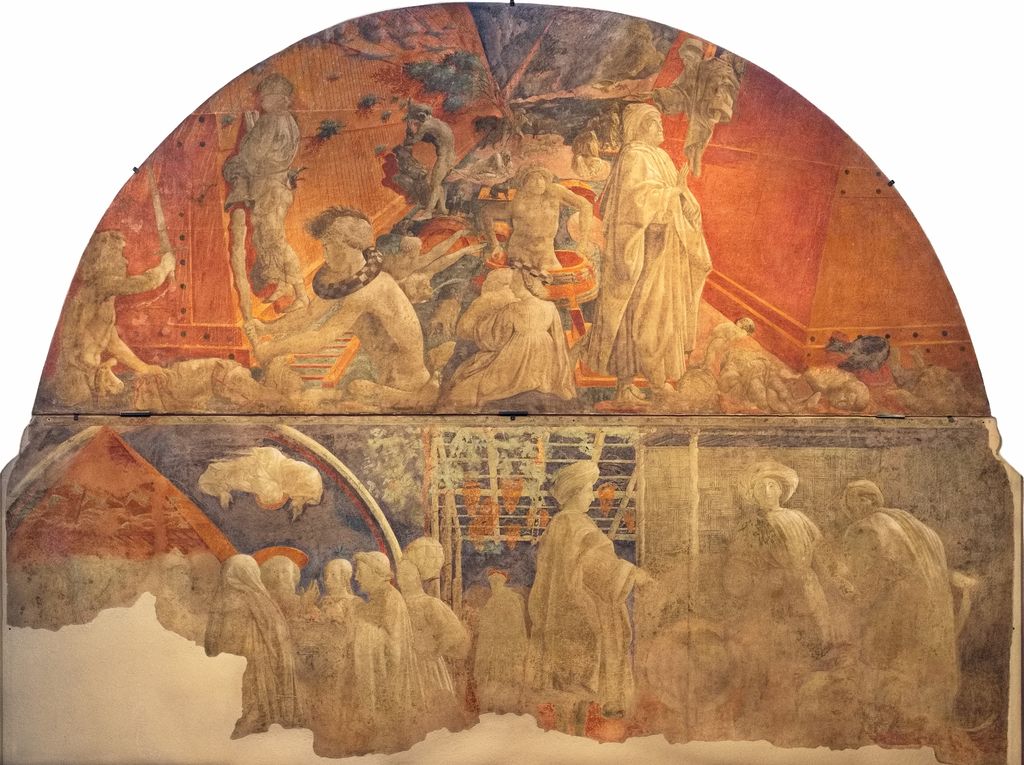
The Flood and Recession of the Waters above the lower episodes from Noah’s story, Santa Maria Novella. Photograph by Armin Kleiner. Image source. CC BY-SA 4.0. Resized for the web. This derivative is available under the same licence.
The Resurrection of Christ Stained Glass Window
The Resurrection window in Florence Cathedral, designed by Paolo Uccello and made by Bernardo di Francesco. Photograph by Sailko. Image source. CC BY 3.0. Resized for the web.