


 by Tom Gurney
Tom Gurney BSc (Hons) is an art history expert with over 20 years experience
Published on June 19, 2020 / Updated on November 29, 2026
Email: tomgurney1@gmail.com / Phone: +44 7429 011000
The Adoration of the Child: Introduction
Three small figures gather on a ridge under a dark sky. One raises an arm. Near them a crescent still shines, while a slant of ochre roof cuts across the night. Farther down the wall a child props himself up, right at the feet of two hefty beasts. The people around him have lost much of their painted bodies, but a hand, a sleeve and the steep angle of the animals’ heads still direct our eyes towards him. These are the surviving parts of Paolo Uccello’s Adoration of the Child, a mural of the 1430s in the Carmelite church of San Martino Maggiore in Bologna. [1] [2] [3]
At a Glance
- Date1430s, often given as 1437
- MediumDetached fresco with tempera on plaster
- On viewFirst chapel on the left, San Martino Maggiore, Bologna
Contents
- The child beneath the shelter
- Three figures against the night
- From sacristy wall to chapel
- The disputed date and Uccello’s early work
- Annotated details
The child beneath the shelter
Start with the pale body along the bottom of the painted scene. The infant Christ bears his weight on bent arms, with his head turned upwards. His shoulder and back have a roundness that catches the light. Behind him the pale donkey and the reddish ox lower their heads. The near ends of their bodies look large, while the parts that would extend away from us are compressed or hidden. That effect, called foreshortening, makes the animals seem to occupy the shelter and lean into the room. Their presence fixes the child’s position more securely than a stretch of painted ground could. [2] [3] [4]
At the left, folds fall from a light garment and a hand extends towards the child. Red drapery on the right still makes a broad mass despite the diagonal wound through it. Scholars identify a surviving head at the left as Joseph. Mary belongs to the Nativity subject recorded in the Italian state catalogue, but the gaps leave the foreground company difficult to reconstruct. The archive’s catalogue proposes a pair of substantial figures closing the action in a semicircle, possibly donors. One reading sees the Magi themselves kneeling nearby. The remaining bodies give an impression of people gathered closely around the child, even where their faces and the gestures that might identify them have disappeared. [1] [2] [3] [4]
There is a specific suggestion for the kneeling figure at the right. Antonio Buitoni has proposed Carlo da Saliceto, from a family of Bolognese jurists who lived near the Carmelite convent. Carlo had connections with Tuscany through civic and diplomatic service and was buried in Siena Cathedral in 1437. Those ties suggest a plausible route by which a local patron might have commissioned a Florentine painter. The damaged figure and the lack of a known commission leave the identification open. The possible use of the original room as an oratory or confraternity hall also helps explain why the patron question remains wider than the figures alone. [1] [2]
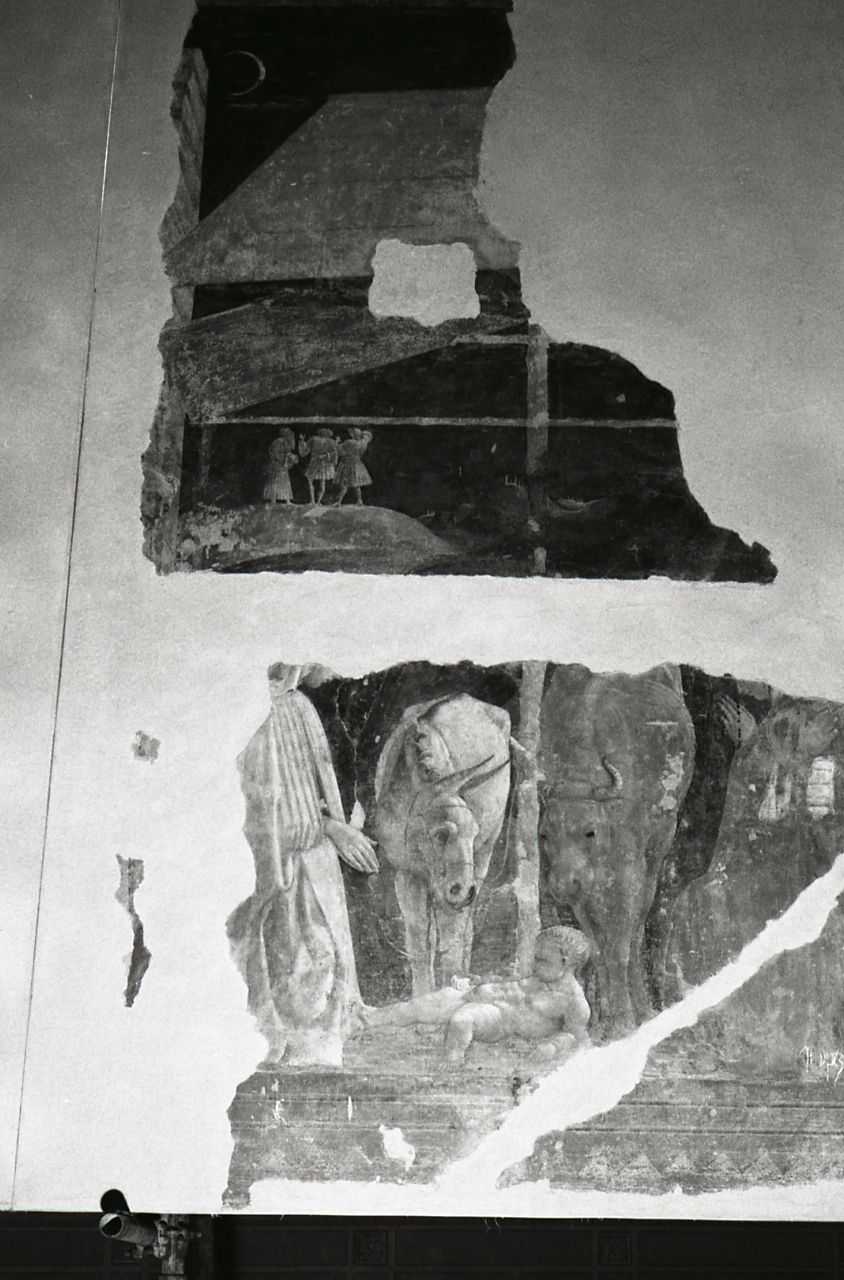
Paolo Monti’s 1979 photograph records the condition of the surviving fresco fragments in Bologna. Photograph by Paolo Monti, BEIC. Image source. CC BY-SA 4.0. Resized for the web. This derivative is available under the same licence.
Three figures against the night
Above the gap, the little group stands on a rounded rise beyond the upright and crosspieces of a wooden shelter. The figures are usually read as the three Magi scanning the sky for the star of Bethlehem. The crescent is plainly visible and belongs to the night sky. The reading of the group concerns what the men are doing within that landscape. If kneeling Magi also appeared beside the child, as Hidehiro Ikegami has proposed, Uccello would have shown the search and the arrival in the same painted space. The distant episode can still be read even with the foreground identities in doubt. [2] [3] [4]
Follow the roof edge and notice how the building makes the slope feel farther away. Its dark beams and angled underside give the scene an intermediate distance between the heavy animals and the small men on the hill. Each plane changes our sense of scale. The child’s shoulder and the animals’ heads are modelled in broad passages of light and shade, while the distant men are legible from gestures and silhouettes. The contrast allows the tiny figures to hold their own in a picture otherwise built on substantial bodies. Volpe compared the little men with figures in the Prato cathedral frescoes. Giacomo Alberto Calogero also heard an echo of Gentile da Fabriano in the distant scene. [2] [4] [5]
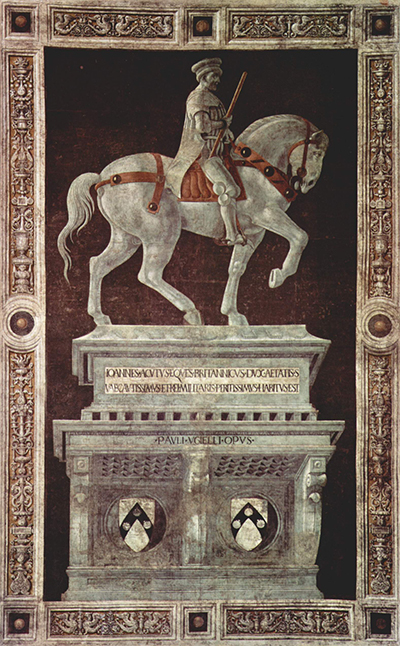
The remnants of a red painted surround add another depth cue. On the lower right, the raised-looking diamond points make a strip of pigment appear to project like moulding. Volpe compared the ornament with the fictive decoration of Uccello’s monument to John Hawkwood of 1436. The archive catalogue records the surviving work as 350 by 237 centimetres. Volpe proposed an original width nearer 270 to 280 centimetres, and the Borsi catalogue entertained the possibility of a broader painted architectural setting. The surviving border gives a sense of the larger design while the exact shape of its upper and lateral limits remains open. [2] [4] [5]
Annotated Details from The Adoration of the Child
The numbered points identify visible features discussed in this article. Return from each detail to the numbered overview. Uccello’s surviving fresco fragments at San Martino Maggiore, Bologna, with the Nativity figures and animals in the lower surviving painted fragment. Photograph by Sailko. Image source. CC BY 3.0. Numbered overview and cropped details from the original photograph. This overview and these details are available under CC BY 3.0.
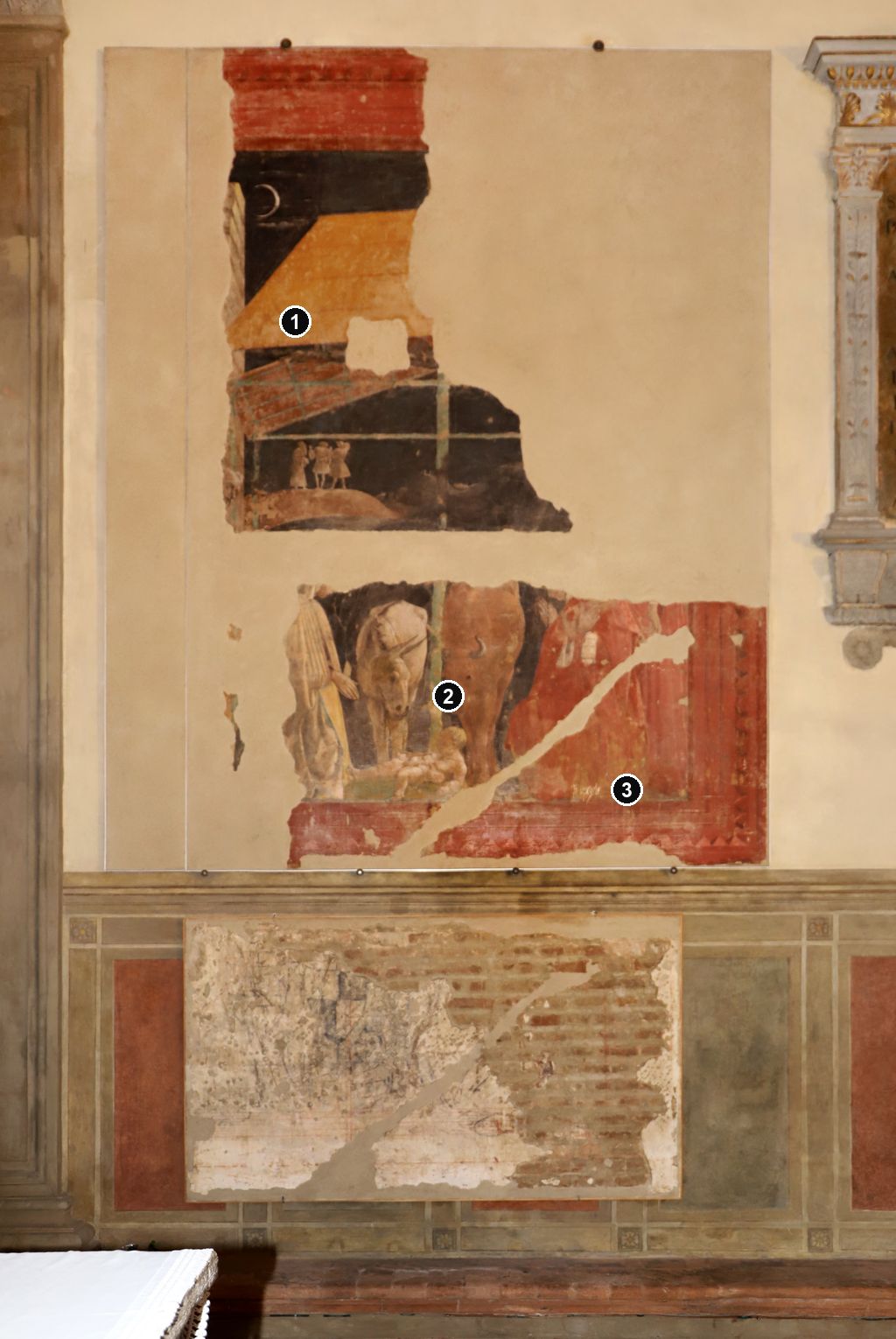
Details from THE ADORATION OF THE CHILD
Compare the cropped details with the source images above. Notice how their colours, shapes and positions contribute to the larger compositions.
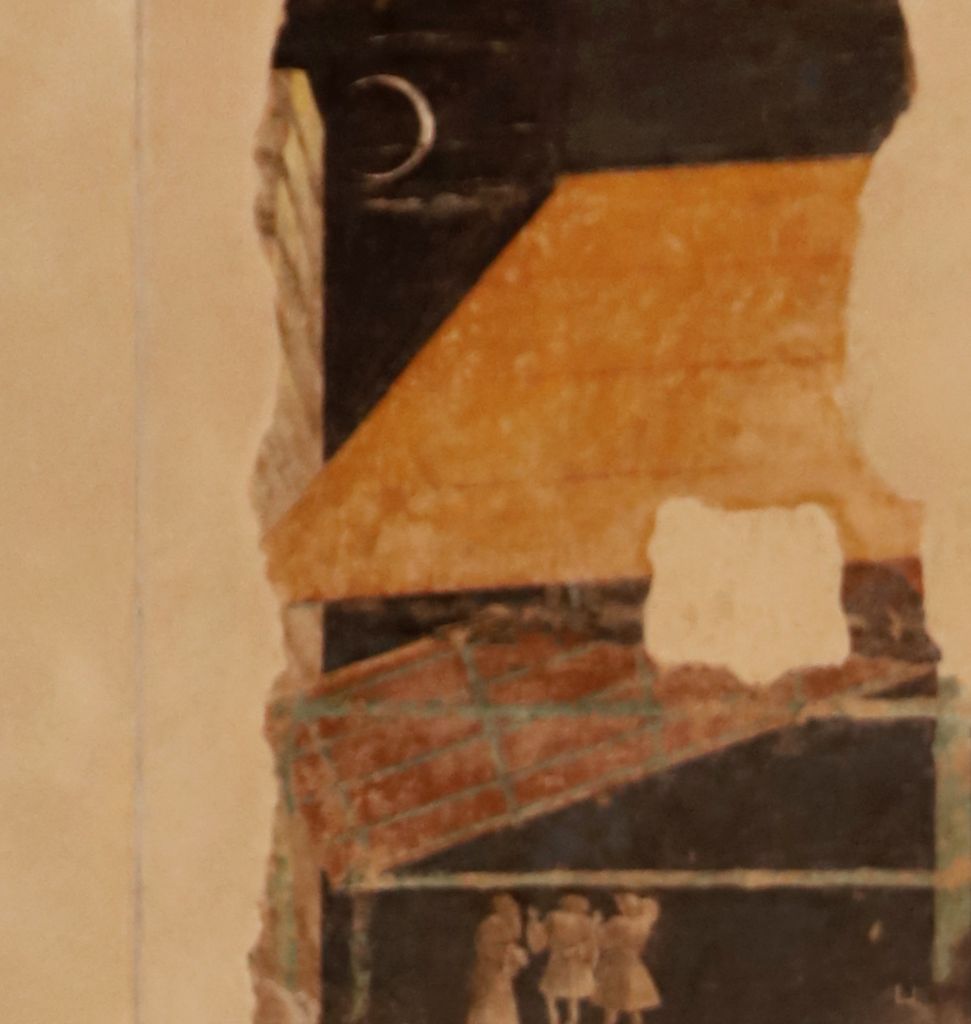
The crescent and the distant figures
In the upper fragment, a small bright crescent is visible against dark paint and figures stand below it. These remnants give hints of the original setting without settling its full story.
The Child, ox and ass
The Child is partly visible below the animals’ heads in the lower painted fragment. Their broad faces and downturned gazes direct attention into the worn area between them.
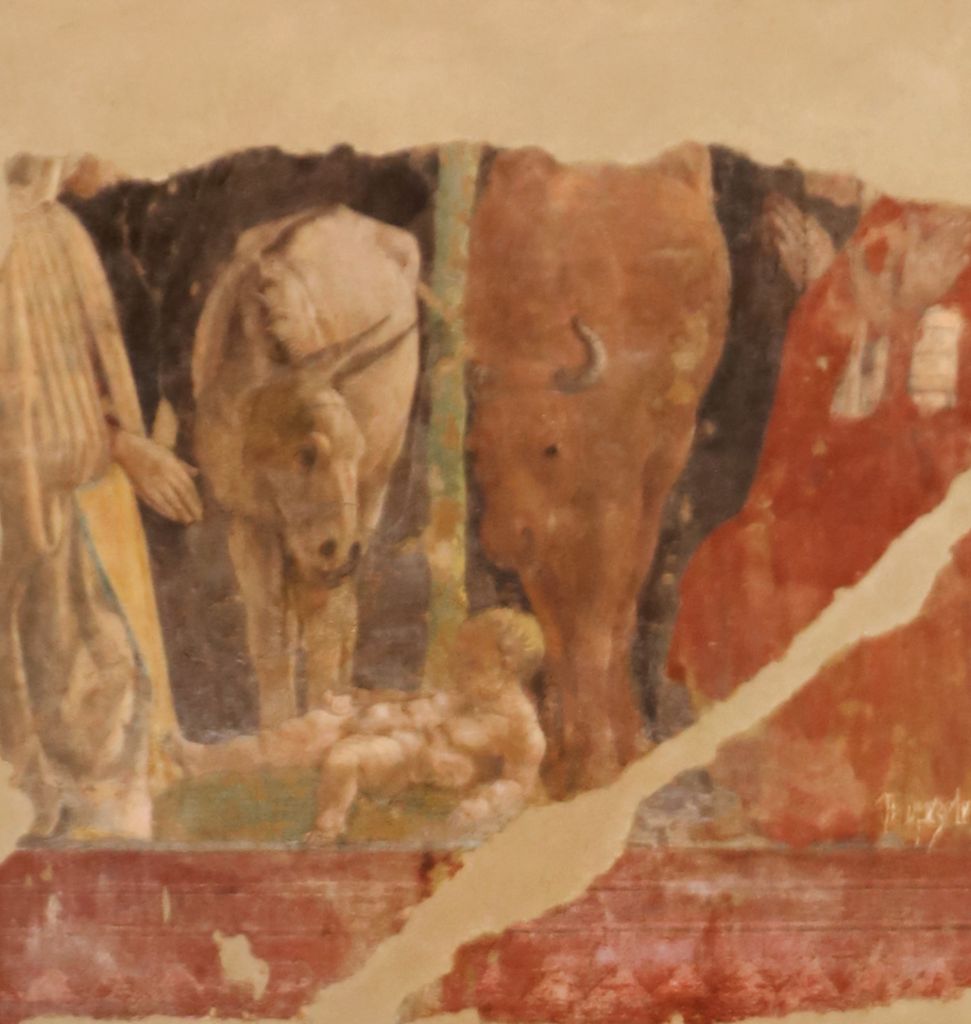
The broken edge of the lower painted fragment
The diagonal loss separates surviving colour and figures from exposed support. Its course helps distinguish today’s visible image from any proposed reconstruction.
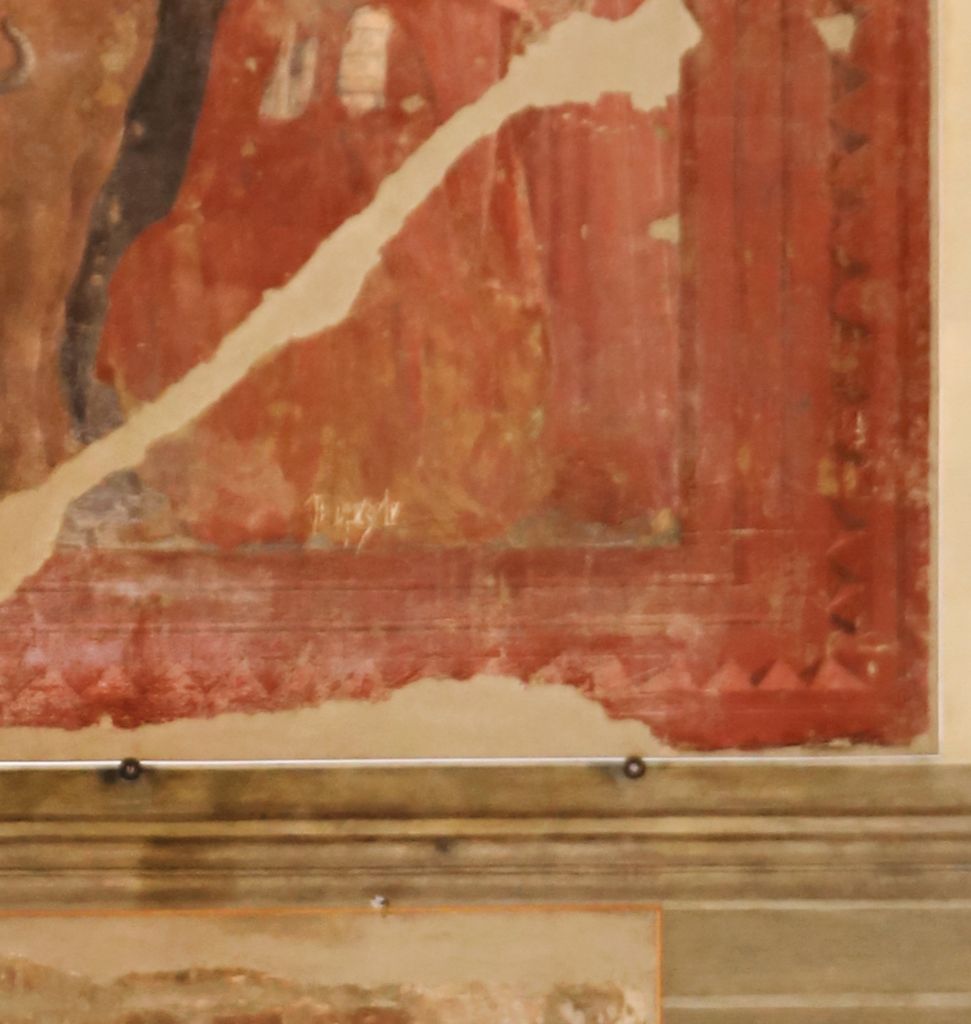
From sacristy wall to chapel
The fragments came to light in 1977 on the east wall of the room now used as the sacristy. The municipal library records the chance find during maintenance, and Ikegami describes furniture being moved away from the wall. Whitewash had hidden the picture. The state catalogue records fifteenth-century devotional markings along the lower edge and cites Rosalba D’Amico’s suggestions that the surface might have been covered after the local plague of 1478 or after earthquake damage in 1506. The date of the covering remains uncertain. Those early marks are evidence that the painted surface had once been within reach. [1] [2] [6] [7]
Plumbing work had already cut across the foreground while the painting was concealed. The damage explains the wide horizontal interruption through the figures as well as the difficulty of reading what they were doing. The Soprintendenza authorised detachment. In two treatment campaigns between 1978 and 1980, Camillo Tarozzi and Silvia Baroni worked on the removal and cleaning. Tarozzi’s photographs, including details recorded during the intervention, gave Volpe material for the study he published in Paragone in 1980. Published before Volpe’s study, a 1979 notice had assigned the work to Francesco del Cossa, following the initial inclination to link it with Ferrara and the middle of the century. [1] [2] [4] [5]
The fragments remained at San Martino Maggiore and were mounted on the right wall of the first chapel on the left, the Poltroni-Marescotti chapel. The new setting makes a large work accessible from the nave. Pale fields around and between the pieces make the broken edges conspicuous. They also give our eyes space to connect the star-seekers above with the adoration below. The state register describes fresco and tempera on plaster. A new examination in December 2021 used raking light, ultraviolet fluorescence and infrared imaging, among other methods. The preliminary report noted incised perspective lines. Caterina Corsi’s subsequent research identifies marks left by the transfer of a design from a cartoon, a full-size preparatory drawing. One way of transferring the lines was pouncing, or dusting pigment through holes pricked along the outlines. It helped a painter keep the proportions worked out on paper when setting out a figure on the wall. Luca Ciancabilla also reproduces the Bologna mural’s surviving sinopia, a drawing on the rough plaster beneath the finished surface. The layers show how work could begin on the wall and also draw on designs prepared away from it. [1] [2] [4] [8] [9] [10] [11]
The disputed date and Uccello’s early work
The restoration revealed a date cut into plaster. Volpe read it as 1437, the year adopted by the Italian state catalogue. Alessandro Parronchi read the last digit as a 1, and the National Gallery of Victoria study allows a 2 as another possibility. Lorenzo Sbaraglio gives the secure portion as 143 followed by a gap. The state record places the inscription before the application of the paint, and the NGV study describes fine grooves whose raised edges could have formed while the plaster was damp. The Volpe archive catalogue takes a more cautious view of the inscription’s authority. It also records broken letters beneath the base that have been proposed as part of a signature. The close resemblance between the timber shelter and the one in Uccello’s Quarate predella has also been used to support a date around 1437. The inscription and the comparative evidence give a strong indication of the decade, while the exact year and reading of the letters remain matters of interpretation. [1] [2] [3] [5] [12] [13]
The difference between 1431 and 1437 changes where the Adoration falls beside the documented Hawkwood commission of 1436. Either reading places a painter capable of giving weight to bodies and organising a complicated space in the 1430s. For Volpe this mattered because his teacher Roberto Longhi had placed Uccello’s mature engagement with the innovations of Masaccio relatively late. The Bologna child, with his strongly modelled torso, and the emphatic mass of the surrounding figures helped Volpe argue for an earlier engagement. The archive catalogue compares the muscular infant with Masaccio’s child in Saint Anne Metterza. The small, gesturing Magi show how that way of painting could coexist with Uccello’s interest in delicate silhouettes and late Gothic storytelling. [2] [4] [5] [12] [14]
What the fresco changed for art historians is easier to establish than what it changed for fifteenth-century painters in Bologna. Volpe reconsidered Uccello’s place in the early Renaissance partly on the evidence of this work. Neville Rowley notes that a direct influence from the fresco on later Bolognese painting is hard to trace. So much local material has disappeared, and the whitewash would have hidden the work from view. Its secure place in Bologna still shows that a painter trained in Florence was working there at a time when the city’s own late Gothic traditions remained strong. [1] [5] [15]
The discovery also helped clarify the relationship between the San Martino fresco and the Adoration of the Christ Child in Karlsruhe, a separate work on a narrow wooden panel set in a nocturnal landscape. The Karlsruhe picture once gave its name to an unidentified master working in Uccello’s orbit. Its changes of scale and the way it gives solidity to the animals made the mural a useful comparison as scholars reconsidered the panel’s authorship. The Kunsthalle now presents its panel under Paolo Uccello’s name. In Bologna, despite the gaps, it is still possible to see what connects a cow’s lowered head, a shelter beam and a distant hillside. Each helps the eye find its way through the night towards the child. [4] [14] [16]
Artworks directory
Browse paintings, drawings, stained-glass designs and other objects connected with Uccello. Cycles and their surviving components may have separate entries. The collection or catalogue’s wording is retained where a date, attribution or subject is debated.
| Name | Date | Medium, attribution and collection |
|---|---|---|
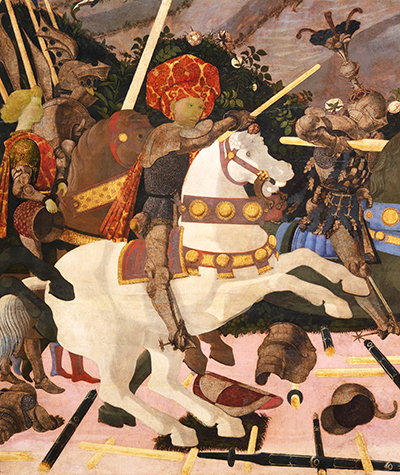
| Niccolò da Tolentino at the Battle of San Romano · London | Probably c.1438–40 | Tempera and oil on wood, with metallic decoration · National Gallery Catalogue. |
| Bernardino della Carda Unhorsed · Florence | c.1435–40 | Tempera on panel · Uffizi Galleries Catalogue. |
| The Counterattack of Micheletto da Cotignola · Paris | 1450–75 in the Louvre catalogue | Tempera (possibly) on wood · Musée du Louvre Catalogue. |
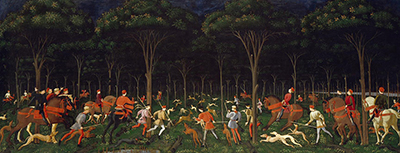
| The Hunt in the Forest | c.1465–70 | Tempera and oil with traces of gold on panel · Ashmolean Catalogue. |
| Saint George and the Dragon · London | c.1470 | Oil on canvas · National Gallery Catalogue. |
| Saint George Slaying the Dragon · Melbourne | c.1430 | Oil, tempera and silver leaf on wood · National Gallery of Victoria Catalogue. |
| Saint George and the Dragon · Paris | 1430–35 in the museum catalogue | Painted wood panel · Musée Jacquemart-André Catalogue. |
| Equestrian Monument to John Hawkwood | 1436 | Transferred wall painting · Florence Cathedral Catalogue. |
| Study for the John Hawkwood Monument | 1436 | Study on prepared paper · Uffizi Catalogue. |
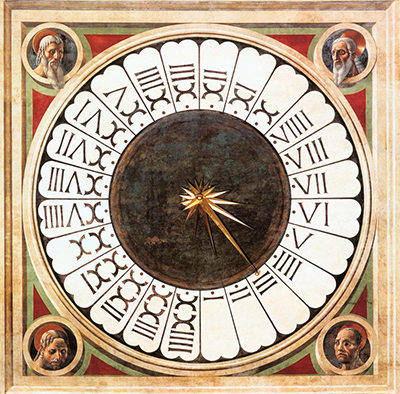
| Monumental Clock Face | 1443 | Painted dial · Florence Cathedral Catalogue. |
| Resurrection of Christ | 1443–44 | Stained glass · Uccello design · Florence Cathedral Catalogue. |
| Nativity | 1440s | Stained glass · Uccello design · Florence Cathedral Catalogue. |
| Creation of the Animals and Creation of Adam | Third to fourth decade of the 15th century | Detached fresco · Green Cloister, Santa Maria Novella Catalogue. |
| Creation of Eve and the Fall | Third to fourth decade of the 15th century | Detached fresco · Green Cloister, Santa Maria Novella Catalogue. |
| Flood and Recession of the Waters | 15th century; dating debated | Detached fresco · Green Cloister, Santa Maria Novella Catalogue. |
| Sacrifice and Drunkenness of Noah | 15th century; dating debated | Detached fresco · Green Cloister, Santa Maria Novella Catalogue. |
| Stories of the Virgin and Saint Stephen · Assunta Chapel | 1430s, with later completion | Fresco cycle · Paolo Uccello and Andrea di Giusto · Prato Cathedral Catalogue. |
| Blessed Jacopone da Todi | 1436 in the diocesan museum | Detached fresco · Museo dell’Opera del Duomo, Prato Catalogue. |
| Adoration of the Child · Bologna | 1430s; inscription incomplete | Detached fresco · San Martino Maggiore, Bologna Catalogue. |
| Adoration of the Christ Child · Karlsruhe | c.1436 | Painted panel · Attribution to Uccello · Staatliche Kunsthalle Karlsruhe Catalogue. |
| Annunciation · Oxford | Early 15th century | Tempera and gilding on panel · Ashmolean Catalogue. |
| Allegory of Monastic Life (Thebaid) | c.1460–65 | Tempera on canvas · Galleria dell’Accademia, Florence Catalogue. |
| Miracle of the Profaned Host | 1467–68 | Tempera on wood · Galleria Nazionale delle Marche, Urbino Catalogue. |
| Triumphal Entry into Rome of Titus and Vespasian(?) | c.1430–35 | Tempera, gold and silver on panel · Yale University Art Gallery Catalogue. |
| Crucifixion with the Virgin and Saints | c.1460–65 | Painted panel · Museo Nacional Thyssen-Bornemisza Catalogue. |
| The Crucifixion · Met triptych | Probably mid-1450s | Tempera on wood with gold ground · Metropolitan Museum of Art Catalogue. |
| Perspective Study of a Chalice | 1450–75 | Pen, ink and stylus on paper · Attributed to Uccello · Uffizi Catalogue. |
| Study of a Mazzocchio | 15th century | Perspective study · Attributed to Uccello · Uffizi Catalogue. |
| Mazzocchio Seen in Perspective | Uncertain | Drawing · Attribution debated · Musée du Louvre Catalogue. |
| Head of a Man in Profile | 15th century | Pen, ink and wash · Musée du Louvre Catalogue. |
| Five Masters of the Florentine Renaissance | 1500–50 | Oil on wood · Anonymous Florentine school · Musée du Louvre Catalogue. |
| Madonna and Child from the Del Beccuto House | 15th century | Detached fresco · Museo di San Marco, Florence Catalogue. |
| Man of Sorrows with the Virgin and Saint John · Avane Predella | 15th century | Predella · Museo di San Marco, Florence Catalogue. |
| Calling of Saint Paul the Hermit · San Miniato | After 1447 to c.1454 in state catalogue | Sinopia · Attributed to Uccello or collaborator Catalogue. |
| The host changes hands · Urbino predella, scene 1 | 1467–68 | Tempera on wood · Component of DE 231 · Galleria Nazionale delle Marche Catalogue. |
| The figures at the door · Urbino predella, scene 2 | 1467–68 | Tempera on wood · Component of DE 231 · Galleria Nazionale delle Marche Catalogue. |
| The procession approaches the altar · Urbino predella, scene 3 | 1467–68 | Tempera on wood · Component of DE 231 · Galleria Nazionale delle Marche Catalogue. |
| The condemned woman and the ladders · Urbino predella, scene 4 | 1467–68 | Tempera on wood · Component of DE 231 · Galleria Nazionale delle Marche Catalogue. |
| Persecution of the family · Urbino predella, scene 5 | 1467–68 | Tempera on wood · Component of DE 231 · Galleria Nazionale delle Marche Catalogue. |
| Angels and demons at the bier · Urbino predella, scene 6 | 1467–68 | Tempera on wood · Component of DE 231 · Galleria Nazionale delle Marche Catalogue. |
| Birth of the Virgin · Prato Cathedral | 1430s; dating debated | Fresco · Assunta Chapel, Prato Cathedral Catalogue. |
| Presentation of the Virgin · Prato Cathedral | 1430s; dating debated | Fresco · Assunta Chapel, Prato Cathedral Catalogue. |
Discussion
Look again at the images and ideas explored in The Adoration of the Child. These editorial prompts invite your observations.
Reader Insights
Where does your eye go after it finds the child, and which surviving mark makes it move there?
How does reading the distant Magi and the damaged foreground as two moments change the way you look at the shelter between them?
Join the Conversation
Share a detail, comparison or question about The Adoration of the Child below.
References
- Ministero della Cultura, Catalogo Generale dei Beni Culturali. Natività, national record 0800316463. View source.
- Emma Squartini and Sofia Zanardi, Università di Bologna. “Paolo Uccello, Natività,” catalogue entry for La fototeca di Carlo Volpe: l’officina del conoscitore. View source.
- Hidehiro Ikegami. “L’adorazione del bambino di Paolo Uccello,” Portici, no. 4, 1999, p. 42. View source.
- Giacomo Alberto Calogero. “Carlo Volpe e il Rinascimento bolognese,” in Marinella Pigozzi, ed., Le immagini della ricerca, 2012, especially pp. 114–121. View source.
- Biblioteca delle Arti, Università di Bologna. “Paolo Uccello in San Martino a Bologna,” exhibition essay and Camillo Tarozzi photographs, Fototeca Volpe 2258, quoting Carlo Volpe, “Paolo Uccello a Bologna,” Paragone 365, July 1980, pp. 3–28. View source.
- Biblioteca Salaborsa, Comune di Bologna. “Un affresco di Paolo Uccello nella chiesa di San Martino,” Cronologia di Bologna. View source.
- Hidehiro Ikegami. “ボローニャ派の諸問題:形成期からルネサンス” [Questions of the Bolognese school from its formation to the Renaissance], Bijutsushi Ronshū 6, 2006, pp. 87–102, especially p. 95 and fig. 14. View source.
- Regione Emilia-Romagna. “Bologna, il centro antico nella cerchia dei torresotti,” San Martino entry. View source.
- Nicoletta Barberini Mengoli. “Paolo Uccello: i segreti dietro l’affresco,” reporting the University of Bologna’s December 2021 diagnostic campaign, Il Resto del Carlino, 9 January 2022. View source.
- Caterina Corsi. “La tecnica dello spolvero al servizio delle sperimentazioni rinascimentali,” Critica d’Arte, 2024, pp. 7–19, University of Florence repository abstract. View source.
- Luca Ciancabilla. “‘Sinopie e affreschi’ sessant’anni dopo,” in Giuseppina Perusini and Monica Visentin, eds., Restauri e restauratori in Italia fra gli anni Venti e gli anni Cinquanta del Novecento, Udine, 2024, pp. 53–68, especially fig. 4. View source.
- National Gallery of Victoria. “A Knight in Shining Armour, a Virgin – Uccello’s Melbourne Saint George and the dragon and Oxford Annunciation,” discussion of the Bologna mural. View source.
- Lorenzo Sbaraglio. “Paolo di Dono, detto Paolo Uccello,” Dizionario Biografico degli Italiani, vol. 81, 2014. View source.
- Dillian Gordon, National Gallery, London. “Paolo di Dono, called Uccello,” The Fifteenth Century Italian Paintings, vol. 1, 2003. View source.
- Neville Rowley. « Pittura di luce »: la manière claire dans la peinture du Quattrocento, doctoral thesis, Université Paris-Sorbonne, 2010, p. 179, note 701. View source.
- Staatliche Kunsthalle Karlsruhe. Adoration of the Christ Child with Saint Jerome, Saint Mary Magdalene, and Saint Eustace, inv. 404. View source.
More PAOLO UCCELLO Artworks

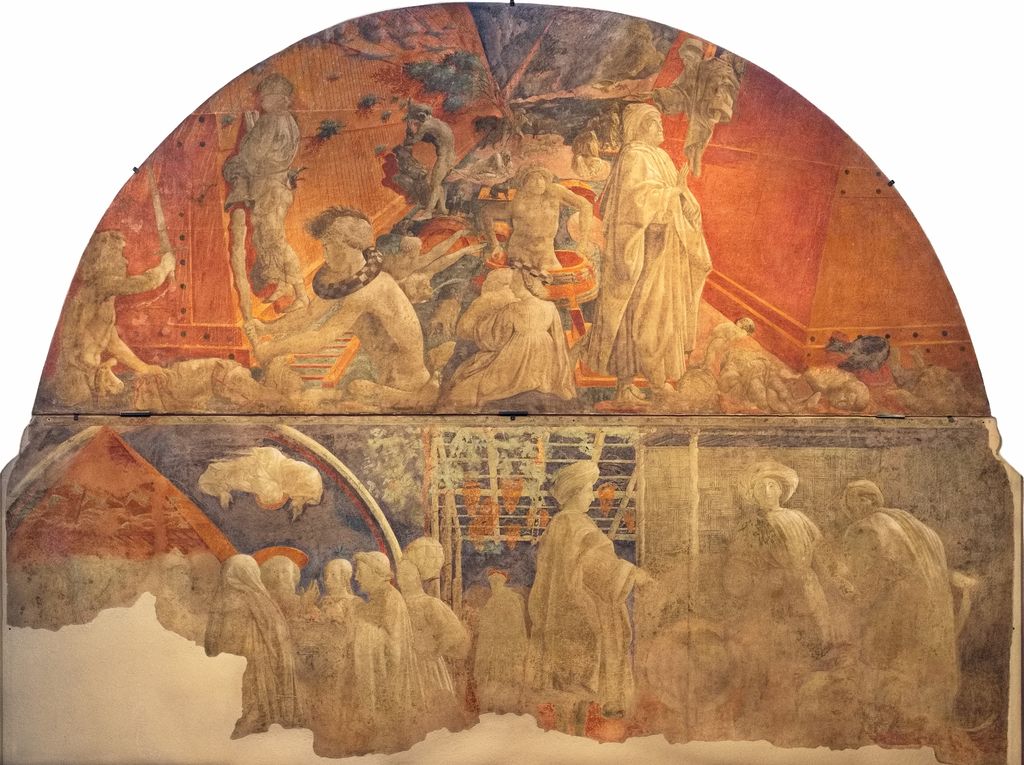
Noah and the Flood
The Flood and Recession of the Waters above the lower episodes from Noah’s story, Santa Maria Novella. Photograph by Armin Kleiner. Image source. CC BY-SA 4.0. Resized for the web. This derivative is available under the same licence.
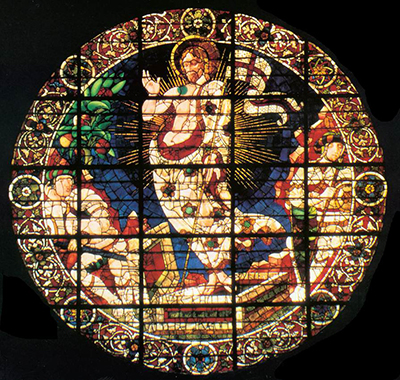
The Resurrection of Christ Stained Glass Window
The Resurrection window in Florence Cathedral, designed by Paolo Uccello and made by Bernardo di Francesco. Photograph by Sailko. Image source. CC BY 3.0. Resized for the web.