


 by Tom Gurney
Tom Gurney BSc (Hons) is an art history expert with over 20 years experience
Published on June 19, 2020 / Updated on November 29, 2026
Email: tomgurney1@gmail.com / Phone: +44 7429 011000
Clock with Heads of Prophets for the Florence Cathedral: Introduction
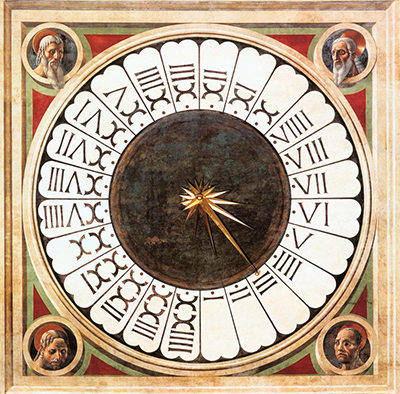
Walk a little way into Florence Cathedral, turn back towards the main doors and look up. Between the mosaic of the Coronation of the Virgin and the stained-glass rose window of the Assumption, a gilded star crosses a dark circle. It is the single hand of the cathedral clock. Four faces look out from the corners of the painted square. Paolo Uccello finished the frescoed dial in 1443. The clock still follows a day measured from sunset, with a mechanism and a hand that belong to later chapters in its history. [1] [2] [3]
At a Glance
- Painted dial1443, fresco by Paolo Uccello
- LocationAbove the main doors, inside Florence Cathedral
- Time display24 hours, anticlockwise, with hour XXIIII at sunset
This work across Paolo Uccello’s career
Battle of San Romano
Probably c.1438–40 · GordonResurrection glass
1443–44The Hunt in the Forest
c.1465–70The Urbino predella
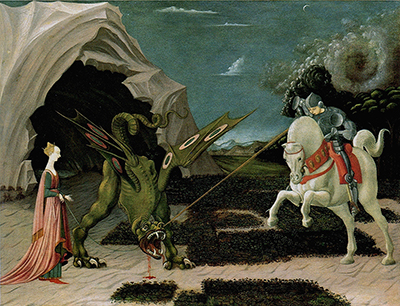
1467–68Saint George and the Dragon · London
About 1470Contents
- A clock that counts from sunset
- A painted wheel on the inner façade
- Who are the faces in the corners?
- The fresco, the star and the machine
- Annotated details
A clock that counts from sunset
Begin at the foot of the circle, where the twenty-fourth hour is written XXIIII. The numbers rise on your right as the star moves anticlockwise. VI is near the right-hand edge, XII near the top and XVIII near the left-hand edge. The dial makes room for the full day and night in one revolution. Each division represents an hour, with sunset closing one count and starting the next. This was the ora italica, or Italian reckoning. If sunset is at six in the evening by a modern clock, hour XXII falls at about four that afternoon. On another day, with sunset at eight, that same numeral falls at about six. The example works in reverse, too. When the hand reaches XXII, the dial tells you that roughly two hours of daylight remain. [1] [3] [4]
The clock measures equal hours, and the shifting reference point is what makes the system seasonal. Gears and a pendulum can keep the hand moving steadily through a full turn. To keep its twenty-fourth hour aligned with the changing time of sunset, someone has to adjust the clock. The Opera’s account of the 2014 restoration names two cathedral custodians, Lucio Bigi and Mario Mureddu, who wound and regulated it weekly. The same institution connects the dial with the evening Ave Maria, signalled by the bells of Giotto’s Campanile, and records the practice of ringing at sunset as well as an hour before and an hour after it. A person looking up in the nave and a person listening outside could both orient themselves by the evening. [3] [4] [5]
The anticlockwise course looks surprising because the opposite direction became familiar. The Opera relates it to the path of a shadow on a sundial and points out that the placement and direction of hour markings were still unsettled when Uccello painted the dial. Erika Timm’s comparison with surviving or recorded dials from Milan, Padua, Mantua and Venice brings out just how distinctive Florence’s choice was. Those examples include twenty-four-hour dials read in the direction we now call clockwise. The division into twenty-four hours and the decision to read them towards the right from the bottom are separate features. [2] [4] [6]
A painted wheel on the inner façade
Uccello set the dial inside a square, with the circle fitted so closely that the four corners are almost the only spaces left for figures. The Opera describes the monumental face as 6.7 metres square, while its scientific catalogue lists 4.7 metres square for the mural entry without explaining the difference between the measurements. From the floor the boldest lines do the work first. A circular band of pale compartments surrounds the broad blue centre. At the outer edge each compartment has a rounded end, so the line of numbers looks like a ring of petals. The numerals sit towards the inner ends of their compartments, where the tip of the moving hand can be read against them. Elisa Camporeale records small points incised in the plaster with a metal tip to lay out the divisions. The shape is intricate up close and easy to follow from a distance. [1] [7] [8]
The blue disc belongs to a revision made while the work was new. The Opera’s accounts record forty lire for work on the clock on 22 February 1443, with the precise work unspecified. The entry of 2 April records a further ten lire connected with gilding the star and painting the field blue. Hugh Hudson notes that conservation revealed an earlier green centre and a painted inner moulding comparable to the one around the outside of the dial. The simplified blue field gives the gold hand a more even background, which may have helped people on the floor distinguish its position. The accounts leave room for several readings of the second payment, including reimbursement for costly materials and payment for a revised design. They leave the conversation between artist and patrons to our imagination. [7] [9] [10]
The circle looks at home between the horizontal ledges and arched openings of the entrance wall. The Opera has compared it to a painted counterpart of a small rose window and to Brunelleschi’s arrangements of circles and squares. Camporeale and other scholars have proposed that Brunelleschi, who was both the cathedral’s architect and a maker of clocks, helped conceive the project. Angelo di Niccolò is credited with making the first movement. A comparison you can make across the square is the zodiac pavement at the Baptistery, an early thirteenth-century marble inlay in which a wheel is set inside a square. Its radial compartments frame the signs of the zodiac, while the cathedral’s wheel frames the hours. The two designs lie on the same axis, with the cathedral dial high on the wall and the zodiac set into the pavement across the piazza. The suggestion that the pavement once served as a solar instrument belongs to a local tradition about how light entered the Baptistery. A similar pavement at San Miniato al Monte carries the date 1207. The similarity makes the Baptistery a persuasive visual comparison for the clock, even though Uccello’s exact source remains uncertain. [2] [3] [7] [11] [12]
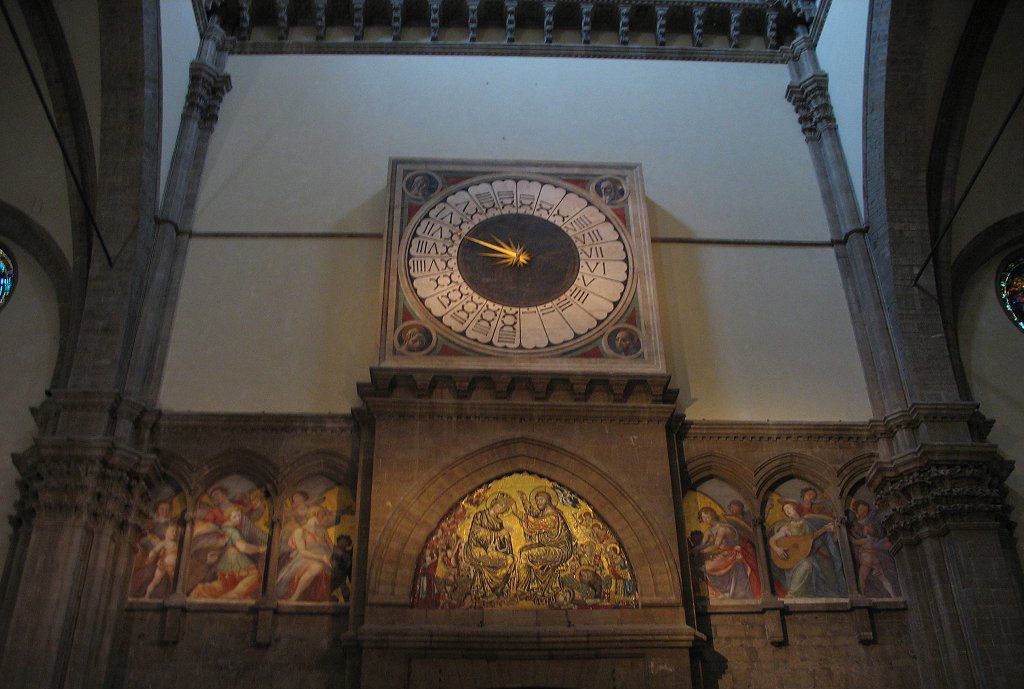
The painted clock viewed from the cathedral floor, above the central entrance. Image source. Public domain.
Who are the faces in the corners?
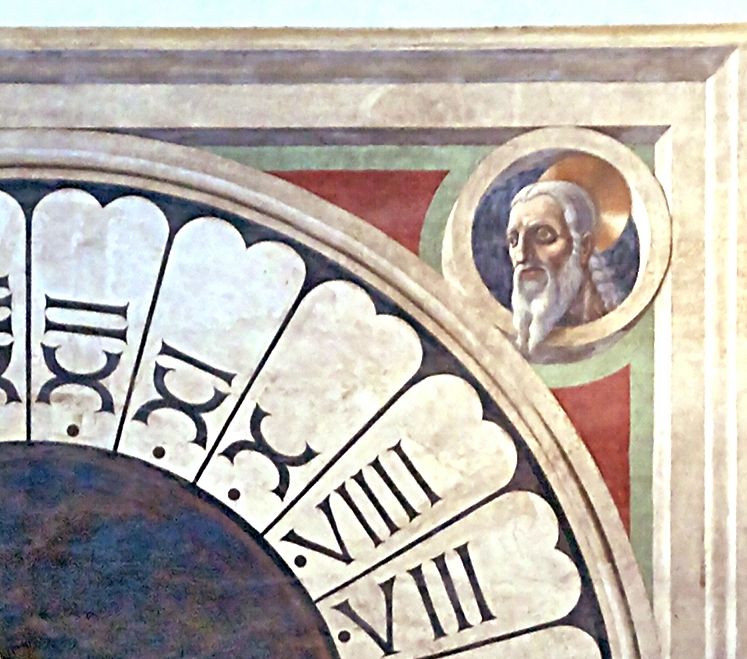
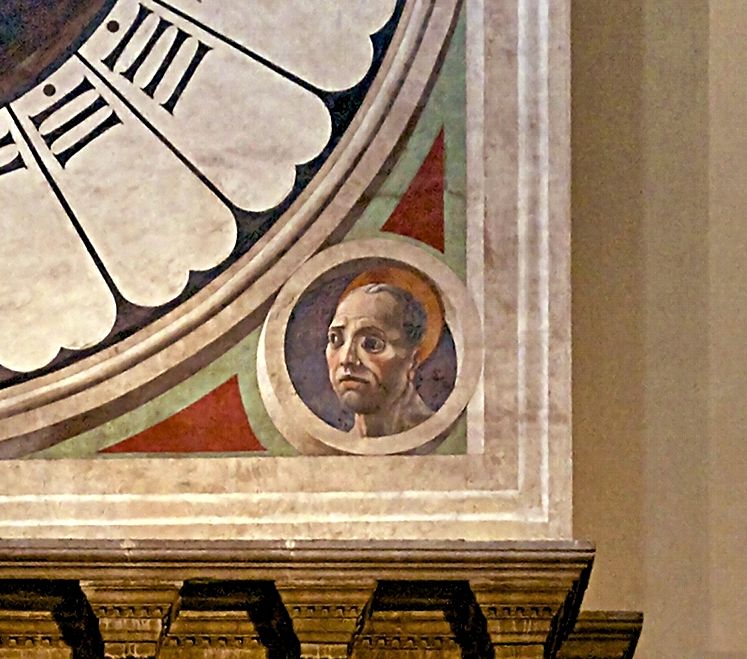
The pale rims around the heads are painted as short cylinders seen in perspective. A dark interior makes each head seem to emerge from a recess. Seen from the nave, the lifted rims and the faces’ chins make the height of these little openings part of the illusion. The two upper heads have long grey beards, with different turns of the head. The man at bottom left lowers his face and brings his brow forward, while the one at bottom right turns to the side with his eyes held slightly upward. The repeated circles keep the corners in balance. The different angles and expressions give each face its own presence. [1] [2] [7] [10]
Giorgio Vasari credited Uccello with the dial and described the four heads in the corners. Giovanni Poggi confirmed the commission from the Opera archives in research published in 1933. The name ‘prophets’ has a long history, and the faces’ sculptural modelling makes the comparison with Donatello’s prophets for the adjacent bell tower particularly apt. The encircling mouldings also recall Lorenzo Ghiberti’s Gates of Paradise, now represented by a replica on the Baptistery, with the originals in the Opera museum. These comparisons show how a painter could give faces the bearing of figures in relief. One comparison made in the Opera’s catalogue pairs the gaunt face at bottom right with Donatello’s figure of Habakkuk, a prophet whose jutting features are likewise legible from below. The resemblance does not establish that Uccello intended to depict the same man. [2] [7] [13] [14]
The Opera’s scientific catalogue also considers the four Evangelists. Alessandro Parronchi drew attention to possible likenesses between the faces and the beings traditionally associated with the Gospel authors. In the reading attributed to Umberto Baldini and Camporeale, Matthew and John occupy the upper left and upper right, with Mark below Matthew and Luke below John. The associated forms are a winged human figure, an eagle, a lion and an ox respectively. Uccello gave the men haloes, but the usual accompanying creatures are absent. The figures’ positions at the four corners have suggested the Gospel reaching the four quarters of the world. Another reading gathered in the Opera catalogue links the star with Christ’s birth and the revolving hand with the finite time before his return. The fresco makes room for these readings without fixing a name to any face. [2] [4] [7] [13]
Annotated Details from Clock with Heads of Prophets for the Florence Cathedral
The numbered points identify visible features discussed in this article. Return from each detail to the numbered overview. The 24-hour dial on the inner façade of Florence Cathedral. Four painted heads fill its corners. Image source. CC0 / Public domain.
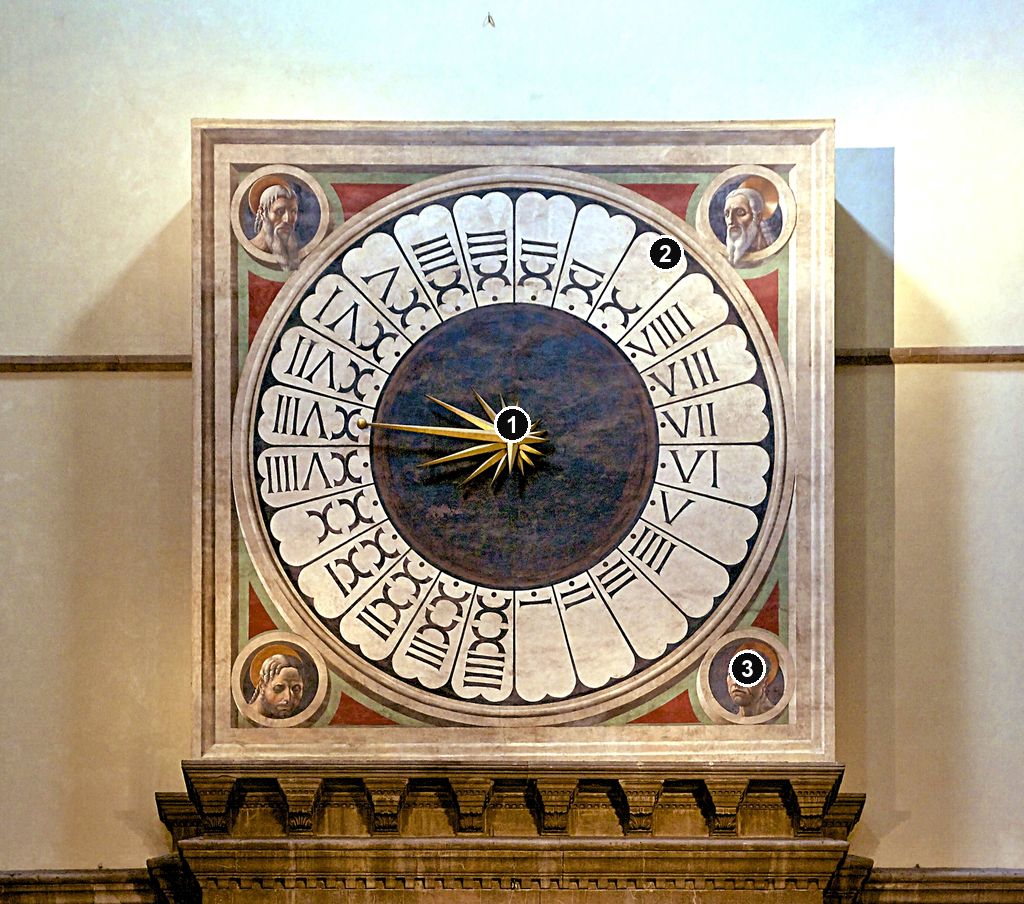
Details from CLOCK WITH HEADS OF PROPHETS FOR THE FLORENCE CATHEDRAL
Compare the cropped details with the source images above. Notice how their colours, shapes and positions contribute to the larger compositions.
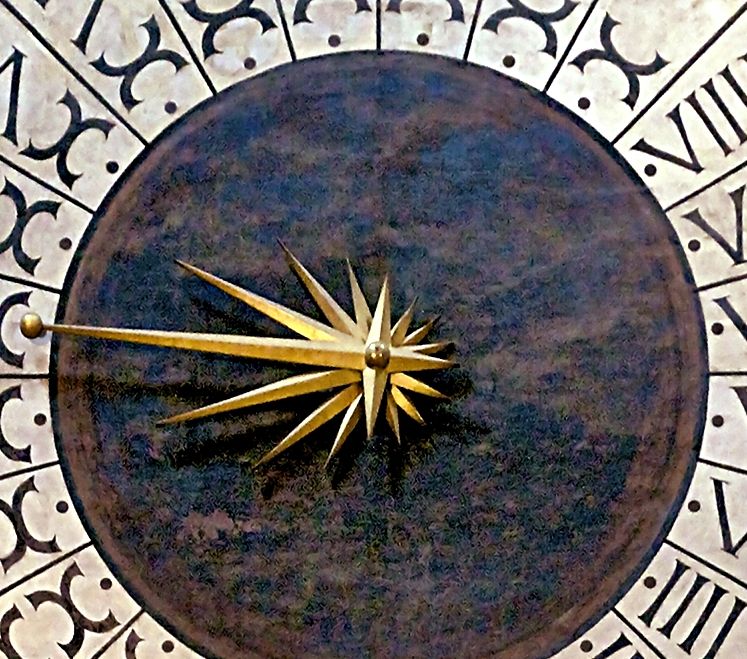
Single star-shaped hand
The gilded hand has one long pointer. Only that pointer indicates the hour; the smaller rays form the star around its centre.
The tapering numeral compartments
Lines divide the circle into twenty-four cells. The numerals follow the ring and turn with the painted compartments.
One of four heads
The head in the lower right fills a circular frame set within a triangular corner. Each head is framed in the same way, and their faces and directions vary.
The fresco, the star and the machine
Angelo di Niccolò’s mechanism was repaired by Lorenzo della Volpaia in 1497 and largely rebuilt in 1546–47 by his son Camillo. In 1688 the cathedral adopted a pendulum movement. Giuseppe Borgiacchi supplied the movement that survives in 1761. In the Opera’s scientific catalogue the first of two later painted faces is Angiolo Gori’s of 1669, associated with a switch to a clockwise twelve-hour dial. The catalogue dates another face to 1761, the year the Opera’s account of the machinery associates with the change to twelve hours and replacement of the hand. The two sources agree that successive refittings buried the old hour scale. Camporeale notes that the corner heads remained visible while the round dial was covered. [3] [7] [8] [15]
In 1963–68 the Soprintendenza’s restorers worked under Dino Dini, assisted by Guido Botticelli and Sabino Giovannoni, to uncover Uccello’s painting. The wider campaign restored the twenty-four-hour display around the turn of the 1970s. The gilded star now on the wall is a reconstruction. The 2 April record mentions gilding a ball at the tip of a ray, a clue to the earlier hand’s appearance. For a model, the restorers looked up into the cathedral itself. The comet that shines over the scene in the Nativity window follows a design by Uccello, which Angelo di Lippo translated into stained glass. Its elongated ray gave the restorers a way to make one arm of the new star legible as the hour pointer. Under the dome you can also see Uccello’s design for the Resurrection window, a separate commission from the same period. [1] [5] [7] [8] [9] [16] [17]
The mechanism sits roughly fifteen metres above ground in a narrow space between the inner and outer walls. A falling stone weight supplies the power, and the pendulum and escapement regulate its release through the gears. Winding by hand raises the weight again. A small dial beside the mechanism allows a keeper to check the position of the great hand without going down to the nave. Andrea Palmieri and Ugo Pancani of Florence’s Leonardo da Vinci institute completed a restoration of the movement in October 2014. The work addressed dirt and corrosion as well as wear to pivots and parts of the escapement. The conservators disassembled and cleaned the mechanism, attended to individual components, then reassembled and regulated it. [3] [15] [18]
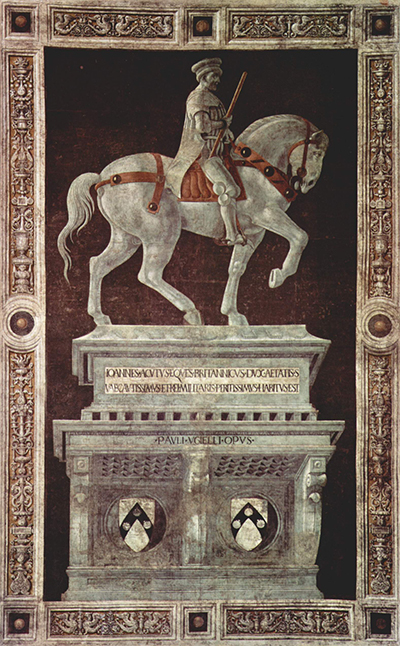
On your way back along the nave, look towards Uccello’s monument to Sir John Hawkwood in the north aisle. There the painter made a flat wall look as if it supported a tall sarcophagus and a mounted figure. The clock gives you four smaller examples of the same ability to suggest solid form at a height. Look at them again on your way out. From farther down the nave, the circle and star dominate. As you approach the door, the faces, with their different angles of gaze, are the part of the painting most likely to hold your eye. [2] [7] [9]
Artworks directory
Browse paintings, drawings, stained-glass designs and other objects connected with Uccello. Cycles and their surviving components may have separate entries. The collection or catalogue’s wording is retained where a date, attribution or subject is debated.
| Name | Date | Medium, attribution and collection |
|---|---|---|
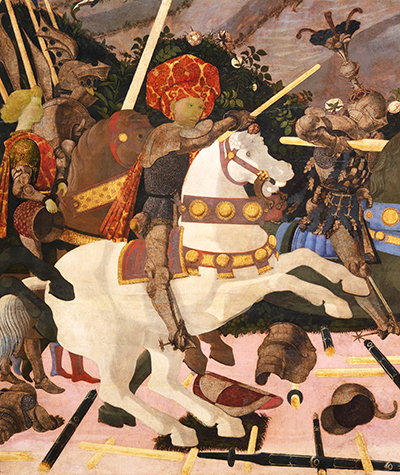
| Niccolò da Tolentino at the Battle of San Romano · London | Probably c.1438–40 | Tempera and oil on wood, with metallic decoration · National Gallery Catalogue. |
| Bernardino della Carda Unhorsed · Florence | c.1435–40 | Tempera on panel · Uffizi Galleries Catalogue. |
| The Counterattack of Micheletto da Cotignola · Paris | 1450–75 in the Louvre catalogue | Tempera (possibly) on wood · Musée du Louvre Catalogue. |
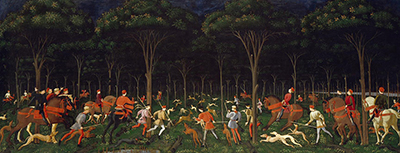
| The Hunt in the Forest | c.1465–70 | Tempera and oil with traces of gold on panel · Ashmolean Catalogue. |
| Saint George and the Dragon · London | c.1470 | Oil on canvas · National Gallery Catalogue. |
| Saint George Slaying the Dragon · Melbourne | c.1430 | Oil, tempera and silver leaf on wood · National Gallery of Victoria Catalogue. |
| Saint George and the Dragon · Paris | 1430–35 in the museum catalogue | Painted wood panel · Musée Jacquemart-André Catalogue. |
| Equestrian Monument to John Hawkwood | 1436 | Transferred wall painting · Florence Cathedral Catalogue. |
| Study for the John Hawkwood Monument | 1436 | Study on prepared paper · Uffizi Catalogue. |
| Monumental Clock Face | 1443 | Painted dial · Florence Cathedral Catalogue. |
| Resurrection of Christ | 1443–44 | Stained glass · Uccello design · Florence Cathedral Catalogue. |
| Nativity | 1440s | Stained glass · Uccello design · Florence Cathedral Catalogue. |
| Creation of the Animals and Creation of Adam | Third to fourth decade of the 15th century | Detached fresco · Green Cloister, Santa Maria Novella Catalogue. |
| Creation of Eve and the Fall | Third to fourth decade of the 15th century | Detached fresco · Green Cloister, Santa Maria Novella Catalogue. |
| Flood and Recession of the Waters | 15th century; dating debated | Detached fresco · Green Cloister, Santa Maria Novella Catalogue. |
| Sacrifice and Drunkenness of Noah | 15th century; dating debated | Detached fresco · Green Cloister, Santa Maria Novella Catalogue. |
| Stories of the Virgin and Saint Stephen · Assunta Chapel | 1430s, with later completion | Fresco cycle · Paolo Uccello and Andrea di Giusto · Prato Cathedral Catalogue. |
| Blessed Jacopone da Todi | 1436 in the diocesan museum | Detached fresco · Museo dell’Opera del Duomo, Prato Catalogue. |
| Adoration of the Child · Bologna | 1430s; inscription incomplete | Detached fresco · San Martino Maggiore, Bologna Catalogue. |
| Adoration of the Christ Child · Karlsruhe | c.1436 | Painted panel · Attribution to Uccello · Staatliche Kunsthalle Karlsruhe Catalogue. |
| Annunciation · Oxford | Early 15th century | Tempera and gilding on panel · Ashmolean Catalogue. |
| Allegory of Monastic Life (Thebaid) | c.1460–65 | Tempera on canvas · Galleria dell’Accademia, Florence Catalogue. |
| Miracle of the Profaned Host | 1467–68 | Tempera on wood · Galleria Nazionale delle Marche, Urbino Catalogue. |
| Triumphal Entry into Rome of Titus and Vespasian(?) | c.1430–35 | Tempera, gold and silver on panel · Yale University Art Gallery Catalogue. |
| Crucifixion with the Virgin and Saints | c.1460–65 | Painted panel · Museo Nacional Thyssen-Bornemisza Catalogue. |
| The Crucifixion · Met triptych | Probably mid-1450s | Tempera on wood with gold ground · Metropolitan Museum of Art Catalogue. |
| Perspective Study of a Chalice | 1450–75 | Pen, ink and stylus on paper · Attributed to Uccello · Uffizi Catalogue. |
| Study of a Mazzocchio | 15th century | Perspective study · Attributed to Uccello · Uffizi Catalogue. |
| Mazzocchio Seen in Perspective | Uncertain | Drawing · Attribution debated · Musée du Louvre Catalogue. |
| Head of a Man in Profile | 15th century | Pen, ink and wash · Musée du Louvre Catalogue. |
| Five Masters of the Florentine Renaissance | 1500–50 | Oil on wood · Anonymous Florentine school · Musée du Louvre Catalogue. |
| Madonna and Child from the Del Beccuto House | 15th century | Detached fresco · Museo di San Marco, Florence Catalogue. |
| Man of Sorrows with the Virgin and Saint John · Avane Predella | 15th century | Predella · Museo di San Marco, Florence Catalogue. |
| Calling of Saint Paul the Hermit · San Miniato | After 1447 to c.1454 in state catalogue | Sinopia · Attributed to Uccello or collaborator Catalogue. |
| The host changes hands · Urbino predella, scene 1 | 1467–68 | Tempera on wood · Component of DE 231 · Galleria Nazionale delle Marche Catalogue. |
| The figures at the door · Urbino predella, scene 2 | 1467–68 | Tempera on wood · Component of DE 231 · Galleria Nazionale delle Marche Catalogue. |
| The procession approaches the altar · Urbino predella, scene 3 | 1467–68 | Tempera on wood · Component of DE 231 · Galleria Nazionale delle Marche Catalogue. |
| The condemned woman and the ladders · Urbino predella, scene 4 | 1467–68 | Tempera on wood · Component of DE 231 · Galleria Nazionale delle Marche Catalogue. |
| Persecution of the family · Urbino predella, scene 5 | 1467–68 | Tempera on wood · Component of DE 231 · Galleria Nazionale delle Marche Catalogue. |
| Angels and demons at the bier · Urbino predella, scene 6 | 1467–68 | Tempera on wood · Component of DE 231 · Galleria Nazionale delle Marche Catalogue. |
| Birth of the Virgin · Prato Cathedral | 1430s; dating debated | Fresco · Assunta Chapel, Prato Cathedral Catalogue. |
| Presentation of the Virgin · Prato Cathedral | 1430s; dating debated | Fresco · Assunta Chapel, Prato Cathedral Catalogue. |
Discussion
Look again at the images and ideas explored in Clock with Heads of Prophets for the Florence Cathedral. These editorial prompts invite your observations.
Reader Insights
Which parts of the dial help you read the hour from the middle of the nave, and which details become clearer as you approach the door?
How does the moving star change the way you read the four faces, and what changes if you think of them simply as figures looking out of painted openings?
Join the Conversation
Share a detail, comparison or question about Clock with Heads of Prophets for the Florence Cathedral below.
References
- Opera di Santa Maria del Fiore. Paolo Uccello, Orologio monumentale, cathedral object entry. View source.
- Opera di Santa Maria del Fiore. “The clock painted by Paolo Uccello for the Cathedral of Florence,” 6 May 2025. View source.
- Opera di Santa Maria del Fiore. “L’orologio del Duomo: un’opera d’arte che segna l’Ora Italica,” on the mechanism and 2014 restoration. View source.
- Opera di Santa Maria del Fiore. “Paolo Uccello e il suo orologio… Controcorrente!”, on the dial, Italian hours and the Evangelist hypothesis. View source.
- Opera di Santa Maria del Fiore. “Cosa rende speciale l’Orologio del Duomo di Firenze,” on the bells and restored display. View source.
- Erika Timm. “Rabbi Juda der Fromme und sein Spiegel. Eine bisher nicht bekannte jiddische Maïse.” Jiddistik Mitteilungen 64, November 2020, p. 18 and notes 112–13, on twenty-four-hour dials and adjustment. View source.
- Opera di Santa Maria del Fiore. Quadrante di orologio, scientific catalogue entry 6785. View source.
- Elisa Camporeale. “Sugli orologi pubblici in Italia: presenze e rappresentazioni.” Atti e memorie dell’Accademia Toscana di Scienze e Lettere La Colombaria 75, new series 61, 2010, especially pp. 229–30 and 240 n. 74. View source.
- Hugh Hudson. “The Politics of War: Paolo Uccello’s Equestrian Monument for Sir John Hawkwood in the Cathedral of Florence.” Parergon 23, no. 2, 2006, especially pp. 22–24 and fig. 4. View source.
- Lorenzo Sbaraglio. “Paolo di Dono, detto Paolo Uccello.” Dizionario Biografico degli Italiani, vol. 81, 2014. View source.
- Opera di Santa Maria del Fiore. Maestranze toscane, Pavimento marmoreo del Battistero, Baptistery object entry. View source.
- Opera di Santa Maria del Fiore. “History and mysteries of the Baptistery’s gnomon.” View source.
- Ministero della Cultura. Teste di profeti (?) entro clipei, Catalogo generale dei Beni Culturali, record 0900289644. View source.
- Opera di Santa Maria del Fiore. Lorenzo Ghiberti, Porta del Paradiso, museum object entry. View source.
- Officine Panerai. “Restoration of the clock in the Florence Duomo painted by Paolo Uccello,” restoration announcement reproduced by MyWatch, 6 June 2014. View source.
- Opera di Santa Maria del Fiore. Natività di Gesù, scientific catalogue entry 5659. View source.
- Opera di Santa Maria del Fiore. Cristo risorto, scientific catalogue entry 5663. View source.
- Jack Forster. “Inside the Walls of the Duomo: A Visit to the Great Clock of Paolo Uccello in Florence, Restored by Officine Panerai.” Hodinkee, eyewitness report and photographs of the movement. View source.
More PAOLO UCCELLO Artworks

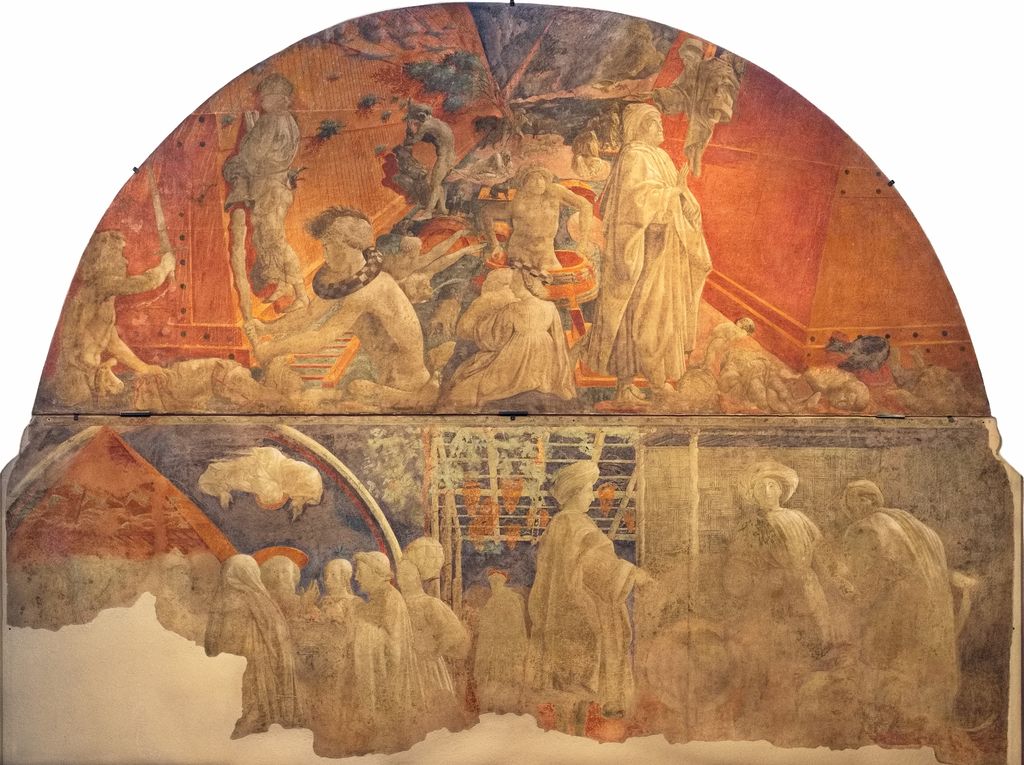
Noah and the Flood
The Flood and Recession of the Waters above the lower episodes from Noah’s story, Santa Maria Novella. Photograph by Armin Kleiner. Image source. CC BY-SA 4.0. Resized for the web. This derivative is available under the same licence.
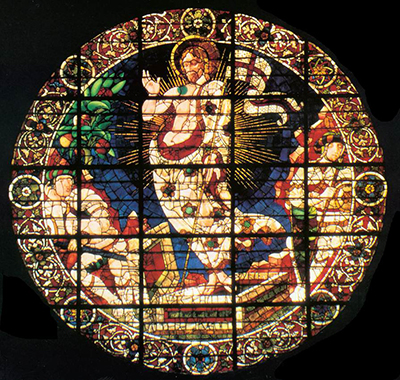
The Resurrection of Christ Stained Glass Window
The Resurrection window in Florence Cathedral, designed by Paolo Uccello and made by Bernardo di Francesco. Photograph by Sailko. Image source. CC BY 3.0. Resized for the web.