


 by Tom Gurney
Tom Gurney BSc (Hons) is an art history expert with over 20 years experience
Published on June 19, 2020 / Updated on November 29, 2026
Email: tomgurney1@gmail.com / Phone: +44 7429 011000
Blessed Jacopone da Todi: Introduction
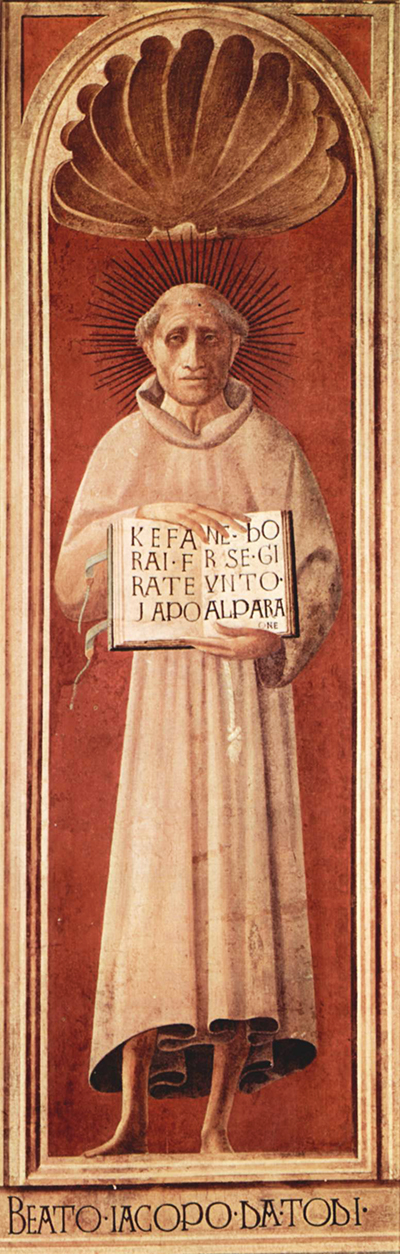
In Paolo Uccello’s fresco of the Franciscan poet Jacopone da Todi, a friar stands barefoot beneath a painted shell. He holds a book open towards us and looks straight out of a red niche. The words on the pages come from a poem Jacopone wrote about his imprisonment. The painting once occupied the back wall of the Chapel of the Assumption in Prato Cathedral. The fragment, 181 centimetres high and 59 wide, is now displayed in the fifteenth-century painting room of Prato’s Museo dell’Opera del Duomo. [1] [2] [3] [4]
At a Glance
- Date1436 according to the Museo dell’Opera del Duomo, with an earlier dating to about 1433–34 also proposed
- Medium and dimensionsDetached fresco, 181 × 59 cm
- LocationMuseo dell’Opera del Duomo, Prato, Italy, originally the Chapel of the Assumption at Prato Cathedral
Contents
- A figure made to be seen from below
- The question in the book
- Why Jacopone was put to the test
- Why paint Jacopone at Prato?
- From the altar wall to the museum
- Annotated details
A figure made to be seen from below
Start at the hem of the habit. Its folds break into a series of dark hollows, and we see far enough beneath the cloth to follow the bare legs down to the ledge. The foot on the left stretches out across it, while the foot on the right is partly hidden by the ledge. These details make the friar seem to have weight and give us a position from which to look. In the chapel the figure stood above the observer. Uccello made that height visible inside the picture. [1] [3]
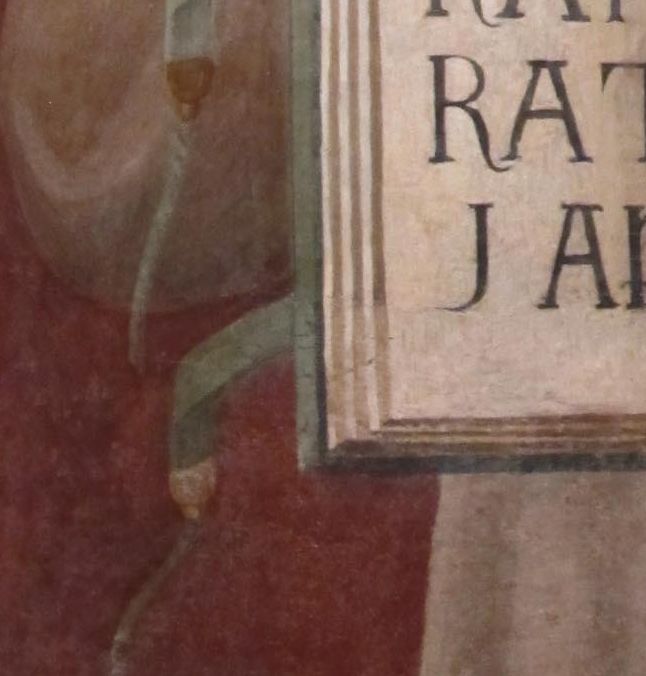
Follow the habit upwards and the view changes. Its long, light folds lead to a book held almost square to the wall. One hand rests across the upper edges of the pages. The other comes up under the binding, carrying its weight. A pale cord drops at the friar’s waist, and thin book ties hang freely at the left. The generous sleeves help the restrained gesture read at some distance. Above the book the bust and face turn fully towards the chapel. You can still look Jacopone in the eye even as the glimpse below the habit tells you that you are standing beneath him. [1] [3] [5]
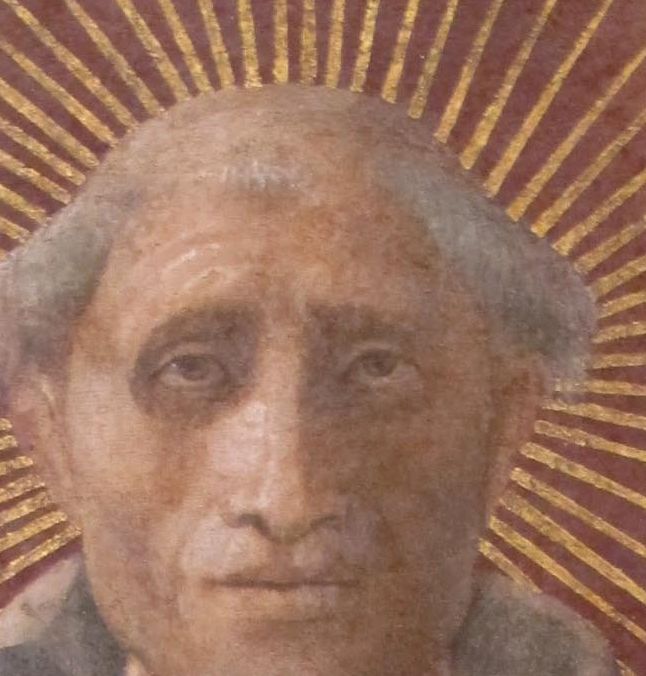
The shell overhead fans out from a low point in the arch, while bands of pale moulding enclose the red field. The dark rays around the friar’s head stand out against that red. His deeply shadowed eyes, drawn cheeks and small closed mouth are the only concentrated marks in an expanse of light cloth. Art historian Machtelt Israëls compares the shell niche to the tabernacle Donatello made for his bronze Saint Louis of Toulouse at Orsanmichele. She also likens the compact silhouette and the foreshortened habit to a statue in painted wood. Look at how little room Jacopone has on either side and how much space his feet seem to find at the bottom. The painter made a strip of plaster behave like an architectural recess deep enough to contain a standing figure. Rebecca Müller, writing about the reverse of an altarpiece in San Zaccaria in Venice, compares its similarly abbreviated view up under a robe with the Prato figure. The example shows how a device familiar from sculpture could also shape the experience of painted figures seen from below. [1] [3] [6]
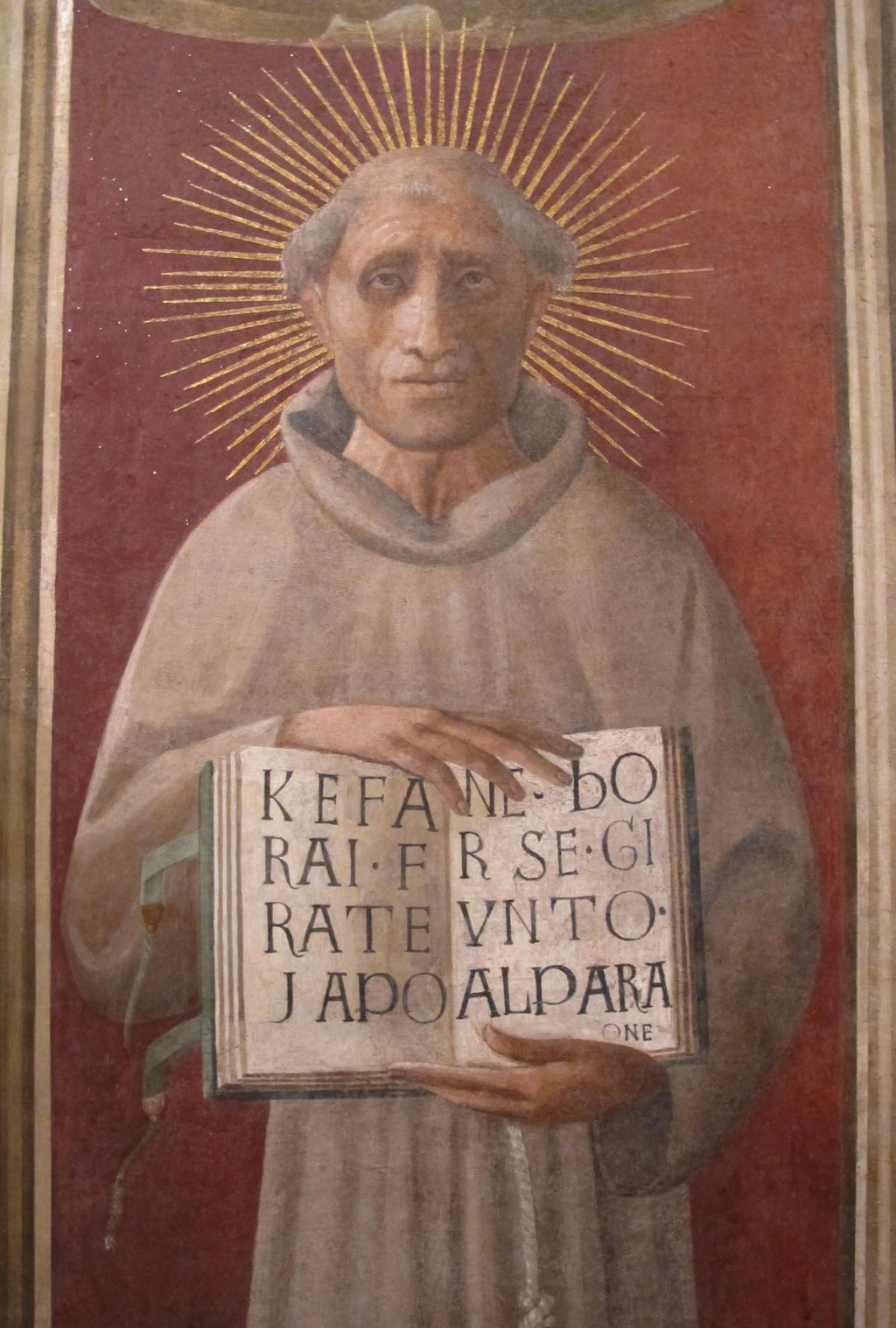
The face, radiating halo and inscribed book in the Prato fresco of Jacopone da Todi. Photograph by Sailko. Image source. CC BY-SA 3.0. Resized for the web. This derivative is available under the same licence.
The question in the book
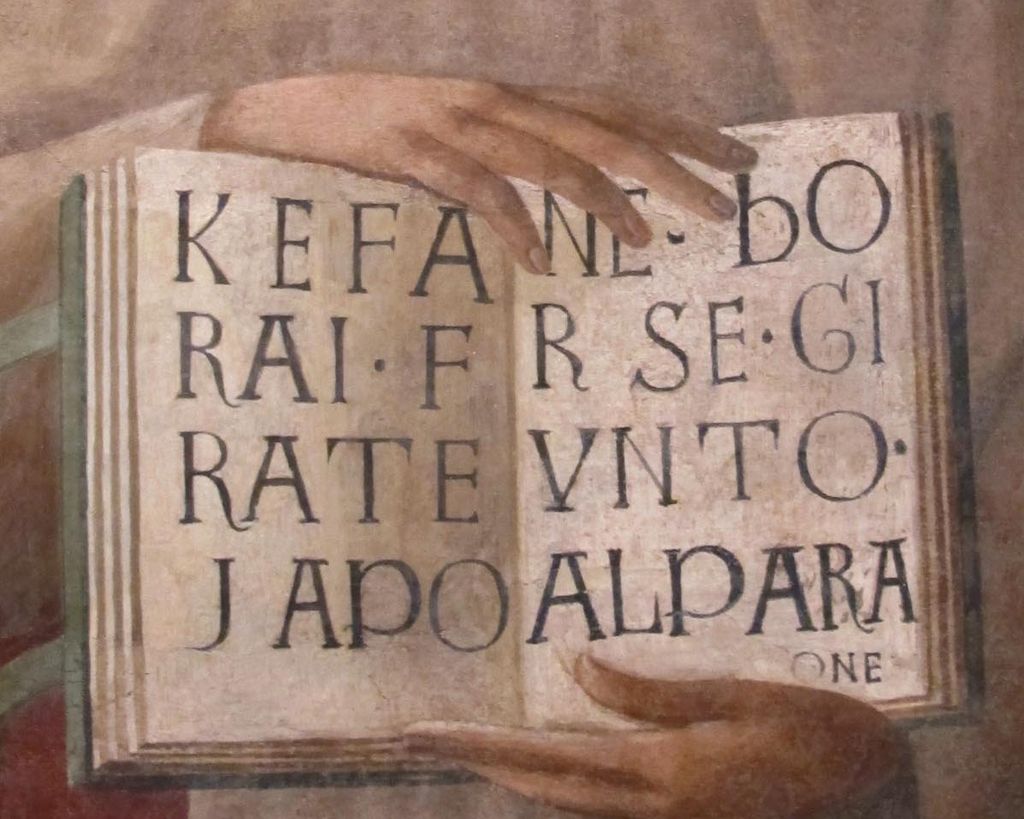
The inscription along the ledge names the figure as Blessed Jacopo of Todi. His habit gives his Franciscan identity, but the book identifies him in a more personal way. The lines are the opening of one of his laude, or vernacular devotional poems. In an English rendering, they ask what Brother Jacopone will do now that he has come to the test. His name is woven into the line he speaks to himself. A viewer who recognised the poem could supply something of his voice for the silent figure on the wall. [3] [4] [7]
The lettering is worth reading across both leaves. Large capitals fill the book almost to the binding, with dots between some words and a few smaller letters tucked at the foot of the right page. The painted name reads Japone, a loss of letters that the philologist Claudio Ciociola identifies as a copying error. Ciociola also notes that the second line differs from the wording preferred in the modern critical edition and that the painted variant is attested in the manuscript tradition. The visual resemblance to carved lettering is striking: the page is painted as part of a book, but the capitals give the verse the public presence of an inscription. The shorter name on the ledge and the unusual spelling in the book both belong to the same identification. An old Brogi photograph in the Federico Zeri archive keeps the name Jacopo da Todi but describes the painter as an unknown artist of the fifteenth century. Recognition of the friar remained consistent even when the name of the painter was in doubt. [3] [4] [5] [8]
There is a telling comparison in a fifteenth-century manuscript of Jacopone’s poetry in the Biblioteca Riccardiana in Florence. In the decorated initial at the start of the collection, the friar points to the opening of a different poem in a book that he holds. Ciociola draws attention to the way the manuscript repeats its own first words inside the image. In the Prato fresco, something comparable happens on a wall. Uccello takes a form associated with the act of reading and makes the opening of a poem legible as part of a public likeness. Laude also belonged to a culture of shared vernacular devotion. Matteo Leonardi describes how the confraternity at San Francesco in Cortona gathered around a book of sacred songs to sing. That practice helps explain how a familiar opening could bring a whole poem to mind. [4] [9]
Annotated Details from Blessed Jacopone da Todi
The numbered points identify visible features discussed in this article. Return from each detail to the numbered overview. The face, radiating halo and inscribed book in the Prato fresco of Jacopone da Todi. Photograph by Sailko. Image source. CC BY-SA 3.0. Numbered overview and cropped details from the original photograph. This overview and these details are available under CC BY-SA 3.0.
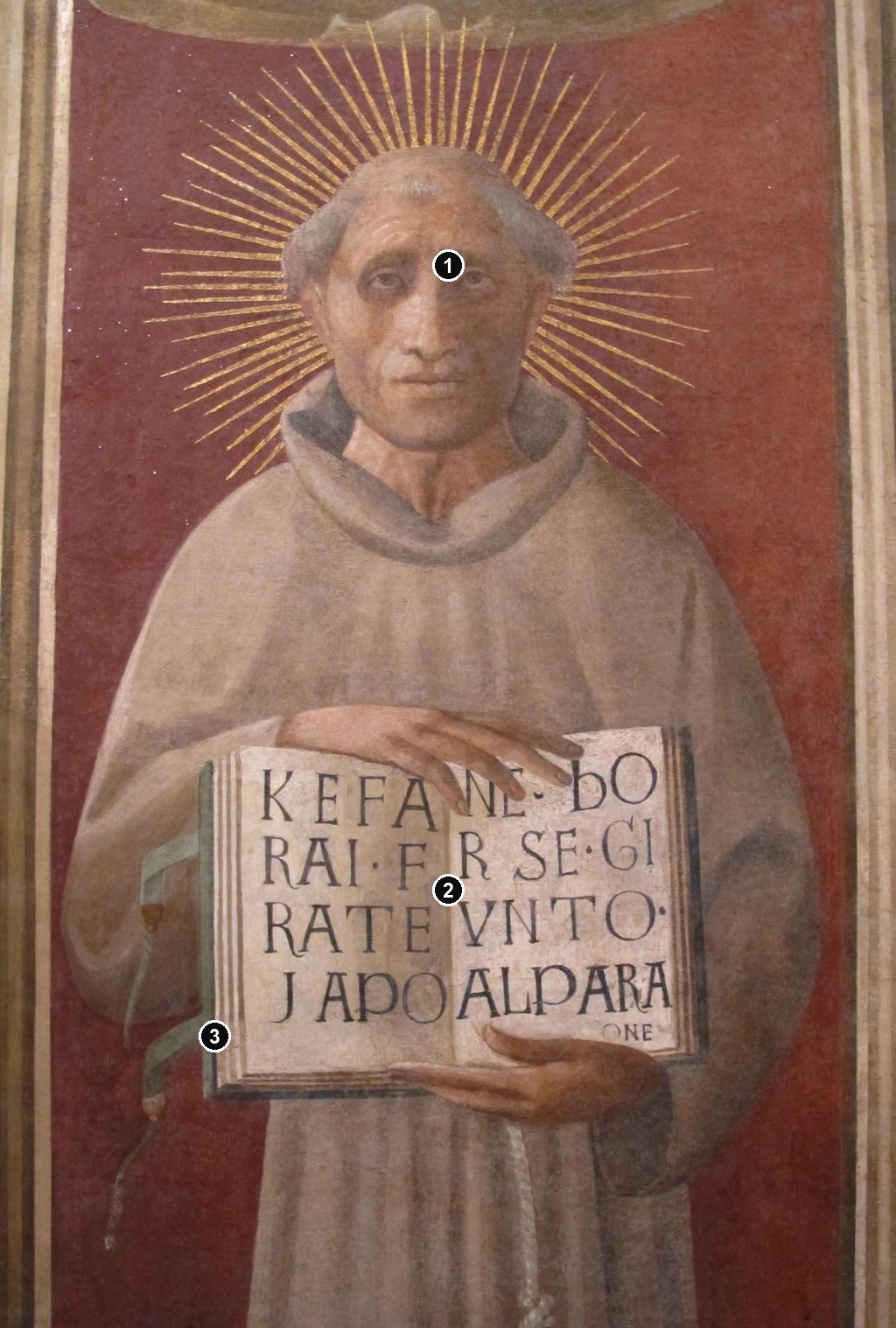
Details from BLESSED JACOPONE DA TODI
Compare the cropped details with the source images above. Notice how their colours, shapes and positions contribute to the larger compositions.
The radiating halo
Narrow radiating gold lines stand out against the red ground and frame a face directed outward toward the viewer.
The inscription spread over an open book
Several words extend across line breaks and the centre of the open book. The fingers interrupt the letters, giving the book a sense of weight and use.
The rough habit and the book ribbon
The grey sleeve and painted ribbon set off the bright book pages. The ribbon curls down beside the exposed edge of the book.
Why Jacopone was put to the test
Jacopone joined the Franciscan Order in the late thirteenth century and sided with the Spirituals, who pressed for strict observance of the rule, especially its demands of poverty. In 1297 he signed the manifesto at Lunghezza in which the Colonna cardinals challenged the legitimacy of Pope Boniface VIII and appealed to a council. When the papal forces took Palestrina in 1298, Jacopone was imprisoned. He wrote about his captivity and appealed against his excommunication. He gained his release and absolution under Boniface’s successor, Benedict XI, and spent his last years at Collazzone, where he died in 1306. [10] [11]
In the poem Uccello quotes, that history comes down to bodily particulars. Jacopone describes an underground cell, a chain that tangles when he turns at night, and bread kept in a basket hung out of reach of mice. He jokes grimly about his fortunes by talking of his imprisonment as if he had been rewarded with a rich ecclesiastical post. The friar in the fresco holds his ground and offers the first lines of that poem without any of the scenery of captivity. That choice gives the face particular force. The weariness around the eyes can be read alongside a verse that meets disgrace with defiance, self-examination and humour. [1] [4] [7] [10]
Why paint Jacopone at Prato?
The friar’s appearance in the Assumption Chapel was unusual. The side walls tell the lives of Mary and Saint Stephen, and Saint Francis himself appears at the entrance. Jacopone takes a place among the chapel’s devotional figures more than a century after he died. The art historian Alessandro Angelini connected this rare subject with two events in 1433. Jacopone’s remains were rediscovered and transferred at Todi in January, and Bernardino of Siena, a Franciscan preacher who admired his poetry, spoke at Prato that Easter. The timing gives a plausible reason why the poet was of particular interest when the chapel was being painted. [1] [12] [13]
The Museo dell’Opera gives the fresco as 1436. The checklist for the 2013 exhibition The Springtime of the Renaissance at Palazzo Strozzi gives about 1433–34. Another clue comes from Andrea di Giusto’s Madonna of the Belt, dated 1437 and painted for Cortona. Scholars have pointed out the resemblance of its Saint Francis, including the way his habit flares, to Uccello’s Saint Francis in the chapel entrance. This comparison concerns a neighbouring figure, so its value is in dating Uccello’s work in the chapel as a whole. The Jacopone revival and the likeness in the dated altarpiece make a case for the earlier part of the decade, although neither provides the date on which Uccello painted this section of plaster. [1] [2] [12] [13] [14]
The diocesan museum also connects the choice of Jacopone with the wool merchant Michele Marcovaldi. Matteo Mazzalupi’s archival work complicates that suggestion. Marcovaldi’s 1435 provision was for a chaplaincy at the altar where the Sacred Girdle of the Virgin was shown, in a different part of the church. Evidence for the later work of Andrea di Giusto leads to another bequest, made by Stefano di Ciato. The person who asked Uccello to paint Jacopone remains uncertain. The painted friar is a direct witness to the reach of his memory, even when the records leave open who arranged for his portrait to appear there. [1] [12] [13] [15]
From the altar wall to the museum
A later altar dedicated to the Guardian Angel covered much of the Assumption Chapel’s back wall. Uccello’s friar came to light when that seventeenth-century structure was removed in 1871. The diocesan museum dates the detachment to that rediscovery. A watercolour by Giuseppe Nesti records the newly exposed wall, including heraldic shields near the feet of two other figures. Most of the earlier decoration on that wall was lost in the nineteenth-century work. The fresco that survives was once part of a company of figures, and the isolated format in which we now see it is a consequence of what happened to the wall. [1] [12] [13] [15]
The detached fresco has also been displayed away from its current museum. The 2006–07 exhibition on Jacopone and medieval Umbrian art in Todi listed the work from Prato’s Museo di Pittura Murale and showed it alongside evidence of the poet’s life and the circulation of his writings. In Prato today, the Museo dell’Opera exhibits it with other fifteenth-century paintings. The two settings invite different kinds of attention. The museum display brings the face and lettering within close range. A visit to the Prato Cathedral frescoes sets the niche back in the room for which it was planned and makes it easier to picture a viewer lifting their eyes to the friar and the book. [1] [9] [11] [12]
Artworks directory
Browse paintings, drawings, stained-glass designs and other objects connected with Uccello. Cycles and their surviving components may have separate entries. The collection or catalogue’s wording is retained where a date, attribution or subject is debated.
| Name | Date | Medium, attribution and collection |
|---|---|---|
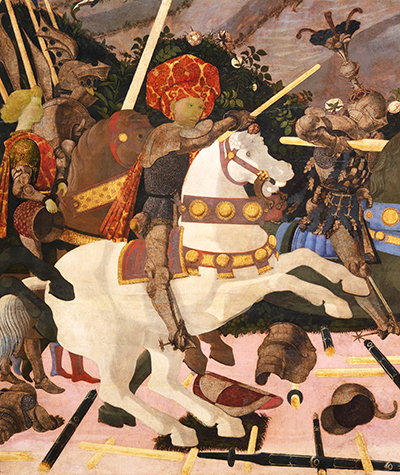
| Niccolò da Tolentino at the Battle of San Romano · London | Probably c.1438–40 | Tempera and oil on wood, with metallic decoration · National Gallery Catalogue. |
| Bernardino della Carda Unhorsed · Florence | c.1435–40 | Tempera on panel · Uffizi Galleries Catalogue. |
| The Counterattack of Micheletto da Cotignola · Paris | 1450–75 in the Louvre catalogue | Tempera (possibly) on wood · Musée du Louvre Catalogue. |
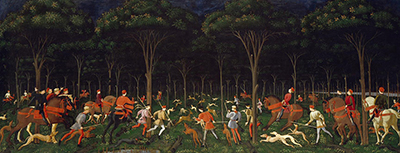
| The Hunt in the Forest | c.1465–70 | Tempera and oil with traces of gold on panel · Ashmolean Catalogue. |
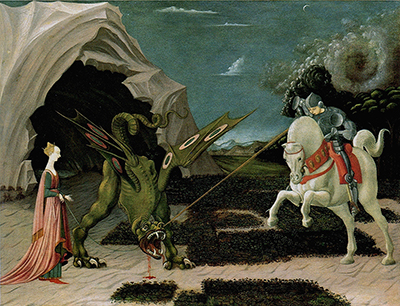
| Saint George and the Dragon · London | c.1470 | Oil on canvas · National Gallery Catalogue. |
| Saint George Slaying the Dragon · Melbourne | c.1430 | Oil, tempera and silver leaf on wood · National Gallery of Victoria Catalogue. |
| Saint George and the Dragon · Paris | 1430–35 in the museum catalogue | Painted wood panel · Musée Jacquemart-André Catalogue. |
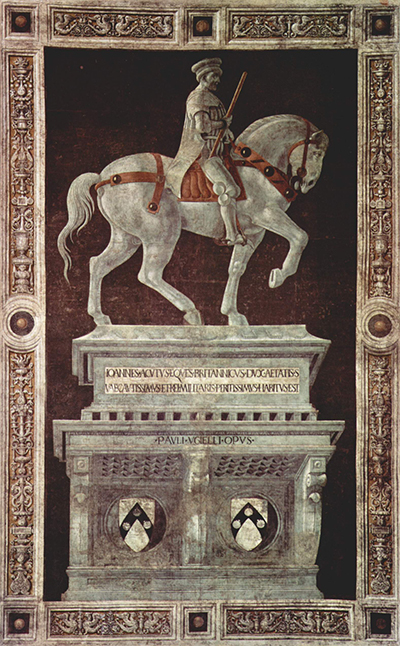
| Equestrian Monument to John Hawkwood | 1436 | Transferred wall painting · Florence Cathedral Catalogue. |
| Study for the John Hawkwood Monument | 1436 | Study on prepared paper · Uffizi Catalogue. |
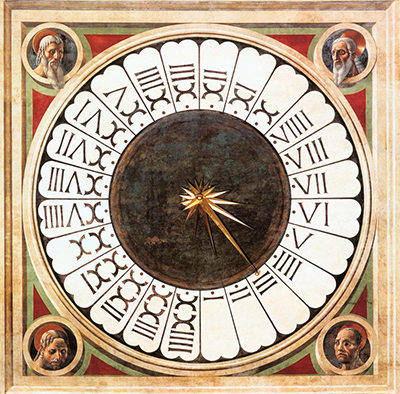
| Monumental Clock Face | 1443 | Painted dial · Florence Cathedral Catalogue. |
| Resurrection of Christ | 1443–44 | Stained glass · Uccello design · Florence Cathedral Catalogue. |
| Nativity | 1440s | Stained glass · Uccello design · Florence Cathedral Catalogue. |
| Creation of the Animals and Creation of Adam | Third to fourth decade of the 15th century | Detached fresco · Green Cloister, Santa Maria Novella Catalogue. |
| Creation of Eve and the Fall | Third to fourth decade of the 15th century | Detached fresco · Green Cloister, Santa Maria Novella Catalogue. |
| Flood and Recession of the Waters | 15th century; dating debated | Detached fresco · Green Cloister, Santa Maria Novella Catalogue. |
| Sacrifice and Drunkenness of Noah | 15th century; dating debated | Detached fresco · Green Cloister, Santa Maria Novella Catalogue. |
| Stories of the Virgin and Saint Stephen · Assunta Chapel | 1430s, with later completion | Fresco cycle · Paolo Uccello and Andrea di Giusto · Prato Cathedral Catalogue. |
| Blessed Jacopone da Todi | 1436 in the diocesan museum | Detached fresco · Museo dell’Opera del Duomo, Prato Catalogue. |
| Adoration of the Child · Bologna | 1430s; inscription incomplete | Detached fresco · San Martino Maggiore, Bologna Catalogue. |
| Adoration of the Christ Child · Karlsruhe | c.1436 | Painted panel · Attribution to Uccello · Staatliche Kunsthalle Karlsruhe Catalogue. |
| Annunciation · Oxford | Early 15th century | Tempera and gilding on panel · Ashmolean Catalogue. |
| Allegory of Monastic Life (Thebaid) | c.1460–65 | Tempera on canvas · Galleria dell’Accademia, Florence Catalogue. |
| Miracle of the Profaned Host | 1467–68 | Tempera on wood · Galleria Nazionale delle Marche, Urbino Catalogue. |
| Triumphal Entry into Rome of Titus and Vespasian(?) | c.1430–35 | Tempera, gold and silver on panel · Yale University Art Gallery Catalogue. |
| Crucifixion with the Virgin and Saints | c.1460–65 | Painted panel · Museo Nacional Thyssen-Bornemisza Catalogue. |
| The Crucifixion · Met triptych | Probably mid-1450s | Tempera on wood with gold ground · Metropolitan Museum of Art Catalogue. |
| Perspective Study of a Chalice | 1450–75 | Pen, ink and stylus on paper · Attributed to Uccello · Uffizi Catalogue. |
| Study of a Mazzocchio | 15th century | Perspective study · Attributed to Uccello · Uffizi Catalogue. |
| Mazzocchio Seen in Perspective | Uncertain | Drawing · Attribution debated · Musée du Louvre Catalogue. |
| Head of a Man in Profile | 15th century | Pen, ink and wash · Musée du Louvre Catalogue. |
| Five Masters of the Florentine Renaissance | 1500–50 | Oil on wood · Anonymous Florentine school · Musée du Louvre Catalogue. |
| Madonna and Child from the Del Beccuto House | 15th century | Detached fresco · Museo di San Marco, Florence Catalogue. |
| Man of Sorrows with the Virgin and Saint John · Avane Predella | 15th century | Predella · Museo di San Marco, Florence Catalogue. |
| Calling of Saint Paul the Hermit · San Miniato | After 1447 to c.1454 in state catalogue | Sinopia · Attributed to Uccello or collaborator Catalogue. |
| The host changes hands · Urbino predella, scene 1 | 1467–68 | Tempera on wood · Component of DE 231 · Galleria Nazionale delle Marche Catalogue. |
| The figures at the door · Urbino predella, scene 2 | 1467–68 | Tempera on wood · Component of DE 231 · Galleria Nazionale delle Marche Catalogue. |
| The procession approaches the altar · Urbino predella, scene 3 | 1467–68 | Tempera on wood · Component of DE 231 · Galleria Nazionale delle Marche Catalogue. |
| The condemned woman and the ladders · Urbino predella, scene 4 | 1467–68 | Tempera on wood · Component of DE 231 · Galleria Nazionale delle Marche Catalogue. |
| Persecution of the family · Urbino predella, scene 5 | 1467–68 | Tempera on wood · Component of DE 231 · Galleria Nazionale delle Marche Catalogue. |
| Angels and demons at the bier · Urbino predella, scene 6 | 1467–68 | Tempera on wood · Component of DE 231 · Galleria Nazionale delle Marche Catalogue. |
| Birth of the Virgin · Prato Cathedral | 1430s; dating debated | Fresco · Assunta Chapel, Prato Cathedral Catalogue. |
| Presentation of the Virgin · Prato Cathedral | 1430s; dating debated | Fresco · Assunta Chapel, Prato Cathedral Catalogue. |
Discussion
Look again at the images and ideas explored in Blessed Jacopone da Todi. These editorial prompts invite your observations.
Reader Insights
Where does your eye go first, to Jacopone’s face or to the words in the book, and how does that change the feel of the encounter?
How do the foreshortened feet, dark folds at the hem and straight-on face work together when you picture standing below the fresco in the chapel?
Join the Conversation
Share a detail, comparison or question about Blessed Jacopone da Todi below.
References
- Musei Diocesani di Prato. Sala della Pittura del Quattrocento. Museo dell’Opera del Duomo, object entry for Beato Iacopo da Todi. View source.
- Fondazione Palazzo Strozzi and Musée du Louvre. La Primavera del Rinascimento. La scultura e le arti a Firenze 1400–1460. Florence exhibition press dossier, 2013, checklist item 6.03, Jacopone da Todi, inv. AGJ 2685. View source.
- Rebecca Müller. Stil oder Modus? Zum Verhältnis von Wandmalerei und Altardekoration in San Zaccaria. Marburger Jahrbuch für Kunstwissenschaft 36, 2009, pp. 33–75, especially fig. 19 and discussion on pp. 53–54. View source.
- Claudio Ciociola. “Visibile parlare”: agenda, 2nd ed., Cassino, 1992, pp. 94–95. Reading of the painted book and comparison with Biblioteca Riccardiana ms. 2762. View source.
- Epigraphica Dialogica Volgare, Sapienza Università di Roma. Record 08.128, Paolo Uccello, Jacopone da Todi. View source.
- Machtelt Israëls. Sculptured Painting in Early Renaissance Florence. In The Springtime of the Renaissance: Sculpture and the Arts in Florence 1400–60, Florence, 2013, pp. 150–157. View source.
- Jacopone da Todi. Laude, Que farai, fra’ Iacovone?, numbered LIII in the IntraText edition and LV in some other editions. View source.
- Fondazione Federico Zeri, Università di Bologna. Brogi photograph 31283, Prato – Cattedrale – Beato Jacopo da Todi; ignoto del XV secolo. The record links the historical photograph to the modern object entry under Paolo di Dono. View source.
- Matteo Leonardi. Tra Cortona e Assisi: il Laudario cortonese e lo spirito di Francesco. Discussion of the Franciscan song tradition and illustrated entry for the Prato fresco. View source.
- Franca Ageno Brambilla. Benedetti, Iacopo. Dizionario Biografico degli Italiani, vol. 8, 1966. View source.
- Iacopone da Todi e l’arte in Umbria nel Duecento. Todi exhibition dossier, 2006–07, first section curated by Enrico Menestò, fiche 56. View source.
- Lorenzo Sbaraglio. Paolo di Dono, detto Paolo Uccello. Dizionario Biografico degli Italiani, vol. 81, 2014. View source.
- Matteo Mazzalupi. Un caso di metodo. Gli affreschi di Prato e la giovinezza di Paolo Uccello. In Da Donatello a Lippi. Officina pratese, Milan, 2013, pp. 65–75. Discusses Alessandro Angelini’s proposed dating in Prospettiva 61, 1991, pp. 49–53. View source.
- Galleria dell’Accademia di Firenze. Madonna of the Belt between Sts Catherine of Alexandria and Francis of Assisi. Andrea di Giusto’s 1437 altarpiece for Cortona. View source.
- Matteo Mazzalupi. “Licet indigeat picturis et ornamentis”. Affondi per Paolo Uccello a Prato. In Officina Pratese. Tecnica, stile, storia, 2014, pp. 263–273. View source.
More PAOLO UCCELLO Artworks

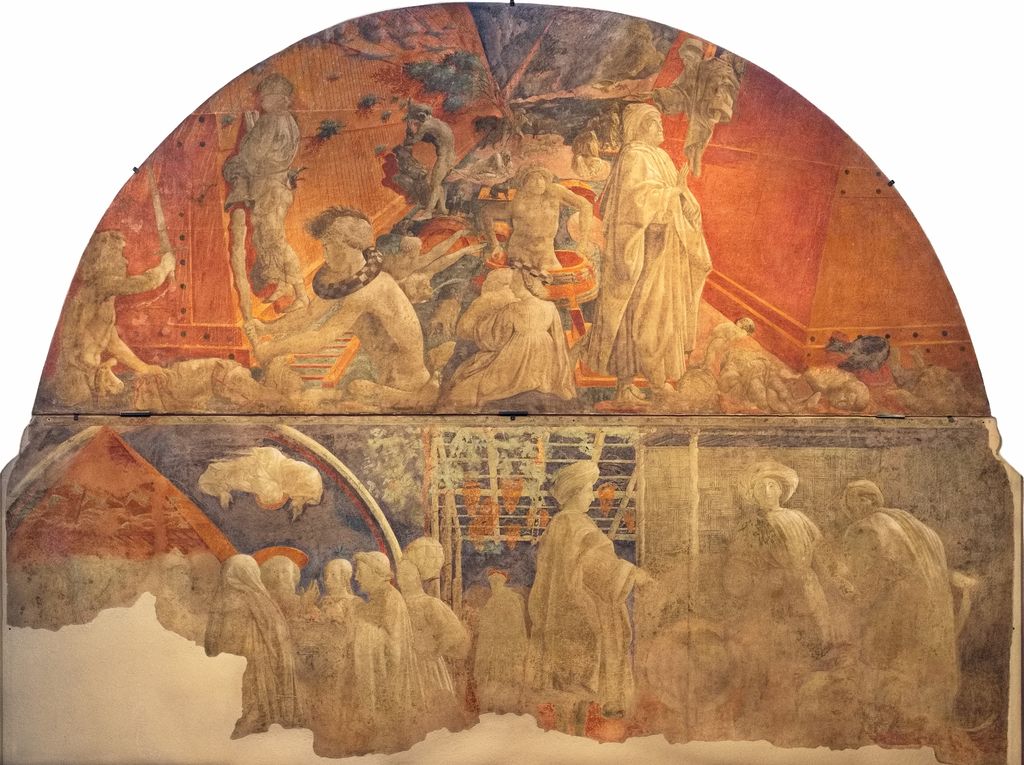
Noah and the Flood
The Flood and Recession of the Waters above the lower episodes from Noah’s story, Santa Maria Novella. Photograph by Armin Kleiner. Image source. CC BY-SA 4.0. Resized for the web. This derivative is available under the same licence.
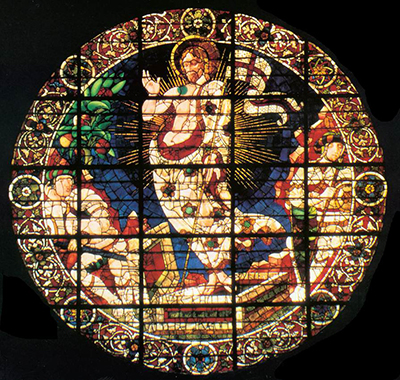
The Resurrection of Christ Stained Glass Window
The Resurrection window in Florence Cathedral, designed by Paolo Uccello and made by Bernardo di Francesco. Photograph by Sailko. Image source. CC BY 3.0. Resized for the web.