


 by Tom Gurney
Tom Gurney BSc (Hons) is an art history expert with over 20 years experience
Published on June 19, 2020 / Updated on November 29, 2026
Email: tomgurney1@gmail.com / Phone: +44 7429 011000
Saint George and the Dragon: Introduction
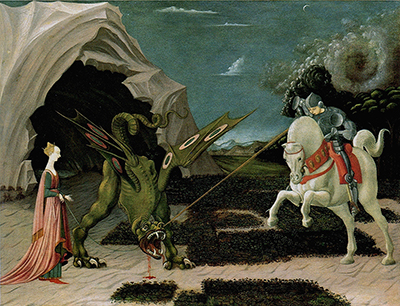
Paolo Uccello’s Saint George and the Dragon shows the knight driving his lance into the dragon’s head while the princess already has the creature on a leash. The National Gallery in London dates this oil painting on canvas to about 1470. It measures 55.6 × 74.2 cm and is catalogued as NG6294. [1]
At a Glance
- DateAbout 1470
- MediumOil on canvas
- CollectionNational Gallery, London (NG6294)
This work across Paolo Uccello’s career
Battle of San Romano
Probably c.1438–40 · GordonResurrection glass
1443–44The Hunt in the Forest
c.1465–70The Urbino predella
1467–68Contents
- Why the princess is already holding the dragon
- A landscape pulled in several directions
- The dragon, the storm and the land
- What the canvas tells us
- The drawing beneath the paint
- What has happened to the colours
- Two panels and a Florentine relief
- From Vienna to London
- Annotated details
Why the princess is already holding the dragon
In Jacobus de Voragine’s thirteenth-century Golden Legend, a dragon living in a swamp terrorises Silene in Libya. The inhabitants placate it with sheep until the supply runs low, then draw lots to decide whose child to sacrifice. When the lot falls to the king’s daughter, her father dresses her in royal robes and sends her out to face the creature. George meets her outside the city and wounds the dragon with his lance. At his instruction she ties her girdle around its neck and leads it back to the city. George offers to kill it if the inhabitants convert to Christianity. They agree, and he kills the dragon with his sword. [2]
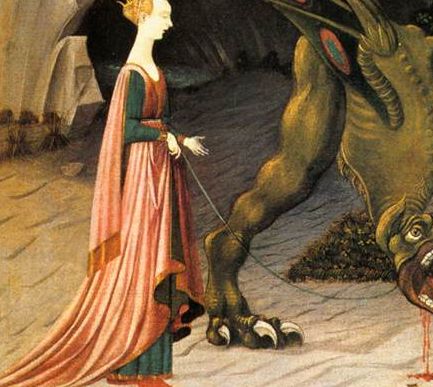
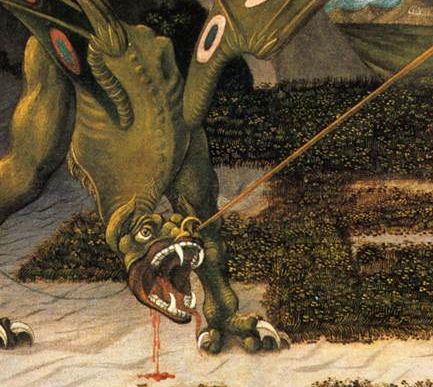
Uccello combines the wound and the tethering. The lance enters the dragon’s head from the right, beneath the pointed wing, while the narrow line of the girdle extends towards the princess at the left. The monster still spreads its wings and braces its feet even as she holds it in check. Eye-like markings punctuate the webbing, and a thin streak of blood falls from the head to the ground. She stands upright in profile and has only to reach a hand in front of her to keep hold of the line. The saint and his horse appear to strain against the dragon, but much of the tension comes from seeing the princess handle the same creature with so little apparent effort. [1]
The girdle is easy to miss beside the much longer lance. Once you notice it, the story changes. The princess has survived the encounter and is already helping to bring it to an end. George’s part is visible in the straight diagonal of his weapon, hers in the slack curve of the tether. The city in the distance leaves room in the picture for what happens next. The citizens, their baptism and the dragon’s death all lie beyond the moment Uccello chose to paint. [1] [2]
A landscape pulled in several directions
The space immediately behind George’s horse opens into a view of the country beyond, with walls just visible on the horizon. Patches of grass get smaller as they extend into the distance. In the foreground, the roughly rectangular stones tilt towards the right, drawing the eye along a different line. The cave presents a third invitation to look into depth. Rings and ridges on its rock face follow the curved opening back towards a dark interior. Each device works over a short stretch of the painting. Their directions are harder to reconcile if you try to read the whole landscape from a single fixed viewpoint. [1]
The two ends of the picture also speak to each other across the action. The cave and the dragon below it share a jagged silhouette. At the upper right, banks of cloud seem to turn in on themselves, echoing the recesses of the rock across the sky. The lance runs in the direction of the dragon’s raised wing and towards the clouds behind George. The Gallery notes how awkwardly George bends his arm to hold it at that angle. A more plausible grip would change the line that binds those forms together. [1]
Look also at the white horse’s sharply bent forelegs and its sweeping neck. Its lifted front hooves clarify the outline of the body against the ground, and the shape of its neck makes the horse legible even where George’s armour and saddle interrupt the white. The small crescent above the action may suggest twilight, as the National Gallery proposes. The Gallery’s teaching notes suggest that the cloud’s alignment with the lance could signal divine help. Its current account stresses the magical atmosphere and leaves the cloud’s precise meaning open. [1] [3]
Annotated Details from Saint George and the Dragon
The numbered points identify visible features discussed in this article. Return from each detail to the numbered overview. The London Saint George and the Dragon, National Gallery NG6294. Image source. Public domain.
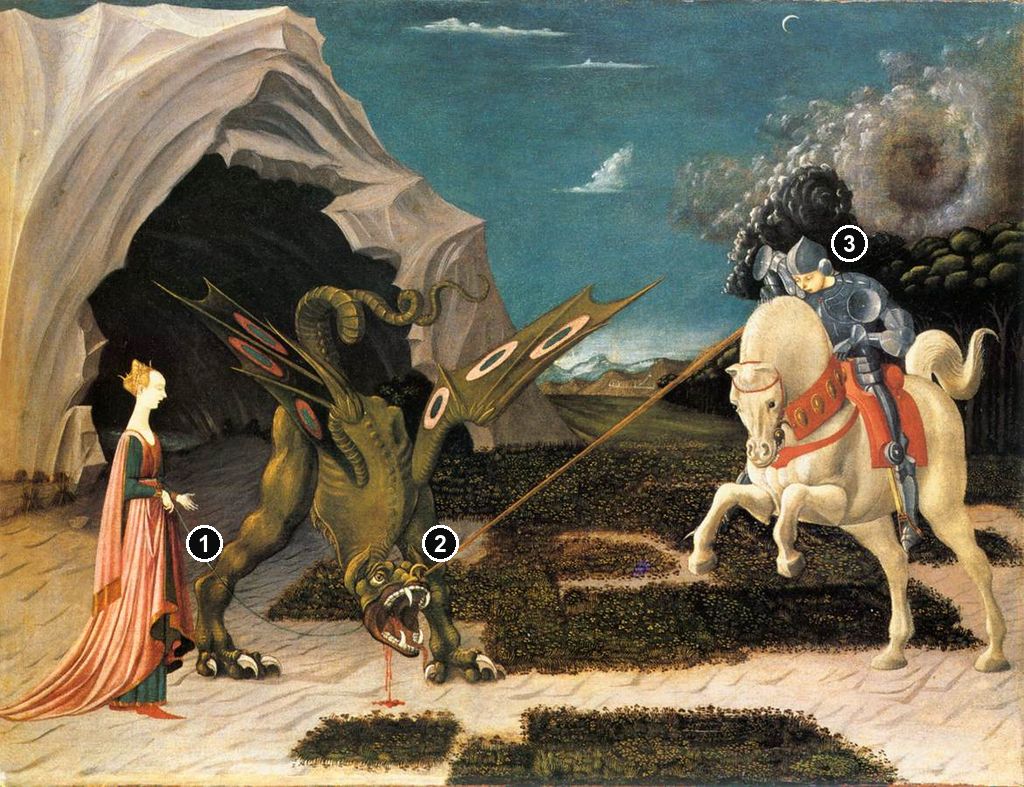
Details from SAINT GEORGE AND THE DRAGON
Compare the cropped details with the source images above. Notice how their colours, shapes and positions contribute to the larger compositions.
The princess and the tether
The princess holds the tether as the dragon faces the knight. The thin line ties her small gesture to the attack across the centre.
Lance and jaws
The lance meets the dragon on a rising diagonal. The overlapping head and weapon compress the intervention into one small point.
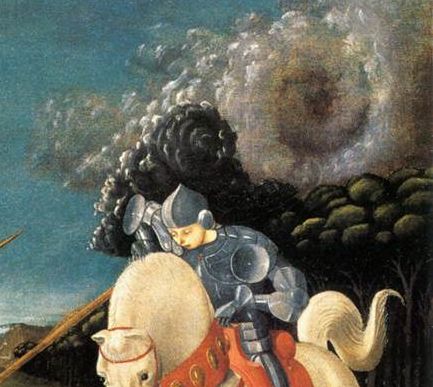
The cloud above the knight
A spiral of dark cloud brings a second turn to the work above the knight and horse. Look back to the cave to compare the two large arcs.
The dragon, the storm and the land
Art historian Emanuele Lugli reads the landscape in light of fifteenth-century Tuscan fears about stagnant water. In the Golden Legend, the dragon lives in a swamp and its breath makes the air dangerous. Lugli draws attention to the water he identifies by the cave, the way the dragon lowers its head and the vortex directly behind the rider. He suggests that a contemporary audience could have associated the monster with foul air rising from marshes and the clouds with rain that cleanses it. He connects those associations to the Florentine interest in drainage and in bringing land back into cultivation. [2] [4]
This reading puts the ground on which the contest takes place at the centre of the story. Lugli sees the Paris panel’s ploughed fields as an even clearer invitation to connect the episode with agriculture. In London the identification of the cloud with cleansing rain and of the dragon with pollution is an interpretation grounded in period writings about land and water. The picture gives us the cloud, the cave and the cultivated-looking patches of ground, while its original commission and the meaning attached to those details by its first viewers remain undocumented. [1] [4]
What the canvas tells us
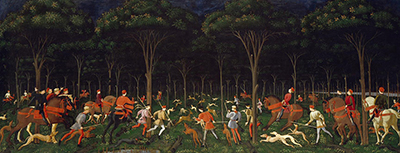
The Gallery’s current date is a useful approximation. Dillian Gordon places the painting around 1468 in her catalogue biography. Jill Dunkerton and Ashok Roy suggested the early 1470s in their technical study, following James Beck’s proposed chronology for the closely related subject in Paris. An earlier date also has a history. The Fondazione Federico Zeri catalogue gives 1455–60, and the Gallery once used about 1460 in its teaching notes. The princess’s pointed shoes suggest a fashion around 1460, whereas the knight’s armour recalls the earlier Battle of San Romano. The handling of the landscape invites comparison with Uccello’s late Hunt in the Forest in Oxford. These clues carry different weight, and the patron, commission and precise year of the London painting remain unknown. [1] [3] [5] [6] [7]
The National Gallery suggests a home as a possible setting, perhaps even a bedroom. The canvas is small enough to examine at close range, and the pigments include azurite but do without costly ultramarine or gilding. The storytelling leaves most of the legend’s explicitly religious action offstage. The object itself supplies evidence for its original appearance at the edges. Traces of azurite show that a broad blue band was painted over the gesso near the margins. Some of that paint survives where canvas folds around the stretcher. The blue border belonged to the prepared cloth and should be distinguished from the separate fifteenth-century Italian frame the Gallery now lists. [1] [6]
The cloth is a relatively coarse plain-weave linen. A fault crosses it near the dragon’s mouth and the horse’s hind legs. It shows up in the X-ray like a join, although close examination identified it as a fault in the weave. When the painting was cleaned and examined after its 1959 acquisition, the Gallery looked for signs that a painting first made on wood had been transferred to the cloth. The relationship of the gesso to the linen and the surviving margins support the use of canvas from the outset. The canvas was subsequently lined, probably in the nineteenth century. [6]
The drawing beneath the paint
Infrared reflectography reveals dark lines underneath parts of the painted scene. Around the princess, these lines show changes in the placement and size of her hands, the contours of her crown and the folds at the front of her dress. Uccello carried the folds farther out over areas where he had already painted the landscape. The opening of the cave beside her had first been set lower, nearer to the figure. Changes also occur on the other side. The published comparison suggests that the lance was narrowed or shifted slightly upwards, and the technical study records revisions to the horse, the saint and the country immediately behind him. [1] [6]
A different set of marks lies deeper in the picture’s history. Dunkerton and Roy re-examined fragments of paint under the microscope and found that a dark stratum once interpreted as a general priming was missing in some samples and replaced by dull green in others. In several sections, orange-red paint lies beneath these local colours. A broadly brushed layer of lead white lies above them in the examined samples. Beneath the princess’s dress, the infrared image catches dark, curved geometric forms. The researchers proposed that the cloth might have carried an unfinished decorative design, possibly heraldic or emblematic, which was covered with white before the present scene began. [6]
The marks give only part of the pattern. The relevant colours register weakly in X-rays, especially below lead white, and the red earth beneath them gives little contrast in infrared. Samples came chiefly from near the edges, so the distribution of the dark layer across the centre remains uncertain. There is also a curving mark in the X-ray that the conservators interpreted as a ridge of white paint. It is distinct from the dark forms seen in the infrared image. Taken together, these findings explain why a previously used canvas is plausible and why its proposed earlier design is still unidentified. [6]
What has happened to the colours
The Gallery’s medium survey found walnut oil in samples of the blue-green sky and bright green grass, and heat-bodied walnut oil in a sample of the pink path. Heat-bodied oil has been thickened by heating. These findings identify binders in particular samples. The blue at the edge may have had a different binder, since infrared microscopy suggested possible egg tempera there. The Gallery’s catalogue designation of oil on canvas describes the painting as a whole, while the analyses let us see differences between the visible paint and individual preparatory or border layers. [1] [6] [8]
Today the azurite sky looks greener than the Gallery judges it would originally have appeared. The princess’s green garment has darkened and the red of her overdress has faded. The grass has changed too. A strip at the bottom, long covered by the frame, retained a brighter green. When reframing exposed some of that paint to light, colour measurements over the later twentieth century tracked a shift towards brown in the copper-containing glaze. The researchers checked whether moving the measuring spot across the unevenly coloured blades of grass could account for the difference. The shift towards yellow persisted even when the exact placement changed. The protected strip gives a local clue to the earlier colour and to how much the contrast between foliage and ground has diminished. [1] [6] [9]
Two panels and a Florentine relief
The National Gallery of Victoria’s version, Saint George Slaying the Dragon, is a vertical wood panel measuring 62.2 × 38.8 cm, dated about 1430 in Melbourne. The museum lists oil, tempera and silver leaf. Acquired through the Felton Bequest in 1949 as a work by the Sienese painter Domenico di Bartolo, it was subsequently attributed to Uccello, an identification advanced by Roberto Longhi and strengthened by Carlo Volpe’s study of the painter’s early work. In Melbourne the upright format makes room for God the Father above the encounter. George fights at ground level, with a broken lance and discarded sword nearby. Hugh Hudson draws attention to the dagger and to the chain and apparent collar that the princess holds. He reads them as signs that tethering is about to happen, an interpretation that adds a different emphasis to the museum title. The patterned wings offer a point of comparison across all three works. London has ring-like markings across its dragon’s wings, while Hudson compares the crescent shapes inside the spots in Paris and Melbourne. [10] [11]
In the wider wood panel at the Musée Jacquemart-André in Paris, George’s lance penetrates the dragon’s jaws. The horse rears as the knight’s surcoat, marked with its cross, lifts behind him. The princess watches in a patterned robe. Behind the figures, furrows and a track run towards the fortified city on one side, while the slopes at the other open into a higher view of the country. The 2021 Palazzo Cini exhibition dated the panel to about 1440 and described its medium as tempera, lakes and resin varnishes on wood. Lugli uses 1430–35 in his study of the two paintings. Beck’s suggested link to a 1465 document offers a later dating for Paris and informed the early-1470s proposal for London. Nélie Jacquemart bought the panel at auction in 1899 after it had been in the collection of the Florentine dealer Stefano Bardini. [4] [6] [12] [13]
An earlier Florentine treatment puts the cave and the princess on opposite sides of the fight. In Donatello’s shallow marble relief from Orsanmichele, the princess stands beside a receding arcade. The architectural lines make the depth apparent even in a very thin carving. London places the princess beside the cave and finds its depth in the diminishing grass, distant walls and rock contours. Donatello’s marble had a documented place beneath his statue of Saint George, and is now displayed with it at the Bargello. London’s original setting is still open. [1] [14]
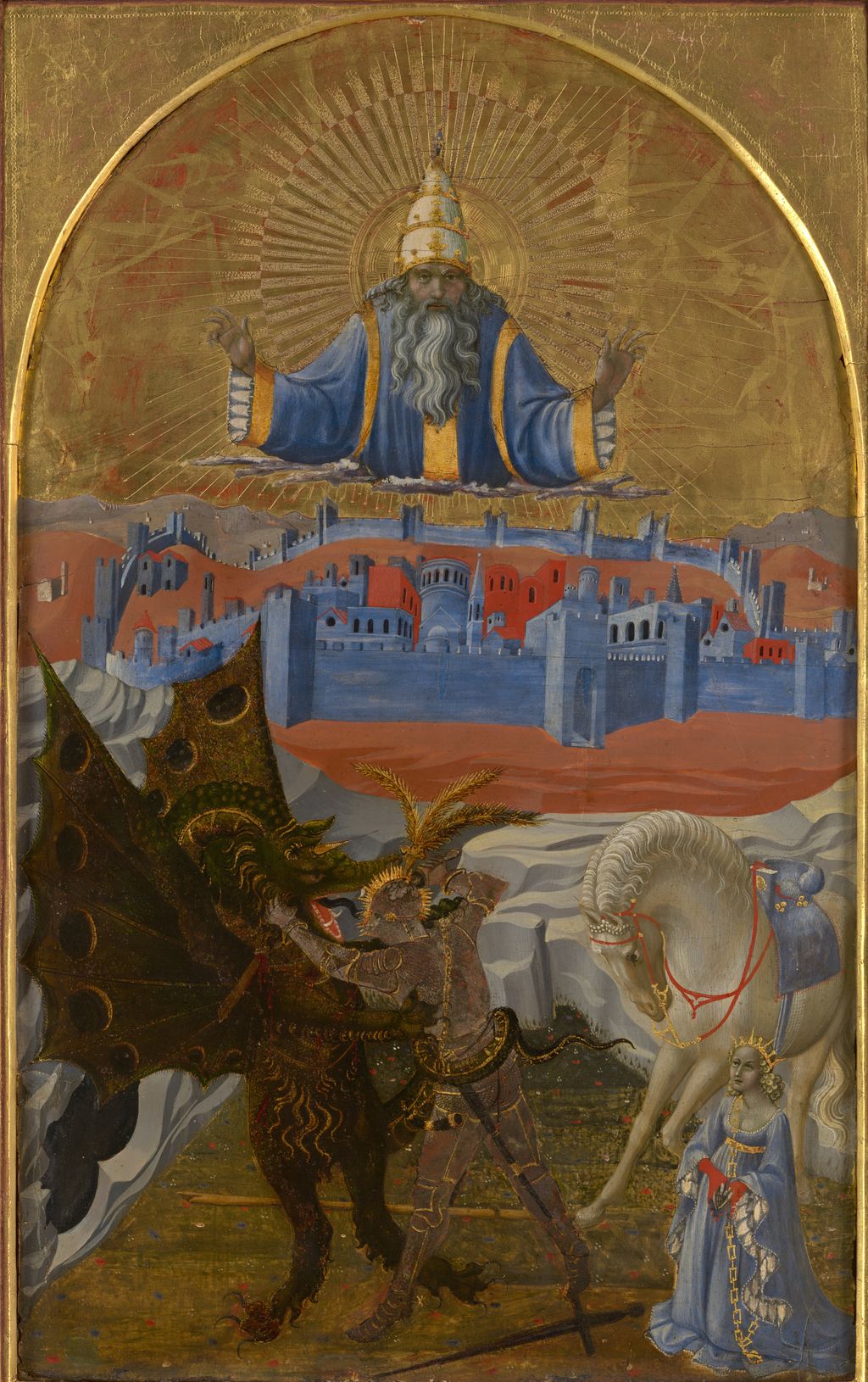
Saint George Slaying the Dragon, National Gallery of Victoria 2124-4. Image source. Public domain.
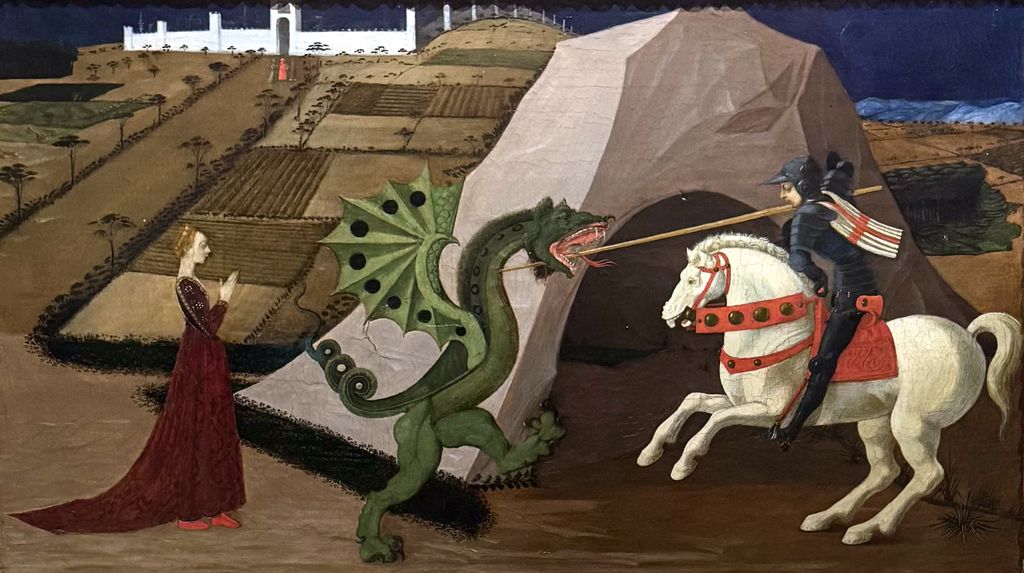
Saint George and the Dragon, Musée Jacquemart-André, MJAP-P 2248. Image source. Public domain.
From Vienna to London
The Gallery’s provenance begins with the 1898 record of the painting in Count Karol Lanckoroński’s collection in Vienna. Historian Jerzy Miziołek identifies the canvas in a watercolour by Ludwig Hans Fischer of an interior in the collector’s earlier house on Wasagasse. That identification puts it in the collection before the 1898 publication. It later hung in the small Italian study of the family palace on Jacquingasse. [1] [15]
The National Gallery records that the Nazis took the painting from the family’s Vienna house in 1939 for the planned museum in Linz. Its storage is uncertain. The Gallery gives the salt mine at Altaussee and Immendorf Castle as possibilities and records recovery by the US Army, passage through the Munich Collecting Point and Hohenems Castle, and storage in a Zurich bank from 1946 to 1959. Joanna Winiewicz-Wolska’s study of the family collection complicates that route. She notes a prewar export permit and the absence of the Uccello from the particular wartime inventory, postwar Munich inventory and 1947 return list she examined. Those omissions leave parts of the Gallery’s account difficult to corroborate. [1] [6] [16]
The Gallery negotiated with the Lanckoroński family and sought government support before buying the canvas in 1959. Mr Farago handled the sale, and a special grant and contributions from the Phillott and Temple-West Funds paid for the acquisition. Its acquisition archive records correspondence on the Zurich visit as well as a later letter from conservator Norman Brommelle about his restoration. Gallery staff inspected the work in Switzerland to address questions about its authenticity. The subsequent technical investigations place the materials and construction within fifteenth-century practice, and the Gallery catalogues the painting as a work by Uccello. It featured in the Gallery’s 2010 exhibition on attribution and scientific examination and travelled to Wawel Royal Castle in 2022, where it was shown alongside other works that had belonged to the Lanckoroński collection. [1] [6] [17] [18] [19]
Artworks directory
Browse paintings, drawings, stained-glass designs and other objects connected with Uccello. Cycles and their surviving components may have separate entries. The collection or catalogue’s wording is retained where a date, attribution or subject is debated.
| Name | Date | Medium, attribution and collection |
|---|---|---|
| Niccolò da Tolentino at the Battle of San Romano · London | Probably c.1438–40 | Tempera and oil on wood, with metallic decoration · National Gallery Catalogue. |
| Bernardino della Carda Unhorsed · Florence | c.1435–40 | Tempera on panel · Uffizi Galleries Catalogue. |
| The Counterattack of Micheletto da Cotignola · Paris | 1450–75 in the Louvre catalogue | Tempera (possibly) on wood · Musée du Louvre Catalogue. |
| The Hunt in the Forest | c.1465–70 | Tempera and oil with traces of gold on panel · Ashmolean Catalogue. |
| Saint George and the Dragon · London | c.1470 | Oil on canvas · National Gallery Catalogue. |
| Saint George Slaying the Dragon · Melbourne | c.1430 | Oil, tempera and silver leaf on wood · National Gallery of Victoria Catalogue. |
| Saint George and the Dragon · Paris | 1430–35 in the museum catalogue | Painted wood panel · Musée Jacquemart-André Catalogue. |
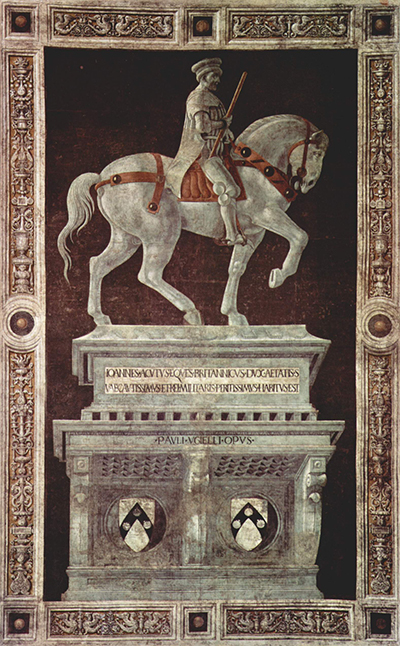
| Equestrian Monument to John Hawkwood | 1436 | Transferred wall painting · Florence Cathedral Catalogue. |
| Study for the John Hawkwood Monument | 1436 | Study on prepared paper · Uffizi Catalogue. |
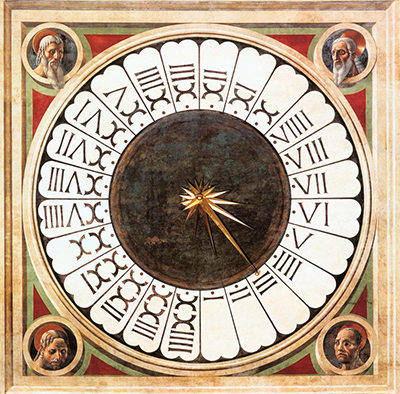
| Monumental Clock Face | 1443 | Painted dial · Florence Cathedral Catalogue. |
| Resurrection of Christ | 1443–44 | Stained glass · Uccello design · Florence Cathedral Catalogue. |
| Nativity | 1440s | Stained glass · Uccello design · Florence Cathedral Catalogue. |
| Creation of the Animals and Creation of Adam | Third to fourth decade of the 15th century | Detached fresco · Green Cloister, Santa Maria Novella Catalogue. |
| Creation of Eve and the Fall | Third to fourth decade of the 15th century | Detached fresco · Green Cloister, Santa Maria Novella Catalogue. |
| Flood and Recession of the Waters | 15th century; dating debated | Detached fresco · Green Cloister, Santa Maria Novella Catalogue. |
| Sacrifice and Drunkenness of Noah | 15th century; dating debated | Detached fresco · Green Cloister, Santa Maria Novella Catalogue. |
| Stories of the Virgin and Saint Stephen · Assunta Chapel | 1430s, with later completion | Fresco cycle · Paolo Uccello and Andrea di Giusto · Prato Cathedral Catalogue. |
| Blessed Jacopone da Todi | 1436 in the diocesan museum | Detached fresco · Museo dell’Opera del Duomo, Prato Catalogue. |
| Adoration of the Child · Bologna | 1430s; inscription incomplete | Detached fresco · San Martino Maggiore, Bologna Catalogue. |
| Adoration of the Christ Child · Karlsruhe | c.1436 | Painted panel · Attribution to Uccello · Staatliche Kunsthalle Karlsruhe Catalogue. |
| Annunciation · Oxford | Early 15th century | Tempera and gilding on panel · Ashmolean Catalogue. |
| Allegory of Monastic Life (Thebaid) | c.1460–65 | Tempera on canvas · Galleria dell’Accademia, Florence Catalogue. |
| Miracle of the Profaned Host | 1467–68 | Tempera on wood · Galleria Nazionale delle Marche, Urbino Catalogue. |
| Triumphal Entry into Rome of Titus and Vespasian(?) | c.1430–35 | Tempera, gold and silver on panel · Yale University Art Gallery Catalogue. |
| Crucifixion with the Virgin and Saints | c.1460–65 | Painted panel · Museo Nacional Thyssen-Bornemisza Catalogue. |
| The Crucifixion · Met triptych | Probably mid-1450s | Tempera on wood with gold ground · Metropolitan Museum of Art Catalogue. |
| Perspective Study of a Chalice | 1450–75 | Pen, ink and stylus on paper · Attributed to Uccello · Uffizi Catalogue. |
| Study of a Mazzocchio | 15th century | Perspective study · Attributed to Uccello · Uffizi Catalogue. |
| Mazzocchio Seen in Perspective | Uncertain | Drawing · Attribution debated · Musée du Louvre Catalogue. |
| Head of a Man in Profile | 15th century | Pen, ink and wash · Musée du Louvre Catalogue. |
| Five Masters of the Florentine Renaissance | 1500–50 | Oil on wood · Anonymous Florentine school · Musée du Louvre Catalogue. |
| Madonna and Child from the Del Beccuto House | 15th century | Detached fresco · Museo di San Marco, Florence Catalogue. |
| Man of Sorrows with the Virgin and Saint John · Avane Predella | 15th century | Predella · Museo di San Marco, Florence Catalogue. |
| Calling of Saint Paul the Hermit · San Miniato | After 1447 to c.1454 in state catalogue | Sinopia · Attributed to Uccello or collaborator Catalogue. |
| The host changes hands · Urbino predella, scene 1 | 1467–68 | Tempera on wood · Component of DE 231 · Galleria Nazionale delle Marche Catalogue. |
| The figures at the door · Urbino predella, scene 2 | 1467–68 | Tempera on wood · Component of DE 231 · Galleria Nazionale delle Marche Catalogue. |
| The procession approaches the altar · Urbino predella, scene 3 | 1467–68 | Tempera on wood · Component of DE 231 · Galleria Nazionale delle Marche Catalogue. |
| The condemned woman and the ladders · Urbino predella, scene 4 | 1467–68 | Tempera on wood · Component of DE 231 · Galleria Nazionale delle Marche Catalogue. |
| Persecution of the family · Urbino predella, scene 5 | 1467–68 | Tempera on wood · Component of DE 231 · Galleria Nazionale delle Marche Catalogue. |
| Angels and demons at the bier · Urbino predella, scene 6 | 1467–68 | Tempera on wood · Component of DE 231 · Galleria Nazionale delle Marche Catalogue. |
| Birth of the Virgin · Prato Cathedral | 1430s; dating debated | Fresco · Assunta Chapel, Prato Cathedral Catalogue. |
| Presentation of the Virgin · Prato Cathedral | 1430s; dating debated | Fresco · Assunta Chapel, Prato Cathedral Catalogue. |
Discussion
Look again at the images and ideas explored in Saint George and the Dragon. These editorial prompts invite your observations.
Reader Insights
Follow the princess’s girdle from her hand to the dragon. How does seeing that curve change your reading of the lance thrust at the centre of the painting?
What happens to the balance of the composition when you attend to the cave before the cloud?
Join the Conversation
Share a detail, comparison or question about Saint George and the Dragon below.
References
- National Gallery, London. Paolo Uccello, Saint George and the Dragon, NG6294. Current object facts, in-depth interpretation, provenance and exhibition history. View source.
- Jacobus de Voragine. The Golden Legend, chapter 58, “George”. English translation presented in Daniel Ogden’s University of Exeter source collection. View source.
- National Gallery, London. Primary Teachers’ Notes: Saint George and the Dragon, 2001–02, pp. 2–3. Earlier catalogue dating and the alignment of the cloud and lance. View source.
- Emanuele Lugli. “Wastelands and dragons: On Paolo Uccello’s London Saint George”, Res: Anthropology and Aesthetics 77–78, 2022, pp. 81–99. Landscape, dragon lore and the proposed relationship to Tuscan agriculture and water management. View source.
- Dillian Gordon. Paolo di Dono, called Uccello, in The Fifteenth Century Italian Paintings, 2003, online version 2025. Career chronology and dating of NG6294. View source.
- Jill Dunkerton and Ashok Roy. “Uccello’s Saint George and the Dragon: Technical Evidence Re-evaluated”, National Gallery Technical Bulletin 19, 1998, pp. 26–30. Canvas, paint cross-sections, imaging, revised dating and provenance notes. View source.
- Fondazione Federico Zeri. Paolo di Dono, San Giorgio e il drago, catalogue record 11143. Earlier date range assigned to NG6294. View source.
- Raymond White, Jennifer Pilc and Jo Kirby. “Analyses of Paint Media”, National Gallery Technical Bulletin 19, 1998, p. 87. NG6294 sample table and notes 43–45. View source.
- David Saunders, Helene Chahine and John Cupitt. “Long-term Colour Change Measurement: Some Results after Twenty Years”, National Gallery Technical Bulletin 17, 1996, pp. 87–88. Colour changes in NG6294, including the green paint exposed after reframing. View source.
- National Gallery of Victoria. Saint George Slaying the Dragon, accession 2124-4. Melbourne panel’s medium, dimensions, date and acquisition. View source.
- Hugh Hudson. “A Knight in Shining Armour, a Virgin – Uccello’s Melbourne Saint George and the Dragon and Oxford Annunciation”, Art Bulletin of Victoria 46. Attribution history, treatment of the legend and visual comparisons. View source.
- Musée Jacquemart-André. Saint George and the Dragon. Paris panel, collection history and subject. View source.
- Fondazione Giorgio Cini. A Guest at the Palace | Saint George and the Dragon by Paolo Uccello. Loan of the Paris panel in 2021, with medium, dating and analysis of the composition. View source.
- Musei del Bargello. Donatello and the Dawn of Renaissance. Saint George and the original relief from Orsanmichele. View source.
- Jerzy Miziołek. “Toskańskie malarstwo cassonowe z kolekcji Karola Lanckorońskiego w zbiorach Zamku Królewskiego na Wawelu. Studium wstępne”, Studia Waweliana VI–VII, 1997–1998, pp. 149–150. Identification of the painting in Ludwig Hans Fischer’s watercolour of the Wasagasse interior. View source.
- Joanna Winiewicz-Wolska. “Dzieje kolekcji Karola Lanckorońskiego”, in Arcydzieła z kolekcji Lanckorońskich, 2022, pp. 53–54. Export documentation and comparison of wartime and postwar lists. View source.
- National Gallery Archive. Acquisition file, NG14/183/1, 1958–1965. Negotiations and conservation correspondence. View source.
- National Gallery, London. Review of the Year 2011–2012. Martin Davies chronology and pre-acquisition inspection in Switzerland. View source.
- Wawel Royal Castle. Masterpieces from the Lanckoroński Collection. 2022 exhibition catalogue and participating loans. View source.
More PAOLO UCCELLO Artworks
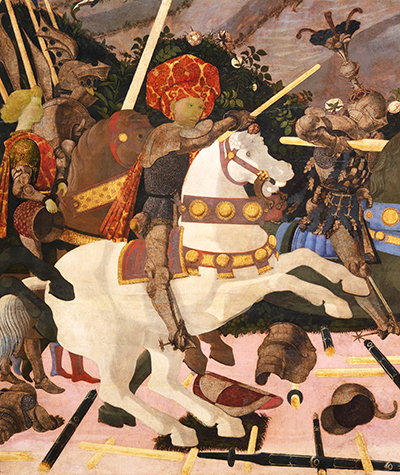

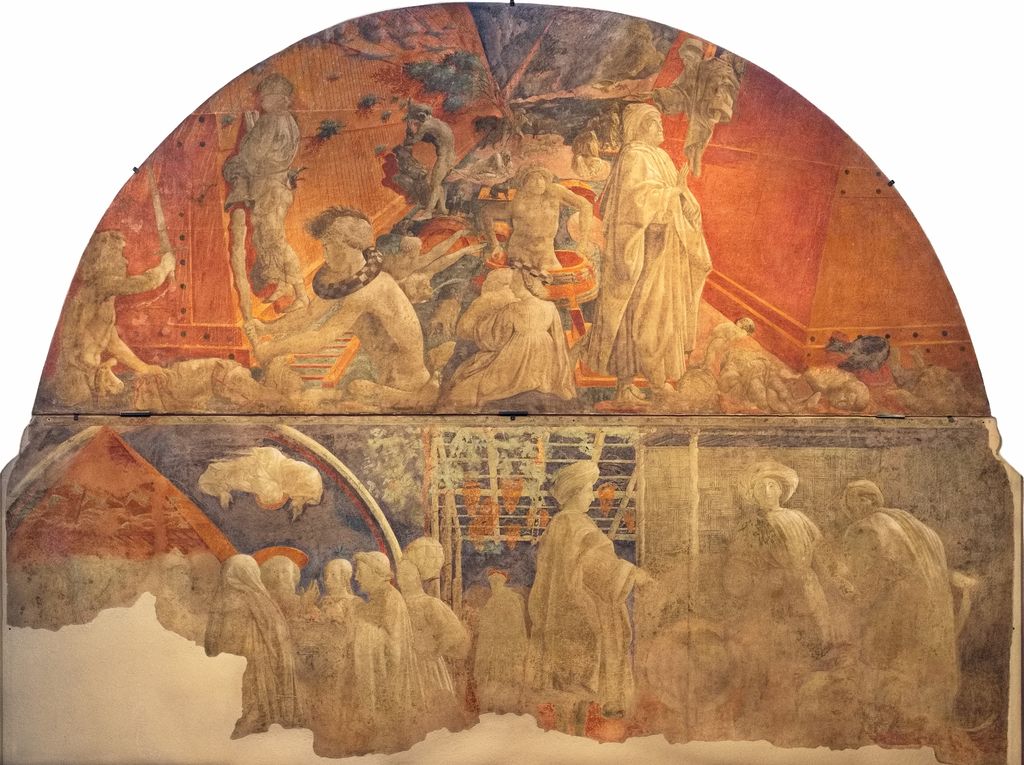
Noah and the Flood
The Flood and Recession of the Waters above the lower episodes from Noah’s story, Santa Maria Novella. Photograph by Armin Kleiner. Image source. CC BY-SA 4.0. Resized for the web. This derivative is available under the same licence.
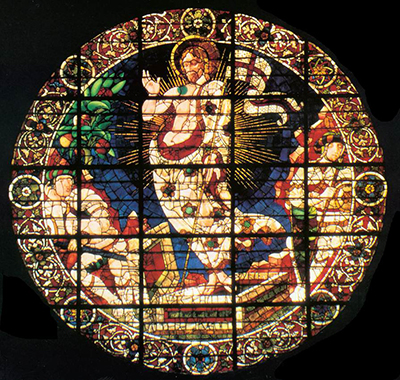
The Resurrection of Christ Stained Glass Window
The Resurrection window in Florence Cathedral, designed by Paolo Uccello and made by Bernardo di Francesco. Photograph by Sailko. Image source. CC BY 3.0. Resized for the web.