


 by Tom Gurney
Tom Gurney BSc (Hons) is an art history expert with over 20 years experience
Published on June 19, 2020 / Updated on November 29, 2026
Email: tomgurney1@gmail.com / Phone: +44 7429 011000
The Counterattack of Micheletto da Cotignola: Introduction
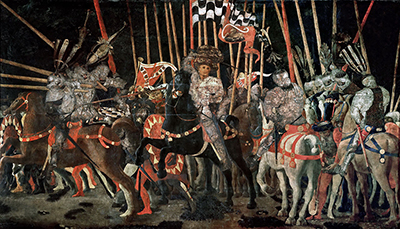
On the right, pale horses bunch together beneath a stand of upright lances. At the centre a black horse rears, its front hooves clear of the ground. Farther left the riders turn into profile and their weapons slope towards the edge of the painting. Paolo Uccello spreads the first moments of a charge across more than three metres of wood. The Louvre identifies the barefaced rider on the black horse as Micheletto Attendolo da Cotignola, also known as Michelotto, whose reinforcements helped Florence win the Battle of San Romano in 1432. The panel is Louvre MI 469, also recorded as Campana 166. [1] [2] [3]
At a Glance
- SubjectMicheletto Attendolo da Cotignola leads the Florentine counterattack at San Romano
- CollectionMusée du Louvre, Paris, MI 469 / Campana 166
- Dimensions182 × 317 cm
Contents
- How Uccello starts the charge
- Where the Paris panel fits in the battle
- What the surface once looked like
- How the painting was fitted to a room
- Why the date is disputed
- From Florence to the Louvre
- Annotated details
How Uccello starts the charge
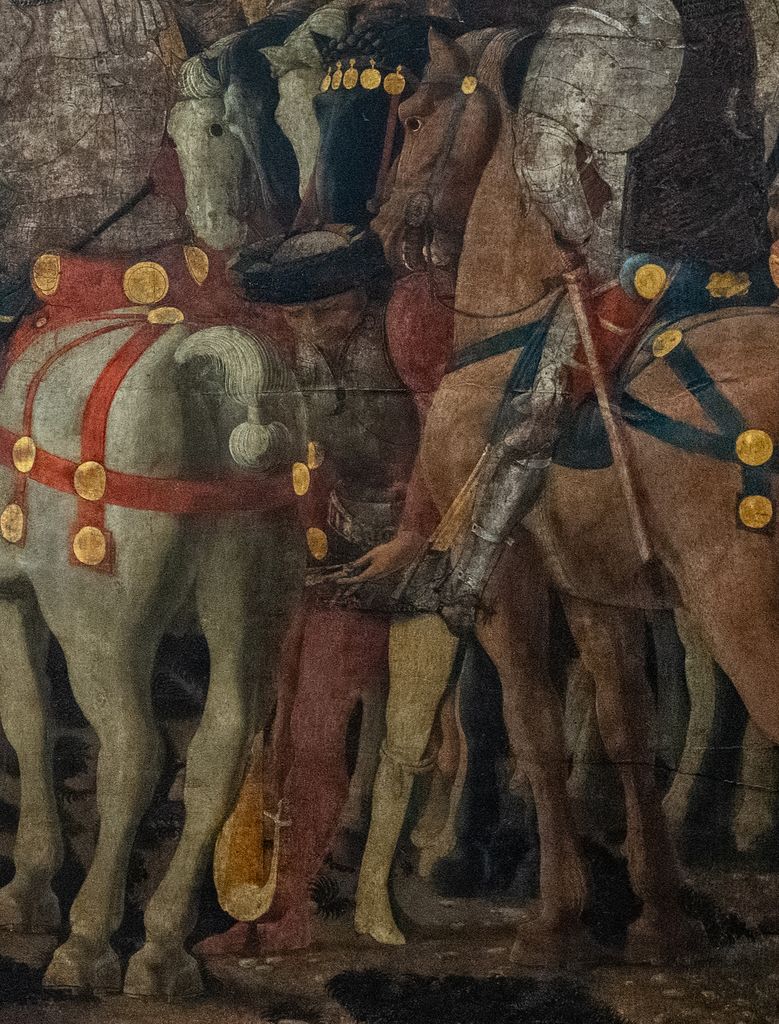
Start at the right with the two pale horses whose hindquarters face out of the picture. One wears red harness straps, the other blue. The broad, rounded shapes bring the animals forward, while the riders above them are partly hidden by the armour and crests of their neighbours. Behind this group the nearly upright lances reach much higher than the horses or men. Set against the dark background, the shafts can be counted across an area where there are few faces to follow. Much of the company is still assembling in this part of the picture. [1] [2]
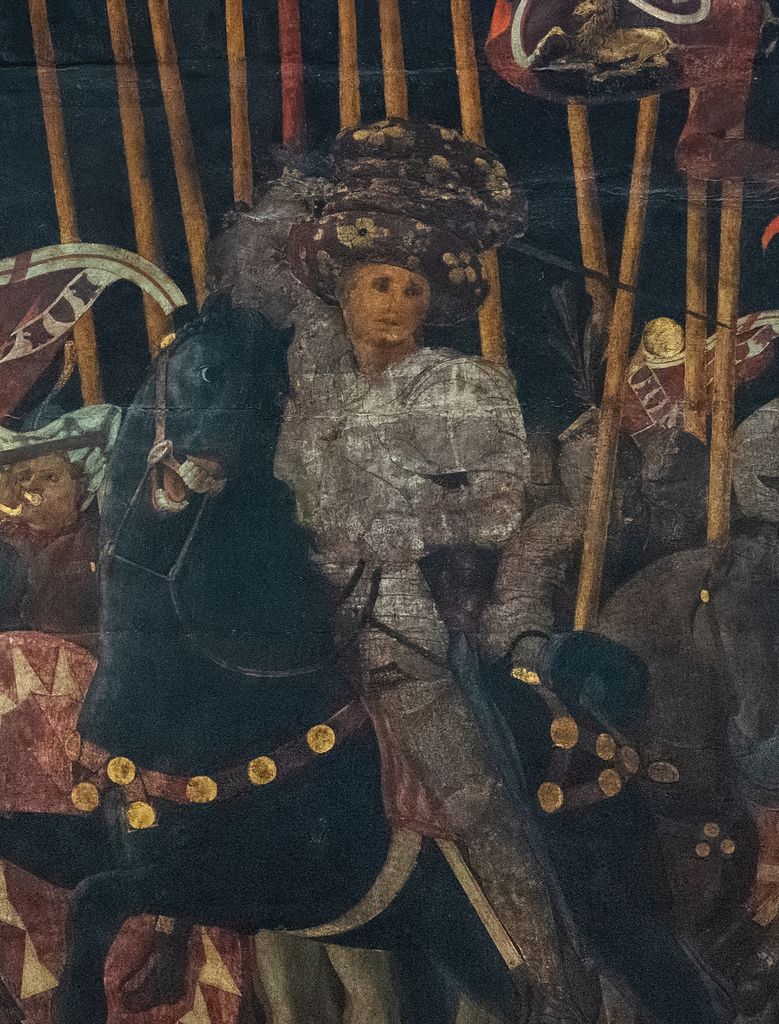
Micheletto’s horse breaks that regularity. Its body is angled left, its forelegs are raised and its head turns towards the picture’s surface. The rider’s face turns back towards the formation behind him. His patterned hat and exposed face stand out among the closed helmets. Above him the black and white waves of the standard give the viewer a second point of recognition. Dillian Gordon associates the wavy design, or ondato, and the unicorn with Micheletto. The standard sweeps right while the horse moves left. Both motions remain legible because they interrupt the long vertical lines above the riders. [1] [3] [4]
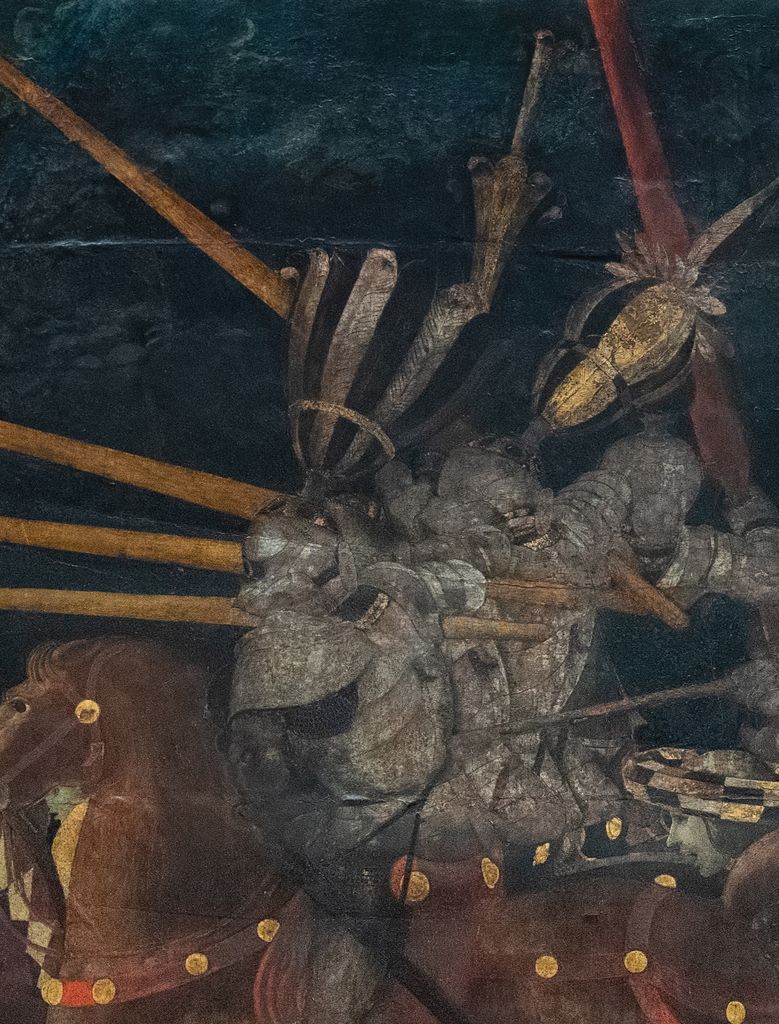
Follow the movement farther left and the space between the lances opens out. Several shafts descend across the dark ground at different angles. The longer ones run almost sideways out of the picture. The brown horse with the red breast strap stretches left, its hind leg still close to the raised hooves of Micheletto’s mount. Red cloth and harness details recur on either side of that overlap, letting the eye move across horses that partly obscure one another. People on foot appear in glimpses below the riders. The changing angles of bodies and weapons allow the charge to register before most of the company has moved. [1] [2] [4]
Annotated Details from The Counterattack of Micheletto da Cotignola
The numbered points identify visible features discussed in this article. Return from each detail to the numbered overview. The Paris San Romano panel, Musée du Louvre MI 469, with Micheletto da Cotignola leading the counterattack. Image source. CC0 / Public domain.
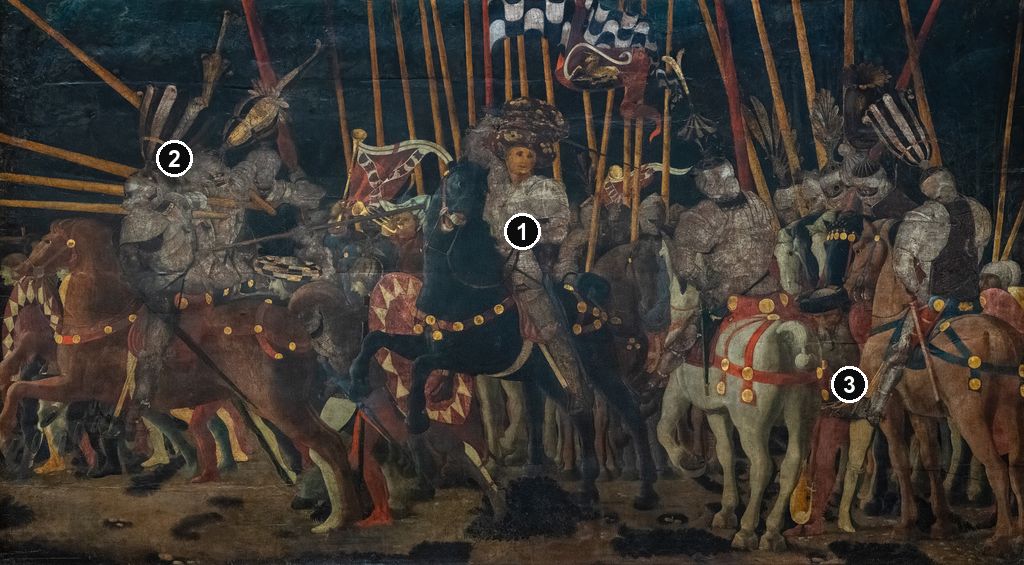
Details from THE COUNTERATTACK OF MICHELETTO DA COTIGNOLA
Compare the cropped details with the source images above. Notice how their colours, shapes and positions contribute to the larger compositions.
The turn of the commander
Micheletto’s uncovered face turns to the right as his dark horse moves left. The accented harness and overlapping lances make the opposed directions easier to follow.
The lowered lances
Lances drop to a diagonal above the left-hand riders. Alongside the upright shafts further right, they show different stages of the cavalry movement.
Red and blue harness straps
Bright straps cross the backs of the horses in the right-hand group. The view from behind sets their direction against the lateral charge at the left.
Where the Paris panel fits in the battle
The historical battle took place on 1 June 1432 in the Arno valley during Florence’s war with Lucca and its allies. Niccolò da Tolentino was at one point cut off from his troops. Micheletto’s arrival helped turn the action in Florence’s favour against its opponents, who included Sienese and Milanese forces. The Paris painting gives that intervention its own protagonist. The viewer sees him bringing men into motion. The outcome is conveyed across the series, including by the rider thrown off balance in the painting at the Uffizi. [3] [5] [6]
The National Gallery and Uffizi favour reading the three panels in the order London, Florence, Paris. London shows Tolentino leading the Florentines, Florence centres on the unhorsing traditionally associated with Bernardino della Carda, and Paris shows Micheletto’s counterattack. The Louvre’s Salon Carré guide places Paris in the middle of the story, followed by the Sienese defeat in Florence. The difference is easiest to understand if the pictures are treated as three chosen episodes. If the scene of defeat follows the arrival of reinforcements in a retelling, it can still occupy the middle position on the wall. The damaged shapes of the panels provide separate evidence for how they might have been arranged. [2] [3] [6]
In London, the broken lances and a fallen figure give the foreground a conspicuous framework of lines receding into space. The Paris panel sets its foreground horses on a relatively shallow strip of ground. Overlapping bodies, turned hindquarters and varied angles create depth within the cavalry, while the crowd and near-black backdrop close off most of the view beyond it. Hannah Baader points out that the dominant movement in Paris runs against that of its companions. In a London–Florence–Paris arrangement, the forward thrust of the outer scenes can be read as directed towards the middle panel. The darkness may suggest a time of day, as Baader notes, but it cannot fix an hour in the historical battle. [3] [4]
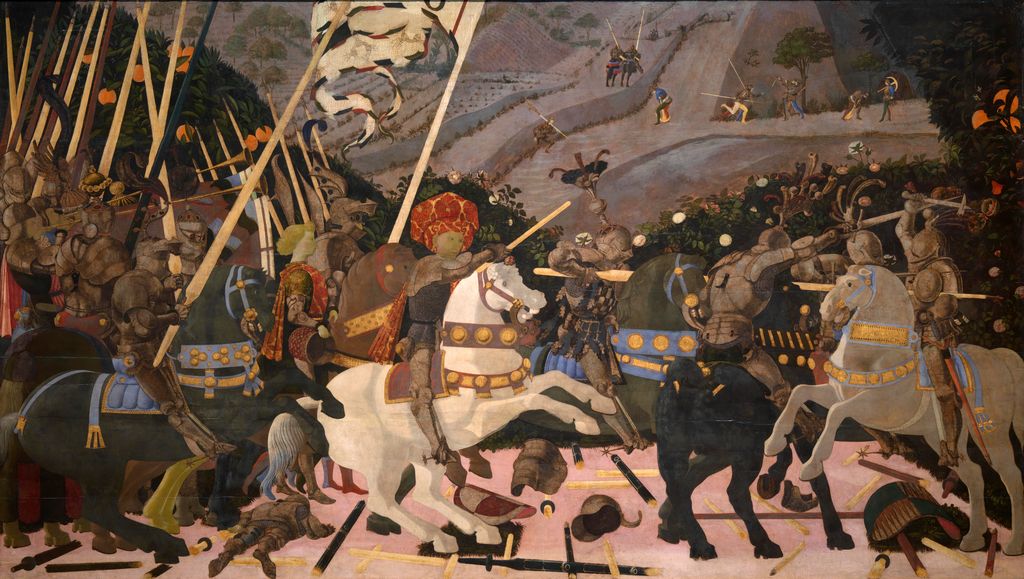
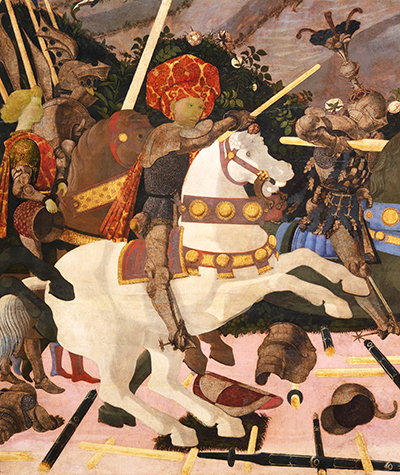
Niccolò da Tolentino rides a white horse in the London San Romano panel, National Gallery NG583. Image source. Public domain.
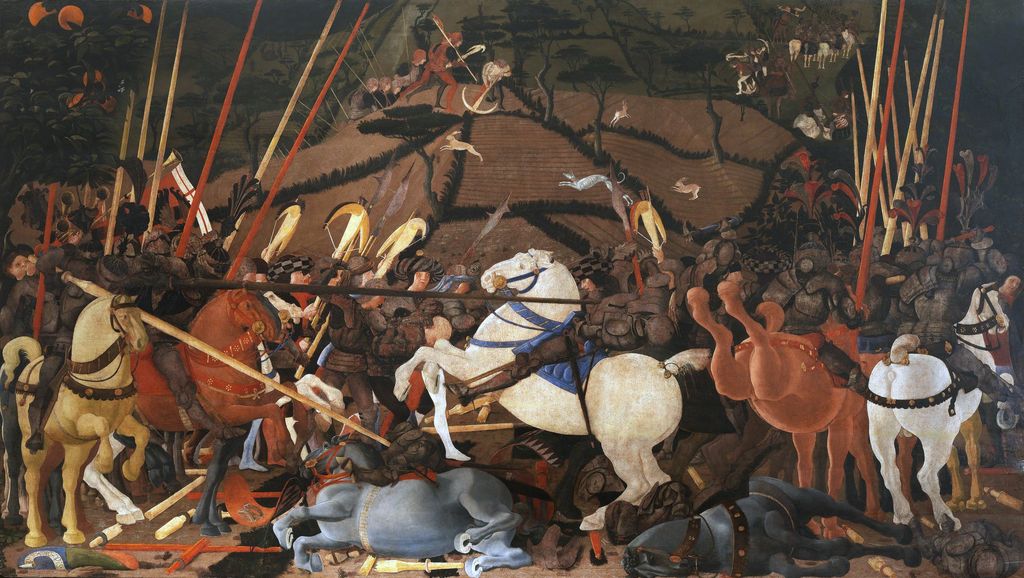
The Florence San Romano panel, with the fall of Bernardino della Carda at the centre. Image source. Public domain.
What the surface once looked like
The dull, patchy armour can be misleading. Uccello used actual metal leaf, including gold on the patterned horse harnesses and silver on the armour. Writing about the Paris panel, conservation scientist Michel Menu describes a wooden support covered with two layers of calcium-sulphate ground bound in animal glue. The finer upper coat gave the painter a smooth surface for drawing and incising. A thin ochre-rich layer under the leaf helped receive the metal. Incised and punched details gave individual pieces of armour texture that could catch the light. The Louvre lists the medium as possible tempera on wood. Menu describes egg yolk with some oil in the paint. [1] [7]
Muriel Vervat, who worked on the Florence panel, compared technical records and paint samples from the three paintings through an ARCHLAB project. Samples from areas of armour show a similar sequence in all three, with very thin silver leaf over an orange-brown ground called bole. Over the silver, thin dark paint defined the edges and shadows of the armour plates. Vervat also found the use of sharp incisions across all three works, including to mark the boundary of an area intended for metal leaf. She records signs of heavy cleaning on all three panels. The mottling on the Paris riders today need not be read as shading laid down by Uccello. Imagine light catching the original metal differently as a viewer moved past the panel. The effect would have shifted the emphasis between horses, riders and equipment. [7] [8]
How the painting was fitted to a room
The outside edges are evidence of a different kind. Gordon’s account of the X-radiograph identifies seven horizontal boards and traces of metal fixings. Menu identifies the wood of the seven boards as poplar. The earlier technical paper by Ashok Roy and Gordon reports five boards in a footnote. The later catalogue’s diagram also helps explain why the cloth can be counted as either four or five strips. Four broad lengths of linen run vertically across the horizontal boards, and a fifth, much narrower strip survives at the far right. At the left, an edge of the linen curves towards the top, evidence that the painted panel once had an arched outline. Gordon records five further pieces of wood along the top. Menu also reports thinning after insect damage and nineteenth-century reinforcement of the wood. [3] [5] [7]
The Louvre reconstructs the original shape as a low arch, or lunette, with cutouts at both upper corners and a further notch at the lower left. When the panel was turned into a rectangle, probably around 1484, the upper edge was cut down and the gaps were filled. On the upper left, yellow lances painted on the main panel were extended across a corner insert. The ochre mixture on the insert lacks the lead white present in the older paint, and the grooves incised along the lances stop at the join. At the upper right, red lances have a black underlayer on the original section, while their extensions on the new wood are painted in vermilion without that dark base. The later painter matched the direction of the lances while working with different materials. [1] [3]
The lower-left insert is a particularly revealing change. The grass on the added piece was painted more thinly in a mixture of yellow and black. The green just above it in the original foreground contains artificial malachite. Gordon suggests that the original opening might have accommodated a doorway. The composition leaves enough space under the action at this corner to make that possible. Comparison of the upper cutouts likewise suggests a way the panels might have fitted around architectural brackets. Gordon follows Umberto Baldini in proposing that London and Florence shared a wall and Paris stood at right angles, with the narrow brackets joining Florence to Paris. The broad cutout at the far right of the Paris panel remains harder to explain. Other scholars place the paintings in a line on the east wall of Lorenzo’s room after the move, where the 1492 inventory describes them among six paintings in gilded frames above furnishings. The earlier cutouts and the later inventory tell us about two different installations. [1] [3]
Why the date is disputed
The Louvre’s catalogue gives 1450–1475 for the Paris panel, although its provenance also suggests a connection with Lionardo Bartolini Salimbeni around 1438. The record in the French Institut national d’histoire de l’art gives about 1435–1440. Vervat’s technical comparison proposes that Uccello made all three panels as one project over roughly 1438–1440. Similarities in the preparation and metalwork support that view. The armour gives an independent clue. Lionello Boccia identified equipment typical of the 1430s, and Karen Watts confirmed to Gordon that the Paris armour fits the same period as the armour in London and Florence. That dates the kinds of equipment Uccello represented. A painter could still have portrayed older armour in a work made later. [1] [3] [8] [9]
The larger figures and different viewpoint in Paris have led some scholars to think it was designed separately or added later. Boccia noted slimmer, more involved bits and single rather than double reins, and dated the Paris panel to around 1440. Pietro Roccasecca went further, proposing a date around 1456–1458 and identifying the subject as the Battle of Anghiari, in which Micheletto also fought. The records of ownership make that reading harder to sustain. Francesco Caglioti identified the three paintings in the Bartolini Salimbeni family’s possession in 1480, and Gordon points out that the family’s claim in 1495 treats the three as paintings of the rout at San Romano. A commission for Lionardo around his second marriage in 1438 is plausible. The earliest surviving ownership record postdates both the proposed commission and Uccello’s death, leaving the exact date of the Paris panel open. [3] [8] [10]
From Florence to the Louvre
Caglioti’s archival findings also explain why the painting has long been associated with the Medici. After Lionardo’s death the panels passed to his sons Damiano and Andrea. Damiano later said that Lorenzo de’ Medici had obtained Andrea’s share and sent the woodworker Francione to remove the paintings against Damiano’s wishes. Correspondence makes 1484 the likeliest year for the move. By 1492 the paintings were recorded in Lorenzo’s ground-floor room on the Via Larga. The dispute over ownership and the alterations to the wood are separate kinds of evidence, but together they explain why the picture looks like a rectangle even though it was built to fit a different wall. [1] [3] [4]
The Paris panel was still listed with the Medici collections in the eighteenth century. It later belonged to the Roman collector Giampietro Campana. After his bankruptcy, the French state bought the work from the papal government in 1861 for the Musée Napoléon III. The work entered the Louvre in 1863. Campana had assembled a collection that ranged from ancient artefacts to Renaissance painting. The panel appeared in the Louvre’s 2018–19 exhibition on that collection, and the museum now lists it in the Salon Carré, among its early Italian paintings. Seen at its full scale, the story can be read from the backs of the nearly stationary horses at one end to the lances already pointing out of the scene at the other. [1] [2] [11]
Artworks directory
Browse paintings, drawings, stained-glass designs and other objects connected with Uccello. Cycles and their surviving components may have separate entries. The collection or catalogue’s wording is retained where a date, attribution or subject is debated.
| Name | Date | Medium, attribution and collection |
|---|---|---|
| Niccolò da Tolentino at the Battle of San Romano · London | Probably c.1438–40 | Tempera and oil on wood, with metallic decoration · National Gallery Catalogue. |
| Bernardino della Carda Unhorsed · Florence | c.1435–40 | Tempera on panel · Uffizi Galleries Catalogue. |
| The Counterattack of Micheletto da Cotignola · Paris | 1450–75 in the Louvre catalogue | Tempera (possibly) on wood · Musée du Louvre Catalogue. |
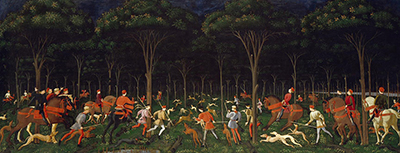
| The Hunt in the Forest | c.1465–70 | Tempera and oil with traces of gold on panel · Ashmolean Catalogue. |
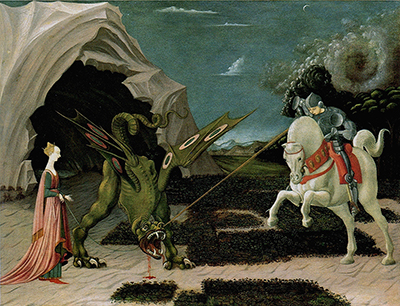
| Saint George and the Dragon · London | c.1470 | Oil on canvas · National Gallery Catalogue. |
| Saint George Slaying the Dragon · Melbourne | c.1430 | Oil, tempera and silver leaf on wood · National Gallery of Victoria Catalogue. |
| Saint George and the Dragon · Paris | 1430–35 in the museum catalogue | Painted wood panel · Musée Jacquemart-André Catalogue. |
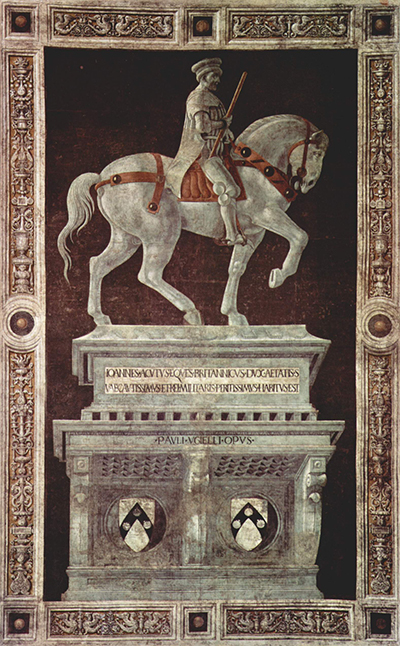
| Equestrian Monument to John Hawkwood | 1436 | Transferred wall painting · Florence Cathedral Catalogue. |
| Study for the John Hawkwood Monument | 1436 | Study on prepared paper · Uffizi Catalogue. |
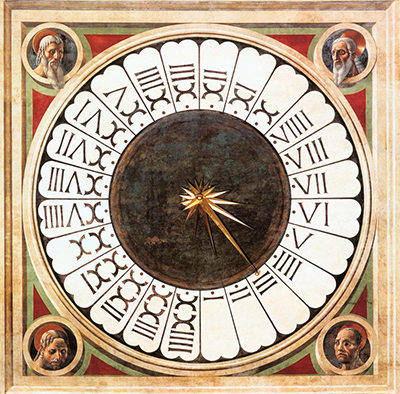
| Monumental Clock Face | 1443 | Painted dial · Florence Cathedral Catalogue. |
| Resurrection of Christ | 1443–44 | Stained glass · Uccello design · Florence Cathedral Catalogue. |
| Nativity | 1440s | Stained glass · Uccello design · Florence Cathedral Catalogue. |
| Creation of the Animals and Creation of Adam | Third to fourth decade of the 15th century | Detached fresco · Green Cloister, Santa Maria Novella Catalogue. |
| Creation of Eve and the Fall | Third to fourth decade of the 15th century | Detached fresco · Green Cloister, Santa Maria Novella Catalogue. |
| Flood and Recession of the Waters | 15th century; dating debated | Detached fresco · Green Cloister, Santa Maria Novella Catalogue. |
| Sacrifice and Drunkenness of Noah | 15th century; dating debated | Detached fresco · Green Cloister, Santa Maria Novella Catalogue. |
| Stories of the Virgin and Saint Stephen · Assunta Chapel | 1430s, with later completion | Fresco cycle · Paolo Uccello and Andrea di Giusto · Prato Cathedral Catalogue. |
| Blessed Jacopone da Todi | 1436 in the diocesan museum | Detached fresco · Museo dell’Opera del Duomo, Prato Catalogue. |
| Adoration of the Child · Bologna | 1430s; inscription incomplete | Detached fresco · San Martino Maggiore, Bologna Catalogue. |
| Adoration of the Christ Child · Karlsruhe | c.1436 | Painted panel · Attribution to Uccello · Staatliche Kunsthalle Karlsruhe Catalogue. |
| Annunciation · Oxford | Early 15th century | Tempera and gilding on panel · Ashmolean Catalogue. |
| Allegory of Monastic Life (Thebaid) | c.1460–65 | Tempera on canvas · Galleria dell’Accademia, Florence Catalogue. |
| Miracle of the Profaned Host | 1467–68 | Tempera on wood · Galleria Nazionale delle Marche, Urbino Catalogue. |
| Triumphal Entry into Rome of Titus and Vespasian(?) | c.1430–35 | Tempera, gold and silver on panel · Yale University Art Gallery Catalogue. |
| Crucifixion with the Virgin and Saints | c.1460–65 | Painted panel · Museo Nacional Thyssen-Bornemisza Catalogue. |
| The Crucifixion · Met triptych | Probably mid-1450s | Tempera on wood with gold ground · Metropolitan Museum of Art Catalogue. |
| Perspective Study of a Chalice | 1450–75 | Pen, ink and stylus on paper · Attributed to Uccello · Uffizi Catalogue. |
| Study of a Mazzocchio | 15th century | Perspective study · Attributed to Uccello · Uffizi Catalogue. |
| Mazzocchio Seen in Perspective | Uncertain | Drawing · Attribution debated · Musée du Louvre Catalogue. |
| Head of a Man in Profile | 15th century | Pen, ink and wash · Musée du Louvre Catalogue. |
| Five Masters of the Florentine Renaissance | 1500–50 | Oil on wood · Anonymous Florentine school · Musée du Louvre Catalogue. |
| Madonna and Child from the Del Beccuto House | 15th century | Detached fresco · Museo di San Marco, Florence Catalogue. |
| Man of Sorrows with the Virgin and Saint John · Avane Predella | 15th century | Predella · Museo di San Marco, Florence Catalogue. |
| Calling of Saint Paul the Hermit · San Miniato | After 1447 to c.1454 in state catalogue | Sinopia · Attributed to Uccello or collaborator Catalogue. |
| The host changes hands · Urbino predella, scene 1 | 1467–68 | Tempera on wood · Component of DE 231 · Galleria Nazionale delle Marche Catalogue. |
| The figures at the door · Urbino predella, scene 2 | 1467–68 | Tempera on wood · Component of DE 231 · Galleria Nazionale delle Marche Catalogue. |
| The procession approaches the altar · Urbino predella, scene 3 | 1467–68 | Tempera on wood · Component of DE 231 · Galleria Nazionale delle Marche Catalogue. |
| The condemned woman and the ladders · Urbino predella, scene 4 | 1467–68 | Tempera on wood · Component of DE 231 · Galleria Nazionale delle Marche Catalogue. |
| Persecution of the family · Urbino predella, scene 5 | 1467–68 | Tempera on wood · Component of DE 231 · Galleria Nazionale delle Marche Catalogue. |
| Angels and demons at the bier · Urbino predella, scene 6 | 1467–68 | Tempera on wood · Component of DE 231 · Galleria Nazionale delle Marche Catalogue. |
| Birth of the Virgin · Prato Cathedral | 1430s; dating debated | Fresco · Assunta Chapel, Prato Cathedral Catalogue. |
| Presentation of the Virgin · Prato Cathedral | 1430s; dating debated | Fresco · Assunta Chapel, Prato Cathedral Catalogue. |
Discussion
Look again at the images and ideas explored in The Counterattack of Micheletto da Cotignola. These editorial prompts invite your observations.
Reader Insights
Cover the upper part of the picture with your hand so that the lances disappear. Which horse or rider then gives you the clearest sense that the company is moving to the left?
Micheletto’s horse moves left while the standard above him streams right. How do these two movements change the way you read his backward glance?
Join the Conversation
Share a detail, comparison or question about The Counterattack of Micheletto da Cotignola below.
References
- Musée du Louvre. La Bataille de San Romano : la contre-attaque de Micheletto Attendolo da Cotignola. Collection entry for MI 469 / Campana 166. View source.
- Musée du Louvre. Le Salon par excellence. Salon Carré gallery guide, including its account of the Paris panel. View source.
- Dillian Gordon. The Battle of San Romano. London National Gallery catalogue, 2003, pp. 378–397, especially the sections on the related paintings, armour, panel adaptations and sequence. View source.
- Hannah Baader. Aufprall, Schock, Geschichte. Paolo Uccellos Schlacht von San Romano. In Uwe Fleckner, ed., Bilder machen Geschichte, 2014, pp. 53–72, especially pp. 54–58. View source.
- Ashok Roy and Dillian Gordon. Uccello’s Battle of San Romano. National Gallery Technical Bulletin 22, 2001, pp. 4–17. View source.
- Gallerie degli Uffizi. Battaglia di San Romano. Collection entry and narrative sequence for the Florence panel. View source.
- Michel Menu. The Battle of San Romano by Uccello, Louvre Museum, Paris, inv. M.I. 469. Technical description in the exhibition catalogue Mirror, Dirimart, 2017. View source.
- Muriel Vervat. An ARCHLAB project: researches on the painting technique of the three panels of the Battle of San Romano by Paolo Uccello. Technè 43, 2016, pp. 110–113. View source.
- Institut national d’histoire de l’art. La Bataille de San Romano : la contre-attaque de Micheletto Attendolo da Cotignola. RETIF record for MI 469. View source.
- Angela Orlandi. Il costo della guerra. La compagnia di Michele Attendolo da Cotignola ad Anghiari. Archival study of Micheletto’s participation in the 1440 battle. View source.
- Musée du Louvre. Un rêve d’Italie. La collection du marquis Campana. Louvre and State Hermitage Museum exhibition, Paris, 2018–19. View source.
More PAOLO UCCELLO Artworks

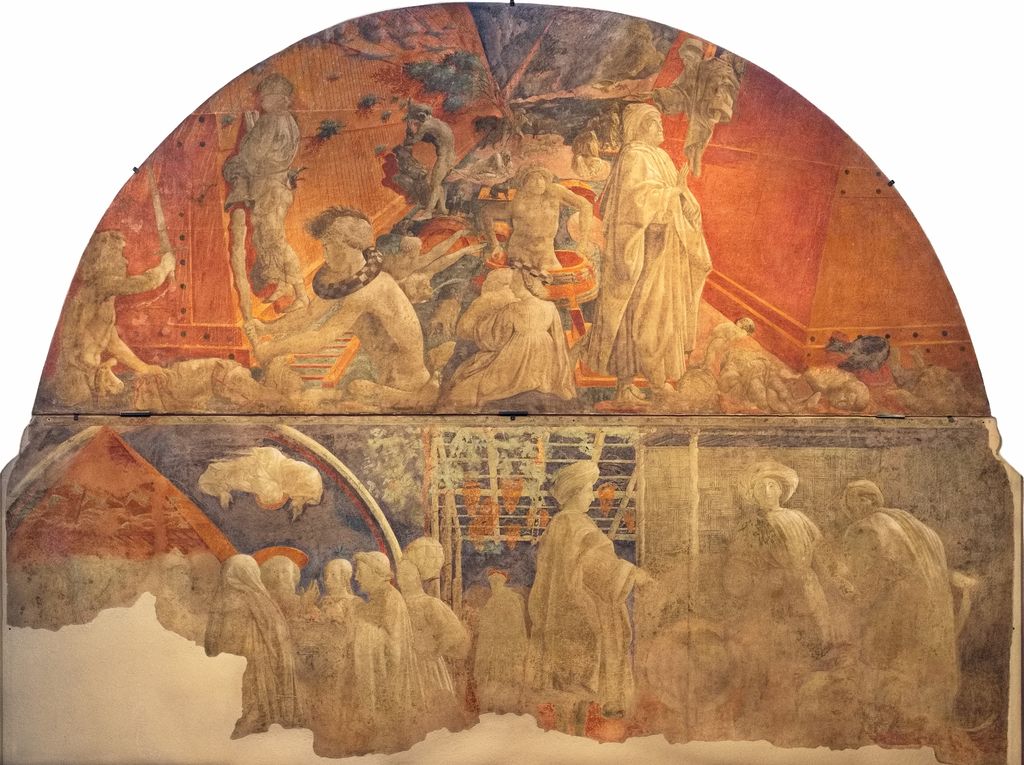
Noah and the Flood
The Flood and Recession of the Waters above the lower episodes from Noah’s story, Santa Maria Novella. Photograph by Armin Kleiner. Image source. CC BY-SA 4.0. Resized for the web. This derivative is available under the same licence.
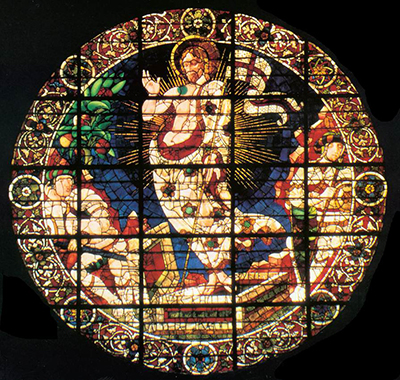
The Resurrection of Christ Stained Glass Window
The Resurrection window in Florence Cathedral, designed by Paolo Uccello and made by Bernardo di Francesco. Photograph by Sailko. Image source. CC BY 3.0. Resized for the web.