


 by Tom Gurney
Tom Gurney BSc (Hons) is an art history expert with over 20 years experience
Published on June 19, 2020 / Updated on November 29, 2026
Email: tomgurney1@gmail.com / Phone: +44 7429 011000
Paintings: Introduction
A horse and rider painted to look like a statue tower above the floor of Florence Cathedral. At the Metropolitan Museum of Art, a nun kneels beneath the cross in a triptych small enough to keep in her cell. In Oxford, hounds and huntsmen vanish into a dark forest across a panel made to be seen in a furnished room. Paolo Uccello designed pictures for very different kinds of attention. Some had to register across a nave. Others invited a single person to come close. [1] [2] [3]
The works below are grouped by the places and purposes that shaped them. Start by looking at the edges. A shape cut to fit a wall, hinged wings or a keyhole in a painted piece of furniture can explain what a photograph leaves out.
At a Glance
- Principal mediaPainted panels and cloth, fresco, and stained-glass designs
- Major seriesThe Battle of San Romano; the Urbino predella
Contents
- Frescoes for cathedrals, chapels and cloisters
- A painted clock and a window designed for daylight
- Devotional paintings at close range
- Three panels for a battle and six scenes for an altar
- A hunt and a triumph in furnished rooms
- Three paintings of Saint George and the dragon
- Later portraits and what an attribution means
Frescoes for cathedrals, chapels and cloisters
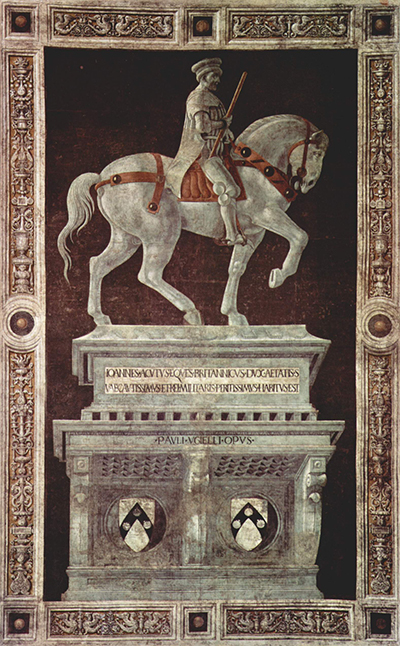
The Funerary Monument to Sir John Hawkwood offers a good place to start because its commission is documented. Florence’s cathedral authorities contracted Uccello in May 1436 to paint a memorial to the English military commander known in Italy as Giovanni Acuto. The rider and his horse occupy what seems to be a stone monument set against a deep red field. Look up at the underside of the sarcophagus and then at the horse, shown much more nearly in profile. The change of viewpoint lets the painted pedestal appear to project over the spectator while keeping the horse and commander clearly legible. The Opera del Duomo records that the first version was rejected and that the surviving fresco was later transferred to canvas. A fifteenth-century commission, a revised design and a change of support all belong to the history of the same object. [1] [4]
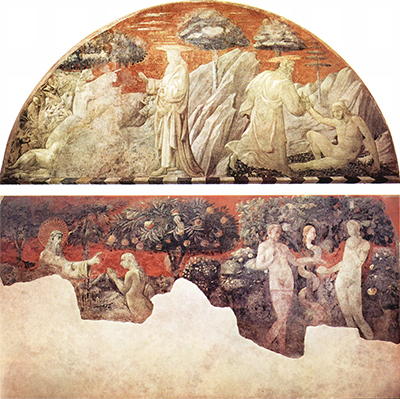
The Genesis scenes at Santa Maria Novella were made to be encountered in sequence. The Green Cloister takes its name from the prevailing earth-green paint, which gives the plastered walls something of the muted colour of carved stone. The narrative began beside the door by which the Dominican friars entered from the church. In the first bay on the east side, the curved upper field holds the Creation of the Animals and Creation of Adam. The creation of Eve and the Fall occupy the lower field. The city museum also records two detached preliminary drawings from these frescoes. They are sinopie, preparatory images originally on a layer of plaster beneath the finished surface, and can help a viewer distinguish the painter’s planning from the surviving painted episodes. [5] [6]
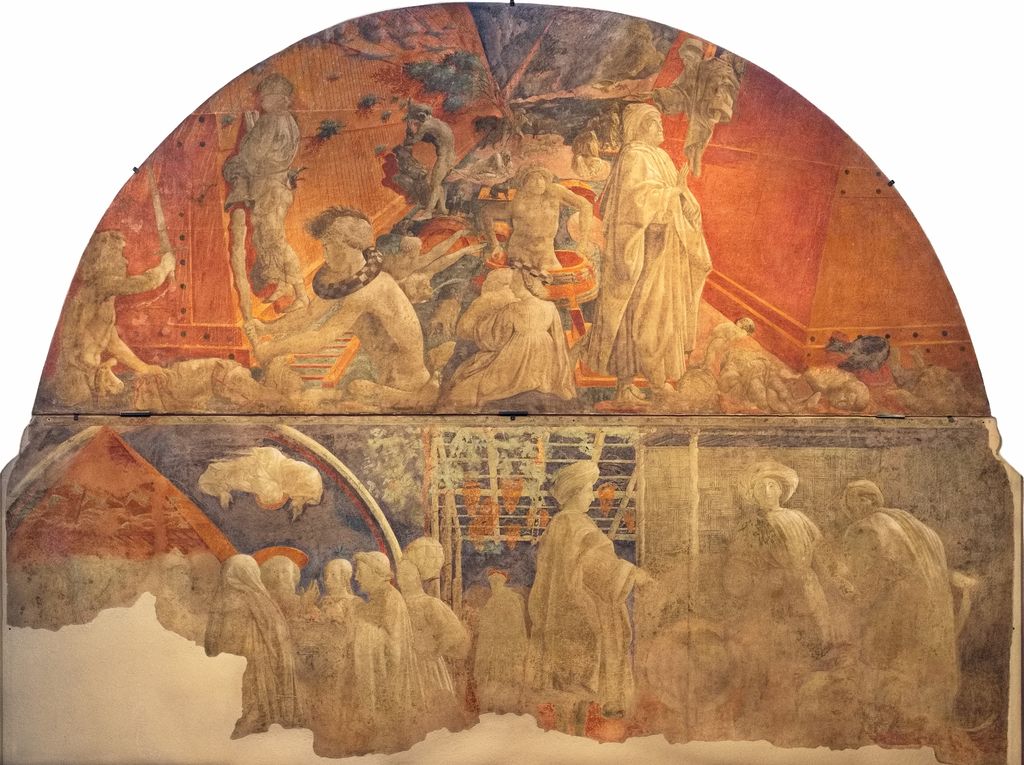
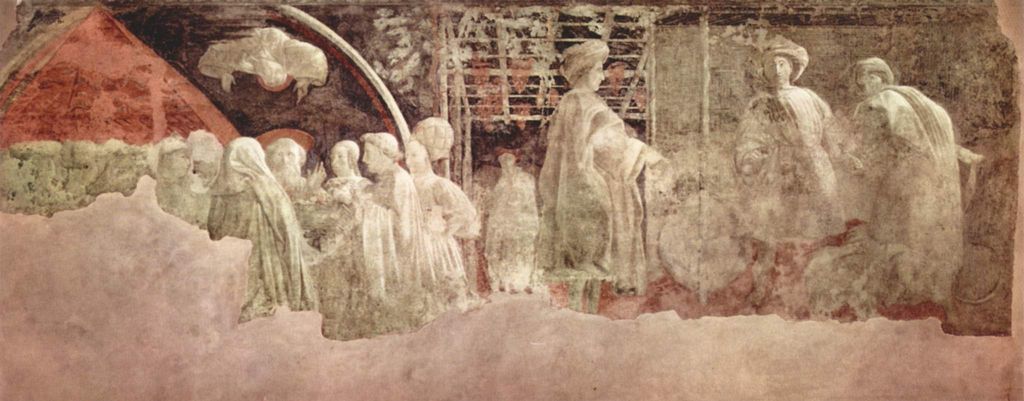
At Noah and the Flood, originally in the fourth bay of the same walk, two opposed, sharply receding profiles of the ark hem in figures caught in the disaster and its aftermath. The repetition accommodates two moments in one field. It also makes the space feel dangerously narrow even as the diagonals drive the eye deep into it. The date is debated within the earlier and middle decades of Uccello’s career. The Comune attributes work on the first four eastern bays to Uccello and his workshop, an important distinction in a cloister decorated by several hands. [5] [6] [7]
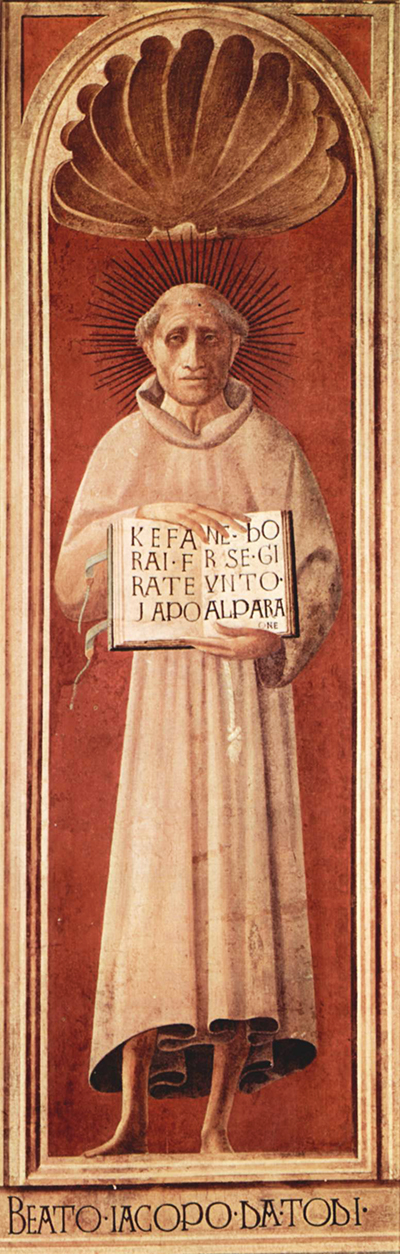
At Prato Cathedral, the Assunta Chapel has its own history. The diocesan museum dates Uccello’s start to early 1436 and identifies Andrea di Giusto as the painter who completed the cycle. The figure of Blessed Jacopone da Todi, rediscovered and detached from the chapel’s back wall in 1871, is now in the diocesan museum. The lower body is seen from below while the face meets the viewer nearly head-on. Put the figure back in its chapel in your imagination and the odd angle begins to make sense. The painting still preserves a clue to its intended spectator now that it hangs apart from the chapel. [8]
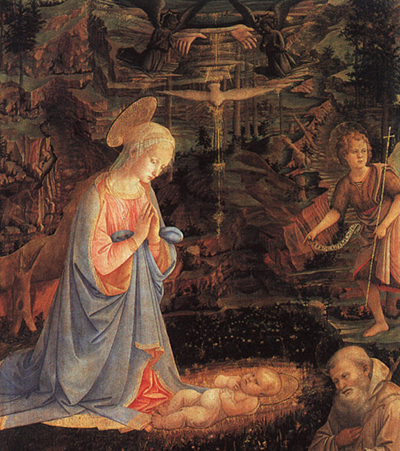
A rediscovered work can enter the catalogue by a different path. In Bologna, a fragmentary Adoration of the Child surfaced during works in the sacristy of San Martino Maggiore. Carlo Volpe identified it as Uccello’s in 1980. It was detached and moved to the first chapel on the left. Its history makes a useful comparison with Hawkwood’s. A contract anchors the Florentine fresco, while the Bologna attribution grew out of an unexpected chance to look closely at the surviving paint. [9]
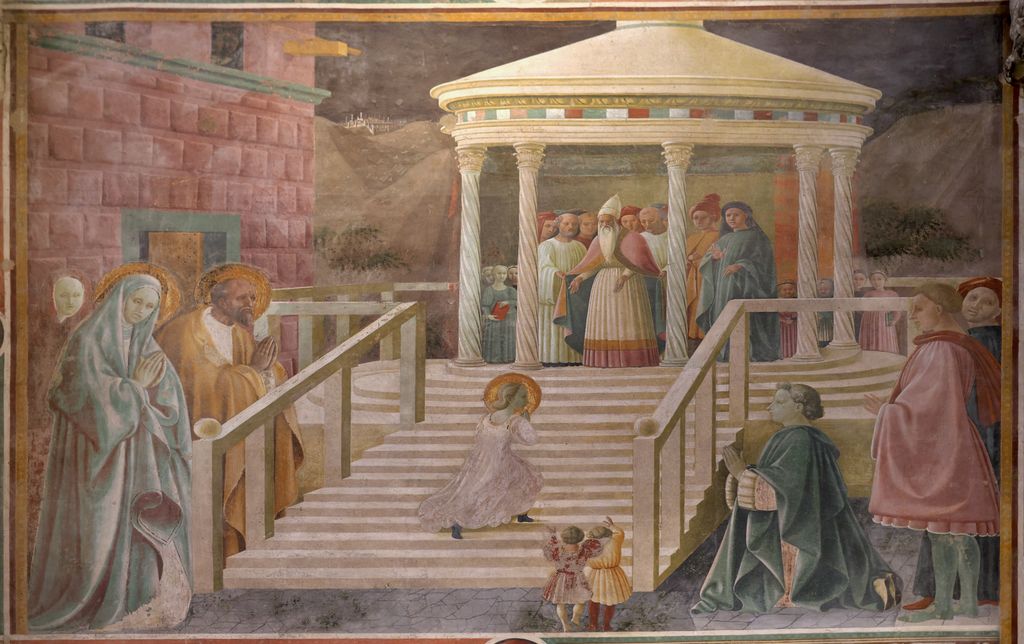
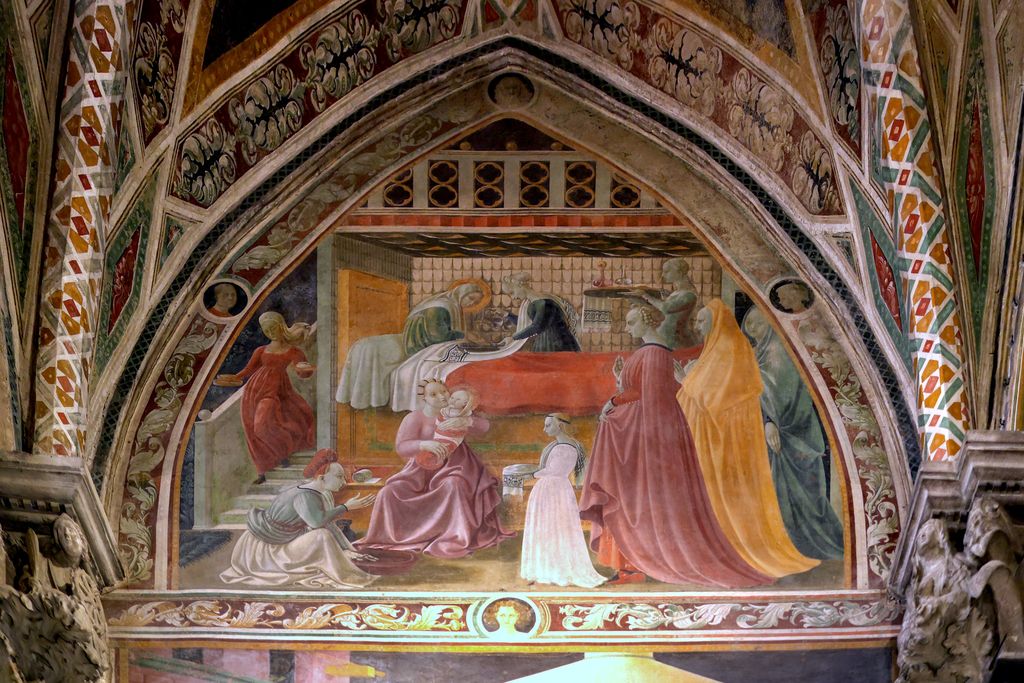
The Presentation of the Virgin in the Assunta Chapel at Prato. Mary approaches the temple stairs. Image source. CC0 / Public domain.
Explore Uccello’s paintings
The Resurrection of Christ Stained Glass Window
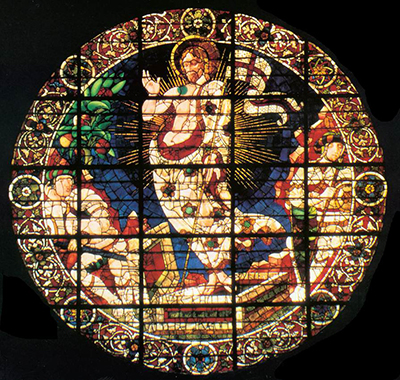
The Resurrection window in Florence Cathedral, designed by Paolo Uccello and made by Bernardo di Francesco. Photograph by Sailko. Image source. CC BY 3.0. Resized for the web.
Noah and the Flood
The Flood and Recession of the Waters above the lower episodes from Noah’s story, Santa Maria Novella. Photograph by Armin Kleiner. Image source. CC BY-SA 4.0. Resized for the web. This derivative is available under the same licence.
Blessed Jacopone da Todi
The detached fresco of Blessed Jacopone da Todi in the Museo dell’Opera del Duomo, Prato. Photograph by Sailko. Image source. CC BY-SA 3.0. Resized for the web. This derivative is available under the same licence.
The Adoration of the Child
Uccello’s surviving fresco fragments at San Martino Maggiore, Bologna, with the Nativity figures and animals in the lower surviving painted fragment. Photograph by Sailko. Image source. CC BY 3.0. Resized for the web.


A painted clock and a window designed for daylight
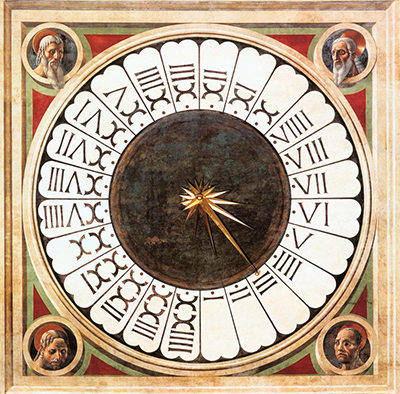
Turn back towards the entrance of Florence Cathedral to find Uccello’s monumental clock face, painted in 1443. The four heads occupy the corners outside a dial that tracks twenty-four hours from sunset, with a single hand moving counterclockwise. They are often described as prophets, though their identities are uncertain. Their tilted faces register even when the viewer is standing far below. Uccello was responsible for the painted dial. The original mechanism was the work of Angelo di Niccolò, and the star-shaped hand seen today is a reconstruction. [10] [11]
The Resurrection of Christ window is up in the drum of Brunelleschi’s dome. Its round opening gives the figure of the risen Christ and the sweep of his banner a border quite different from any panel. Below him, the tomb tilts away and the guards occupy different depths. Here coloured glass has to transmit light and keep the bodies legible at a distance. Cathedral accounts record payments for Uccello’s design in 1443, and identify Bernardo di Francesco in the making of the window. A subsequent payment even suggests Uccello had a hand in painting the glass. The accounts and the window together explain an authorship shared across kinds of work. [12]
A document can also establish a project whose object has disappeared. The cathedral catalogue distinguishes Uccello’s lost Annunciation window from the surviving Resurrection and the separately made Nativity. A letter of 1432 attests that he had made a mosaic of Saint Peter for the façade of San Marco in Venice in 1425. That work has also been lost. Gentile Bellini’s later painting of a procession in Piazza San Marco gives some idea of where the mosaic appeared, while evidence for any other surviving Venetian work needs to be assessed separately. [6] [12]
Devotional paintings at close range
At the Met in New York, The Crucifixion is a gold-ground triptych in tempera on wood, probably painted in the mid-1450s. The very small figure at the foot of the cross is identified by an inscription as Sister Felicity, a nun of the Brigittine order. The museum suggests she may have been Felicita di Francesco Casavecchia, who entered the order in 1455, and identifies her private devotions at Santa Maria del Paradiso near Florence as the setting for the work. The narrow wings and the nun’s position beside the cross make particular sense on that intimate scale. [2]
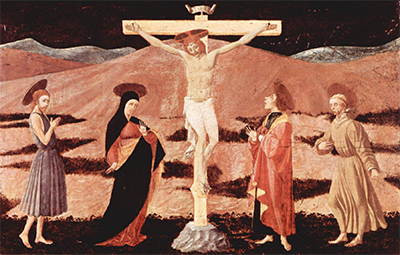
The Crucifixion with the Virgin and three saints in Madrid is a different object. The Museo Nacional Thyssen-Bornemisza dates its wide tempera panel to about 1460–65, following Miklós Boskovits. The cross stands against an ochre landscape, with the Virgin, John the Baptist, John the Evangelist and Francis spaced across it. The separate figures and the pattern of vegetation direct attention back towards the centre. The museum discusses a possible place at the centre of an altarpiece predella, the painted band below the main image. Its original altarpiece, location and any companion panels remain unidentified. To date it, Boskovits compared the style and technique with Uccello’s predella from Avane, now in Florence’s Museo di San Marco. That predella bears a dated inscription from 1452. A dated work can serve as a point of comparison even when its neighbour in the catalogue has no such inscription. [6] [13]
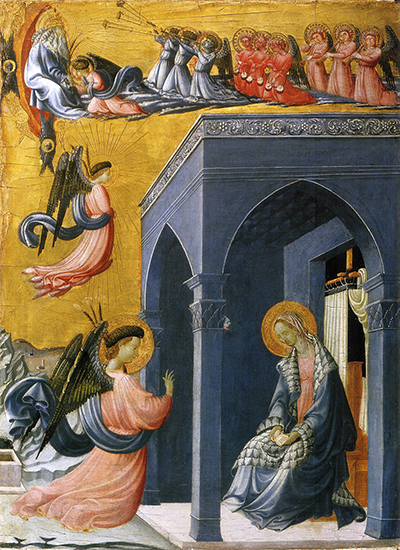
The Ashmolean’s small Annunciation belongs early in Uccello’s career, around 1430 in Hugh Hudson’s study for the National Gallery of Victoria. Here the architecture dividing and joining Mary and Gabriel is part of the action. Hudson sets the painting beside the early Melbourne Saint George, comparing details of technique as well as style. That kind of examination can support an attribution when no named commission survives. It can also show how the young painter’s gilt surfaces and fine contours work alongside his experiments with architectural depth. [14] [15]
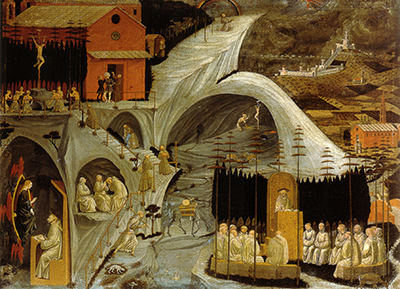
Tempera also appears on cloth. The Galleria dell’Accademia in Florence dates its Allegory of Monastic Life, or Thebaid, to about 1460–65 and specifies a fabric support. In the rocky landscape, Jerome keeps to a cave and Francis receives the stigmata on the spur above him. Prayer, penance and shared reading occur in separate pockets of the same terrain. The canvas comes from the Florentine Vallombrosian monastery of San Giorgio alla Costa, but the museum offers more than one possible original audience. Its title recalls the early Christian hermits of the Egyptian desert, although the range of saints and orders suggests a broader subject. The Thebaid at the Uffizi is a separate painting tentatively assigned there to Fra Angelico. [16] [17]
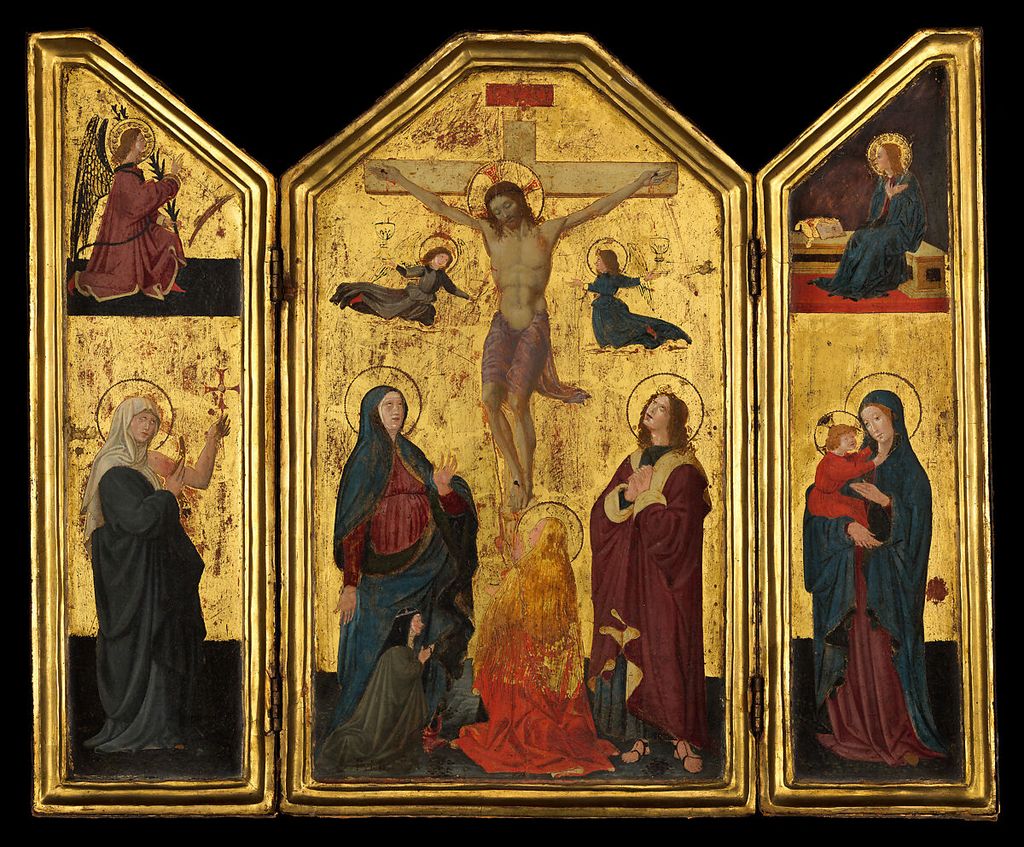
Uccello’s portable Crucifixion triptych, with Sister Felicity kneeling beneath the cross. Image source. CC0 / Public domain.
Three panels for a battle and six scenes for an altar
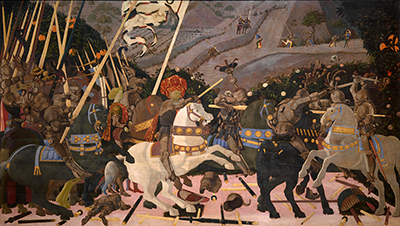
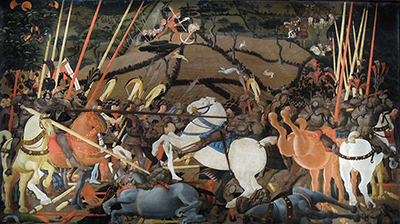
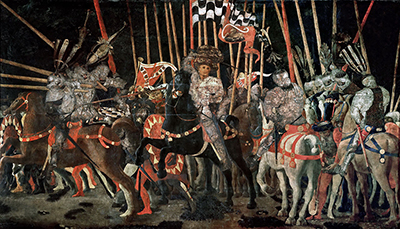
Uccello’s Battle of San Romano survives as three immense wooden panels in three cities. They picture episodes from the battle of 1 June 1432. Francesco Caglioti’s archival discovery places the paintings together in the Bartolini Salimbeni household in 1480. He proposed a commission in 1438, an attractive possibility that remains distinct from the first surviving record. The paintings appear later in Lorenzo de’ Medici’s inventory of 1492. The Medici collection explains one important setting in their history, while the earlier record restores the scale and ambition of another Florentine household. [18] [19]
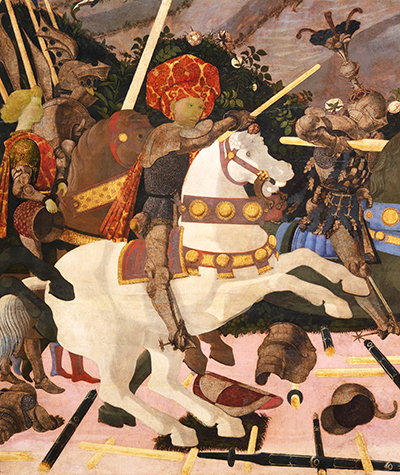
In the National Gallery’s panel, the commander Niccolò da Tolentino rides a white horse. Broken lances lie across the foreground and help define the ground beneath the tightly packed cavalry. In the Uffizi panel, a horseman pitches backwards amid a dense crossing of weapons. The Uffizi identifies him as Bernardino della Carda, an identification that scholars have questioned. In the Louvre panel, Micheletto Attendolo da Cotignola leads the counterattack. Watch how the upright and lowering lances turn the preparation for a charge into a sequence the eye can follow. The National Gallery proposes about 1438–40 for its picture, the Uffizi gives about 1435–40, and the Louvre lists its panel under the third quarter of the fifteenth century. The order in which the fighting unfolds is a separate question from when Uccello painted each scene. [18] [19] [20]
The paintings’ current outlines and surfaces are also part of what we see. Examination of the London panel and comparison with the other two show how the shapes were altered for later settings. Silver leaf once gave the armour and trappings a metallic gleam. Where it has darkened, a reproduction can make an area appear to be painted in shadow. Other areas, such as sections of the fallen knight’s armour in the foreground of the London panel, retain their original glazes and some of that surface detail. [18] [21]
In Urbino, the Miracle of the Desecrated Host tells its story across six scenes and measures close to three and a half metres wide despite being only 43 centimetres high. The Corpus Domini confraternity paid Uccello for the work in the late 1460s. The Galleria Nazionale delle Marche connects his predella with the altarpiece programme that eventually produced Justus of Ghent’s Communion of the Apostles. Their physical arrangement is uncertain. The repeated divisions and scene changes take the eye across the strip from an interior to a street and on to the final struggle over a soul. The episodes repeat a false anti-Jewish accusation about abuse of the Eucharist. Art historian Dana E. Katz places the predella in a wider history of Renaissance images that punished Jews symbolically for alleged crimes against Christianity. The high altar was an especially consequential setting for such a story. [6] [22] [23]
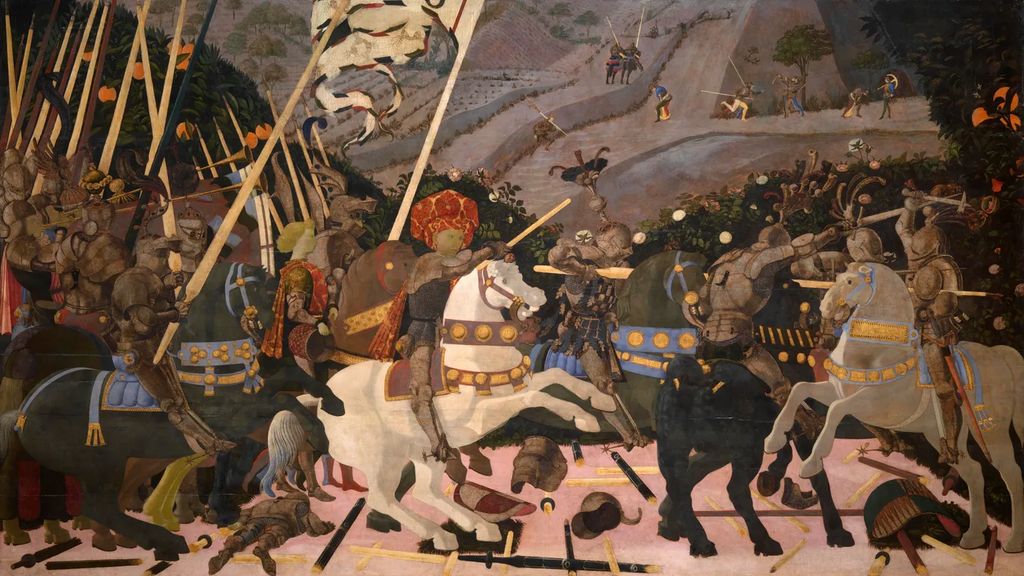
The London San Romano panel, National Gallery NG583, with Niccolò da Tolentino at the head of the cavalry. Image source. Public domain.
A hunt and a triumph in furnished rooms
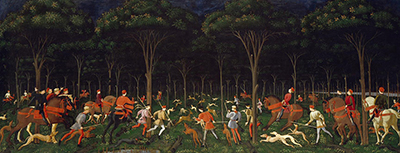
The Ashmolean’s Hunt in the Forest is a long panel of about 1465–70, painted in tempera and oil with traces of gold. At 177 centimetres across, it gives hounds and horsemen room to stream in from both sides. Spears, logs and broken branches guide the eye towards the middle as the figures thin out among the trees. The museum describes the format as a spalliera, a painted furnishing intended to be viewed at about shoulder height. A chest backboard and room panelling are both possibilities. Small traces of gold in the foliage also give a clue to how the wood might once have looked in a room lit by candles. The first owner and original installation are unknown. [3]
Yale’s Triumphal Entry into Rome of Titus and Vespasian(?) has a comparably generous sweep. Two processions enter from opposite sides and wind back towards the same walled city. Find the young commander holding a baton on one cart and the figure displaying a sword on the other. The double triumph supports the traditional identification, but the painting lacks the distinctive spoils from Jerusalem that would make the reading more secure, and it is unclear which general is which. Yale dates the painting to about 1430–35 and records gold and silver alongside tempera on the panel. Here the furniture evidence is unusually strong. A keyhole interrupts the painted panel and a recess for a lock survives in the wood, showing that this was the front of a cassone, or chest. Yale’s catalogue also traces a full replica and partial reworkings from other workshops. That afterlife helps explain how a familiar-looking detail can appear in more than one object. [24] [25]
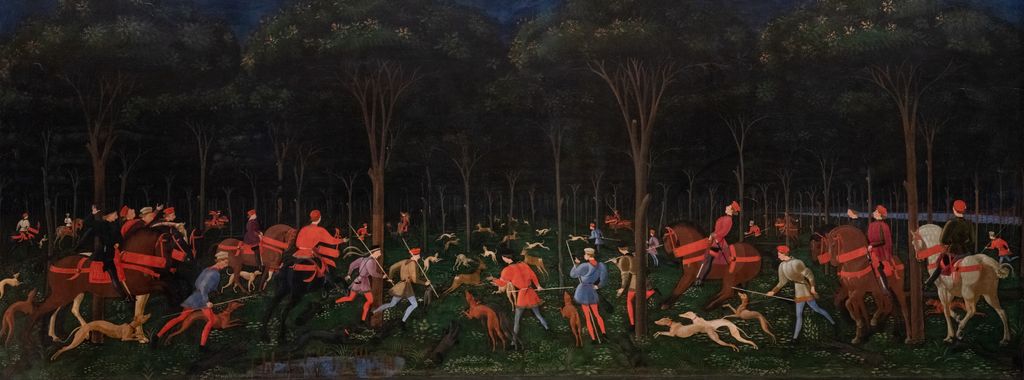
The Hunt in the Forest, Ashmolean Museum WA1850.31. Image source. CC0 / Public domain.
Three paintings of Saint George and the dragon
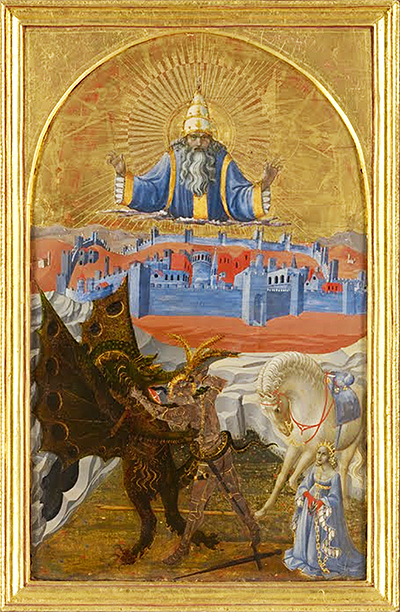
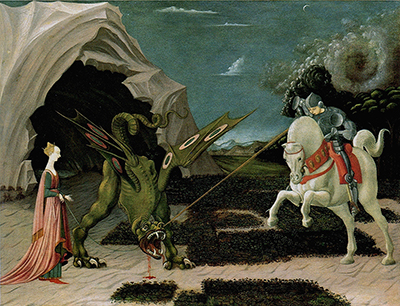
In the Melbourne painting, the figures are arranged on a tall wooden panel. The National Gallery of Victoria dates it to about 1430 and lists oil, tempera and silver leaf. The princess’s chain and George’s small blade help explain why Hugh Hudson prefers the more open-ended title Saint George and the Dragon to the collection’s Saint George Slaying the Dragon. The picture entered the collection as Sienese. Roberto Longhi identified it as Uccello’s, Carlo Volpe made a further case for the attribution, and technical study with the Oxford Annunciation adds evidence for the pairing. The artist’s name on a current catalogue entry can be the endpoint of several kinds of investigation. [15] [26]
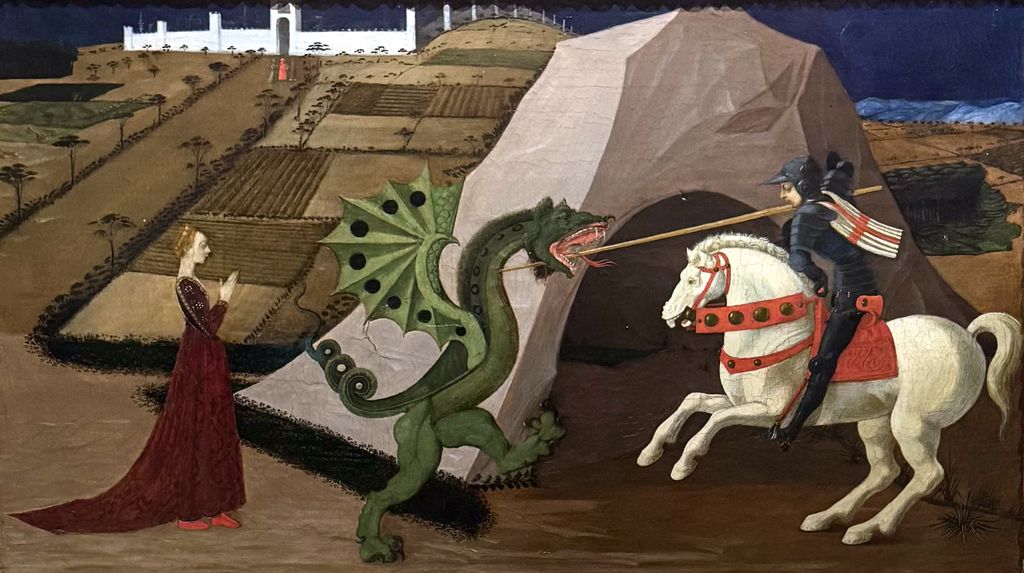
In the Paris painting at the Musée Jacquemart-André, the saint’s lance strikes through the dragon’s jaws and the princess stands apart in a patterned gown. A rock splits the scene. On one side, a road and tilled fields lead towards a walled settlement. On the other, the land opens at a different angle. The museum dates the wooden panel to 1430–35, while the Institut national d’histoire de l’art records a much wider range of proposals. The Paris picture was acquired by Nélie Jacquemart in 1899 after passing through the collection of Stefano Bardini. [27] [28] [29]
In the London painting, the princess already has a leash around the dragon’s neck while George drives the lance home. The cave opening almost repeats the outline of the dragon, and the spiral cloud draws the eye back towards the horseman. The National Gallery dates the picture to about 1470 and catalogues it as oil on canvas. Its small scale has prompted a suggestion that it was intended for a domestic interior. The broad panel in Paris, the upright panel in Melbourne and the cloth picture in London can each be recognised by the way the princess takes part, even before the medium or collection name comes into view. Our guide to Uccello’s perspective compares how such different pictures lead the eye into depth. [26] [27] [30]
Later portraits and what an attribution means
At the Louvre, five bust-length men appear across a single panel of oil on wood. The museum calls it Five Masters of the Florentine Renaissance and identifies them as Giotto, Uccello, Donatello, Manetti and Brunelleschi. The painting was sold as an Uccello in 1847. The Louvre now catalogues it as an anonymous Florentine-school work of the first half of the sixteenth century. It belongs to the history of how Uccello was remembered. The Rijksmuseum’s later woodcut by Cristoforo Coriolano likewise represents Uccello as the subject of somebody else’s work. [31] [32]
The collection and inventory number are the safest starting points when a title recurs. Next ask what the label’s certainty applies to. The year in a contract can establish a commission, while a close comparison may be the strongest evidence for a date or an attribution on a portable work. A catalogue can be confident about the painter of a chest front and still leave the generals unnamed. A portrait can preserve an old reputation long after its own authorship has been revised. These differences help explain how we know what we are seeing. [4] [15] [24] [31]
Artworks directory
Browse paintings, drawings, stained-glass designs and other objects connected with Uccello. Cycles and their surviving components may have separate entries. The collection or catalogue’s wording is retained where a date, attribution or subject is debated.
| Name | Date | Medium, attribution and collection |
|---|---|---|
| Niccolò da Tolentino at the Battle of San Romano · London | Probably c.1438–40 | Tempera and oil on wood, with metallic decoration · National Gallery Catalogue. |
| Bernardino della Carda Unhorsed · Florence | c.1435–40 | Tempera on panel · Uffizi Galleries Catalogue. |
| The Counterattack of Micheletto da Cotignola · Paris | 1450–75 in the Louvre catalogue | Tempera (possibly) on wood · Musée du Louvre Catalogue. |
| The Hunt in the Forest | c.1465–70 | Tempera and oil with traces of gold on panel · Ashmolean Catalogue. |
| Saint George and the Dragon · London | c.1470 | Oil on canvas · National Gallery Catalogue. |
| Saint George Slaying the Dragon · Melbourne | c.1430 | Oil, tempera and silver leaf on wood · National Gallery of Victoria Catalogue. |
| Saint George and the Dragon · Paris | 1430–35 in the museum catalogue | Painted wood panel · Musée Jacquemart-André Catalogue. |
| Equestrian Monument to John Hawkwood | 1436 | Transferred wall painting · Florence Cathedral Catalogue. |
| Study for the John Hawkwood Monument | 1436 | Study on prepared paper · Uffizi Catalogue. |
| Monumental Clock Face | 1443 | Painted dial · Florence Cathedral Catalogue. |
| Resurrection of Christ | 1443–44 | Stained glass · Uccello design · Florence Cathedral Catalogue. |
| Nativity | 1440s | Stained glass · Uccello design · Florence Cathedral Catalogue. |
| Creation of the Animals and Creation of Adam | Third to fourth decade of the 15th century | Detached fresco · Green Cloister, Santa Maria Novella Catalogue. |
| Creation of Eve and the Fall | Third to fourth decade of the 15th century | Detached fresco · Green Cloister, Santa Maria Novella Catalogue. |
| Flood and Recession of the Waters | 15th century; dating debated | Detached fresco · Green Cloister, Santa Maria Novella Catalogue. |
| Sacrifice and Drunkenness of Noah | 15th century; dating debated | Detached fresco · Green Cloister, Santa Maria Novella Catalogue. |
| Stories of the Virgin and Saint Stephen · Assunta Chapel | 1430s, with later completion | Fresco cycle · Paolo Uccello and Andrea di Giusto · Prato Cathedral Catalogue. |
| Blessed Jacopone da Todi | 1436 in the diocesan museum | Detached fresco · Museo dell’Opera del Duomo, Prato Catalogue. |
| Adoration of the Child · Bologna | 1430s; inscription incomplete | Detached fresco · San Martino Maggiore, Bologna Catalogue. |
| Adoration of the Christ Child · Karlsruhe | c.1436 | Painted panel · Attribution to Uccello · Staatliche Kunsthalle Karlsruhe Catalogue. |
| Annunciation · Oxford | Early 15th century | Tempera and gilding on panel · Ashmolean Catalogue. |
| Allegory of Monastic Life (Thebaid) | c.1460–65 | Tempera on canvas · Galleria dell’Accademia, Florence Catalogue. |
| Miracle of the Profaned Host | 1467–68 | Tempera on wood · Galleria Nazionale delle Marche, Urbino Catalogue. |
| Triumphal Entry into Rome of Titus and Vespasian(?) | c.1430–35 | Tempera, gold and silver on panel · Yale University Art Gallery Catalogue. |
| Crucifixion with the Virgin and Saints | c.1460–65 | Painted panel · Museo Nacional Thyssen-Bornemisza Catalogue. |
| The Crucifixion · Met triptych | Probably mid-1450s | Tempera on wood with gold ground · Metropolitan Museum of Art Catalogue. |
| Perspective Study of a Chalice | 1450–75 | Pen, ink and stylus on paper · Attributed to Uccello · Uffizi Catalogue. |
| Study of a Mazzocchio | 15th century | Perspective study · Attributed to Uccello · Uffizi Catalogue. |
| Mazzocchio Seen in Perspective | Uncertain | Drawing · Attribution debated · Musée du Louvre Catalogue. |
| Head of a Man in Profile | 15th century | Pen, ink and wash · Musée du Louvre Catalogue. |
| Five Masters of the Florentine Renaissance | 1500–50 | Oil on wood · Anonymous Florentine school · Musée du Louvre Catalogue. |
| Madonna and Child from the Del Beccuto House | 15th century | Detached fresco · Museo di San Marco, Florence Catalogue. |
| Man of Sorrows with the Virgin and Saint John · Avane Predella | 15th century | Predella · Museo di San Marco, Florence Catalogue. |
| Calling of Saint Paul the Hermit · San Miniato | After 1447 to c.1454 in state catalogue | Sinopia · Attributed to Uccello or collaborator Catalogue. |
| The host changes hands · Urbino predella, scene 1 | 1467–68 | Tempera on wood · Component of DE 231 · Galleria Nazionale delle Marche Catalogue. |
| The figures at the door · Urbino predella, scene 2 | 1467–68 | Tempera on wood · Component of DE 231 · Galleria Nazionale delle Marche Catalogue. |
| The procession approaches the altar · Urbino predella, scene 3 | 1467–68 | Tempera on wood · Component of DE 231 · Galleria Nazionale delle Marche Catalogue. |
| The condemned woman and the ladders · Urbino predella, scene 4 | 1467–68 | Tempera on wood · Component of DE 231 · Galleria Nazionale delle Marche Catalogue. |
| Persecution of the family · Urbino predella, scene 5 | 1467–68 | Tempera on wood · Component of DE 231 · Galleria Nazionale delle Marche Catalogue. |
| Angels and demons at the bier · Urbino predella, scene 6 | 1467–68 | Tempera on wood · Component of DE 231 · Galleria Nazionale delle Marche Catalogue. |
| Birth of the Virgin · Prato Cathedral | 1430s; dating debated | Fresco · Assunta Chapel, Prato Cathedral Catalogue. |
| Presentation of the Virgin · Prato Cathedral | 1430s; dating debated | Fresco · Assunta Chapel, Prato Cathedral Catalogue. |
Discussion
Look again at the images and ideas explored in Paintings. These editorial prompts invite your observations.
Reader Insights
Look at the princess in the Melbourne, Paris and London paintings of Saint George. In which picture does she seem to have the most influence over what happens next? What in her gesture, dress or position makes you read the scene that way?
Which differences would you expect to notice first when comparing a fresco to a painted panel in person?
Join the Conversation
Share a detail, comparison or question about Paintings below.
References
- Opera di Santa Maria del Fiore. Paolo Uccello, Monumento a Giovanni Acuto. Catalogue entry, location, technique and history of the civic fresco. View source.
- The Metropolitan Museum of Art. The Crucifixion, 1997.117.9. Overview and artwork details, including the inscription and Sister Felicity’s possible identification. View source.
- Ashmolean Museum. The Hunt in the Forest by Uccello, WA1850.31. Medium, domestic format, perspective and traces of gold. View source.
- Hugh Hudson. “The Politics of War: Paolo Uccello’s Equestrian Monument for Sir John Hawkwood in the Cathedral of Florence.” Parergon 23, no. 2 (2006), 1–28. First contract, revision and civic context. View source.
- Comune di Firenze. Visita il museo, Santa Maria Novella. Green Cloister sequence, earth-green pigment, workshop context and detached sinopie in the Ubriachi Chapel. View source.
- Lorenzo Sbaraglio. “Paolo di Dono, detto Paolo Uccello.” Dizionario Biografico degli Italiani, vol. 81 (2014). Venetian mosaic, Green Cloister chronology and Urbino documentation. View source.
- Giovanni Giura. “La seconda età della pittura in Santa Maria Novella.” Green Cloister discussion and fig. 1, fourth bay of the eastern walk. View source.
- Musei Diocesani di Prato. Sala della Pittura del Quattrocento. Entry for Beato Iacopo da Todi, the Assunta Chapel, Andrea di Giusto and the 1871 detachment. View source.
- Biblioteca Salaborsa. Un affresco di Paolo Uccello nella chiesa di San Martino. Bologna civic chronology, 1980 entry with the circumstances of the rediscovery and Volpe’s publication. View source.
- Opera di Santa Maria del Fiore. Paolo Uccello, Orologio monumentale. Painted dial, restored hand, system of hours and proposed identities of the four heads. View source.
- Opera di Santa Maria del Fiore. Quadrante di orologio, catalogue 6785. Historical notes on Angelo di Niccolò, the counter-façade and the Italian hour. View source.
- Opera di Santa Maria del Fiore. Cristo risorto, catalogue 5663, state identifier 0900188137. Documentary history, 1443–44, and iconography of the dome window. View source.
- Mar Borobia, Museo Nacional Thyssen-Bornemisza. The Crucifixion with the Virgin, Saint John the Baptist, Saint John the Evangelist and Saint Francis, 411 (1930.118). Format, dating debate, attribution and possible predella function. View source.
- Ashmolean Museum. Early Italian Art Gallery. Collection highlight for Paolo Uccello’s Annunciation, WA1850.7. View source.
- Hugh Hudson, National Gallery of Victoria. “A Knight in Shining Armour, a Virgin – Uccello’s Melbourne Saint George and the dragon and Oxford Annunciation.” Art Journal 46, figs. 1–2 and comparative technical and attribution discussion. View source.
- Galleria dell’Accademia di Firenze. Scene di vita eremitica (Tebaide), Allegoria della vita monastica, inv. 1890 n. 5381. Italian technical record, subject, provenance and possible original audiences. View source.
- Gallerie degli Uffizi. Thebaid. Collection entry for the distinct work tentatively attributed to Fra Angelico. View source.
- Dillian Gordon, National Gallery. The Battle of San Romano. The Fifteenth Century Italian Paintings, vol. I. Catalogue entry for NG583, iconography, earliest recorded location and Lorenzo de’ Medici’s ownership. View source.
- Gallerie degli Uffizi. Battle of San Romano, inv. 1890 n. 479. Panel showing the unhorsing, technique, date and inscription. View source.
- Musée du Louvre. La Bataille de San Romano : la contre-attaque de Micheletto Attendolo da Cotignola. Identifies the counterattack, panel, materials and provenance. View source.
- Ashok Roy and Dillian Gordon. “Uccello’s ‘Battle of San Romano’.” National Gallery Technical Bulletin 22 (2001), 4–17. London panel manufacture, condition of the metal leaf and comparison of the altered supports. View source.
- Galleria Nazionale delle Marche. Miracle of the Profaned Host, DE 231. Six episodes, tempera support, dimensions and confraternity commission. View source.
- Dana E. Katz. The Jew in the Art of the Italian Renaissance. University of Pennsylvania Press, 2008. Interpretation of host-desecration imagery in Renaissance Italy, including Uccello’s predella. View source.
- Yale University Art Gallery. The Triumphal Entry into Rome of Titus and Vespasian(?), 2015.17.1. Current object title, medium, dimensions and dating. View source.
- Laurence Kanter and Pia Palladino, Yale University Art Gallery. Italian Paintings at the Yale University Art Gallery, vol. 2, Florentine School, entry 93. “The Triumphal Entry into Rome of Titus and Vespasian(?)”, condition and discussion of the lock, iconography and related panels. View source.
- National Gallery of Victoria. Saint George slaying the dragon, 2124-4 (online work 3747). Medium, c. 1430 date, object history and image. View source.
- Musée Jacquemart-André. Saint Georges terrassant le dragon. Paris panel, date and visual description. View source.
- Institut national d’histoire de l’art. Saint Georges combattant le dragon. AGORHA object dossier, proposed dates and original functions. View source.
- Fondazione Giorgio Cini. A Guest at the Palace: “Saint George and the Dragon” by Paolo Uccello. 2021 loan, discussion of the panel’s composition and Bardini–Jacquemart provenance. View source.
- National Gallery. Saint George and the Dragon, NG6294. About 1470, oil on canvas, legend and suggested domestic use. View source.
- Musée du Louvre. Cinq maîtres de la Renaissance florentine : Giotto, Uccello, Donatello, Manetti, Brunelleschi, INV 267 / LP 6905. Current anonymous Florentine-school classification and the 1847 sale attribution. View source.
- Rijksmuseum. Portret van Paolo Uccello, RP-P-2022-4271. Woodcut by Cristoforo Coriolano. View source.
More PAOLO UCCELLO Artworks
Noah and the Flood
The Flood and Recession of the Waters above the lower episodes from Noah’s story, Santa Maria Novella. Photograph by Armin Kleiner. Image source. CC BY-SA 4.0. Resized for the web. This derivative is available under the same licence.
The Resurrection of Christ Stained Glass Window
The Resurrection window in Florence Cathedral, designed by Paolo Uccello and made by Bernardo di Francesco. Photograph by Sailko. Image source. CC BY 3.0. Resized for the web.