


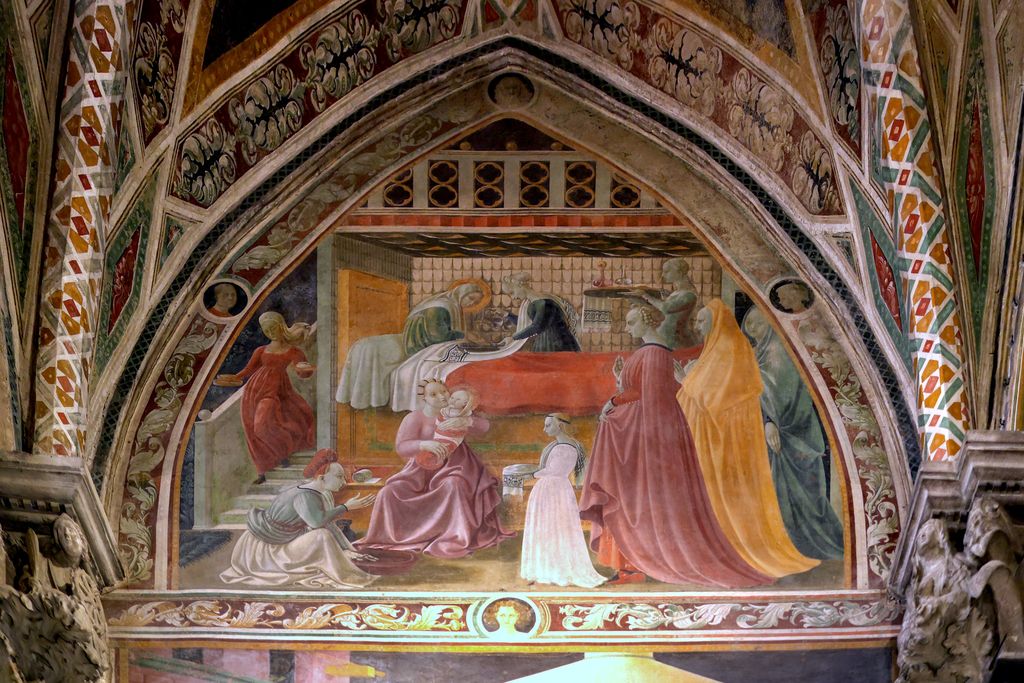
The Birth of the Virgin in the Assunta Chapel at Prato, seen with its painted border and the adjoining architecture. Image source. CC0 / Public domain.
 by Tom Gurney
Tom Gurney BSc (Hons) is an art history expert with over 20 years experience
Email: tomgurney1@gmail.com / Phone: +44 7429 011000
Prato Cathedral Frescoes: Introduction
A girl climbs the steps alone in Paolo Uccello’s Presentation of the Virgin. Her parents pray at the foot of the stairs, the priest reaches towards her from the top, and two children watch from close to the painted edge. In the arched fresco above, the same girl is a baby held among women in a bedchamber. These two paintings occupy the right wall of the Assumption Chapel in Prato Cathedral. On the wall facing them, Saint Stephen speaks before a council, is stoned outside a city, and is eventually found in his grave. Look across the chapel as well as up and down it, and the design takes shape. Two lives unfold at different speeds, carried by painted rooms, streets, and gatherings of people. [1] [2]
Uccello began the paintings in the 1430s. Andrea di Giusto completed the cycle in a later campaign, and in the Stoning of Saint Stephen the change of painter takes place within the same picture. Prato’s cathedral museum dates the start of the work to early 1436, while some historians put Uccello on the scaffolding around 1433–34. The different dates reflect two ways of accounting for the chapel’s documents and for the few years in which the paintings could plausibly have been made. [1] [3] [4] [5]
At a Glance
- LocationAssumption Chapel, Cathedral of Santo Stefano, Prato, Italy
- SubjectsThe lives of the Virgin Mary and Saint Stephen
- ArtistsBegun by Paolo Uccello in the 1430s and completed by Andrea di Giusto
Contents
- The Assumption Chapel at Santo Stefano
- Birth of the Virgin
- Presentation of the Virgin
- Stephen’s wall and Andrea di Giusto’s completion
- Two stages of work and a disputed patron
- What survived from behind the altar
- Annotated details
The Assumption Chapel at Santo Stefano
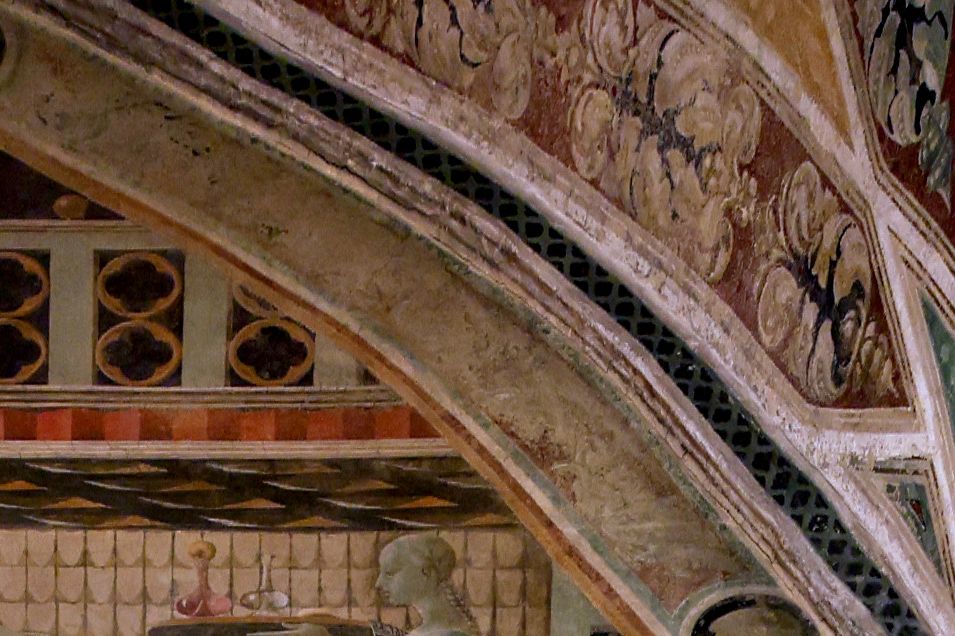
The Cappella dell’Assunta opens to the right of the main choir in what was then the parish church, or pieve, of Santo Stefano. The actual entrance arch carries painted saints, including Paul, Francis, Jerome and Dominic. Beyond them, the side walls are divided into three registers. A broad lunette fills the top of each wall, and bands of foliage and roundels with faces mark out the pictures below. Allegorical figures occupy the vault, which Lorenzo Sbaraglio assigns to Uccello along with the saints of the entrance arch. The framing makes a difference to the experience of the stories. Lifting your eyes from the fictive staircase to the painted foliage, for instance, brings you back to the masonry that holds the picture in place. [1] [2] [6]
The Assumption dedication explains why events from Mary’s life fill one wall, while Stephen was the titular saint of the church. A priest officiating at the altar, people attending Mass and anyone approaching the chapel saw the scenes from different heights and distances. The painted saints at the entrance and the details of the stories offered different points of attention for those viewers. An altarpiece associated with the later furnishing, by Zanobi Strozzi and Domenico di Michelino, brought Mary’s death and ascent into the room. Its main panel is in the National Gallery of Ireland, and the three predella scenes are in Prato’s Palazzo Pretorio. One of those small scenes shows Francis receiving the stigmata. The links between altar and walls extended to individual saints as well as to the two principal devotions. [4] [5] [6] [7]
There is another Presentation of the Virgin under the same roof. It belongs to Agnolo Gaddi’s earlier frescoes in the Chapel of the Sacred Girdle, which houses the relic Prato venerates as Mary’s belt. In 1428 the church commissioned Donatello and Michelozzo to make an exterior pulpit from which the belt could be shown to the crowds in the square. That public ceremony gives some idea of the range of audiences for sacred art in Prato, from the gathering outside to those who could approach an altar in the church. Filippo Lippi later painted a second narrative of Stephen in the cathedral’s larger choir, alongside the life of John the Baptist. Lippi even gives his Stoning room to continue across the junction between two walls. Uccello and Andrea’s version belongs to the smaller chapel, inside the frame of a single field. Keeping the rooms in view helps explain why a visitor to Santo Stefano encounters some of the same episodes more than once. [2] [6] [8] [9]
Birth of the Virgin
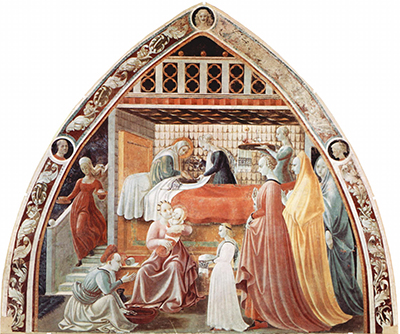
High on the right, the Birth of the Virgin fits beneath the pointed curve of the lunette. The Fondazione Federico Zeri records it as a fresco measuring 302 by 361 centimetres. The upper part of the painted house has a row of dark quatrefoils. Below that decorative band a flat ceiling projects over the bed, with its pattern foreshortened so that we seem to be looking up at its underside. The wall at the back of the room, with its repeated hanging pattern, gives the room a shallow depth. Uccello fits a rectangular chamber into a pointed frame by setting the bed at its centre and using the sloping edges for figures entering or gathering at either side. [6] [10]
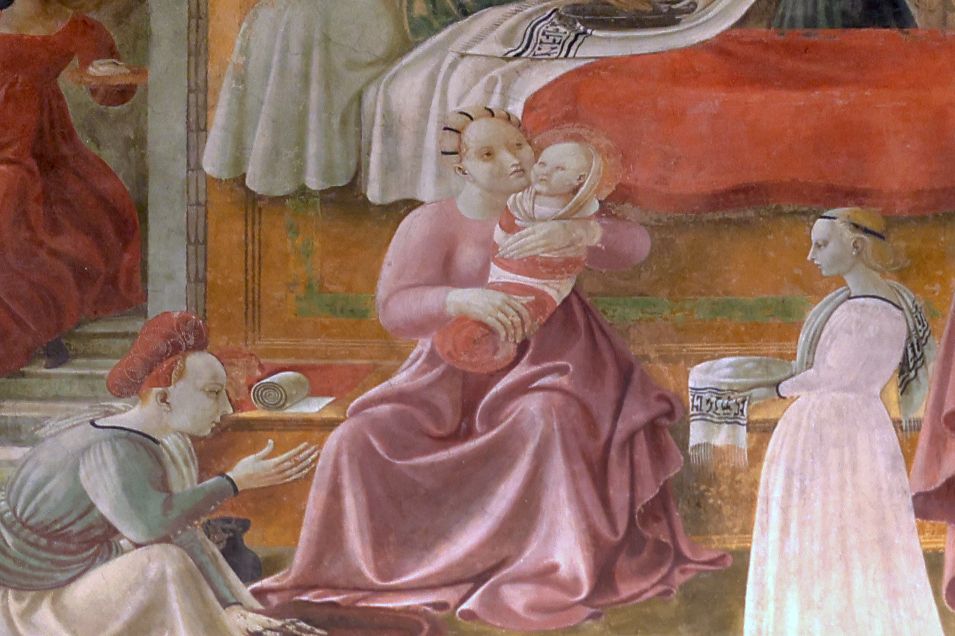
Anne lies at the back, her head inclined over white linen and a bright red coverlet. An attendant bends over her. At the front, a woman in a lilac dress supports the swaddled infant, whose small halo lets us pick her out from the busy company. To the left, a woman in red descends a staircase carrying dishes. Below her, another attendant kneels by a basin. On the other side, the visitors’ long garments form a nearly continuous sweep of rose, gold and blue-green. The woman carrying a tray behind them brings the eye back around to the bed. From the floor of the chapel the broad red bedspread and the masses of cloth are easy to grasp. Closer looking brings out the care in the separate acts of washing, carrying and holding. [6] [10]
The stairs are narrow and off to one side. They bring someone down into the room instead of taking our eye through its centre. The ceiling and bed let us gauge the dimensions of the room while the folds and gestures make its activity felt. Look at the descending woman’s sleeves and the bend of her body against the stair rail, or at the way the seated woman’s skirt folds around the infant she holds. Andrea De Marchi sees an affinity between such floating rhythms and the figures on Lorenzo Ghiberti’s North Doors for the Florence Baptistery, where Uccello worked early in his career. At Prato those rhythms give the figures an ease of movement alongside the firm geometry of the bed and walls. [1] [6] [10]
Presentation of the Virgin
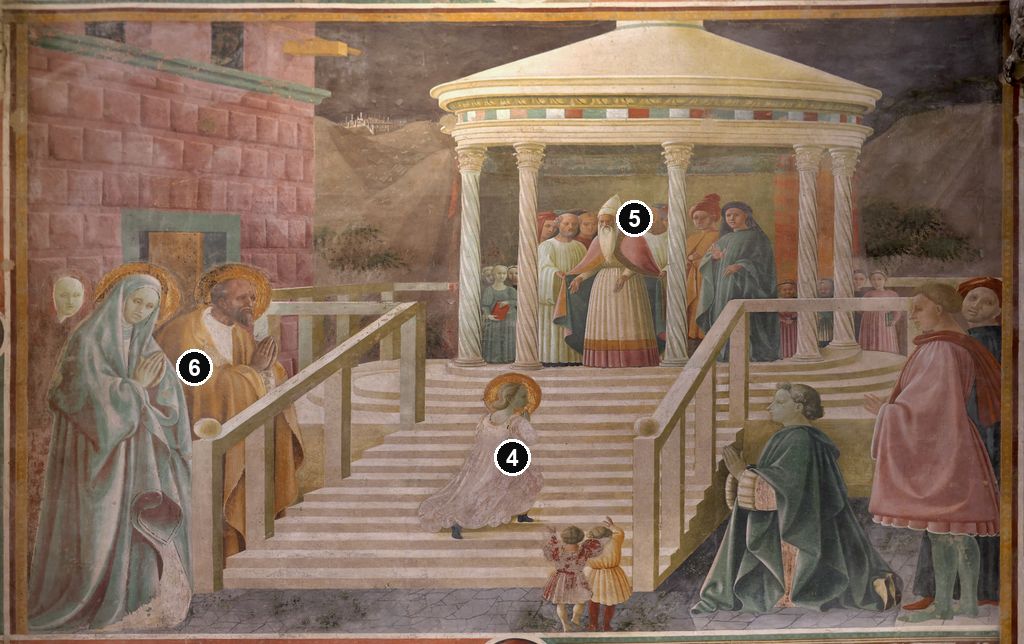
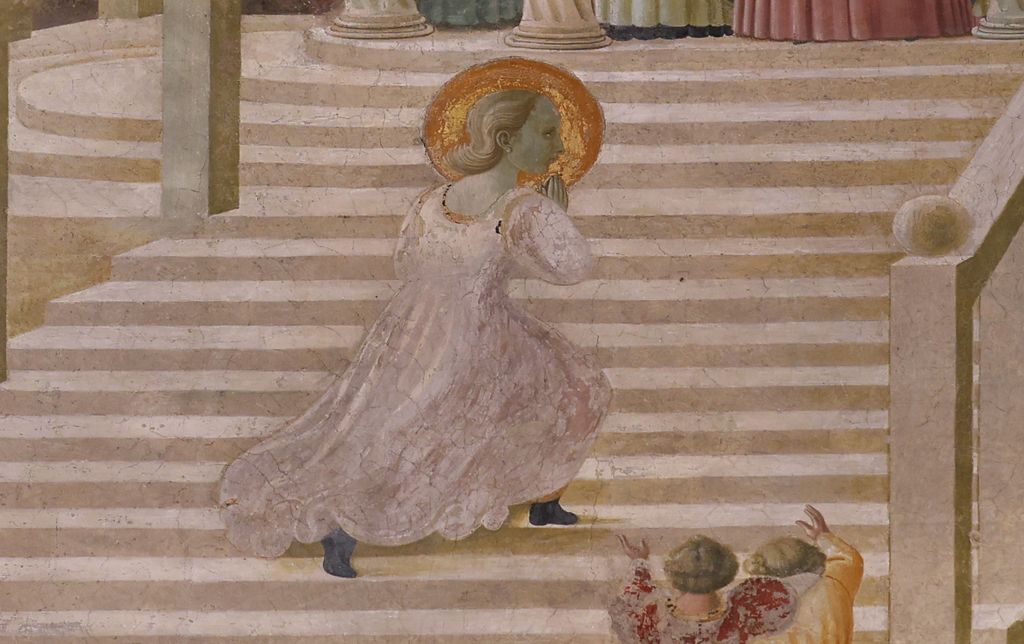
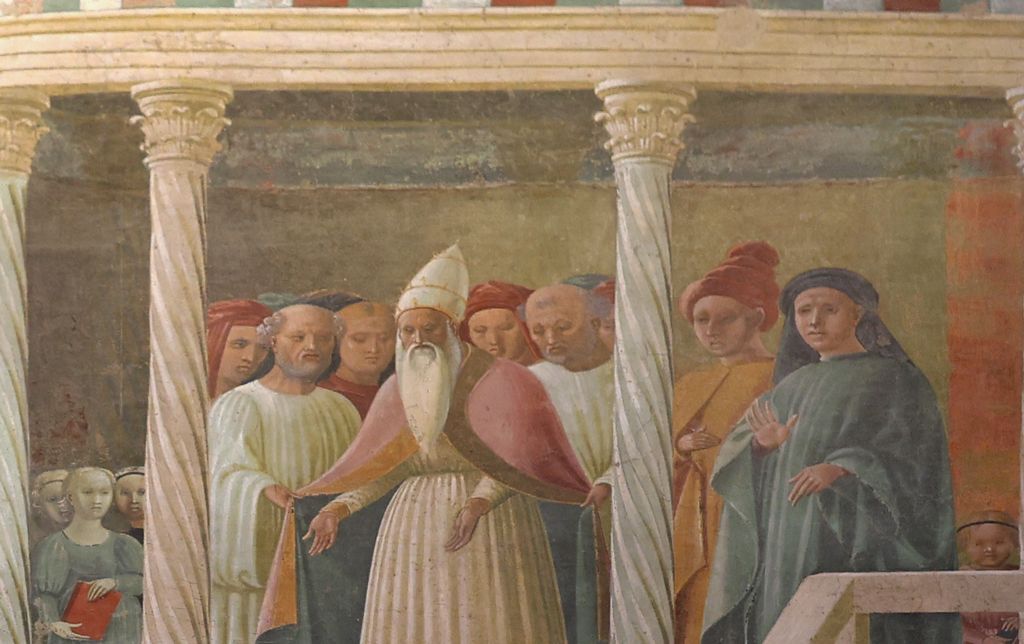
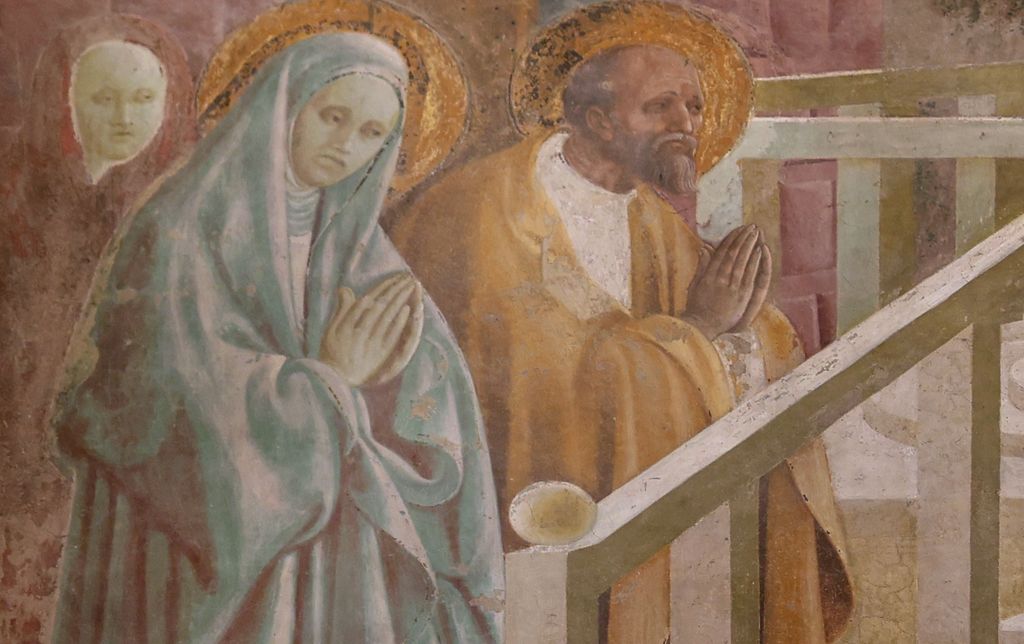
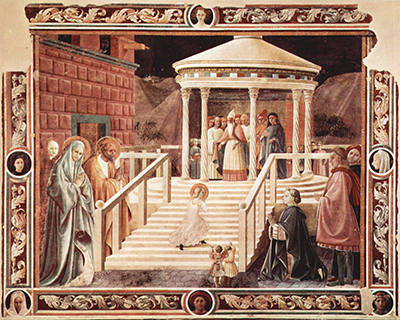
The stairs in the Presentation occupy the centre of a wide field, which the Zeri catalogue gives as 335 by 420 centimetres. The story tells how Mary’s parents, Anne and Joachim, brought her to the Temple as a child. The early Christian Protoevangelium of James gives her age as three and describes girls accompanying her with lit lamps. Uccello gives the small figure the stairs to herself. He places them to the left of the stair with their hands joined in prayer. Mary has already gone ahead. Her small figure, with its pale dress, dark shoes and large halo, marks the crossing between two spaces. Below her is the pavement with its scattered spectators. Above her is a priest and the company gathered under the columns. The angle of her body and the repeated horizontal treads give a sense of the effort and progress of climbing. [2] [11] [12]
Follow one of the handrails from its rounded finial up to the temple. The parallel stairs give way to rounded steps, and the horizontal bands around the temple bend to show the building turning away from us. Spiral shafts, pale capitals and small coloured panels under the roof make the architecture as elaborate as the clothes in the Birth. The large pink masonry block on the left feels heavy by comparison. Beyond it, a small settlement on a distant ridge offers another measure of distance. The stair rises towards the priest, who reaches down with an open hand. Uccello uses the building to show how far Mary must travel before anyone receives her. [2] [6] [11]
The margins have a life of their own. Two small spectators at the foot of the steps lean towards one another, one reaching up. A much larger figure kneels in prayer to the right, on the viewer’s side of the rail. The man in a red cap at the far edge looks out of the fresco. A study by Harald Rupfle traces the suggestion that he might be Uccello himself. The outward glance and position at the edge make that an attractive reading, although the face has also been identified differently. Once we notice those spectators we can see how the architecture assigns them their roles. The priest has the full breadth of the entrance behind him. The people at the bottom can follow Mary’s progress without entering the space she is climbing into. [2] [11]
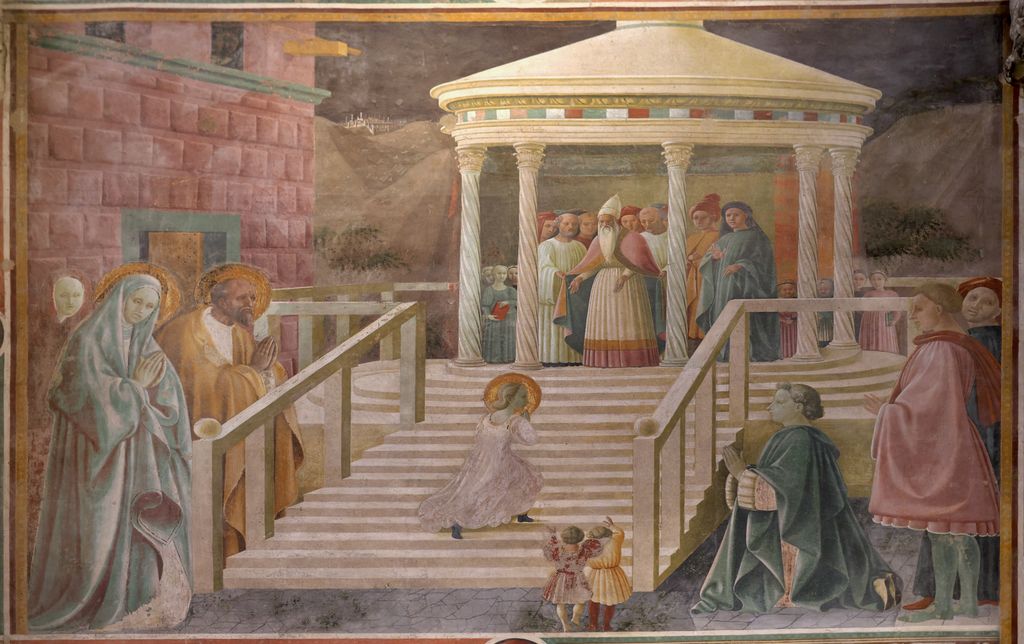
The Presentation of the Virgin in the Assunta Chapel at Prato. Mary approaches the temple stairs. Image source. CC0 / Public domain.
Annotated Details from Prato Cathedral Frescoes
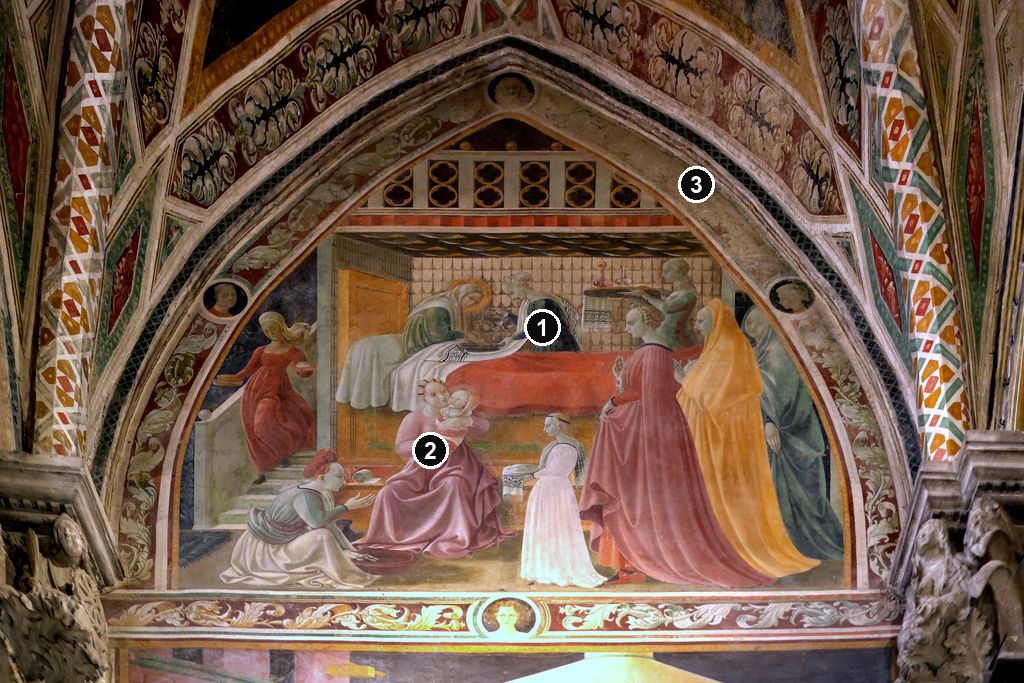
The numbered points identify visible features discussed in this article. Return from each detail to the numbered overview. Each caption identifies the work shown.
The Birth of the Virgin at Prato
The Birth of the Virgin in the Assunta Chapel at Prato, seen with its painted border and the adjoining architecture. Image source. CC0 / Public domain.
The Presentation of the Virgin at Prato
The Presentation of the Virgin in the Assunta Chapel at Prato. Mary approaches the temple stairs. Image source. CC0 / Public domain.
Details from PRATO CATHEDRAL FRESCOES
Compare the cropped details with the source images above. Notice how their colours, shapes and positions contribute to the larger compositions.
The Birth of the Virgin at Prato
Anne and the covered bed
Anne’s red bed forms a broad horizontal shape behind the attendants. Its breadth and the tiled back wall organise the room within the pointed arch.
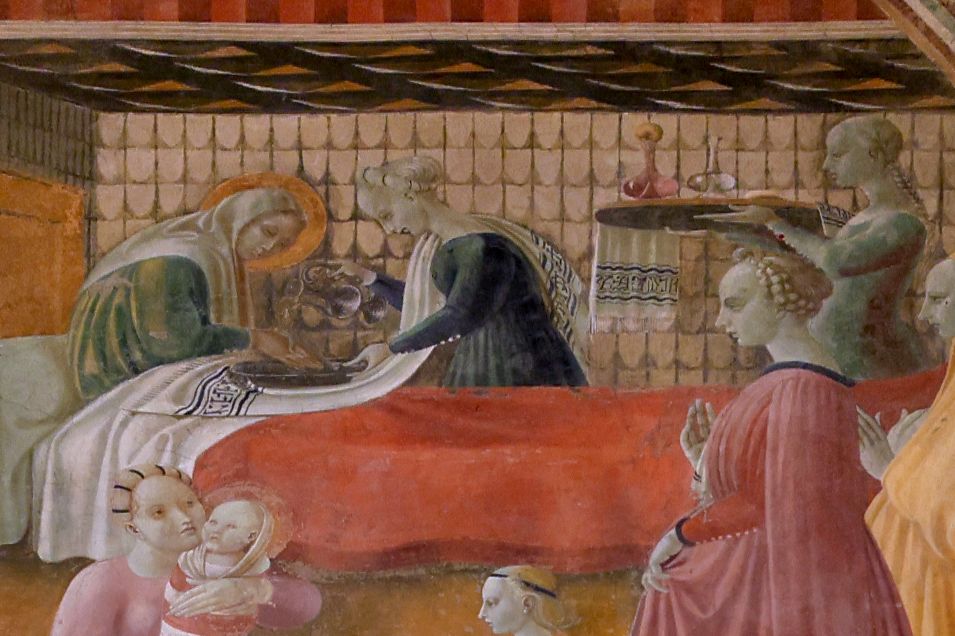
The infant and the basin
The cluster of hands brings attention to Mary in the foreground. The woman leaning toward the basin ties this smaller group to the left edge of the room.
The painted room and the chapel arch
The painted interior sits inside the curve of the lunette. Look from the horizontal lines of the imaginary room to the coloured bands of the real chapel architecture.
The Presentation of the Virgin at Prato
Mary on the steps
Mary has the broad middle steps to herself. Her place between the flanking groups draws attention towards the people waiting at the entrance.
Entrance to the temple
The priest and attendants gather between columns under a shallow roof. The curve of the building crowns the lines established by the steps.
The left-hand witnesses
The adults on the left watch from outside the central flight of steps. Their position and the handrail help distinguish the foreground from the platform.
Stephen’s wall and Andrea di Giusto’s completion
The Disputation of Saint Stephen fills the opposite lunette. Stephen confronts his opponents before the council, the encounter that precedes his death in the Acts of the Apostles. The architecture gathers figures around a public confrontation, and their faces and gestures give the argument several points of focus. De Marchi draws attention to the range of expression, from pronounced grimaces to quieter faces. He compares these differences with the heads painted in the roundels. Even out in the border, where a face has no duty to move the narrative forward, Uccello can make us imagine it looking or reacting. [1] [6]
In the Stoning of Saint Stephen, the background belongs to Uccello’s campaign. De Marchi identifies his preparatory drawing and the first four areas of plaster painted in a day’s work, or giornate, which contain the city and sea. The fortified waterfront, clustered towers and domed building give the event a precise-looking setting without requiring us to recognise the place as an actual city. Alessandra Acconci compares the dome in the fresco with Brunelleschi’s Old Sacristy at San Lorenzo in Florence. The comparison helps explain how a viewer might recognise a modern architectural form in the setting of an ancient story. Andrea di Giusto is credited with completing the lower portion, where the figures enact the stoning. The resulting picture brings together Uccello’s distant prospect and the more immediate action of Andrea’s figures. Its change of hand is easier to understand once the painting is considered as a wall coated and worked on in separate areas. [1] [6] [13] [14]
Andrea is also credited with the Finding of Saint Stephen’s Body at the foot of the left wall and the Marriage of the Virgin at the foot of the right. The finding is the Invention of Saint Stephen in the older sense of the word invention, the discovery of his relics. It would acquire particular significance at the Assunta altar when a chaplaincy of that name was installed there. Andrea was already working independently in Prato. Palazzo Pretorio holds his large polyptych made in 1435 for the Olivetan house at Le Sacca and suggests that a commission of that standing may have helped him secure the task of completing the chapel. His work here belongs to a second campaign. The Stoning offers evidence that he took over a composition already laid out by Uccello. [2] [4] [5] [6] [13] [15]
Two stages of work and a disputed patron
The Museo dell’Opera del Duomo still dates the start of Uccello’s campaign to early 1436 and names the wool merchant Michele di Giovannino Marcovaldi in its account of Jacopone. The archival reading advanced by Matteo Mazzalupi starts with Marcovaldi’s 1435 testament. A bequest for services at a Marian altar can sound like a commission for this chapel. Mazzalupi traces the wording and later benefit records to the altar where the Sacred Girdle was shown, in the distinct chapel near the entrance. The record therefore establishes Marcovaldi’s investment in devotion to Mary at Santo Stefano while leaving the contract for these wall paintings open. [3] [4] [5]
A separate will offers firmer ground for the later work. The Pratese woodworker Stefano di Ciato established a chaplaincy of the Finding of Saint Stephen in his will of 30 July 1437. On 26 February 1438 his executors Roberto Salviati and Leonardo Buonristori sought the use of the Assumption Chapel by the high altar, acknowledging that it needed paintings and ornaments. A record of 1463 identifies the chaplaincy explicitly with the Assumption altar, and subsequent records and accounts preserve the two families’ patronage. Mazzalupi reads the notice about missing decoration as a reference to work still needed after Uccello’s departure. The document sets out the conditions for completing and endowing the chapel, while the first campaign has to be dated from other evidence. De Marchi likewise distinguishes an unrelated 1448 record concerning replacement of removed stained glass from the date of the murals. [4] [5] [6]
Two works of art help put bounds on the earlier phase. Uccello’s rare figure of Jacopone da Todi has been connected with the discovery of the friar’s relics in January 1433 and Bernardino of Siena’s preaching in Prato that year. At the other end of the proposed interval stands Andrea di Giusto’s Madonna of the Belt, an altarpiece dated 1437 and made for an oratory at Cortona. Sbaraglio sees its Francis as a quotation of the saint Uccello painted in the Prato entrance arch. Taken together with comparisons of style, these arguments support an earlier start around 1433–34. The dates belong to the events and the altarpiece. The link between them and the original campaign depends on how convincingly the images can be connected. [1] [3] [4] [16]
What survived from behind the altar
The Blessed Jacopone da Todi was painted on the back wall. It shows the Franciscan Jacopone, identified by the inscription below him, standing in a tall red niche. His lower body is foreshortened for a view from below, while his face is presented almost head-on. The care taken over the imagined viewing position is particularly clear in a figure now seen away from its original wall. The painting was recovered behind a seventeenth-century altar during alterations in 1871, detached, and is now held by the Museo dell’Opera del Duomo. Most of the original decoration on the back wall was lost in the nineteenth-century work. [1] [3] [5] [17]
A watercolour drawn by Giuseppe Nesti in 1871 records details of the back wall that are otherwise difficult to recover. The restorers also reproduced family shields in new positions high on the wall. These versions were taken down during twentieth-century conservation. Mazzalupi identified two photographs taken from the restoration scaffolding, now in the Fototeca Berenson, that show where the reconstructed shields were placed. The photographs can tell us what nineteenth-century restorers understood the wall to have been, and the chaplaincy records establish a firmer connection with Salviati and Buonristori. The identity of the patron who first hired Uccello remains open. [4] [5]
Other conservation work has brought the process of painting into view. In 1964, damp and failing plaster had already left parts of the cycle blistering and friable, as Eve Borsook records in her study of Italian mural conservation. The Presentation was transferred to a new support and remounted at its original location. Preparatory drawings for the Birth and the Disputation, laid out on the rough plaster before the painting went on, are held with the Museo di Pittura Murale collection at San Domenico. In 2026 the diocese and the Palazzo Spinelli conservation institute reported a programme of cleaning and monitoring those two drawings. The sinopie and the painted scenes preserve different moments in the work. The drawings retain exploratory lines and some variations from the finished design. In the chapel, the painted scenes retain their relationship to the actual arches and to the people standing below. [2] [18] [19] [20]
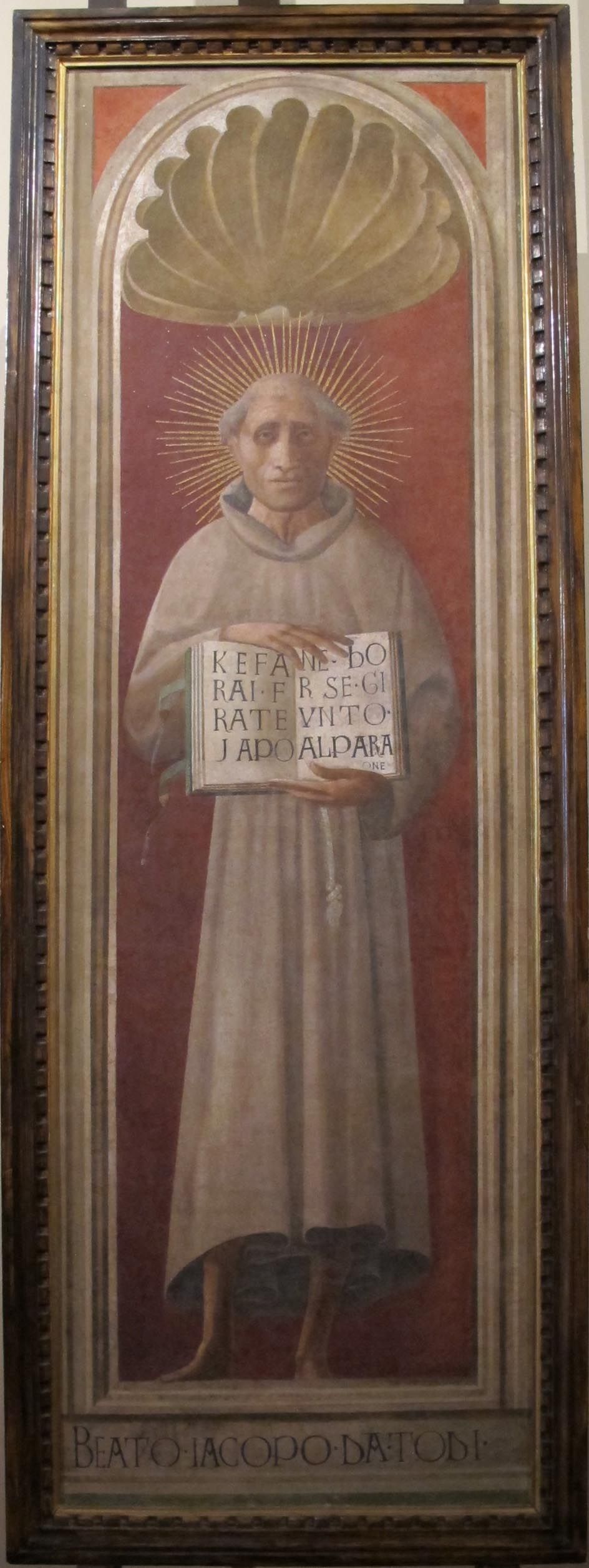
The detached fresco of Blessed Jacopone da Todi in the Museo dell’Opera del Duomo, Prato. Photograph by Sailko. Image source. CC BY-SA 3.0. Resized for the web. This derivative is available under the same licence.
Artworks directory
Browse paintings, drawings, stained-glass designs and other objects connected with Uccello. Cycles and their surviving components may have separate entries. The collection or catalogue’s wording is retained where a date, attribution or subject is debated.
| Name | Date | Medium, attribution and collection |
|---|---|---|
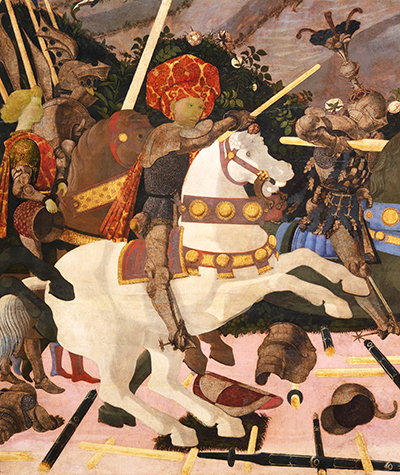
| Niccolò da Tolentino at the Battle of San Romano · London | Probably c.1438–40 | Tempera and oil on wood, with metallic decoration · National Gallery Catalogue. |
| Bernardino della Carda Unhorsed · Florence | c.1435–40 | Tempera on panel · Uffizi Galleries Catalogue. |
| The Counterattack of Micheletto da Cotignola · Paris | 1450–75 in the Louvre catalogue | Tempera (possibly) on wood · Musée du Louvre Catalogue. |
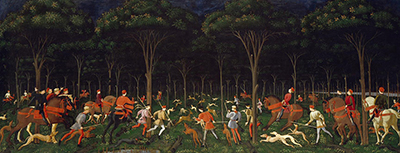
| The Hunt in the Forest | c.1465–70 | Tempera and oil with traces of gold on panel · Ashmolean Catalogue. |
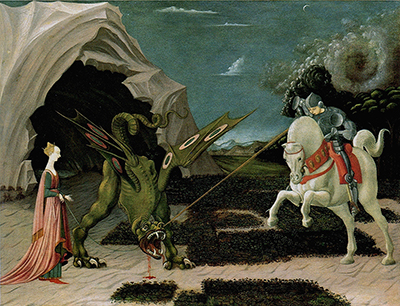
| Saint George and the Dragon · London | c.1470 | Oil on canvas · National Gallery Catalogue. |
| Saint George Slaying the Dragon · Melbourne | c.1430 | Oil, tempera and silver leaf on wood · National Gallery of Victoria Catalogue. |
| Saint George and the Dragon · Paris | 1430–35 in the museum catalogue | Painted wood panel · Musée Jacquemart-André Catalogue. |
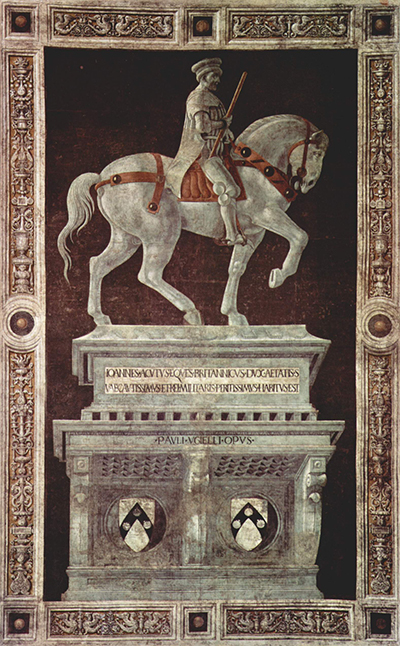
| Equestrian Monument to John Hawkwood | 1436 | Transferred wall painting · Florence Cathedral Catalogue. |
| Study for the John Hawkwood Monument | 1436 | Study on prepared paper · Uffizi Catalogue. |
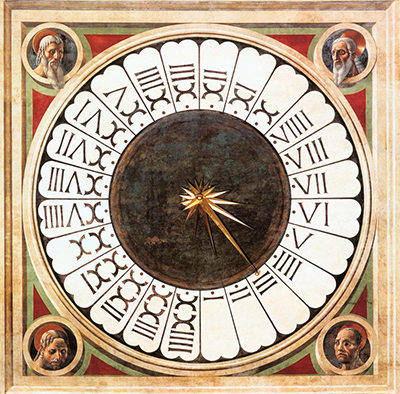
| Monumental Clock Face | 1443 | Painted dial · Florence Cathedral Catalogue. |
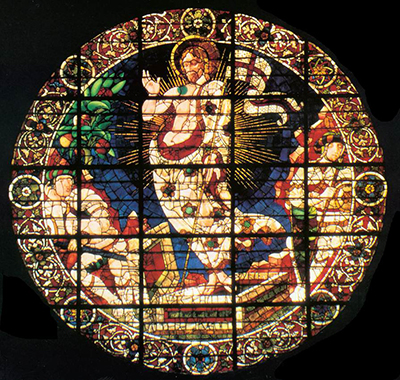
| Resurrection of Christ | 1443–44 | Stained glass · Uccello design · Florence Cathedral Catalogue. |
| Nativity | 1440s | Stained glass · Uccello design · Florence Cathedral Catalogue. |
| Creation of the Animals and Creation of Adam | Third to fourth decade of the 15th century | Detached fresco · Green Cloister, Santa Maria Novella Catalogue. |
| Creation of Eve and the Fall | Third to fourth decade of the 15th century | Detached fresco · Green Cloister, Santa Maria Novella Catalogue. |
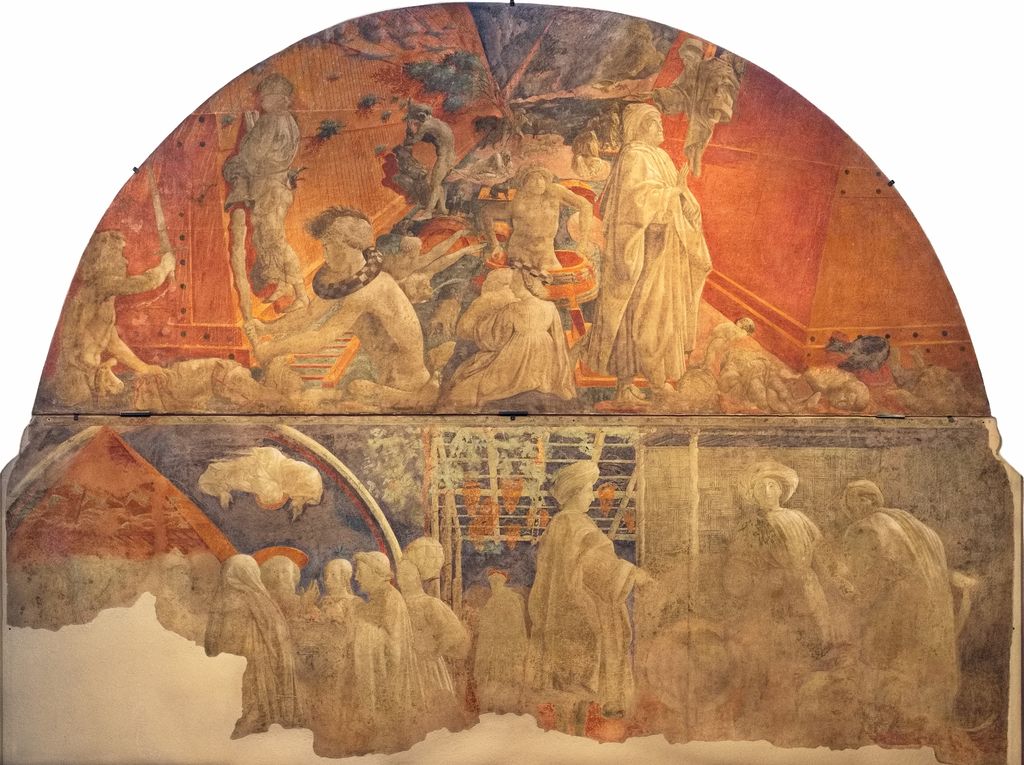
| Flood and Recession of the Waters | 15th century; dating debated | Detached fresco · Green Cloister, Santa Maria Novella Catalogue. |
| Sacrifice and Drunkenness of Noah | 15th century; dating debated | Detached fresco · Green Cloister, Santa Maria Novella Catalogue. |
| Stories of the Virgin and Saint Stephen · Assunta Chapel | 1430s, with later completion | Fresco cycle · Paolo Uccello and Andrea di Giusto · Prato Cathedral Catalogue. |
| Blessed Jacopone da Todi | 1436 in the diocesan museum | Detached fresco · Museo dell’Opera del Duomo, Prato Catalogue. |
| Adoration of the Child · Bologna | 1430s; inscription incomplete | Detached fresco · San Martino Maggiore, Bologna Catalogue. |
| Adoration of the Christ Child · Karlsruhe | c.1436 | Painted panel · Attribution to Uccello · Staatliche Kunsthalle Karlsruhe Catalogue. |
| Annunciation · Oxford | Early 15th century | Tempera and gilding on panel · Ashmolean Catalogue. |
| Allegory of Monastic Life (Thebaid) | c.1460–65 | Tempera on canvas · Galleria dell’Accademia, Florence Catalogue. |
| Miracle of the Profaned Host | 1467–68 | Tempera on wood · Galleria Nazionale delle Marche, Urbino Catalogue. |
| Triumphal Entry into Rome of Titus and Vespasian(?) | c.1430–35 | Tempera, gold and silver on panel · Yale University Art Gallery Catalogue. |
| Crucifixion with the Virgin and Saints | c.1460–65 | Painted panel · Museo Nacional Thyssen-Bornemisza Catalogue. |
| The Crucifixion · Met triptych | Probably mid-1450s | Tempera on wood with gold ground · Metropolitan Museum of Art Catalogue. |
| Perspective Study of a Chalice | 1450–75 | Pen, ink and stylus on paper · Attributed to Uccello · Uffizi Catalogue. |
| Study of a Mazzocchio | 15th century | Perspective study · Attributed to Uccello · Uffizi Catalogue. |
| Mazzocchio Seen in Perspective | Uncertain | Drawing · Attribution debated · Musée du Louvre Catalogue. |
| Head of a Man in Profile | 15th century | Pen, ink and wash · Musée du Louvre Catalogue. |
| Five Masters of the Florentine Renaissance | 1500–50 | Oil on wood · Anonymous Florentine school · Musée du Louvre Catalogue. |
| Madonna and Child from the Del Beccuto House | 15th century | Detached fresco · Museo di San Marco, Florence Catalogue. |
| Man of Sorrows with the Virgin and Saint John · Avane Predella | 15th century | Predella · Museo di San Marco, Florence Catalogue. |
| Calling of Saint Paul the Hermit · San Miniato | After 1447 to c.1454 in state catalogue | Sinopia · Attributed to Uccello or collaborator Catalogue. |
| The host changes hands · Urbino predella, scene 1 | 1467–68 | Tempera on wood · Component of DE 231 · Galleria Nazionale delle Marche Catalogue. |
| The figures at the door · Urbino predella, scene 2 | 1467–68 | Tempera on wood · Component of DE 231 · Galleria Nazionale delle Marche Catalogue. |
| The procession approaches the altar · Urbino predella, scene 3 | 1467–68 | Tempera on wood · Component of DE 231 · Galleria Nazionale delle Marche Catalogue. |
| The condemned woman and the ladders · Urbino predella, scene 4 | 1467–68 | Tempera on wood · Component of DE 231 · Galleria Nazionale delle Marche Catalogue. |
| Persecution of the family · Urbino predella, scene 5 | 1467–68 | Tempera on wood · Component of DE 231 · Galleria Nazionale delle Marche Catalogue. |
| Angels and demons at the bier · Urbino predella, scene 6 | 1467–68 | Tempera on wood · Component of DE 231 · Galleria Nazionale delle Marche Catalogue. |
| Birth of the Virgin · Prato Cathedral | 1430s; dating debated | Fresco · Assunta Chapel, Prato Cathedral Catalogue. |
| Presentation of the Virgin · Prato Cathedral | 1430s; dating debated | Fresco · Assunta Chapel, Prato Cathedral Catalogue. |
Discussion
Look again at the images and ideas explored in Prato Cathedral Frescoes. These editorial prompts invite your observations.
Reader Insights
How does Uccello use the narrow stair in the Birth of the Virgin and the broad stair in the Presentation to change the way you follow each story?
What changes in the Stoning of Saint Stephen when you look first at Uccello’s distant city and then at Andrea di Giusto’s figures below it?
Join the Conversation
Share a detail, comparison or question about Prato Cathedral Frescoes below.
References
- Lorenzo Sbaraglio. Paolo di Dono, detto Paolo Uccello. Dizionario Biografico degli Italiani, vol. 81, 2014. Uccello’s formation, Assunta attributions and proposed dating. View source.
- Harald Rupfle, Metapictor, Universität Innsbruck. Tempelgang Mariens. Fresco location, chapel arrangement, remounting and hypotheses about the spectators. View source.
- Musei Diocesani di Prato. Sala della Pittura del Quattrocento. Catalogue description of Beato Iacopo da Todi, recovery and institutional dating. View source.
- Matteo Mazzalupi. Un caso di metodo. Gli affreschi di Prato e la giovinezza di Paolo Uccello. In Da Donatello a Lippi. Officina pratese, Milan, 2013, pp. 65–75. View source.
- Matteo Mazzalupi. “Licet indigeat picturis et ornamentis”. Affondi per Paolo Uccello a Prato. In Officina Pratese. Tecnica, stile, storia, 2014, pp. 261–272. View source.
- Andrea De Marchi. Genius loci. Paolo Uccello e Filippo Lippi per Prato o il teatro degli affetti. In Da Donatello a Lippi. Officina pratese, Milan, 2013, pp. 17–29. Assunta authorship, workshop sequence, style and comparison with Lippi. View source.
- Museo di Palazzo Pretorio. Saint Jerome, Dormitio Virginis, St Francis receiving the stigmata. Catalogue of the surviving predella and its connection with the Assunta altarpiece. View source.
- Fondazione Federico Zeri, Università di Bologna. Affreschi di Agnolo Gaddi nella cappella del Sacro Cingolo del Duomo di Prato. Catalogue of the earlier cycle, including its Presentation of the Virgin. View source.
- Museo di Palazzo Pretorio. The Sacred Girdle. Prato’s Marian relic, the purpose of the exterior pulpit and the church’s decorative campaigns. View source.
- Fondazione Federico Zeri, Università di Bologna. Paolo di Dono, Nascita di Maria Vergine. Object catalogue and photographs. View source.
- Fondazione Federico Zeri, Università di Bologna. Paolo di Dono, Presentazione di Maria Vergine al Tempio. Object catalogue and photographs. View source.
- Protoevangelium of James, chapters 5–8, translated by Alexander Walker. Ante-Nicene Fathers, vol. 8. Account of Mary’s birth and childhood in the Temple. View source.
- Fondazione Federico Zeri, Università di Bologna. Affreschi di Paolo Uccello e Andrea di Giusto nella cappella dell’Assunta del Duomo di Prato. Linked catalogue records for the chapel cycle. View source.
- Alessandra Acconci. Paolo Uccello. Storia della civiltà europea a cura di Umberto Eco, Treccani, 2014. Architectural comparison with the Old Sacristy and Uccello’s Florentine formation. View source.
- Museo di Palazzo Pretorio. Madonna col Bambino tra i santi Bartolomeo, Giovanni Battista, Benedetto e Margherita. Andrea di Giusto’s 1435 polyptych and later Prato commission. View source.
- Galleria dell’Accademia di Firenze. Madonna of the Belt between Sts Catherine of Alexandria and Francis of Assisi. Andrea di Giusto’s 1437 altarpiece for Cortona. View source.
- Rebecca Müller. Stil oder Modus? Zum Verhältnis von Wandmalerei und Altardekoration in San Zaccaria. Andrea del Castagno und die Vivarini. Marburger Jahrbuch für Kunstwissenschaft 36, 2009, pp. 33–75. Jacopone photograph and discussion of Prato and foreshortened devotional figures. View source.
- Eve Borsook, translated by Jeanne Bouniort. La sauvegarde des peintures murales en Italie de 1960 à 1993. Un bilan. Revue de l’Art 108, 1995, pp. 49–60. Condition of the Assunta murals in the 1960s. View source.
- Diocesi di Prato. Museo di pittura murale. History of the collection and overview of the preparatory drawings. View source.
- Diocesi di Prato. Studenti di restauro a lavoro sulle sinopie di Paolo Uccello, 29 January 2026, carried by the Città Metropolitana di Firenze. Conservation at San Domenico and introduction to the sinopia technique. View source.
More PAOLO UCCELLO Artworks

Noah and the Flood
The Flood and Recession of the Waters above the lower episodes from Noah’s story, Santa Maria Novella. Photograph by Armin Kleiner. Image source. CC BY-SA 4.0. Resized for the web. This derivative is available under the same licence.
The Resurrection of Christ Stained Glass Window
The Resurrection window in Florence Cathedral, designed by Paolo Uccello and made by Bernardo di Francesco. Photograph by Sailko. Image source. CC BY 3.0. Resized for the web.