


 by Tom Gurney
Tom Gurney BSc (Hons) is an art history expert with over 20 years experience
Published on June 19, 2020 / Updated on November 29, 2026
Email: tomgurney1@gmail.com / Phone: +44 7429 011000
The Unhorsing of Bernardino della Carda: Introduction
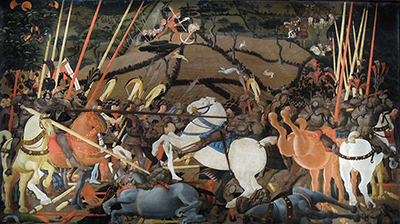
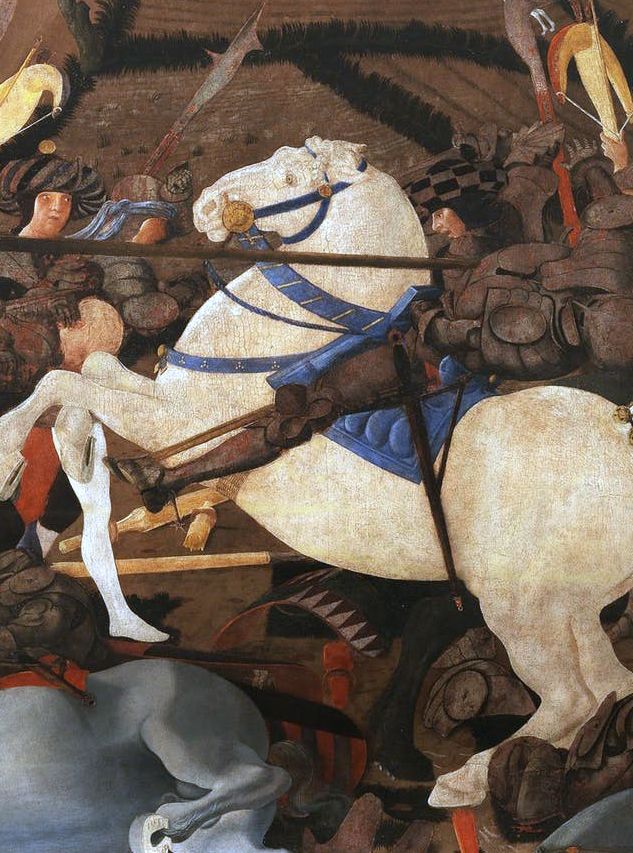
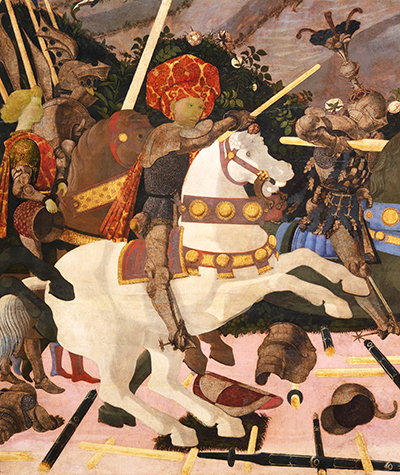
A long, dark lance cuts across the neck of a white horse at the centre of Paolo Uccello’s Battle of San Romano in Florence. The horse rears to the left, its blue harness taut, while the armoured rider pitches backwards out of line with the other horsemen. His fall is easy to miss in the first rush of colour and movement. Once you see it, the white horse anchors a scene in which a single loss of balance seems to spread through the ranks. The Uffizi identifies the falling rider as Bernardino della Carda and the man who unseats him as Niccolò da Tolentino. [1]
This is the middle episode in the Uffizi’s account of the three surviving paintings. Its crowded foreground brings the clash close to the picture surface. At 182 × 323 centimetres, the panel is wide enough for two mounted ranks to press in from the sides while a separate landscape opens behind them. It also retains two kinds of evidence from different moments in its life. Uccello’s name survives low on the left, and sour-orange branches occupy corners added after the main scene was painted. [1] [2]
At a Glance
- DateAbout 1435–40
- Medium and sizeTempera on poplar, 182 × 323 cm
- CollectionUffizi Galleries, Florence, inventory 1890 no. 479
Contents
- A commander falls
- Where the horses meet the picture edge
- What the painted surface preserves
- The signature and the added oranges
- From the grand-ducal collection to the gallery
- Annotated details
A commander falls
The battle took place in the Arno valley on 1 June 1432, during Florence’s war with Lucca and its allies. Tolentino led the Florentine force. Bernardino della Carda, who had recently changed sides, commanded the Sienese troops fighting against it. Uccello painted the scene years later for a cycle celebrating Florence’s victory. The Italian national catalogue preserves the variant spelling Ciarda, while the Uffizi uses Carda. [1] [2] [3]
The Uffizi reads the forward tilt of the Florentine weapons and the backward inclination of the opposing weapons as signs of the outcome. The dark shaft that crosses the white horse and reaches the rider’s tilted body is unusually legible among the upright and slanting weapons. Pale and red lengths of broken shaft litter the ground. Above them, the unbroken lances lead the eye higher, until their tips leave the picture. There is a whole range of movement in these lines, from the steady forward pressure of the mounted ranks to the plunge of a rider who can no longer keep his seat. [1]
The precise identification has been debated. Dillian Gordon records Pietro Roccasecca’s argument that Bernardino withdrew from the battle and that the falling knight may stand for the defeat of his side. Gordon also points out that no single known account of the battle seems to explain everything Uccello painted. Matteo Palmieri’s chronicle has been proposed as one source for elements such as men appearing over the hill and the vegetation around them. The picture gives the Florentine victory a memorable central action whether the rider is understood as Bernardino or as a figure for the rout. [2]
Annotated Details from The Unhorsing of Bernardino della Carda
The numbered points identify visible features discussed in this article. Return from each detail to the numbered overview. The Florence San Romano panel, with the fall of Bernardino della Carda at the centre. Image source. Public domain.
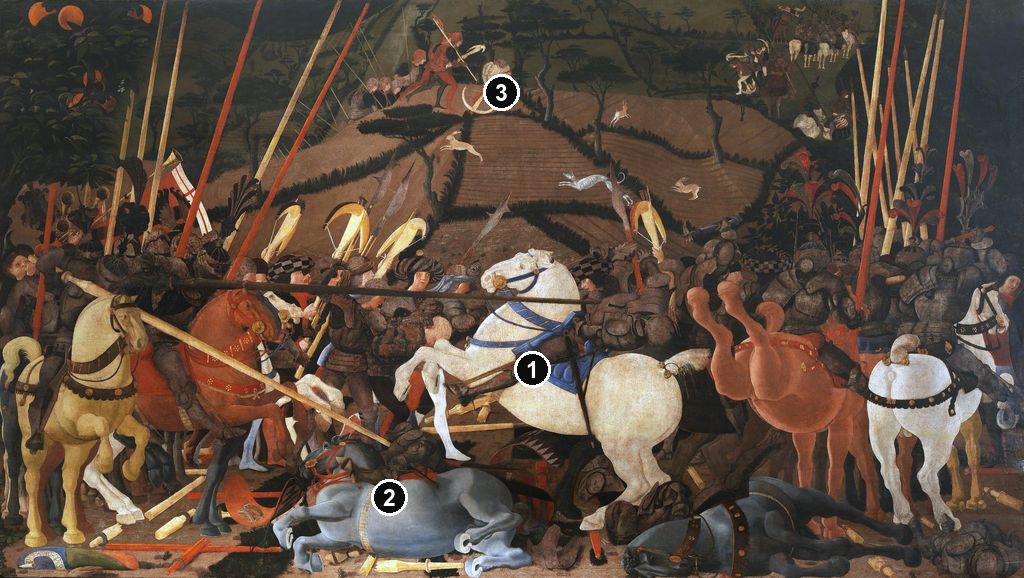
Details from THE UNHORSING OF BERNARDINO DELLA CARDA
Compare the cropped details with the source images above. Notice how their colours, shapes and positions contribute to the larger compositions.
The unhorsing
The horizontal lance leads towards the central tangle of bodies. The horse’s raised white forelegs pick out the point where the ranks break.
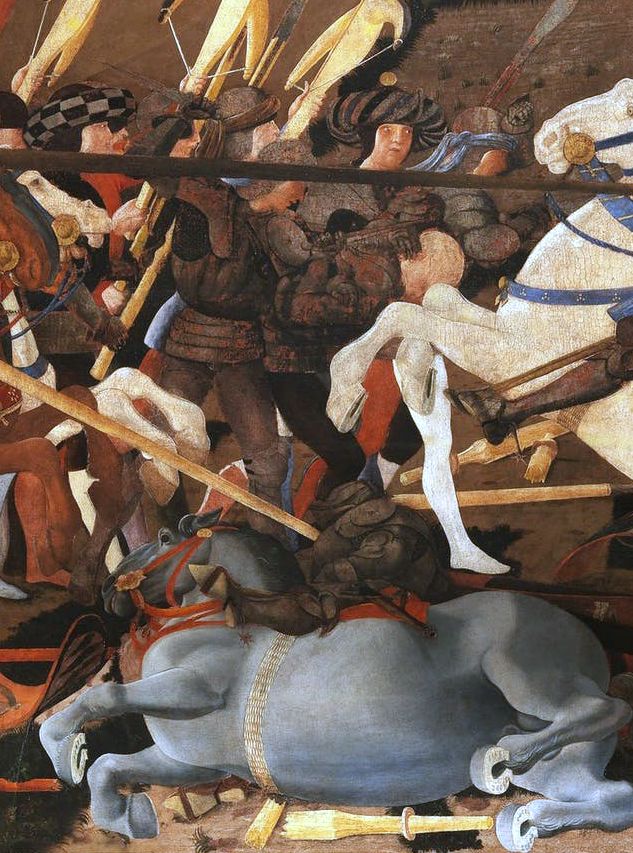
The fallen blue-grey horse
The blue-grey horse lies almost parallel to the edge of the panel. Its lowered body makes the white horse’s lift and turn appear more abrupt.
Hunting figures beyond the cavalry
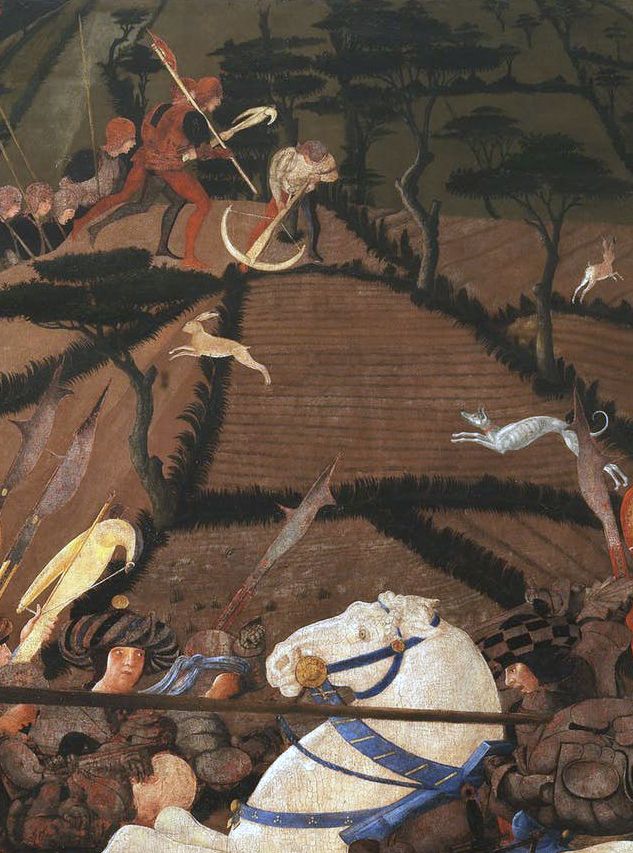
Small people and animals move through the hills above the crowded horses. The spaces between them differ sharply from the tightly overlapping forms below.
Where the horses meet the picture edge
Compare the white horse’s open profile with the dark horse down at the right. The white horse’s side gives the eye enough room to read the curve from neck to chest and the lift of both forelegs. The dark horse lies at an angle to the panel. Its muzzle reaches the lower edge, and overlapping parts of its body make its length much harder to see. Nearby, a fallen soldier and scattered pieces of lance hold the eye near the ground. Yukihiro Nomura draws attention to this interplay between the shortened forms of fallen bodies and the broken shafts. The shafts carry the eye back into the picture, while the bodies seem to intrude on the viewer’s space. [4] [5]
That compression in depth is called foreshortening. At the right, one reddish horse and one white horse present their rounded hindquarters to the viewer. At the left, the raised forelegs of an ochre horse cross in front of the crowded ranks. These shifts in view make it possible to read one body against another even where several horses share nearly the same patch of ground. The Uffizi relates the foreshortened bodies to a low viewing position, looking up towards panels hung high in Lionardo Bartolini Salimbeni’s palace. The hillside behind the horses tilts up so steeply that we seem to look down on the fields while looking up at the riders. [1] [4]
Follow the dark boundaries of the fields through the centre and you find hares and dogs in pursuit. The small figures near the crest and the figures at the far upper right remain apart from the tightly packed horsemen below. The hedged plots, trees and cultivated strips become visible just where there is finally room for the eye to travel. This change of scale has had an afterlife of its own. The Dutch poet Willem van Toorn recalled sitting in front of this painting at the Uffizi in the 1970s. He made the gap between the immobilised battle and the small hunting scene the turning point of the poem he wrote about it. [3] [6]
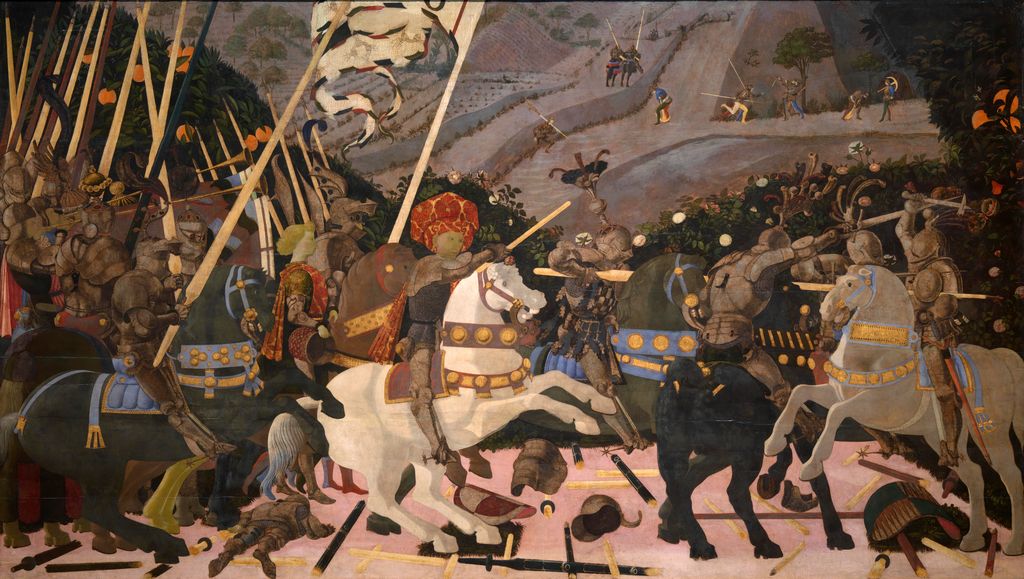
Niccolò da Tolentino rides a white horse in the London San Romano panel, National Gallery NG583. Image source. Public domain.
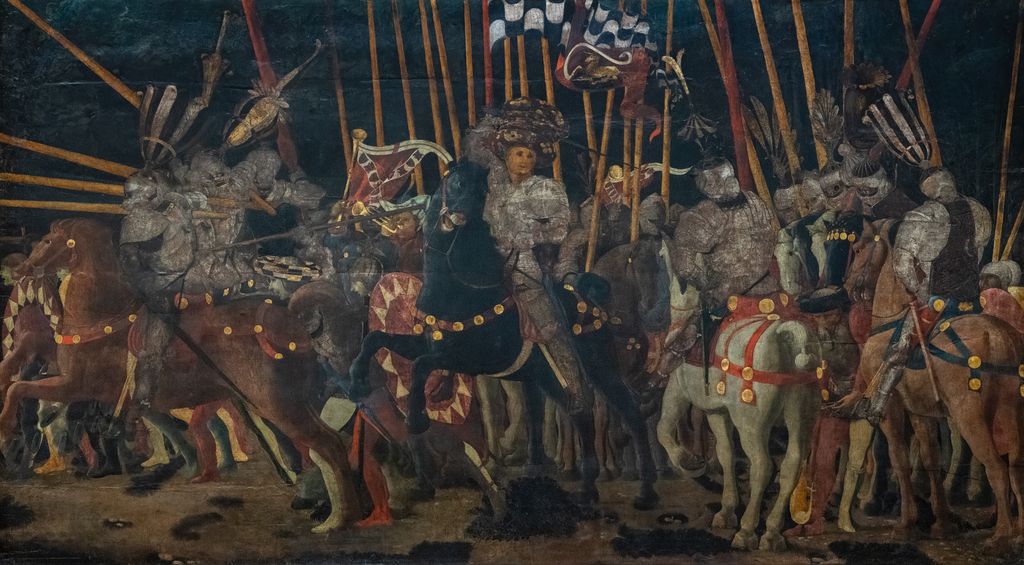
The Paris San Romano panel, Musée du Louvre MI 469, with Micheletto da Cotignola leading the counterattack. Image source. CC0 / Public domain.
What the painted surface preserves
The Uffizi catalogues the work as tempera on panel, inventory 1890 no. 479. Gordon gives the same dimensions as the Uffizi, 182 × 323 centimetres. Italy’s national heritage catalogue records a height of 180 centimetres and the same width. Gordon’s description identifies the support more precisely as eight horizontal poplar planks, with four vertical strips of canvas laid across them beneath the ground. X-rays show the fabric and the extent of the incised design. Metal fixings are apparent in the X-rays of the London and Paris paintings, while Gordon reports no obvious traces of them in the Florence panel. [1] [2] [3] [7]
Some of the lines were scored into the prepared surface with a pointed tool. Muriel Vervat’s comparative conservation study illustrates an X-ray of a halberdier in which the incision defines the whole figure. Incisions in the three paintings also mark out boundaries where silver or gold leaf would go. Vervat suggests that small three-dimensional models could have helped with the horses. She compares similar arrangements of the legs on the ochre horse at the far left, the central white horse and the dark fallen horse at the lower right, seen from such different angles that the resemblance can be easy to overlook. This is a hypothesis drawn from the repeated poses. [5]
The armour took shape through metal as well as paint. Cross-sections from armour on the three panels reveal silver leaf no more than five micrometres thick laid over an orange-brown clay layer called bole, above the prepared ground. Dark paint containing carbon black gave the polished forms their curves and edges. In figure 3 of Vervat’s study, fingerprints are visible in the brown-black glaze on the armour of a knight above the red horse at the left of the Florence panel. A finger pressed into wet paint softened the shading on the silver. On some of the helmets at the right, Uccello scratched through red paint over the silver to delineate the plumes. Vervat also found lapis lazuli and azurite over silver on a headdress, where the two blues may have evoked different textiles. The metal could thus be an exposed highlight, a base for a glaze or a layer beneath opaque colour. [1] [5]
The paintings’ dates reflect different ways of weighing this evidence. The Uffizi gives about 1435–40 for the Florence panel, and the national heritage catalogue gives about 1438. Vervat interprets the similarities in design, incisions and metalwork as consistent with a single coordinated project around 1438–40. The earlier technical bulletin by Ashok Roy and Gordon places the prevailing estimate in the early 1440s and considers the possibility that the Paris picture came later. The Uffizi’s description of tempera on panel leaves room for the metal, pigments and glazes identified in individual layers. Roy and Gordon also report walnut and linseed oils in samples from the main composition and the additions respectively, both on the London panel. [1] [3] [5] [7]
The signature and the added oranges
Look low on the left for the inscription the Uffizi transcribes as PAULI UGIELI OPUS, meaning ‘the work of Paolo Uccello’. Gordon connects the position of the signature to a possible original hanging. If the London and Florence panels were arranged side by side around a broad stone support for a vault, the left edge of the Florence painting would have been near the middle of that wall. The painter’s name would have fallen into a much more prominent position than it occupies on a gallery wall today. The reconstruction depends on the shapes of the old cuts and the way the three panels might have fitted around the room. [1] [2]
Francesco Caglioti’s archival research places the paintings with the Bartolini Salimbeni family in 1480 and proposes that Lionardo commissioned them around the time of his second marriage in 1438. By 1492 an inventory records them in Lorenzo de’ Medici’s ground-floor room in the palace on Via Larga. The Uffizi describes a transfer by Lionardo’s heirs, rendered as a sale in its English entry. Caglioti and Gordon discuss Damiano Bartolini Salimbeni’s later claim that the woodworker Francione took the panels at Lorenzo’s bidding over Damiano’s objection. The transfer probably occurred around 1484. The later Medici display explains a longstanding association with the family, while the earlier record puts the works in the Bartolini Salimbeni household. [1] [2] [8] [9]
The Florence X-ray shows a curved line at the upper left. The incised lances stop at that line, and the added wood begins beyond it. The curve is evidence of a former arched outline which could fit beneath a vault. To make a rectangle, the top was cut down and the corners filled. Gordon notes that the wood at the Florence panel’s upper right differs from that of the other additions and may replace an earlier insert. Daniela Parenti, writing for the Uffizi, identifies the orange branches painted in the additions as the Medici sour orange, or mala medica. Their position on the added wood connects the emblem to the later Medici display. The Uffizi suggests Uccello may have adapted the panels. A date around 1484 would place that work after his death in 1475, and Caglioti proposes Francione as the woodworker. [1] [2] [7] [8]
From the grand-ducal collection to the gallery
The Florence panel was exhibited at the Uffizi in 1784, after the three works had passed through the Medici and grand-ducal collections. In the nineteenth century the poplar support was planed from about four centimetres thick to roughly 1.2–1.3 centimetres. Vervat records signs of severe earlier cleaning as well as variations in how the surface aged, possibly related to the presence or absence of canvas beneath it. The painting’s condition today reflects both the behaviour of its materials and successive attempts to repair it. [2] [5]
In 1954 Leonetto Tintori removed aged varnish and altered retouching, filled losses and applied new retouching and glazes over worn areas. Umberto Baldini’s report from that year describes a dark blue strip of later sky paint that covered the highest part of the landscape and cut across small figures. The report’s before-and-after photographs show how much the landscape changed when this overpaint was removed. What now looks like a steep field rising behind the riders had previously met a strip of sky lower down. [5] [10]
A new diagnostic campaign began in 2009, and the restored panel was the last work visitors encountered in the Uffizi’s 2012 exhibition Bagliori dorati, on International Gothic art in Florence. That setting drew attention to the original use of reflective materials on painted wood. Visitors can look for the contrast between the opaque whites and reds of the horses and the uneven tones of the armour, which preserve traces of the metallic effects. The holding museum lists the work in its painting collection under room A8. The Uffizi also announced that it would appear alongside the London and Paris panels in Magnifico 1492 at Palazzo Pitti, scheduled for 3 December 2026 to 1 March 2027. [1] [5] [11] [12]
In the London panel, Tolentino is easy to pick out in his patterned headgear on a white charger. The Paris counterattack gathers its action around Micheletto Attendolo da Cotignola and the lowering of the lances. Here in Florence it is the loss of a seat that gives the scene its focus. The blue harness and the white horse are still visible from across a gallery. The small signature, the orange foliage and the dark modelling over the silver reward the time it takes to come closer. [1] [2] [5] [13]
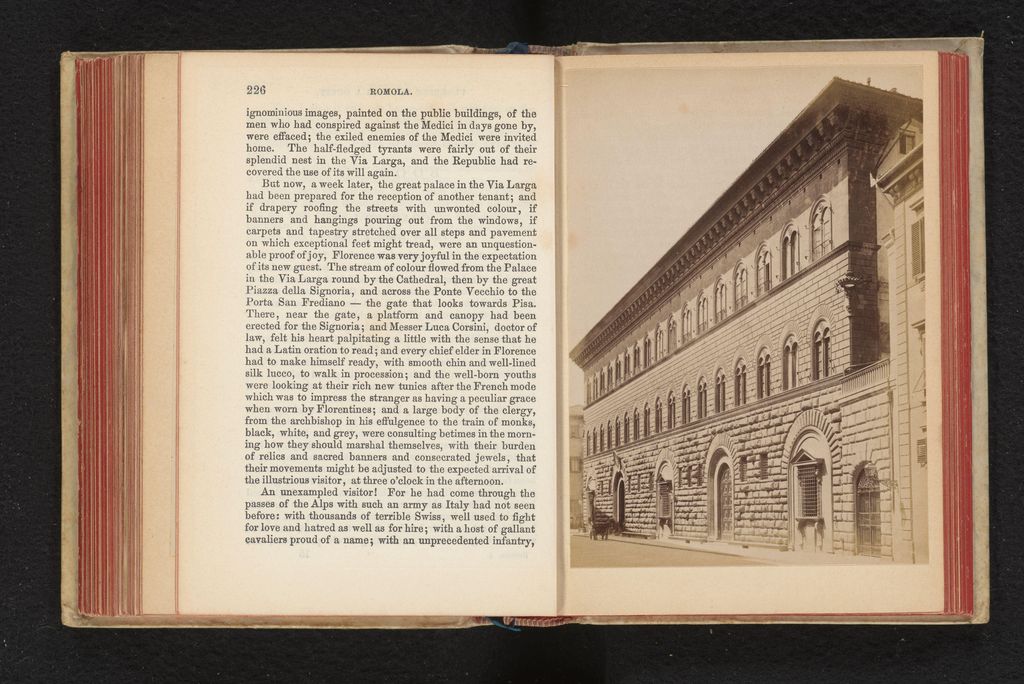
Giacomo Brogi’s photograph of the Palazzo Medici-Riccardi in a nineteenth-century volume of Romola, Rijksmuseum RP-F-F25436-AH. Image source. Public domain.
Artworks directory
Browse paintings, drawings, stained-glass designs and other objects connected with Uccello. Cycles and their surviving components may have separate entries. The collection or catalogue’s wording is retained where a date, attribution or subject is debated.
| Name | Date | Medium, attribution and collection |
|---|---|---|
| Niccolò da Tolentino at the Battle of San Romano · London | Probably c.1438–40 | Tempera and oil on wood, with metallic decoration · National Gallery Catalogue. |
| Bernardino della Carda Unhorsed · Florence | c.1435–40 | Tempera on panel · Uffizi Galleries Catalogue. |
| The Counterattack of Micheletto da Cotignola · Paris | 1450–75 in the Louvre catalogue | Tempera (possibly) on wood · Musée du Louvre Catalogue. |
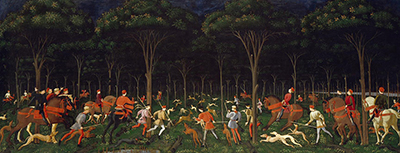
| The Hunt in the Forest | c.1465–70 | Tempera and oil with traces of gold on panel · Ashmolean Catalogue. |
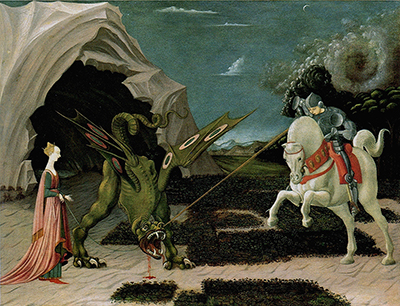
| Saint George and the Dragon · London | c.1470 | Oil on canvas · National Gallery Catalogue. |
| Saint George Slaying the Dragon · Melbourne | c.1430 | Oil, tempera and silver leaf on wood · National Gallery of Victoria Catalogue. |
| Saint George and the Dragon · Paris | 1430–35 in the museum catalogue | Painted wood panel · Musée Jacquemart-André Catalogue. |
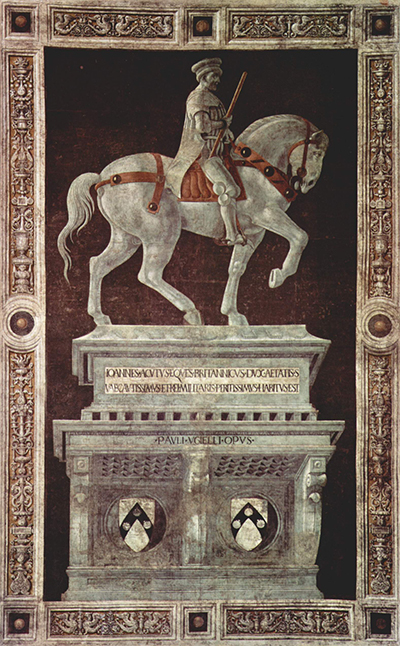
| Equestrian Monument to John Hawkwood | 1436 | Transferred wall painting · Florence Cathedral Catalogue. |
| Study for the John Hawkwood Monument | 1436 | Study on prepared paper · Uffizi Catalogue. |
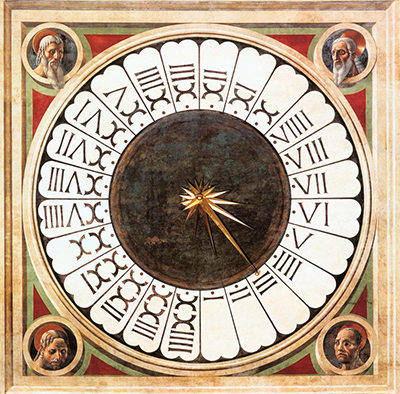
| Monumental Clock Face | 1443 | Painted dial · Florence Cathedral Catalogue. |
| Resurrection of Christ | 1443–44 | Stained glass · Uccello design · Florence Cathedral Catalogue. |
| Nativity | 1440s | Stained glass · Uccello design · Florence Cathedral Catalogue. |
| Creation of the Animals and Creation of Adam | Third to fourth decade of the 15th century | Detached fresco · Green Cloister, Santa Maria Novella Catalogue. |
| Creation of Eve and the Fall | Third to fourth decade of the 15th century | Detached fresco · Green Cloister, Santa Maria Novella Catalogue. |
| Flood and Recession of the Waters | 15th century; dating debated | Detached fresco · Green Cloister, Santa Maria Novella Catalogue. |
| Sacrifice and Drunkenness of Noah | 15th century; dating debated | Detached fresco · Green Cloister, Santa Maria Novella Catalogue. |
| Stories of the Virgin and Saint Stephen · Assunta Chapel | 1430s, with later completion | Fresco cycle · Paolo Uccello and Andrea di Giusto · Prato Cathedral Catalogue. |
| Blessed Jacopone da Todi | 1436 in the diocesan museum | Detached fresco · Museo dell’Opera del Duomo, Prato Catalogue. |
| Adoration of the Child · Bologna | 1430s; inscription incomplete | Detached fresco · San Martino Maggiore, Bologna Catalogue. |
| Adoration of the Christ Child · Karlsruhe | c.1436 | Painted panel · Attribution to Uccello · Staatliche Kunsthalle Karlsruhe Catalogue. |
| Annunciation · Oxford | Early 15th century | Tempera and gilding on panel · Ashmolean Catalogue. |
| Allegory of Monastic Life (Thebaid) | c.1460–65 | Tempera on canvas · Galleria dell’Accademia, Florence Catalogue. |
| Miracle of the Profaned Host | 1467–68 | Tempera on wood · Galleria Nazionale delle Marche, Urbino Catalogue. |
| Triumphal Entry into Rome of Titus and Vespasian(?) | c.1430–35 | Tempera, gold and silver on panel · Yale University Art Gallery Catalogue. |
| Crucifixion with the Virgin and Saints | c.1460–65 | Painted panel · Museo Nacional Thyssen-Bornemisza Catalogue. |
| The Crucifixion · Met triptych | Probably mid-1450s | Tempera on wood with gold ground · Metropolitan Museum of Art Catalogue. |
| Perspective Study of a Chalice | 1450–75 | Pen, ink and stylus on paper · Attributed to Uccello · Uffizi Catalogue. |
| Study of a Mazzocchio | 15th century | Perspective study · Attributed to Uccello · Uffizi Catalogue. |
| Mazzocchio Seen in Perspective | Uncertain | Drawing · Attribution debated · Musée du Louvre Catalogue. |
| Head of a Man in Profile | 15th century | Pen, ink and wash · Musée du Louvre Catalogue. |
| Five Masters of the Florentine Renaissance | 1500–50 | Oil on wood · Anonymous Florentine school · Musée du Louvre Catalogue. |
| Madonna and Child from the Del Beccuto House | 15th century | Detached fresco · Museo di San Marco, Florence Catalogue. |
| Man of Sorrows with the Virgin and Saint John · Avane Predella | 15th century | Predella · Museo di San Marco, Florence Catalogue. |
| Calling of Saint Paul the Hermit · San Miniato | After 1447 to c.1454 in state catalogue | Sinopia · Attributed to Uccello or collaborator Catalogue. |
| The host changes hands · Urbino predella, scene 1 | 1467–68 | Tempera on wood · Component of DE 231 · Galleria Nazionale delle Marche Catalogue. |
| The figures at the door · Urbino predella, scene 2 | 1467–68 | Tempera on wood · Component of DE 231 · Galleria Nazionale delle Marche Catalogue. |
| The procession approaches the altar · Urbino predella, scene 3 | 1467–68 | Tempera on wood · Component of DE 231 · Galleria Nazionale delle Marche Catalogue. |
| The condemned woman and the ladders · Urbino predella, scene 4 | 1467–68 | Tempera on wood · Component of DE 231 · Galleria Nazionale delle Marche Catalogue. |
| Persecution of the family · Urbino predella, scene 5 | 1467–68 | Tempera on wood · Component of DE 231 · Galleria Nazionale delle Marche Catalogue. |
| Angels and demons at the bier · Urbino predella, scene 6 | 1467–68 | Tempera on wood · Component of DE 231 · Galleria Nazionale delle Marche Catalogue. |
| Birth of the Virgin · Prato Cathedral | 1430s; dating debated | Fresco · Assunta Chapel, Prato Cathedral Catalogue. |
| Presentation of the Virgin · Prato Cathedral | 1430s; dating debated | Fresco · Assunta Chapel, Prato Cathedral Catalogue. |
Discussion
Look again at the images and ideas explored in The Unhorsing of Bernardino della Carda. These editorial prompts invite your observations.
Reader Insights
Where did you first register the rider’s fall, and which line or shape brought you to it through the crowd?
How does the small hunt on the hillside change the way you see the crowded fight below?
Join the Conversation
Share a detail, comparison or question about The Unhorsing of Bernardino della Carda below.
References
- Daniela Parenti and the Uffizi Galleries. Battaglia di San Romano. Italian collection record and essay for inventory 1890 n. 479. View source.
- Dillian Gordon. Niccolò Mauruzi da Tolentino at the Battle of San Romano. National Gallery catalogue, 2003, with comparative technical notes, historical accounts, provenance and display reconstructions. View source.
- Italian Ministry of Culture. Battaglia di S. Romano. National cultural heritage catalogue, record 0900285047. View source.
- Yukihiro Nomura. Scorcio: Perspective of the Bodies in the Paintings from Giotto to Michelangelo. Gifu University, Faculty of Education Research Bulletin 53, no. 2, 2005, p. 85 and fig. 15. View source.
- Muriel Vervat. An ARCHLAB Project: Researches on the Painting Technique of the Three Panels of the Battle of San Romano by Paolo Uccello. Technè 43, 2016, pp. 110–113, figs. 2–4. View source.
- Willem van Toorn. Groninger lezingen over poëzie I. Raster, 2003, pp. 166–167, on his encounter with the painting and his response in verse. View source.
- Ashok Roy and Dillian Gordon. Uccello’s Battle of San Romano. National Gallery Technical Bulletin 22, 2001, pp. 4–17, on support, painting technique and the added corners. View source.
- Francesco Caglioti. Nouveautés sur la Bataille de San Romano de Paolo Uccello. La Revue du Louvre et des musées de France 51, no. 4, 2001, pp. 37–54. View source.
- Uffizi Galleries. Battle of San Romano. English collection record, including its account of the transfer to Lorenzo de’ Medici. View source.
- Umberto Baldini. Restauri di dipinti fiorentini in occasione della mostra di quattro maestri del rinascimento. Bollettino d’Arte 39, no. 3, 1954, especially pp. 231–234 and figs. 18–22. View source.
- Uffizi Galleries and exhibition organisers. Bagliori dorati. June 2012 exhibition press release, including curator Antonio Natali’s account of the freshly restored panel. View source.
- Uffizi Galleries. Tickets now online for Magnifico 1492. 2 November 2026 exhibition announcement. View source.
- Musée du Louvre. La Bataille de San Romano : la contre-attaque de Micheletto Attendolo da Cotignola. Collection record for MI 469. View source.
More PAOLO UCCELLO Artworks

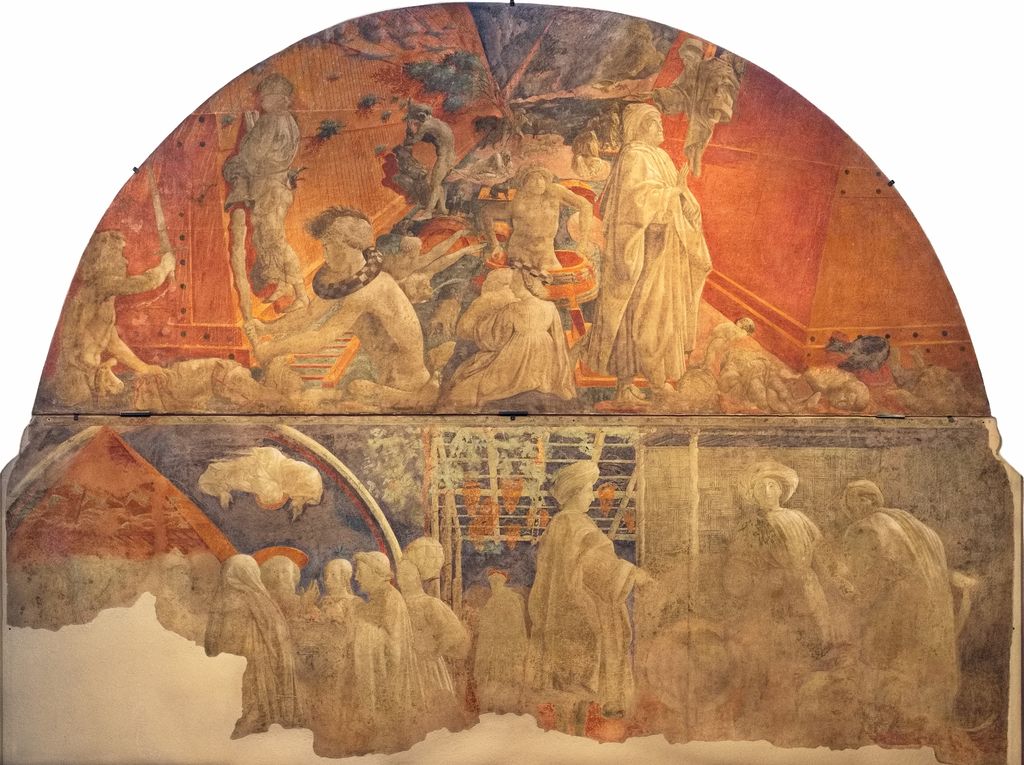
Noah and the Flood
The Flood and Recession of the Waters above the lower episodes from Noah’s story, Santa Maria Novella. Photograph by Armin Kleiner. Image source. CC BY-SA 4.0. Resized for the web. This derivative is available under the same licence.
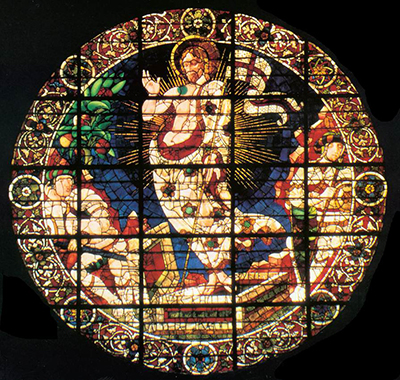
The Resurrection of Christ Stained Glass Window
The Resurrection window in Florence Cathedral, designed by Paolo Uccello and made by Bernardo di Francesco. Photograph by Sailko. Image source. CC BY 3.0. Resized for the web.