


 by Tom Gurney
Tom Gurney BSc (Hons) is an art history expert with over 20 years experience
Published on June 19, 2020 / Updated on November 29, 2026
Email: tomgurney1@gmail.com / Phone: +44 7429 011000
Biography: Introduction
On the inside wall of Florence Cathedral, Paolo Uccello gave a long-dead English soldier the presence of a statue. A few years later, people in the same cathedral could tell the hour by an enormous dial he had painted. The two jobs called for different skills, and the cathedral records follow him from one to the other. They also reveal a working life larger than the one Giorgio Vasari made famous, in which the painter stayed awake at night for the pleasure of solving problems in perspective. [1] [2] [3]
At a Glance
- NamePaolo di Dono
- TrainingLorenzo Ghiberti’s Florentine workshop
- Documented citiesFlorence, Venice and Urbino
Paolo Uccello in context
Late Gothic in Uccello’s early context
Late fourteenth and early fifteenth centuries [1]Early Renaissance Florence
Fifteenth century · displayed through Uccello’s career [4]Paolo Uccello
c.1397–1475 [4]Lorenzo Ghiberti
1378–1455 · workshop connection [4]Paolo Uccello
c.1397–1475 [4]Andrea del Castagno · Cathedral counterpart
1456 · Niccolò da Tolentino monument [2]Justus of Ghent · Urbino altarpiece
1470s · main altarpiece commission [1]Battle of San Romano
Probably c.1438–40 · Gordon [5]Resurrection glass
1443–44 [7]The Hunt in the Forest
c.1465–70 [8]The Urbino predella
1467–68Saint George and the Dragon · London
About 1470 [9]Contents
- Paolo di Dono and Ghiberti’s workshop
- Finding the early paintings
- Venice and San Marco
- A home in Florence and a commission in Prato
- A monument for Florence
- San Romano and the Bartolini Salimbeni
- Painted hours and light in the cathedral
- Working for religious houses
- Household commissions and a painter’s family
- Urbino and the last Florentine records
Paolo di Dono and Ghiberti’s workshop
Paolo was born around 1397, probably in Florence. The year comes from ages given in early Florentine tax declarations. His father, Dono di Paolo di Dono, had worked as a barber and surgeon in Pratovecchio and acquired Florentine citizenship in 1373. Dono married Antonia del Beccuto in 1387. Pratovecchio appears as Paolo’s birthplace in some accounts, but the firmer connection is to his father's life before the marriage. In the records of Lorenzo Ghiberti’s workshop, the young assistant appears as Pagolo di Dono. He used the name Uccello as an adult. The Florence panel of the Battle of San Romano bears the signature PAULI UGIELI OPUS, identifying it in Latin as his work. A similar signature appears on the Hawkwood fresco. Vasari explained the nickname through the painter’s love of depicting birds. [1] [10]
The first substantial evidence of Paolo’s training comes from Ghiberti’s workshop for the bronze doors later installed on the north side of the Florence Baptistery. A workshop agreement drawn up in 1407 names him among the assistants. The wage record distinguishes a period as a junior helper from a later stretch at a higher rate. Lorenzo Sbaraglio calculates roughly four and a half to five years altogether. Dillian Gordon places the work provisionally in 1412–16. The names associated with the shop include sculptors and metalworkers as well as painters, and Sbaraglio identifies Donatello as an especially important artistic example for Paolo. The workshop records give us a group of people employed on a large undertaking. They offer little basis for assigning individual touches in the finished bronze doors to the young painter. [1] [4]
Two other records concern his professional standing. A traditional reading gives 1414 for his entry as a painter in the Compagnia di San Luca, the painters’ confraternity, though the register is difficult to read. In 1415 he entered the Arte dei Medici e Speziali, the guild of doctors and apothecaries that also admitted painters. As the son of an existing guild member he paid no admission fee. [1] [4]
Four stages of Paolo Uccello’s career
These overlapping periods group related commissions. Different media continued to occupy Uccello at the same time.
Painting for walls and panels
The Prato Assunta Chapel campaign and Florence’s 1436 John Hawkwood monument put very different kinds of wall painting side by side, from sacred narrative to civic commemoration. [4] [1]
Finding the early paintings
The decade after Paolo’s guild entry is sparsely documented. A small fresco of the Virgin and Child, now at the Museo di San Marco in Florence, came from above a doorway in a house belonging to his mother’s family. It has commonly been attributed to him since Alessandro Parronchi’s study of 1969. Its association with the del Beccuto household gives the painting an unusual tie to Paolo’s life. Sbaraglio also sees in it the lively late Gothic manner of Gherardo Starnina, a reminder of how much an artist trained in Ghiberti’s circle could take from Florentine painting. [1] [11]
Two portable pictures show how cautiously the next part of the career has been reconstructed. Melbourne's Saint George Slaying the Dragon entered the National Gallery of Victoria as a Sienese work. Roberto Longhi initially associated it with Uccello’s circle and later gave it to the painter himself. Carlo Volpe made the case for that attribution in 1980 and argued for the Oxford Annunciation in the same study. In the Melbourne picture the saint bends over his mount to bring a sword down on the dragon. In Oxford the angel approaches Mary beneath a structure whose architecture gives the small scene its surprising depth. Hudson compared the armoured saint fighting before a walled city with Ghiberti’s relief of David and Goliath. He also found a parallel for the Oxford portico in Ghiberti’s relief of Esau and Jacob. Infrared examination of the Annunciation showed that Paolo first laid out the portico with a ruler and then drew the figures and drapery freehand. A round arch in the design became pointed in the finished painting. The proposed dates of the two panels fall around the 1420s and the early 1430s. Comparisons can show where the painter found ideas, and examination of the painted panels can show how he altered them as he worked. [1] [12]
The restoration of a damaged fresco in Bologna gave Volpe a further point of comparison. The Adoration of the Child was brought to light at San Martino Maggiore during work in 1978–80. It retains the beginning of a year incised in the plaster, with the final digit disputed. Volpe read it as 1437, while other readings include 1431. For Volpe, a date in the 1430s put the fresco’s boldly constructed shelter in the company of the new painting Florence had seen since Masaccio. His work helped bring the Bologna fresco and pictures previously grouped around anonymous followers back into discussion alongside Uccello’s own early career. Those provisional groups had been named after works at Karlsruhe, Quarate and Prato. The Karlsruhe picture is a portable panel, distinct from the Bologna wall painting. It is their visual relationship that matters for the history of attribution. [1] [4] [13]
Venice and San Marco
On 5 August 1425 Paolo made his first will in Florence before leaving for Venice. In July 1427 his maternal relative Deo di Deo del Beccuto submitted a Florentine tax declaration in his place and reported that Paolo was living in Venice. Deo also declared in his own return in 1431 that he owed Paolo 184 florins, considerably more than the painter later paid for his home. The reason for the debt is uncertain. The returns show how this relative represented Paolo in his absence and how extensive their financial dealings could be. By 31 January 1431, the painter was in Florence again to submit his own declaration. [1] [11]
The evidence for Paolo’s work in Venice comes from a Florentine enquiry of 1432. Officials of the Opera del Duomo wrote to their city’s ambassador in Venice asking about the abilities of Paolo di Dono. They described him as a master of mosaic and referred back to a figure of Saint Peter that he had made in 1425 for the façade of San Marco. The figure was high on an outer corner and was later destroyed. In his Procession in Piazza San Marco, painted in 1496, Gentile Bellini shows the façade as it had looked before later alterations. The little figure identified there with Saint Peter preserves an idea of the placement. Its scale and distance from the viewer in Bellini’s picture leave much of the original design and workmanship beyond recovery. [1] [14]
Ghiberti had been in Venice in the winter before Paolo left Florence, so a recommendation from his former employer is possible. The strongest evidence for this stage of the painter’s life remains the commission named in the letter. A figure intended for a high exterior wall posed a different problem from an intimate painted panel. It had to read at a distance and in shifting daylight. His figure belonged to a campaign of work on the basilica’s exterior following a fire in 1419. The Florentine officials’ enquiry shows that experience acquired away from home had become part of his reputation there. [1] [15]
A home in Florence and a commission in Prato
In April 1434 Paolo bought a house in Via della Scala for 110 florins. It stood in the parish of Santa Lucia near Santa Maria Novella and remained his home for the rest of his life. The tax declarations also place him in rented working premises. He reported a shop in Via delle Terme in 1442 and one in Piazza San Giovanni in 1458. The first was near the Bartolini Salimbeni palace, the second by the Baptistery and cathedral. The house and shops put Paolo within walking distance of several of the buildings and families that recur in the history of his commissions. [1] [11]
At nearby Prato he worked on the Assunta Chapel of what is now the cathedral. The frescoes tell stories of the Virgin and Saint Stephen. Andrea di Giusto completed part of the scheme, and the diocesan museum dates the beginning of Uccello’s work to early 1436. An altarpiece by Andrea dated 1437 repeats the figure of Saint Francis from the chapel arch. That comparison helps date Paolo’s contribution, which Sbaraglio would place a few years earlier than the museum does. Matteo Mazzalupi tested the documents formerly used to connect these paintings to particular patrons. Foundations for the saying of Mass and documents about the use of a chapel may postdate a painter’s work there. A dated entry naming a benefactor can say more about who endowed a chaplaincy than who ordered the frescoes. [1] [16] [17] [18]
A surviving piece offers a close view of what Uccello did with this relatively small space. The Blessed Jacopone da Todi was detached from the chapel’s back wall in 1871 and is now in the diocesan museum. Its figure, severe against a red ground, stands within a painted recess seen at an angle. The scenes nearby are richer in movement and incident. Even within one scheme, Paolo could use a sharply defined space to isolate a single person and crowded architecture to organise a story. The Assunta cycle belongs to a different chapel and campaign from Filippo Lippi’s later frescoes in the main choir. [16] [17]
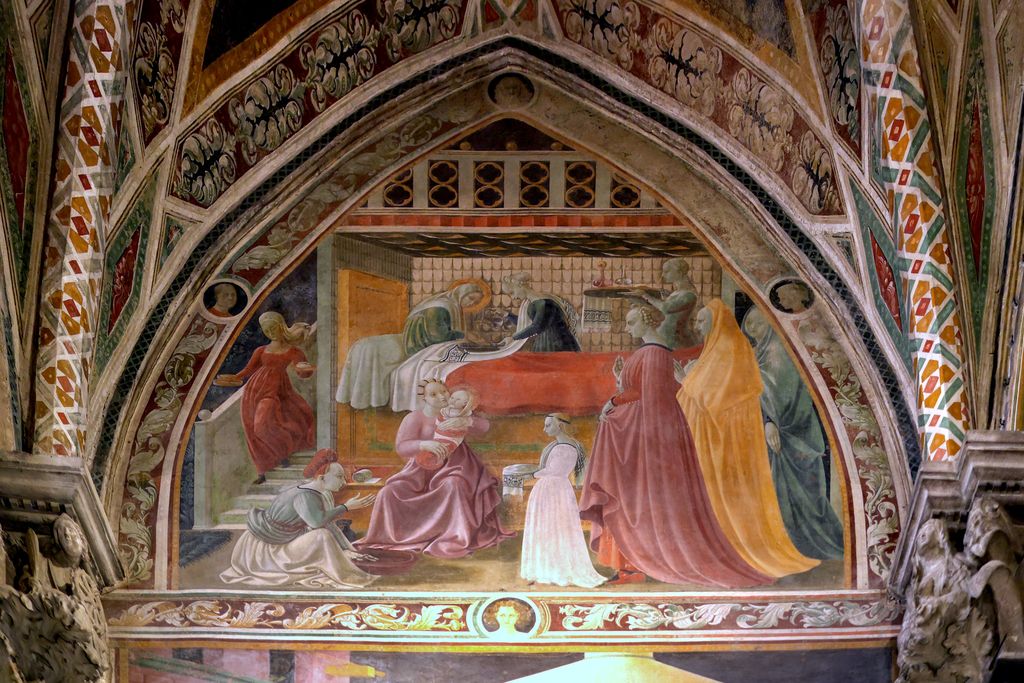
The Birth of the Virgin in the Assunta Chapel at Prato, seen with its painted border and the adjoining architecture. Image source. CC0 / Public domain.
A monument for Florence
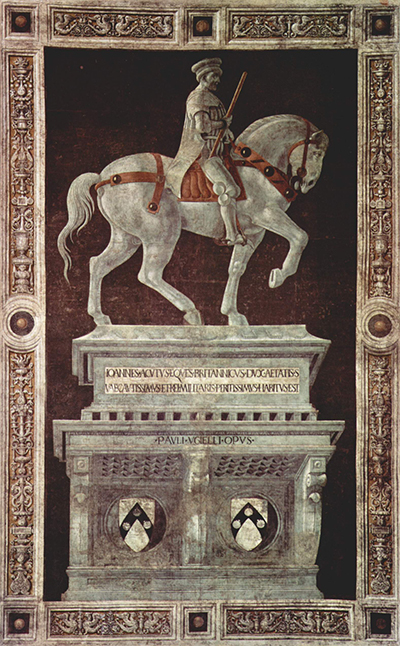
John Hawkwood, known in Florence as Giovanni Acuto, had commanded the city’s forces and died in 1394. The new monument continued an earlier commemoration by Agnolo Gaddi and Giuliano d’Arrigo, called Pesello. The project was revived in 1433. The Opera del Duomo deliberated again in May 1436, and the first surviving contract naming Uccello is dated 30 May. It specified green earth, a pigment that allowed him to suggest the substance and weight of a sculpted monument on the cathedral wall. On 28 June the officials ordered a revision. The second version was finished by the end of August, when the cathedral was celebrating the completion of Brunelleschi’s dome. A further instruction in December concerned the inscription on the sarcophagus. [1] [2] [19]
The Opera was a body with changing membership. Hugh Hudson connects the progress of the commission to those changes, reading the new monument in the context of the shift from Albizzi ascendancy to Medici influence. He proposes that revisions to Hawkwood’s appearance made the commander less insistently warlike while retaining a public honour that was politically valuable. The documents establish the sequence of orders and the extra payment for painting the horse and rider twice. The officials’ precise reason for demanding a revision remains open. [2] [19]
Lorenza Melli’s examination of the preparatory drawing, discussed by Hudson, offers clues to what was reconsidered. The earlier arrangement had a more heavily armed and helmeted figure. In the revised drawing his head is bare and his clothing and posture have changed. The painted monument gives the rider a dignified profile, while the ledges beneath the sarcophagus are seen from below. A visitor who looks up from the cathedral floor feels the height of the pedestal and can still read the commander’s silhouette clearly. A grid on the drawing helped transfer the design to the wall at a much larger scale. The combination of viewpoints was planned on a sheet that could be held in the hand. [19]
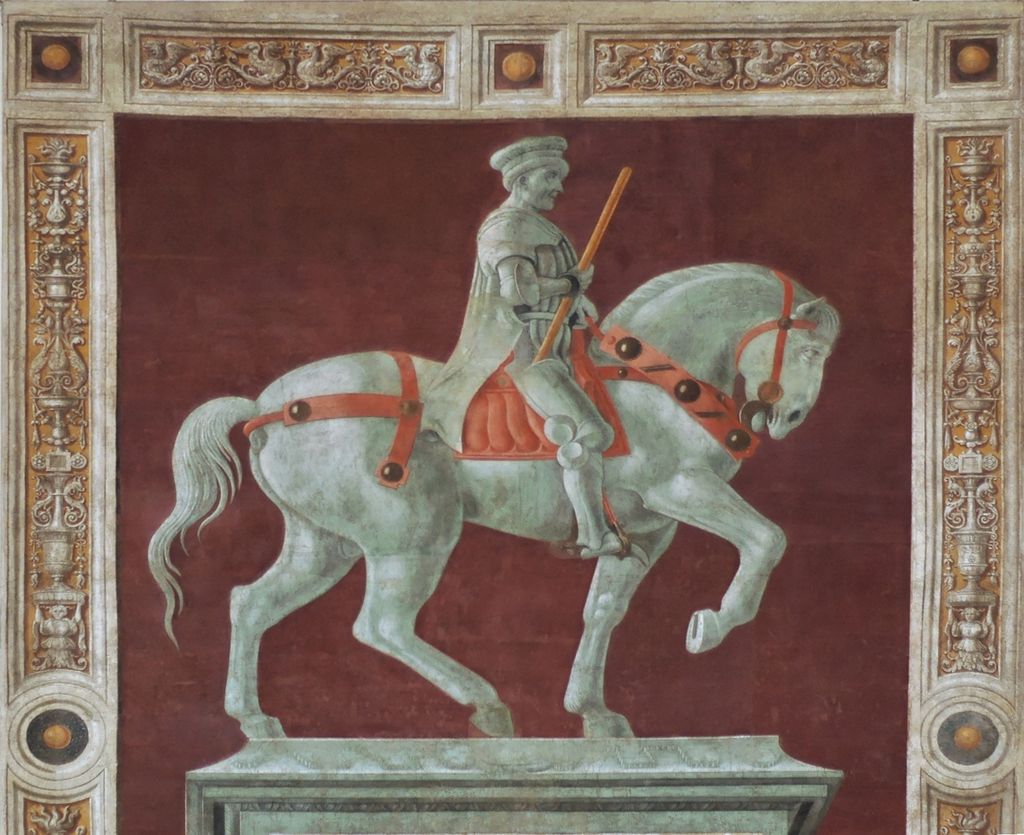
The rider and horse in Uccello’s monument to John Hawkwood, above the painted sarcophagus. Image source. Public domain.
San Romano and the Bartolini Salimbeni
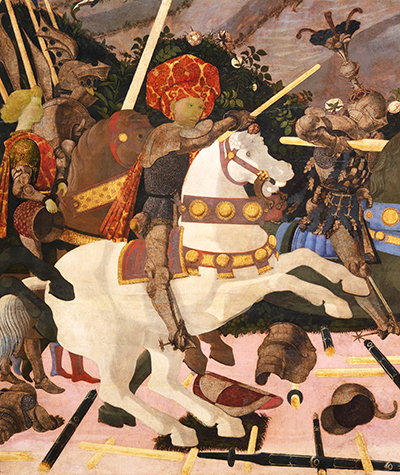
The three panels of the Battle of San Romano commemorate a Florentine victory fought on 1 June 1432. The paintings were made after the battle, probably beginning around the end of the 1430s. Their elaborately equipped men and horses would have filled a domestic interior with the spectacle of a public victory. Because the paintings were recorded in Lorenzo de’ Medici’s palace in 1492, his family's possession long shaped accounts of their purpose and date. Archival work by Francesco Caglioti, discussed by Dillian Gordon, put them in a different family's possession in 1480, in the large room of the Bartolini Salimbeni town house. [20] [5]
Lionardo Bartolini Salimbeni had served as a supervisor for the Florentine council that conducted the war against Lucca. Caglioti suggests that he may have commissioned the panels around the time of his second marriage in 1438. The marriage and Lionardo’s involvement in the war make the proposal intelligible. The first known record of the paintings in the family’s possession nevertheless dates from after Paolo’s death. When the panels passed to Lorenzo, the transfer itself was disputed. The Uffizi describes a transfer from Lionardo’s heirs. Gordon cites the testimony of Damiano Bartolini Salimbeni, who said in 1495 that the panels had been removed against his wishes, and explains why Caglioti proposes 1484 for the transfer. The altered corners of the surviving paintings show how they were fitted for a different room. If the refitting followed the probable 1484 transfer, it took place after Uccello’s death. [20] [5] [10]
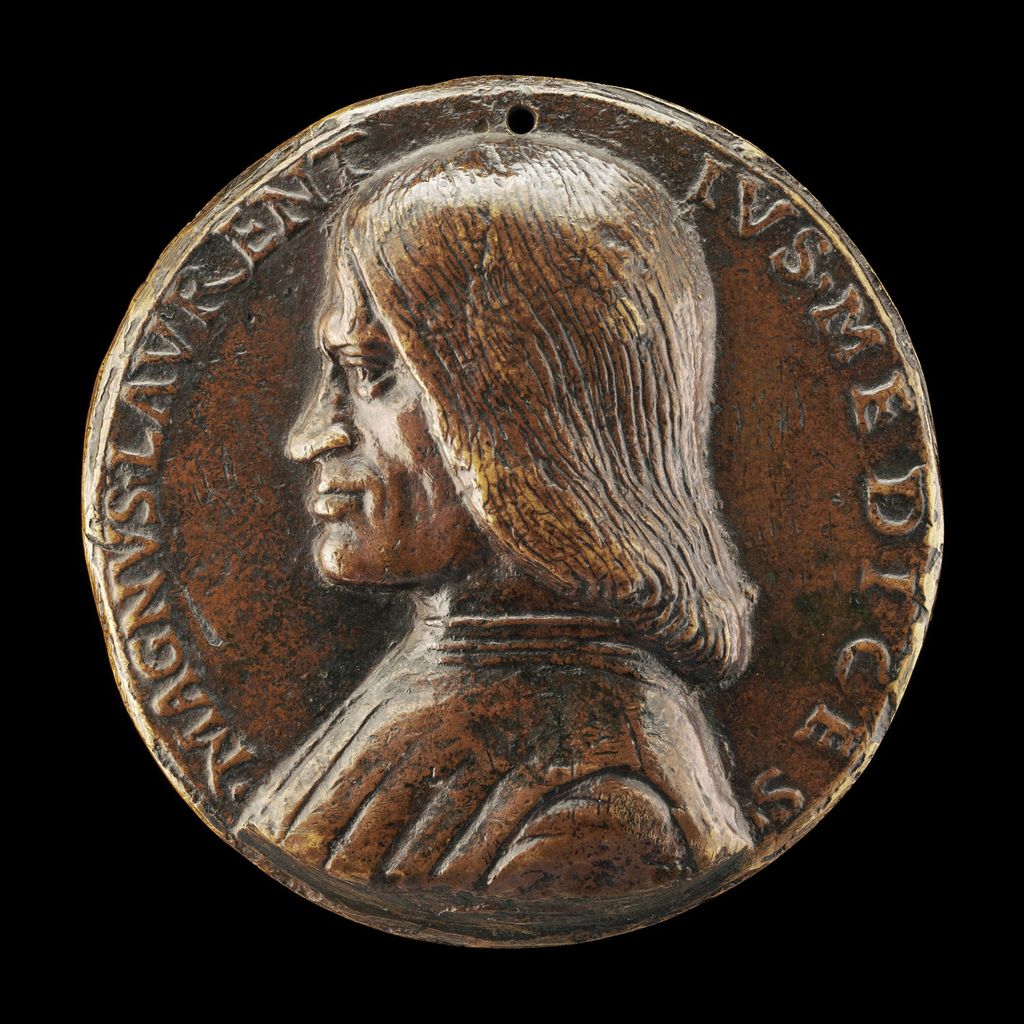
Niccolò Fiorentino’s medal of Lorenzo de’ Medici, who had all three San Romano panels installed in the family palace. Image source. Public domain.
Painted hours and light in the cathedral
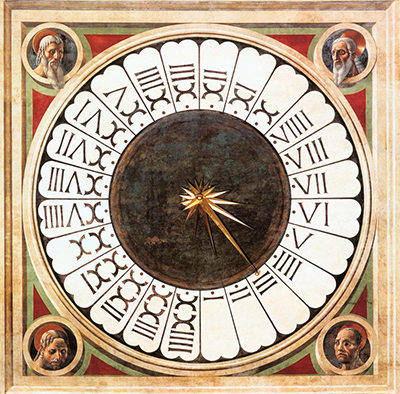
In 1443 Uccello painted the monumental clock dial high on the inside of the cathedral’s entrance wall. Four heads look out from its corners. They have been called prophets and evangelists, but their individual identities are uncertain. In the system known as Italian hours, the dial counted twenty-four hours with the day ending at sunset. The single hand travels anticlockwise. The wall painting, the mechanism behind it and the hand have different histories. The present movement is eighteenth-century, and the star-shaped hand was remade in the twentieth century using documentary evidence and a visual comparison with the star in Uccello’s Nativity window. [1] [6]
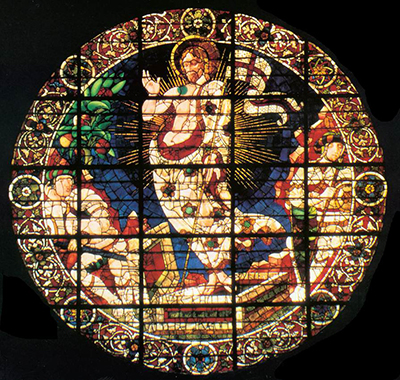
His work on the cathedral windows called for drawings that glassmakers could use to translate figures and drapery into coloured pieces held by lead. The Nativity and Resurrection survive in the drum supporting Brunelleschi’s dome. A third subject, the Annunciation, is lost. The surviving Resurrection, in the opening above the Mass sacristy, makes the distribution of the work unusually clear. The cathedral catalogue records a payment for a second design in July 1443. Following Giovanni Poggi’s archival analysis, it identifies a May payment as the first, although the notary called the subject an Ascension, the name of a separate window designed by Ghiberti. A January 1444 record names Bernardo di Francesco as maker of the window and also refers to Uccello’s labour in painting it. Design and execution were distinct responsibilities, with room in this case for the designer's hand during manufacture. [1] [7]
Working for religious houses
Around 1445 Uccello was in Padua, where he painted enormous figures for the courtyard of the Vitaliani house. The murals are lost. Vasari connected the journey to Donatello, who was already at work in the city. He also preserved a reported judgment from the Paduan humanist Girolamo Campagnola that Andrea Mantegna held the figures in high esteem. These later accounts give a sense of the paintings’ reputation, even though their original appearance can no longer be examined. [1] [3] [4]
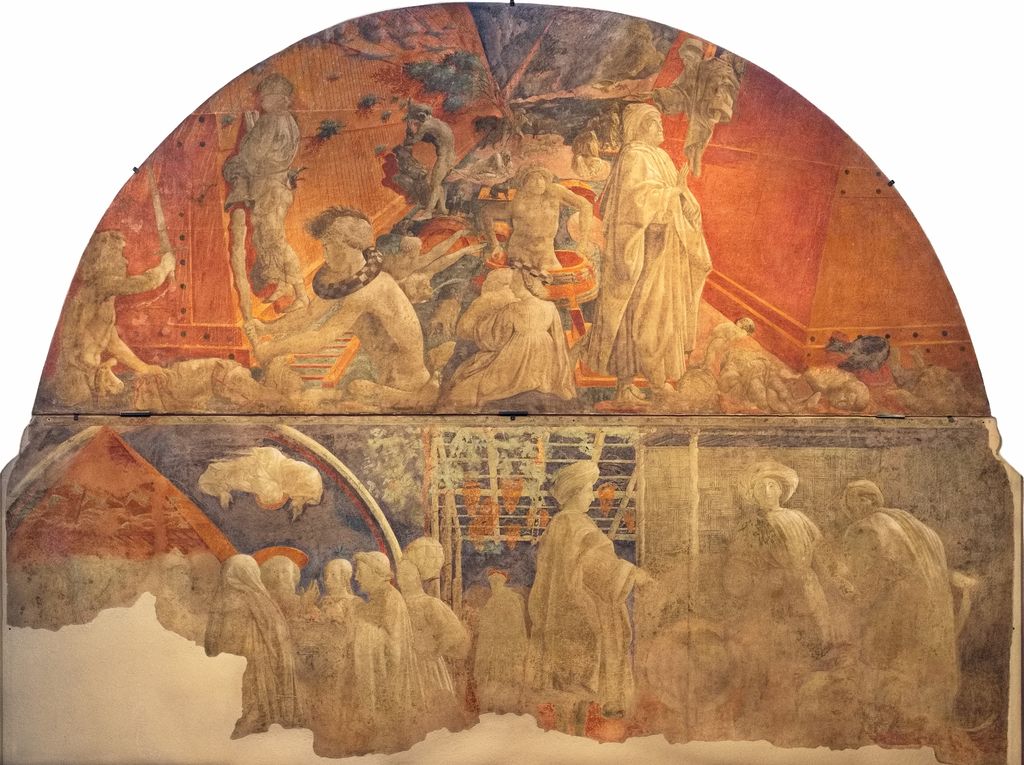
At Santa Maria Novella, Paolo worked on scenes from Genesis in the Green Cloister of the Dominican convent. The Creation of the Animals and Creation of Adam occupied the first bay of the east side. Giovanni Giura places the early part of the work after the Venetian stay, finding a comparison for the moving figures in the reliefs of Ghiberti’s later Baptistery doors. Farther along the wall, in the fourth bay, the Flood shows two converging views of the ark across a field of conflicting movements. Giura places the lunette around 1439, close to the monumental experiments of Hawkwood and San Romano. A later dating in the 1440s partly depends on Vasari’s identification of the painter Dello Delli in the related scene of Noah’s drunkenness, because Dello returned from Spain in 1446. The likeness matters because the later dating depends in part on recognising a man in a fresco from a description written over a century afterwards. [1] [21] [22]
Uccello also worked for the Olivetan monks at San Miniato al Monte. Payments in 1454–55 record a lost Crucifixion for the refectory, on which Antonio di Papi assisted him. One entry mentions oil painting, possibly used for finishing. Remains of another commission, stories of the Desert Fathers in the upper cloister, date from around 1461. Vasari remembered the unusual colour, especially the blue fields and red towns among figures painted in green earth. Around 1460–65 the Accademia dates Uccello’s separate Allegory of Monastic Life, which sets episodes from the lives of several saints among rocky shelves and caves. The museum lists the penitential confraternity of San Girolamo as one possible patron. Paolo’s membership of that confraternity in 1437–38 establishes a connection without settling who commissioned the canvas. [1] [3] [4] [23]
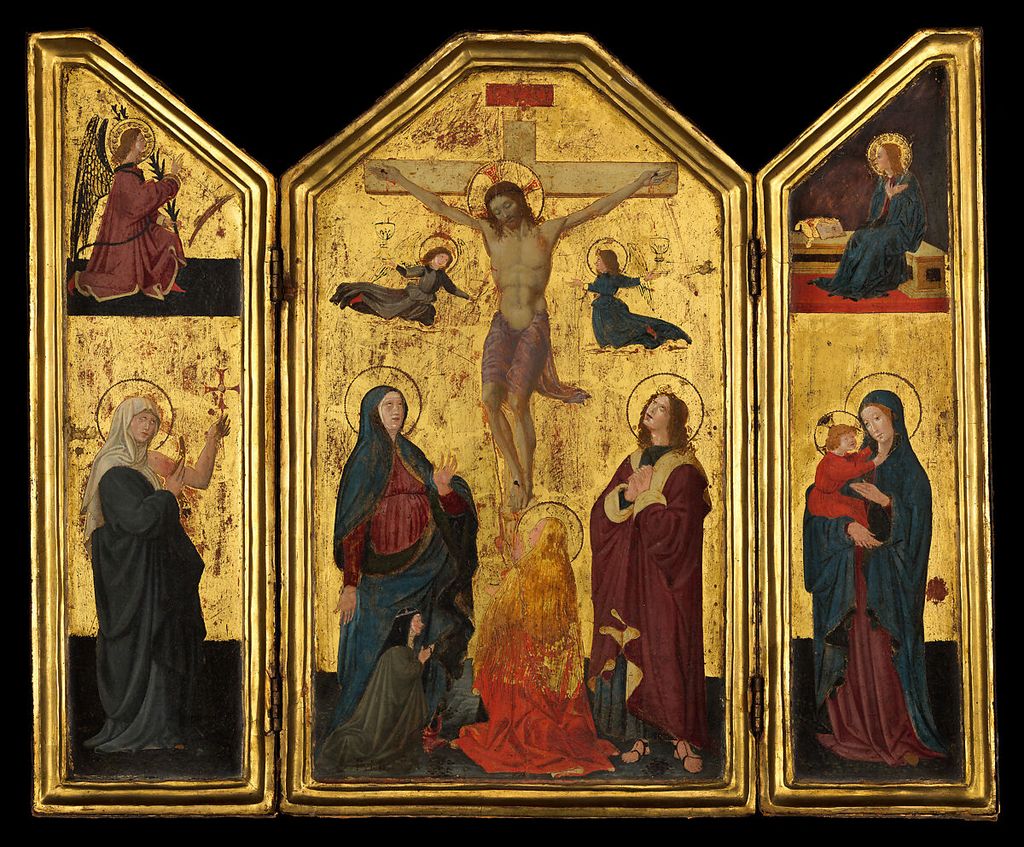
Uccello’s portable Crucifixion triptych, with Sister Felicity kneeling beneath the cross. Image source. CC0 / Public domain.
Household commissions and a painter’s family
Small commissions were also part of Paolo’s work in the 1450s. In 1452 he finished a predella for Antonio di Pietro del Golia. Its inscription names the patron and dates the work. The gold ground carries three roundels showing Christ as the Man of Sorrows between Mary and Saint John. The altarpiece that once stood above it was stolen in 1897. Another small work, now at the Metropolitan Museum of Art, bears the name of Sister Felicita. The donor’s entry into a Bridgettine convent makes the middle of the 1450s a plausible date for the portable Crucifixion. Such inscriptions let us name people whose commissions were modest in size and might otherwise have disappeared from the written record. [1] [24]
A tax return in 1458 records Paolo’s family with Tommasa di Benedetto Malefici, whom he had married around 1450. Their son Donato was baptised in November 1451 and their daughter Antonia in October 1456. Both became painters. Donato’s collaboration has a firm documentary basis in Urbino. For Antonia, who became a Carmelite nun, the death register in 1491 specifies her profession. Individual pictures have been proposed for both siblings, including small devotional works close to Paolo’s manner, but no attribution is secure. The family shared a trade whose skills could be transmitted at home and in the shop, and whose products could pass under the name of the best-known painter. [1] [4] [11]
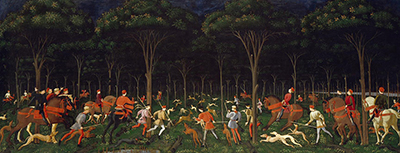
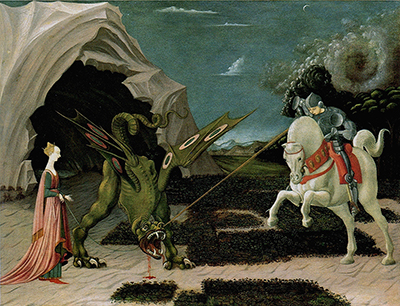
The records occasionally show what a Florentine household commissioned without providing enough detail to link the entry to a surviving piece. Jacopo and Giovanni Lanfredini paid for a panel in 1451–52 whose subject is unknown. Giovanni Rucellai named Paolo among the artists responsible for work in his palace. For the Hunt in the Forest, the Ashmolean proposes a date around 1465–70 and associates the long panel with the domestic format known as a spalliera. The original room and patron are unknown. The painting’s succession of trunks and the repeated lean of the dogs draw the eye into deep space across an object made to be seen horizontally. The smaller London Saint George and the Dragon, dated about 1470 by the National Gallery, was painted in oil on canvas and also may have been intended for a home. The two works show how many effects he could achieve at the scale of domestic furnishing. [1] [8] [9]
Urbino and the last Florentine records
In Urbino the Compagnia del Corpus Domini paid Paolo and Donato for work on its altarpiece project. The Galleria Nazionale delle Marche dates Uccello’s six-scene predella to 1467–68. Sbaraglio discusses a longer series of payments and related records extending into October 1469. The confraternity’s account book gives an unusually practical view of the work. It lists the transport of gesso and colours from Florence, glue for the panel, and even straw for a bed. Some purchases of clothes and shoes could have been for either painter. The ledger counts expenses for both men in Paolo’s account and gives no reliable way to divide the six scenes between them. [1] [25] [26]
The work dramatises a medieval anti-Jewish accusation of desecrating a consecrated host. Its scenes use architecture to move the eye between imagined offence, supposed miracle and persecution. The legend made violence against Jews appear justified to Christian audiences, and the painting belongs to the history of how that accusation was disseminated. [25] [27]
Fra Carnevale had accepted and given up the commission in 1456. In 1469 the confraternity brought in Piero della Francesca to inspect the prepared panel, but he did not take the job. The Communion of the Apostles, completed in 1474, was painted by Justus of Ghent. Both paintings came from the confraternity’s project for its church in Pian di Mercato. The predella later became separated from the altarpiece, and it turned up in a college attic in 1857. Its disappearance and rediscovery help explain why the early physical arrangement is difficult to reconstruct. [1] [25]
Back in Florence, Paolo made his last known tax return in 1469. It describes advancing age, difficulty earning a living and his wife’s illness. It went to tax officials assessing his circumstances, and Sbaraglio suggests he may have hoped for a reduction. Other returns show that he had a house in Florence and agricultural land at Ugnano. The last return lists no separate shop. He may have worked from home, with Donato’s help. In 1474 Paolo brought a claim against the woodworker Domenico del Tasso for money due on two paintings. The record establishes a sale, but the pictures are unidentified. [1] [11]
On 11 November 1475 Paolo made his second will and named Donato his heir. He asked to be laid in his father's tomb at Santo Spirito. He died in Florence that December and was buried there. Gordon gives 10 December as his death date, and Sbaraglio places the burial on 12 December. [1] [4]
How perspective came to define him
Only a few years after Uccello’s death, Cristoforo Landino described a painter who was inventive in composition, skilled with animals and landscape, and learned in perspective. Vasari’s account, first published in 1550 and expanded in 1568, developed the last quality into a story about the artist’s character. In one scene, Uccello’s wife calls him to bed and he responds by praising the sweetness of perspective. The remark survives in Vasari’s telling, written generations after Paolo’s death. Later portraits gave Uccello a recognisable face as well as a familiar personality. A group portrait in the Louvre depicts him in a company of Florentine masters. It was acquired in 1847 as a work by Uccello, but the museum now catalogues it as anonymous and dates it to the first half of the sixteenth century. A woodcut by Cristoforo Coriolano in the Rijksmuseum is also posthumous. [1] [3] [28] [29]
The objects and records support part of that reputation. The Hawkwood drawing shows a design revised with close attention to the way the parts sit in space. The Flood turns depth into a source of instability, while the recession of the forest in the Hunt lends order to a chase full of small, fast movements. In the cathedral clock, the painter could make a face at the edge of a painted circle command attention from far below. These choices make more sense when seen in the places where Paolo worked, from the high interior wall of a cathedral to a room where people lived. The records of payment and revision let us see that ingenuity at work, as a skill called on by people who had a wall to fill, an altarpiece to complete or a room to decorate. [19] [6] [21] [8] [25]
Artworks directory
Browse paintings, drawings, stained-glass designs and other objects connected with Uccello. Cycles and their surviving components may have separate entries. The collection or catalogue’s wording is retained where a date, attribution or subject is debated.
| Name | Date | Medium, attribution and collection |
|---|---|---|
| Niccolò da Tolentino at the Battle of San Romano · London | Probably c.1438–40 | Tempera and oil on wood, with metallic decoration · National Gallery Catalogue. |
| Bernardino della Carda Unhorsed · Florence | c.1435–40 | Tempera on panel · Uffizi Galleries Catalogue. |
| The Counterattack of Micheletto da Cotignola · Paris | 1450–75 in the Louvre catalogue | Tempera (possibly) on wood · Musée du Louvre Catalogue. |
| The Hunt in the Forest | c.1465–70 | Tempera and oil with traces of gold on panel · Ashmolean Catalogue. |
| Saint George and the Dragon · London | c.1470 | Oil on canvas · National Gallery Catalogue. |
| Saint George Slaying the Dragon · Melbourne | c.1430 | Oil, tempera and silver leaf on wood · National Gallery of Victoria Catalogue. |
| Saint George and the Dragon · Paris | 1430–35 in the museum catalogue | Painted wood panel · Musée Jacquemart-André Catalogue. |
| Equestrian Monument to John Hawkwood | 1436 | Transferred wall painting · Florence Cathedral Catalogue. |
| Study for the John Hawkwood Monument | 1436 | Study on prepared paper · Uffizi Catalogue. |
| Monumental Clock Face | 1443 | Painted dial · Florence Cathedral Catalogue. |
| Resurrection of Christ | 1443–44 | Stained glass · Uccello design · Florence Cathedral Catalogue. |
| Nativity | 1440s | Stained glass · Uccello design · Florence Cathedral Catalogue. |
| Creation of the Animals and Creation of Adam | Third to fourth decade of the 15th century | Detached fresco · Green Cloister, Santa Maria Novella Catalogue. |
| Creation of Eve and the Fall | Third to fourth decade of the 15th century | Detached fresco · Green Cloister, Santa Maria Novella Catalogue. |
| Flood and Recession of the Waters | 15th century; dating debated | Detached fresco · Green Cloister, Santa Maria Novella Catalogue. |
| Sacrifice and Drunkenness of Noah | 15th century; dating debated | Detached fresco · Green Cloister, Santa Maria Novella Catalogue. |
| Stories of the Virgin and Saint Stephen · Assunta Chapel | 1430s, with later completion | Fresco cycle · Paolo Uccello and Andrea di Giusto · Prato Cathedral Catalogue. |
| Blessed Jacopone da Todi | 1436 in the diocesan museum | Detached fresco · Museo dell’Opera del Duomo, Prato Catalogue. |
| Adoration of the Child · Bologna | 1430s; inscription incomplete | Detached fresco · San Martino Maggiore, Bologna Catalogue. |
| Adoration of the Christ Child · Karlsruhe | c.1436 | Painted panel · Attribution to Uccello · Staatliche Kunsthalle Karlsruhe Catalogue. |
| Annunciation · Oxford | Early 15th century | Tempera and gilding on panel · Ashmolean Catalogue. |
| Allegory of Monastic Life (Thebaid) | c.1460–65 | Tempera on canvas · Galleria dell’Accademia, Florence Catalogue. |
| Miracle of the Profaned Host | 1467–68 | Tempera on wood · Galleria Nazionale delle Marche, Urbino Catalogue. |
| Triumphal Entry into Rome of Titus and Vespasian(?) | c.1430–35 | Tempera, gold and silver on panel · Yale University Art Gallery Catalogue. |
| Crucifixion with the Virgin and Saints | c.1460–65 | Painted panel · Museo Nacional Thyssen-Bornemisza Catalogue. |
| The Crucifixion · Met triptych | Probably mid-1450s | Tempera on wood with gold ground · Metropolitan Museum of Art Catalogue. |
| Perspective Study of a Chalice | 1450–75 | Pen, ink and stylus on paper · Attributed to Uccello · Uffizi Catalogue. |
| Study of a Mazzocchio | 15th century | Perspective study · Attributed to Uccello · Uffizi Catalogue. |
| Mazzocchio Seen in Perspective | Uncertain | Drawing · Attribution debated · Musée du Louvre Catalogue. |
| Head of a Man in Profile | 15th century | Pen, ink and wash · Musée du Louvre Catalogue. |
| Five Masters of the Florentine Renaissance | 1500–50 | Oil on wood · Anonymous Florentine school · Musée du Louvre Catalogue. |
| Madonna and Child from the Del Beccuto House | 15th century | Detached fresco · Museo di San Marco, Florence Catalogue. |
| Man of Sorrows with the Virgin and Saint John · Avane Predella | 15th century | Predella · Museo di San Marco, Florence Catalogue. |
| Calling of Saint Paul the Hermit · San Miniato | After 1447 to c.1454 in state catalogue | Sinopia · Attributed to Uccello or collaborator Catalogue. |
| The host changes hands · Urbino predella, scene 1 | 1467–68 | Tempera on wood · Component of DE 231 · Galleria Nazionale delle Marche Catalogue. |
| The figures at the door · Urbino predella, scene 2 | 1467–68 | Tempera on wood · Component of DE 231 · Galleria Nazionale delle Marche Catalogue. |
| The procession approaches the altar · Urbino predella, scene 3 | 1467–68 | Tempera on wood · Component of DE 231 · Galleria Nazionale delle Marche Catalogue. |
| The condemned woman and the ladders · Urbino predella, scene 4 | 1467–68 | Tempera on wood · Component of DE 231 · Galleria Nazionale delle Marche Catalogue. |
| Persecution of the family · Urbino predella, scene 5 | 1467–68 | Tempera on wood · Component of DE 231 · Galleria Nazionale delle Marche Catalogue. |
| Angels and demons at the bier · Urbino predella, scene 6 | 1467–68 | Tempera on wood · Component of DE 231 · Galleria Nazionale delle Marche Catalogue. |
| Birth of the Virgin · Prato Cathedral | 1430s; dating debated | Fresco · Assunta Chapel, Prato Cathedral Catalogue. |
| Presentation of the Virgin · Prato Cathedral | 1430s; dating debated | Fresco · Assunta Chapel, Prato Cathedral Catalogue. |
Discussion
Look again at the images and ideas explored in Biography. These editorial prompts invite your observations.
Reader Insights
Stand back from the Hawkwood and then look closely at the Hunt in the Forest. Where does each painting seem to place you, and how might being in a cathedral or a private room change that experience?
Which surviving object or document most changes your sense of Uccello’s working life?
Join the Conversation
Share a detail, comparison or question about Biography below.
References
- Lorenzo Sbaraglio. Paolo di Dono, detto Paolo Uccello, Dizionario Biografico degli Italiani, vol. 81 (2014). Chronology, documentary evidence and attribution history. View source.
- Opera di Santa Maria del Fiore. Al via il restauro dei leggendari condottieri Giovanni Acuto e Niccolò da Tolentino di Paolo Uccello e Andrea del Castagno nel Duomo di Firenze, 1 June 2022. Hawkwood commission and revisions. View source.
- Giorgio Vasari. Lives of the Artists, life of Paolo Uccello, English text in Fordham University’s Internet Medieval Sourcebook, which identifies the Gaston du C. de Vere translation (1912–15). View source.
- Dillian Gordon. Paolo di Dono, called Uccello, The Fifteenth Century Italian Paintings, vol. 1 (2003, online version 2025). Career chronology and notes. View source.
- Dillian Gordon. The Battle of San Romano, The Fifteenth Century Italian Paintings, vol. 1 (2003, online version 2025). Patronage, earliest documented location, date and reconstruction of the transfer, including Francesco Caglioti’s archival findings. View source.
- Opera di Santa Maria del Fiore. Paolo Uccello, Orologio monumentale. 1443 dial, Italian hours, replacement movement and reconstruction of the hand. View source.
- Opera di Santa Maria del Fiore. Cristo risorto, catalogue no. 5663. Archival entries and historical commentary on Uccello’s design and Bernardo di Francesco’s execution. View source.
- Ashmolean Museum. The Hunt in the Forest by Uccello, WA1850.31. Date, proposed domestic use and perspective. View source.
- The National Gallery, London. Saint George and the Dragon, NG6294. Date, oil on canvas and likely domestic use. View source.
- Gallerie degli Uffizi. Battaglia di San Romano, inv. 1890 n. 479. Daniela Parenti’s catalogue entry, including the signature, format and ownership history. View source.
- Hugh Hudson. From Via della Scala to the Cathedral: Social Spaces and the Visual Arts in Paolo Uccello’s Florence, Place (November 2007). Family, property and workshop evidence, including Archivio di Stato di Firenze, Catasto 926, 2, fols. 259r–259v, cited in n. 17. View source.
- Hugh Hudson. A Knight in Shining Armour, a Virgin – Uccello’s Melbourne Saint George and the dragon and Oxford Annunciation, Art Bulletin of Victoria 46 (2006). Attribution, dating and comparisons with Ghiberti’s figures. View source.
- Università di Bologna, Biblioteca delle Arti. La fototeca di Carlo Volpe: l’officina del conoscitore. Exhibition from Volpe’s photographic archive, including his work on the San Martino rediscovery. View source.
- Gallerie dell’Accademia di Venezia. Gentile Bellini, Processione in piazza San Marco, 1496. Object entry and view of the façade. View source.
- Procuratoria della Basilica di San Marco. Cronologia essenziale. The 1419 fire, Tuscan artists on the façade and Bellini’s later record. View source.
- Musei Diocesani di Prato. Sala della Pittura del Quattrocento. Catalogue entry for the detached Beato Jacopone da Todi and account of the Assunta Chapel campaign. View source.
- Matteo Mazzalupi. Un caso di metodo: gli affreschi di Prato e la giovinezza di Paolo Uccello, in Da Donatello a Lippi. Officina pratese (2013), pp. 65–75. Chronology, comparison with Andrea di Giusto’s 1437 altarpiece and chapel patronage. View source.
- Matteo Mazzalupi. “Licet indigeat picturis et ornamentis”. Affondi per Paolo Uccello a Prato. Documents concerning the use of the Assunta Chapel and proposed endowments. View source.
- Hugh Hudson. The Politics of War: Paolo Uccello’s Equestrian Monument for Sir John Hawkwood in the Cathedral of Florence, Parergon 23, no. 2 (2006), pp. 18–20 on the monument’s viewpoints and Lorenza Melli’s reconstruction of the stages of the drawing, with earlier sections on the Opera’s membership and decisions. View source.
- Ashok Roy and Dillian Gordon. Uccello’s ‘Battle of San Romano’, National Gallery Technical Bulletin 22 (2001), pp. 4–17. Date of the battle and technical comparison of the panels. View source.
- Giovanni Giura. La seconda età della pittura in Santa Maria Novella. Green Cloister chronology, Baptistery comparisons and the Flood, including fig. 1. View source.
- Comune di Firenze. Visita il museo, Santa Maria Novella. Green Cloister context, original bay positions and their subjects. View source.
- Galleria dell’Accademia di Firenze. Allegory of Monastic Life, inv. 1890 n. 5381. Date, subjects, provenance and proposed recipients. View source.
- The Metropolitan Museum of Art. The Crucifixion, accession no. 1997.117.9. Portable devotional work, probably mid-1450s, and identification of the donor. View source.
- Galleria Nazionale delle Marche. Miracle of the Profaned Host, inv. DE 231. Predella dating, Urbino commission and related altarpiece. View source.
- Massimo Ciambotti, Federica Palazzi and Francesca Sgrò. Il ruolo delle Confraternite nello sviluppo delle arti figurative del XV e XVI secolo come emerge dai registri contabili: il caso della Confraternita del Corpus Domini di Urbino, Storia della ragioneria e arti, Turin, 2018, § 5.3. Transcriptions and analysis of the confraternity’s account book B 1, especially fols. 37v, 38r and 44v. View source.
- Miri Rubin. Desecration of the Host: The Birth of an Accusation, Studies in Church History 29 (1992), pp. 169–185. Origins, pattern and function of the anti-Jewish accusation. View source.
- Rijksmuseum. Portret van Paolo Uccello, RP-P-2022-4271. Posthumous woodcut, catalogued under Cristoforo Coriolano and dated 1568–1650. View source.
- Musée du Louvre. Cinq maîtres de la Renaissance florentine : Giotto, Uccello, Donatello, Manetti, Brunelleschi, INV 267. Current anonymous attribution, date and 1847 acquisition history. View source.
More PAOLO UCCELLO Artworks

Noah and the Flood
The Flood and Recession of the Waters above the lower episodes from Noah’s story, Santa Maria Novella. Photograph by Armin Kleiner. Image source. CC BY-SA 4.0. Resized for the web. This derivative is available under the same licence.
The Resurrection of Christ Stained Glass Window
The Resurrection window in Florence Cathedral, designed by Paolo Uccello and made by Bernardo di Francesco. Photograph by Sailko. Image source. CC BY 3.0. Resized for the web.