 by Tom Gurney
Tom Gurney BSc (Hons) is an art history expert with over 20 years experience
Published on June 19, 2020 / Updated on November 17, 2026
Email: tomgurney1@gmail.com / Phone: +44 7429 011000
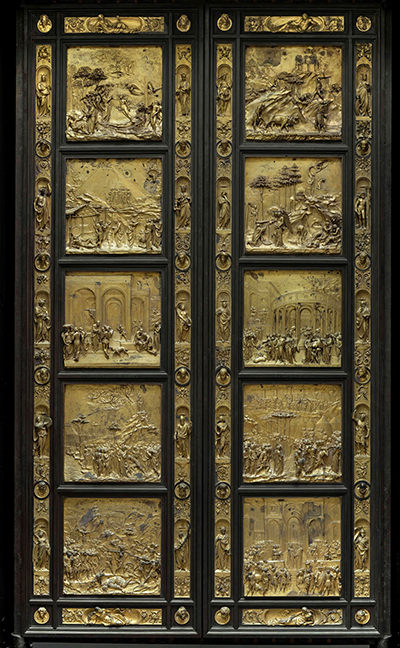
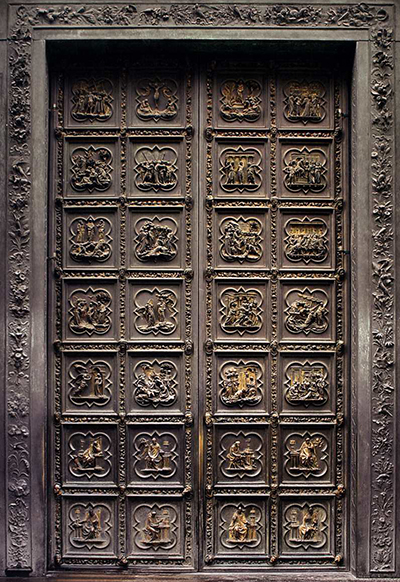
Stand between Florence Cathedral and the octagonal Baptistery of San Giovanni and look towards the Baptistery’s east entrance. Amid the green and white marble, ten golden squares catch the light. Walk round to the north entrance and the pattern changes: smaller scenes sit inside four-lobed frames, with dark bronze showing through between gilded figures. Both designs are by Lorenzo Ghiberti (c. 1378–1455), the Florentine goldsmith and sculptor who spent much of his working life on these two commissions. [7] [15] The doors outside are copies. Their originals stand in the Sala del Paradiso in the Museo dell’Opera del Duomo, where the difference between them is easier to study. [1] [2] [3] [4] [11] [20]
Across the piazza, the doors have to make sense as part of a building. Inside the museum a gap between two hands can hold a story in suspense. The shift in scale is worth making elsewhere in Florence. At the Bargello two sculptors answered the same brief in a relief the size of a single door compartment. At Orsanmichele a solitary figure had to hold its own above the street. The cathedral opposite the Baptistery contains Ghiberti’s design for a circle of glass more than six metres across. [1] [5] [6] [22]
The orders for these works came from different kinds of patron. Calimala, the merchants’ guild that administered the Baptistery, commissioned the doors and put its patron saint on Orsanmichele. Other guilds commissioned their own saints, the Opera del Duomo was responsible for the cathedral, and the authorities at Siena enlisted several sculptors to make a single font. Some of the work was under way at the same time. The timeline follows the contracts, deliveries and installations, and the biography follows Ghiberti from his training in a goldsmith’s household through those overlapping jobs. On the ground, the changing formats are easier to grasp by starting with one work that fits inside a single doorway compartment. [2] [6] [15] [17] [19]
At a Glance
- Lifespanc. 1378–1455
- Based inFlorence
- PracticeGoldsmithing, bronze sculpture and stained-glass design
- Major worksNorth Doors, Gates of Paradise and the Orsanmichele bronzes
- WritingsCommentarii
Lorenzo Ghiberti in context
International Gothic in Florence and Siena
c. 1395–1430 (approximate)Lorenzo Ghiberti
c. 1378–1455Filippo Brunelleschi
1377–1446Donatello
c. 1386–1466Sacrifice of Isaac
1401 competitionNorth Doors
1403–1424St John the Baptist
c. 1414–1416St Matthew
1419–1422Gates of Paradise
1425–1452St Stephen
c. 1427–1429Ghiberti’s connections
Trace the commissions, collaborations and ideas that shaped Ghiberti’s work.
- Andrea Pisano. Ghiberti took up the earlier door’s grid of quatrefoil reliefs and gave the new doors a programme centred on the life of Christ. [2]
- Arte di Calimala. The merchants’ guild organised the Baptistery competition. Its successive contracts show how a public commission set the terms for years of workshop labour. [2]
- Orsanmichele. At Orsanmichele, guild patronage put Ghiberti’s standing saints in niches above the street. The indoor originals and outdoor copies now offer two ways to see the figures. [6]
- Narrative space. The Gates of Paradise set several moments within each square. Figures shift in scale and projection as the eye moves between episodes. [4]
Contents
- At the Bargello: the moment before the blow
- The Baptistery: two ways of telling a story
- The entrance and its museum counterpart
- Orsanmichele: a figure above the street
- Inside the cathedral, and on the page
At the Bargello: the moment before the blow
In 1401 the Florentine merchants’ guild, the Arte di Calimala, asked competing sculptors to make a bronze relief of the Sacrifice of Isaac. The gilded trial panels by Ghiberti and Filippo Brunelleschi survive at the Bargello. Both artists had to fit the same episode into a quatrefoil, a frame with four rounded lobes. [5] [7] [8]
In Ghiberti’s panel an oblique ridge divides the two attendants and donkey from the action at the altar. Above the ridge the ram has a little ledge of its own. Isaac’s exposed torso catches the eye, and the curve of Abraham’s body carries it up towards the angel, whose hand reaches into the scene without taking hold of him. There is time to register the distance between those figures. In Brunelleschi’s version the angel catches Abraham’s wrist and Abraham’s other hand grips Isaac. The people below take up much of the bottom edge, making events at the altar seem to press forward above them. The shared outline helps us see what each sculptor made of the space it enclosed. [7] [8]
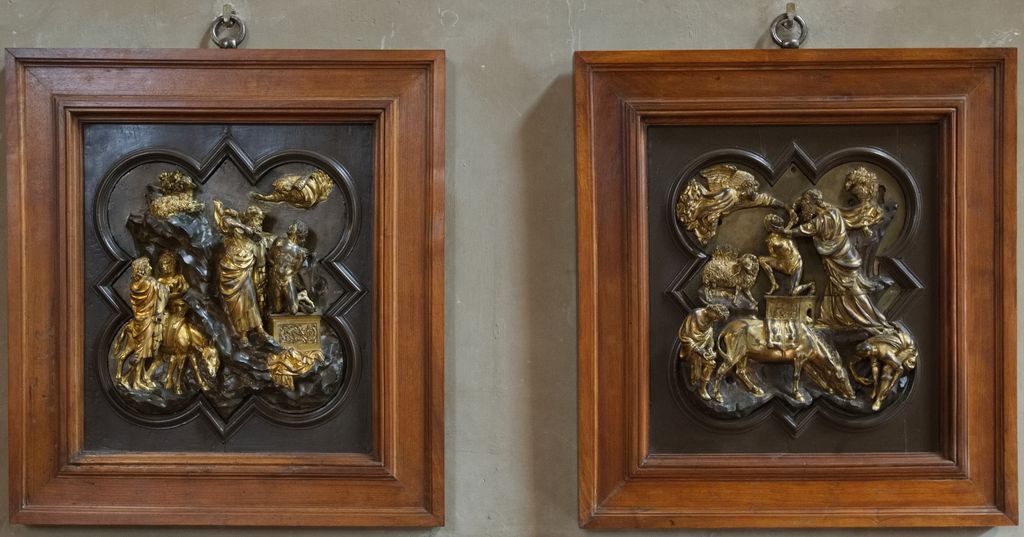
The trial relief also brings two visual traditions into the same small field. Isaac’s body recalls ancient sculpture, while Abraham’s robe sweeps towards the lobes of the Gothic frame. The turn of Isaac’s body registers so clearly because the bronze around it moves differently: fabric loops and rock breaks into ridges. After the competition, Calimala entrusted Ghiberti with the door, and he and the goldsmith Bartolo di Michele signed the first contract in November 1403. Accounts differ on how the judges reached their decision; the surviving bronzes show what the sculptors did with the brief. [2] [7] [8]
Start at the lower edge of each relief. The attendants occupy much of the lower part of each relief and continue about their business while Abraham raises the knife. The servant bent over his foot in Brunelleschi’s relief is particularly conspicuous because a limb reaches out towards the frame. In Ghiberti’s version the animal and attendants form a group that can be read along the foot of the ridge.
Look back to the knife in each relief after finding those details. With Brunelleschi the figures above and below sit almost on top of one another in the field of view. With Ghiberti the slope of the rock leaves a channel through which the eye can travel from one group to the other. The two approaches give a different amount of attention to the people who are unaware of what is happening. [7] [8]
The edge of the relief also reveals where a figure stands in relation to its surroundings. A hand projecting far enough to take light on its underside will be visible as a separate form before the smaller detail of the fingers becomes clear. Where a form merges more gradually with the ground, a change in the angle of the light can do much of that work.
In the competition bronzes, differences of projection are sometimes also differences of construction. The national catalogue and Fabian Jonietz’s study discuss how the two artists combined cast components. Ghiberti cast much of his scene together, with Isaac made separately, while more of Brunelleschi’s elements were cast apart and attached. The style and technique page follows this kind of evidence from the visible faces to the backs of the bronzes. [7] [8]
Look for the sacrifice again in the museum across from the cathedral. The trial relief at the Bargello is distinct from the scene in the Abraham and Isaac square on the later east doors. On that door the sacrifice is high on the right and shares its field with Abraham’s other encounters. The angel actually takes hold of Abraham’s wrist, a gesture Ghiberti had left in suspense in the trial piece.
The later decision to put a small sacrifice above a great expanse of landscape makes sense when the whole square is in view. The Bargello panel gives the altar group commanding space within its own frame. Finding both versions shows how much the relative prominence of an episode could change during the career of the same sculptor. [4] [8] [19] [30]
The Baptistery: two ways of telling a story
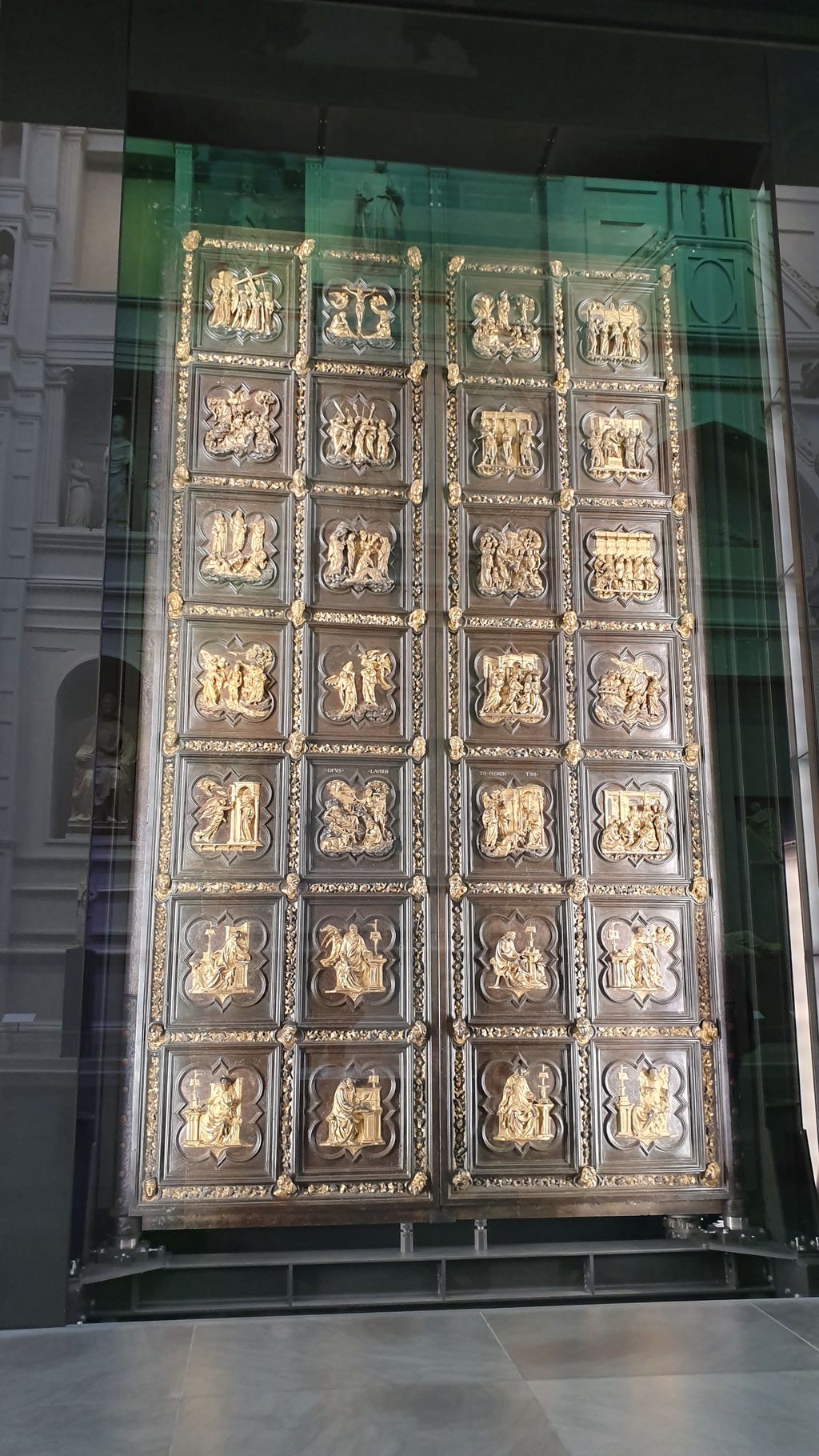
Andrea Pisano’s earlier doors, associated with the south portal, tell the story of John the Baptist in a grid of quatrefoils. Ghiberti kept that form for his first set, now known as the North Doors, made between 1403 and 1424. They initially occupied the east entrance facing the cathedral and were moved north in 1452 when the Gates of Paradise took their place. Five narrative tiers rise above two rows of seated Evangelists and Doctors of the Church. At the top the cross in the Crucifixion has a compartment to itself; the Resurrection occupies the next field across the central seam. Even before a viewer identifies the figures, the architecture of the door tells them to pause and start again. [1] [2]
Near the bottom of that same door, where the observer is closer to the bronze, books are part of the action. The seated Evangelists turn, lean and work within the same outline that elsewhere contains a crowd or a landscape. Along the edges, small heads project from the intersections of the grid and foliage and animals fill the bands between scenes. The selective gilding, recovered in the restoration completed in 2015, makes the pattern clearer: the raised forms catch the light against a darker ground. A door can be legible as a whole even when its smaller details are out of reach. [2] [3]
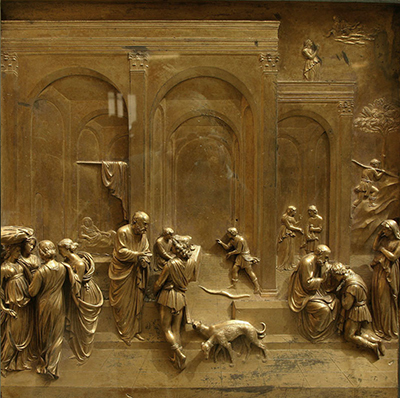
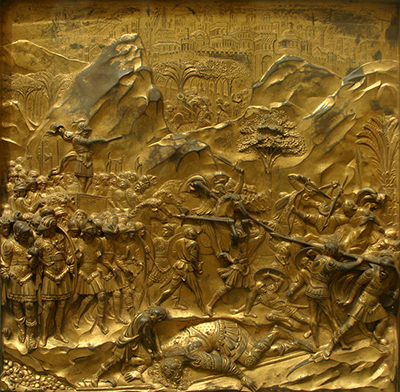
The Gates of Paradise, commissioned in 1425 and installed in 1452, use ten square fields for Old Testament stories. Inside each square, changes in the size and projection of figures can mark distance, and the same character can appear more than once. In the Stories of Jacob and Esau, a succession of arches draws the gaze inwards while figures nearer the lower edge project more boldly.
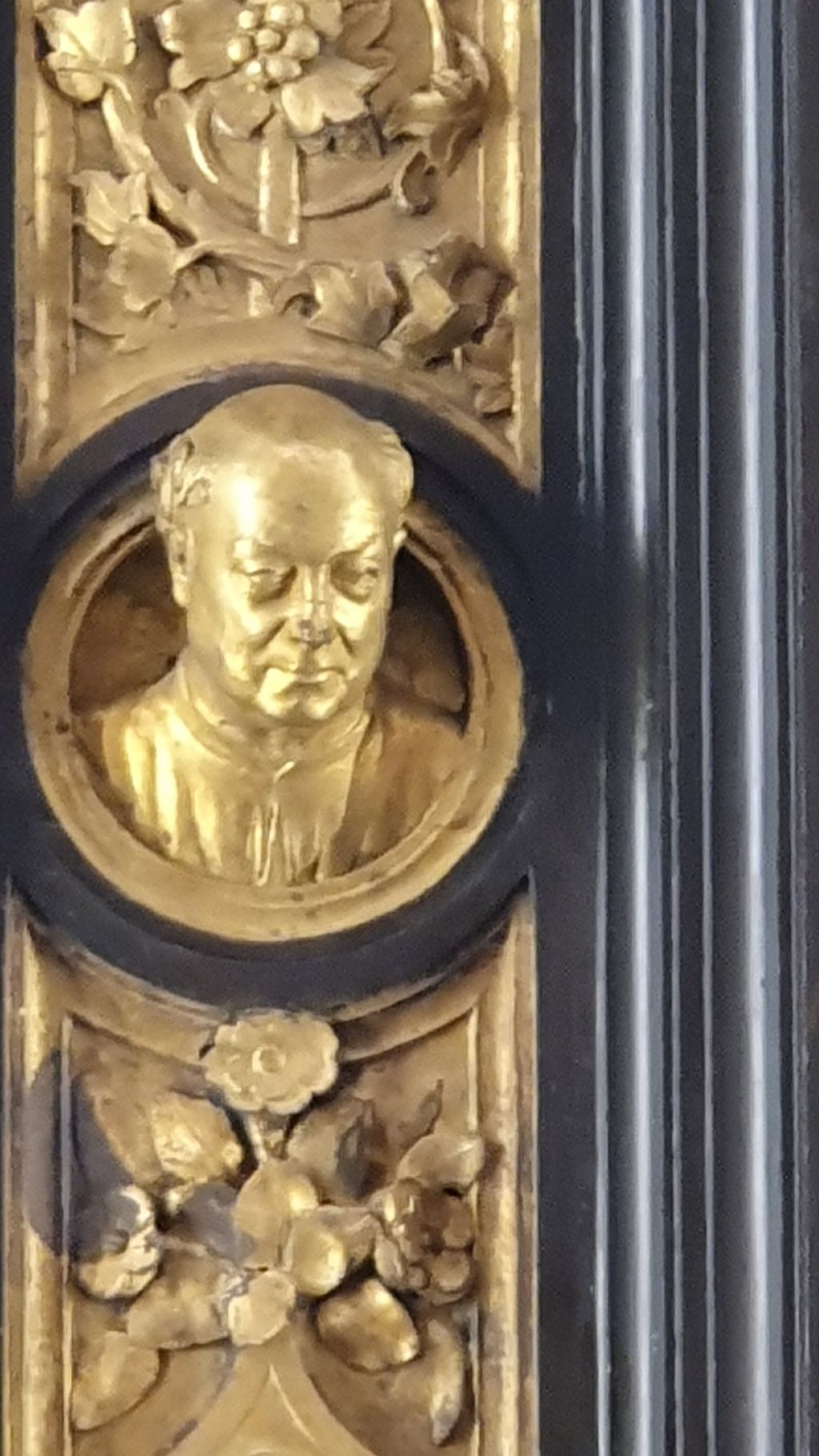
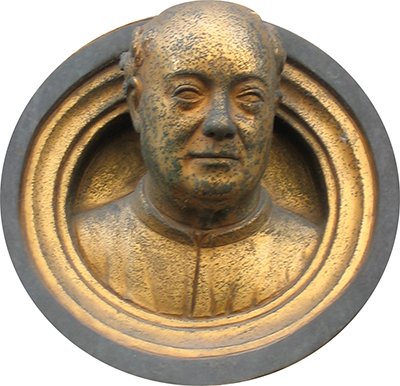
The blessing of Jacob at lower right comes into focus against the earlier encounters distributed through the arcade. Architecture gives each encounter a place; it also lets the viewer take in several moments at once before disentangling their order. Around the squares, standing figures alternate with projecting heads. Ghiberti’s own bald head projects from the inner border on the left leaf, close to the central seam. [4] [9] [10]
Ghiberti and his assistants sharpened details in the bronze before gilding it. In the museum, look for the difference between a foreground figure whose head stands clear of the background and the fine lines that describe the masonry behind it. Both are part of the same cast field, but light falling across the gilded bronze gives them different weight. From across the piazza the ten squares set the rhythm; up close, these changes in depth set the pace within a square. [4] [9] [10] [11]
The entrance and its museum counterpart
The Sala del Paradiso stages the encounter across the piazza indoors. The museum’s reconstruction evokes the cathedral’s medieval façade, so the original Baptistery doors can be considered beside sculpture once on the buildings around the square. Look at the doors from far enough away to see both leaves before choosing a panel. The central seam and the repeated borders are strong coordinates.
On the North Doors it helps to begin just above the seated writers, with the first narrative tier. The Annunciation and Nativity share the left leaf there. In the first, the angel approaches from the left and Mary draws back in a little portico. A column marks the interval between them. In the second, the reclining figure and the figures around the child gather the eye near the centre. Above the Nativity, look for the beginning of Ghiberti’s signature. It continues across the seam over the Adoration of the Magi, so the name is read across both leaves. [2] [26] [32]
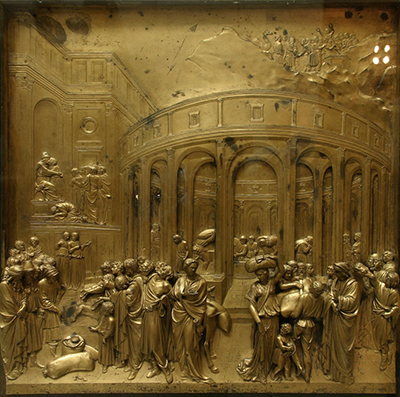
The square fields of the east doors can put changes of setting within a single border. Look for a large circular building in the Joseph panel. The architecture is a landmark from which to locate the surrounding groups, even before working out which figure is Joseph. The Joseph square occupies the right side of the middle tier. In the Adam and Eve square at the top left, the bodies and changes of setting give a viewer bearings.
Adam lies at the lower left, Eve rises near the centre, and the couple are driven towards the far right. The spaces between episodes are part of the storytelling. There is no need to search for the equivalent of an architectural plan in every square. Compare which shapes can still be made out at a distance, then look for the smaller bodies as you move nearer. [4] [9] [31]
Gold changes how those forms register. Under a highlight a projecting brow or knee can catch the eye first. A shallow line farther back becomes easier to follow where the surface changes tone. The North Doors give the eye the added contrast of gilded details and dark grounds. The east doors ask it to distinguish depths across areas where the ground itself is gilded. It helps to look first at the edges of two forms of comparable size and see how much shadow each leaves against its background.
This is also an advantage of seeing the replica and original in succession. The replica shows how the composition fits the marble portal in daylight. The museum original lets the visitor follow the different pitches of the metal itself. The guide to all three Baptistery doors traces the changes of site and the other sculpture associated with the entrances. [1] [2] [3] [4] [11] [26]
Orsanmichele: a figure above the street
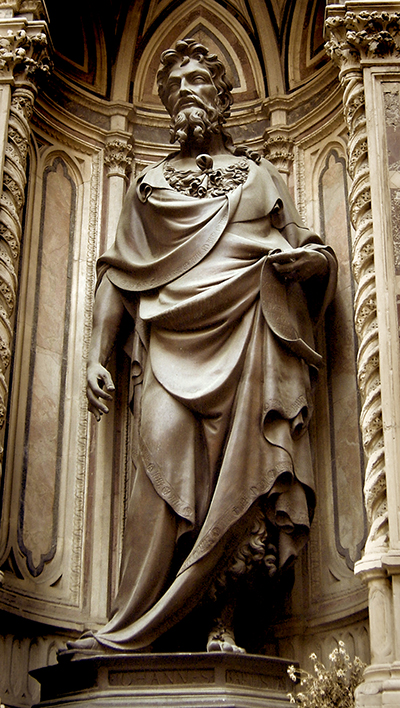
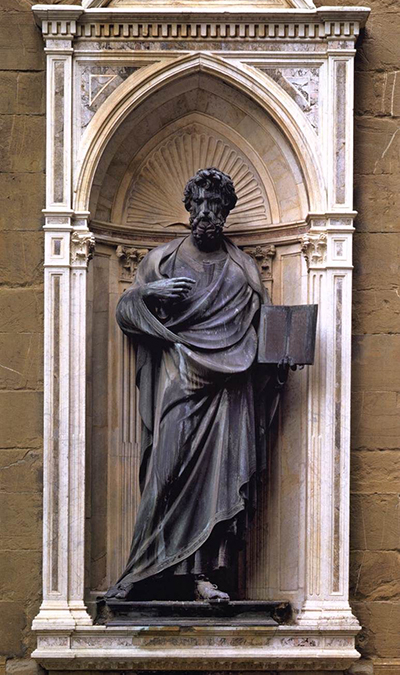
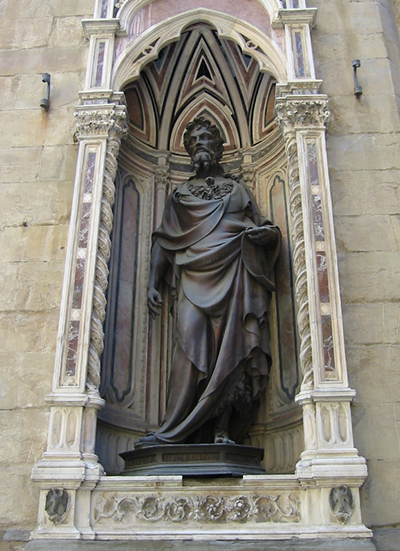
A short walk from the Baptistery brings you to Orsanmichele, where the niches belong to a former grain market turned church. Florence’s guilds commissioned patron saints for the outside of the building. Ghiberti made three monumental bronzes for it, and the copies in the niches explain something that is easy to miss in the museum upstairs: a passer-by first encounters the saint from below, bounded by stone and in the company of figures commissioned by other guilds. Up close, the originals allow a different kind of comparison, between the furls of a mantle, the handling of a face and the objects each saint carries. [5] [6]
In St John the Baptist, made for Calimala, follow the looping edge of the mantle and then look at the pronounced veins of the arm and the lean, lined face. The living particularity of the figure survives the sweep of the drapery. Ghiberti even used the edge of the garment to carry his name. [12] [21]
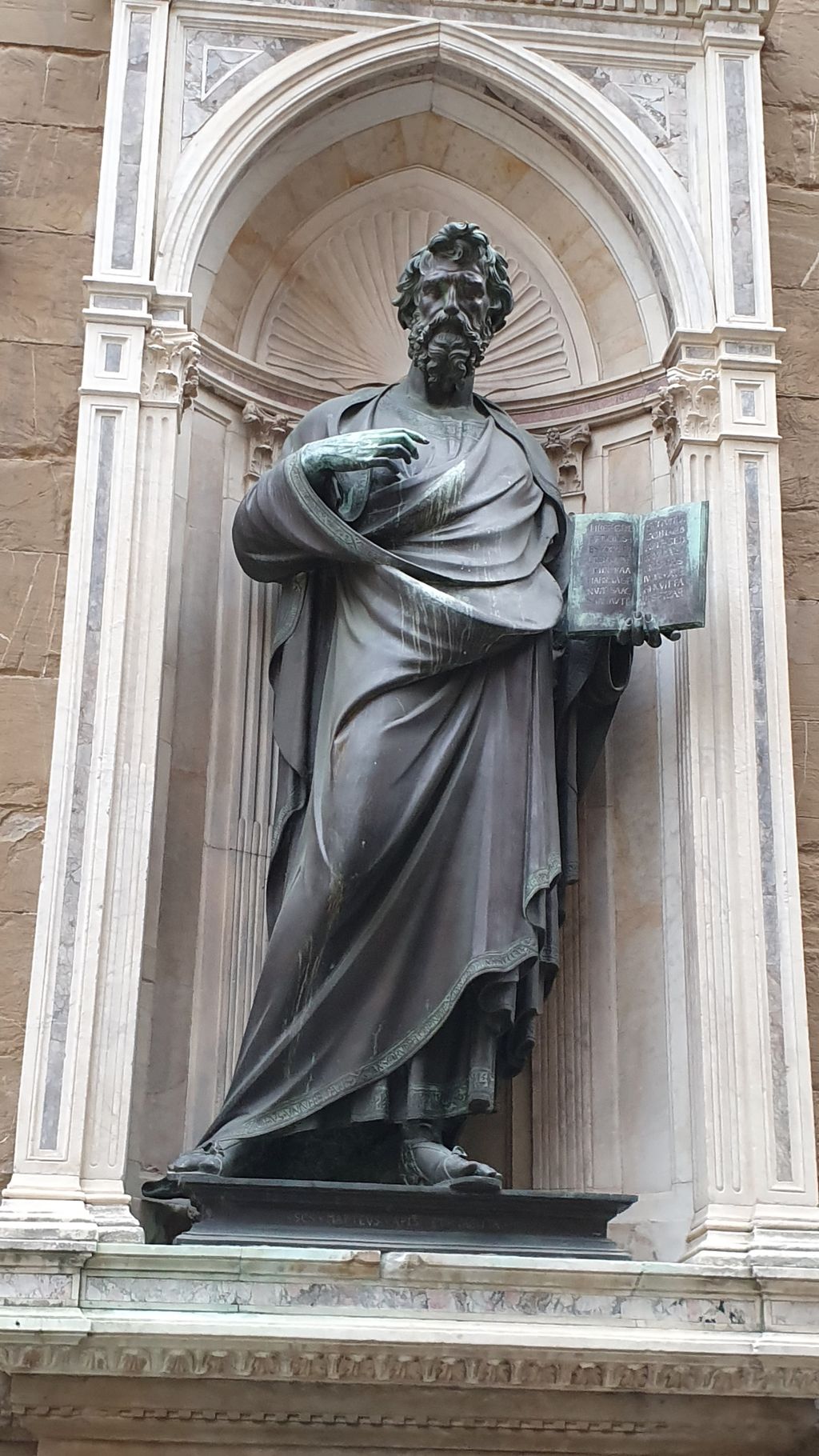
In St Matthew, made for the bankers’ guild, the open Gospel draws the gaze up towards the head. Silver survives in the letters of the book and in the whites of the eyes, picking out the saint’s gaze as well as the words on the page. This upright figure has a different job from the seated Evangelist contained within a quatrefoil on the North Doors. The making and installation had their own schedules: Ghiberti had to recast the failed upper portion at his own expense, and the statue, made in 1419–22, was set in its niche in March 1423. [2] [13] [24]
St Stephen, commissioned by the wool guild, offers a quieter contrast. The broad fall of the deacon’s dalmatic gives most of the figure a continuous surface. Small changes at the neckline and face have more effect against that breadth; the folds describe a garment with weight as well as an outline that reads from the pavement. Set beside the Baptist’s emphatic mantle and Matthew’s bright inlays, the statue shows how differently Ghiberti could distribute detail across a figure intended to be seen from the street. [14] [15]
The museum’s plan identifies all three figures and shows the relation between the upstairs displays and the exterior tabernacles. On the pavement, the base of a niche cuts off the lowest viewing angle, and the projecting architectural surround groups the edges of the statue into a single vertical field. Upstairs it is easier to see the stance and the face together and to follow the outline of an arm through its folds.
The change is especially helpful with the Baptist. His long mantle can draw the gaze down to the feet, while the scroll carries it back to the raised part of the figure. Even if the words on the scroll are too small at street distance, its shape identifies the saint as someone who speaks or proclaims. [6] [12] [21] [27]
Look for Matthew’s book from below and then at the original. The width of the opening makes it a recognisable object at a distance. At closer range the lines of silver lettering matter independently of that pronounced outline. The eyes use the same contrast between metals on a much smaller scale. With Stephen, the great uninterrupted field of the garment makes an equally strong silhouette by different means.
Beside works by other sculptors in the museum, the three figures also show that bronze was one choice among several for this public project. The museum identifies Donatello’s marble St Mark on the same floor. A comparison of the pale stone and the bronze Matthew is particularly useful around the faces, where the way a shadow edges the cheek or the nose depends both on how the form was made and on what the surface does with the light. [6] [13] [14] [27]
One trace of the building’s earlier function is easy to pass by. The museum guide points out the openings associated with the chutes that carried grain from the upper storeys. Their presence puts the saints back in a building the city used for storing food. The sanctuary at street level and the former storeys above occupy the same structure. Outside, the guild figures give successive sides of that structure a religious and civic identity. The three works by Ghiberti answer the same broad demand for a visible patron saint, while their differing gestures and garments advertise different identities even to someone walking past without time to read. [6] [27]
Inside the cathedral, and on the page
Once inside Santa Maria del Fiore, turn back towards the entrance. The great round window above the central door is the Assumption of the Virgin, 6.16 metres across. Nicolò di Pietro Tedesco made the window in 1405 from Ghiberti’s cartoon, the preparatory design. Start with the white-robed Virgin, who rises among banks of angels, and follow her upwards to Christ descending to crown her. The two figures share a vertical axis, so the main action reads from the floor before the individual apostles and prophets in the border come into focus. The glass marks the cathedral’s dedication to Mary at the very place where the visitor turns to look back towards the square. [22]
The smaller windows to either side use a different arrangement. St Stephen and St Lawrence each sit on a throne with an architectural surround, with ranks of angels and a border of festoons. The enclosed figure is a useful counterpart to the bronze Stephen at Orsanmichele: there the saint stands against the stone of a niche, while here the throne is part of the image and the design takes its colour from light passing through the glass.
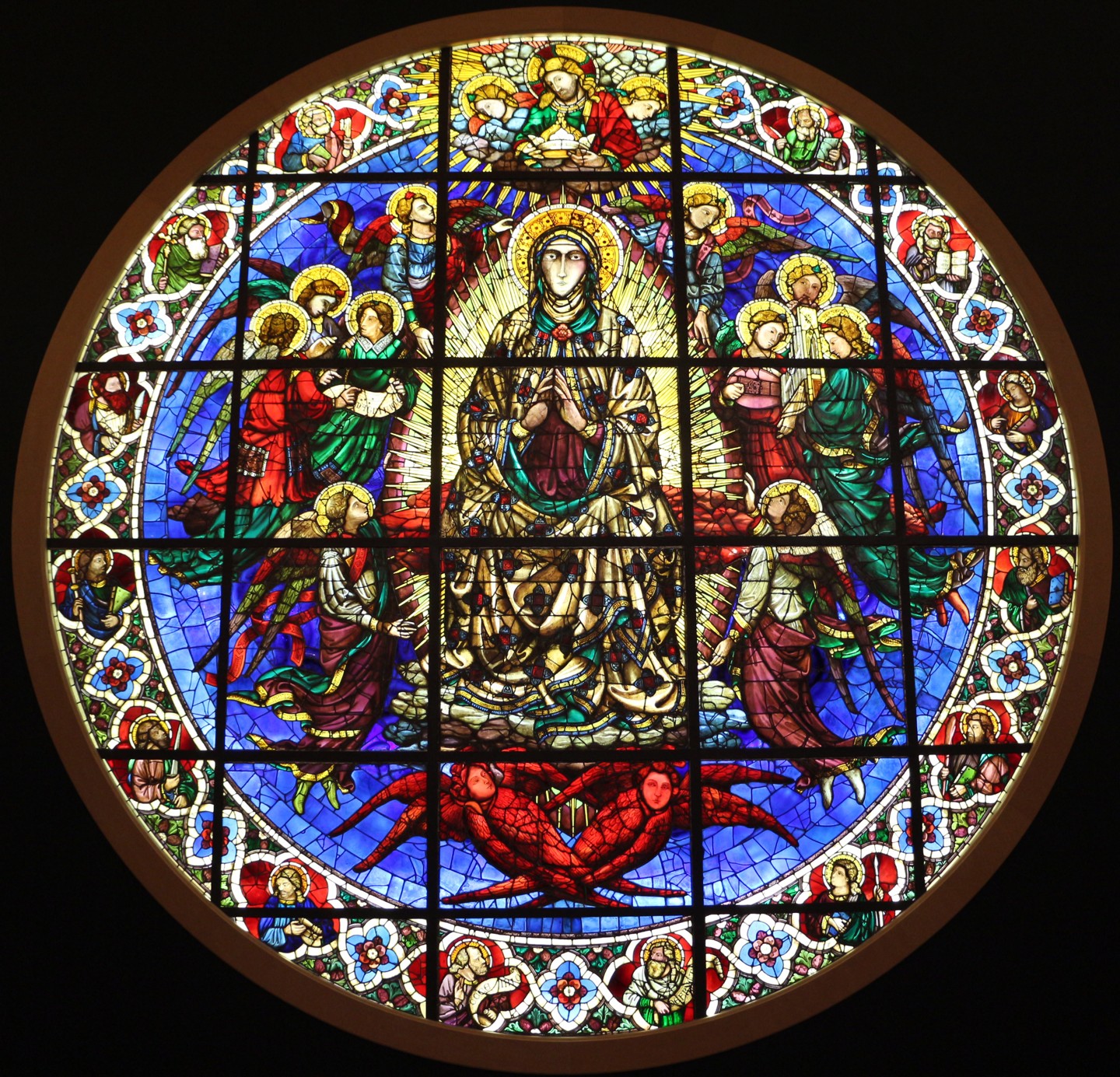
The Opera credits the same glazier and designer with the pair, executed in 1412–15 and altered later. Ghiberti went on to provide designs for thirty windows in the cathedral’s tribunes and for three round windows in the drum beneath the dome: the Presentation in the Temple, the Agony in the Garden and the Ascension. Other designers and specialist glassmakers also worked on the cathedral’s glazing. [14] [15] [16] [23]
The Ascension in the drum gives a second window by which to judge distance. The Opera catalogue records payments to Ghiberti for its design in 1443 and to the glassmaker Bernardo di Francesco in January 1444. The large circle is high at the base of the dome, where the surrounding masonry is itself part of the view. Find Christ and then the figures below. They make groups that read against one another at the height of the window.
In the central entrance window, the broad border makes the passage from the apostles and prophets to the principal figures especially legible. Looking between the two brings out how much a designer could do with the division of a circle before a viewer registers details of the painted faces. The catalogue also records substantial losses of the original modelling and grey painted shading in the Ascension after restoration. The light and colour still make the broad divisions visible, while the present glass gives partial evidence for the finer effects of the original. [22] [23] [28]
The bronze shrine of St Zenobius brings the comparison back to sculpture on the scale of a furnishing. A draft contract calls for a chest to hold the saint’s remains in his cathedral chapel, with scenes from his life around it. The finished casket puts the miracle of the child restored to life on the long front and two other miracles on the short sides.
On the back, six angels support a garland with an epitaph composed by Leonardo Bruni. The three narrative faces give the saint a part in events; the back gives him a memorial in words. Where the Baptistery doors gather their stories on a single plane across an entrance, the shrine distributes its images and inscription across the sides of a container made for an altar. [15] [25]
The shrine’s front panel can be read in relation to the size of the casket. The saint has to be recognisable amid the people involved in the miracle, and the scene has a long horizontal field in which to gather their attention. The two short ends give a smaller stage to their respective stories. Ghiberti’s own account describes the servant dying on the journey and his companion returning to find him alive.
The sides and the long front give the artist three opportunities to show the saint’s presence in a place, while the epitaph has its own face. The six angels turn the act of reading the inscription into part of the design by holding up its garland. Their hands connect the inscription to the figures around it, much as the gestures on the narrative faces establish who is addressing whom. The placement of that inscription on the reverse and the number of figures holding it are secure from both Ghiberti’s account and the Opera’s description. [15] [19] [25]
The baptismal font at Siena provides another instance of relief attached to a piece of liturgical furniture. Ghiberti’s Baptism of Christ there is a separate bronze from the North Door scene; it forms part of a six-sided ensemble made by several sculptors, among them Donatello and Jacopo della Quercia. In Florence, the relief belongs to an entrance and a cycle of Christ’s life. In Siena, the story stands on the vessel used for the rite it depicts. [2] [17]
In Siena the basin has six faces. Bronze Virtues stand between the gilded narratives, with Donatello’s Faith and Hope among them. The stone and the bronze establish a repeating pattern that a person sees in stages while walking round the font. Find Ghiberti’s Baptism by looking for the central standing figure of Christ and the raised arm of the Baptist.
The body of Christ gives the scene a firm axis, while the smaller marks around the water can be read once the two main figures are clear. Seen in relation to the broad marble structure, the little stream belongs to a scene about the rite performed at the basin itself. This is a different scale of attention from the Florence door, where the same subject occupies a quatrefoil among a series of episodes from the life of Christ. [2] [17]
Continue round to Donatello’s Feast of Herod. At the centre of the foreground, open space helps register the reaction of the people to the head that is brought before the company. The architecture gives the background its own depth, and the feast belongs to a different part of John’s life from the baptism. The comparison is possible because the font brings the works of several sculptors into the same sequence at roughly the same height. It lets the viewer look from an outdoor setting, where the water and the meeting of two principal figures provide the focus, to an interior where the intervals across a room help tell the story. [17]
Late in life, Ghiberti brought questions of art and vision into the unfinished Commentarii. He wrote about ancient artists and about Tuscan predecessors, included an account of his own work, and devoted much of the final part to optics. [18] [19] In his account of the second doors he describes varying figure size and using very shallow relief to suggest distance. It is a useful observation to take back to the bronzes.
Look from the barely raised details under the arches of the Stories of Jacob and Esau to the bodies that stand far enough out to cast their own shadows. What the written account sets out as a problem of distance, the sculptor had to judge in wax, bronze and gold, for a door that Florentines would first see from the square. [9] [10] [18] [19]
The book takes up decisions that are visible in the finished work, including how to make figures appear near or far away. The selection of quotations pairs short passages with the words around them, including Ghiberti’s account of what he was asked to make for Siena. Photographs and catalogue records let a reader follow details that are hard to see high in a building, such as the seams between episodes or the inscriptions that run along a garment.
The cathedral museum’s TouchAble project also documents a full-scale tactile reproduction of the North Door Annunciation. In that medium the interval between the two figures and the extent of their projection can be explored directly. It brings the route back to the relation between a small panel and the doorway that carries it. [2] [18] [19] [29]
Lorenzo Ghiberti sculpture directory
Discussion
Ghiberti rewards slow looking: relief, gilding, narrative structure, workshop practice and conservation evidence can all change how a work is read.
Join the Conversation
Have an observation about Lorenzo Ghiberti, a source to add, or a comparison that sharpens the reading? Share it below.
References
- Opera di Santa Maria del Fiore, “Baptistery”, Florence: building, door attributions and museum location. View source.
- Opera di Santa Maria del Fiore, “Porta Nord del Battistero”, scientific catalogue record 3618: description, panel layout, commission and placement. View source.
- Opera di Santa Maria del Fiore, “The Northern Door of the Baptistery”, 9 September 2015: gilding, completed treatment and museum installation. View source.
- Opera di Santa Maria del Fiore, “Porta del Paradiso”, scientific catalogue record 1320: whole door, production, installation and conservation history. View source.
- Musei del Bargello, “Donatello and the Dawn of Renaissance”, collection itinerary: trial reliefs and Orsanmichele sculpture. View source.
- Musei del Bargello, “Orsanmichele”, Florence: building history, exterior niches and museum collection. View source.
- Fabian Jonietz, “The Burden of Success in Quattrocento Sculpture: Lorenzo Ghiberti, Mino da Fiesole, Donatello”, in Yannis Hadjinicolaou, Joris van Gastel and Markus Rath (eds.), Synagonism: Theory and Practice in Early Modern Art (Leiden and Boston: Brill, 2024), pp. 230–271, especially pp. 236–242 and figs. 6.1–6.4. View source.
- Ministero della Cultura, Catalogo generale dei Beni Culturali, “Sacrificio di Isacco”: competition reliefs by Ghiberti, record 0900287017 and Brunelleschi, record 0900287016. View source 1. View source 2.
- Art Institute of Chicago, “The Gates of Paradise: Lorenzo Ghiberti’s Renaissance Masterpiece”, exhibition themes, 2007: narrative, casting, chasing, gilding and portraits. View source.
- Opera di Santa Maria del Fiore, “Formella con Storie di Giacobbe ed Esaù”, scientific catalogue record 2779 and object photographs. View source.
- Opificio delle Pietre Dure, “Lorenzo Ghiberti, Porta detta ‘del Paradiso’, 1425–1452”, conservation account. View source.
- Ministero della Cultura, Catalogo generale dei Beni Culturali, “San Giovanni Battista”, record 0900291908. View source.
- Opificio delle Pietre Dure, “Lorenzo Ghiberti, San Matteo, 1419–1422”, conservation account. View source.
- Ministero della Cultura, Catalogo generale dei Beni Culturali, “Santo Stefano”, record 0900291899. View source.
- Opera di Santa Maria del Fiore, “Lorenzo Ghiberti and the Opera del Duomo of Florence: Beauty, Technique, and Thought”, 1 May 2026: cathedral glazing, St Stephen and the shrine of St Zenobius. View source.
- Opera di Santa Maria del Fiore, “Lorenzo Ghiberti, Santi Stefano e Lorenzo”, cathedral stained glass record. View source.
- Opera della Metropolitana di Siena, “Baptistry of San Giovanni”, description of the baptismal font and its reliefs. View source.
- University of Zurich, Written Camposanto, “Lorenzo Ghiberti (1378–1455), Commentari (1452–1455)”, 23 February 2021: manuscript identification, structure and excerpt. View source.
- Lorenzo Ghiberti, Lorenzo Ghiberti’s Denkwürdigkeiten (I commentarii), ed. Julius von Schlosser, vol. I (Berlin: Julius Bard, 1912), pp. 45–50, especially p. 49 for the grading of relief. View source.
- Opera di Santa Maria del Fiore, “Renaissance Clonation: The North Door Replica”, 4 August 2016: installation of the outdoor replica. View source.
- Opificio delle Pietre Dure, “Presentata oggi la mostra ‘Ospiti illustri da Orsammichele’”: the Baptist and the Calimala niche. View source.
- Opera di Santa Maria del Fiore, “Lorenzo Ghiberti, Assunzione della Vergine”, cathedral stained glass record and photographs: location, manufacture, diameter and subject. View source.
- Opera di Santa Maria del Fiore, “Le vetrate di Santa Maria del Fiore”, 2 April 2024: the wider glazing programme, designers and glassmakers. View source.
- Fondazione Palazzo Strozzi, “Aspettando la primavera del Rinascimento: arrivati i due giganti, San Matteo e San Ludovico”, exhibition account drawing on Aldo Galli’s catalogue entry: casting, finish and placement of St Matthew. View source.
- Archivio dell’Opera di Santa Maria del Fiore, draft contract for the shrine of St Zenobius, March 1431/32, AOSMF I 1 4, c. 95r, o0101004.095a, Poggi 1909 no. 906: digital transcription. View source.
- Opera di Santa Maria del Fiore, “Sala del Paradiso”, gallery plan and display of the original doors in relation to the reconstructed façade. View source.
- Musei del Bargello, Orsanmichele visitor guide, building plan with grain outlets and first-floor display of the original statues. View source.
- Opera di Santa Maria del Fiore, “Ascensione di Gesù”, scientific catalogue record 5664: design, glassmaking, location and conservation history. View source.
- Opera di Santa Maria del Fiore, “TouchAble”, documentation of the museum’s tactile reproductions. View source.
- Opera di Santa Maria del Fiore, “Formella con Storie di Abramo”, scientific catalogue record 1324: panel, location, images and description of the sacrifice. View source.
- Opera di Santa Maria del Fiore, scientific catalogue entries for Creazione di Adamo ed Eva e Cacciata dal Paradiso Terrestre, 1332 and Storie di Giuseppe, 2798: individual squares, positions and photographs. View source 1. View source 2.
- Opera di Santa Maria del Fiore, scientific catalogue entries for Annunciazione, 4256 and Natività di Gesù, 4260: photographs, positions and inscription. View source 1. View source 2.