 by Tom Gurney
Tom Gurney BSc (Hons) is an art history expert with over 20 years experience
Published on June 19, 2020 / Updated on November 17, 2026
Email: tomgurney1@gmail.com / Phone: +44 7429 011000
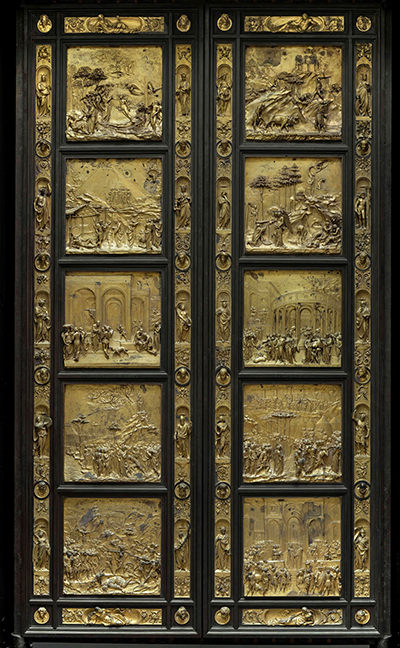
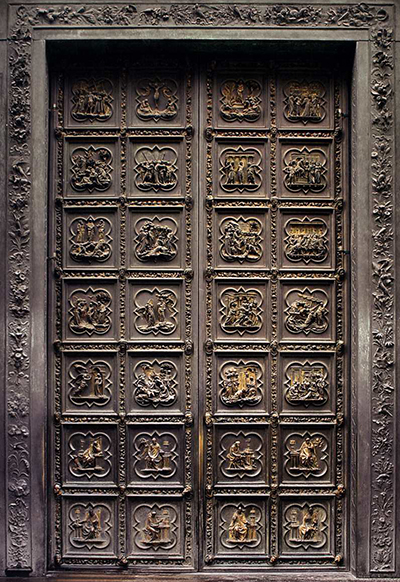
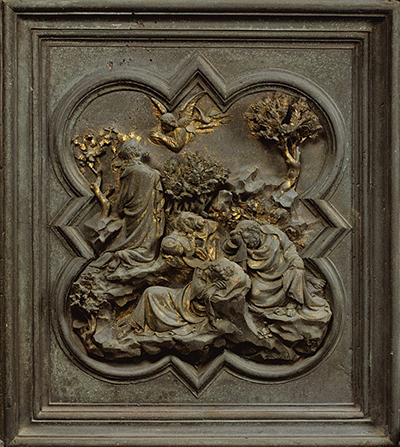
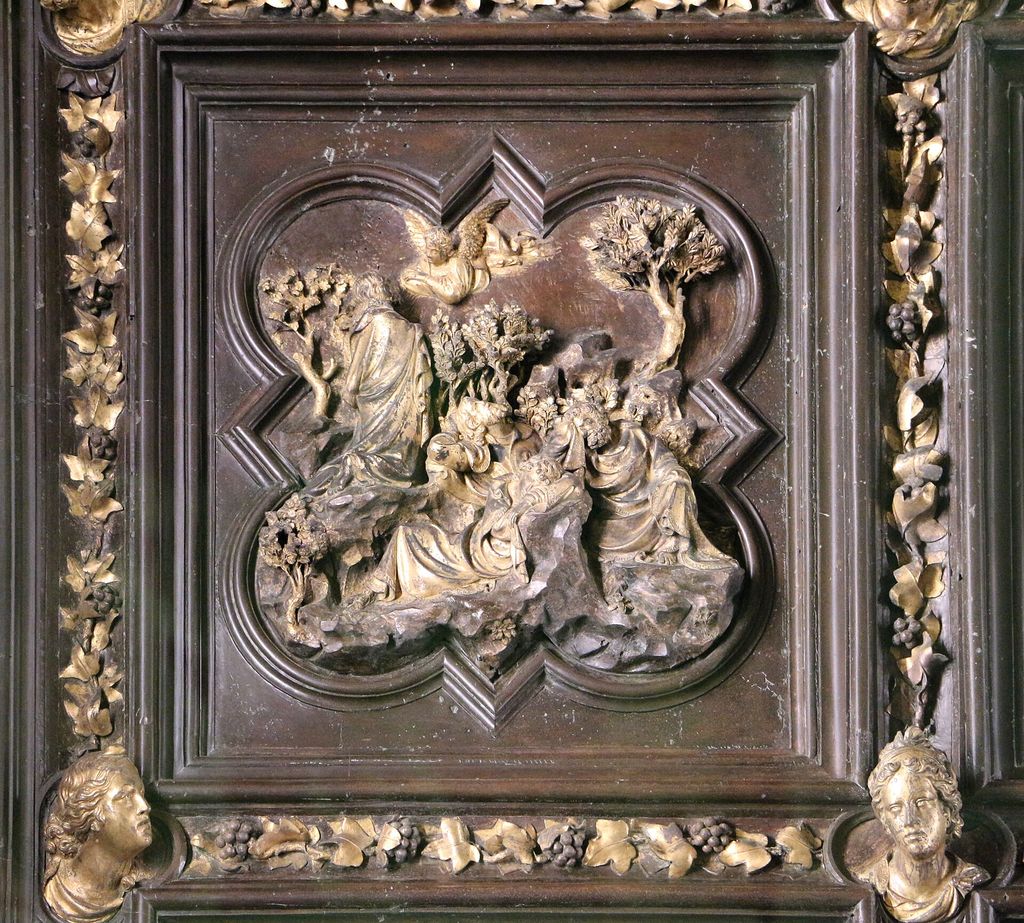
The nearest disciple in Lorenzo Ghiberti’s Agony in the Garden lies across a ledge, one knee lifting the folds of his cloak. A little higher, Christ’s robe also spills onto rock, but his back holds the upright line of a man kneeling in prayer. The edge of Christ’s robe comes close to the cluster of sleepers. It takes only a glance to go from the man who has given his weight to the ground to the one who is still holding himself up. The gilded bronze relief belongs to the North Door of the Florence Baptistery, now in the Museo dell’Opera del Duomo. Within one small compartment, Ghiberti makes a withdrawal into solitude visible without sending Christ very far from his companions. [1] [2]
Contents
- What the ground does
- The only figure who looks up
- The cup in the prayer
- Prayer and return
- A device from the competition bronze
- Where the quiet ends
What the ground does
The longest ledge belongs to the sleeper in front. Follow it from the bottom left, where the hem of his robe meets the rock, to the outcrop that supports his head and arm. Behind him, a second man has sunk towards his bent arm. His head and sleeve are enough to establish a separate posture even where the body disappears behind the foreground figure.
Farther right, the third disciple sits on a shelf of his own, with his head tipped towards the others and his cloak falling in loops towards his foot. In the museum close-up the gilded folds make the three bodies easy to pick out. In Mary Ann Sullivan’s slide the broken faces of the rock are especially legible below them. The long shelf in front gives way to shorter, more abrupt surfaces beneath the seated man. Each pose depends on a different bit of the same slope. [1] [2] [3]
The shelf under Christ’s knees projects to the left of the central stand of trees. Their trunks and leaves interrupt the view across the middle of the relief, but the rock continues through and around them, rising again under the prominent olive on the right. The moulding also helps to sort the figures. The lower curves give the reclining man room to stretch and the seated man room for the fall of his mantle. Christ’s folds run down his back and gather on the shelf in a much narrower space. The Opera identifies the three sleepers collectively as Peter, James and John. Their relation to the ground is easier to establish than the identity of any one of them. [1] [2] [3]
The only figure who looks up
Christ’s face turns towards a winged figure beneath the upper point of the frame. Its head leads, with the body trailing to the right. The relatively bare bronze around it separates the wings from the crown of the olive and leaves an interval between the angel and the foliage over the sleepers. Christ’s expression is largely screened by the turn of his body.
What we can read is the direction of his attention. Luke gives that upward turn a setting. Jesus withdraws about a stone’s throw, kneels and asks for the cup to pass from him while submitting to his Father’s will. An angel comes to strengthen him in verse 43. The New American Bible brackets verses 43–44 because important early witnesses omit them. [1] [2] [3] [4]
The cup in the prayer
Irving Lavin places Ghiberti among the artists who adopted an earlier formula in which an angel appears with a chalice above three apostles on a rocky slope. The cup belongs to the language of Christ’s prayer in Luke, so the proposed attribute has an intelligible place in the scene. It is harder to locate on the bronze. In the museum close-up, the lit surfaces at the front of the angel run into the folds around its bent arms.
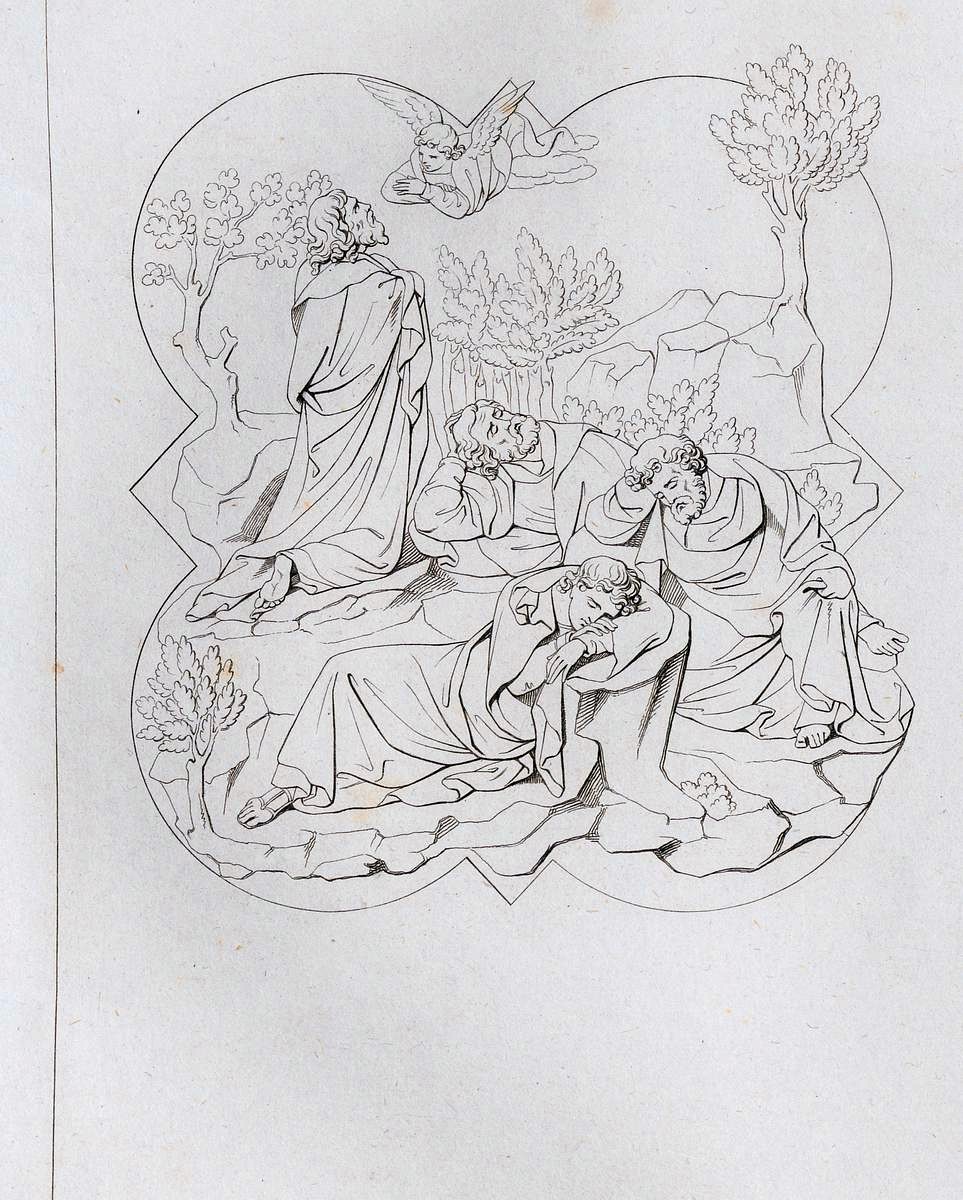
Sullivan’s slide changes the shadows but still gives the wings a clearer outline than anything at the hands. In Giovanni Paolo Lasinio’s 1821 engraving after Vincenzo Gozzini, even with the turn of the arms drawn in line, there is no separate rim and stem that can be matched securely to the photographs. The appearance of the angel is clear across all three views. Its role as the figure sent to strengthen Christ comes from Luke, while a chalice remains a possible reading of the form at the hands. [2] [3] [4] [5] [6]
Prayer and return
Mark names Peter, James and John as the companions Jesus takes farther into Gethsemane. Matthew names Peter and describes the other two as the sons of Zebedee. In both accounts Jesus asks them to keep watch, then comes back more than once to find them asleep. Neither account describes an angel coming to him. Luke gives the sleep a cause, grief, and has Jesus rise from prayer before discovering it.
The commentary published with the 1821 engraving combines the angel, the three names and the repeated discoveries in one paragraph. It then singles out the three attitudes of deep sleep. The distinction matters when looking at the bronze. The accompanying prose takes Christ back to the disciples several times, but the engraved figure, like the bronze one, is still at prayer. The sleepers’ lowered heads let us see what he will find before he has turned towards them. [2] [4] [5] [7] [8] [9]
Duccio’s Gethsemane panel from the Maestà, painted for Siena Cathedral between 1308 and 1311, gives the encounter with the disciples a place of its own. Near the centre Christ addresses Peter, James and John, with other apostles asleep at the lower left. A second Christ prays before the angel at the upper right. The two figures have their backs to one another, and trees help mark the passage from one action to the other.
The angled terrain in Ghiberti’s bronze also divides one enclosure, but here the distinction is between what different people are doing at the same time. The central growth screens part of the sleepers from the place of prayer. The broken shelves beyond it let the eye trace a short way back to the men. [1] [2] [3] [10] [11]
In Duccio the red garment and dark mantle recur, making it easy to recognise the same person on either side of the tree. The hand extended towards the disciples belongs to a standing figure. Higher up, a hand rises in prayer as the kneeling figure leans into the slope. The men addressed at the centre look towards Christ, so the painting gives both encounters someone who can answer or respond. In the bronze, Christ lifts his face towards the angel while all three disciples remain asleep. Their presence brings the prospect of the return into the scene, and their poses show why a return will be necessary. [2] [4] [7] [8] [10] [11]
A device from the competition bronze
The diagonal rock recalls Ghiberti’s Sacrifice of Isaac, the gilded bronze he made for the Baptistery competition in 1401, now at the Bargello. There the ridge divides the attendants and donkey on the left from the sacrifice on the right. Its sides give each group a separate footing while keeping them close within the frame. In the Agony the principal act is on the left, and the broken slope extending to the right gives the companions three places to settle.
The Opera catalogue cites the resemblance in explaining Richard Krautheimer’s placement of the panel in a probable early group around 1403–07. That is a stylistic chronology within the documented 1403–24 span of the door project. The ridge suggests a device carried forward from the trial panel and adapted to a different story. It gives no exact year for the casting. [1] [2] [12] [13]
Where the quiet ends
The Agony occupies the far left compartment in the second row from the top. Directly below it, the Transfiguration also sets Christ above three disciples on rock. In that panel the three lower figures raise or turn their arms towards their faces, and the standing Christ occupies the centre of the upper group. Their gestures register a response to what has happened above them. In Gethsemane the upper encounter falls to one side and the disciples’ heads sink into their supports. The vertical pairing shows how differently a rocky setting can relate the men below to Christ, even within the same four-lobed frame. [1] [2] [14] [15] [16]
Immediately to the right of the Agony comes the Arrest. The open bronze that gives the angel room to approach has its counterpart there in a field crossed by raised shafts. At ground level, the intervals between Christ and his companions give way to a crowd close enough to seize him. The men in the garden are already within easy reach, as the continuous ledges make clear. Christ has room to pray alone. The disciples are close enough to have kept watch. [2] [5] [7] [8] [14] [15]
Lorenzo Ghiberti in context
Sacrifice of Isaac
1401 competitionNorth Doors
1403–1424St John the Baptist
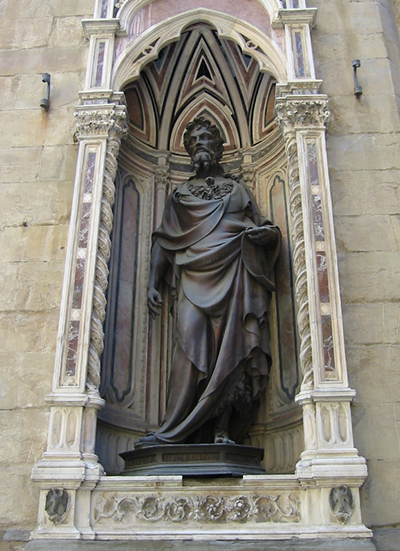
c. 1414–1416St Matthew
1419–1422Gates of Paradise
1425–1452St Stephen
c. 1427–1429Lorenzo Ghiberti sculpture directory
Discussion
Ghiberti rewards slow looking: relief, gilding, narrative structure, workshop practice and conservation evidence can all change how a work is read.
Join the Conversation
Have an observation about Agony in the Garden, a source to add, or a comparison that sharpens the reading? Share it below.
References
- Opera di Santa Maria del Fiore, scientific catalogue, Orazione di Cristo nell’orto dei Getsemani, Porta Nord del Battistero, record 4076. View source.
- Sailko, Photograph of the original Agony in the Garden relief and its surround. View source.
- Mary Ann Sullivan, Colour slide of the Agony in the Garden relief. View source.
- United States Conference of Catholic Bishops, New American Bible, Revised Edition, Luke 22:39–46 and note on verses 43–44. View source.
- Giovanni Paolo Lasinio, engraving after Vincenzo Gozzini, Adorazione nell’orto and Cristo è preso, e Giuda lo bacia, plates XV and XVI, 1821. View source.
- Irving Lavin, ‘The Sources of Donatello’s Pulpits in San Lorenzo’, The Art Bulletin 41 (1959), p. 25. View source.
- United States Conference of Catholic Bishops, New American Bible, Revised Edition, Mark 14:32–42. View source.
- United States Conference of Catholic Bishops, New American Bible, Revised Edition, Matthew 26:36–46. View source.
- Le tre porte del Battistero di San Giovanni di Firenze, commentary to plate XV, p. 8 (1821). View source.
- Opera della Metropolitana di Siena, Duccio’s Maestà — Orazione di Cristo nell’orto, inventory OA-4504. View source.
- Reproduction of Duccio’s Agony in the Garden, Web Gallery of Art image WGA06790. View source.
- Francesco Bini, Photograph of Ghiberti’s Sacrifice of Isaac at the Bargello. View source.
- Musei del Bargello, ‘Donatello and the Dawn of Renaissance’, section on the 1401 competition bronzes. View source.
- Opera di Santa Maria del Fiore, scientific catalogue, Porta Nord del Battistero, record 3618. View source.
- Yair Haklai, Photograph of the original North Door in the Museo dell’Opera del Duomo. View source.
- Opera di Santa Maria del Fiore, scientific catalogue, Trasfigurazione, Porta Nord del Battistero, record 4198. View source.