

 by Tom Gurney
Tom Gurney BSc (Hons) is an art history expert with over 20 years experience
Published on June 19, 2020 / Updated on July 28, 2026
Email: tomgurney1@gmail.com / Phone: +44 7429 011000
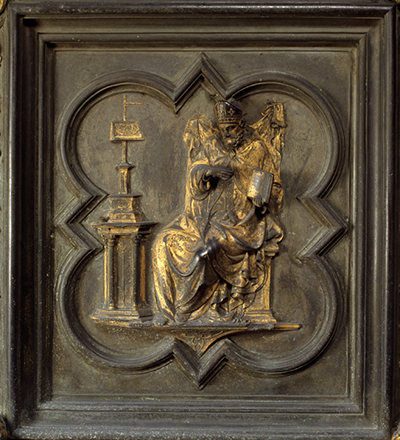
Lorenzo Ghiberti presents Ambrose as an episcopal teacher. The mitred saint sits on a high-backed seat, turning across his body while holding or indicating an open book. A reading stand occupies the left side, and deeply folded ceremonial drapery gives the compact figure visual weight.
Contents
Position on the North Door
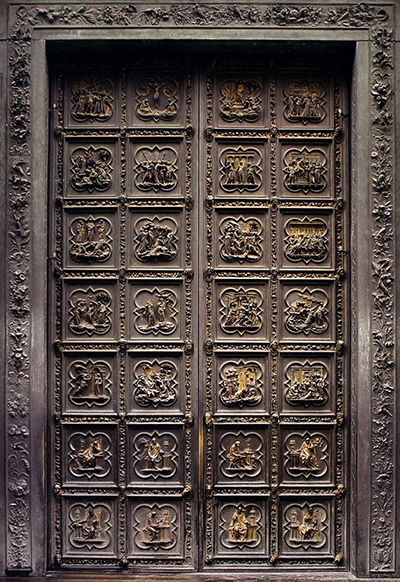
Ambrose is on the right leaf in the lowest register, directly beneath Mark. The four Latin Doctors form the foundation of the door's figural programme, below the Evangelists and the twenty scenes from Christ's life.
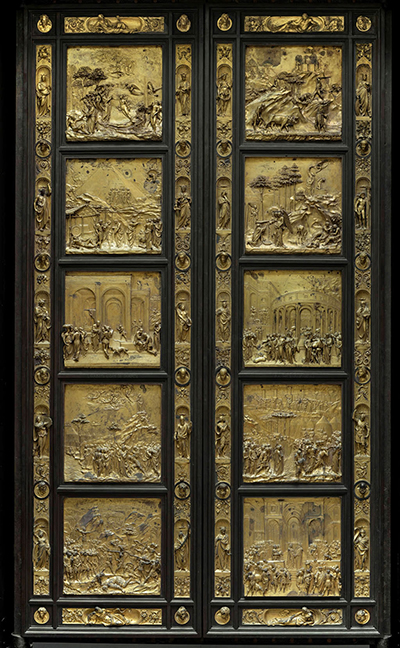
The North Door was made between 1403 and 1424. Its original panels are now in the Museo dell'Opera del Duomo; a copy stands outside on the Baptistery. Opera del Duomo reports the Doctors within a proposed Krautheimer phase around 1407–1413/15. This is a stylistic reconstruction, not a documented individual date.[1][2]
Book and teaching gesture
The book identifies learned authority, but Ambrose does not merely read. His hands interact with the volume, and his turned torso makes the pose communicative. Thought is directed outward as instruction.
Mitre, throne and layered vestments establish episcopal office. These signs should not be treated as ornamental additions: they distinguish institutional teaching from the more private authorial settings of the Evangelists above.
A compact teaching space
Seat, stand and drapery fill the quatrefoil without requiring architectural background. The high chair encloses Ambrose, while the stand creates a second vertical at the left. His turning body connects the two sides.
Compare Ambrose with Augustine on the opposite leaf. Both are bishops, yet Ambrose appears closely engaged with the book held before him, while Augustine extends more strongly toward the adjacent stand. Ghiberti makes shared office visually varied through posture and the placement of reading furniture.
Discussion
Ghiberti rewards slow looking: relief, gilding, narrative structure, workshop practice and conservation evidence can all change how a work is read.
Join the Conversation
Have an observation about Ambrose, a source to add, or a comparison that sharpens the reading? Share it below.