 by Tom Gurney
Tom Gurney BSc (Hons) is an art history expert with over 20 years experience
Published on July 10, 2026 / Updated on November 17, 2026
Email: tomgurney1@gmail.com / Phone: +44 7429 011000
From the cathedral side of the square in Florence, the bronze doorway that commands the view across the square is Lorenzo Ghiberti’s Gates of Paradise. To see what it replaced, turn the corner to the north face of the Baptistery. There, at a different angle to the square, you meet Ghiberti’s first door, which once occupied the opening you have just left.
Turn back and go round to the south face for Andrea Pisano’s door, the oldest of the three. The doors outside are replicas. The originals face a reconstruction of the medieval cathedral façade in the Museo dell’Opera del Duomo, where all three can be seen together. The walk outside and the view inside give two ways of understanding the same works. [1] [2] [3] [4] [5]
The shape of the Baptistery matters to both experiences. It is an octagon faced in patterned white and green marble, with entrances to the north, east and south and a projecting sanctuary on the west. The bronze leaves fill openings in separate wall faces. A person crossing directly from the cathedral can take in the east doorway frontally while still some distance away. Reaching either of the flanking portals from that direction entails turning, and a glimpse along the side gives way to a fuller view. The doors have a common scale and material, and each is encountered against a related arrangement of marble. Their separation gives each its own front. [1] [2]
The building already held an extensive cycle of images when the bronze commissions began. The mosaics overhead include stories of the Baptist, Christ and the patriarch Joseph, and episodes from Genesis, subjects that would also appear on the doors. Inside they belong to an arrangement that rises above the visitor and includes the Last Judgement. Outside, scenes come within reach of the eye in vertical fields which also have to work as doors.
John the Baptist, the patron saint of Florence and the figure to whom the building is dedicated, appears on both the earlier doors. In one, the story is his own. In the other, his act of baptising Christ forms part of another life. A later sculptural campaign would place him above every entrance. [1] [3] [4] [5]
The names South Door, North Door and East Door describe the familiar arrangement established by the middle of the fifteenth century. The dates tell a different story. Pisano’s door was installed in 1336, Ghiberti’s first in 1424, and the Gates of Paradise in 1452. Several generations of guild officials could reconsider what belonged on the building between the first decision and the last installation. At each stage they inherited a structure that was in use, a set of images already in place and, eventually, a bronze door available to compare with the one they wanted next. The three portals are the result of those successive decisions. [1] [3] [4] [5]
Contents
- The guild that commissioned all three
- Two versions of the same baptism
- When the story moves inside the frame
- The place facing the cathedral
- The sculptures around and above the doors
- From working doors to museum exhibits
- The three replicas and the museum display
The guild that commissioned all three
The Arte di Calimala, Florence’s cloth merchants’ guild, had responsibility for San Giovanni. Its first decision about metal doors, in 1322, was to give an existing wooden door a metal covering. Seven years later, the guild resolved to have a new door made and sent the goldsmith Piero di Jacopo on two errands. He was to study the bronze doors at Pisa, associated in the Opera’s catalogue with Bonanno at the cathedral, and to look for a master who could do the work in Venice.
The surviving summary uses broad terms for the material and calls for beauty. The change of plan suggests how much lay between having the means to order a handsome metal facing and having the means to supply an entire bronze door. The guild needed a design it could show to a craftsman and a craftsman who could put that design into production. [3] [6]
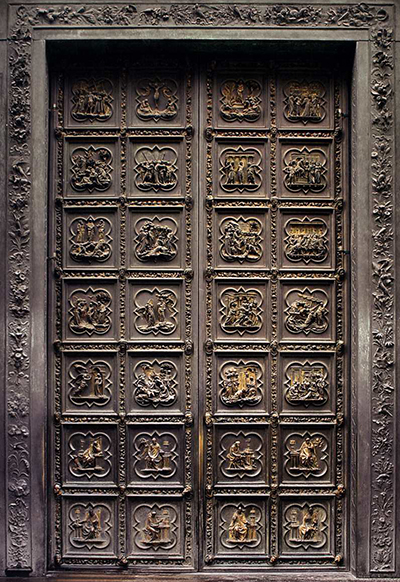
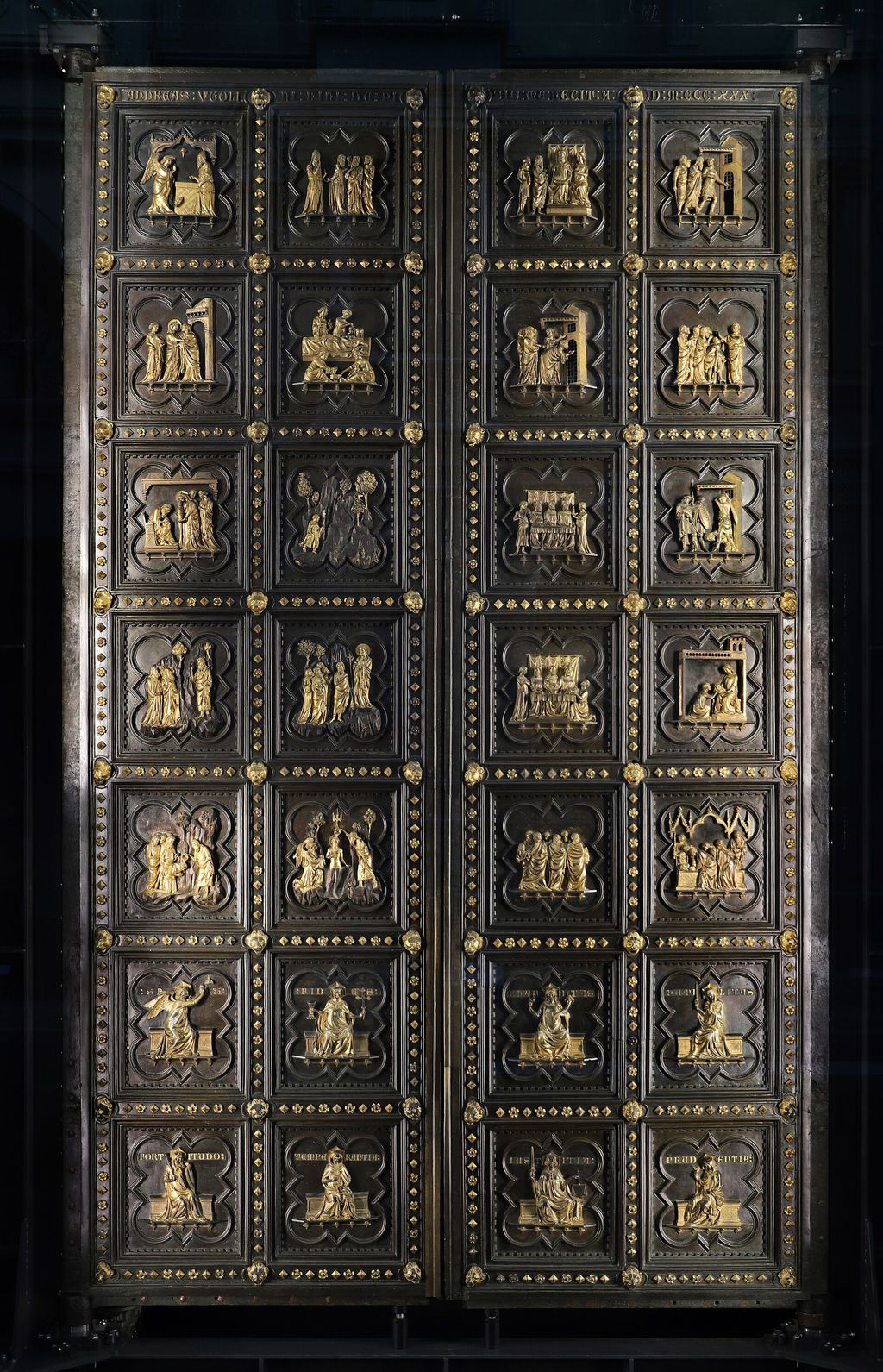
The records are especially revealing when read alongside the object. The two leaves have a framework holding the individual reliefs. At the meeting points of the narrow decorated bars are small projecting heads; between them run lines of gold ornament. Andrea’s name and the date 1330 span the top horizontal members of the two leaves. The name belongs to a door for which the medieval accounts list several workers, including goldsmiths, and whose framework the Opera attributes to the Venetian bell founder Leonardo Avanzi and his collaborators.
Avanzi’s settlement of his wages, recorded in April 1332, establishes that he was paid for the doors. Assigning the separately cast framework to him is a scholarly reconstruction made with that document and the structure in view. At the same time, the accounts associate Andrea with narrative reliefs and twenty-four lion heads. The smaller heads that punctuate the grid were a named part of the work. [3] [6] [7]
The evidence comes to us in different forms. The guild’s original records behind the published Andrea documents are lost, and those entries survive in seventeenth-century summaries by Carlo Strozzi, as transmitted in modern editions. The inscription is visible on the bronze. The two kinds of evidence place 1330 at an early stage of manufacture, and the summaries record work on the door in subsequent years.
The Opera’s account relates the delay to a fault in casting and dates installation to the Baptist’s feast in June 1336. A payment entry for ropes, pulleys and ironwork used when raising the door brings the story back to the building. With the leaves up and in use, Andrea’s inscription could be read across the closed ensemble; the physical join between the two halves of the text would open whenever the leaves swung apart. [3] [6] [7]
The next documented commission began with a different kind of test. Around 1401 the guild invited sculptors to produce a trial relief of the Sacrifice of Isaac. The surviving submissions by Ghiberti and Brunelleschi use a field of four rounded lobes with pointed intervals, the type of frame already familiar from Pisano’s door. The test allowed the patrons to compare two treatments of the same moment inside a given outline.
Abraham and Isaac would eventually appear in Ghiberti’s second door. The commission won with this trial led instead to a sequence centred on the life of Christ. The older door supplied a full-scale precedent for the compartments, and a subject from Genesis supplied the test. Those two choices were available to the guild independently of the decision about the finished narrative. [3] [4] [5] [8]
The first agreement in 1403 names Lorenzo and Bartolo di Michele. The Opera’s North Door record describes provision for an organised workshop and a requirement that Lorenzo should personally work on figures, trees and comparable details. The agreement renewed in 1407 was made with Lorenzo alone. Writing a condition about the sculptor’s own hand into a workshop commission acknowledges how the door would be made.
A great many separate pieces had to reach a consistent standard and fit together, and the passages that mattered to the guild included features of the setting as well as the people in the reliefs. The signatures, wreaths, heads and narrative details visible in the finished metal belong to a much larger operation than the single surviving competition piece allows us to see. The commission records let us distinguish the named responsibility for the work from the individual handling of every surface. [4] [8]
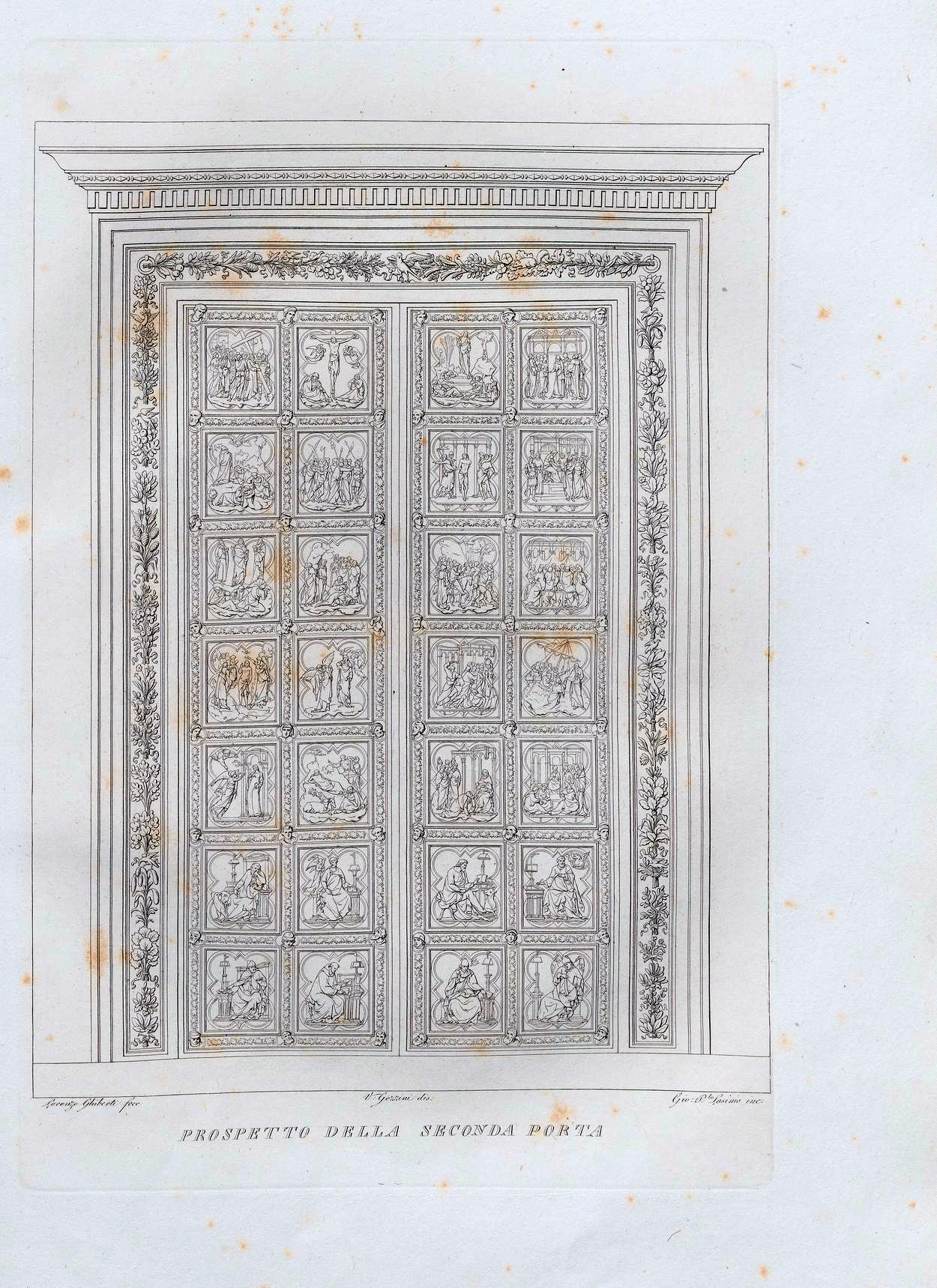
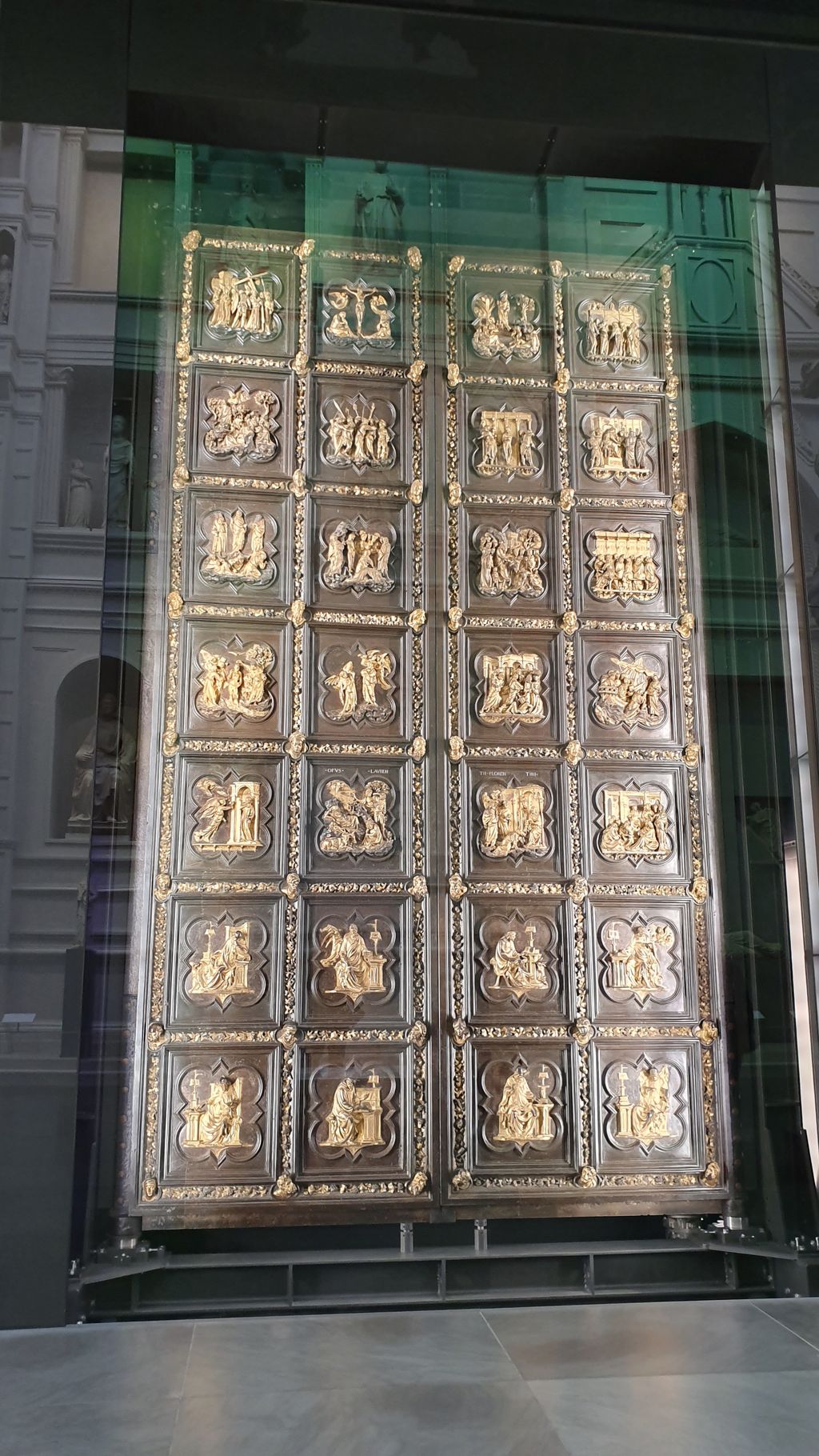
Comparison with Pisano makes the continuity in the second order unusually visible. Each door has two leaves, each leaf has two columns of reliefs, and each column is seven fields high. On both, the two bottom tiers are occupied by single figures with an authority of their own. Even the more expansive action in Ghiberti’s reliefs must be arranged around the dips and projections of the inherited frame.
In the older door, many scenes are held above a little transverse ledge with a plain area behind. The first Ghiberti door makes room for richer settings within much the same outline. From a distance, the agreement in the number and placement of images makes the two doors look closely related. It is the progression through the fields that reveals the change of purpose. [3] [4] [7]
Another option was still open in 1424. Leonardo Bruni’s proposal for the third entrance set out twenty scenes from the Old Testament and eight prophets, maintaining the numerical division familiar from both older doors. At the beginning of 1425 the commission went directly to Ghiberti, whose first door was already up. The two events are evidence of different responsibilities. A plan was sought for the subjects, while the guild knew whom it wanted to make the door.
The finished work still draws on the Old Testament, but its ten squares and the figures set into its borders organise the material very differently from Bruni’s scheme. The proposal records a possibility at a particular moment. The evidence does not identify a single decision or give a definitive reason for the move to ten large fields. [4] [5] [9]
Two versions of the same baptism
The first scene on Pisano’s door is high in the left leaf. Zacharias stands across an altar from the angel announcing the birth of his son. The altar fills the interval between them. Little architectural shapes above are enough to mark the sacred interior. The neighbouring relief shows the aftermath of the announcement: Zacharias has been struck dumb.
Next come the Visitation and the birth, then the naming and the young Baptist in the wilderness. A person looking for the beginning of the story has to look high, while the reliefs depicting the acts for which John is most easily recognised are appreciably lower. The compression of the settings helps single out an altar, a doorway or a small group from the dark field around it. [3] [7]
Read each successive pair of panels on the left before moving down a row, keeping to that leaf. John preaches, points out Christ and baptises the multitude. The Baptism of Christ closes the left-hand narrative. To continue, the eye goes back up to the top of the right leaf, where John is brought before Herod and then taken to prison. The two leaves carry separate stretches of the life, and the seam comes at a change in the kind of action.
On the left, John goes from being the child whose coming is announced to the man who makes an announcement of his own. On the right, the Baptist has to be brought out or sought in prison, and after his execution others bear his head and body. The visit of the disciples to John and the episode of Christ healing the sick place an answering action outside the prison alongside the confined prophet. [3] [7]
Pisano gives the crowd baptism and the baptism of one man two adjoining frames. Both have irregular ground, trees and figures whose attention converges around the water. In the first the clothed witnesses form a mass at the left. In the second the standing figure of Christ leaves room around his upper body, and the liquid rises around his legs in a compact shape.
The Baptist on the right reaches into the space above Christ. The attending group on the other bank bends towards him, and the dove descends above Christ’s head. The figures stand far enough apart to give Christ a distinct outline, while the lifted arm carries the action across the gap. In the whole-door photograph the small gilded group is easily found before the river becomes legible. [3] [7] [10] [11]
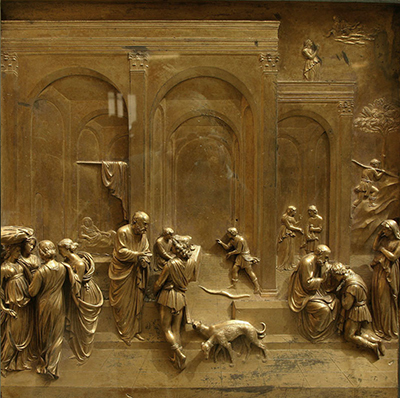
On the North Door, the Baptism of Christ begins the second narrative tier from the bottom, at the far left. The arrangement again sets the Baptist on the right and winged attendants on the left. Here a hand lifts a small vessel above Christ’s head, and the dove spreads its wings against the relatively open field directly above. The group at the left has considerable depth.
One attendant bends forward and the others’ faces and shoulders come into view behind. On the right the tree canopy fills the space over John’s shoulder. The rippled water runs from the standing figure towards the lower right, finding a way out past the rocks that support the Baptist. The visible river has a course within the scene. Christ, lightly draped and with one hand raised, stands at the point where that course opens towards the viewer. [4] [12] [13]
Put these scenes back into their frames and the comparison widens. Both sculptors give the act a lateral axis, drawing the eye from the attendants across Christ to the Baptist; both use Christ’s body to organise the middle. The lobes give each artist space for a tree or a wing at the sides. The openings around the figures matter equally. In Pisano’s version the important intervals are small and discrete, and a shift of attention carries the viewer from the crowd baptism in the next field to the singled-out Christ.
In Ghiberti’s panel the stepped bank and streaming water draw the sides together across the lower part of the one field. The richest detail gathers close to the edges, leaving a central space where the hand, head and dove can be picked out. These are comparisons of forms visible in images of the originals, taken at very different distances. The relative shine of the two panels in those photographs tells us about the photographs as well as the bronzes. [7] [10] [11] [12] [13]
The next work in the sequence changes the meaning of what one has just seen. On Pisano’s door, John’s arrival before Herod is removed by both height and the central join from the baptism that precedes it. In Ghiberti’s cycle, the Temptation follows immediately alongside the Baptism in the same tier. Christ remains the centre of the story and the Baptist’s role is complete.
That tier also demonstrates that one has to read Ghiberti’s first narrative across the pair of leaves and then go upwards, in four-panel rows. From the same relatively low part of the two doors, a viewer reading one story would look across and up to begin the Baptist’s imprisonment, while on the other the first move would be sideways to the next scene in Christ’s public life. [3] [4] [10] [12]
There is a third comparison within easy reach of the eye. Below the scenes on Pisano’s door sit eight Virtues. On the viewer’s left, Hope and Faith sit above Fortitude and Temperance. On the right, Charity and Humility are above Justice and Prudence. The grouping contains the three Theological and four Cardinal Virtues and adds Humility. The names inscribed behind the figures run horizontally within the lobed fields.
Hope rises towards a crown, her drapery pulled into the lift of the gesture. Faith holds her attributes in a relatively still, balanced posture. Seen across the bottom of the door, the repetition of the seat or ledge brings the figures into relation with one another, while the inscribed words ask the viewer to connect actions and objects with named qualities. [3] [7]
Ghiberti puts the Evangelists in the upper of his two low tiers, with four Doctors of the Church beneath. Their books, desks and writing gestures give sustained attention and study a visible form. The names and attributes distinguish figures whose work is connected to the history above them in different ways. An Evangelist can be understood as handing on the account whose episodes occupy the higher tiers, and a Doctor as a reader and interpreter of Christian teaching.
Pisano’s fixed seats and inscribed names and Ghiberti’s emphases on writing make two different uses of the same part of a doorway. At close range the visitor can inspect the smaller things each figure handles before raising their eyes to the historic action. Ghiberti’s division preserves the dignity of an eight-figure base while making the relationship between that base and the stories specifically about testimony and authority. [3] [4] [7]
When the story moves inside the frame
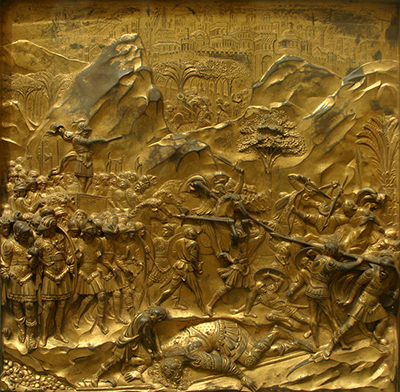
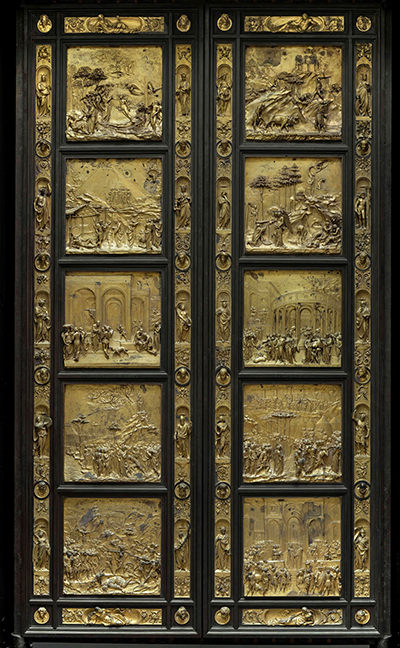
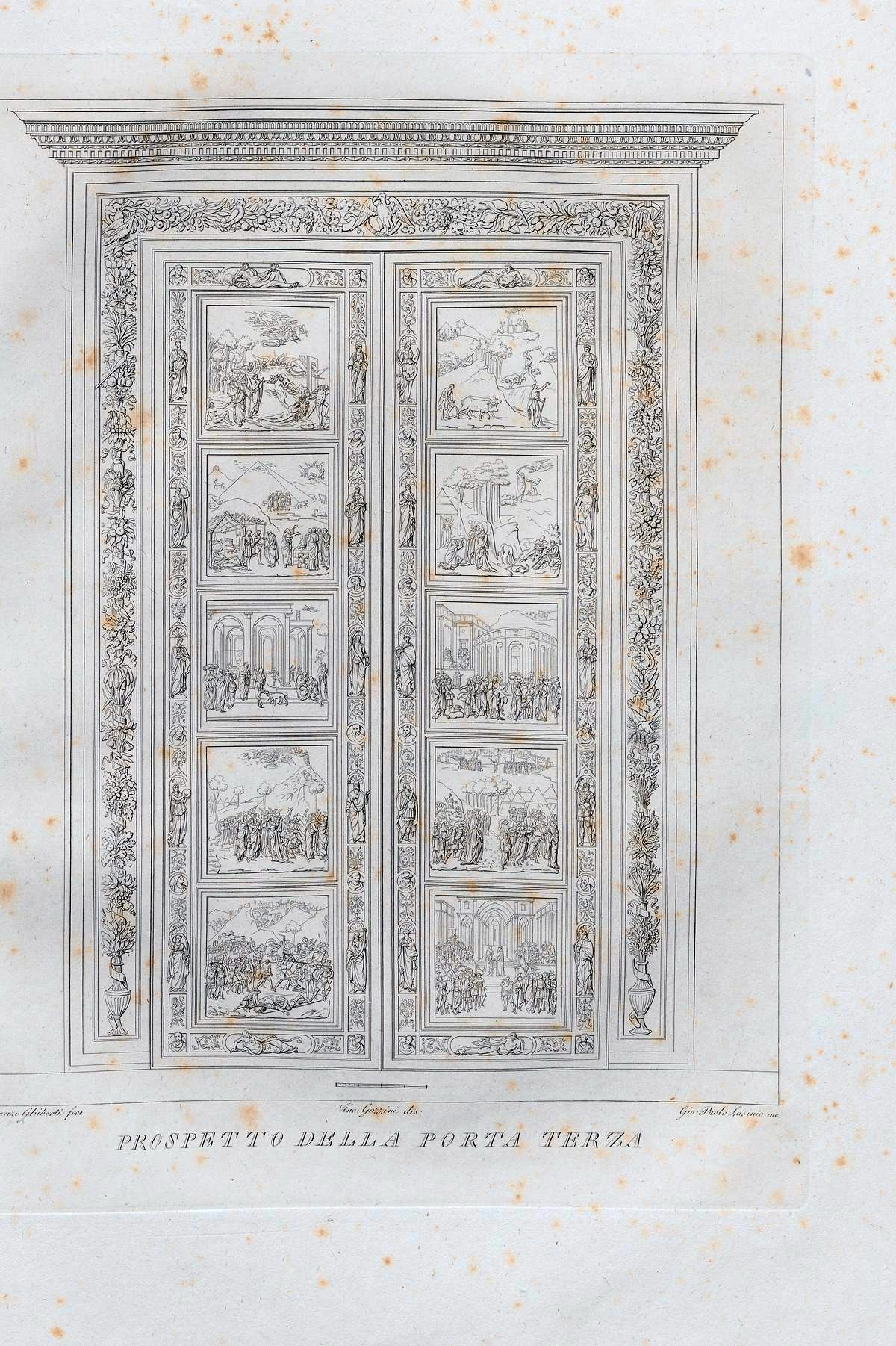
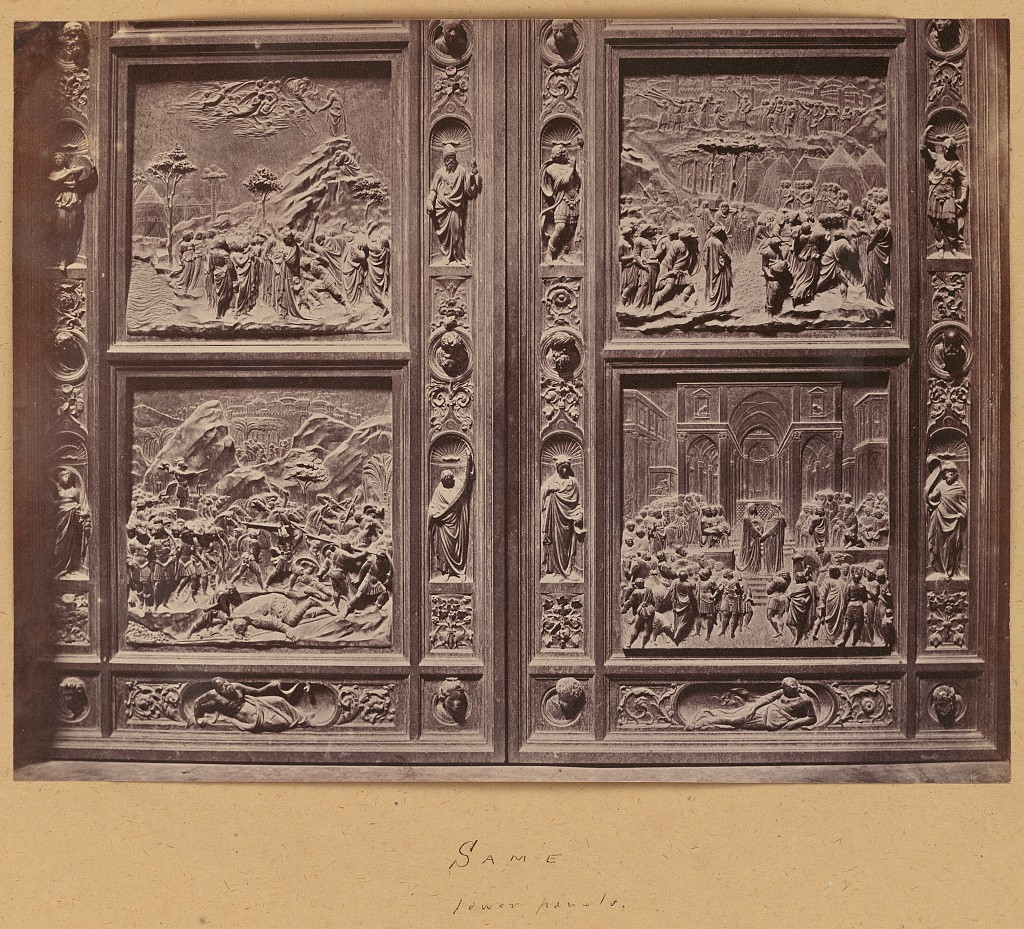
The Gates of Paradise change the distribution of space on the leaves. Begin at the top with the first human beings and their children, then follow the pairs across and down to the last rank, with David on one side and Solomon and the Queen of Sheba on the other. Even at the foot of the door you are inside the narrative. There is no equivalent of a two-row base reserved for Virtues or Church writers.
Standing figures and projecting heads have their own smaller spaces in the framework beside and between the large squares. As a result, the shift from reading a story to considering an individual figure can occur at the side of a narrative or between panels at several heights. Looking up or down the door connects different kinds of image as well as consecutive stories. [4] [5]
The difference in narrative form can be seen without surveying all ten squares. Return in thought to the right leaf of Pisano’s door. In the banquet scene the table and its hanging organise the image. The diners are arranged in a band behind it, while Salome has space to dance beside it. The next field moves to the execution, where the straight lines of a building and the executioner’s raised arm mark a different kind of space.
Below, the table returns for the presentation of the head. Its reappearance helps identify the setting after the interruption. Bronze bars give the reader intervals at which to grasp what has just happened. The field divisions let the palace and prison succeed one another, each with its own governing shapes. The same measured distance between two panels can contain as much or as little elapsed time as the story requires. [3] [7]
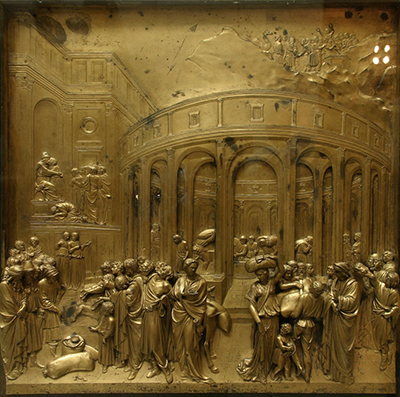
Ghiberti’s Joseph relief uses built space to organise successive incidents on a single large surface. A curving building holds much of the scene together. People further back are smaller, and the projecting figures at the front can be followed as groups before all the actions within and around the architecture are distinct. There is more than one episode to distinguish, but the viewer can keep the architectural setting in sight while moving from a denser part of the relief to a more open one.
For comparison, the table in Pisano’s two banquet scenes has to be seen twice so that one setting can serve two stages of the story. The third door makes it possible for places and spatial relations within a square to do work that the metal dividers did on the earlier ones. [3] [5] [7] [14]
The building offers other instances of the Baptist’s life being distributed through different fields and media. In the Baptistery vault, the Baptist cycle occupies part of a much larger arrangement, adjacent in the overall scheme to cycles such as the stories of Christ and of Joseph. From the floor, its fields have to be picked out along the surface of the vault.
Pisano made John’s history the principal subject of a single flat, upright entrance, giving a person outside a very different place from which to see it. The Opera also identifies Giotto’s Baptist cycle in the Peruzzi Chapel at Santa Croce as a comparison. Those two precedents show that Florence already had ways of laying out a life in architectural space. The number of images and the distinctive break between Pisano’s leaves are particular to the commission in bronze. [1] [3]
The sculpted baptismal font introduces a different relationship between the image and the ceremony. The Opera records a date of 1371 in connection with the font and lists a sequence that begins with the crowd baptism and Christ’s baptism, the very scenes set together by Pisano. It continues with Christ baptising John and the Apostles, Sylvester baptising Constantine and a priest baptising children.
John receives the rite as well as administering it, and the encounter in the Jordan becomes part of a history of baptism that reaches the actions of a priest. In a baptistery, a child being brought to the font has an immediate counterpart among those reliefs. Their relevance to that action is well grounded. The font’s movement in 1658, and the uncertainty about its earliest position discussed in its catalogue entry, make it harder to assign that meeting of object and ceremony to one exact medieval line of approach. [3] [15]
John receiving baptism from Christ turns up again in the fifteenth-century embroideries for the vestments of San Giovanni. The museum catalogues twenty-seven scenes, and the design for this one puts John low in the Jordan with Christ leaning towards him from the left. The sculpted font records the same reversal of roles, and the embroidery adds it to a far more extended life of the saint. The Opera discusses connections to the earlier Florentine cycles, including the mosaics and Pisano’s reliefs.
An individual motif could have more than one model in the city by then. The two bronze door reliefs of Christ’s Baptism hinge on John’s outstretched hand; in the embroidered scene it is Christ’s hand that reaches out, with John in the water. The comparison brings the local tradition into focus without requiring a single line of copying from the doors to the textiles. [3] [7] [10] [12] [15] [16]
The Opera gives the complete set a theological reading that begins at the east with the Old Testament, passes through the Baptist on the south and reaches the life of Christ on the north. Its catalogue also associates the descending order of the east stories with immersion in baptismal water and the upward reading of the north stories with emergence. There is visible evidence for the opposed directions. Linking them with the sacrament is an interpretation of what those directions can mean at San Giovanni.
Similarly the appearance of Old Testament, Baptist and Christ cycles outside, as well as related stories inside, opens up a reading across the building. The two figures present at Christ’s baptism give the south and north entrances a shared episode on which that reading can rest. By 1452 these different histories could be understood as a sequence, whether or not a person physically followed it round the building. [1] [3] [4] [5]
The place facing the cathedral
Pisano’s door stood on the south in the familiar arrangement. Its first position in 1336 is disputed. Vasari, writing long after the event, transmitted a history in which it had originally faced the cathedral, and the arrival of a Ghiberti door would then have required its move. The Opera’s South Door catalogue records the work at the south opening from 1336; Amy Bloch also places it there from the start. In summary form the early records are unusually precise about the decision to change materials, the people employed and the work of installation. They give us much less leverage on the question of its compass position. [3] [6] [9] [17]
Gwynne Ann Dilbeck points to the unequal evidence for the three works. In September 1403 the guild chose the opening facing Santa Maria del Fiore for the door it had awarded to Ghiberti. His first door was installed there in 1424. In July 1452 the guild again selected that opening, citing the beauty of the new work, and directed that its predecessor be put in the opening towards the column and the Opera houses. The description identifies the north side by nearby landmarks.
In Dilbeck’s discussion, the text of the earlier decision is published as document 60 in the second volume of Krautheimer’s study, and the records concerning the later decision as documents 48 and 73. They are instructions about the site, the sort of record that a scholar seeking to establish Pisano’s first position would need. The absence of a corresponding record of relocation for Pisano may favour a south installation from the beginning. It cannot tell us what an unrecorded or lost instruction might have said. [3] [4] [5] [9] [17]
Dilbeck discusses the approach from the built-up town in the fourteenth century, when the east entrance faced the works at the cathedral. She also cites Bloch’s observation that the south portal received mosaic decoration on the underside of its lintel before the other two. A portal could have great importance to the people of Florence through the direction from which they normally reached it.
Such considerations make a south installation in 1336 intelligible in its own right. In Vasari’s account the cathedral-facing opening functions as the prize, with each admired door in turn taking the place of the one before it. That pattern fits the documented decision of 1452 particularly well. Extending it to the whole history would also apply a mid-fifteenth-century hierarchy of entrances to an earlier city and building. [3] [9] [17]
The original intended position of the third door presents a related problem. Bloch infers a north destination at an early stage, before the new door displaced the first Ghiberti work. Such an inference is plausible in a building with three portals and two doors already installed. The securely documented point is the east installation.
The distinction matters for any explanation in which Ghiberti was to have designed every relief for the location, lighting and ceremonies of the east portal from the moment of commission. The choice made in 1452 tells us that the consuls compared the finished door with what stood there. The award of the commission in 1425 and the choice of site in 1452 belong to separate moments in the long history of making it. [4] [5] [9] [17]
Dilbeck distinguishes solemn communal baptism, associated with the vigils of Easter and Pentecost, from baptisms held soon after the birth of individual children. The Florentine merchant Gregorio Dati’s record of his children shows how quickly the rite could follow a birth. The service books describe the communal liturgy, but even the detailed Florentine ordinal leaves the exact route into the Baptistery unspecified.
The case for routine use of the south is a reconstruction, built in part from the way the bronze scenes and earlier sculpture related to the ritual outside the building. An image by Giovanni Stradano of the 1541 baptism of Francesco de’ Medici shows a procession entering on the east. A conspicuous dynastic baptism could use that entrance, a finding compatible with a different practice on ordinary days. [17]
Dilbeck also connects the Old Testament scenes at the east with readings from the baptismal calendar. The vigil’s scriptural concern with deliverance through water gives a liturgical context to a relief such as Noah, which includes the ark after the Flood. This is one explanation for the appropriateness of an Old Testament door at a baptismal building. The service books allow a historian to recognise the resonance of a subject for a particular occasion. Whether it was chosen for that reason is a further question about the commission. [5] [17]
A procession, someone carrying a child and a person studying a door also have different opportunities to see. From well away a viewer can distinguish an upright bright square from a dark grid with small highlights. As the distance closes, the size of the groups, the direction of movement and the spaces between figures become clearer. A relief at the top of the door then has to be looked at from below at a steeper angle. An open leaf would change the angle of its reliefs and break the picture made by the two halves together.
The ceremony reconstructed from liturgical evidence therefore offers a different way into the work from an account of the closed doors as a sequence to be read. Nicholas Temple’s discussion of Ghiberti’s understanding of vision and space, with the passages on sight in the Commentarii, likewise invites attention to the relative positions of viewer and object. The multiple decisions involved in arranging, approaching and opening a door resist the idea of one permanent vantage point. [4] [5] [17] [18]
The sculptures around and above the doors
The earliest door acquired a new border soon after the third door was installed. The great bronze surround at the south entrance dates from 1453–66 and was made by Vittorio Ghiberti, Lorenzo’s son. The parts that hold Pisano’s reliefs move with the leaves. Vittorio’s work frames their architectural opening. On the outer faces of the uprights a garland rises from vessels borne by Adam and Eve and their children, Cain, Abel and Seth; within the jambs, bands of vegetation are worked in much lower relief.
Roundels with the busts of three children occupy the lintel. Fruit, birds, ears of grain and cornucopias make the decoration readable in fragments as the viewer gets closer. The newer surround lets the branching and spreading ornament move the eye up the sides independently of the regular count of panels on Pisano’s leaves. [3] [7] [19]
The subjects offer connections in both directions. Adam and Eve belong to the beginning of the history told on the east door. Put at the foot of the south surround, the first family gives the leaves devoted to John a border with its own beginning in Genesis. The Opera proposes that the abundant life of the garland can be understood through creation, the Fall and purification by baptism.
The details that give rise to the interpretation are outside the leaves and have a date of their own. A person looking only at Pisano’s panels in their case sees a coherent work of the 1330s; the surround at the Baptistery shows how the same design could be set into a newer conception of the entrance in the next century. [2] [3] [5] [19]
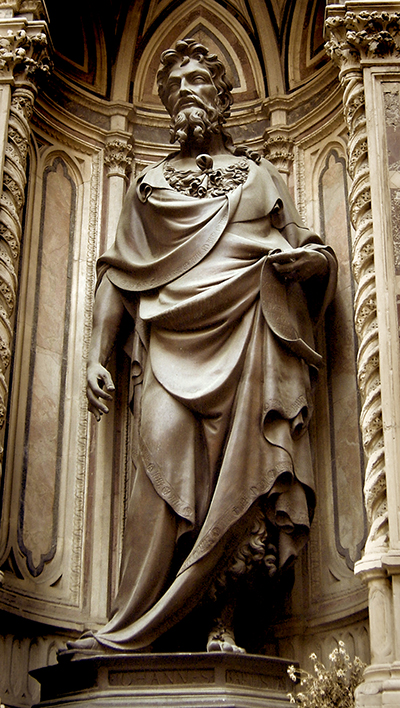
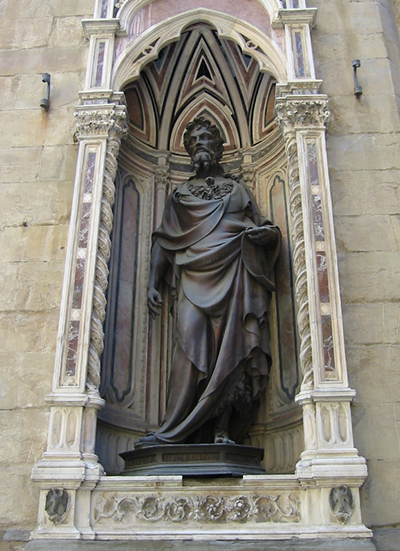
The three groups above the entrances belong to a further history. At the north entrance, Giovan Francesco Rustici’s bronze Preaching of the Baptist, made in 1506–11, shows John addressing a Pharisee and a Levite. The figures are free-standing and must be read against the building. John’s raised finger carries his reply upwards, while the orientation of his two listeners makes the gesture part of an exchange. Below, the bronze leaves follow the life of Christ.
Above, the Baptist’s ministry announces the presence of the titular saint across the distance of the square. The Calimala eagle that the Opera catalogues at the Baptistery belongs to the setting of the group; the emblem of a cloth merchants’ guild incorporates a bale, and gives the patron an identifiable presence at the entrance. The original figures have been in the museum since 2006 and are displayed with the North Door. [1] [2] [4] [20] [21]
On the east side the additional figures supply an episode the door itself lacks. Andrea Sansovino worked on the marble Christ and Baptist in 1502–05, and Vincenzo Danti completed the pair in 1569. The angel at the side, made by Innocenzo Spinazzi, dates from 1792. Christ’s joined hands draw attention inward. John’s body and extended arm carry the movement out across the gap between the figures.
The stone group makes the action legible by the disposition of bodies that can be seen from below, rather than by the line of water around Christ’s feet that fixes his position in the bronze panels. White marble also sets the scene apart from the field of gilded stories below. The museum holds the composite original group, and a copy stands above the east portal. What now reads as one encounter includes work done almost three centuries apart. [2] [5] [22]
Above the south entrance, Danti’s bronze group dated 1569–71 shows John kneeling between the executioner and Salome. The original came down for conservation in 2006. The museum has placed it above Pisano’s door. At the small scale of the relief, the execution occupies one field between the banquet and presentation of the head. In the large group the upright figures on either side and the lower one in the middle give the episode a shape recognisable without the relief’s architectural setting. Repeating the event on a larger scale gives special weight to one moment among many on the leaves.
The pedestals bring back another element of Pisano’s programme on a much smaller scale. The Opera identifies reliefs of the three Theological Virtues below John, and records the reading of Lust and Intemperance beneath the other figures. Danti’s group gives those personifications a specific relationship to the saint waiting for the blow. The figures of the execution can be recognised approaching the doorway from the square. At that distance, the reliefs down by their feet are harder to make out. [2] [3] [7] [23]
Taken together, the overdoors set out three acts in the Baptist’s life at building scale: preaching on the north, baptism on the east and death on the south. They connect the entrances at a height above the grids and broad squares, and the order they propose belongs to their own subject. It runs differently from the theological succession the Opera finds in the door programmes.
It is also a consequence of choices made long after the last bronze leaves were put in place. At the south, particularly, the object called a portal now combines a fourteenth-century door, a fifteenth-century surround and a sixteenth-century group. Their different dates account for the changing scale of the images as much as their position up the wall does. [2] [3] [4] [5] [19] [20] [22] [23]
From working doors to museum exhibits
The war brought the three originals under cover together. Giovanni Poggi describes their removal early in 1943 and their transport in April and May to the Sant’Antonio tunnel at Incisa, on an abandoned stretch of the Florence–Arezzo railway. The doors travelled with other Florentine bronzes. Back in Florence in 1944, they were sheltered under the loggias of the Palazzo Pitti courtyard. Poggi recalls that people driven from their houses near the Ponte Vecchio saw them there while seeking refuge. The doors had been taken down to protect them against destruction. Their temporary presence at the palace also afforded officials time to examine surfaces usually upright and exposed in the square. [11]
One observation changed the question they asked of all three doors. During the journey back from Incisa, the packing wood rubbed against a field on Pisano’s door and exposed a small patch of gold. Poggi recounts the discovery as grounds for testing how well the gilding had survived beneath the green patina. The gold was visible in places before the accident, but the brightness of the exposed patch gave the investigators a reason to ask how much of the original surface the weathered appearance concealed. The official report illustrates Pisano’s Baptism and two different reliefs from Ghiberti’s first door. It records the three doorways as a shared responsibility and lets us see how the modern account of their colour began to change. [11]
The East Door left the building permanently in 1990, after treatment of four individual reliefs. Earlier work had used reliefs that could already be extracted to test and apply a chemical treatment. In its record of the campaign, the Opificio delle Pietre Dure describes why taking the whole assembly indoors mattered. Some of the gold lay upon corrosion products that had to remain in place to keep the gilding.
A treatment capable of bringing more of the decoration into view could succeed only in conjunction with a protected environment. The door had once been made to provide a richly finished surface on the outside of a building. By the end of the twentieth century, the conditions of that position were incompatible with preserving all of the surface that could still be seen. [24] [25]
The next two projects confronted the same question of what the original surfaces could bear, with different objects under examination. The restored North Door went on view in 2015 after a campaign that began in 2013. The Opera drew attention to the contrast of gilded relief with the darker bronze of the fields, a distinction previously harder to see. On Pisano’s door, treated in 2016–19, the Opificio used several kinds of cleaning, including laser work in combination with other methods on gilded areas, and mechanical cleaning appropriate to ungilded ones.
The team took out a selection of components, among them the Annunciation to Zacharias, a lion head, a section of frieze and two circular elements at the rear, and reassembled them. The sample included a narrative, a small ornament and pieces from the structure of the door. Looking at the work from the back and in parts gave investigators access to relationships usually concealed when it was hung. [3] [26] [27]
For the visitor, the effect of the three conservation histories is most apparent in the balance of gold and bronze. On the two older doors the gilded figures inhabit dark compartments. On the third, areas of gold extend across the space within the larger panels. In the hall the change can be seen across the full size of the leaves, something a row of photographs of isolated bronzes would obscure.
It is safer to compare the distribution of colour than its brightness. Cleaning has revealed the different places where gold was applied and survives, while earlier weathering, different treatment histories and the way light strikes each relief all affect what is visible. Even under related display conditions, each door has a surface with a history of its own. [2] [7] [24] [25] [26] [27]
The three replicas and the museum display
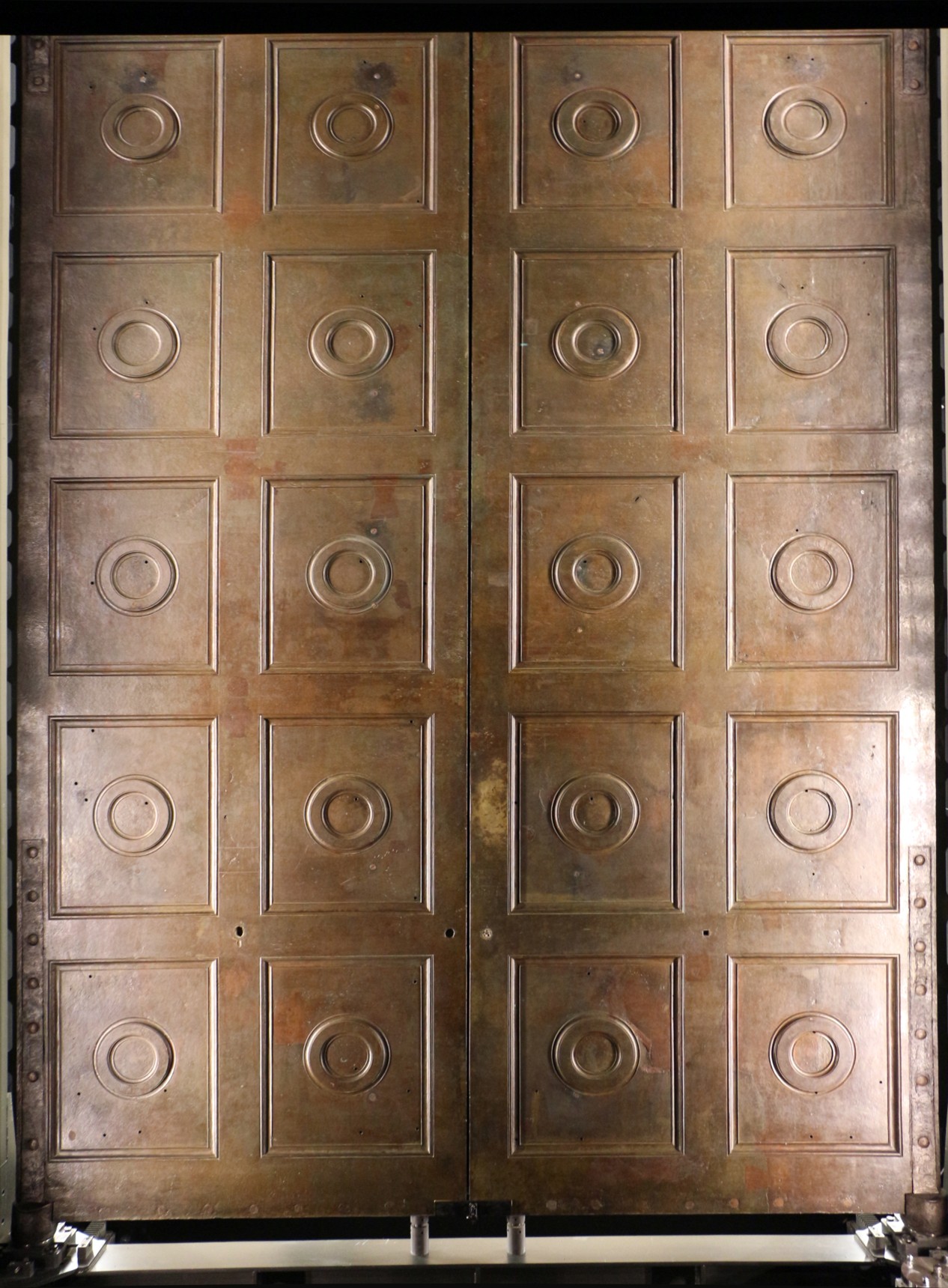
The replicas preserve the scale and positions of the leaves through three distinct histories of manufacture. The east copy was produced using moulds formed in 1948 after the earlier treatment, according to the conservators Annamaria Giusti and Mauro Matteini. That use of existing moulds linked the replacement in 1990 to work carried out in the aftermath of the war. The North Door replica, presented on 23 January 2016, came from the Florentine Galleria Frilli and the Ciglia e Carrai foundry. The makers document laser scanning of the original reliefs alongside wax retouching and hand chasing of the casts.
Digital capture supplied a record of the shapes, while the casts still needed finishing by hand. For the South Door, the Opera commissioned Galleria Frilli to make the copy inaugurated on the Baptist’s feast on 24 June 2019. Its account also describes the work on moulds, casts and finishing. On the feast day of 1336 the achievement had been to put the commissioned door into service. The replica ceremony marked the decision to separate an original from the doorway for which it was made. [3] [24] [25] [28] [29]
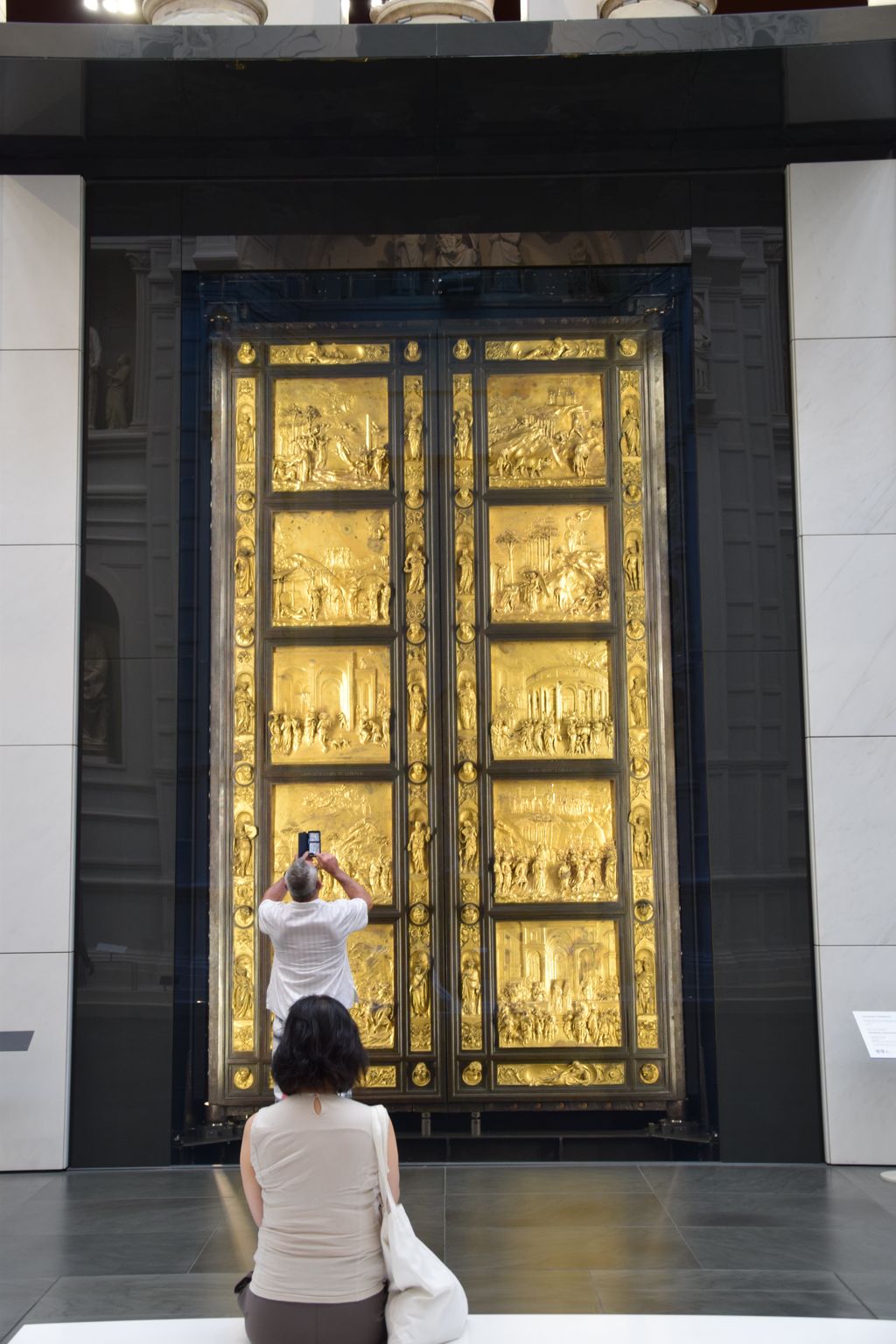
Pisano’s restored door went on public view in the Sala del Paradiso on 9 December 2019, after the replica had already taken its place. The room aligns the three original doors opposite the reconstructed early cathedral façade. Several of the sculptures from that façade have been returned to their corresponding positions in the reconstruction. On the doors’ side, figures from above the Baptistery portals are related again to the leaves below.
The result lets the visitor look across a space from doorway to façade, seeing sculptures bearing on one another across it. The enclosure is modern and the three portals of the octagon have been unfolded into one wall. That arrangement makes it possible to put more than one building phase in view at a time, including a cathedral façade dismantled in 1587 and the later angel from the Baptism group. [2] [22] [30]
In the hall, a comparison can begin at ground level with Pisano’s named Virtues, move across to Ghiberti’s writers and return to the lowest pair of the Gates, where the history continues almost to the threshold. Raising the eye from the leaves to the overdoors changes the comparison again. The Baptist becomes the figure who connects three ensembles that, at the level of the doors, can be distinguished by their different subjects.
In the square, those same connections have to be made across a corner or across the space in front of the cathedral. From one entrance the others are out of sight, and the size of an image determines how soon it becomes recognisable on the approach. The differences between the two settings are especially tangible at the south portal, where the surviving surround wraps around a replica outdoors, while inside the original leaves can be seen in relation to the bronzes that came after them. [1] [2] [3] [4] [5] [19] [20] [22] [23]
Lorenzo Ghiberti sculpture directory
Discussion
Ghiberti rewards slow looking: relief, gilding, narrative structure, workshop practice and conservation evidence can all change how a work is read.
Join the Conversation
Have an observation about Baptistery Doors, a source to add, or a comparison that sharpens the reading? Share it below.
References
- Opera di Santa Maria del Fiore, Baptistery of San Giovanni, building, mosaics and three entrances. View source.
- Museo dell’Opera del Duomo, Sala del Paradiso, room 6, reconstruction and object list. View source.
- Opera di Santa Maria del Fiore, Porta sud del Battistero, scientific catalogue 5719, inscription, history, technical data, conservation and component list. View source.
- Opera di Santa Maria del Fiore, Porta Nord del Battistero, scientific catalogue 3618, history, iconographic account and component list. View source.
- Opera di Santa Maria del Fiore, Porta del Paradiso, scientific catalogue 1320, history, iconographic account and component list. View source.
- George Bent, “Andrea Pisano”, Florence As It Was, “Documents”, entries for 29 November 1322, November 1329, April 1330, October 1331, 1332–33 (stories and lion heads), 27 April 1332 (Avanzi), and the unheaded payment to Pasquino Telli for raising the door. View source.
- Francesco Bini (Sailko), Andrea Pisano’s restored South Door in the Museo dell’Opera del Duomo, full view of the original leaves. View source.
- Musei del Bargello, Donatello e l’alba del Rinascimento, competition reliefs of Ghiberti and Brunelleschi. View source.
- Amy R. Bloch, Lorenzo Ghiberti’s Gates of Paradise, introduction, Cambridge University Press, 2016, pp. 3–4 and 9–10. View source.
- Opera di Santa Maria del Fiore, Formella Battesimo di Cristo Porta sud, scientific catalogue 7476. View source.
- Giovanni Poggi, “La ripulitura delle porte del Battistero fiorentino”, Bollettino d’arte, series 4, 33, no. 3, 1948, pp. 244–257, especially pp. 251–253 and figs. 4–8. View source.
- Opera di Santa Maria del Fiore, Formella Battesimo di Cristo Porta nord, scientific catalogue 4246. View source.
- Francesco Bini (Sailko), Ghiberti’s Baptism of Christ from the North Door, photograph of the original relief. View source.
- George M. Groutas, The original Gates of Paradise in the Museo dell’Opera del Duomo, view of the displayed ensemble. View source.
- Opera di Santa Maria del Fiore, Fonte battesimale istoriato del Battistero, scientific catalogue 6697, subjects, dating and provenance. View source.
- Opera di Santa Maria del Fiore, Ventisette ricami dal Parato di San Giovanni, scientific catalogue 11335, historical discussion and scene 13, Cristo battezza san Giovanni. View source.
- Gwynne Ann Dilbeck, Opening the Gates of Paradise, University of Iowa dissertation, 2011, pp. 72–75 and nn. 213–214 on placement, pp. 86–89 and 99–101 on ritual, chapter 4 on the liturgical calendar, and fig. A50, with the consultable text reproduction. View source 1. View source 2.
- Nicholas Temple, “Lorenzo Ghiberti and Contested Views of Perspectiva in Renaissance Concepts of Space”, Micrologus XXIX, 2021, pp. 239–263, especially pp. 250–260 and Lorenzo Ghiberti, I commentarii, ed. Julius von Schlosser, I, 1912, pp. 48–50. View source 1. View source 2.
- Opera di Santa Maria del Fiore, Vittorio Ghiberti, Cornice della Porta Sud, exterior object entry 9176, with scientific catalogue 7184. View source 1. View source 2.
- Museo dell’Opera del Duomo, Giovan Francesco Rustici, Preaching of the Baptist, object entry 8640. View source.
- Opera di Santa Maria del Fiore, Giovan Francesco Rustici, Aquila di Calimala, exterior object entry 9186. View source.
- Museo dell’Opera del Duomo, Andrea Sansovino, Battesimo di Cristo, object entry 9199, including Danti’s completion and Spinazzi’s angel. View source.
- Museo dell’Opera del Duomo, Vincenzo Danti, Beheading of the Baptist, object entry 9003. View source.
- Opificio delle Pietre Dure, Lorenzo Ghiberti, Porta detta del Paradiso, treatment record GR 8117. View source.
- Annamaria Giusti and Mauro Matteini, “The Gilded Bronze Paradise Doors by Ghiberti in the Florence Baptistery”, Metallrestaurierung, 1998, pp. 47–51, especially pp. 49–50 on treatment and the replica. View source.
- Opera di Santa Maria del Fiore, “La Porta Nord del Battistero”, 9 September 2015, completed conservation and museum installation. View source.
- Opificio delle Pietre Dure, Andrea Pisano, Porta Sud, “Intervento”, treatment and selected disassembly. View source.
- Opera di Santa Maria del Fiore, “La replica eseguita ad arte della Porta Nord del Battistero”, 23 January 2016, replica manufacture and installation, with the Galleria Frilli workshop account, North Door photographs of laser scanning and wax retouching. View source 1. View source 2.
- Opera di Santa Maria del Fiore, “Inaugurazione della copia della Porta Sud”, 24 June 2019, replica manufacture and inauguration. View source.
- Opera di Santa Maria del Fiore, “Il Museo dell’Opera del Duomo accoglie la Porta Sud di Andrea Pisano”, installation account and public display from 9 December 2019. View source.