

 by Tom Gurney
Tom Gurney BSc (Hons) is an art history expert with over 20 years experience
Published on June 19, 2020 / Updated on July 28, 2026
Email: tomgurney1@gmail.com / Phone: +44 7429 011000
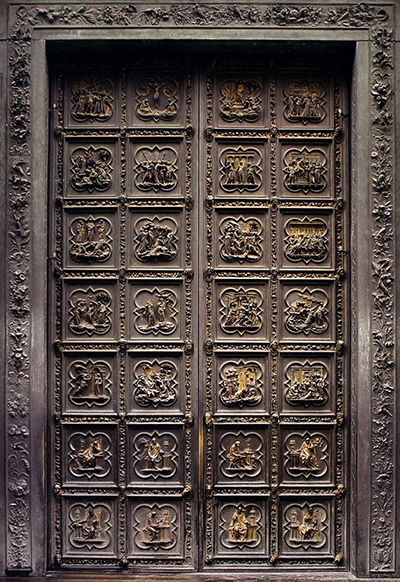
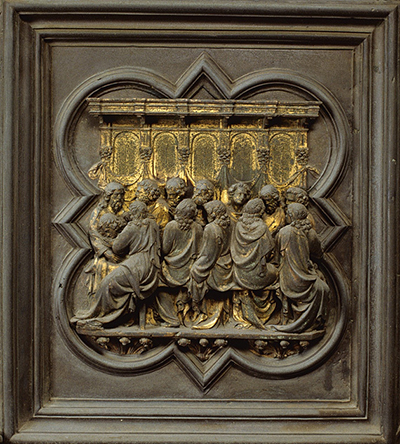
Lorenzo Ghiberti's Last Supper turns the final meal into an image of compressed community. Christ and the apostles form a dense gathering around the table; overlapping backs fill the foreground, while a shallow arcaded interior closes the upper field. Individual gestures remain visible, but the group reads first as an almost continuous human ring.
Contents
- Position on the North Door
- A ring around the table
- Christ within the group
- Architecture and enclosure
- Reading collective identity
Position on the North Door
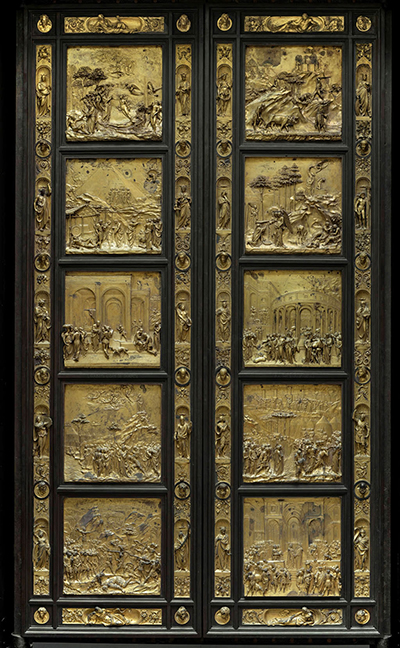
The panel is on the right leaf of the North Door, paired with the Entry into Jerusalem. The pairing moves from public arrival to the meal that opens the Passion sequence. Above it come trial, punishment, death, Resurrection and Pentecost.
The North Door was made between 1403 and 1424. Its original bronze panels are now displayed in the Museo dell'Opera del Duomo; the Baptistery's exterior door is a copy. Opera del Duomo reports the Last Supper within a proposed Krautheimer phase around 1407–1413/15. This is a stylistic reconstruction, not a documented completion date for the panel.[1][2]
A ring around the table
The table supplies a centre, but the apostles' bodies largely conceal its edge. Several figures turn their backs toward the viewer, drawing the audience into the outer boundary of the gathering. Heads and shoulders overlap so closely that the group feels enclosed even before the architecture is considered.
Matthew 26:17–30, Mark 14:12–26 and Luke 22:7–23 establish the meal, blessing and announcement of betrayal; John 13 provides a related account of the final gathering. Ghiberti condenses these meanings into a collective scene rather than isolating every action.[3]
Christ within the group
Christ is identifiable within the assembly, yet he is not separated by a broad empty zone. His authority must be found through placement, gesture and the direction of surrounding attention. This makes close looking necessary: sacred hierarchy exists within fellowship, not outside it.
Judas likewise should not be identified through assumption alone. The panel's primary visual achievement is the relation between the compact whole and its distinct participants. Any precise identification should follow secure attributes or the institutional description rather than a convenient guess based on position.
Architecture and enclosure
A shallow arcaded interior occupies the upper field. Its repeated openings create rhythm behind the irregular heads below. The architecture establishes an ordered room but does not generate deep perspective; instead, it presses the gathering forward toward the bronze surface.
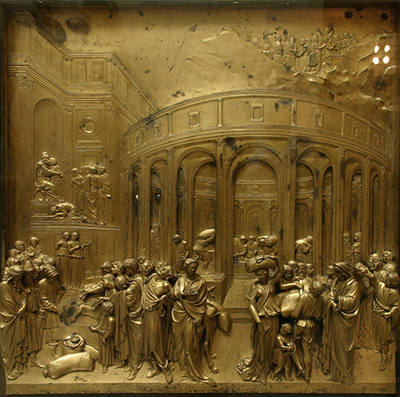
This enclosure differs from the open convergence of the Entry into Jerusalem. Public crowds there approach from opposing sides. Here, bodies close around a shared centre and turn movement into still, tense proximity.
Reading collective identity
Begin with the outer ring of backs and shoulders, then work inward toward the table and Christ. Note which figures turn toward one another and which gestures interrupt the repeated curve. Finally, compare the human semicircle with the architectural rhythm above.
The relief makes community visually powerful without presenting it as simple harmony. Compression holds the apostles together, but varied gestures suggest the uncertainty of the final meal. Ghiberti uses the small quatrefoil to show a group simultaneously united by ritual and unsettled by what Christ announces.
Discussion
Ghiberti rewards slow looking: relief, gilding, narrative structure, workshop practice and conservation evidence can all change how a work is read.
Join the Conversation
Have an observation about Last Supper, a source to add, or a comparison that sharpens the reading? Share it below.
References
- Opera del Duomo scientific catalogue, North Door
- Opera del Duomo, North Door
- Matthew 26:17–30; Mark 14:12–26; Luke 22:7–23; compare John 13.