 by Tom Gurney
Tom Gurney BSc (Hons) is an art history expert with over 20 years experience
Published on June 19, 2020 / Updated on November 17, 2026
Email: tomgurney1@gmail.com / Phone: +44 7429 011000
On 31 May 1427 Lorenzo Ghiberti wrote from Florence to the official in charge of Siena Cathedral’s works. One of the two reliefs for the Siena font was gilded. The other needed as much gold again, and Ghiberti said he had no means to provide it. He had borrowed close to two hundred florins from the banker Antonio di Jacopo Pini to meet his own needs and finish Siena’s work. If the official sent his treasurer, Ghiberti hoped to finish the second relief and satisfy his creditor on the same visit. He signed the letter as Lorenzo di Bartolo, goldsmith in Florence.
By then one of his bronze doors already stood at the entrance to the Florentine Baptistery and a second was in hand. The circumstances of the letter belong to that career as surely as the doors do. A master who could turn a movement of the hand into a gesture legible in a public square still had to secure a morning’s supply of gold. His correspondence follows work in transit between assistants, patrons and officials. His later Commentarii follows much of the same work into the buildings where a reader could find it. Both are accounts by the artist, written from very different points in the life of an object. [1] [2] [3]
Contents
- The goldsmith’s household
- Birth, family and training
- The competition and the contract
- The competition of 1401
- The first Baptistery doors
- Work in Florence and Siena
- Orsanmichele and monumental bronze
- The Siena font and the independence of the shop
- The second door and the cathedral shrine
- The Gates of Paradise
- The shrine of St Zenobius
- Papal work and ancient gems
- Writing about art in his last years
- The Commentarii and Ghiberti's final years
The goldsmith’s household
Modern accounts generally date Ghiberti’s birth to around 1378. Ghiberti gave that year in his defence in a civic case in 1444. In earlier Florentine tax declarations, from 1427 to 1442, he had given 1381 and called himself the son of Bartolo di Michele, a goldsmith. The Opera del Duomo gives Pelago as his birthplace.
The place securely belongs to the family story as he told it in 1444, when he said his mother Fiore and Cione Paltami Ghiberti had married there in 1370. Both the birth date and the location need to be read with the circumstances in which this testimony was given. A man who had already served as one of the Twelve, a Florentine governing college, now had to defend his eligibility for the office against an allegation of illegitimacy. [2] [4] [5]
Johann Wilhelm Gaye’s nineteenth-century transcription prints the March denunciations within Lorenzo’s petition of April 1444. His accusers cited the education he had received from Bartolo and brought his use of a family name and his dealings with property into their case. Lorenzo answered with evidence drawn from a different part of his history. Cione, he said, had acknowledged receipt of Fiore’s dowry in September 1371. Lorenzo also cited a property arbitration of 1413.
As he represented it, the proceeding called him Nencio di Bartoluccio, using a familiar form of Lorenzo and the name of the man who had raised him, while he claimed Cione as his father. Thus the petition appeals to a record in which the two affiliations were already present. The allegation and the answer survive in a text put together to contest a judgement. Each side selected the facts it thought would carry weight with the government. [5]
One issue in the proceedings was how long he had paid his fiscal obligations in his own name when he held office. The adverse finding discussed in the petition concerns that qualification. The text records a penalty of five hundred lire and seeks remission, with a reservation of fifty lire. It also seeks the right to hold office under the name Lorenzo di Bartolo or Bartoluccio.
The form under which he might be drawn for office mattered as much to the petition as the family name used in its opening. Gaye prints a favourable vote at the end of the petition. The date there gives 1424, at odds with the 1444 proceedings in the text and the date in his heading. The petition brings marriage, inheritance, household reputation and taxation into the same defence, and the vote concerns the relief Ghiberti sought. [2] [5]
Birth, family and training
The names have a history in the objects and the workshop as well as in the lawsuit. The Siena contract of 1417 gives the Latin equivalent of Master Lorenzo di Bartolo, goldsmith of Florence. The letters keep the occupational name, even when Lorenzo writes personally to another goldsmith. In the cathedral’s records he appears as Lorenzo di Bartoluccio, with variants including the Ghiberti name. On the first bronze door he identifies himself as the Florentine Lorenzo. On the second the inscription names him as Lorenzo di Cione of the Ghiberti and praises the skill with which the door was made.
Its capitals run across both leaves along the strip between the second and third registers from the top. These forms belong to distinct encounters. The Sienese were entering into an obligation with a Florentine goldsmith. The bronze inscription was made to be read by people who had no need to know the working arrangements of his shop. It gave the public monument a family name that would travel with it. The door, the contract and the tax declaration all identify the same man. None can certify his biological parentage. [1] [4] [6] [7]
La Bella reconstructs a household in which Fiore moved to Florence with Lorenzo and his older sister and lived with Bartolo, marrying him after Cione’s death in 1406. Bartolo’s role in raising and instructing Lorenzo is more consequential for the early career than a decision between rival accounts of his birth. He gave the boy access to a goldsmith’s trade, in which drawing, modelling, the preparation of metal and the final working of a surface were parts of a single commission.
A commission could also bring the shop into a relationship with a client who supplied the chief material or arranged its purchase. Ghiberti’s educational account in the Commentarii thanks his family collectively for having him instructed. He connects that debt with the study of letters as well as the pursuit of an art. The memory is shaped by an argument about what an education leaves its possessor, and allows little reconstruction of lessons in Bartolo’s shop. [2] [3]
Ghiberti describes a master from Cologne he calls Gusmin, who made a gold panel for the Duke of Anjou. He praises the sculptor’s treatment of heads and naked bodies, compares his work with ancient Greek statuary and finds his statues a little short in proportion. Ghiberti says he saw many figures modelled by the master. He also records what young men told him of the artist as a teacher, willing to show them measurements and give examples. [3]
In Ghiberti’s account, the gold panel was broken up for the duke’s public needs. He gives the artist a prayer on witnessing the destruction, then has him give away his possessions and retire to a hermitage. The reported words and gesture belong to the moral shape of the story. The boy from a goldsmith’s household grew up in a trade where a highly wrought object might be reduced to its metal value.
As a writer he placed the episode just before a discussion of education as something that survives a reversal of fortune. A court can recover gold by undoing a goldsmith’s work. Instruction can survive in people who saw the objects or learnt from the maker, even when the thing made has disappeared. That relationship between informed looking and the hazards of a precious material returns in Ghiberti’s account of his own work. [3]
In 1400, Ghiberti says, bad air and the poor condition of his city drove him away from Florence with a painter whom the lord of Pesaro had summoned. La Bella identifies the lord as Malatesta IV. The two worked on the decoration of a chamber. Ghiberti remembers being drawn to painting, encouraged both by his companion and by the prospect of further employment. Letters from friends told him the governors of the Baptistery wanted to see proofs from masters, and he asked his patron and colleague for leave.
The account supplies a plausible reason to change course and a glimpse of a career that could have taken a different direction. Its most definite details are the room, the collaborative work and the written summons from Florence. The painter’s name has remained uncertain. The writer who eventually made so much of his skill in bronze wanted his reader to see him first at work in another medium. [2] [3]
The competition and the contract
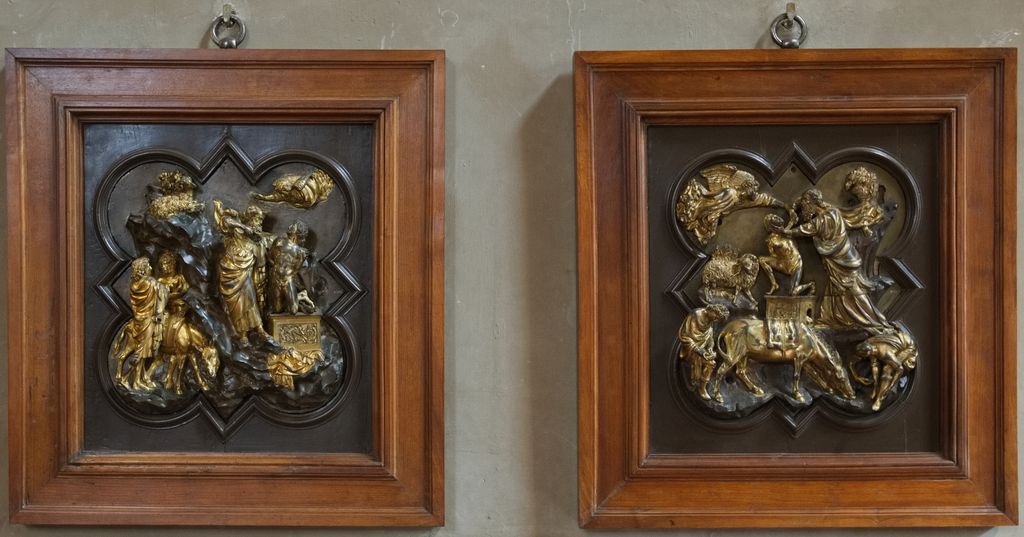
The Baptistery trial conventionally dated to 1401 put the same problem before the competitors. They were to show Abraham about to sacrifice Isaac in a bronze relief fitted to a four-lobed field. The Arte di Calimala, the merchants’ guild responsible for the Baptistery, needed a demonstration of how a sculptor might turn an assigned story into a legible and durable panel. In the two surviving bronzes in the Bargello, Ghiberti and Filippo Brunelleschi give broadly comparable space to the son, father, angel and servants.
There was room within the requirement for emphatically different accounts of what it means to stop an act. Ghiberti makes the eye travel along a ridge before it reaches the exposed body and blade. Brunelleschi puts the angel’s hand directly on Abraham’s wrist. In his version, the contact between two bodies is the point on which the action depends. [2] [3] [8]
The competition of 1401
In Ghiberti’s Sacrifice of Isaac the boy’s chest turns towards the viewer while his head turns towards his father. The altar supports the bent leg and gives the figure a clear lower edge. Abraham’s arm and the space beside it keep the blade in view. Brunelleschi compresses the heads and hands around the instant of intervention and makes Abraham’s grip on Isaac palpable. The reliefs disclose two judgements about where the spectator’s attention should come to rest.
Their construction also bears on the commission. Ghiberti incorporated much of his design in one casting, while Brunelleschi joined more separately cast elements. The former’s contour and joins offered a commissioning body something it could inspect in the metal as well as in the story. The objects establish that different solutions were submitted. The terms on which a panel’s surface, weight, assembly or composition entered the judges’ discussion have to be sought in the records of the competition. [2] [8] [9]
Ghiberti presents the verdict as unanimous. He says thirty-four judges included people skilled in painting and sculpture in gold, silver and marble, and that the governors sought their written opinions. The competitors too, in his account, conceded the palm. He extends the recognition from the experts to the consuls, officers and entire guild. The sequence is important to his version of becoming a public artist.
A trial of work made by one man is examined by many men competent in different materials. Their decision is then carried into effect by the institution that had asked for the work. The precision of the number and the reference to signatures make the account sound like a document of the proceedings, though it is the memory of a beneficiary set down many decades later. [3]
The life attributed to Antonio Manetti describes a different decision. Manetti depicts Ghiberti seeking advice and remodelling the work in wax, while Brunelleschi keeps his relief largely to himself. The judges in this version find two projects they cannot easily separate and propose shared responsibility, with the expense and duration of the enterprise in view. Brunelleschi declines to take it on in partnership. It becomes a story about a man who could afford to relinquish a substantial commission to retain control of his work.
The refusal supplies a reason why Ghiberti went ahead alone as the principal creative figure, while allowing Brunelleschi’s relief to have stood level with his. In Vasari’s much later life, Brunelleschi and Donatello persuade the consuls to choose Ghiberti. Vasari makes this a sign of disinterested judgement, then has Brunelleschi decline a joint commission. Fabian Jonietz treats that participation as doubtful. Donatello’s documented presence in the later workforce belongs to a different stage of the enterprise. The contract establishes who undertook the commission, with Lorenzo’s name beside another goldsmith’s. [10] [11] [12] [13]
The first Baptistery doors
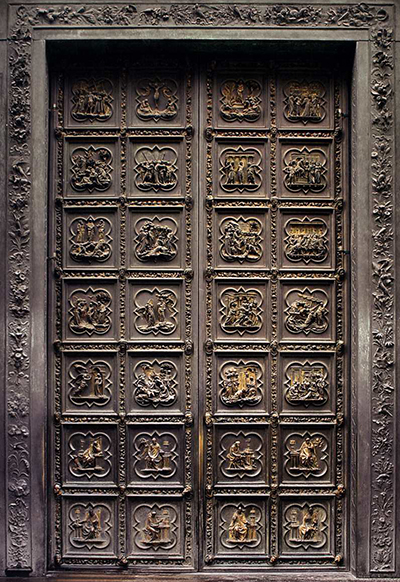
An early guild decision appears separately in the Krautheimer documentary digest, under 1402 with a cross-reference to an edition giving 1403. The contract recorded on 23 November 1403 was made with Lorenzo and Bartolo. La Bella connects the elder man’s inclusion with Lorenzo’s lack of guild membership at the time. Lorenzo was to produce three reliefs a year with the support of Bartolo and assistants of his choosing.
The completed commission, now known as the North Doors, has scenes from the New Testament. The Isaac trial had tested his ability to compose in the existing format, which the guild kept. Its subject had changed before the definitive undertaking, so the submitted relief and the finished series belong to consecutive but distinct decisions about the door. [2] [13] [14]
The joint agreement developed a household’s capacity to take on work into an obligation to supply a sequence of panels. On 1 June 1407 a fresh agreement named Lorenzo alone and defined supervision more closely. The consuls were to have a daily account of workshop activity and a say in the outside work he could take on. These clauses concern time as well as quality. A master could assign parts of the process to assistants but could still be held answerable for the rate at which the shop was delivering.
The two agreements can be followed in the Opera’s catalogue through references to the Strozzi papers. Seventeenth-century copies and summaries preserve information from the guild archive, much of which was subsequently lost to fire. An eighteenth-century publication associated with Thomas Patch and Giovanni Battista Gregori, represented by the Soane Museum’s copy, also brought documentary material about the doors into print. The surviving record of accountability has passed through several acts of preservation. [2] [13] [15]
One unusually plain statement of a workshop relationship occurs in a document of 1405. Krautheimer’s published excerpt calls Giuliano di Ser Andrea a pupil of Lorenzo di Bartoluccio. Giuliano’s later work for Siena gives this early notice particular interest. It provides a point of comparison with a letter written twenty years later in which he has a bronze in his charge. Donatello also appears in the early workforce. The relationship attested for each man belongs to a particular time and task.
A payment or a description of someone as a pupil does not identify his share of a particular finished relief. At the other end of the enterprise Luca Boschetto’s archival study finds three founders from Burgundy undertaking work on the structural frames, with attempts between late 1421 and March 1423. Their work came long after the terms of the 1407 agreement. A shop that retained authority over its commission could still call in people able to handle an exceptional part of it. [1] [2] [13] [14] [16]
Along the borders of the completed door, ivy and projecting heads take up the spaces between reliefs and continue across changes of subject and scale. A panel might be ready to show well before a frame could carry it. When the leaves were installed on the Baptistery’s east side in 1424, over twenty years had passed since the initial agreement. [2] [13] [16]
Work in Florence and Siena
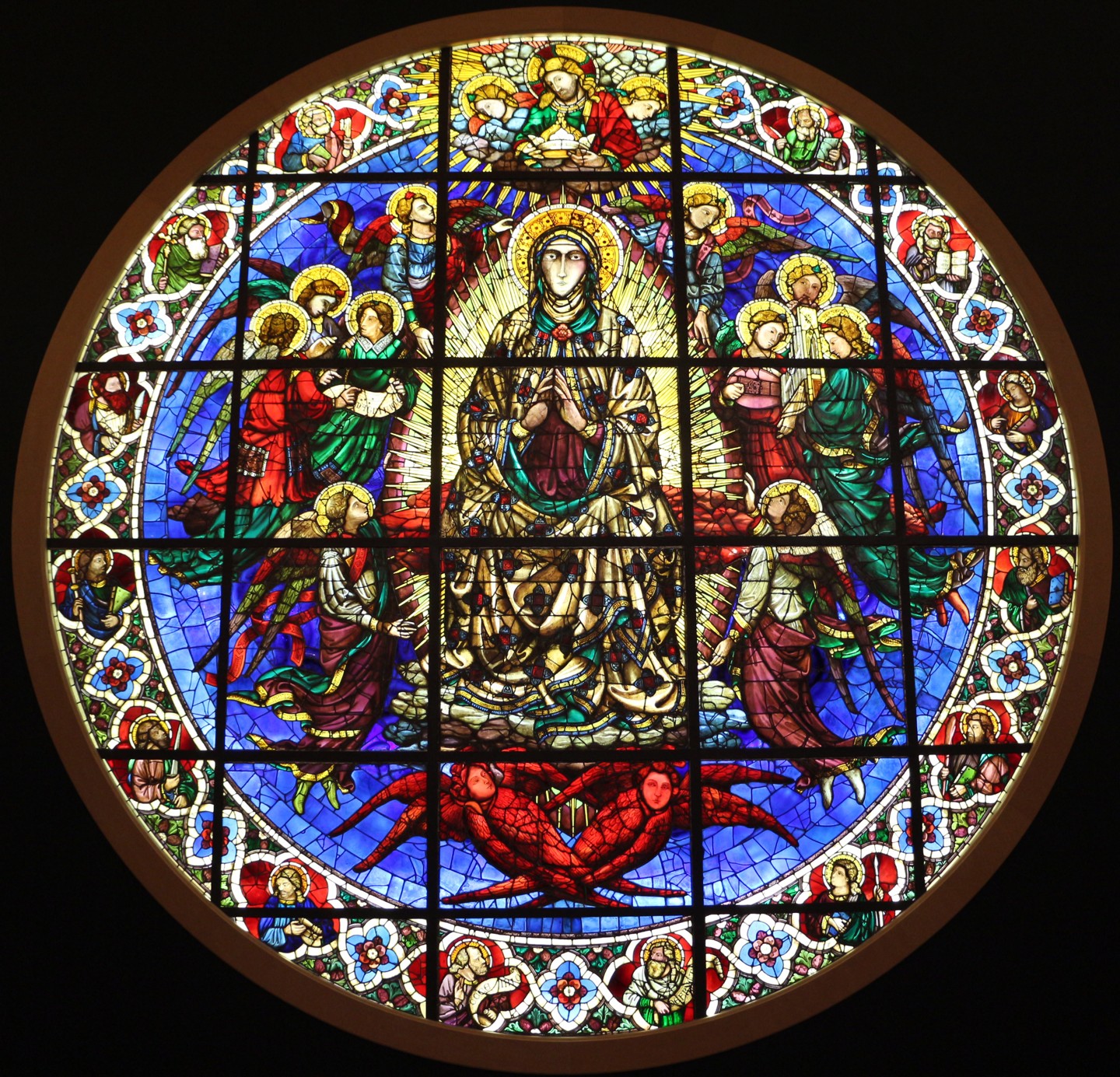
While the first door was still in progress, the Opera of Santa Maria del Fiore began paying Ghiberti for designs that would be realised by other craftsmen. The large Assumption of the Virgin on the inner face of the cathedral façade was among his early projects for the building. In the surviving roundel for Saints Stephen and Lawrence, made in 1412–15, the Opera credits the design to Ghiberti and the execution to Nicolò di Piero Tedesco. The paired saints are seated, with their haloes held well clear of the perimeter and their broad masses of drapery carrying the symmetry down to the bottom of the circle.
The identities of the two figures remain distinct within that symmetry. The window had to read as a whole from far below, where the arrangement of the bodies and areas of colour matters long before the eye can follow an individual line. The attribution here attaches to an agreement between recognisable kinds of work. The design supplied a figure and an arrangement that a glassmaker could turn into a window, using the resources of his own trade. [2] [4] [17]
The cathedral works drew on Ghiberti in less visible ways. In September 1418 the Opera authorised support for his model for the cupola. On 16 April 1420 he received a salaried appointment connected with the construction. Haines and Battista distinguish Ghiberti and Brunelleschi, the two provveditori charged with oversight, from Battista d’Antonio, the Opera’s regular capomaestro. The titles describe a distribution of work on the site.
A salaried appointment tells us who was expected to participate in its management at a given date. A model points to a contribution at the stage of developing or considering proposals. Responsibility for devising the structure and directing its execution requires a further judgement about the evidence. In 1423 the Opera singled out Brunelleschi’s leading role. Ghiberti’s own later assertion of parity belongs beside, and has to be read against, the records of the building office. [2] [3] [6] [18]
On 28 June 1425 a record withheld Ghiberti’s salary despite his election. On 4 February 1425/26, in the archival edition’s double dating, a further election provided a salary. An August 1435 account again places him among the administrators of the cupola. Election, pay and responsibility for aspects of construction had separate histories. The Opera could continue to draw on Ghiberti while varying the terms of his service. [6] [18]
In July 1422 orders concerning bricks put Ghiberti to work on the quality and price of materials. The associated proceedings describe broad bricks that failed to correspond to a wooden form. The discrepancies had to be considered against a physical standard before the suppliers could be paid appropriately. This was a kind of judgement a man who handled materials and supervised production could make in company with others.
On 12 October 1425 the Opera credited him for making five bronze fittings for its lifting equipment. The account distinguishes the bronze supplied by the Opera from metal supplied by the goldsmith, priced with his workmanship. The same institution could ask him to assess other makers’ output and supply a part that would be handed on for others to use. [6] [19]
In March 1434/35 the Opera paid Ghiberti for a design for an oculus that was never used. Set beside the window executed by Nicolò di Piero Tedesco, the entry shows that the inventor’s role could be recognised and paid in its own right. The bricks, hoist and unused design belong to the working life of a man whom the archive still called a goldsmith. [6] [17]
Orsanmichele and monumental bronze
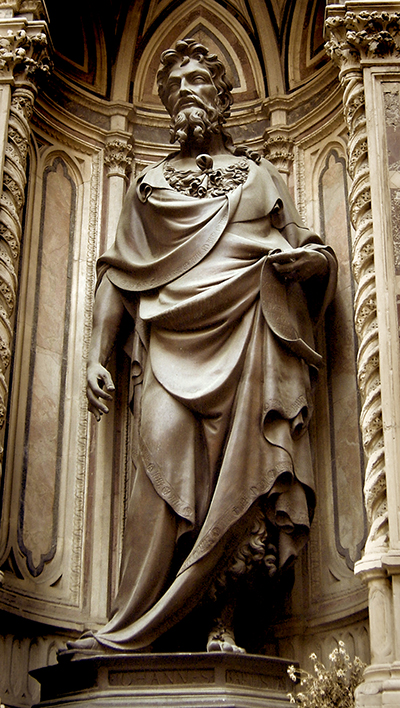
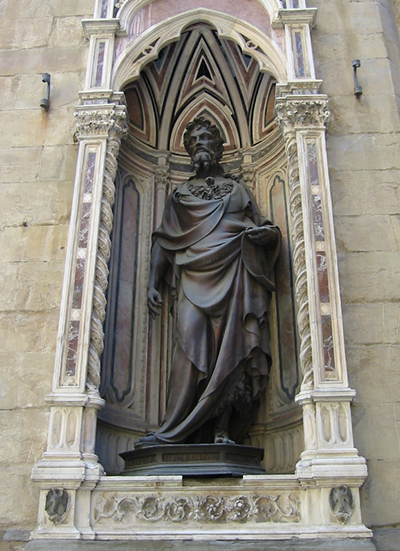
At Orsanmichele another group of records follows Ghiberti as three different guilds took responsibility for the bronze images of their patron saints. Calimala commissioned St John the Baptist, which Ghiberti says was put in place in 1414. La Bella relates 1414 to the beginning of casting and gives 1416 for installation, with payment for gilding following in 1417. Even the artist’s stated year has different implications depending on what the record means by beginning or setting up a statue.
The treatment of John’s cloak shows what became visible when an object of that scale was mounted above the street. Its long border travels down the figure in repeated curves and announces the turn of the body across a distance at which the finer work of the surface recedes. The guild had bought a public figure whose placement was an event distinct from its manufacture. [2] [3] [20]
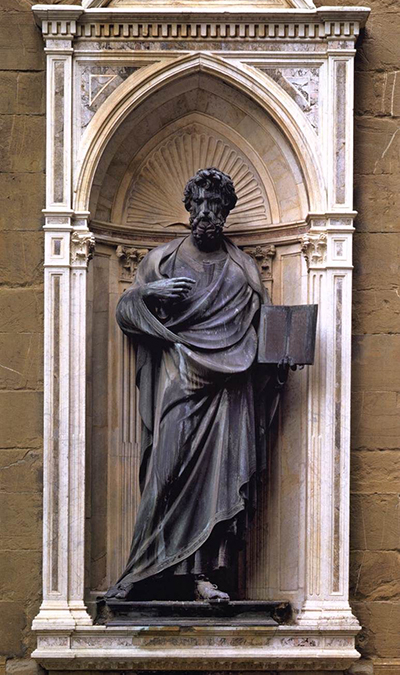
The bankers’ commission for St Matthew in 1419 is a more direct instance of where the cost fell when the work demanded another attempt. Ghiberti bore the expense of recasting the upper part. In the completed figure the head turns away from the open book while the silver details in the eyes and book articulate two different kinds of attention. There was an expense behind bringing those fine distinctions to view, even after the problem of the failed casting had been addressed.
Matthew was in place by 1422. The wool guild’s bronze St Stephen, funded in 1427 and in place by 1429, took a position previously occupied by a marble image associated with Andrea Pisano. The successive appointments show Ghiberti dealing with different guilds at the same building while cathedral oversight and the Siena reliefs made separate demands on him. They also explain his prominence among sculptors at the point when the Siena correspondence shows him asking for time and money. [2] [20] [21] [22]
The Siena font and the independence of the shop
The commission of 21 May 1417 gave Ghiberti two of the six reliefs for the new font in the Siena Baptistery. The Opera’s representative and councillors could specify the figures and the form of the scenes. They advanced one hundred florins to get the work under way. The first panel was due within ten months and was to be shown to them before and after gilding. After that inspection they were to determine the price for both reliefs.
A further period of ten months was allowed for the second panel, to match or improve on the first. The first bronze was thus expected to settle what they would pay and what they could reasonably ask for in the next. Even the allocation of six figures for the font was to wait for the first relief and its valuation. The commission set an order for making, looking and judging, in which the patron kept considerable authority beyond choosing a master. [1]
Writing in March 1424, Ghiberti told the cathedral official that an envoy had seen the reliefs almost finished. He attributed the delay to plague. He had gone to Venice and his workers too had left. He offered the end of June as a new date. The mention of the envoy makes the claim of progress verifiable by someone answerable to the patron. For the interruption we have the explanation of the man who needed more time to make good on his contract. [1]
On 16 April 1425 he wrote to Giovanni di Turino, a Sienese goldsmith who had offered to help clean one of the panels. Ghiberti says that Giuliano di Ser Andrea has one relief in hand and that he himself has the other. He expects to meet the date promised to the official. Then he gives a second explanation for the overdue work. His former partners had done him injury, he says, and he is glad to be out of their hands.
He resolves to be master of his own shop and receive friends there freely. This is the same letter in which he welcomes Giovanni’s offer and reports a trained colleague at work. For Ghiberti, dispensing with partnership could mean securing the right to direct a commission and decide whom to call on. There was still a place in that arrangement for help, friendship and the work of other masters. The complaint tells us what he wanted to change. His correspondents’ own accounts of that breach are absent from the exchange. [1] [14]
Ghiberti also asks Giovanni to recover sheets with birds that he says he lent to Goro. He believes they and other things formerly in Goro’s hands are with Domenico, a carver in wood, whom he asks Giovanni to approach. Designs or studies on paper could pass between practitioners in different materials. Ghiberti expected a friend in another city to know whom to ask about this loan. The birds’ appearance and purpose remain open. [1]
By August 1425 Ghiberti could name one relief in a request to the patron. At the official’s wish he had sent the Baptism to Siena. He now wanted it back to finish it. The Florentine tax officers had been promised its return within three weeks and the time was up. He also asked Siena to choose where to gild the panels. The relief moving between the cities was already identifiable by subject and worth showing to its patron.
Its movement could incur a charge and affect decisions about where it would be finished. A March 1426 letter names Michele da Santo Donato as the bearer of the returned reliefs and reports Ghiberti’s efforts to have the obligation cancelled, including his willingness to go back repeatedly to the office. The correspondence puts an object usually seen fixed to a font into the hands of agents, treasurers, carriers and officials. Its arrival at any one place was a stage of the job with consequences for what could happen at the next. [1]
Ghiberti estimated that the two panels would take gold costing about eighty florins or more and asked for a hundred to be sent. On 12 May 1427 he reported that gilding of the Baptism had begun. The other relief was otherwise ready. By 31 May the gold supplied had covered one panel. The letter with which this biography opens distinguishes Antonio di Jacopo Pini’s loan, close to two hundred florins, from the gold then needed for the remaining work.
After a further twenty-five florins were arranged through the banker, Ghiberti wrote that both panels were finished and could be collected. He wanted the outstanding sum directed to Pini. The moment of delivery was, for the shop, also a moment at which its creditor expected to be paid. Siena could commission bronzes and make advances, yet the sequence still left an interval in which the maker needed credit of his own. [1]
For the price of the work, Ghiberti referred the current official to his predecessor’s memorial book and to people who might remember the negotiations. In his account Caterino Corsini had proposed 220 florins for one relief and he had wanted 240. Corsini had urged him to go ahead with an assurance that he would be satisfied. He mentions four figures separately, for which there had been no agreement on price, and offers to make them. These were offers and demands recalled by one side. A commission framed around appraisal could reach the point of collection with the price still disputed. [1]
On the finished font the Baptism focuses attention on the hand with which John reaches over the head of Christ. The flanking bodies and the shallower setting give this small gesture its space. In the companion scene the Baptist is brought before a ruler and the exchange of gestures is spread among several figures. The works could be read around the same basin while asking quite different things of the people making them. Ghiberti named both subjects among his own commissions. His letter establishes Giuliano’s responsibility for work on a panel, whose subject it leaves unnamed. The font preserves the result of a commission entrusted to Ghiberti, while the letters recover work and bargaining that could fall to others besides the master. [1] [3] [23]
The second door and the cathedral shrine
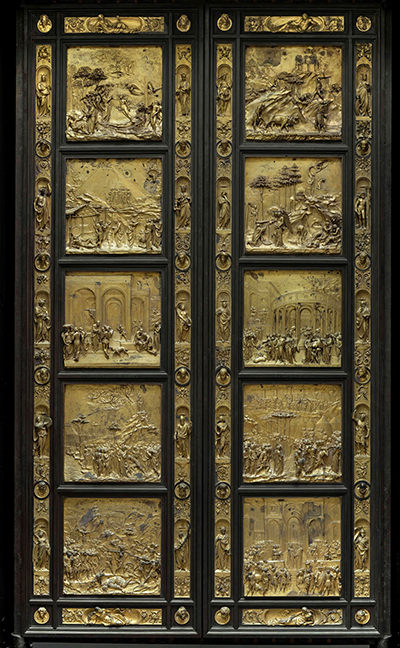
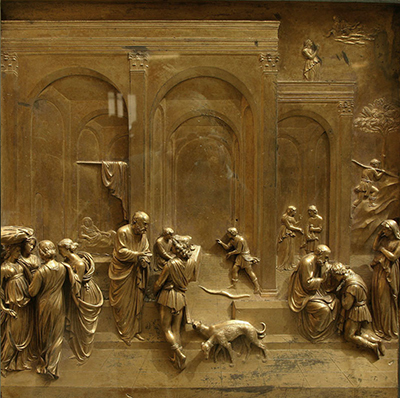
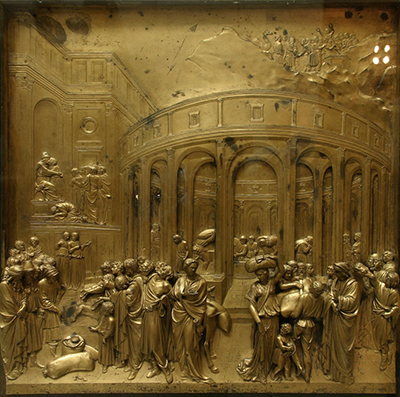
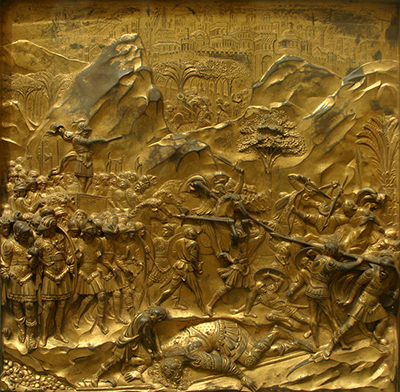
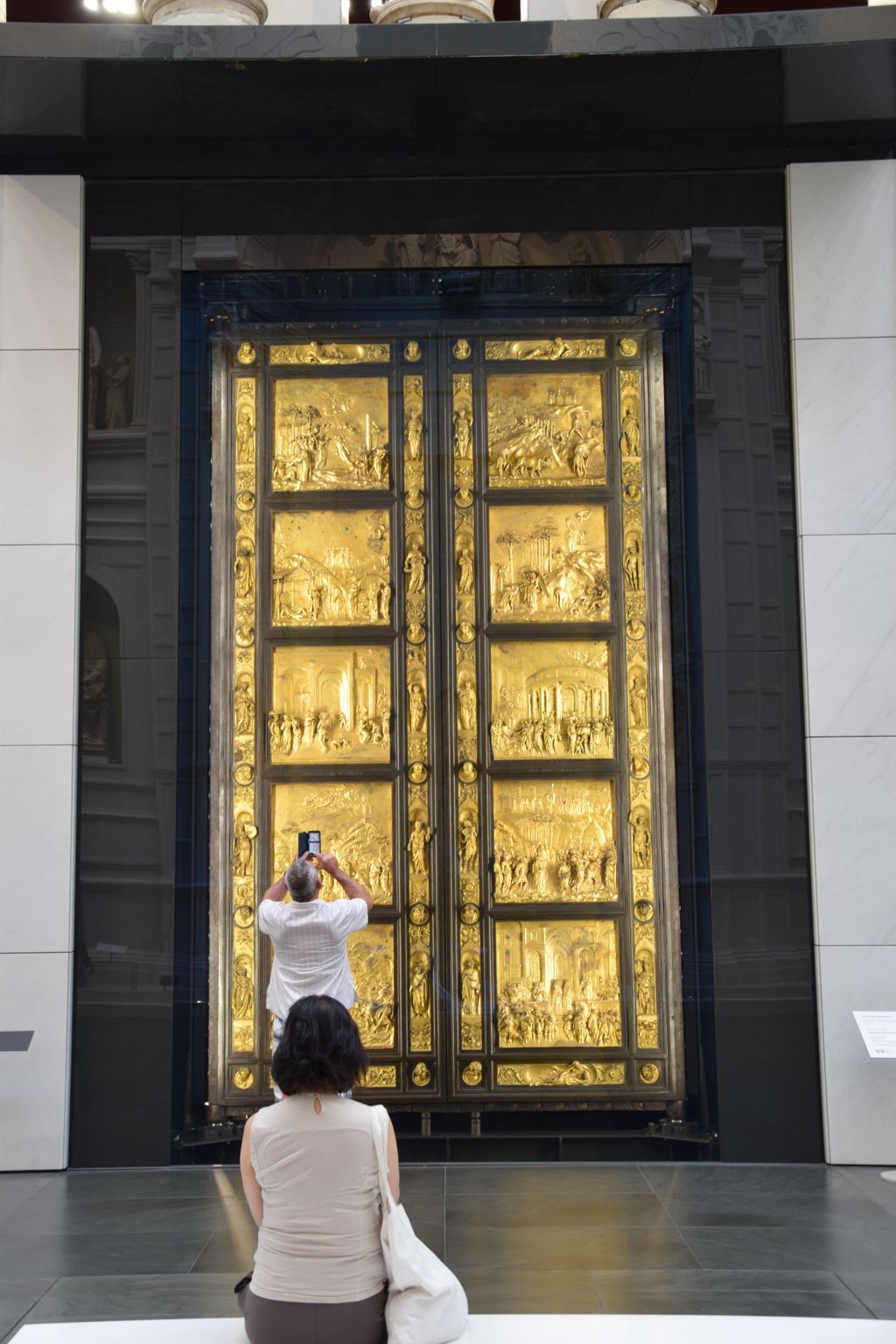
The agreement of 2 January 1425 for the second Baptistery door opened a long commission while the font reliefs were still on Ghiberti’s hands. Leonardo Bruni proposed a programme with twenty Old Testament scenes and eight prophets. Ghiberti later wrote that he had licence to carry out the work as he thought best. The completed door has ten large reliefs. The proposal documents the kind of advice available in a project where format and choice of subjects could both change substantially. Bloch places Ghiberti in contact with scholars including Ambrogio Traversari and Palla Strozzi, evidence of the company in which he could discuss antiquity and sacred history. [3] [7] [24]
The Gates of Paradise
By April 1437, on Bloch’s reconstruction, the major panels for the Gates of Paradise had been cast. Four still awaited finishing in 1443. Michelozzo returned in 1437 to assist with chasing, and Benozzo Gozzoli joined the workforce in 1444. Work on the frame, ornaments and gilding continued after the reliefs were ready in 1447. When Ghiberti described the work as his, he claimed its direction across stages that called for different kinds of judgement and assistance. [3] [7] [24]
The shrine of St Zenobius
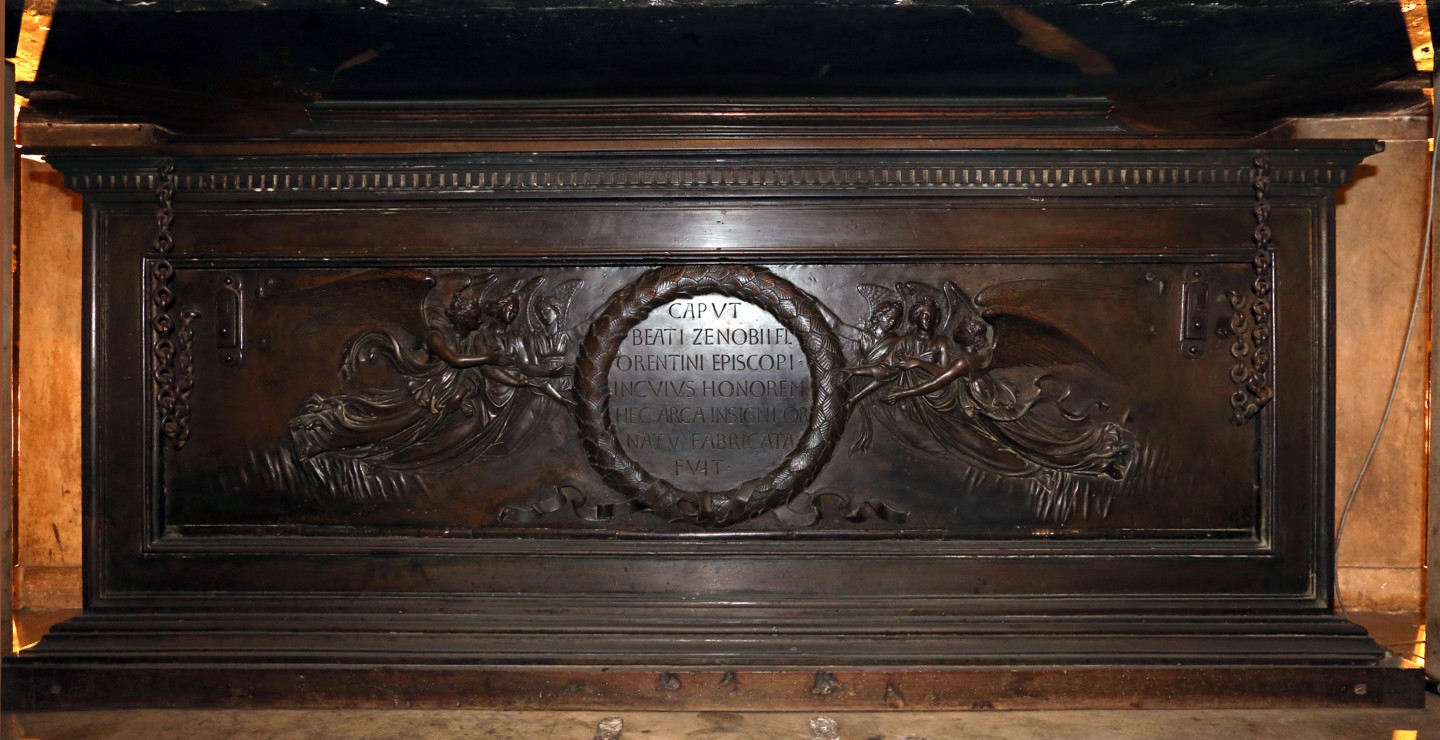
During the years of work on the Gates, Ghiberti won the competition for the shrine of St Zenobius in 1432. A draft agreement dated March 1431/32 in the archival edition describes a chest of prescribed length and height, with a lid to follow the model and framing left to Ghiberti’s judgement. The stories of the saint were subject to the instructions of two deputies.
Materials were described in some detail, with options for silver or other inlay and with a proposed limit of five thousand pounds including the bases. Surplus weight would have been at the master’s expense. These are draft terms, valuable for the distinctions the officials and the artist were working out. They give the model, the dimensions, the deputies’ choice and the amount of material separate authority over the shape the project might eventually take. [2] [4] [25]
The Opera was to supply brass, gold, silver, stone and other materials, together with wax, earth, ironwork, charcoal and timber. It would also pay the assistants, whose time Ghiberti had to record. The draft leaves the monthly amount for the master blank. It provides for the Opera to have his own workmanship appraised when the shrine was finished. It even provides for valuation of his work to date if he died before completion, leaving the Opera free to arrange for someone else to finish it.
Appraisal at Siena had been intended to set a price for two panels the goldsmith undertook to deliver. In the Zenobius draft, the separate provision for the workers and supplies makes it possible to see what the parties understood by payment for the master’s skill alone. The more of the workshop’s expenses the Opera assumed, the more it needed a record to distinguish those disbursements from the claim of the master. [1] [25]
The draft set four years for delivery and contemplated reassignment if the deadline was missed. Ghiberti lost the commission in 1437 and received it again in 1439. In April of that year the relics of the saint’s body were translated to a marble casket in the chapel crypt during the Council of Florence. La Bella dates the completion of Ghiberti’s bronze and the last payment to August 1442, after a decision to varnish the chest. Harpur records that the head reliquary by Andrea Arditi was placed inside Ghiberti’s casket that year. Two containers for different parts of the remains and two stages of their history are involved. [2] [4] [26]
Ghiberti’s account tells the story of the child on the front at considerably more length than it describes the conditions of manufacture. He remembers the mother leaving the child in the saint’s keeping and returning to demand him. The broad relief makes its horizontal length serve the telling, bringing figures towards the saint from either side. On the opposite face, angels gather around the wreath and inscription.
The change in what each face asks of the eye is also a change in what the chest communicates. One face lets the beholder follow the recovery of a life, the other announces the identity and honour of the person whose remains are housed there. The draft’s allocation of subjects to deputies and the artist’s later account of reading the finished fronts are evidence from different ends of the commission. In the surviving object the instructions have become figures, intervals and letters. [3] [25] [26]
Papal work and ancient gems
Two passages of the Commentarii bring Ghiberti’s work as a goldsmith into the sphere of papal patronage. He recalls making a gold mitre and a clasp for a cope for Martin V, with a figure of Christ blessing on the clasp. For Eugenius IV he describes another gold mitre. He gives the weight of the metal and stones, lists varieties of gems and pearls and ascribes a valuation of thirty-eight thousand florins to Florentine jewellers.
The figure is part of his account of the object’s magnificence. It is a valuation he reports, separate from the price of the commission or any amount known to have been paid to him. His description puts Christ and the Virgin at the centres of the front and back, their thrones surrounded by angels. The weight and value are there alongside an exact memory of how he divided the surface. [2] [3]
The carnelian, now in Naples, shows Apollo, Marsyas and Olympos. Ghiberti describes an older figure seated and bound to a dry tree, a kneeling child and a young figure with a stringed instrument. He reads the kneeling figure as seeking instruction. The scene is carved into a stone he compares in size to a walnut. The faces and limbs have room for very little incident. A line behind the seated body tells the eye where the hands are bound and the inclined body of the child directs attention to the figure with the instrument.
Ghiberti’s description records the posture and gestures he could distinguish, as well as the meaning he gave them. He considers either Pyrgoteles or Polyclitus as the cutter. Caglioti and Gasparotto identify the figure group with the Farnese carnelian in Naples and attribute the cutting to Dioskourides. The difference between their attribution and his gives a measure of the distance between an exceptional piece of Renaissance looking and the conclusions of modern study. [3] [27] [28]
Ghiberti gave the gem a gold setting and a dragon handle. He recalls the creature’s slightly open wings as part of the grip. He also says he cut letters in an antique manner naming Nero. A carved antique, a new support and an inscription were thus brought together in a single object. The popular name Seal of Nero preserves the effect of that combination.
In his account, the inscription belongs to his own work as surely as the grip. The carved scene can still be inspected, while the text is needed to imagine the goldsmith’s contribution and the touch of the hand that used it. The survival of the intaglio and the circulation of its composition in relief copies give different ways of recovering the interests it aroused. [3] [27] [28]
The Naples museum’s online presentation names Cosimo de’ Medici as the patron of the mounting. The stone certainly entered the Medici collection. Caglioti and Gasparotto reassess that connection through the written evidence and the copies. Their reconstruction puts Florentine civic possession and the stone’s passage through other hands into the story before it reached the Medici. The Commentarii names no patron for the mounting, and knowledge of the stone and access to it are all that Ghiberti’s own account requires.
An ancient composition could also reach someone who had never held the gem, through small cast plaquettes that gave its sunk image a raised form and made it available to more viewers. This episode places the sculptor within the traffic of objects between learned viewers, goldsmiths, people who could lend or commission a valuable work, and artists who would reuse its design. The same man who tried to recover drawings between Siena and Florence was at another moment entrusted with an ancient thing small enough to disappear into a hand. [1] [3] [27] [28]
Writing about art in his last years
Ghiberti’s Commentarii survives unfinished in a paper manuscript in the Biblioteca Nazionale Centrale di Firenze, Fondo Principale II.I.333. The Zurich record identifies the witness and reproduces a passage on Buffalmacco at folio 9 verso. It dates the work broadly to 1452–55. Temple proposes 1448–55 for the composition of the Third Commentary, after the main panels for the Gates had probably been cast. He considers whether experience of designing the door helped shape the writing. Dating the manuscript or the latest state of the text differs from dating the moment at which each part was conceived. The first edition and its divisions make the surviving text navigable.
In the form in which it is usually read, the first commentary concerns the ancient artists, the second considers more recent Italian masters and includes the writer’s own career, and the third attends chiefly to problems of sight and representation. That arrangement describes the text that survives and the way editors present it. Schlosser describes the surviving witness as a copy, retains an earlier editor’s chapter divisions for the second commentary and follows the manuscript’s spaces for unexecuted initials in the first and third. The chapter boundaries by which a reader navigates the work therefore include decisions made centuries after Ghiberti’s death. [3] [29] [30]
The Commentarii and Ghiberti's final years
Ghiberti’s description of Buffalmacco praises the freshness of his colouring and lists places where he worked. The reference to many scenes in the Camposanto at Pisa has proved consequential for attribution. It leaves open how much of a wall or cycle he meant. At folio 9v a judgement about colour, an attribution and an indication of place occupy a few lines. Each yields a different kind of evidence. [3] [29]
His own list employs different verbs for different forms of responsibility. He describes producing Matthew with his own hand, reports that he drew the likeness of the Dominican Leonardo Dati from life, and says he had the marble tomb of Lodovico degli Obizi and Bartolomeo Valori produced. The last formulation has room for work undertaken on his authority in another material, a distinction familiar from the agreements and letters. Elsewhere he lets an object stand for the whole commission, as when he lists both Siena reliefs without discussing Giuliano.
The sentences give a public account of his output that can be read against the more varied assignments disclosed in his correspondence. A catalogue of completed commissions leaves out delays, rejected suggestions and most of the people who held something in their hands along the way. Even within the selective catalogue, he could affirm particular kinds of contact, from observing a sitter to cutting letters or directing the making of a tomb. [1] [3]
The optical passages similarly keep a place for observations made in front of a thing. Reflected light on a polished surface can conceal fine marks. Touch can disclose what looking has missed. These examples concern the circumstances in which information becomes available to the observer. The careful hand that made a detail and the attentive eye that wanted to find it could be separated by a brilliant patch of light.
Temple argues that Ghiberti’s interest in such conditions belongs with both the inherited study of optics and the new possibilities of depicting space. The passages offer a reason to take his ambition as a writer seriously. A description of a relief as having very little actual projection yet seeming to have depth is part of a larger attempt to work out what the act of looking contributes to the appearance of what has been made. [3] [30]
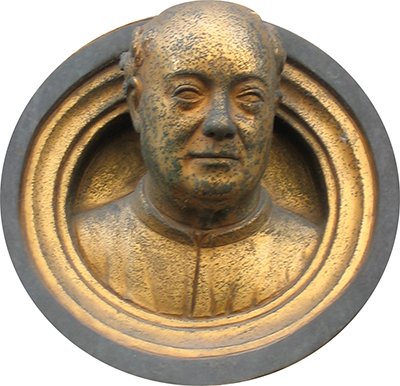
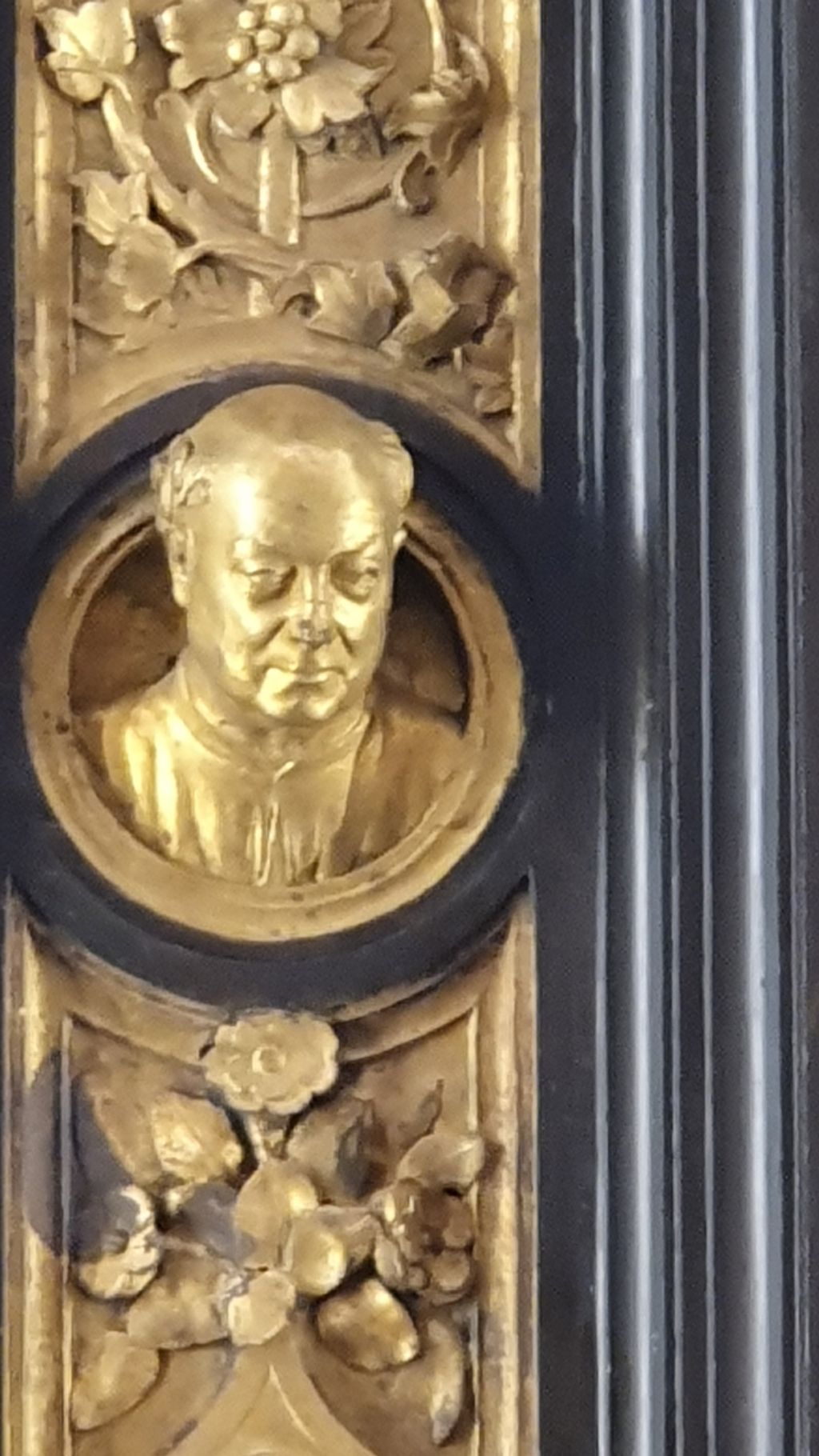
The installed Gates also gave the family a place within the object. The portrait heads identified with Lorenzo and his son Vittorio occupy the border among other human heads. They project towards the space in which a visitor stands while the scenes in the adjoining fields open towards biblical settings. The father and son are joined in the frame, where making and maintaining the whole door had called for work of a different kind from giving each scene its composition.
Vittorio had assisted on the commission. The door was installed on the Baptistery’s east side in July 1452, and the earlier door was moved to the north. In 1453 father and son jointly took on a surround for Andrea Pisano’s door. The new agreement gives the family relationship a contractual place after years in which Vittorio had been part of a changing workforce. [2] [7] [13] [24] [31]
The surviving South Door surround is Vittorio’s work. The Opera dates it to 1453–66. Near its foot, Adam and Eve and their children support the vessels from which the ornament grows. Leaves and fruits establish a continuity with the work of the Ghiberti shop, and the grouping at the base gives the successor’s commission a beginning of its own. By working around an existing door Vittorio took on a recognisable responsibility after years of contributing to his father’s commissions. [7] [13] [31]
Lorenzo died in Florence on 1 December 1455 and was buried in Santa Croce. His name remains on the east door, and his letters preserve the name under which much of its work went forward. One was a way of telling people who encountered the monument whom they should remember. The other introduced a goldsmith who could ask a colleague for help, send for gold and tell a patron it was time to pay. [1] [2] [3] [4] [7]
Lorenzo Ghiberti in context
International Gothic in Florence and Siena
c. 1395–1430 (approximate)Lorenzo Ghiberti
c. 1378–1455Filippo Brunelleschi
1377–1446Donatello
c. 1386–1466Sacrifice of Isaac
1401 competitionNorth Doors
1403–1424St John the Baptist
c. 1414–1416St Matthew
1419–1422Gates of Paradise
1425–1452St Stephen
c. 1427–1429Lorenzo Ghiberti sculpture directory
Discussion
Ghiberti rewards slow looking: relief, gilding, narrative structure, workshop practice and conservation evidence can all change how a work is read.
Join the Conversation
Have an observation about Ghiberti Biography, a source to add, or a comparison that sharpens the reading? Share it below.
References
- Vittorio Lusini, Il San Giovanni di Siena e i suoi restauri (Florence, 1901), appendix no. 3, Pergamena 1437, pp. 96–98, and letters nos. 5–11 and 13, pp. 99–104. Digitised edition, Appendix View source.
- Carlo La Bella, “Ghiberti, Lorenzo”, Dizionario Biografico degli Italiani, vol. 53 (2000), entry on family, training, commissions and civic appointments. Treccani entry View source.
- Lorenzo Ghiberti, I commentarii, ed. Julius von Schlosser, vol. I (Berlin, 1912), preface, pp. ix–x, and printed pp. 43–51 and 60–62. Editorial preface, Second Commentary, Gusmin and ensuing career account and Third Commentary, sight and touch. View source 1. View source 2. View source 3.
- Opera di Santa Maria del Fiore, “Lorenzo Ghiberti and the Opera del Duomo of Florence: Beauty, Technique, and Thought”, career account and captions for the North Door, glass and St Zenobius shrine. Opera article 12032 View source.
- Johann Wilhelm Gaye, ed., Carteggio inedito d’artisti dei secoli XIV. XV. XVI., vol. I (Florence, 1839), doc. LV, “Supplica di Lorenzo Ghiberti alla Signoria di Firenze”, pp. 148–155. Digitised edition, document LV and printed resolution, p. 155. View source 1. View source 2.
- Opera di Santa Maria del Fiore and Max Planck Institute for the History of Science, Gli anni della Cupola, “Lorenzo di Bartoluccio”. Records o0201074.020f and o0201077.034a for the model and appointment, o0201086.025vb, o0202001.171a and o0801002.052vb for salary, election and accounts, o0201081.005d and o0201081.006vb for materials, o0204009.110f for fittings and o0204013.092vf for the unused design. Archival personnel index with links to documents View source.
- Opera di Santa Maria del Fiore, Porta del Paradiso, scientific catalogue 1320, inscriptions and historical description. Catalogue record and photographs View source.
- Musei del Bargello, “Donatello and the Dawn of Renaissance”, the two trial reliefs. Bargello itinerary View source.
- Ministero della Cultura, Sacrificio di Isacco, Ghiberti, 0900287017, and Brunelleschi, 0900287016. Ghiberti catalogue record and Brunelleschi catalogue record. View source 1. View source 2.
- Antonio di Tuccio Manetti (attributed), The Life of Brunelleschi, ed. Howard Saalman, trans. Catherine Enggass (Pennsylvania State University Press, 1970), pp. 49–51, lines 290–300. See also the parallel competition passage, pp. 9–11, in the UFRGS-hosted Portuguese translation. Saalman–Enggass edition record and Portuguese text. View source 1. View source 2.
- Giorgio Vasari, Le vite de’ più eccellenti pittori, scultori e architettori (1568), “Filippo Brunelleschi”, competition narrative beginning with the deliberation dated 1401. 1568 text View source.
- Fabian Jonietz, “The Burden of Success in Quattrocento Sculpture”, in Synagonism: Theory and Practice in Early Modern Art (Brill, 2024), pp. 230–271, especially p. 253 on the claim for Donatello. Author-posted chapter View source.
- Opera di Santa Maria del Fiore, Porta Nord del Battistero, scientific catalogue 3618, historical description, inscriptions and sources, including Archivio di Stato di Firenze, Strozz. L I, I, fols. 79–79v. Catalogue record and photographs View source.
- Richard Krautheimer with Trude Krautheimer-Hess, Lorenzo Ghiberti, vol. II, Appendix D, documentary transcripts, pp. 366–401, doc. 2, and Appendix E, digest, pp. 402–421, entry 4. JSTOR volume with appendix excerpts View source.
- Thomas Patch and Giovanni Battista Gregori, Libro della seconda, e terza porta di bronzo della Chiesa di S. Giovanni Batista di Firenze, c. 1772–74, Soane Museum holding b5638. Soane collection record View source.
- Luca Boschetto, “Ghiberti e i tre ‘compari’. Un nuovo documento sulla fusione dei telai della seconda porta del Battistero”, Mitteilungen des Kunsthistorischen Institutes in Florenz 53 (2009), pp. 145–149. University of Florence abstract by the author View source.
- Opera di Santa Maria del Fiore, “Lorenzo Ghiberti, Santi Stefano e Lorenzo”, cathedral window 9135, maker fields and object description. Opera record and photograph View source.
- Margaret Haines and Gabriella Battista, “Un’altra storia. Nuove prospettive sul cantiere della cupola di Santa Maria del Fiore”, Gli anni della Cupola – Studi (2015), introduction and n. 26. Opera and Max Planck edition View source.
- Opera di Santa Maria del Fiore and Max Planck Institute for the History of Science, The Years of the Cupola, document o0204011.004vh, 23 July 1422, on pricing broad bricks, and o0204009.110f, 12 October 1425, on five bronze fittings. Brick extracts and bronze fittings transcription. View source 1. View source 2.
- Musei del Bargello, “Orsanmichele”, the guild commissions, and Ministero della Cultura, San Giovanni Battista, 0900291908. Bargello museum record and Baptist catalogue record. View source 1. View source 2.
- Opificio delle Pietre Dure, “Lorenzo Ghiberti, San Matteo, 1419–1422, Chiesa di Orsanmichele, Firenze”, restoration record GR 11549. Conservation record View source.
- Ministero della Cultura, Santo Stefano, 0900291899. National catalogue record View source.
- Opera della Metropolitana di Siena, “Baptistry of San Giovanni”, font and reliefs. Siena Baptistery record View source.
- Amy R. Bloch, Lorenzo Ghiberti’s Gates of Paradise: Humanism, History, and Artistic Philosophy in the Italian Renaissance (Cambridge University Press, 2016), introduction, pp. 3–10, especially pp. 9–10 on workshop and chronology. Publisher’s excerpt View source.
- Opera di Santa Maria del Fiore and Max Planck Institute for the History of Science, The Years of the Cupola, draft agreement for the St Zenobius shrine, AOSMF I 1 4, cc. 94a–95a, March 1431/32. Related draft entries and transcription o0101004.095a. View source 1. View source 2.
- Alison Harpur, Studies in Visual Culture and the Council of Ferrara-Florence (1438–1445), doctoral thesis (UCL, 2023), vol. I, pp. 64–66, on the relics and bronze commission. UCL repository copy View source.
- Francesco Caglioti and Davide Gasparotto, “Lorenzo Ghiberti, il ‘Sigillo di Nerone’ e le origini della placchetta ‘antiquaria’”, Prospettiva 85 (1997), pp. 2–38, especially fig. 1, the introductory provenance discussion and the treatment of the Florentine and Medici evidence. Article reproduction View source.
- Museo Archeologico Nazionale di Napoli, Farnese collection, Apollo, Olimpo e Marsia, known as Sigillum Neronis, inv. 26051. Gems collection and museum image and inventory identification. View source 1. View source 2.
- University of Zurich, Written Camposanto, “Lorenzo Ghiberti (1378–1455), Commentari (1452–1455)”, BNCF Fondo Principale II.I.333, fol. 9v, with Lorenzo Bartoli’s edition (Florence, 1998), p. 86. Manuscript identification and excerpt View source.
- Nicholas Temple, “Lorenzo Ghiberti and Contested Views of Perspectiva in Renaissance Concepts of Space”, Micrologus 29 (2021), pp. 239–263, especially the section “Gates of Paradise” beginning on PDF p. 11. London Metropolitan University repository copy View source.
- Opera di Santa Maria del Fiore, “Vittorio Ghiberti, Cornice della Porta Sud”, record 9176, date and object description. Opera catalogue record View source.