 by Tom Gurney
Tom Gurney BSc (Hons) is an art history expert with over 20 years experience
Published on June 19, 2020 / Updated on November 17, 2026
Email: tomgurney1@gmail.com / Phone: +44 7429 011000
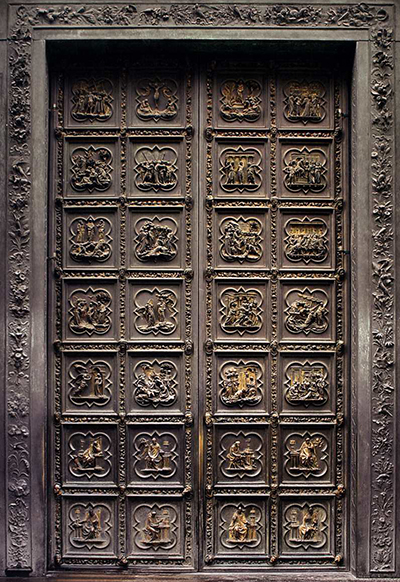
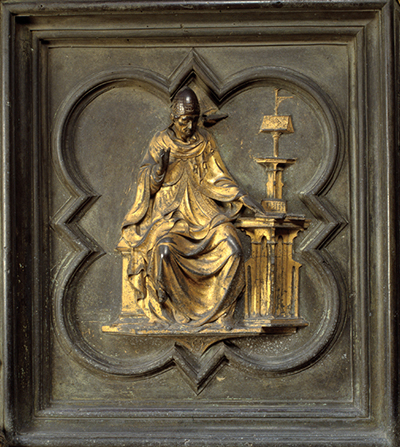
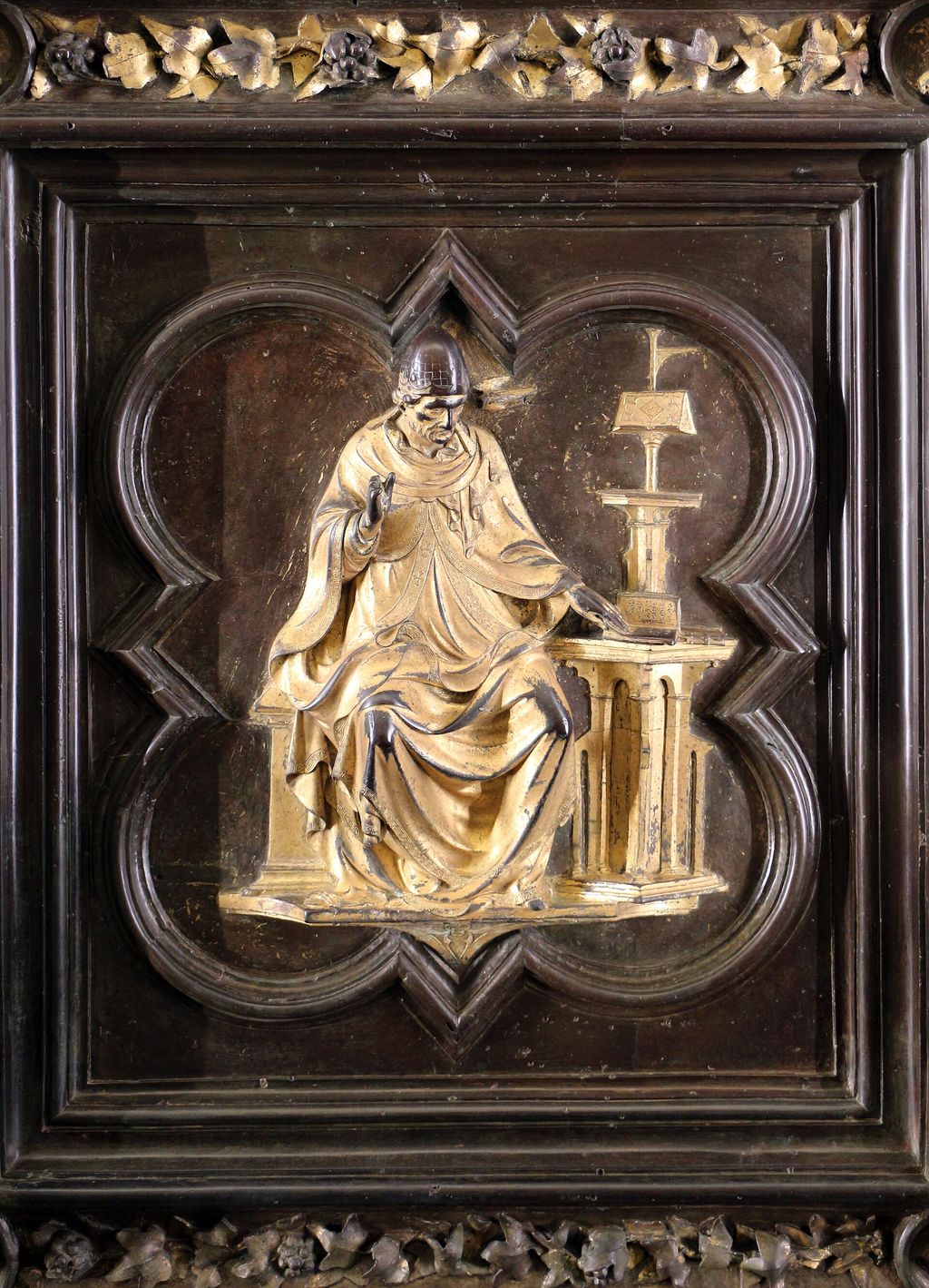
Gregory sits with his knees facing out and his head dipped towards an open book. His left hand reaches down to the volume while his right rises in front of his chest. The Opera del Duomo reads the lifted hand as a blessing and identifies a detail on a much smaller scale: a dove at Gregory’s left ear. From a view of the whole North Door of the Florence Baptistery, the raised hand and tall cap help pick him out. The dove takes a closer look. The panel brings together three different actions: attending to a book, receiving inspiration and blessing a viewer. [1] [2] [3]
Contents
- The figure beneath the pointed frame
- Where the hands lead
- The dove beside Gregory’s ear
- The duties of a teacher
- An interpreter below a Gospel writer
- Seeing the original bronze
The figure beneath the pointed frame
Gregory is third from the viewer’s left in the lowest row, the first figure across the central seam onto the right leaf. His rounded headpiece rises beneath the upper point of the quatrefoil, the four-lobed frame around the panel. A narrow band runs above the brow. In the next relief to the right, Ambrose’s angular mitre gives a bishop’s headgear a distinct outline within the same format. Barely more than the height and profile of the caps is needed to tell them apart at a distance. Gregory’s banded headpiece and the richly edged garments below it are the clearest visual signs of the papal dress described in the catalogue. [1] [2] [3] [4]
Look across the seam in the other direction. Jerome, like Gregory, has his furniture on the viewer’s right, but his uncovered head and shoulders incline towards the cabinet and both hands gather at the books. Gregory angles his head towards the desk while keeping his chest and knees comparatively square to the viewer. Deep folds between his knees give the body a broad base, and the curve of the sleeve sets off the hand at his chest. The shared position of the furniture makes the difference in posture especially clear: Jerome draws the eye into his work space; Gregory leaves room for an outward gesture. [2] [3] [5]
Where the hands lead
Gregory’s lower hand meets the book on the desk’s projecting ledge. One side of the open volume tips towards the viewer, and small rows of marks make the surface read as a page. Above it a slender upright carries a patterned slope; below it tall arched recesses articulate the desk’s foot. The upper slope has an immediate effect on the composition even if its function is uncertain. It brings the furniture up nearly to the level of the headpiece, leaving an interval between the two at eye level. Lower down, Gregory’s extended sleeve bridges the gap between body and desk. [2]
The Opera’s description of this particular panel calls the two actions blessing and leafing through a book. Elsewhere in the same entry the Opera places Gregory in the tradition of saints portrayed writing at a desk. The close view gives firmer evidence for where the fingers rest than for what they are doing: they meet the open volume at the lower ledge, but a pen is hard to establish and the marks yield no secure title. The other hand is easier to follow. Its gathered fingers rise clear of the surrounding folds. Read as a blessing, the gesture directs attention out from the book even while Gregory’s head inclines towards it. [1] [2]
The dove beside Gregory’s ear
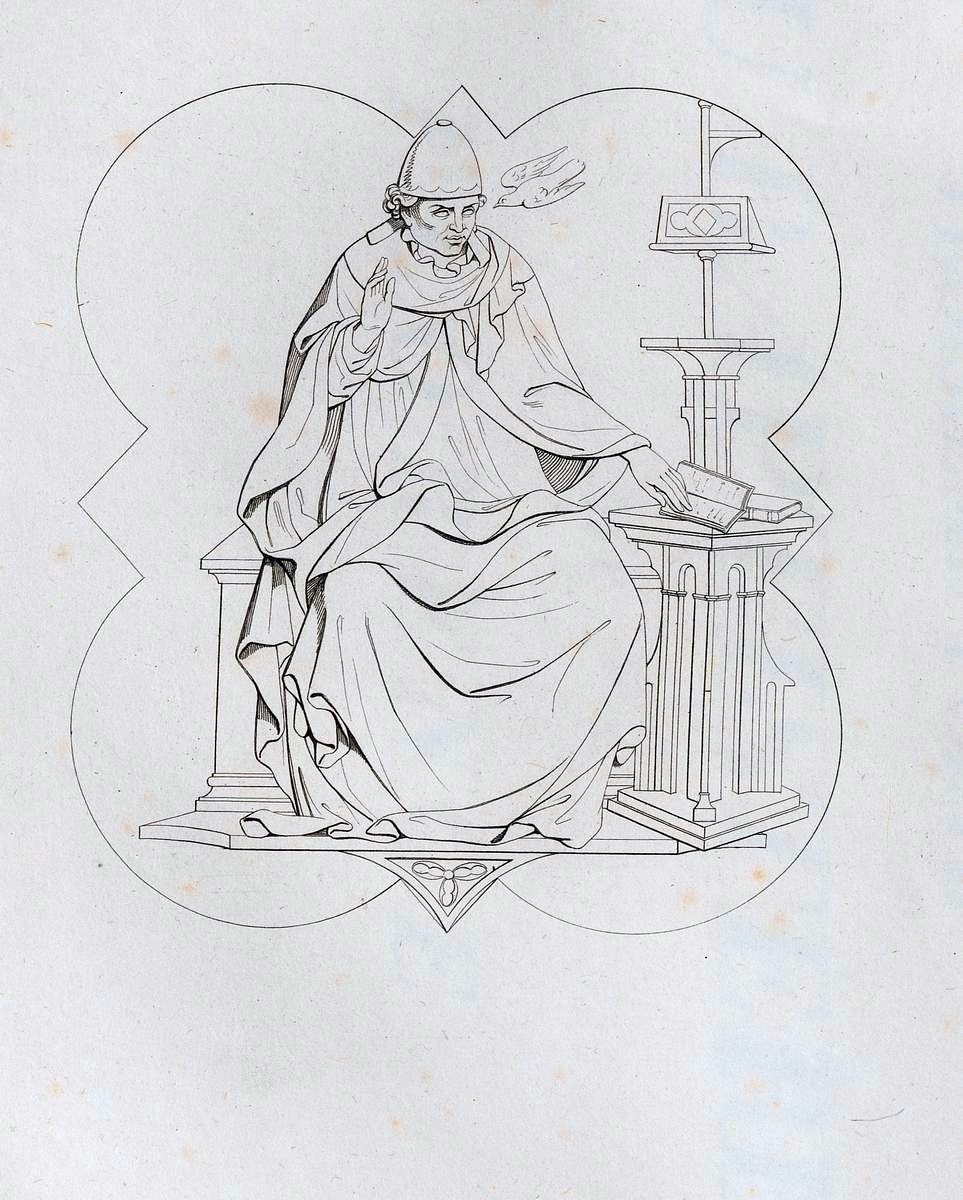
On the viewer’s right of the headpiece, a low projection reaches into the dark field. The catalogue identifies it as the dove at Gregory’s left ear and explains the tradition that the bird prompted him with what to write. In the 1821 engraving published in Le tre porte del Battistero di San Giovanni di Firenze, the bird has a distinct wing and a beak that points towards the pope.
The print makes its direction plain, while the photograph shows how little depth the form needs to occupy that gap in the bronze. The engraving places Gregory beside Augustine on the page; in the assembled door it is Jerome who sits across the seam. The print helps read the detail, and the whole door establishes its setting. [1] [2] [3] [6]
The duties of a teacher
Gregory I was Bishop of Rome from 590 to 604. At the opening of his Pastoral Rule, addressing a fellow bishop named John, he considers the responsibilities that come with taking office. He moves from the decision to assume it to the way a pastor should live, then to how he should teach and how he should examine his own conduct afterwards. In that sequence, teaching is one obligation in a life for which the teacher is himself answerable. It gives historical substance to the combination of papal dress and a book in the relief, whose pages carry no identifiable passage from the treatise. [1] [2] [7] [8]
In the prologue to Book III, Gregory compares a teacher to a player striking the differently tensioned strings of a harp. The player varies the stroke so that the strings sound together in one tune. Gregory draws a practical lesson: the same exhortation may help one listener and harm another, so a pastor must judge how to speak to each person while serving a common purpose. The relief gives no particular words to Gregory’s raised hand. What it does make visible, through the hand at the book and the gesture beyond it, is the passage from attending to a text to addressing other people. [1] [2] [9]
An interpreter below a Gospel writer
In his Commentarii, Ghiberti recalls that four Evangelists and four Doctors occupy the foot of the door below twenty scenes from the New Testament. The Opera reads the Doctors as interpreters of the message handed down by the Gospel writers. Gregory sits directly below Luke. Both figures have a book and furniture at the viewer’s right, but Luke leans more fully towards his work while Gregory’s raised hand interrupts the turn towards the desk. Seen in one column, the two panels give a local example of the relationship between the rows. Ghiberti’s account names the groups collectively and gives no particular text linking Gregory to Luke. [1] [2] [3] [10] [11] [12]
Seeing the original bronze
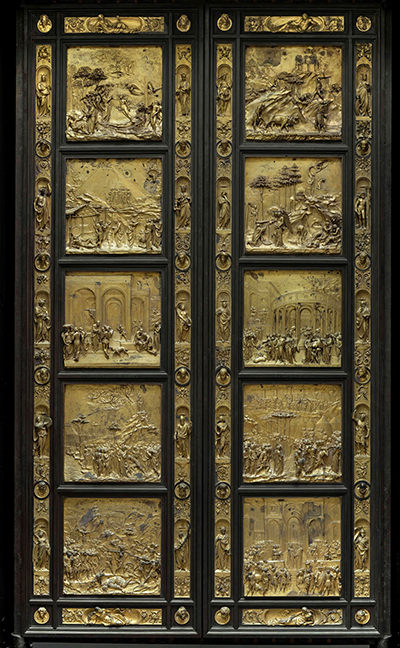
The Opera dates the North Door to 1403–1424. It reports Richard Krautheimer’s narrower proposal of about 1407 to around 1413–15 for the stylistic group that includes the Doctors. That estimate applies to a group; no individual casting year is established for Gregory. The door went up on the east side of the Baptistery in 1424 and moved north in 1452. The outdoor north entrance now carries a replica. In the Sala del Paradiso, look for Gregory on the original door. The Museo dell’Opera del Duomo identifies his relief as inventory 931.23. [1] [11] [13]
The Opificio delle Pietre Dure completed its treatment in 2015. The Opera’s account explains that mercury gilding was applied to the sculpted reliefs, leaving the bronze ground visible. In a whole-door view that contrast helps the rounded cap, broad garments and projecting hand hold together as a single figure against the darker field. In the close photograph, the intervals within the relief begin to matter as much as that silhouette: the left fingers meet the ledge, the right hand clears the chest, and the much shallower form of the dove comes into view at the ear. [2] [3] [14]
Lorenzo Ghiberti in context
Sacrifice of Isaac
1401 competitionNorth Doors
1403–1424St John the Baptist
c. 1414–1416St Matthew
1419–1422Gates of Paradise
1425–1452St Stephen
c. 1427–1429Lorenzo Ghiberti sculpture directory
Discussion
Ghiberti rewards slow looking: relief, gilding, narrative structure, workshop practice and conservation evidence can all change how a work is read.
Join the Conversation
Have an observation about Gregory the Great, a source to add, or a comparison that sharpens the reading? Share it below.
References
- Opera del Duomo scientific catalogue, San Gregorio Magno, Porta Nord del Battistero, inv. 931.23 View source.
- Sailko, close photograph of Gregory the Great on the original North Door, Wikimedia Commons View source.
- Yair Haklai, whole original North Door in the Museo dell’Opera del Duomo, Wikimedia Commons View source.
- Sailko, close photograph of Ambrose on the original North Door, Wikimedia Commons View source.
- Sailko, close photograph of Jerome on the original North Door, Wikimedia Commons View source.
- Le tre porte del Battistero di San Giovanni di Firenze (1821), plates XXIX–XXX, ETH-Bibliothek digitisation View source.
- Benedict XVI, general audience on Gregory the Great, 28 May 2008 View source.
- Gregory the Great, Pastoral Rule, Book I, introduction, translated by James Barmby View source.
- Gregory the Great, Pastoral Rule, Book III, prologue, translated by James Barmby View source.
- Lorenzo Ghiberti, I commentari, Book II, account of the North Door View source.
- Opera del Duomo scientific catalogue, Porta Nord del Battistero View source.
- Sailko, close photograph of Luke on the original North Door, Wikimedia Commons View source.
- Opera del Duomo, Renaissance clonation: the North Door replica View source.
- Opera del Duomo, La Porta Nord del Battistero, on the completed restoration and selective gilding View source.