 by Tom Gurney
Tom Gurney BSc (Hons) is an art history expert with over 20 years experience
Published on July 10, 2026 / Updated on November 17, 2026
Email: tomgurney1@gmail.com / Phone: +44 7429 011000
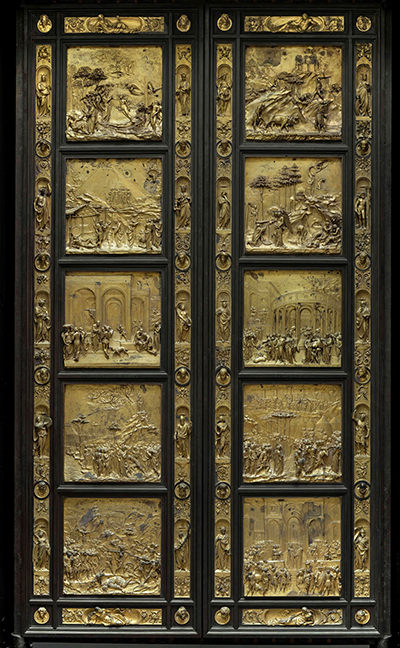
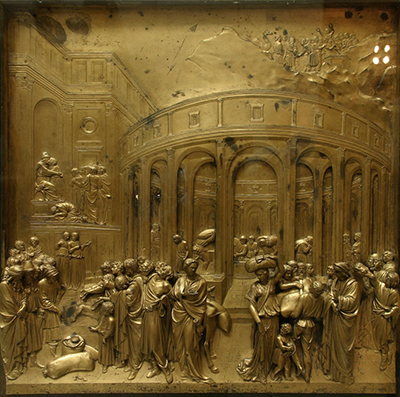
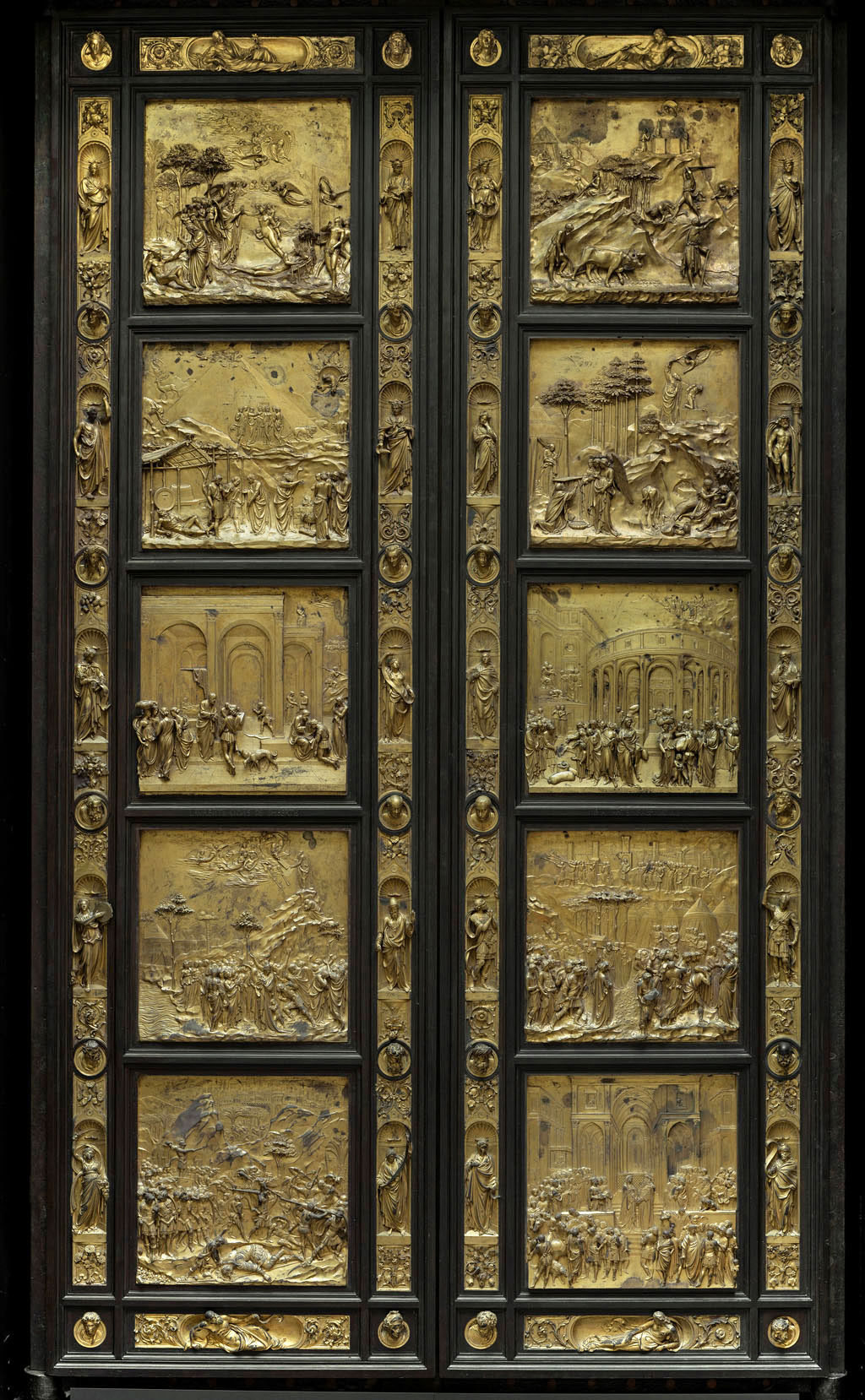
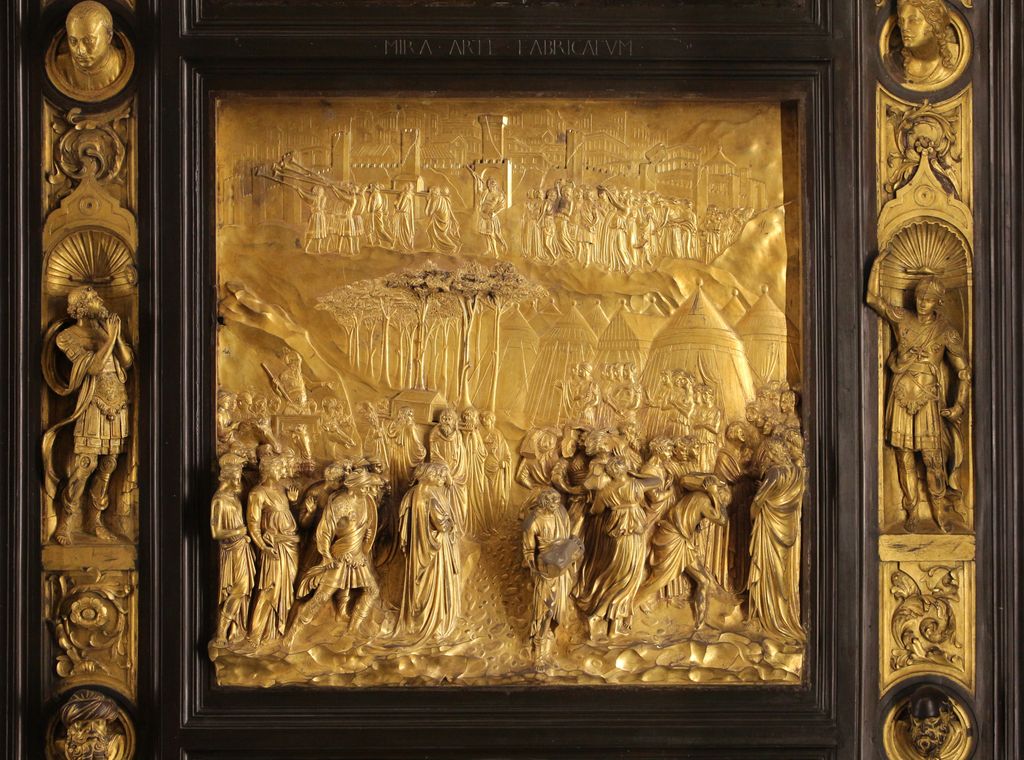
Across the upper part of Lorenzo Ghiberti’s Joshua relief, the roofs of Jericho rise behind walls crowded with little figures. Below them, tent ropes cross the low ground in lines so fine that a change in the light can make one disappear. Near the bottom, a man carrying a stone has room to turn his body and bring both arms forward.
The city reads as a place that could contain streets and buildings, though some of its roofs barely rise from the surface. On the reverse of the panel, branches made by a different set of lines end in places where metal was cut away. Those lines belong to the system that fed the cast. The workshop had to deliver the man and his stone, the crowded skyline and the slight ridges of the ropes in the same bronze. [1] [2]
A photograph of the front can show how a figure interrupts the shape behind it or how a polished fold takes the light. A recess at the back can preserve something of the working wax, and a radiograph can show an internal void that the finished face conceals. A sample smaller than a visible fold can distinguish the bronze from a repair or show what lies immediately beneath a film of gold. These traces range from lines that resolve into letters to a join that crosses the body of a statue. [1] [3]
Contents
- How much depth a door needs
- What the backs of the reliefs tell us
- What the channels and pores reveal
- What the alloy can tell us about separate pours and repairs
- A statue’s front and back
- Finishing the metal and applying the gold
- Why cleaning and display depend on what lies beneath the gold
How much depth a door needs
Follow the foreground stone in Joshua up to the first tents. Its near face has enough breadth to receive light as a plane, and its edge interrupts the body of the man carrying it. The ropes higher up also cross other forms, but they do so with very little bulk. They establish which surfaces lie in front by continuing across them, while the tents give those lines a destination.
Farther back, the wall of Jericho makes a long division across the roofs and bodies that rise behind it. Repetition does some of the work of modelling. A row of small heads implies a crowd even where there is room to give each head only a slight prominence. Relative scale, overlap and actual projection operate together. The small size of those heads suggests distance, while the edge of the wall keeps them in a particular place within it. [1]
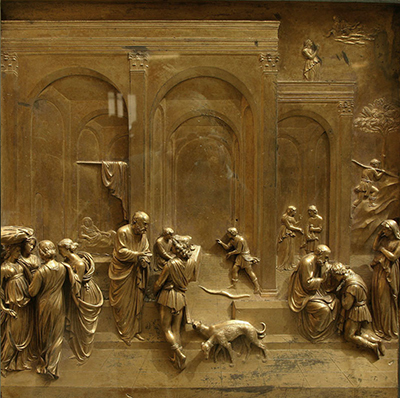
The architecture in Jacob and Esau supplies a different set of comparisons. The large arches establish an upright plane, then the visible sides of the piers, the underside of the vaulting and the lines of the pavement carry the eye inwards. Architectural features with recognisable counterparts let the eye estimate how much smaller each successive element has become. A pavement joint can contribute to that estimate with very little projection of its own.
The bodies nearer the front have a stronger physical presence. A sleeve can hide the upright behind it, and a leg can break into the field occupied by a pavement line. The architecture remains intelligible across those interruptions because its rhythm continues on the other side. In Joshua, the tents and the hillside supply a sequence of intervals. In Jacob and Esau, the building supplies edges along which the eye can follow recession even through a group of figures. [1] [4]
Writing about his work in the Commentarii, Ghiberti describes taking nature as a model and giving works of slight relief an appearance of standing out. In his account nearer figures present themselves as larger, with more distant ones diminishing in scale. The effect belongs to the encounter between the made surface and an eye at a distance.
A face in the background can be modelled with just enough turning of the planes to give it apparent roundness, since the observer already reads it as small and remote. Foreshortening supplies another cue. The visible width of a surface can suggest that it turns away even when the metal behind it occupies very little space. Across the two reliefs, projecting forms establish the material range against which the nearly flat passages can do their work. [1] [4] [5]
Nicholas Temple places Ghiberti’s casamenti, the represented buildings, within an account of vision that takes in optical writing as well as the construction of pictorial space. Later passages of the Commentarii consider how reflection can hide aspects of a surface and how touch can disclose features difficult to see. Those passages sharpen a practical distinction. Under side lighting, a shallow ridge can throw a small shadow and read as a definite edge. From another position, glare can run across the same area and suppress the division between planes. A diagram extending the lines of a pavement answers a question about the depicted building. It leaves a separate question about how much a bronze edge must turn to register in the available light. [4] [5] [6]
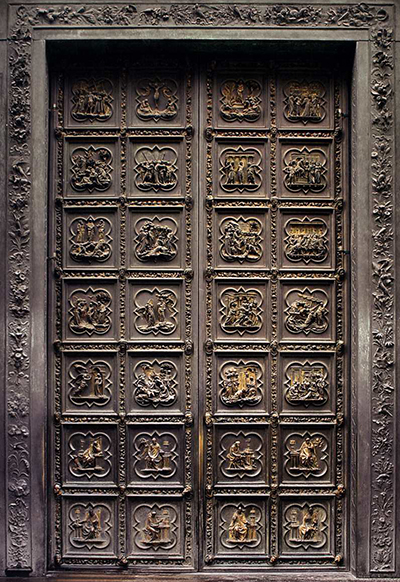
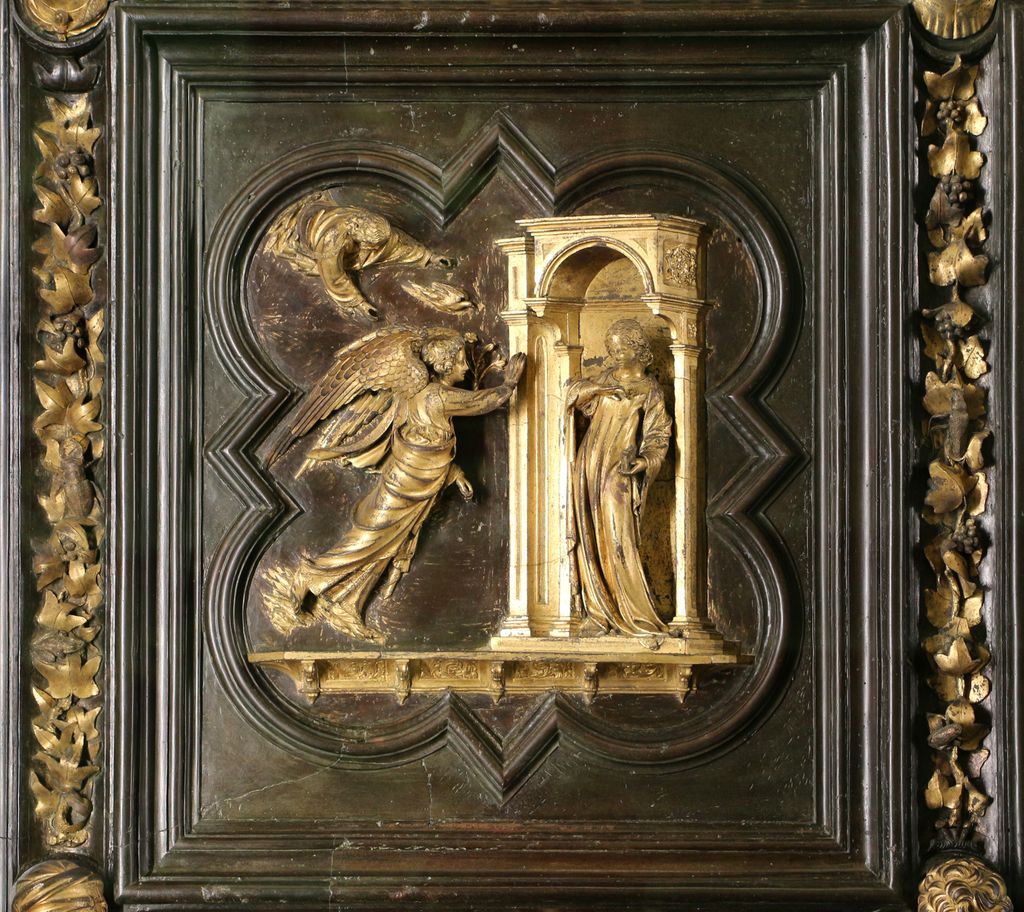
A comparison of the two Baptisms of Christ holds the subject steady while the treatment of relief changes. In the Florentine panel for the North Doors, the angels gather to the viewer’s left of Christ in a tightly overlapping group. Heads and shoulders still hold their own contours, with shadowed edges between them. In the panel for the Siena font, the heavenly figures gather into a much shallower, approximately circular formation above Christ.
The closeness of their relief to the ground allows the group to register as a luminous surround even while the bodies below retain a more emphatic sense of mass. It also allows the modulation at the top to spread across a broad area without breaking the outline of the central encounter into competing silhouettes. Seen at the scale of the whole panel, the amount of bronze relief is only one part of the difference. The relation of one angel to the next changes what the group does in the composition. [7] [8]
Fabian Jonietz reads the Siena work as a revision of Ghiberti’s own Florentine design and relates its shallower forms to Donatello’s use of extremely low relief, or rilievo schiacciato. The comparison is persuasive at the level of projection and grouping. The Florentine angels retain the presence of separate bodies, while the Sienese arrangement binds many bodies into one shallow field. The argument is an interpretation of artistic adaptation and precedent. The illustrations show the change in effect at the face of the works, and the same comparisons leave room for further questions about their waxes, metal thickness and working sequence. [7] [8]
What the backs of the reliefs tell us
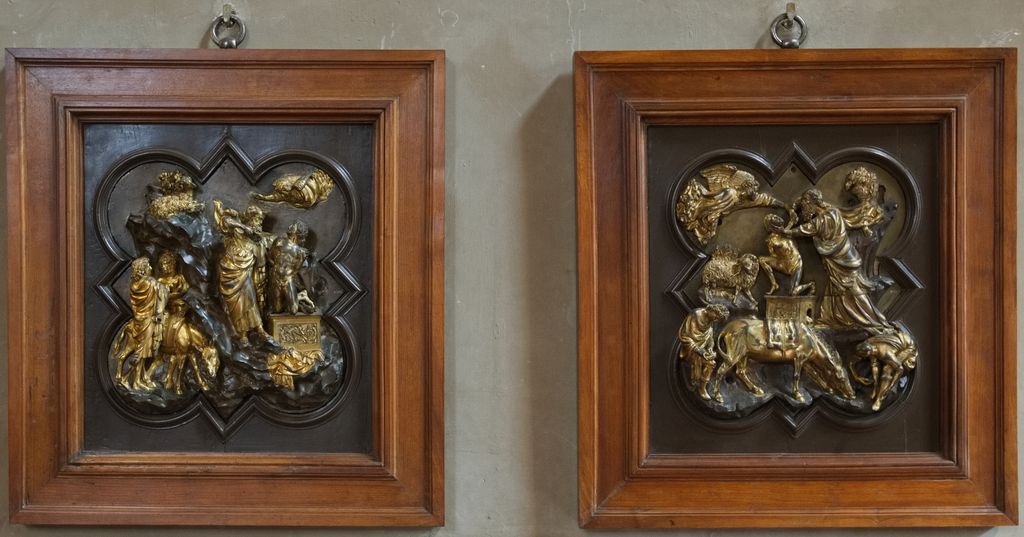
The surviving bronze reproduces both faces of a sacrificial wax. In the lost-wax process the workshop encloses that wax in heat-resistant material, removes it by heating, and fills the space it leaves with metal. A core or backing determines the inner or rear surface. The distance between that surface and the outer mould determines how much bronze occupies a given part of the cast. A projecting part of a relief can therefore be quite thin if a recess follows it behind. The protrusion that a viewer sees from the front gives the height of the sculpture at that point. A near correspondence between front and back tells us about the wall the founders actually had to cast. [2] [3]
Direct and indirect lost-wax casting differ in the making of the expendable wax. In a direct hollow cast, wax can be modelled over a core that will remain in place through the pour. The sculptor works on the very form that will be lost. In an indirect process, a mould taken from a model supplies the sacrificial wax, preserving the source form for possible reuse. A worker can then change that wax, add to it or repair it. A print from a finger in the cast could therefore survive from either process. It establishes physical contact with the wax at a particular stage, while the larger disposition of recesses, joins and marks can help establish how the wax took shape. [2] [3] [9]
Salvatore Siano, Piero Bertelli, Marcello Miccio and Ferdinando Marinelli worked across the two faces of the Gates of Paradise. On Cain and Abel, they compared concavities on the back with corresponding forms on the front, including areas where the relief is shallow. Imagine following the edge of a slight elevation on the face and finding a depression at the same point behind it. Hollowing only the largest projections would explain hollows behind the fullest bodies.
Systematic agreement down into low relief is stronger evidence that the rear surface was formed in relation to the front. Forming a wax against a mould that carries the image provides one way to achieve that relation. The back of the wax stays accessible for working while the face follows the impression. Three-dimensional recording helps make the comparison because the two surfaces can be aligned even where the relevant form is broad or difficult to pick out by eye. [2]
The team also identified marks interpreted as runs or strokes of wax applied with a brush, areas of thicker material, and occasional impressions left by hands. On Moses, the rear records local pressure and movement, including impressions and displaced material associated with working by thumb. Such traces are informative partly because there was little reason to make a display surface of the back before the pour.
In the indirect reconstruction, applying wax against an impression supplies the overall shape and produces a workable shell, while thicker material and hand pressure can establish or correct local thickness. A small fingerprint records a way of working at one point. The related shape of the shell across a much larger area supplies a different kind of evidence, which is why the two observations carry more weight together. [2]
Deep undercuts complicate reproduction from a mould. A bend that reaches back towards the background can lock an impression around a figure’s arm or a fold. The Italian team’s reconstruction allows for separately formed wax parts where projection would make release difficult, and for opening or refining undercuts on the working wax after it has been taken out.
A figure can look continuous in bronze after such work because its constituent wax shapes were joined before investment. Once the wax disappears, molten alloy occupies the connected space. The resulting metal has a different history from two separately poured metal parts subsequently fitted to each other. A hollow behind a head and an undercut visible around a shoulder can thus belong to decisions made at different points in preparing one casting. [2] [3]
The Art Institute of Chicago’s exhibition account records a competing reconstruction in which the reliefs were modelled directly in wax. Francesca Bewer, Richard Stone and Shelley Sturman proposed making the wax over a temporary core, as reported in the Getty’s technical study of Adriaen de Vries. The contrast concerns the origin of the working form. Both accounts can accommodate the fact that people pressed and altered wax.
The indirect proposal has a specific explanation for a continuous correspondence between comparatively shallow forms and rear concavities. The direct proposal makes it especially important to ask which features require a prior impression and which could arise while establishing or working a wax by hand. The Italian paper makes its comparison available in scans, photographs and experimental casts. The exhibition synthesis establishes the disagreement at the level of method, with considerably less detail about how its participants assigned each surviving mark. [2] [3] [9] [32]
There is a consequence for close looking at the finished bronze. A pronounced recess under a chin can be essential to the separation of the head from the body behind it. The clean, uninterrupted shadow of that recess is evidence for the result the workshop achieved. Its shape may owe something to the first model, the reworking of a wax or the tools brought to the cooled bronze. A positive identification becomes possible where another feature preserves the transition between stages, as with a line that continues over metal inserted into a casting flaw. An uninterrupted contour at the front makes the sequence harder to recover precisely because the workshop was successful in bringing the surfaces together. [2] [3] [9]
What the channels and pores reveal
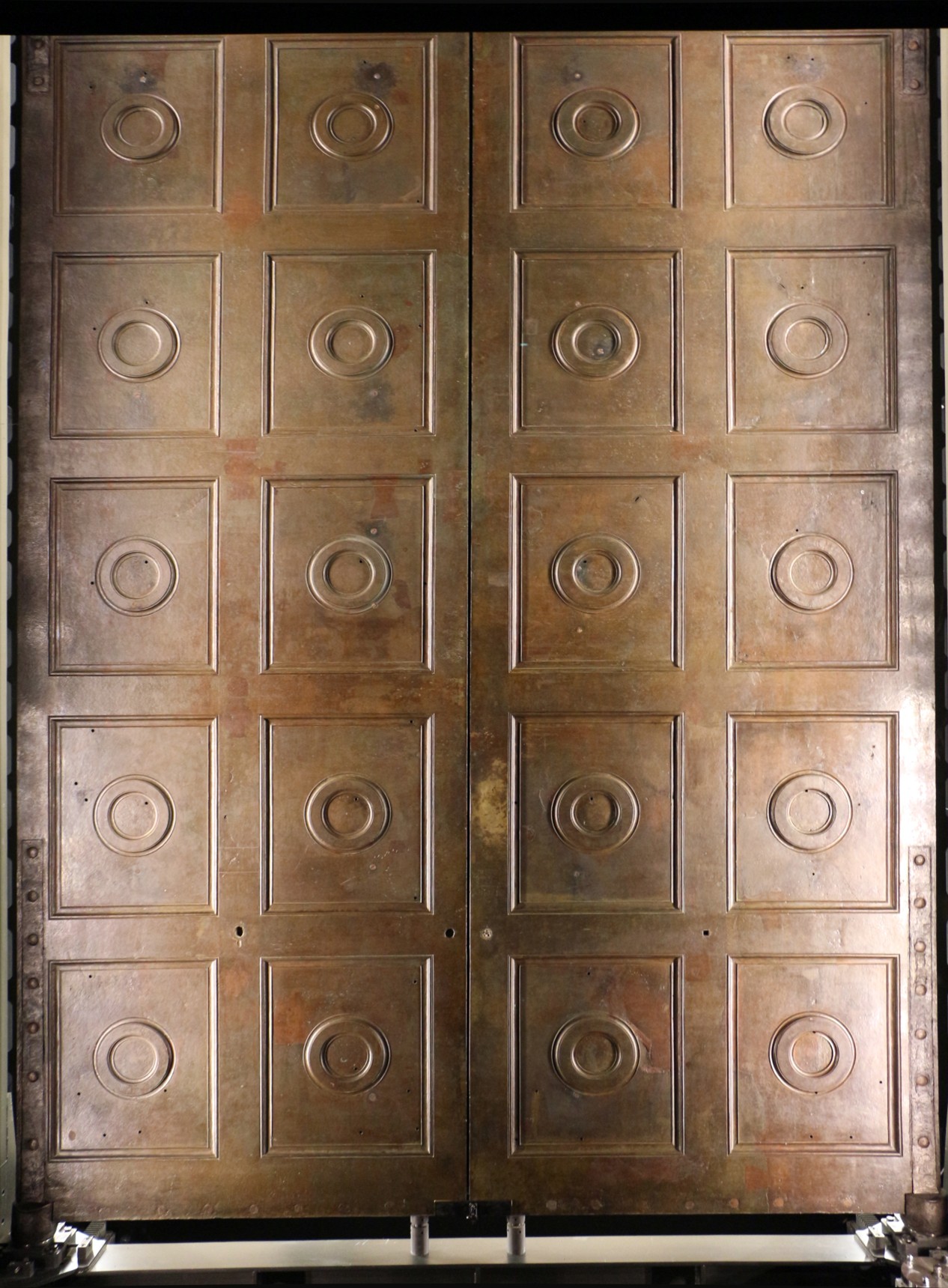
Wax rods attached to the back of a working relief establish passages through the investment. After the wax is removed, the passages allow bronze to reach different areas of the mould and gases to escape through outlets. Any passage that fills with metal will be attached to the casting when the mould is broken away.
Removing the resulting branches can leave a raised stub, a cut or a torn portion of the metal around an attachment. The channels thus belong to the material history of the bronze without representing any part of the story on its face. A shallow linear trace in isolation might resemble an incidental scratch. Its value changes if it branches, ends at a cut attachment and has comparable traces elsewhere along the same route. [2] [3] [9]
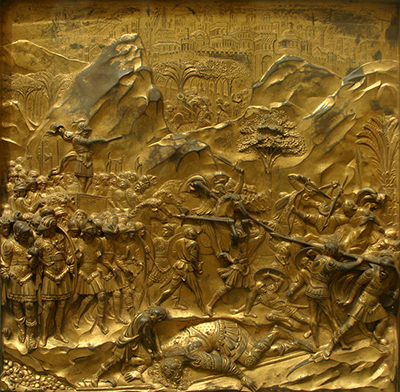
In figure 6 of the Italian study, the diagrams for the backs of Joshua and David plot the lines in relation to chisel marks and tears. The case for reading them as the remains of channels rests on that association. The workmen were removing metal fixed to a large cast, and the force used to detach it sometimes affected the adjacent bronze.
A tear marks such a point even where part of a branch has disappeared. The plotted pattern is therefore a reconstruction from remains with uneven survival. A stretch with few marks may reflect the extent to which the metal was dressed after removal. A branch scarcely visible in ordinary light can become more persuasive when seen as part of a succession of worked attachments. [2]
The composite radiograph of Joshua in figure 5 introduces evidence from inside the bronze. Voids transmit X-rays differently from solid metal. When the separate images are brought together, the position of the larger pores can be considered across the whole casting. In Joshua they are concentrated towards the top of the image, a distribution the authors compare with earlier radiographic findings on three other reliefs.
The Italian team uses that distribution to argue against pouring the piece in a horizontal position. A tilted or standing mould permits a persistent difference in level from one end of the panel to the other. The image alone gives no direct reading of the angle between the mould and the ground, and the pattern leaves open which way the relief faced. [2]
The distinction matters when reconstructing the system. A high part of the depicted landscape is high in the cast only if the workshop mounted the mould with that end up. A feeding arrangement also has to accommodate both the flow of incoming alloy and the behaviour of metal as it cools. In an area where the shell is thin, the space available for bronze is different from the space around a deep figure.
A void can register the combined effects of the shape of the mould, flow, gases and solidification. Reading the pores as a simple arrow on the back of the scene would place too much weight on one of those variables. On Joshua, the spatial distribution of voids narrows the choices. The physical cuts at the rear add a different constraint by showing where the cast was connected to external metal. [2] [3]
The investigators tried two channel arrangements using a model based on the Isaac panel, the relief also known as Jacob and Esau. The comparison made it possible to examine the shape of rear recesses and the kinds of marks left when channels were taken away. Similarities with the original made parts of the reconstruction credible. Neither experimental arrangement reproduced the historical pore distribution in the same way. The surface and the interior thus gave different verdicts about the completeness of the experiments. Reproducing a scar shows that a particular operation can make one. Reproducing the pattern of cavities across the cast would have required a stronger agreement between the many conditions that governed the behaviour of molten metal. [2] [4]
The study distinguishes at least five arrangements of channels across the ten narrative reliefs. The authors consider whether the variation resulted from failed pours or from latitude in the workshop. They favour latitude because the differences occur within a common practice of keeping the channels close to the back and distributing them across the relief. The diagrams show variation within that shared arrangement, even where the individual networks can only be partly recovered.
A comparison between Joshua and David is strongest when it concerns identifiable attachments on each object. A complete order of casting or a division of the reliefs among individual founders would require further evidence. What survives is already enough to show a stage of design separate from the design of the stories. An arrangement that made sense from the back could run across the boundaries between scenes visible on the front. [2]
What the alloy can tell us about separate pours and repairs
The gold creates a broadly continuous face across the narrative panels of the Gates, concealing differences between the metals that carry it. Marco Ferretti and Salvatore Siano took approximately 230 portable X-ray fluorescence readings on the backs of five reliefs, Abraham, Jacob, Joseph, Moses and David. X-rays excite atoms in the metal and the resulting signal helps to identify elements in the area being examined.
Moving the instrument from place to place makes it possible to compare the main body with small areas that look like repairs. The area measured remains local, and the state of an untreated surface can affect the signal. A scatter of readings is therefore part of the evidence. Where measurements from comparable areas group together, the authors can use that grouping to distinguish alloys without relying on an exact chemical percentage for every spot. [10]
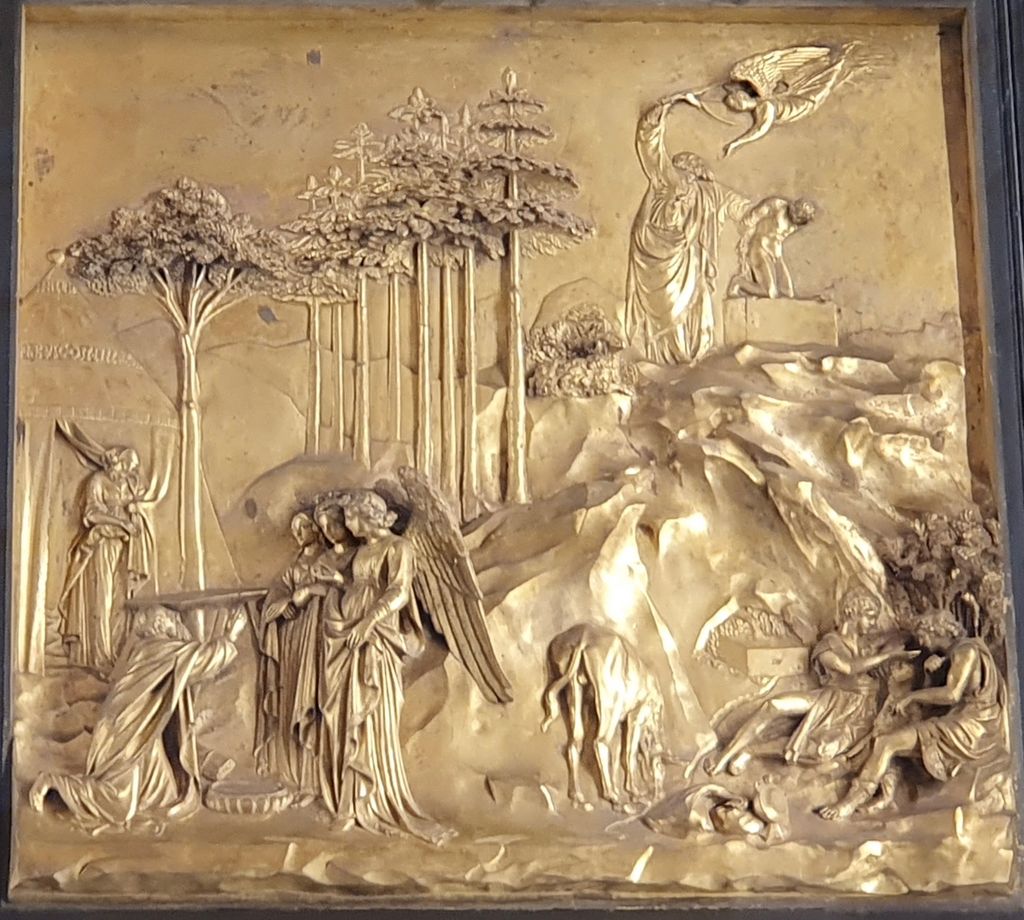
Across the main bodies of the five reliefs the researchers distinguish at least three alloy groupings. The differences are easiest to understand by looking at the two analytical methods together. Their table gives an atomic absorption value of 0.13 per cent tin by weight in the reported sample from Moses, and 2.53 per cent from Jacob. The study’s approximate X-ray fluorescence estimates also place Moses well below Jacob in tin.
Agreement about that difference matters more to the argument than whether the final decimal represents the entire casting. The table records a less tidy relationship for some lead readings, which the authors relate to the distribution of lead within the metal. A small sample and an average of surface signals answer similar questions at different scales. Both gain meaning from where and how the measurements were made. [10]
The results give substance to the possibility that the panels were poured using different stocks or mixtures of metal. A continuous appearance across the door could be achieved despite considerable variation between the underlying alloys. The chemical distinctions raise a question about the order in which particular panels were made. The authors pay particular attention to the lower antimony content reported for Moses. They associate the difference with the stock available for melting and, in conjunction with observations of the casting, entertain the possibility that Moses was the earliest of the five reliefs examined.
Richard Krautheimer, in the stylistic chronology discussed by Amy Bloch, placed Moses among the last four reliefs, following the order of the finished door from top to bottom. A stylistic sequence orders features of the design, while a hypothesis about metal stock concerns the pour. The documents Bloch examines leave the progress of individual panels before 1437 unclear. And although the assay compares five of the narrative reliefs, the door’s structural members lie outside this test. An early alloy grouping would still need a dateable link to the workshop’s supply of metal before it could provide a year. [10] [12]
On a smaller scale the XRF readings can help to identify an intervention in an individual casting. A repair might involve fresh metal flowed into a defect, or a solid piece fitted mechanically into a prepared hole. The interface and the shape of the inserted area give clues about the operation. Measurements that cluster away from those of the surrounding body add evidence of a separate source of metal. Conversely, a repair made with similar stock could be chemically difficult to distinguish from the parent bronze. The interpretation makes best use of both the local geometry and the chemical readings, especially where metal has been worked smooth and a repair edge is hard to recognise. [3] [10]
A group of tin-rich plugs in central regions of several panels gave Ferretti and Siano a more particular problem. Their composition and placement distinguished them from a number of other repairs. The authors suggest that holes were drilled to hold or raise the reliefs during fitting and were filled when that use was over. This would give the plugs a role in installation even though the work eventually left them embedded in a narrative surface. Similar chemistry across these locations gives the proposal a reason to be tested. It cannot recover the equipment that would have occupied the holes. Recycled material is another possible explanation for the chemistry of some additions, without identifying where that stock came from or who put it there. [10]
The earlier examination of Joseph by Annamaria Giusti and Mauro Matteini shows how sharply the question can change even within the same scene. Their table lists five individual metal samples, including sample 3 from a small figure identified as having been remelted. The reported composition belongs to that sampled zone. A small figure contributes very little to any estimate of the overall alloy, yet it becomes crucial if the question is how a specific feature survived a casting problem.
Physical sampling yields a more direct reading of the piece removed, and the surface survey can compare many locations with the object intact. One method lets the researcher examine a small site closely, while the other helps to decide which sites behave alike. The combination gives a fuller account of the panels as objects made, handled and repaired over time. [10] [11]
The gold could carry across such an intervention and lessen its visibility. Even before gilding, levelling a plug to the planes around it would change the interpretation of an edge on the front. If a chased line crosses that edge, the line records work done after insertion, regardless of how early another part of the design entered the wax. The finishing time represented by such a line is independent of the time of the first pour. The records for the Gates show several panels in different stages of finishing at the same date. [3] [10] [12]
A statue’s front and back
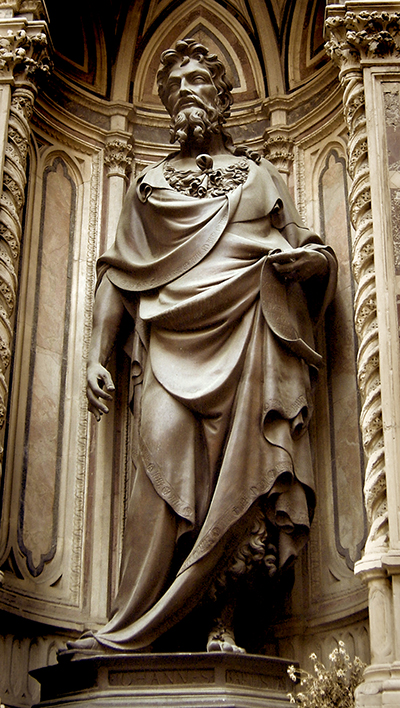
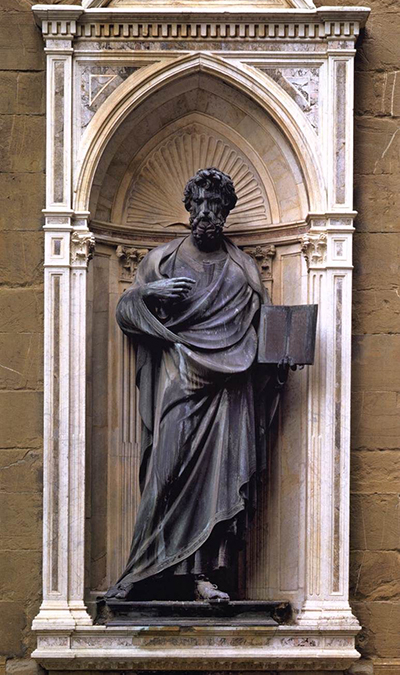
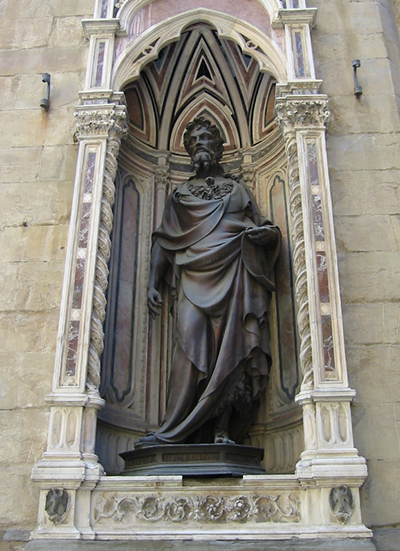
Seen from the street, the replica of St Matthew at Orsanmichele projects an open book into the space in front of its niche. The forearm that carries it pulls a volume of cloth forward, while broad ridges on the mantle lead the eye back across the chest and down the body. On the original those ridges pass across the junction of two casting operations.
Giusti’s account of the conservation and the Opificio’s project report connect the joint to a faulty casting and the recasting of the upper part onto the retained lower section. The guild records cited by Giusti report Ghiberti paying for the recasting. The repair had to maintain the silhouette and the direction of the folds as they passed from one mass of bronze into the other. [13] [14] [15] [16]
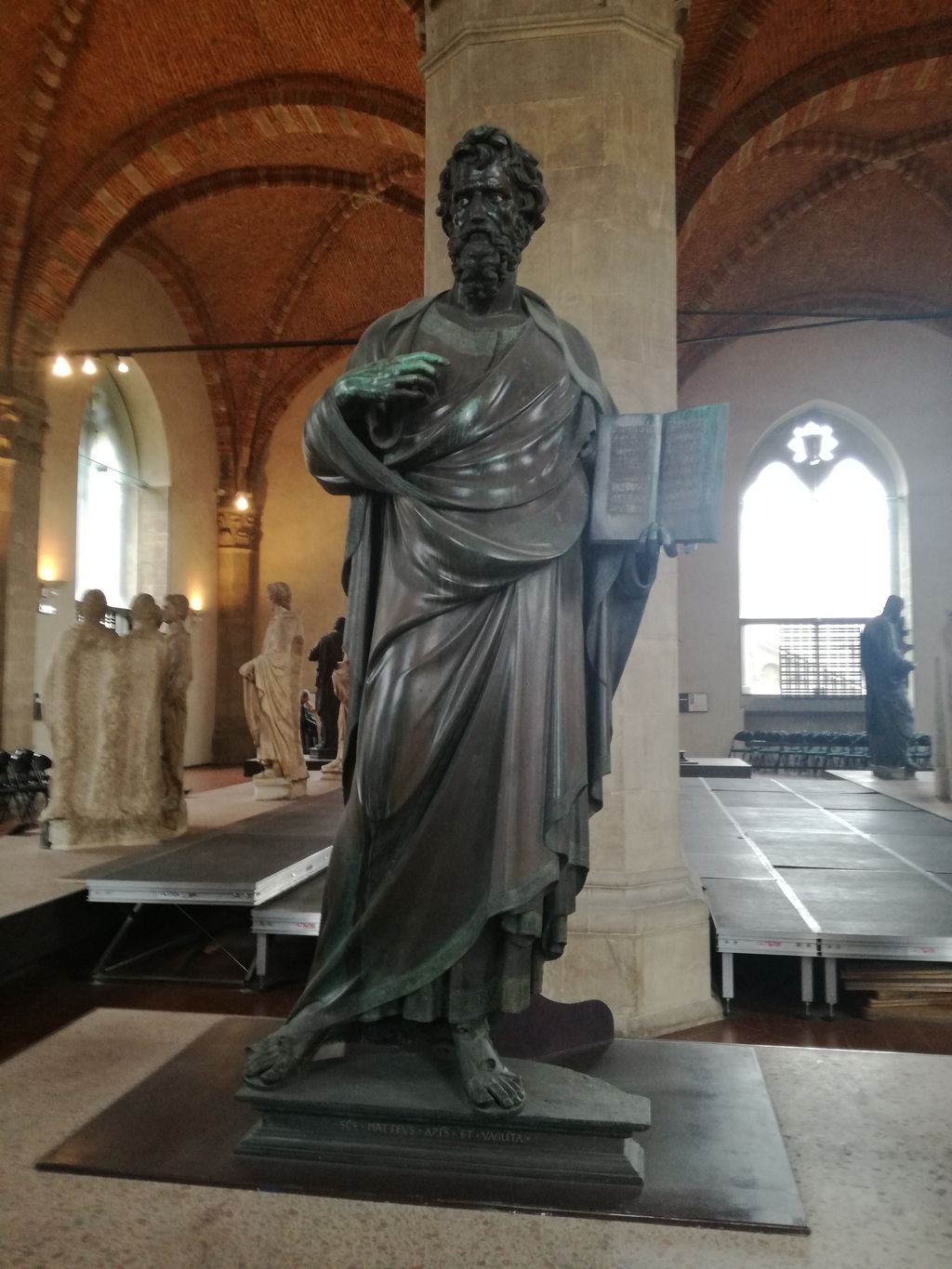
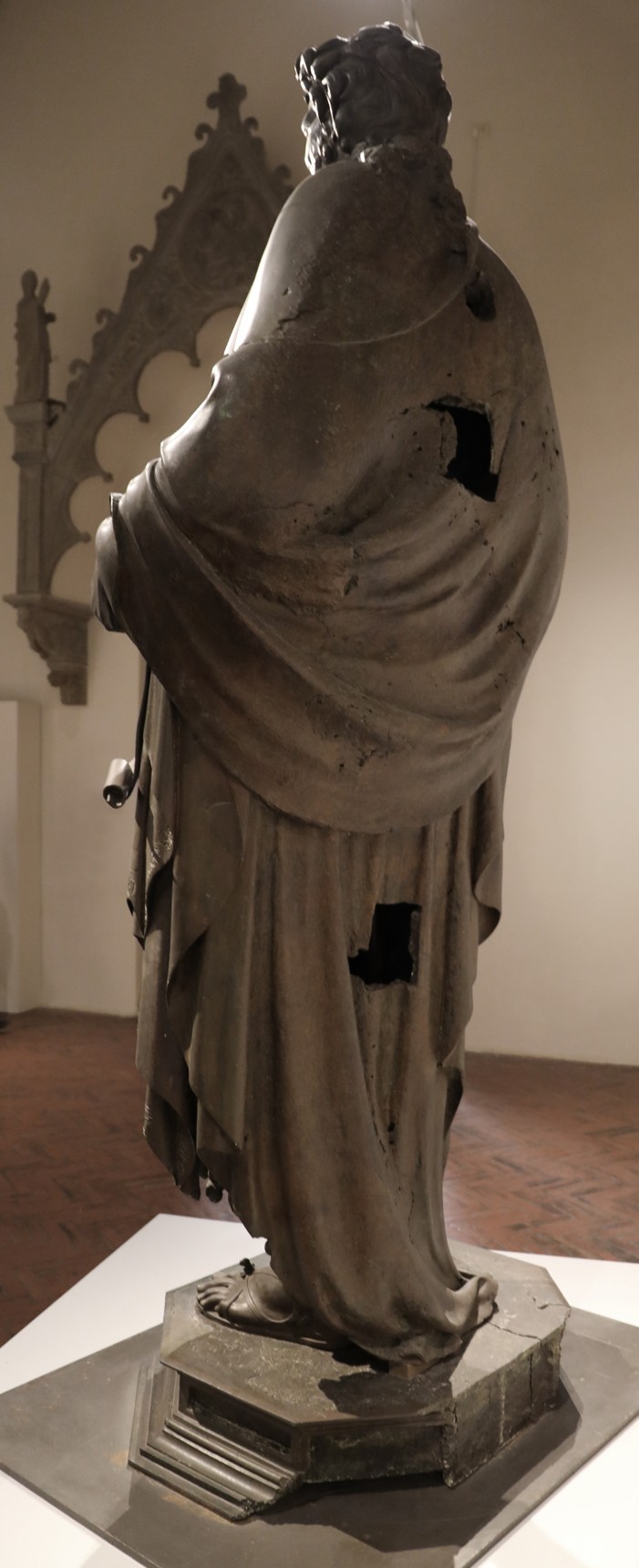
The back is less thoroughly finished and provides a clearer view of the junction. The difference in working is itself evidence of how effort was assigned. Across the front, a fold can take a continuous stripe of light, crossing the level of the join. A step between the two casts would interrupt that stripe, even if the outlines of the two parts agreed.
The workshop therefore had to address the angle and level of adjoining surfaces as well as make a sound connection. The junction at the back serves as a comparison with the effect achieved at the front. The difference has little to do with the size or importance of the repair, which involved a considerable portion of the statue. It corresponds to the visibility of the repaired surface in the niche. [13] [14] [15] [16]
Richard Stone describes Matthew as a direct hollow casting. In that process the wax over a core accounts for the thickness of the metal shell. A broad fold can give the impression of a substantial weight hanging from the arm even where the core takes up much of the space inside it. Hollow casting makes the outward weight of the modelling and the amount of metal required for it partly independent, as the reverse concavities do in a door relief.
The case for calling Matthew direct concerns the making of its wax. The seam and the account of recasting concern what happened after metal first entered the process. A separately prepared wax projection on a Gates panel and a recast upper body on Matthew can each result in a smooth transition on the visible surface, even though the latter has a metal junction where the former has a continuous cast. [2] [3] [13] [17]
The structural frames of the North Doors required work at a different scale again. Luca Boschetto’s documentary study identifies outside specialists involved in casting the large frames and reports at least two attempts between late 1421 and March 1423. The frames take the load of the pieces they carry and give each one a location in a leaf.
The casting problem is therefore expressed in long connected members, their dimensions and the relationship between openings. Local variation between shallow and deeply projecting figures is a different foundry problem. Boschetto’s abstract also raises a possible connection between the frame founders and the contemporary casting of Matthew. The report on the statue and the record of payment establish the recast, while the identity of the workers involved in it remains open. [13] [14] [18]
On the Gates, the Opificio’s work exposed the setting of separately made pieces into prepared grooves, with wedges securing the fit. The meeting of relief and frame was engineered to stay tight within the completed leaf. Years of corrosion at contacts eventually made separation difficult. The locking parts that held the bronze in place preserved evidence of assembly even where the visible transition seemed integral to the decoration.
At Siena, the same institution found actual separately cast sections joined in specific works by Giovanni di Turino, including the Birth and the Preaching of the Baptist and the figure of Prudence. These are useful adjacent cases because the parts belong within single figures or panels in some instances. The Siena findings are assigned to those objects. The frame pours, wedged settings and joins inside a sculpture describe three distinct scales at which a finished ensemble could depend on workshop assembly. [19] [20]
Finishing the metal and applying the gold
In the Florentine Nativity, a ledge of rock supports Mary’s broad folds. The outlines of those folds remain clear across most of the lower half of the quatrefoil, where the small features on the face or along a hem begin to merge at a distance. The rock has a sharper, interrupted pattern. The closer view gives each surface a more particular character.
Daniel Zolli points out the lettering on the garments of Mary and Joseph and the tooling of the angel’s plumage. He also draws attention to the polish of the shepherds’ bodies and the coarser textures of rock and foliage. The polished torso catches light across a single turning surface. The rougher passages break similar illumination into flecks. A variation in texture can thus separate two neighbouring forms even where the distance between their highest points is small. [21] [22]
Chasing can sharpen a ridge, deepen a groove or give a smaller surface a new texture after the cast has been cleaned. A tool can cut away metal or displace it, leaving a lip at the edge of an incision. Wax can also be incised, and the mould can reproduce a fine line made before the pour. The question is what evidence survives of the line’s making. On the backs of the Gates reliefs, tearing at the attachment of a severed casting channel is evidence of force applied to metal.
A shape produced by a punch can likewise be examined for the displacement around its impression. Lauren Jacobi records the small punch marks exposed during cleaning on the reverse of the right leaf, including rosettes, dolphins and images of the Baptist. On a photograph of the front, a very sharp line may be readable as a feature of a wing or hem even where its fabrication is indeterminate. [2] [3] [21] [23]
The accounts discussed by Amy Bloch distinguish the casting of the ten reliefs of the Gates from the years of cleaning and chasing that followed. The extent of that work varied by panel at any one date. Bloch cites a July 1439 report in which work on the surfaces of Cain and Abel, Moses and Jacob and Esau was finished or nearly so, while Joseph and Solomon and the Queen of Sheba were underway. The time available for working the face makes sense of the range of finish within an individual composition.
A founder had to get bronze into the shape that would give a wing its overall dimensions. A worker dealing with the cooled metal could restore clarity where a boundary had become difficult to read, or modulate the reflections within that boundary. A large surface polished to articulate a body, tiny marks added to define feathering and the smoothing of a local repair belong among the operations that could occupy those years. Where the records group such work into a phase of production, study of the surviving surfaces lets us see what finishing entailed at the scale of the object. [3] [12] [21]
The coverage of the precious metal gives those surface differences another role. For the North Door, reports issued by the Opera during and at the end of treatment describe selective mercury-amalgam gilding. Projecting relief forms and areas of the ornament were gilded, with dark bronze visible in the grounds. In the Nativity, the lighter accents through the drapery and around the angel can hold the eye even as the narrower lines in the rock recede.
A body emerging out of that darker field is defined both by the ridge that catches the light and by a change of colour. Present patches include losses and interruptions. They give evidence of where gold survives, and the treatment records identify the original distinction between gilded relief and bronze ground at a larger scale. [22] [24] [25]
On the narrative fronts of the Gates the distribution is more extensive. Gold amalgam was applied across the reliefs, and heating removed mercury to leave a film rich in gold. The same kind of gilding could therefore contribute to different effects according to how much of the surface it covered. On Joshua, a fine roof edge can catch the light within a field of similar colour, and the shadows of the rounded figures articulate strong changes of height.
The comparison with the North Door concerns the role of an area of gold within the design. The metal film follows the topography made in wax and sharpened by hand. By extending over large areas of different depth, it gives a closer relationship in colour between foreground and distance and makes their relief and texture especially consequential. [1] [9] [11] [19] [24]
On Matthew, Giusti describes traces of adhesive gilding along a mantle border and silver inlaid in the eyes, the Gospel lettering and the inscription on the base. Here a line of gold leaf could have led the eye along the very edge of the cloth, marking a narrower path than the broad highlight running down the nearest fold. The silver lettering occupied the nearly flat spread of the book, with its pages turned to the viewer below.
Silver in the eyes concentrated a difference of material at another small point, within the much more broken relief of the face and beard. Shape and precious metal are assigned to tasks at different scales. The treatment accounts use different anatomical descriptions of the eye detail, while agreeing that silver inlay was found there. The leaf on the border is a further reason to keep the evidence local. A trace of gold on this bronze warrants a different explanation from one on a narrative panel of the Gates. [13] [14] [15] [16] [19]
Why cleaning and display depend on what lies beneath the gold
A dark patch on gilded bronze can have more than one cause. Material lying over gold can scatter the light and dull its reflection. Gold that has already broken away exposes the underlying bronze or its corrosion. A raised blister can retain a covering of gold while concealing a change in the metal underneath. These conditions can occur close together on the same relief and require different responses. Cleaning can reveal surviving gilding and make a chased line legible again. Where the original gold has been lost, cleaning exposes the surface that remains. [11] [19]
Giusti and Matteini’s investigation of Joseph and associated material records an average gold thickness of about five micrometres in the material examined. Their cross-sections put the gold, bronze and intervening material in a physical order. Corrosion lay between the gold and bronze in every cross-section they examined, including material near visible blisters. An Auger analysis in their figure 2 follows elemental composition with depth.
Infrared spectroscopy and X-ray diffraction help to identify compounds in the sampled material. The methods distinguish evidence for an element from evidence for the form it has taken. Copper can be present in the bronze and in the corrosion, while the recognition of particular copper salts helps explain why one layer behaves differently from another. The tiny sections establish what happened at the sample sites, where the layers can be seen together. [11]
On the outside the investigators identified gypsum and other material, including particles visible in section. Within blisters they found copper hydroxy-sulphates. Growth beneath the gold can push the film upwards. Continued change can rupture it, leaving a minute crater in a surface that formerly turned light evenly. Moisture helps sustain the movement and reaction of salts.
The investigators tentatively connected nitrates to earlier treatment with nitric acid, a possible source of some of the compounds they observed. The order of layers is especially important here. An obscuring deposit above the metal film can sometimes be reduced to show the gold again. Underneath it, an altered layer can be carrying the gold. Removing that support would take part of the visible relief surface with it. [11] [19]
The early treatment work tested a neutral sodium potassium tartrate preparation to act on selected corrosion products while preserving stable oxides, including the reddish cuprite described in the report. Table 3 records a comparison of the response of bronze and copper oxides to the reagent. The point of testing was to find conditions in which the treatment could discriminate between materials encountered close together.
Later laser experiments on the Gates considered which deposits a pulse could detach and how much energy would reach the gold film. Trial areas allowed the team to compare laser cleaning and chemical poultices and assess their combined use. The same distinction between an unwanted covering and a layer that now carries original material governs both approaches. Each tool is judged on the part of the surface it can reach and the changes it leaves behind. [11] [19] [26]
Giusti and Matteini report renewed corrosion on the first treated panel in ordinary laboratory air, followed by protective storage in nitrogen. The return of activity showed why the surrounding air had to enter the conservation plan. Sara Goidanich and her colleagues later compared a nitrogen-purged enclosure, a closed case kept at low relative humidity, and an open case with a controlled local flow of air. Their galvanic sensors imitated an aspect of gilt bronze corrosion.
Electrically connected gold and alloy in a sensor allowed the investigators to follow a current associated with corrosion when conditions permitted it. The sensor gave the team a running comparison without waiting for fresh losses to become visible on the door. It measured the behaviour of a model couple under defined conditions. Mixed deposits, breaks in the gold and variations in the parent bronze give each original area a more particular history. [11] [27] [28]
The preliminary case comparisons found relatively little difference between the two closed arrangements under the tested conditions, though the nitrogen case showed unstable behaviour in the sensor when humidity rose. The open environment performed less well at the humidity tested. Variation between sensors and their limited durability affected the precision of the comparison. Taken together, the results supported close control at the object, with evidence for more than one workable enclosure in the trial.
The Opera describes the installed case in the Sala del Paradiso as sealed and equipped to control temperature and humidity. The case maker specifies a relative humidity below 15 per cent as a design requirement and describes the supply of filtered air for the museum’s cases. This account concerns the installed equipment, while the nitrogen trial and the earlier nitrogen storage concern specific stages in the treatment and testing. A current measured during the trial gives no single rate of deterioration for every part of the installed door. [27] [28] [29] [30]
At Siena, earlier surface treatments raised a different immediate question for the conservators of the font. Waxy or other organic material could cover the gilding and change the way a laser pulse interacted with it. In the tests reported by Maria Baruffetti and colleagues, the team considered pre-cleaning to reduce those layers and lower the energy subsequently needed for laser cleaning. On the Arrest of John the Baptist, the relief associated with Ghiberti and Giuliano di ser Andrea, they compared settings in selected areas. In setting up the cleaning protocol, the team compared two long Q-switched instruments with similar but distinct pulse durations. In the three test areas on the Arrest, the comparison included two other devices alongside the selected long Q-switched instrument.
Infrared reflectance spectra taken before and after treatment showed smaller signals for several components of the deposits, including gypsum and organic material. The selected instrument reduced those signals most strongly in this comparison. A visual improvement could thus be judged alongside chemical evidence from the same test area. The authors’ solvent-only comparison with solvent followed by laser on the Birth of the Baptist belongs to Giovanni di Turino’s panel. The spectra changed relatively little after solvent alone. After laser treatment the differences included a greater reduction in some signals where an emulsion had been applied first. That was an outcome on those test areas, with a different set of observations behind the comparison of instruments on the Arrest. [20] [31]
Areas where gold had worn away gave the Siena team another reason to decide locally how to proceed. A pulse that works acceptably on a residue over gilding encounters a different surface on exposed bronze. The team observed discoloration in some trials and advised avoiding or screening bare areas where thick deposits coincided with patchy gold. The study’s observations on enamel were preliminary and concerned another material again. The method developed during work on the Gates travelled to Siena as a way of testing and comparing treatments.
The choice of treatment still depended on which layers were present and on the degree to which the gold had survived. In Ghiberti’s reliefs, a fine ridge can become legible because a covering has been reduced, because gilding still reflects along one edge, or because its modelled face turns sharply into shadow. The present appearance is made from those surviving properties, which can be assessed at the scale of a single fold or a roof beyond the walls of Jericho. [1] [11] [26] [31]
Lorenzo Ghiberti sculpture directory
Discussion
Ghiberti rewards slow looking: relief, gilding, narrative structure, workshop practice and conservation evidence can all change how a work is read.
Join the Conversation
Have an observation about Style and Technique, a source to add, or a comparison that sharpens the reading? Share it below.
References
- Opera di Santa Maria del Fiore, Formella con Storie di Giosuè, record 2850, object description and photographs of the original relief. View source.
- Salvatore Siano, Piero Bertelli, Marcello Miccio and Ferdinando Marinelli, Studio sulla tecnica di fusione dei rilievi della Porta del Paradiso, §§ 2–8 and figs. 1–6, 9–10. View source.
- Francesca G. Bewer, David J. Reid, Peta Motture and David Bourgarit, “Casting Processes”, in Guidelines for the Technical Examination of Bronze Sculpture, Getty, sections on direct and indirect lost-wax casting, sprues and evidence of casting. View source.
- Opera di Santa Maria del Fiore, Formella con Storie di Giacobbe ed Esaù, record 2779, object description and photographs. View source.
- Lorenzo Ghiberti, I commentarii, ed. Julius von Schlosser, vol. I, printed pp. 48–50 and 60–62, PDF pp. 64–66 and 76–78. View source.
- Nicholas Temple, “Lorenzo Ghiberti and Contested Views of Perspectiva in Renaissance Concepts of Space”, pp. 239–263, discussion of the Third Commentary and architectural representation. View source.
- Fabian Jonietz, “The Burden of Success in Quattrocento Sculpture: Lorenzo Ghiberti, Mino da Fiesole, Donatello”, in Synagonism. Theory and Practice in Early Modern Art (2024), pp. 251–253, figs. 6.9–6.10. View source.
- Opera di Santa Maria del Fiore, Battesimo di Cristo, North Door relief, record 4246, also listed under “Beni componenti” in North Door record 3618. View source 1. View source 2.
- Art Institute of Chicago, The Gates of Paradise: Lorenzo Ghiberti’s Renaissance Masterpiece, 2007 exhibition, “Making the Gates of Paradise” and “Conservation”. View source.
- Marco Ferretti and Salvatore Siano, “The gilded bronze panels of the Porta del Paradiso by Lorenzo Ghiberti: non-destructive analyses using X-ray fluorescence”, Applied Physics A 90 (2008), pp. 97–100, especially table 1 and figs. 1–4, publisher record. View source 1. View source 2.
- Annamaria Giusti and Mauro Matteini, “The Gilded Bronze Paradise Doors by Ghiberti in the Florence Baptistery. Scientific Investigation and Problems of Restoration”, ICOMOS metal restoration proceedings, pp. 46–51, fig. 2 and tables 1–3. View source.
- Amy R. Bloch, Lorenzo Ghiberti’s Gates of Paradise: Humanism, History, and Artistic Philosophy in the Italian Renaissance, introduction, pp. 9–10. View source.
- Annamaria Giusti, “La statua del San Matteo in bronzo di Lorenzo Ghiberti”, Amici dell’Opificio, no. 1, October 2005, p. 3. View source.
- Opificio delle Pietre Dure, San Matteo, 1419–1422, conservation file GR 11549, intervention and findings. View source.
- Elisa Marianini, St Matthew in the Museo di Orsanmichele, photograph of the original. View source.
- Yair Haklai, St Matthew replica in the original niche at Orsanmichele, photograph. View source.
- Richard E. Stone, “Italian Renaissance and Baroque Sculptors in Bronze”, in Italian Renaissance and Baroque Bronzes in The Metropolitan Museum of Art, pp. 28–29. View source.
- Luca Boschetto, “Ghiberti e i tre ‘compari’. Un nuovo documento sulla fusione dei telai della seconda porta del Battistero”, author’s abstract, University of Florence research repository. View source.
- Opificio delle Pietre Dure, Porta detta “del Paradiso”, conservation file GR 8117, construction, condition and treatment. View source.
- Opificio delle Pietre Dure, Fonte di vita nuova. Il Fonte battesimale del Duomo di Siena restaurato, 2024 completion report, findings on the bronze components and their assembly. View source.
- Daniel M. Zolli, “Donatello’s Visions: The Sculptor at Florence Cathedral”, pp. 47–48, discussion of Ghiberti’s Nativity. View source.
- Sailko, Nativity, North Door, photograph of the original at the Museo dell’Opera del Duomo. View source.
- Lauren Jacobi, “The Punch Marks on Ghiberti’s Gates of Paradise”, chapter summary, Cambridge University Press, 2020. View source.
- Opera di Santa Maria del Fiore, “L’oro del Ghiberti torna a splendere”, 29 November 2013, findings from the North Door gilding tests. View source.
- Opera di Santa Maria del Fiore, “La Porta Nord del Battistero”, 2015, description of the gilded framework and panels on completion of restoration. View source.
- Salvatore Siano et al., “Laser cleaning methodology for the preservation of the Porta del Paradiso by Lorenzo Ghiberti”, Journal of Cultural Heritage 4, supplement 1 (2003), pp. 140–146, comparative and integrated cleaning tests. View source.
- Sara Goidanich et al., “Corrosion Evaluation of Ghiberti’s ‘Porta del Paradiso’ in Three Display Environments”, Metal 2010, pp. 151–159, experimental set-up, results and conclusions. View source.
- Davide Matera, doctoral thesis, University of Milan, “Selection of the best display option for the ‘Porta del Paradiso’”, pp. 167–168. View source.
- Opera di Santa Maria del Fiore, “La tecnologia avanzata che preserva i capolavori del Museo dell’Opera del Duomo”, 26 September 2017, description of the installed case and environmental controls. View source.
- Goppion, Museo dell’Opera del Duomo, Florence, project installed in 2015, “The display cases”, specifications for the Baptistery doors and the museum air supply. View source.
- Maria Baruffetti et al., “The restoration of the amalgam gilded bronze elements from the Baptismal Font of Siena: Remarks on laser ablation in combination with other cleaning methods”, in Lasers in the Conservation of Artworks XIII, pp. 245–252, figs. 3, 5, 7–8 and table 1. View source.
- Jane Bassett et al., The Craftsman Revealed: Adriaen de Vries, Sculptor in Bronze, Getty Conservation Institute (2008), p. 115, technical discussion of the Allegory relief and its comparison with the direct-casting proposal for the Gates of Paradise. View source.