 by Tom Gurney
Tom Gurney BSc (Hons) is an art history expert with over 20 years experience
Published on June 19, 2020 / Updated on November 17, 2026
Email: tomgurney1@gmail.com / Phone: +44 7429 011000
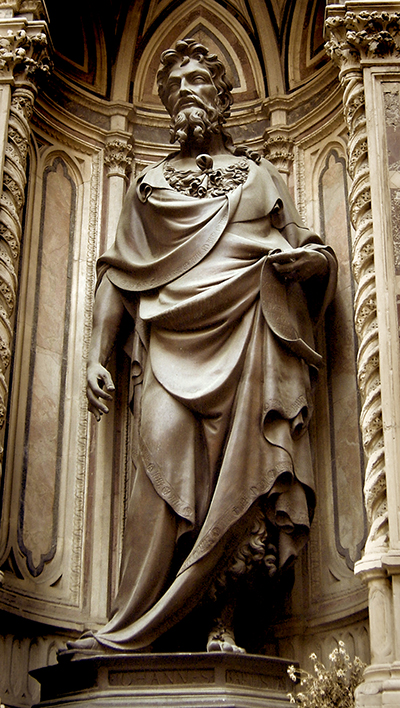
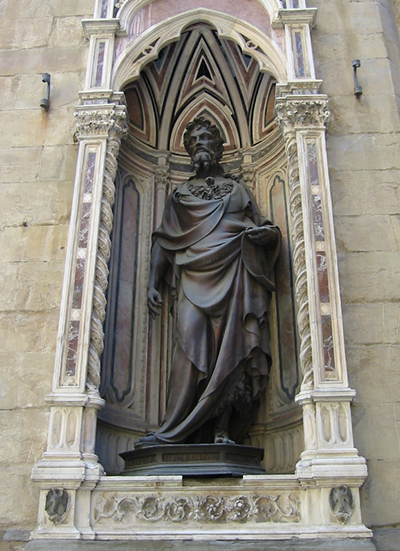
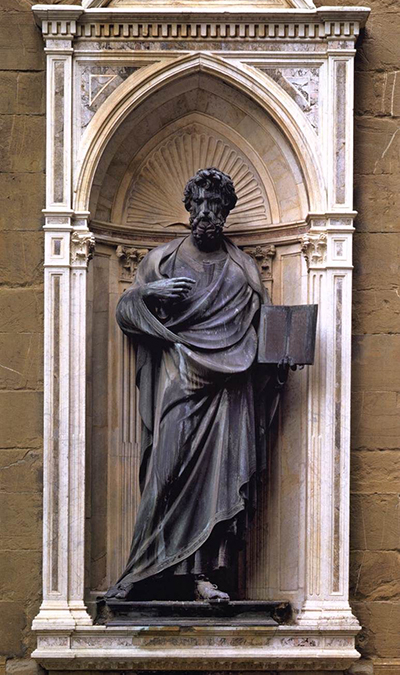
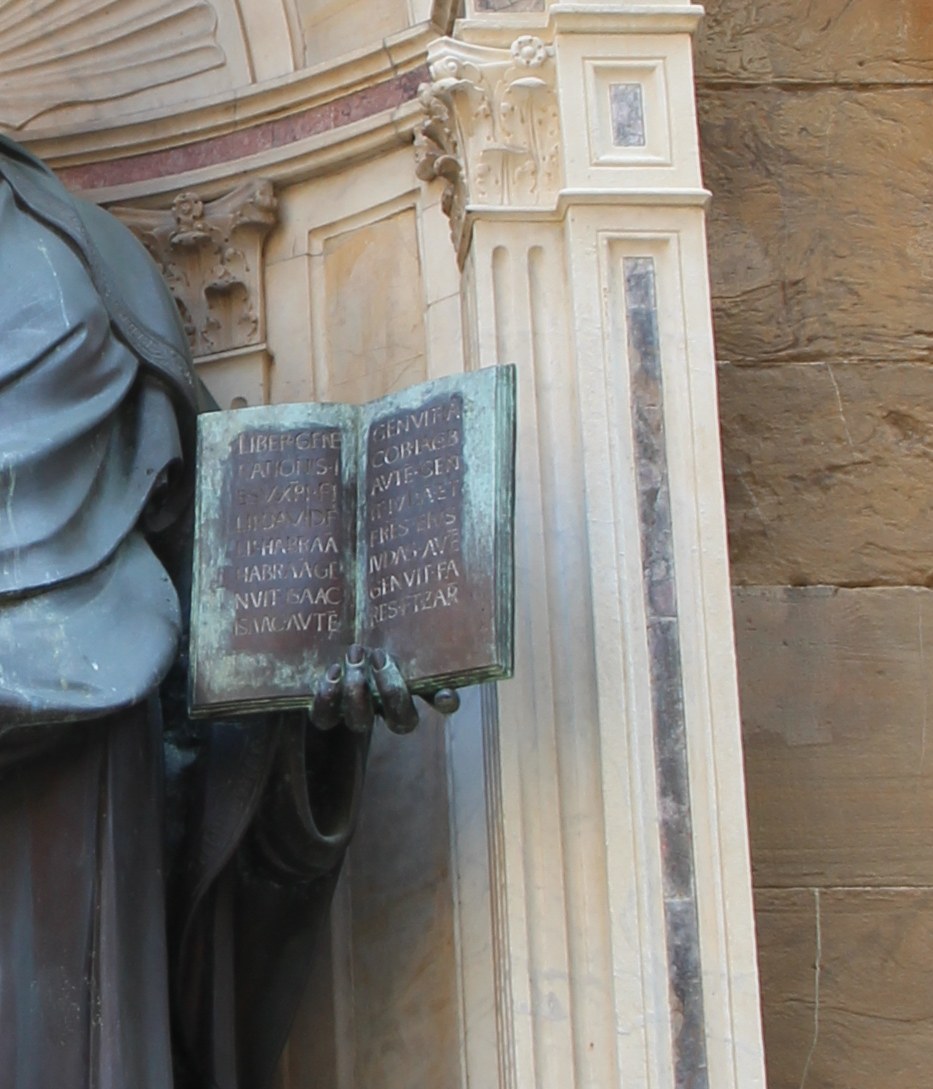
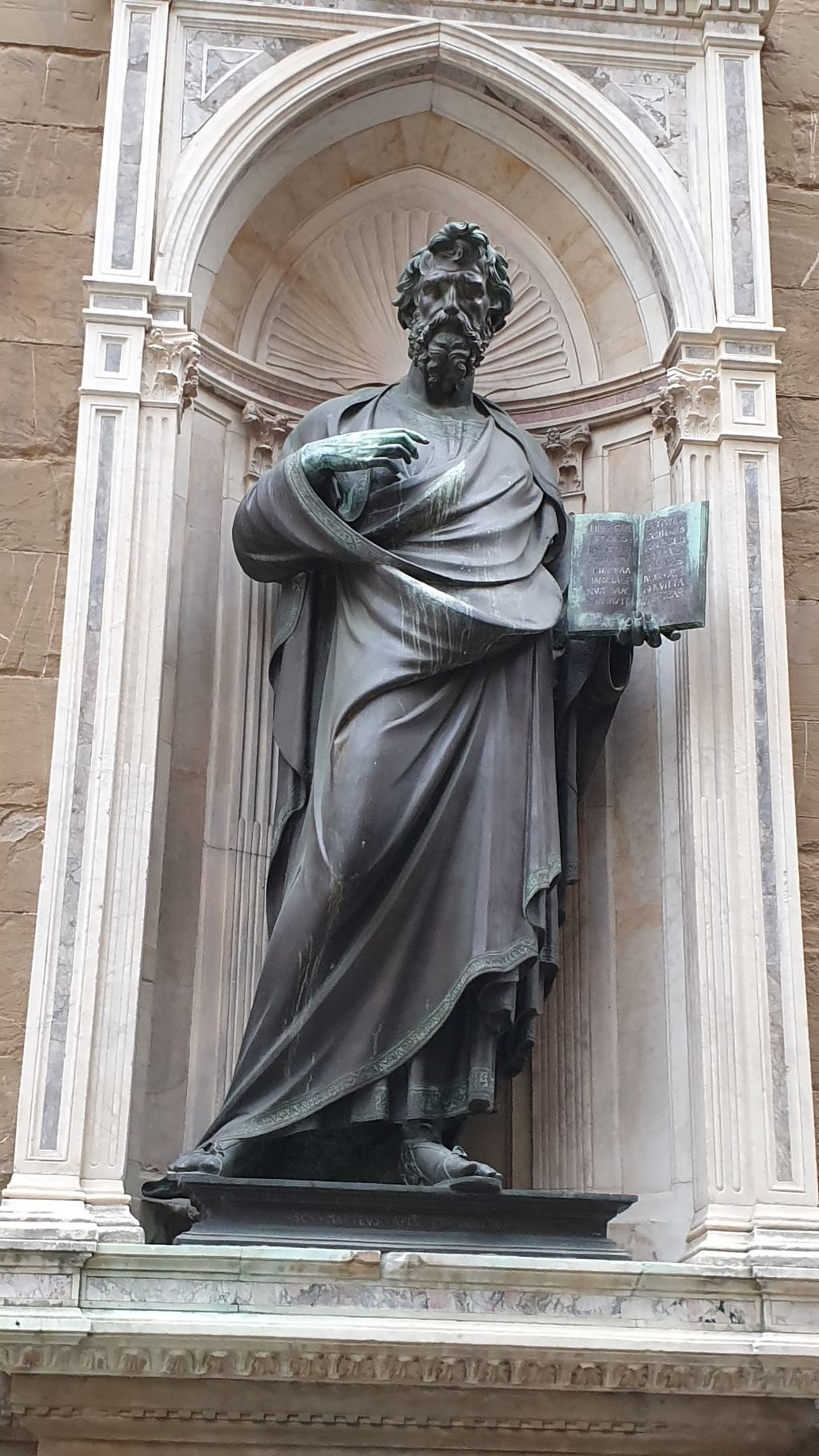
Matthew holds his Gospel open at his left side. His fingers support the book from below, leaving both pages facing out. His right hand rises towards his chest and his eyes look past the book. In Lorenzo Ghiberti’s bronze for the Arte del Cambio, Florence’s guild of bankers and money changers, the hand, the text and the face occupy three distinct points across a figure 272 centimetres tall. The original, made about 1419–22 and installed in 1423, stands in the Museo di Orsanmichele. The copy outside occupies the guild’s stone tabernacle, where the height of the sill and the shallow recess recover the figure’s relation to the street. [1] [2] [3] [4]
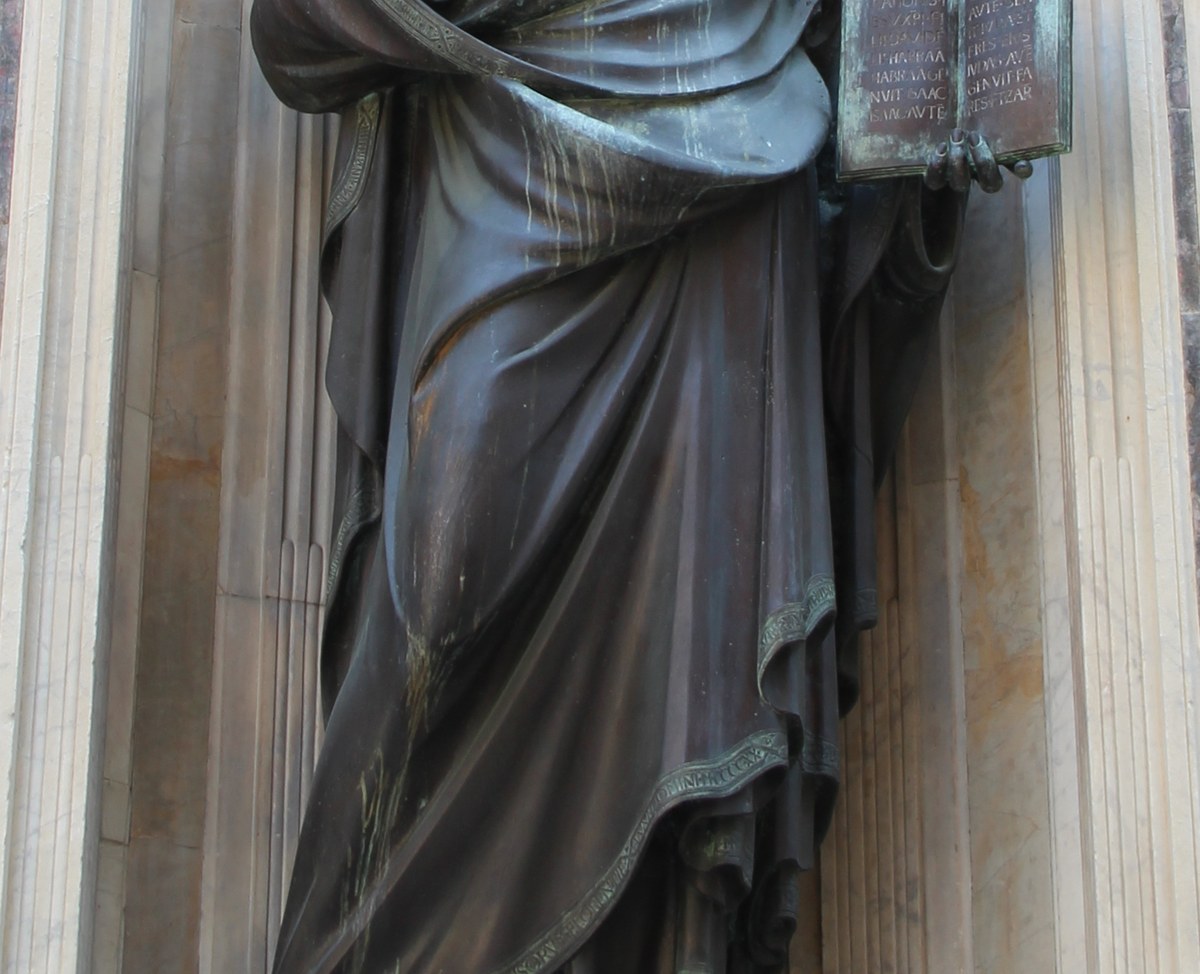
Below the book, the cloth falls almost vertically. On the other side, a diagonal fold rises from the hem and rounds over the knee. From the pavement those folds help the viewer find the stance beneath the mantle, with the feet set apart and one turned outwards. A spiral stair inside the pier limited the depth available for the niche. The shell spreads behind the head, while the sleeves and open volume project in front of the fluted supports. A space too shallow to enclose the whole figure gives the book and the lifted hand room to be seen from below. [1] [4] [5]
Contents
- A place on the west wall
- From the wax to the pier
- Silver in the eyes and on the page
- Seeing the statue in two places
A place on the west wall
On 19 June 1419, the Cambio resolved to commission a bronze Matthew if it could secure the pier assigned to the bakers. The city granted the transfer with the bakers’ consent, giving the bankers the west face of the north-west pier. Orsanmichele already housed a painted Matthew associated with the Cambio. The standing bronze would give the guild’s patron a place among the saints displayed outside the building. In Matthew’s Gospel, Jesus calls him from a tax booth, an episode that helps explain the saint’s appeal to a guild whose members dealt in money. [1] [3] [5] [6] [7] [8]
The bankers recorded decisions and spending in a dedicated book, the Libro del pilastro, or Book of the Pier. Filippo Baldinucci’s account preserves the text of the agreement dated 26 August 1419. It set a minimum size by pointing to a bronze already on the building, Ghiberti’s St John the Baptist for Calimala, the cloth merchants’ guild. Ghiberti could go larger if he judged that a larger figure would suit the setting. Aldo Galli gives the heights as 255 centimetres for the Baptist and 272 for Matthew. The agreement thus gave the sculptor discretion over the increase within a commission whose scale the bankers could judge against a finished work. [5] [6]
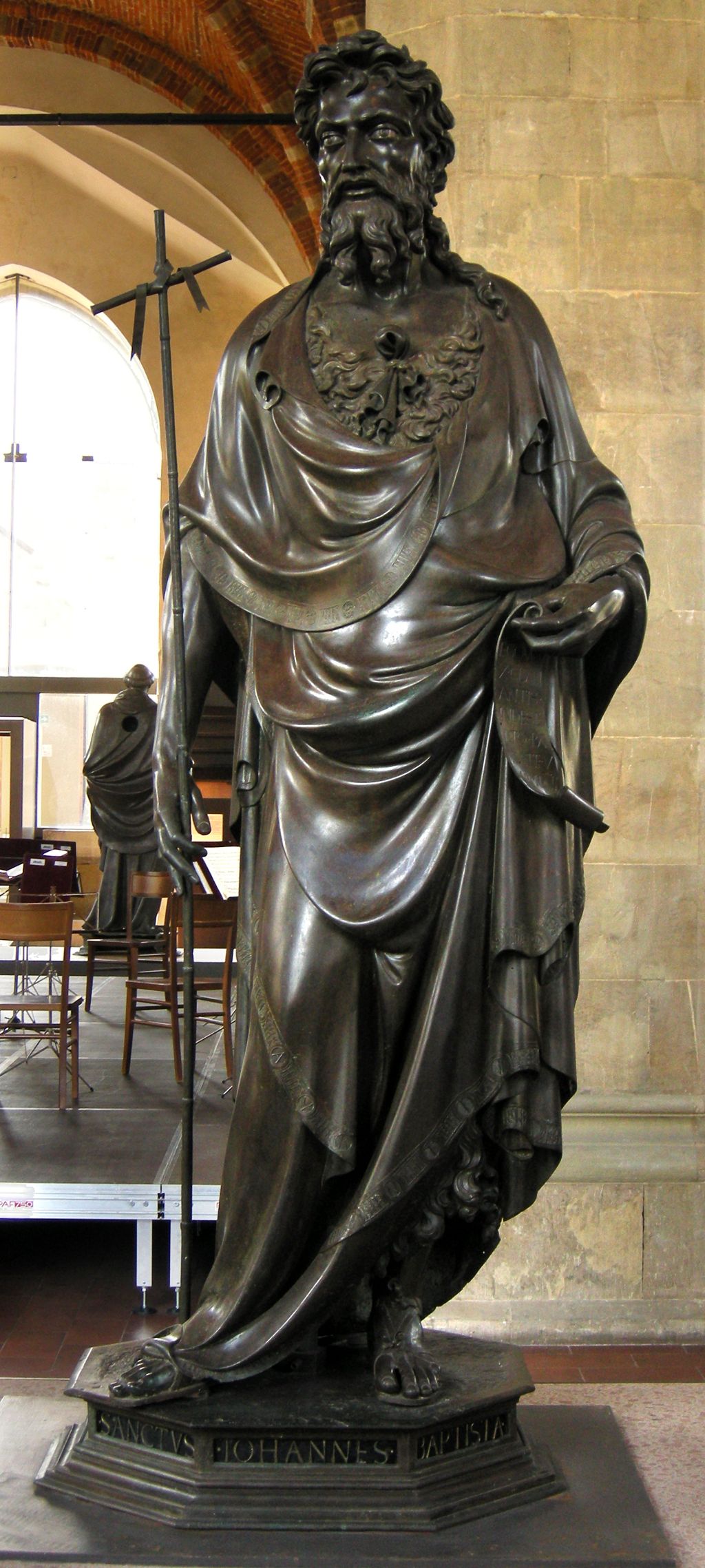
Four wardens, including Cosimo de’ Medici, oversaw the commission with the guild consuls. The contract reserved to them the decision about whether gilding would cover all or part of the figure. It also required Ghiberti to work on the statue personally and provided for skilled craftsmen to take part, with the consuls and wardens able to specify periods of his attendance. The guild undertook to supply materials as needed, including clay, wax, metal and fuel. The arrangement gave the bankers a say in the labour and finish as well as the size. The terms sit alongside those of other commissions discussed in Workshop and Influence. [5] [6]
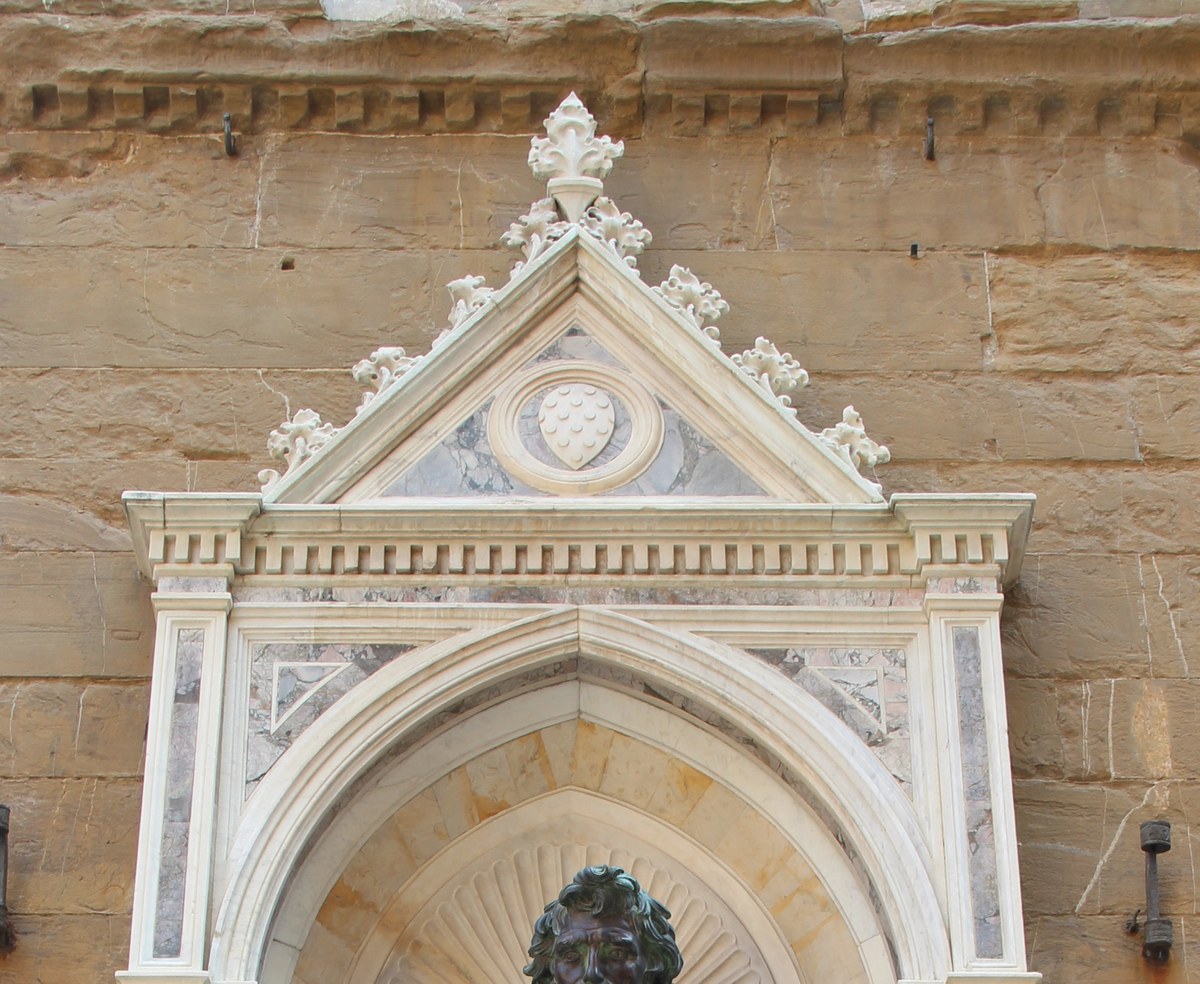
The contract required a finished statue mounted on the pier within three years from 16 July 1419, with provision for a justified impediment. The bronze and its stone setting involved different hands. In May 1422 the guild assigned work on the tabernacle to Jacopo di Corso and Giovanni di Niccolò, working to Ghiberti’s design. The pointed arch above a shell and the fluted supports give the bronze a clear architectural frame on a pier with very little depth to spare. The catalogue records Richard Krautheimer’s reading of classical features in both the setting and the statue, visible in the shell and in the way the drapery gives breadth to the standing body. [1] [4] [5] [6]
Annotated Close Reading of St Matthew
Image note: this photograph shows the exterior replica in Ghiberti’s original Orsanmichele niche; the conserved original bronze is displayed indoors.
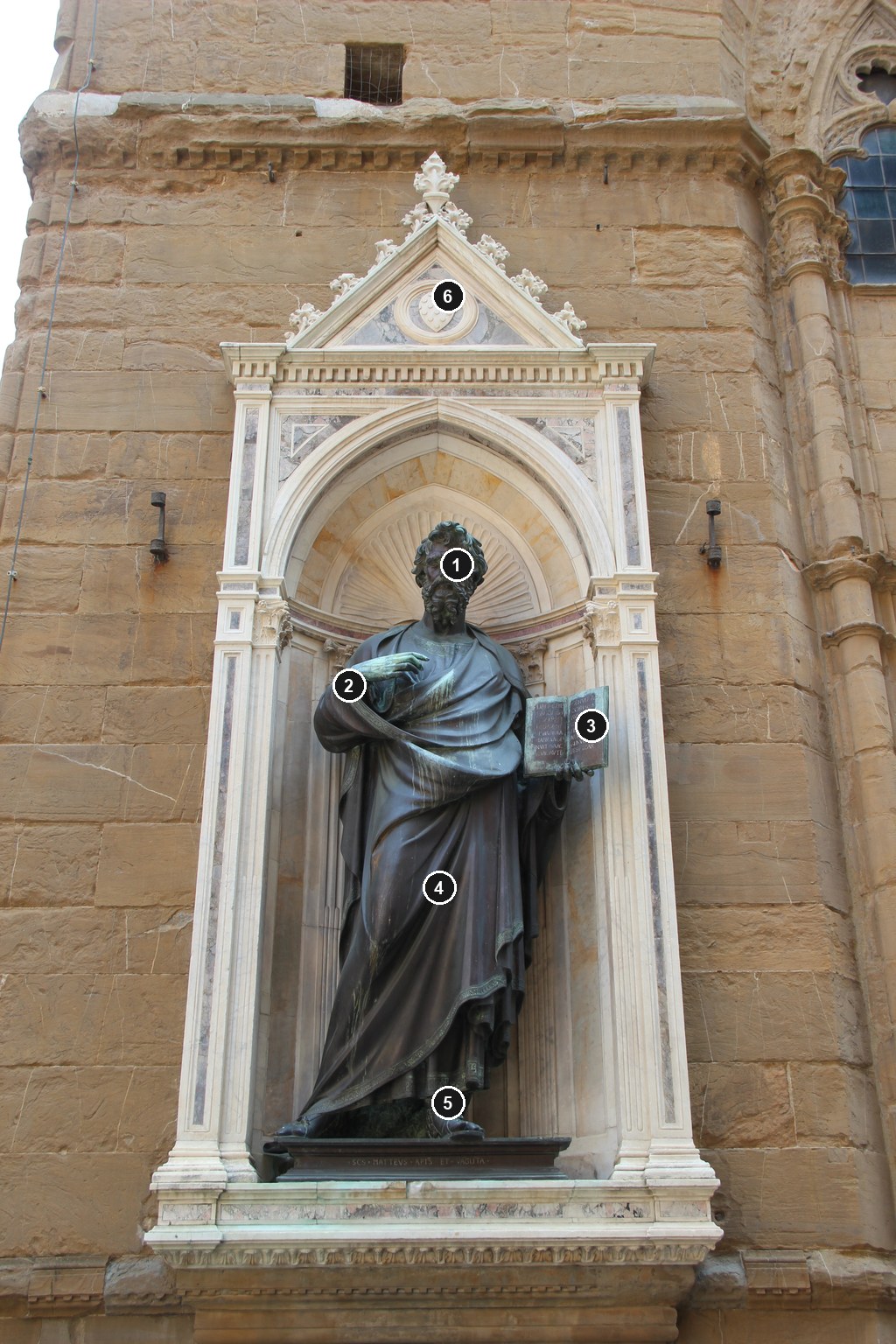
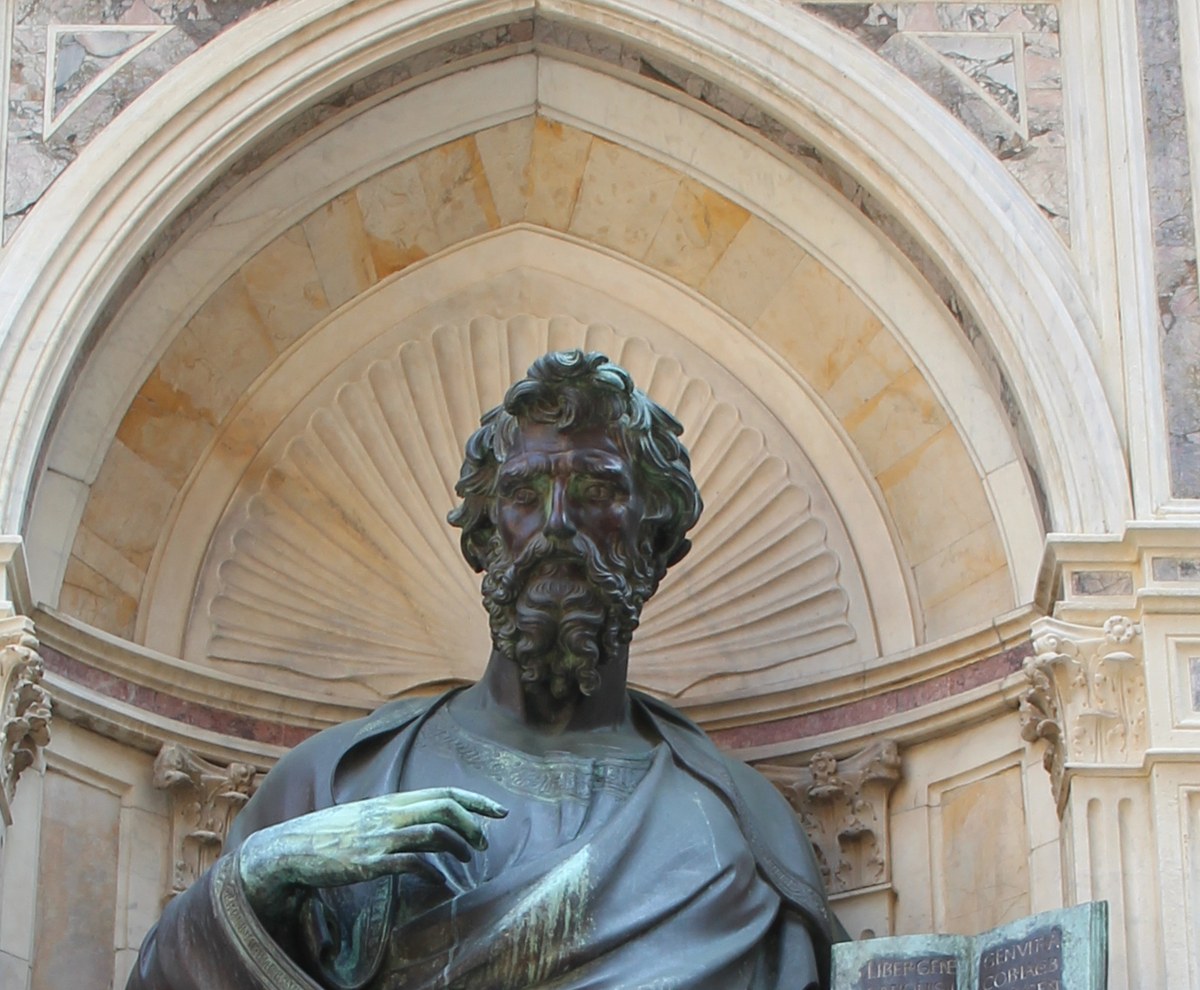
Head and downward address
The head is angled for an elevated niche, directing the saint’s presence toward viewers below.
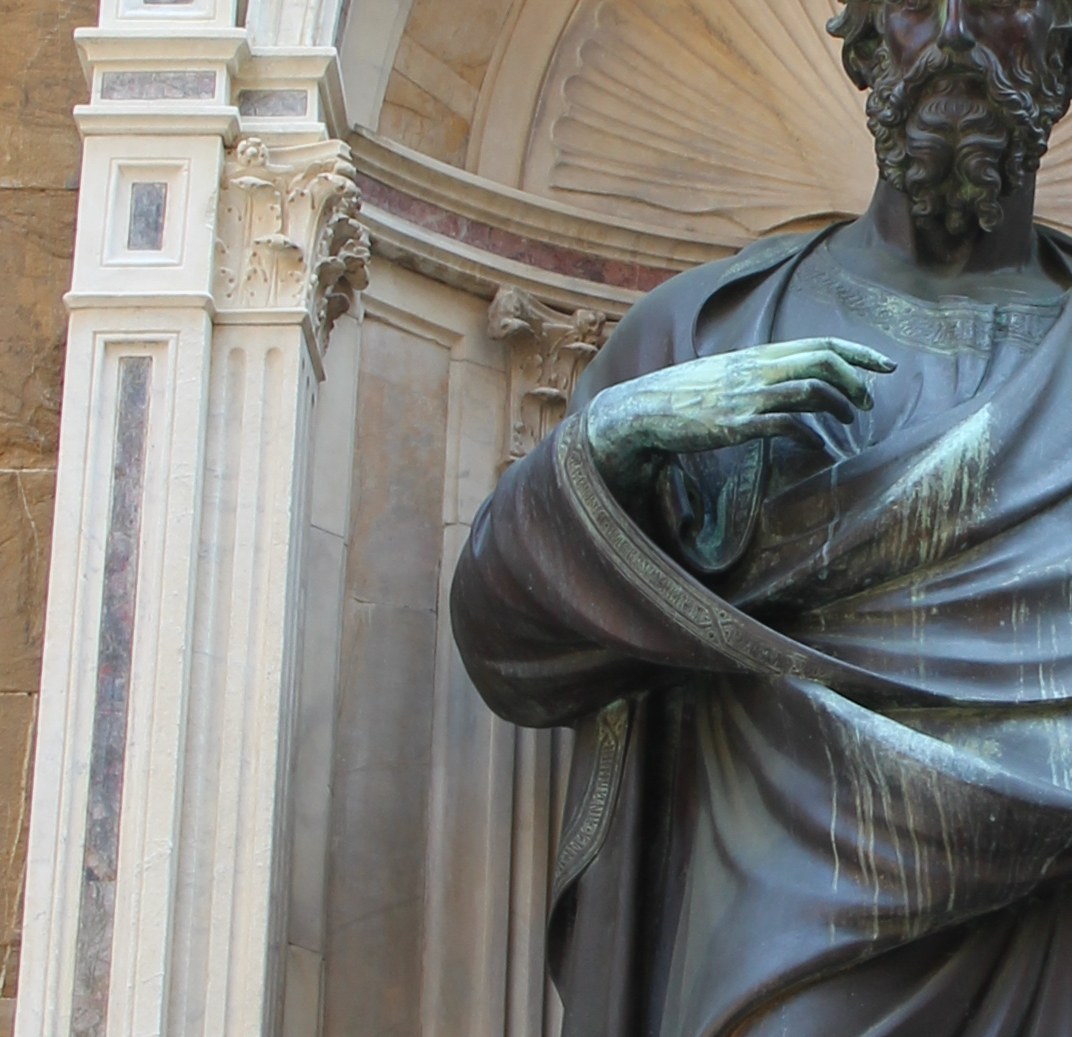
Raised speaking hand
The right hand creates an outward teaching gesture rather than resting against the body.
Open Gospel book
The open book identifies Matthew as Evangelist and creates a second visual focus beside the face.
Broad drapery structure
Large folds establish the body’s mass and connect gesture, torso and stance.
Feet and elevated base
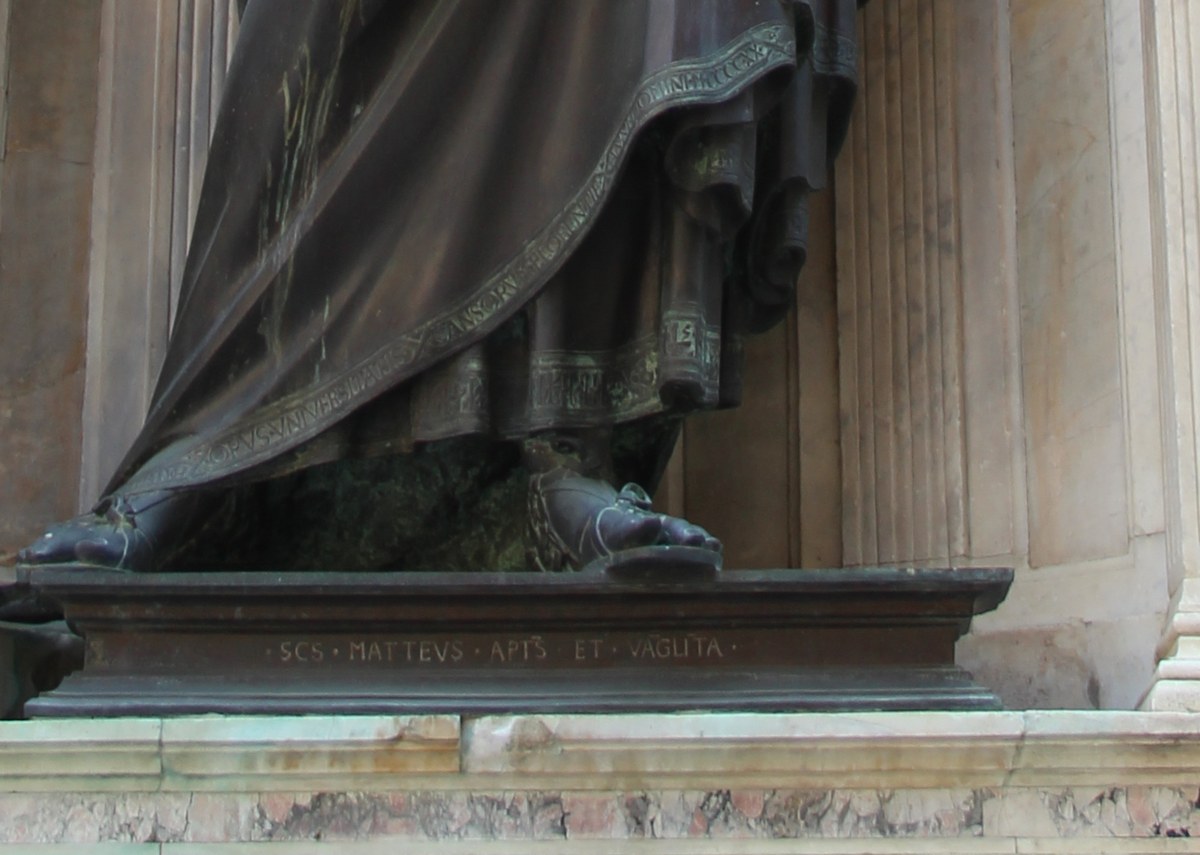
The base and feet reveal how the figure was proportioned for viewing from below.
Tabernacle and guild emblem
The complete setting includes the tabernacle and Arte del Cambio emblem, making the commission a public guild ensemble.
Photograph by Björn S…, CC BY-SA 2.0, via Wikimedia Commons; annotated and cropped. Source. CC BY-SA 2.0.
From the wax to the pier
The date 1420 runs along the lower edge of Matthew’s mantle in an inscription naming the Cambio. The national catalogue associates it with the wax model. The agreement envisaged casting the figure as one piece or casting the head separately from the body. Galli places the first attempt at the body, with the head excluded, between May and July 1421. Baldinucci reports that on 16 July Ghiberti told the guild that the cast had come out defective and offered to repeat the work at his expense. The account also records that 30 florins were made available to him for that purpose. The offer and the accommodation belong to the same episode, although the source supplies no full reckoning of the recast costs. [1] [5] [6]
The Opificio delle Pietre Dure identifies the upper portion as the part that Ghiberti had to remake. Annamaria Giusti, who directed the restoration, describes an upper section recast directly onto the bronze above the waist. Cleaning made the junction easier to see, especially on the back. There the surface was left comparatively rough and matt, while the parts meant to be seen received more work and polish. The guild’s record fixes the point when Ghiberti reported the failure. The join locates the repair on the statue and shows how much of the first casting could be kept. [6] [9] [10]
By early 1422, according to Cosimo’s report as reproduced by Galli, casting was complete. The bronze still needed cleaning, finishing and setting in place. In Baldinucci’s account, the guild allocated 650 gold florins to Ghiberti as remuneration on 17 December 1422. The decision required him to remake the base at his own expense and to secure the figure so that it sat properly in the tabernacle and could resist being levered out. The commission had specified a mounted statue at the outset. The December entry makes fitting and securing it a condition attached to the sculptor’s remuneration. [5] [6]
Matthew was installed in March 1423. A Palazzo Strozzi guide associates the 650 florins with the settlement in that month, while Baldinucci records the allocation in December. The sequence gives the date on the mantle a place early in the making of the bronze. It also brings the work at the other end of the figure into focus. The mantle carried the guild’s name before Matthew reached the pier, and the base still required attention after the casting had been completed. [1] [5] [6] [11]
Silver in the eyes and on the page
The open Gospel is the highest of three inscriptions. Its straight rows follow the plane of the pages, with the spine dividing the writing into two blocks. Below it, the guild’s inscription bends with the border of the mantle. At the feet, the saint’s name faces out from the front of the bronze plinth. The position of each text does some of the work of identifying it. The name at the sill labels the figure above, the inscription on the cloth belongs to the guild, and the writing in Matthew’s hand has the shape and place of a text being presented. A viewer in the street could recognise the book before making out its letters. [1] [2] [4] [9] [10]
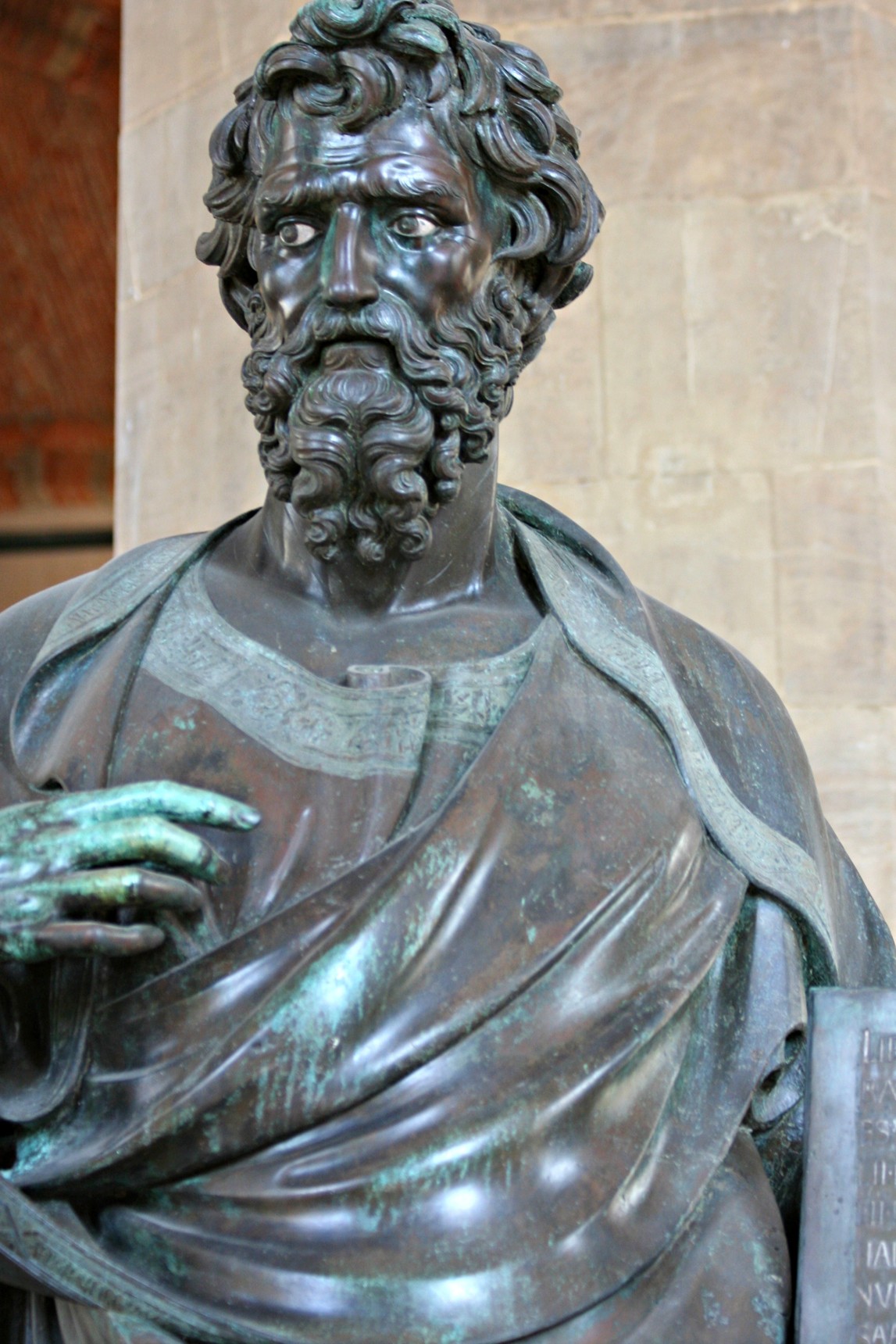
The Opificio identifies silver inlay in the whites of the eyes, the Gospel lettering and the inscription on the base. In Elisa Marianini’s photograph of the original, small highlights sit under the shadow cast by the brow. The head and eyes are directed beyond the page, and a ridge of drapery leads across the chest from the raised wrist towards the book. The inlay gives the two surfaces a related brightness at different scales. On the page it repeats in lines. In the face it occupies a small area that helps give direction to the gaze. The national catalogue relates the expressive effect of the eyes to ancient statuary. [1] [2] [9] [10]
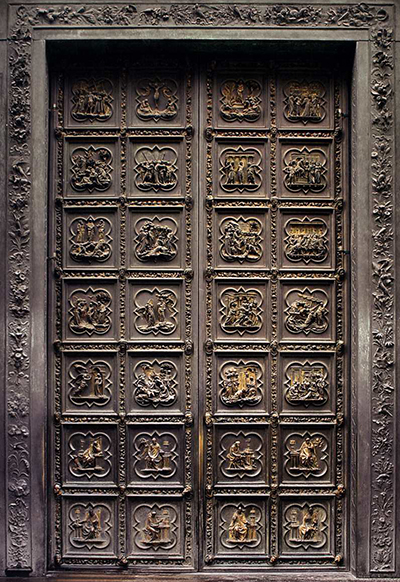
The Opificio also found small traces of gold leaf along the garment’s edges. The contract had left the extent of gilding to the patrons. The surviving leaf gives a location where gold caught the light at the rim of the cloth, beside larger areas of modelled bronze. Its full original distribution remains uncertain. Ghiberti’s seated Matthew on the Baptistery North Doors holds a closed volume within a quatrefoil, beside his winged companion. At Orsanmichele, the pages open towards the viewer whom the saint appears to address. [2] [4] [6] [9] [10] [12] [13]
Seeing the statue in two places
When the statue was removed for conservation in 2001, a later mass of mortar and cement behind it had to be broken away. Giusti describes a shallow bronze base, narrower than the spread of the mantle above it, and explains that the Opificio designed a support for indoor display. The guild’s December requirement shows that achieving a secure fit had occupied the makers at the outset. The mortar records a later response to the problem, and the museum support meets it in a freestanding display. The surviving evidence leaves the relationship between the bronze base and the remake specified in 1422 uncertain. [6] [10]
Rain had washed the exposed surfaces of the bronze, while thicker deposits remained in sheltered areas. The Opificio cleaned the surface in stages by mechanical means and used a laser on the silver and the surviving gold. For indoor display Giusti describes a protective coat of microcrystalline wax, chosen with the forthcoming moulding of the replica in mind.
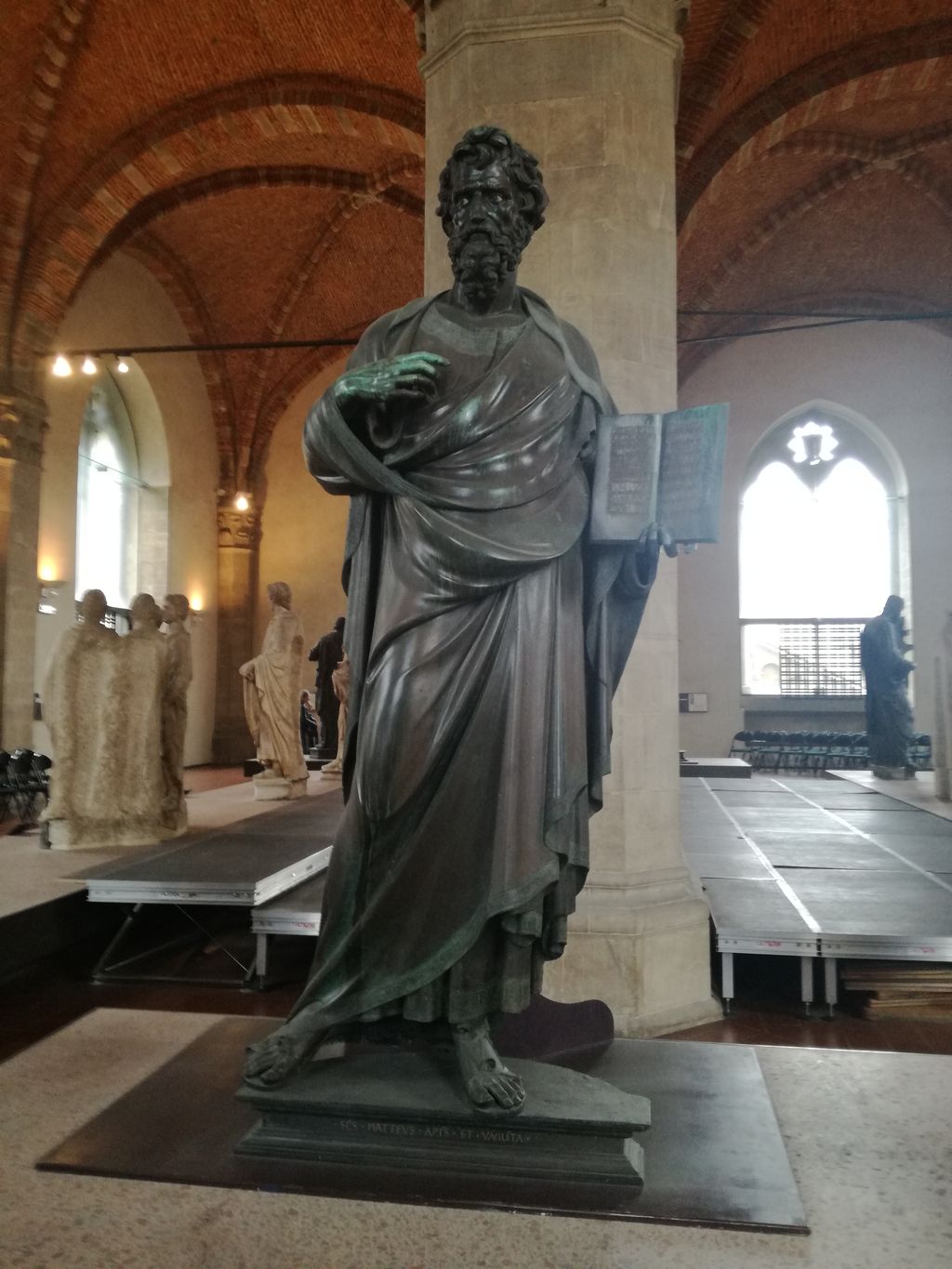
The plan for preserving the original and the plan for returning Matthew to the street thus met in a decision about what would go on the bronze surface. The restoration concluded in 2005. Matthew then went to the National Gallery of Art in Washington for its 2005–06 exhibition of sculpture from Orsanmichele and returned to Florence for the building’s reopening in 2006. The move indoors brought the worked surface and its lettering within closer view. [1] [9] [10] [14]
The bronze received further attention under a partnership agreed in 2023 between the Musei del Bargello and the Opificio. The account issued at the museum’s 2024 reopening describes a review of the cleaning and protection of the copper alloy, with treatment to inhibit chloride-related corrosion. It also records laser work that clarified the inlaid capitals in the Gospel and the whites of the eyes. Inside the museum, those are details a viewer can inspect at close range. Outside, from below the copy, the rows of letters resolve into the shape of an open book held forward, and the head turns that act of showing towards the street. [2] [3] [4] [15]
Lorenzo Ghiberti in context
Sacrifice of Isaac
1401 competitionNorth Doors
1403–1424St John the Baptist
c. 1414–1416St Matthew
1419–1422Gates of Paradise
1425–1452St Stephen
c. 1427–1429Lorenzo Ghiberti sculpture directory
Discussion
Ghiberti rewards slow looking: relief, gilding, narrative structure, workshop practice and conservation evidence can all change how a work is read.
Join the Conversation
Have an observation about St Matthew, a source to add, or a comparison that sharpens the reading? Share it below.
References
- Ministero della Cultura, San Matteo Evangelista, national catalogue record 0900291897, also available as the Ministry’s linked-data record. View source 1. View source 2.
- Elisa Marianini, photograph of the original St Matthew in the Museo di Orsanmichele. View source.
- Musei del Bargello, Orsanmichele. View source.
- Yair Haklai, photograph of the replica of St Matthew in the original niche. View source.
- Fondazione Palazzo Strozzi, Aspettando la Primavera del Rinascimento, adapted from Aldo Galli’s catalogue entry. View source.
- Filippo Baldinucci, Notizie de’ professori del disegno, vol. III, pp. 7–11, digital edition of the Accademia della Crusca. View source.
- Ministero della Cultura, San Matteo Evangelista, detached mural, national catalogue record 0900291990. View source.
- United States Conference of Catholic Bishops, Matthew, chapter 9, verse 9. View source.
- Opificio delle Pietre Dure, Lorenzo Ghiberti, San Matteo, 1419–1422, conservation record GR 11549. View source.
- Annamaria Giusti, La statua del San Matteo di Lorenzo Ghiberti, restoration report in Amici Opificio Friends, October 2005, pp. 3–4. View source.
- Fondazione Palazzo Strozzi, Denaro e bellezza, exhibition guide, pp. 104–105. View source.
- Opera di Santa Maria del Fiore, San Matteo Evangelista, Porta Nord del Battistero, object record 4283. View source.
- Sailko, photograph of Matthew on the original Baptistery North Door. View source.
- National Gallery of Art, Washington, Monumental Sculpture from Renaissance Florence, 2005–06. View source.
- Soprintendenza Archeologia, Belle Arti e Paesaggio, Riapertura al pubblico della Chiesa e Complesso di Orsanmichele, also published by the Comune di Firenze. View source 1. View source 2.