 by Tom Gurney
Tom Gurney BSc (Hons) is an art history expert with over 20 years experience
Published on June 19, 2020 / Updated on November 17, 2026
Email: tomgurney1@gmail.com / Phone: +44 7429 011000
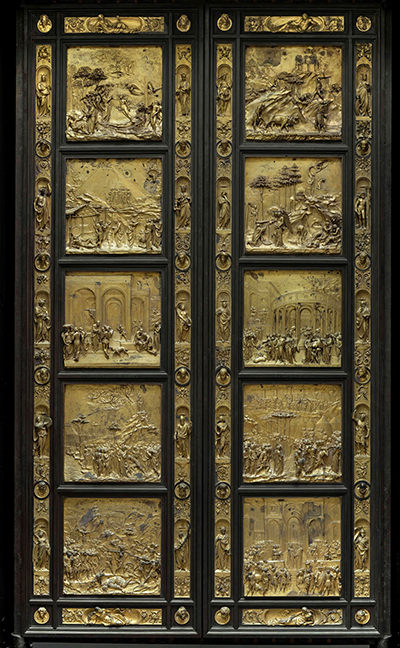
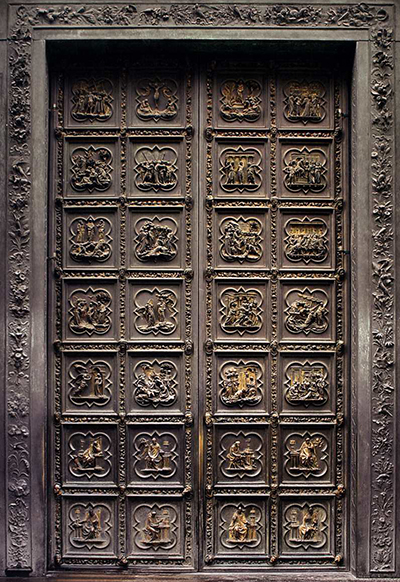
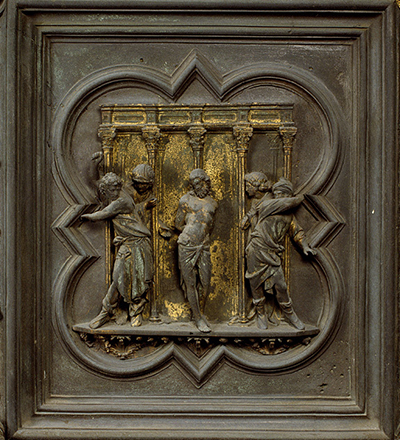
In Lorenzo Ghiberti’s Flagellation, the fullest view is of the man who has the least room to move. Christ stands almost entirely exposed beneath a classical porch. At either side, two men overlap so closely that at first they look like a single figure in motion. The cast bronze relief belongs to the North Door of the Florence Baptistery, made between 1403 and 1424 and now in the Museo dell’Opera del Duomo. Its setting gives the punishment a firm floor and a fixed centre. The action becomes clear as soon as you look down from the moving arms to the men’s feet. [1] [2] [3]
Contents
- The body at the column
- Four men around an open centre
- Five studies for the turns
- How the porch fits the frame
- How the punishment is told
- Beside Pilate’s seat
- Seeing the relief in Florence
The body at the column
Start at the top of the porch. Five principal capitals mark out the front of its horizontal beam, one at the centre and two on either side. Follow the central shaft and it disappears behind Christ’s head; the two shafts immediately to either side remain visible much farther down. These uprights make it possible to judge the slight shifts in his stance.
His head inclines towards one shoulder, his chest and waist turn, and his legs draw in until the ankles converge. The column sets the middle of the scene, but no single straight line could take in the head, shoulders and feet. The same departures from the vertical show in Mary Ann Sullivan’s colour view of the panel under very different light. [1] [2] [4]
The catalogue identifies Christ as bound to the column. In the bronze, his arms pass behind the body, where the fastening is difficult to make out. The smooth chest is much easier to see, as are the creases that converge at the waist and run diagonally across the thigh. Below them, the close-set feet take up little of the platform. Compare the man on the right, whose feet extend from the shaft beside Christ towards the outer edge of the porch. The floor is continuous beneath both men, so there is a direct comparison to make: one man can take his weight across the space between his feet, while the other barely has room to shift his weight where he stands. [1] [2] [4]
Look closely at the Flagellation
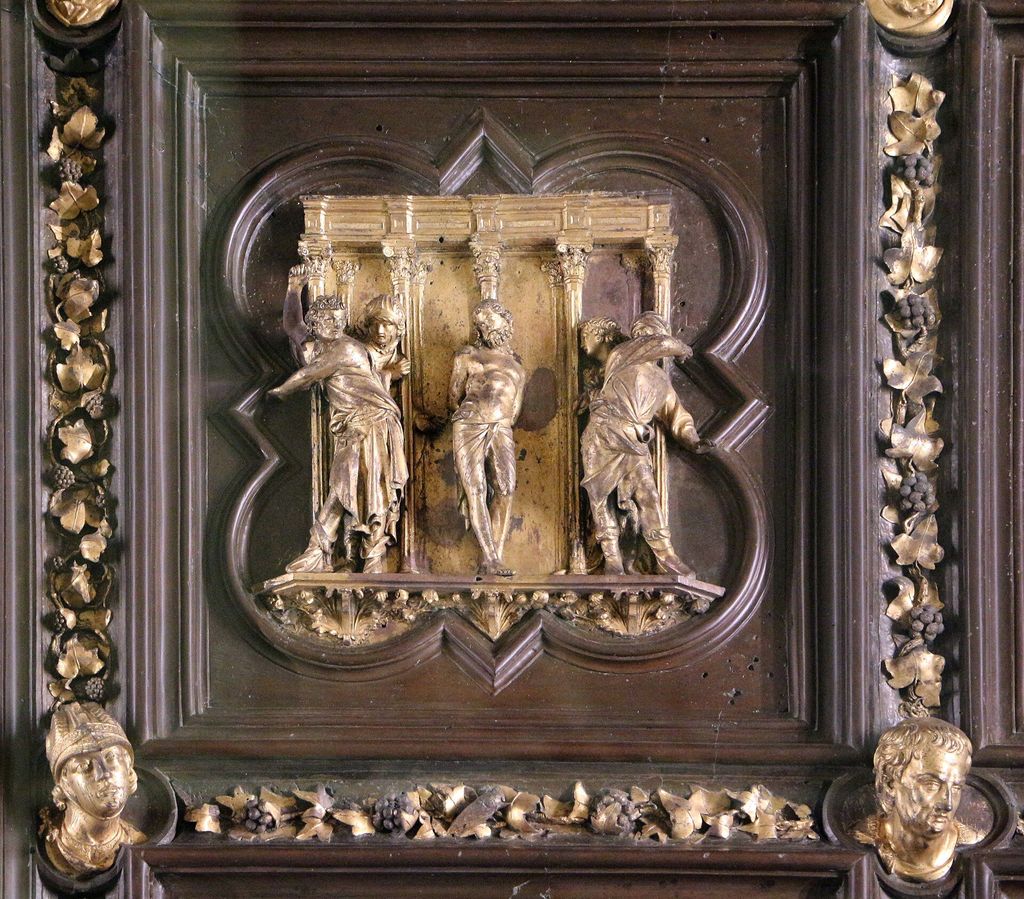
1. Christ at the centre
The upright body divides the executioners. Its stillness is visible against their bent limbs.
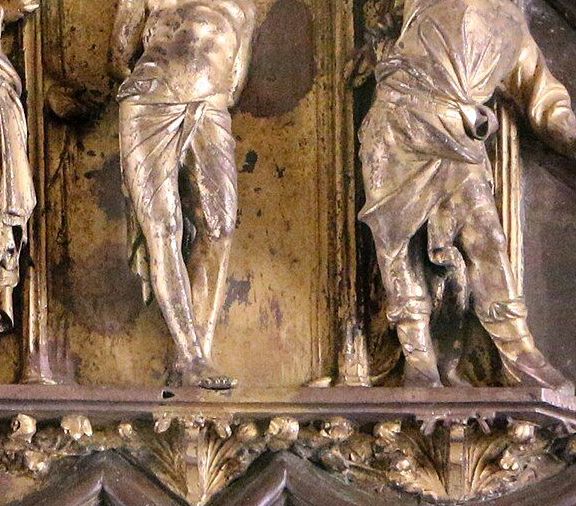
2. The porch above the figures
The horizontal beam and uprights establish a rigid framework across the upper part of the scene.
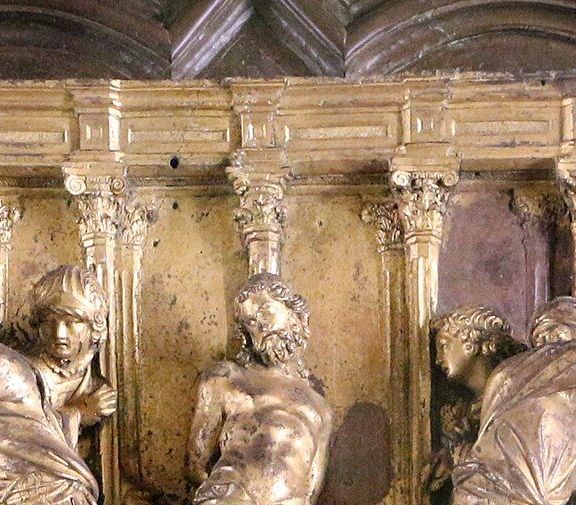
3. An executioner beside Christ
The figure turns across the relief, countering the strict vertical lines of the architecture.
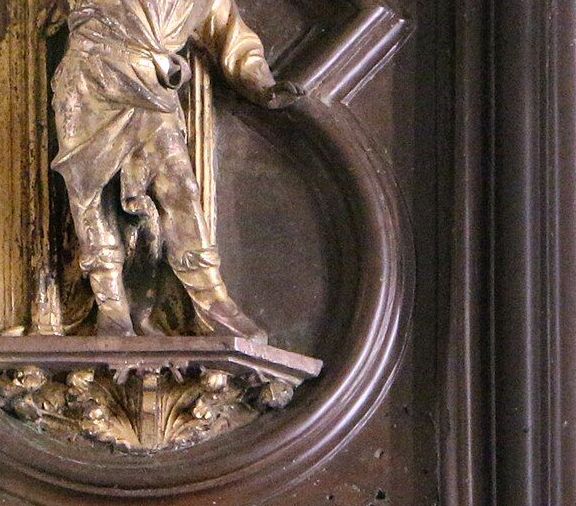
Photograph by Sailko. Source image. CC BY 3.0. Resized for the overview and cropped for detail.
Four men around an open centre
At the viewer’s left, the foremost man lifts a hand beside the outer column and extends his other arm towards the edge of the panel. His chest and the front of his garment are still visible, even as the folds pull sideways across his waist. Across the porch, the other man presents his back. His lifted arm cuts across the line of his head, and the gathered cloth at his lower back gives the eye a point from which to follow the turn down into the legs. The two poses occupy corresponding places, but one opens towards us while the other turns away. In the Opera catalogue both men are preparing to strike. Their different turns give each action its own shape. [1] [2]
The rear figures make that pairing less obvious at first glance. On the left a capped head and a hand appear beside a shaft; on the right a profile emerges in the narrow space between a column and the turning man. Their faces are close to the shoulders of the foreground figures, so the five beats across the porch resolve into two tight groups and an isolated body.
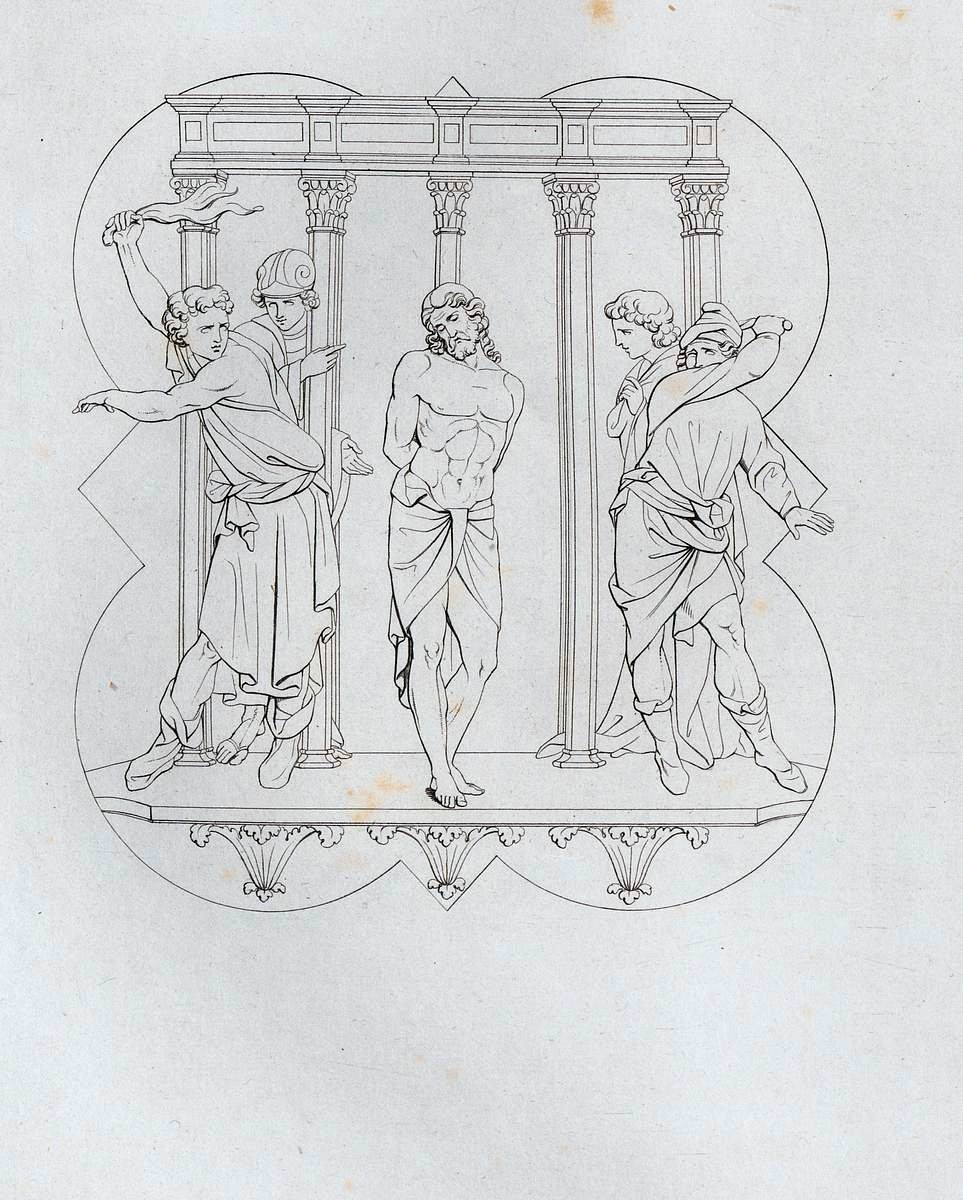
The 1821 engraving published with Carlo Lasinio’s account clarifies the separation of the feet and the direction of the lifted arms. It also puts distinct lines at the raised hands that are harder to make out in the photographs. The print helps to follow each gesture; the bronze views leave the precise form of the implements uncertain. [1] [2] [4] [5]
Five studies for the turns
A pen-and-ink sheet in Vienna’s Albertina offers a comparison for the two foreground poses. Pamela McLean relates the upper three studies principally to the man on the left and the lower two to the man on the right. She singles out the second study as the closest to the left figure. In her reading of the sketch, the man comes forward onto one foot as he brings his arm up to strike.
In the bronze both feet are more firmly planted and the turn is stronger at the waist. The lower sketches explore a figure seen from behind and vary the distribution of his weight. Neither provides a simple match for the right-hand figure, whose lifted left arm McLean compares instead with one of the upper studies. [2] [6] [7]
The comparison helps explain why the bronze man can look ready to strike even with both feet on the platform: shoulders and hips pull in different directions while the ground gives him a firm footing. Whether the sheet was made in preparation for this relief is a separate question. McLean argues that it was a working study, but Spain’s state guarantee for the 2019 Prado loan lists the drawing as about 1427–30, after the door was finished. The loan listing gives no argument for the date. The similarities make the drawings useful for thinking about the poses, but they leave the order in which sheet and bronze were made unresolved. [2] [3] [6] [7]
How the porch fits the frame
The beam and the platform define a rectangle inside the quatrefoil, the frame with four rounded lobes. There is room left above the beam under the upper curves. Beneath the platform, sprays of foliage occupy the bottom curves where the floor itself cannot go. At either side, the limbs of the foreground men reach out from the rectangle towards the sharp indentations between the lobes. The upper and lower edges thus give the scene its stability while the lateral reaches give the two turns somewhere to go. [2] [4] [5]
The Opera’s conservation account describes selective gilding on the North Door against areas of exposed bronze. In Sailko’s museum photograph, the space behind Christ reads as part of the light architecture. A shadow beside the torso gives part of the body a crisp edge where figure and porch are similar in colour. Sullivan’s photograph gives the surfaces a different balance of light and dark, yet the porch and bare torso remain easy to distinguish. Across the two views, what remains constant is the design: the uninterrupted edges of the porch and the open intervals on either side of Christ. [2] [4] [8]
How the punishment is told
Matthew and Mark place the scourging just before Pilate hands Jesus over for crucifixion, and go on to describe the soldiers’ mockery. John puts it before Jesus is shown to the crowd again and before the final handover. In Luke, Pilate proposes punishment and release; the proposal is reported without a completed scourging. The passages give the act little space and do not furnish the colonnade or the arrangement of figures seen here. The panel gives the punishment its own setting and makes the threat visible in the bodies that surround Christ. [1] [2] [9] [10] [11] [12]
Vasari read the slight twist as a response to the blows and found the figure moving. He saw the attackers’ anger in their gestures. Lasinio’s commentary of 1821 likewise reads pain in Christ’s turn, but also finds resignation in the figure. The print that accompanies the commentary makes the pose easy to isolate: Christ’s arms are largely hidden and the outline of his shoulders and legs stands clear of the men to either side. Lasinio asks the viewer to see suffering and composure in that same outline. [2] [5] [13] [14]
Bertha Friedmann came to a different judgement in 1913. She praised the modelling of the body but found its elegant bearing at odds with the subject. The visual contrast that concerned all three writers is still there: Christ makes a small turn in a confined stance while the others throw their arms wide. Whether the smallness of that movement makes the pain more convincing was where they differed. [2] [13] [14] [15]
Beside Pilate’s seat
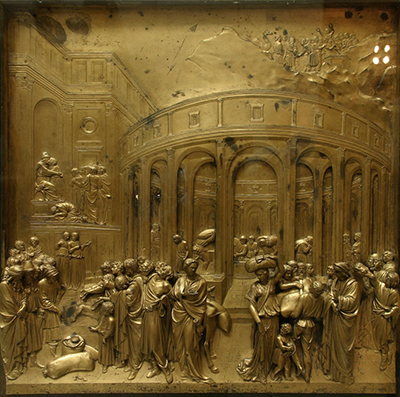
The Flagellation is in the second row from the top, just to the right of the seam between the leaves. Christ before Pilate sits immediately to its right. An Alinari photograph records both panels together: their platforms run at broadly the same height, and in both panels the line of the roof crosses above the heads. Look between those two lines to see how differently the buildings organise the groups.
Behind Pilate, a large arched recess marks his raised seat and smaller arches extend behind the standing figures. Pilate stands out by virtue of his elevation above the group; Christ, at the column, stands out through the space on either side of his body. The nearly level floors make that difference easier to see. Each episode has its own figures and architectural setting, even when the two are read together. [2] [3] [16] [17] [18]
Seeing the relief in Florence
The documented dates cover the door as a whole. The Opera catalogue reports Richard Krautheimer’s stylistic proposal of about 1420–24 for the Flagellation, while Mary Weitzel Gibbons dates it to about 1416–19 in her study of Giambologna’s Passion reliefs. The position of the panel can be fixed more closely than its date. On the assembled original in the Sala del Paradiso, look for the straight span of the porch in the inner column of the right leaf, then compare the space beneath it with the crowd around Pilate. The door on the Baptistery exterior is the replica installed in 2016, following completion of conservation of the original in 2015. [1] [3] [17] [19] [20]
Lorenzo Ghiberti in context
Sacrifice of Isaac
1401 competitionNorth Doors
1403–1424St John the Baptist
c. 1414–1416St Matthew
1419–1422Gates of Paradise
1425–1452St Stephen
c. 1427–1429Lorenzo Ghiberti sculpture directory
Discussion
Ghiberti rewards slow looking: relief, gilding, narrative structure, workshop practice and conservation evidence can all change how a work is read.
Join the Conversation
Have an observation about Flagellation, a source to add, or a comparison that sharpens the reading? Share it below.
References
- Opera di Santa Maria del Fiore, scientific catalogue, Flagellazione di Cristo, Porta Nord del Battistero, record 4323 View source.
- Sailko, photograph of the original Flagellation panel, Wikimedia Commons View source.
- Opera di Santa Maria del Fiore, scientific catalogue, Porta Nord del Battistero, record 3618 View source.
- Mary Ann Sullivan, colour photograph of the Flagellation, Bluffton University View source.
- Carlo Lasinio’s 1821 North Door publication, plate XVII, left, ETH-Bibliothek, e-rara View source.
- Pamela McLean, MPhil thesis, “Five Studies for a Flagellation of Christ”, pp. 117–120, University of St Andrews View source.
- Boletín Oficial del Estado, Order CUD/392/2019, annex item 4, Prado loan of Albertina 24409 View source.
- Opera di Santa Maria del Fiore, L’oro del Ghiberti torna a splendere, North Door conservation and gilding View source.
- Matthew 27:24–31, New American Bible, Revised Edition, USCCB View source.
- Mark 15:12–20, New American Bible, Revised Edition, USCCB View source.
- John 19:1–16, New American Bible, Revised Edition, USCCB View source.
- Luke 23:13–25, New Revised Standard Version Updated Edition, Bible Gateway View source.
- Giorgio Vasari, “Lorenzo Ghiberti”, Le vite, 1568 edition, p. 217, e-rara View source.
- Carlo Lasinio, commentary for plate XVII, 1821, p. 9, ETH-Bibliothek, e-rara View source.
- Bertha Friedmann, Ghibertis Verhältnis zur Gothik und Renaissance, 1913, pp. 22 and 58 View source.
- Fratelli Alinari, photograph no. 1842 of the Flagellation and the neighbouring Pilate panel, SIRBeC record IMM-3a010-0012505 View source.
- Yair Haklai, photograph of the original North Door in the Museo dell’Opera del Duomo, Wikimedia Commons View source.
- Sailko, photograph of the original Christ before Pilate panel, Wikimedia Commons View source.
- Mary Weitzel Gibbons, Giambologna: Narrator of the Catholic Reformation, chapter 5, fig. 59, University of California Press View source.
- Opera di Santa Maria del Fiore, La replica eseguita ad arte della Porta Nord del Battistero View source.