

 by Tom Gurney
Tom Gurney BSc (Hons) is an art history expert with over 20 years experience
Published on June 19, 2020 / Updated on July 28, 2026
Email: tomgurney1@gmail.com / Phone: +44 7429 011000
The most useful writing on Lorenzo Ghiberti falls into several distinct groups: Ghiberti's own Commentarii, documentary monographs, studies of the Baptistery doors, conservation publications and museum catalogues. No single book answers every question. Choosing well depends on whether the reader wants Ghiberti's voice, a career chronology, close analysis of an individual object or technical evidence about bronze and restoration.
Contents
- Ghiberti's Commentarii
- Richard Krautheimer's Lorenzo Ghiberti
- The Gates of Paradise
- Orsanmichele and individual sculptures
- Conservation literature
- Choosing by research need
Ghiberti's Commentarii
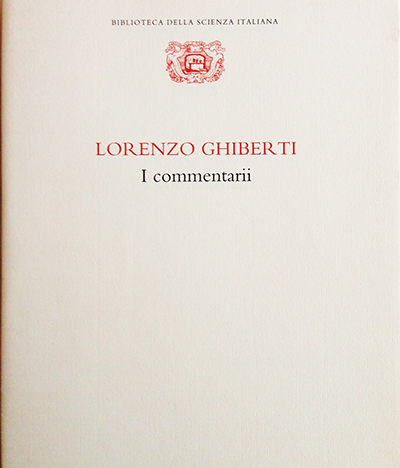
The Commentarii are indispensable because Ghiberti wrote about earlier art, optics, proportion and his own career. They are also difficult evidence. His competition victory and assessment of the Gates are acts of self-presentation, not neutral archival reports.
Lorenzo Bartoli's 1998 Italian edition, published by Giunti, is the preferred modern route in this project. The Biblioteca Nazionale Centrale di Firenze and Internet Culturale verify the edition, but their public digitization is incomplete. It should not be cited as though every passage were available online.[1]
Julius von Schlosser's Lorenzo Ghibertis Denkwürdigkeiten (I Commentarii), published in Berlin in 1912, is fully accessible through the Warburg Institute. It presents the Italian text with extensive German scholarly apparatus. It is especially useful for locating passages and studying the transmission of the manuscript, though it predates a century of later research.[2]
Readers seeking English quotations should be cautious. An unattributed modern translation can hide difficult editorial choices. Where no inspected named English translation is available, a clearly cited paraphrase from the Italian is more responsible than quotation marks around uncertain wording.
Richard Krautheimer's Lorenzo Ghiberti
Richard Krautheimer's two-volume Lorenzo Ghiberti remains a foundational modern study. First published in 1956 and issued in a corrected second printing in 1970, it combines career analysis, catalogue, documents and extensive visual comparison.
Its strength is range. Contracts, workshop chronology, stylistic development and individual works can be examined within one scholarly structure. Its interpretations should still be identified as arguments rather than converted into timeless consensus. Later conservation findings and object research can revise how particular surfaces, dates or workshop roles are understood.
For St Stephen, the relevant 1970 discussion is routed through pp. 86–100. The exact edition matters because pagination and supplementary material may differ among printings.
The Gates of Paradise
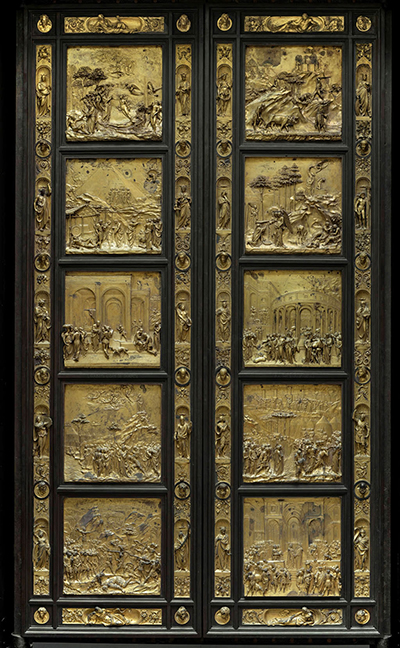
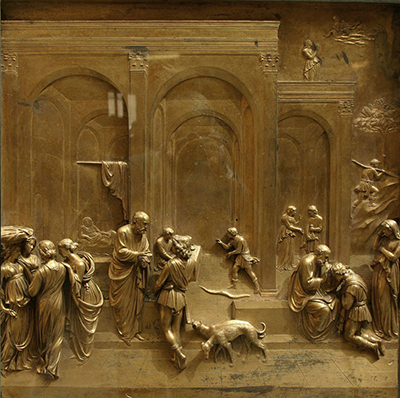
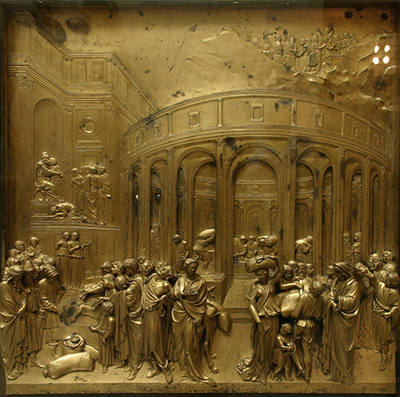
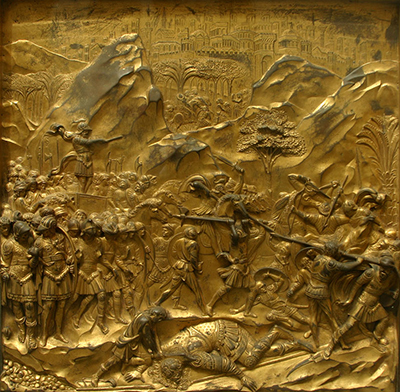
Gary M. Radke's edited volume The Gates of Paradise: Lorenzo Ghiberti's Renaissance Masterpiece accompanied the 2007 exhibition of restored panels and frame elements in the United States. It is the best focused starting point for readers interested in the eastern doors as a combination of narrative, workshop production, material technique and conservation.
The Metropolitan Museum of Art's exhibition pages provide an accessible introduction to Adam and Eve, Jacob and Esau and David and Goliath. They are not substitutes for the complete book, but they give reliable object facts and concise descriptions tied to the exhibition.[4]
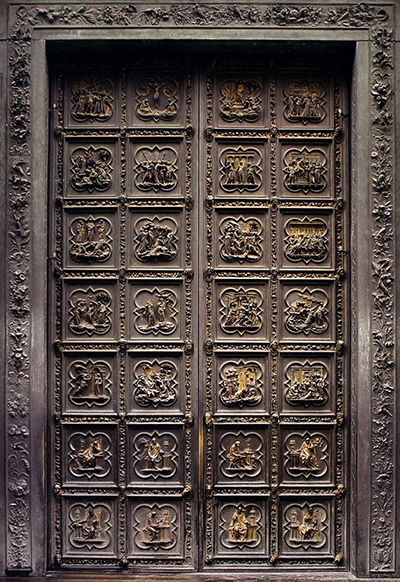
Opera del Duomo's scientific catalogue should be consulted alongside printed scholarship. Its main Gates record and individual panel entries assemble object data, archival references, restoration history and extensive bibliographies. These Italian-language records are particularly useful for verifying panel position, subject inventory and the history of interpretation.[3]
Orsanmichele and individual sculptures
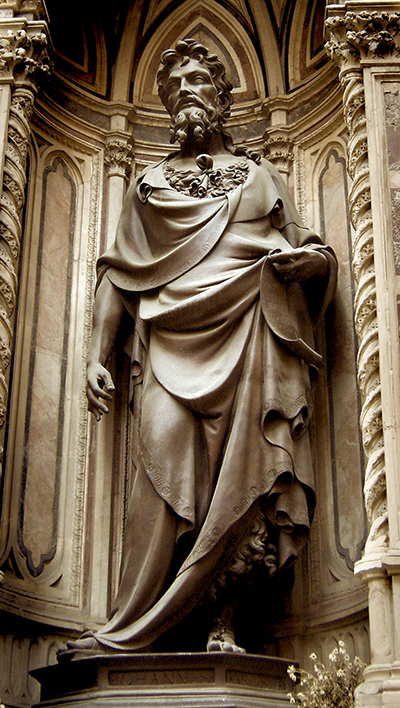
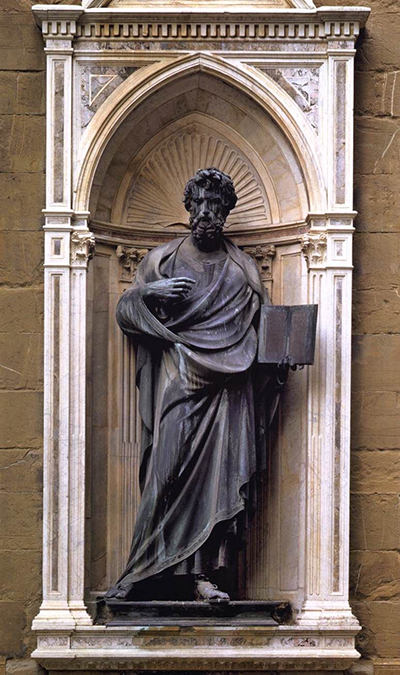
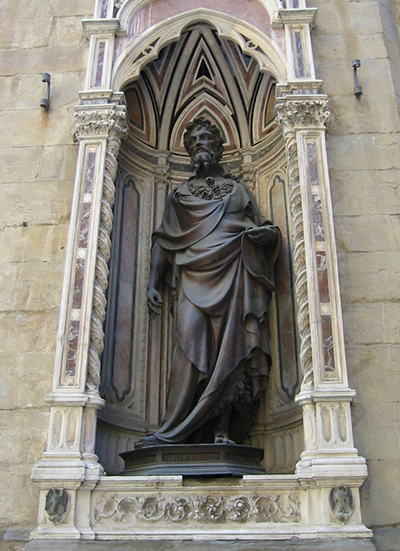
The Musei del Bargello and Italian national cultural-heritage catalogue provide direct records for Ghiberti's three Orsanmichele bronzes. These records clarify material, dimensions, chronology and present location. Their compiled critical notes can direct further research but may preserve older scholarly judgements that deserve attribution.[5]
Specialist articles become valuable when a narrow question matters. Piero Morselli's “The Proportions of Ghiberti's Saint Stephen,” published in The Art Bulletin 60.2 (1978), pp. 235–241, concentrates on proportion and the relation to Vitruvius and Alberti. It is not a general introduction to the statue, but it shows how a focused study can complicate broad stylistic rankings.
Conservation literature
Conservation publications are essential because Ghiberti's bronzes no longer look exactly as they did when installed. Cleaning and technical study have recovered gilding, silver details and information about casting and corrosion.
Opera del Duomo and the Opificio delle Pietre Dure provide the strongest institutional routes for the doors. Their records should be preferred for treatment history. Detailed claims about cleaning chemistry or corrosion mechanisms require the full technical publication, not a shortened museum summary.
Choosing by research need
- For Ghiberti's own words: begin with Bartoli 1998 or the access-confirmed Schlosser 1912 edition.
- For career, documents and catalogue: use Krautheimer, checking the edition and exact pages.
- For the Gates: combine Radke's 2007 volume with Opera del Duomo's object catalogue.
- For museum location and object facts: use Opera del Duomo, Musei del Bargello and the national catalogue.
- For technique or restoration: locate the relevant institutional conservation report before making detailed claims.
The best research practice is cumulative. A primary source supplies Ghiberti's perspective; documents establish chronology; object records fix material and location; conservation changes what can be seen; and later scholarship tests interpretation. Reading across those categories produces a more reliable artist than relying on any one celebrated book.
Discussion
Ghiberti rewards slow looking: relief, gilding, narrative structure, workshop practice and conservation evidence can all change how a work is read.
Join the Conversation
Have an observation about Ghiberti Literature, a source to add, or a comparison that sharpens the reading? Share it below.
References
- Internet Culturale/BNCF, Bartoli edition record
- Warburg Institute, Schlosser 1912 PDF
- Opera del Duomo scientific catalogue, Gates of Paradise (in Italian)
- Metropolitan Museum of Art, The Gates of Paradise
- Musei del Bargello, Orsanmichele