 by Tom Gurney
Tom Gurney BSc (Hons) is an art history expert with over 20 years experience
Published on June 19, 2020 / Updated on November 17, 2026
Email: tomgurney1@gmail.com / Phone: +44 7429 011000
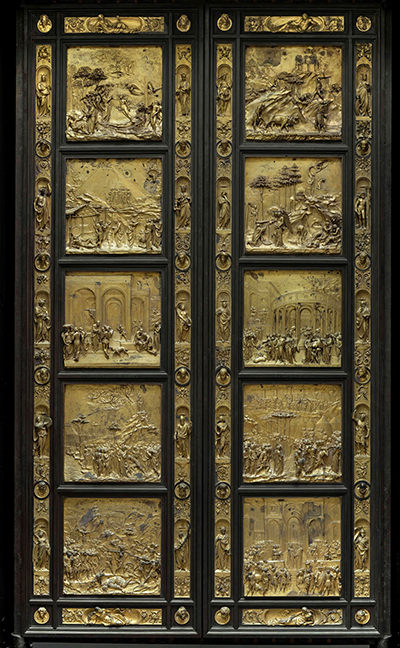
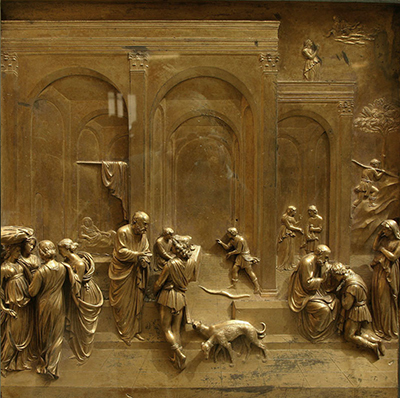
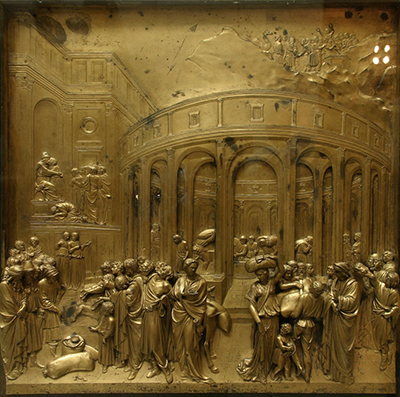
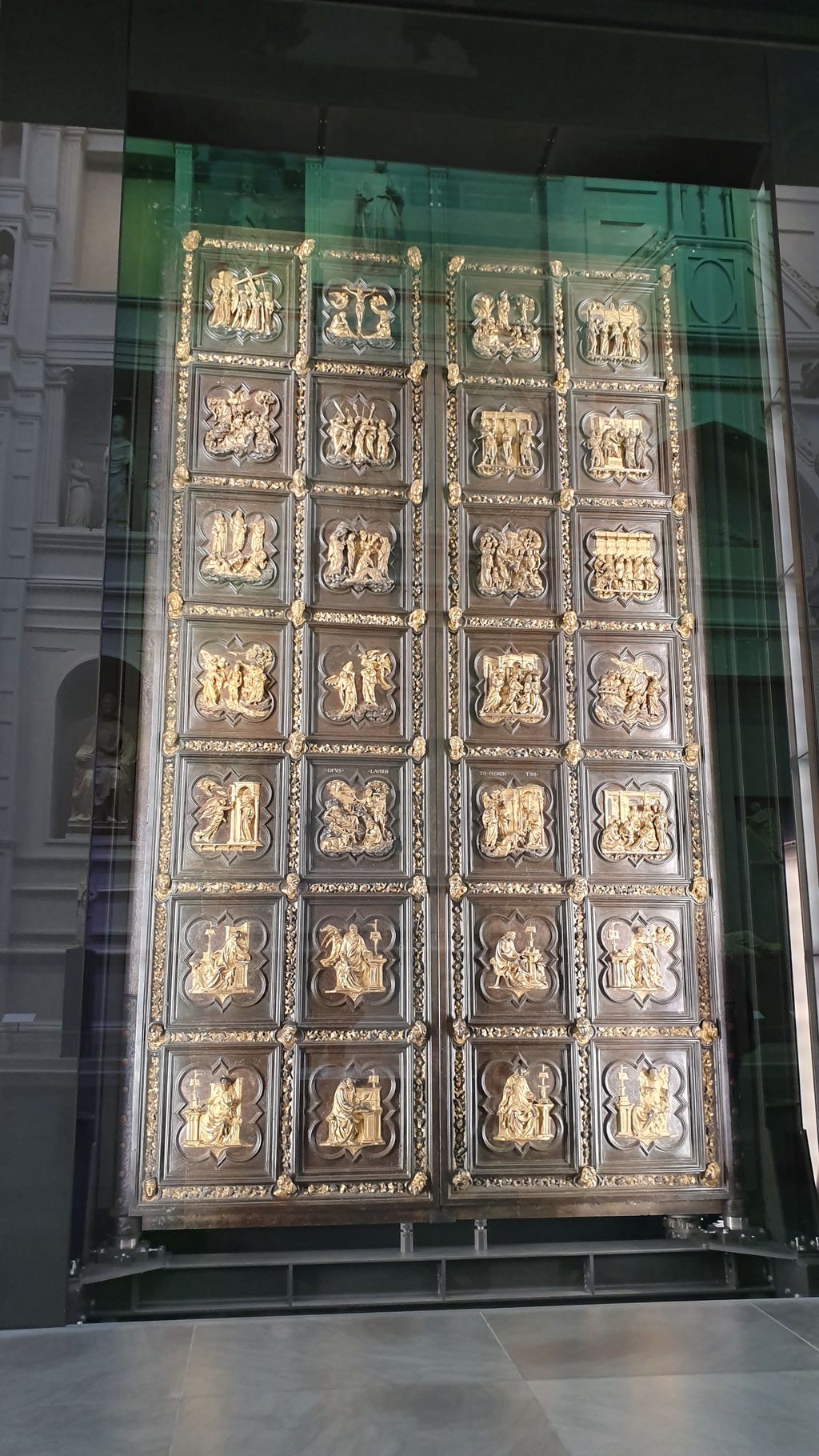
Two scenes at the top of Lorenzo Ghiberti’s North Doors are separated by the gap where the leaves meet. On the left, the arms of the crucified Christ extend over a field with very little in it. On the right, the risen Christ stands above a cluster of bodies at the tomb. One relief suspends the eye across the width of the panel; the other lifts it out of a crowd. The door opens between them. To follow the story, you have to cross that gap, just as you crossed it six times on the way up from the seated figures at the foot of the bronze. [1] [2]
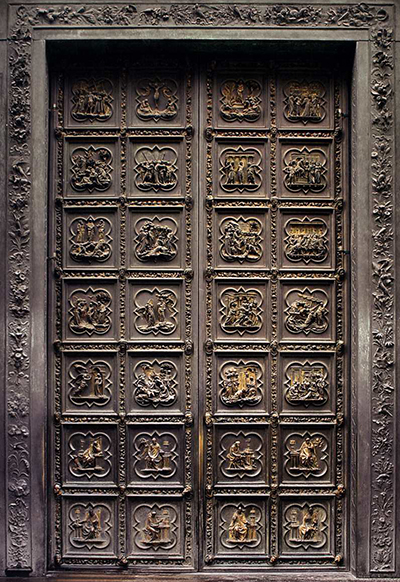
Ghiberti and his workshop made these doors for the Baptistery of San Giovanni in Florence between 1403 and 1424. In the Opera del Duomo’s scientific catalogue the assembled doors measure 506 centimetres high by 310 wide. The original is in the Sala del Paradiso of the Museo dell’Opera del Duomo; a bronze replica occupies the north portal of the Baptistery.
The name describes a later location. The scientific record gives the cathedral-facing east entrance as the first site and dates the move north to 1452, when the Gates of Paradise took its place. The museum’s shorter entry calls the north the original location, but the installation history in the scientific record and the dated provenances of individual reliefs support the east-to-north sequence. [1] [3] [4] [5]
The shorter entry also describes a reading order that can sound as though one leaf should be finished before the other. Try that with the objects in front of you: after the birth of Christ you would jump to the wilderness and leave the visit of the Magi until you came back down. The scene list in the same entry, the scientific catalogue and the installed bronze agree on the more useful route.
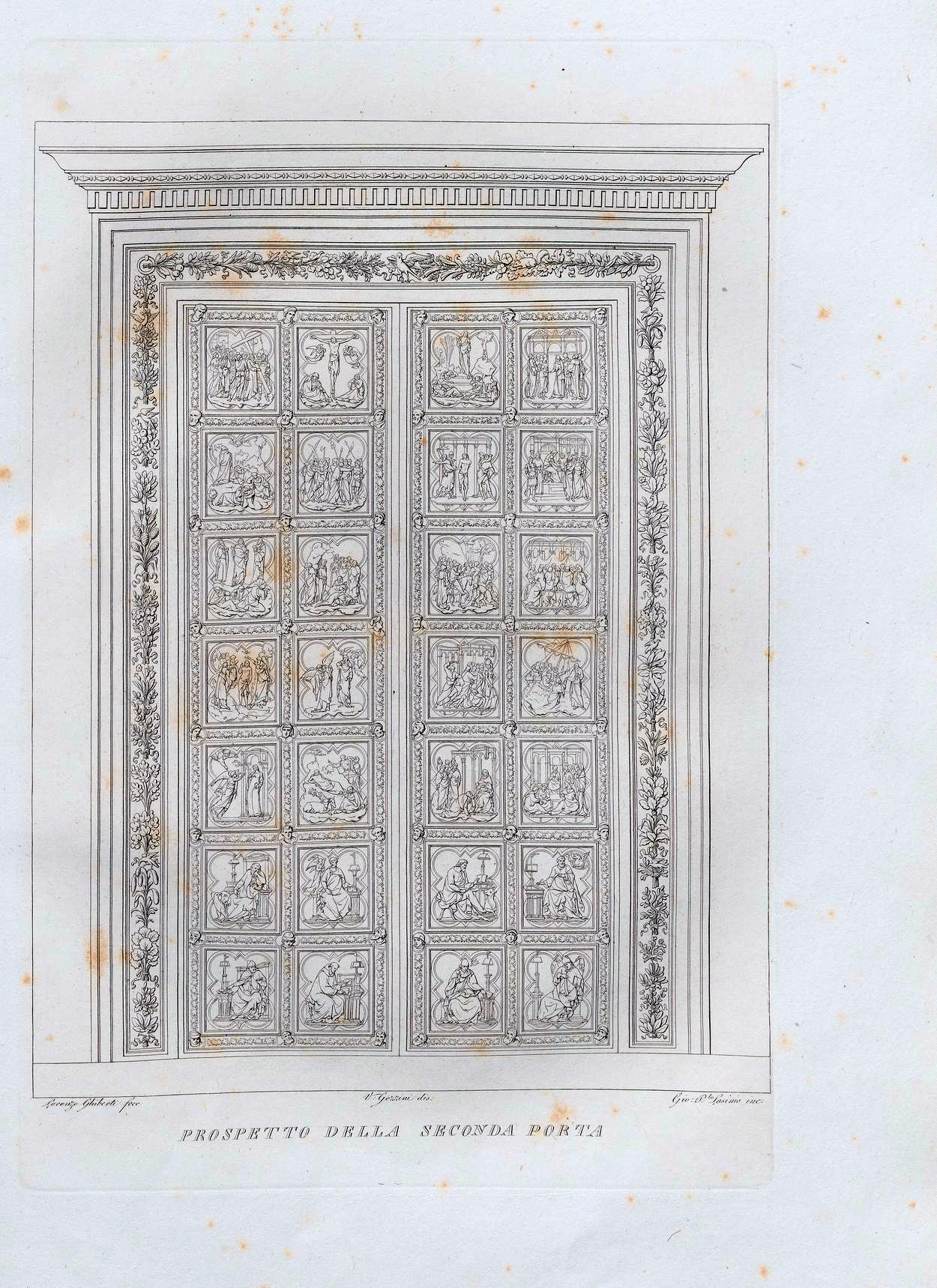
Read four panels from the viewer’s left to right, then return to the left one level higher. Height groups episodes together; the seam makes a pause within each group. The twenty scenes begin in the third row, after eight figures who are already reading, thinking or teaching about the things that happen above them. [1] [2] [3]
Contents
- Seven rows, from the books to Pentecost
- The pattern between the pictures
- From a trial relief to doors that could hang
- What the cleaning brought into view
- Four plasters in Paris and two bronze leaves in Florence
Seven rows, from the books to Pentecost
Start at the lower left with Augustine. His mass of drapery widens towards the floor, while the small book and the furniture draw the eye back up towards his hand. The mitre identifies the seated figure as a bishop before any finer detail becomes clear. Jerome, immediately to his right, provides a contrast in bearing.
His body and the angled surface before him make a concentrated group, and his inclination towards the book sets its plane at odds with the verticals of the frame. In these two fields a support for a book can be almost as conspicuous as the head of its reader. That allocation of bronze matters: the room taken up by furniture is room given to the action of studying. [1] [2] [6]
Across the seam Gregory the Great and Ambrose bring out another possibility of the same formula. Gregory’s papal headgear and the steadier presentation of the figure distinguish him from the more absorbed Jerome. Even so, the raised folds and the arrangement at his side keep the pose from becoming simply frontal. Ambrose, at the far right, can be studied at a more convenient height in Oronzio Lelli’s nineteenth-century plaster cast in Paris.
There the planes of the book and its support are easier to follow around the seated body. Compare the figures on the right leaf first by their headgear and only then by the hands and books: the signs of office sort the two men quickly, while their different ways of attending to the objects beside them take longer to register. The books establish a learned occupation without identifying particular works. [1] [2] [6] [7]
The four are conventionally called the Doctors of the Church. There is no continuous room around them, and they do not turn into a council when the two leaves are closed. Each sits on his own small platform, with dark metal left around the figure and furniture. The result looks orderly from several paces away, where the gilded figures register one after another like large initials.
Nearer the panels the similarity gives way to little changes in the angle of a book, the width of a seat or the extent to which a sleeve cuts across the body. These changes give each man a particular activity within the shared work of interpretation. The Temple doctors several rows above are people within a story; these four are figures of authority placed outside its time. [1] [2] [6]
In the second row, John the Evangelist has his eagle beside him. The inclination of his head and the hand that supports it make a pause visible. His book and writing instrument put that pause in the course of work. Next to him Matthew turns towards the winged human figure, so that the companion, already large enough to command a lobe of the frame, draws attention away from the writing surface.
The formula of the reader at a desk has acquired a second centre of interest. The attraction between figure and emblem makes this John distinct from the Baptist represented above: we recognise the writer by his relation to a book and an eagle, the Baptist by what he does beside the water. [1] [2] [8]
On the right leaf Luke bends into the space of the desk, with the ox low beside him. The animal occupies a very different part of its relief from the eagle alongside John. Look next at Mark: the lion’s raised head and the direction of the writer’s hand keep setting up connections across the small intervals within the panel. Seen from far enough back for both leaves to be in view, these changes make the row more animated than the lowest one.
Up close, the desks, seats and platforms provide a useful control: similar items recur, yet the emblem can settle low like another object in the room or rise to meet the figure’s gaze. The human and animal presences give the Evangelists a way of showing the source and character of their testimony that is unavailable to the four Doctors. [1] [2] [8]
Nearly a third of the fields are devoted to writing and reading. Starting at the bottom takes the viewer backwards from the interpreters, through the Gospel writers, to the events in the books. The rectangular pages inside the reliefs offer a small analogue for the great grid around them: the metal has organised acts of attention at two scales. Once the narrative starts, the seats and books cease to recur on schedule, but the doors continue to direct attention in four measured steps across each row. [1] [2]
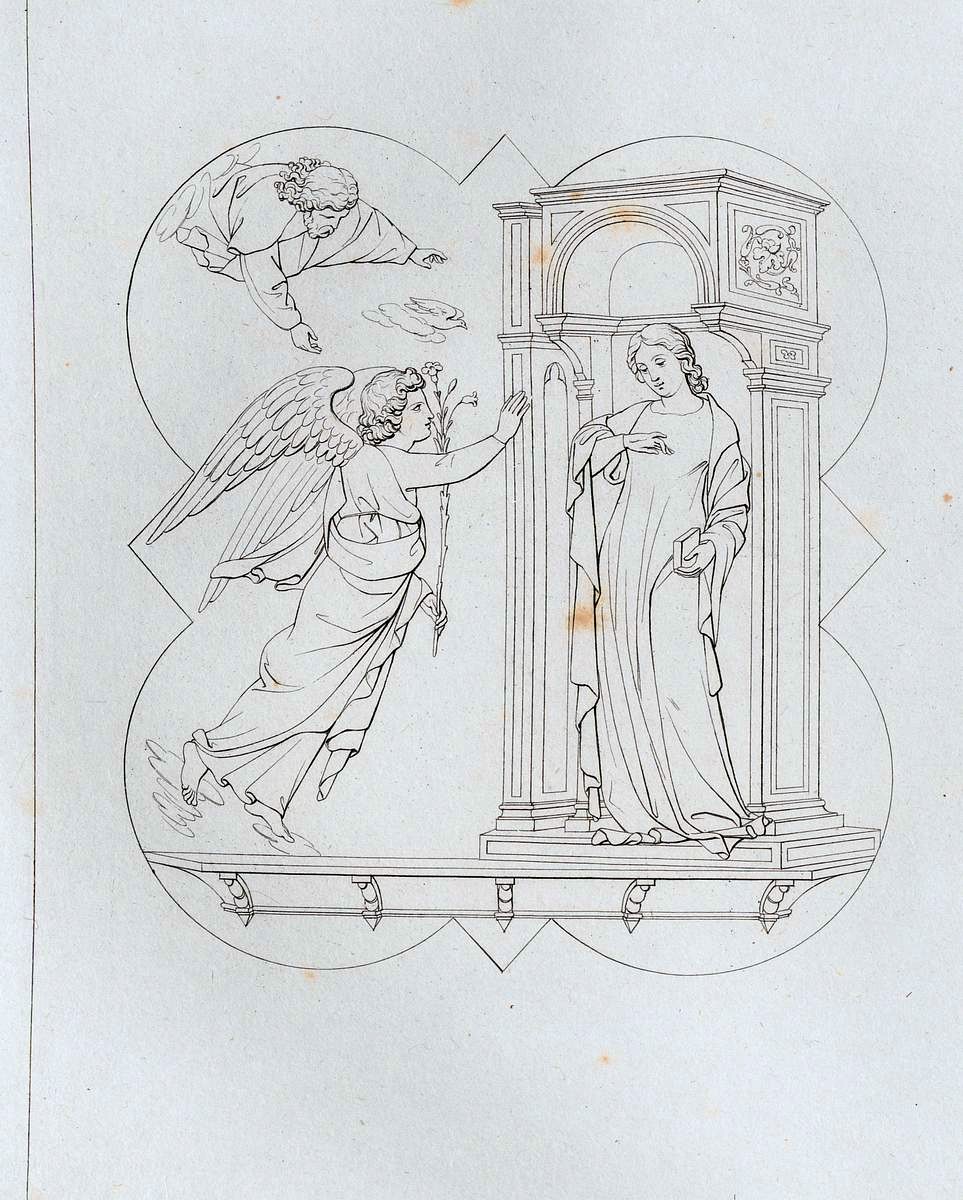
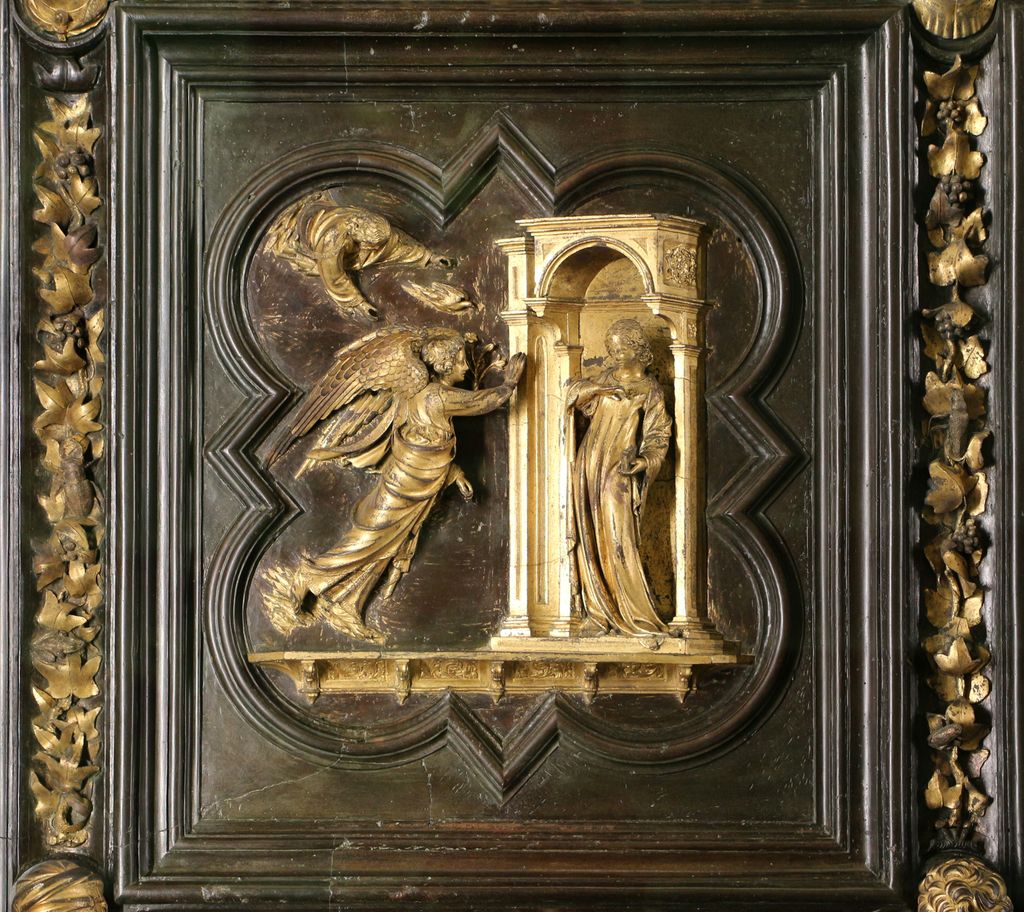
The first of those steps is the Annunciation. The angel leans in from the left, with wing and drapery spread across the open part of the field; Mary stands within a narrow architectural bay on the right. Their footing lies on the same raised ledge. It gives the eye a way across the interval that the upright supports divide, carrying Gabriel into the sphere of Mary’s room before the figures touch. Much of Luke’s account is dialogue. Here a greeting and an answer have to take place through the orientation of the bodies and the small distance between them. The architectural member between them does as much to make the interval felt as the unoccupied space above the angel. [2] [9] [11]
The Nativity replaces that ledge and doorway with irregular ground. The eye that has just moved across a short encounter now has to climb, finding several small groups in the folds of a hillside. At its foot the figures nearest the Child are only part of the action. Farther up, shepherds receive their own announcement. Daniel M. Zolli distinguishes relatively coarse rock and foliage from the smoother torsos of the shepherd boys.
He points out lettering worked into the robes of Mary and Joseph and toolwork on the feathers of the angel. Look first at the jagged rise of the hillside, then at the smooth areas of flesh or the marks on the robes. The ground makes it possible to find the separate incidents from below; the finishing lets a viewer with a close view distinguish kinds of material even where they overlap. Incised lettering is far less likely to read on the piazza than the shape of the hillside. [2] [9] [10] [11]
At the other side of the join, the Adoration of the Magi tightens attention around the visitor who kneels, the Child and the shelter above them. The figures approach through a succession of heights, so that the presentation of a gift stands out from the waiting party. The shelter and uprights give the encounter a more defined destination than the dispersed action in the Nativity.
The shift also crosses between written accounts: Luke gives the journey of the shepherds, Matthew the visit of the Magi. Ghiberti’s sequence puts these recognitions beside one another without requiring the viewer to see both visits in any one field. At the centre of the doors the separation of the leaves sits between two accounts of people coming to find the Child. [1] [2] [11] [12]
In Christ among the Doctors, at the far right, the shelter becomes an interior shared by a group. The young Christ’s place within it and the gestures of the men around him direct attention towards the question of who is teaching whom. Luke describes a child hearing teachers and asking questions, and the amazement his understanding elicits. The relief makes a public exchange legible inside a shallow space.
Compare the arrangement with the far left of the same row: both scenes use upright architectural supports, but in the Annunciation they mark the edge of a private encounter, while here they hold together people who turn towards one another. Between those two rooms, the hillside and the procession of visitors admit different kinds of witnesses. [1] [2] [9] [11] [12]
One tier higher, the Baptism has a strong centre even before the figures on the banks become distinct. Christ stands in the river. The Baptist’s action and the sign above make it possible to read down through the relief as well as across it. Rock and bank gather the attendants to the sides; water is the place where the event happens and part of what separates the bodies.
The standing Christ differs from the young disputant immediately below and across the door, whose relation to those around him depends on the furniture of a room. This Baptism belongs to the Florence doors. The bronze relief of the same subject on the Siena font has its own scale, projection and architectural setting, and answers a different problem of placement. [1] [2] [13]
In the Temptation in the Wilderness, the groups on the riverbank give way to two principals facing one another across a stretch of less occupied bronze. Look at the space above and between them before trying to decipher the tempter’s attributes. The still interval makes a decision perceptible: there is an approach, and the figure facing it holds his place. Matthew recounts several temptations, including the one on a high mountain; the image need not enumerate them to call the episode to mind.
Both this relief and the Baptism were among the first to be cleaned in the recent campaign. Their neighbouring positions make the contrast in the amount of incident particularly apparent when gilded shapes stand out against the ground. The gold can give a clear outline to a single figure with just as much force as it gathers together a crowd. [2] [13] [14] [15]
The next two reliefs fill more of the frame. In the Expulsion of the Money-Changers from the Temple, architecture takes hold of the upper part while the people below recoil and overlap. Its emphatic division between masonry and movement is a change from the open ground in the Temptation. The Temple incident takes place soon after Cana in John’s Gospel, whereas Matthew recounts it after the entry into Jerusalem.
Here it comes a whole tier before the entry. The difference is a reason to look at what the neighbouring scenes do: the catalogue connects them with the revelation of Christ’s authority, and the violent disruption of a settled group can be read beside his resistance in the wilderness and his command of the water. That grouping can make sense even for a reader who first encountered the episode near the end of Matthew. [1] [2] [13] [16]
In Christ Walking on Water the boat supplies a mass as strong as the architecture beside it. The rigging moves up into the space occupied by the Temple’s built forms, but the broad hull sits low, tipping the eye towards the encounter on the water. The difference between the two reliefs can be seen from the floor even before the lines of the water are apparent.
Giovanni Poggi’s postwar article gives a detail of this panel in which finer articulations of the action can be studied separately from the gleam of the present installation. The two stories occupy the inner and outer positions respectively on the right leaf, as the whole door confirms. Their component descriptions in the Opera catalogue reverse the columns. For the order of the stories, the boat at the outer edge is a better check than either description taken on its own. [1] [2] [13] [17]
The Transfiguration on the next tier gives the vertical direction of the door particular force. Three upright figures are separated from the apostles below, whose bodies answer the slopes of the rock. The lower figures spread into the lobes without drawing the eye away from the summit. Luke places the change in Christ’s appearance during prayer on a mountain; elevation is both subject and means of organising the witnesses. Compare the relief with the baptism below it. In each there is a revelation and a way for the eye to climb, but the mountain gives the effect of one ordered group set over another. At the river, onlookers stand to the sides, facing into the action. [2] [18] [19]
The Raising of Lazarus brings the eye back among closely spaced bodies. The figure called out of the tomb stands out for the confined shape of his wrapped body. Christ’s gesture must carry across intervening heads and shoulders, and their orientations help carry it. The relief has a point of emergence in the rock, whereas the Christ of the Transfiguration can be picked out against the upper field almost immediately.
Here the event is made visible through its effect upon a group. John’s account gives unusual weight to the witnesses and the public consequences of the act. One can see the visual difference between bringing someone out before a crowd and Ghiberti’s treatment of Christ’s own Resurrection at the top of the door, where the upright figure occupies ground above the others. [1] [2] [18] [19]
The Entry into Jerusalem keeps the dense grouping as the eye crosses the seam, but turns it into movement towards a place. The followers and the people ahead of the mount are held within the same boundary; the crowd has room to receive Christ, though hardly room to disperse. At the far right the movement closes in the Last Supper. A run of windows and supports encloses the company, and the long table replaces the lines by which the crowd approaches the city.
It can be read at once as a single horizontal form from below, while differences among the seated and leaning bodies take longer to emerge. Across the row, the isolated summit gives way successively to the opening in the rock, the approach to a city and the span of an enclosed room. The Opera takes the supper as the beginning of the Passion. From the supper at the end of the row, the eye goes back to the left and into the garden. [1] [2] [16] [18]
In the Agony in the Garden, rock separates the kneeling Christ from the sleeping disciples. The arrangement gives the eye two paths along the slope: towards the solitary prayer above and back across the lower bodies. A kneeling figure can seem far away within the space of a single panel. That effect depends on the turn of the rock and the dispositions of the figures, rather than on seeing an immense stretch of ground.
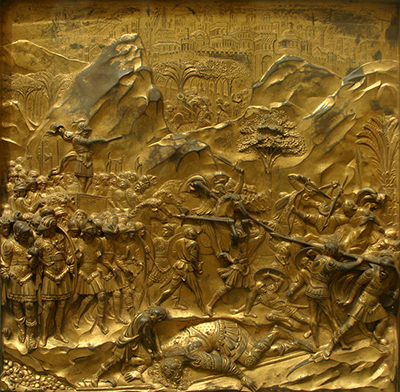
Immediately beside it, the Arrest of Christ brings faces close enough to meet and armed men close enough to jostle. There the conspicuous lines are the shafts rising out of the press of bodies. Compare the upper lobes: in one panel the hillside carries the eye between isolated incidents, while in the other the upright and slanting weapons make an extension of the crowd. [1] [2] [20]
The arrest brings together motifs whose textual sources can be distinguished. The contact between Judas and Christ recalls the kiss in the Synoptic accounts. John’s account names Peter and Malchus in the episode of the sword and the severed ear, but has no kiss. The two motifs can coexist in an image without making it a literal illustration of one Gospel. Their proximity gives a viewer two kinds of action to follow: an intimate sign of recognition and the quick violence of a subordinate encounter.
Ghiberti puts this accumulation after the intervals that organise the garden. There is also a possible separation of many years between the making of the two reliefs. The Opera’s account of Krautheimer’s chronology puts the garden among the earliest designs and the arrest among the last. The nearest neighbour in the finished door can be one of the most distant in the history of the work. [1] [2] [20] [21]
Across the join, architecture changes the character of violence. In the Flagellation, a column and Christ’s body make a steady upright, with the tormentors to either side. The porch sets a common upper limit to the figures and throws their actions back onto the body at the centre. In Christ before Pilate, by contrast, the seat of authority is one focus within a larger arrangement.
The people before it and the divisions of the setting make visible a difference in station. The Paris cast makes those relationships easier to study as shallow differences of level. At the height of the bronze on the door, the wider separation that matters is between the relatively open central group of the punishment and the more complex gathering of a trial. John, for instance, already has Pilate questioning Christ before ordering him to be scourged. [1] [2] [21] [22]
At the far left of the top tier, in the Way to Calvary, the long oblique of the cross imposes direction on a procession. It is possible to follow that line at a greater distance than one can distinguish each person in the crowd or assign a gesture to a named participant. The cross that was borne now stands upright in the Crucifixion. Where the procession filled the lower lobes with standing bodies, the two groups of mourners leave an interval under the figure.
The outline of the outstretched arms gives the middle of the relief width without giving it mass. Look at the edge of the field round the arms: the dominant figure seems far more exposed than the central figure tied to a column just below and to the right, where the building spreads above him. The different uses of the same bounded ground distinguish two kinds of exposure. [1] [2] [20] [23]
The Resurrection, immediately beyond the seam, gives that upper space to a figure free of the cross. At the bottom are the tomb and the guards, spanning enough of the field to give the rising figure a base from which to detach himself. Gospel narratives tell of the discovery of the tomb and later encounters with the risen Christ; the relief supplies a view of the victory itself.
Neither the figure’s spatial elevation here nor the guards’ presence turns this into an account of witnesses seeing the Ascension. The two central reliefs put death and resurrection beside one another where the partition is strongest. Moving the eyes across it is part of seeing the opposition between the narrow suspended body and the figure who rises above the crowded lower field. [1] [2] [23]
At the far right, Pentecost returns the eye to a collective event. The figures are gathered under a broad upper enclosure; the upper sign and the assembly below set up the essential direction of the composition. Acts 2 gives the descent of the Holy Spirit and describes the sound and the tongues as of fire. Acts 1 names Mary among the earlier gathering of disciples; it is a separate passage and cannot by itself identify every participant in the bronze.
The finished sequence ends by making a community visible. Look down from that crowded final field to the isolated writers and teachers: the relation is one the door makes available without illustrating intervening centuries. The gathering above and the desks below mark successive ways in which events become something other people can hear, read and discuss. [1] [2] [24]
Find your way around the North Door
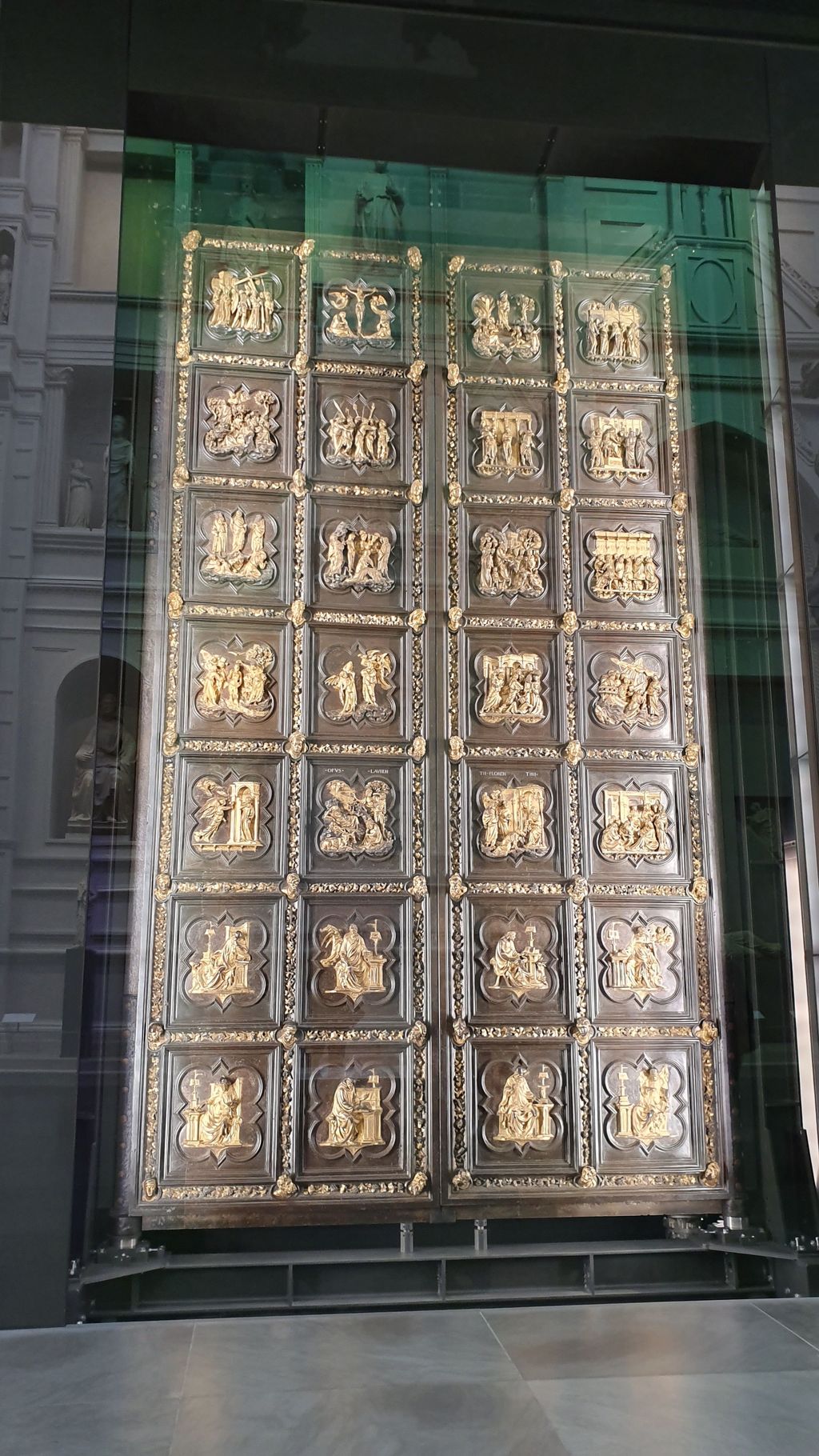
1. The beginning of the Christ cycle
The third row from the bottom opens with the Annunciation at the left. The narrative then continues across both leaves.
2. The Evangelists in the second row
Four seated Evangelists occupy the row immediately below the opening scenes of Christ’s life.
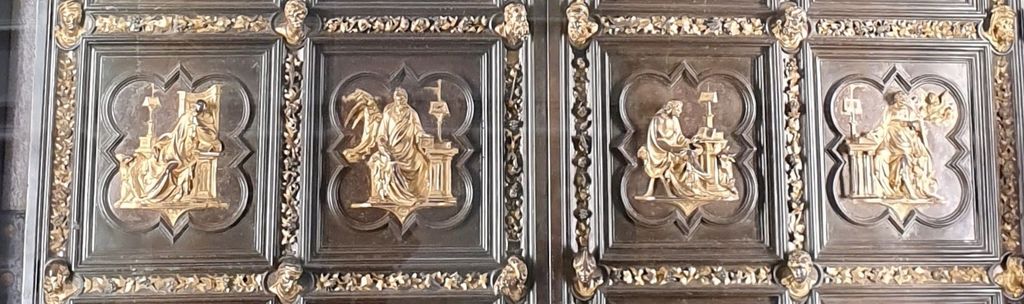
3. The Doctors in the bottom row
The four Doctors of the Church form the lowest register. Like the Evangelists, they occupy individual quatrefoils.
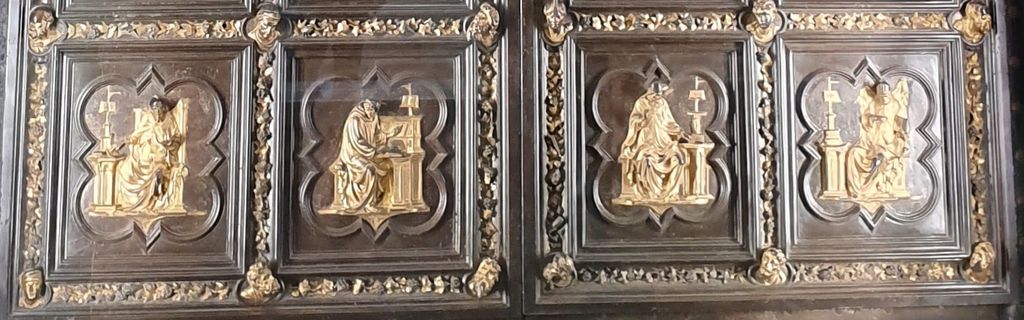
4. Heads at the joins
Small projecting heads mark the junctions in the gilt framework between the narrative reliefs.
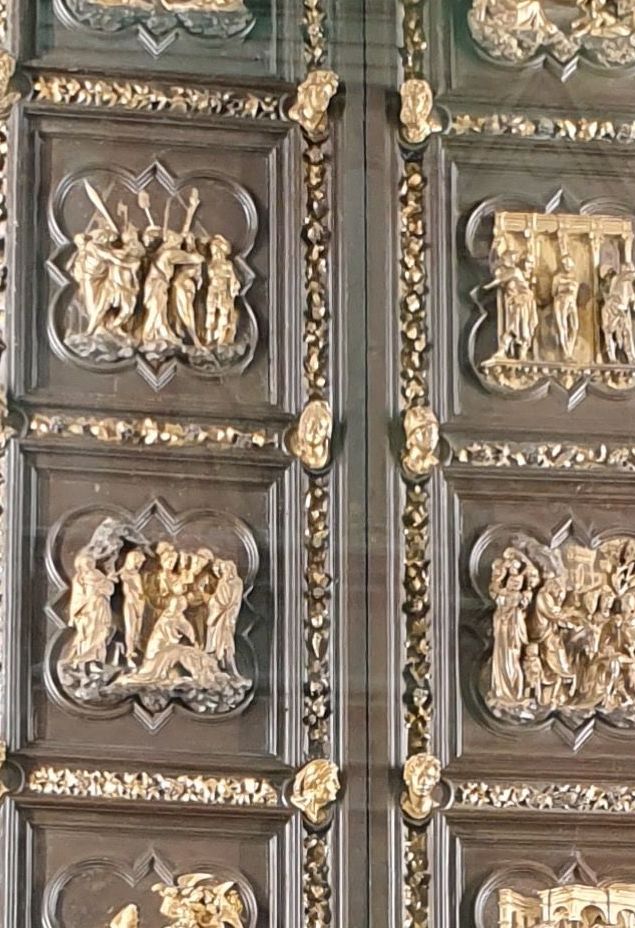
Photograph by Yair Haklai. Source image. CC BY-SA 4.0. Resized for the overview and cropped for detail.
The pattern between the pictures
Take a single relief and follow its edge from the straight outer moulding to the four curved lobes. The outer rectangle defines the place the field takes in the door; the quatrefoil defines the place the figures take in the field. The shapes are nested, with the points between lobes offering small incursions into the ground. Andrea Pisano’s earlier doors established the twenty-eight-panel arrangement for this building. Ghiberti retained a form that makes a change of scene unmistakable even in a busy register.
He could use it to different ends. In the Crucifixion the cross and the spread of arms keep their own geometry within the curve, while in the Last Supper the roof and table lay broad horizontals over it. One makes the dark intervals conspicuous, the other makes the available width conspicuous. The shared frame is what lets a viewer judge the difference so readily. [1] [2] [3] [23]
The ornament starts before the outermost edge of the door. Between fields, narrow bands carry ivy and the small creatures that inhabit it. A strip of this work travels horizontally across the top of a scene and another picks up the direction vertically. At their intersections the projecting human heads stop that movement. They have more depth and a more concentrated gleam than the surrounding leaves, and can look almost like punctuation when seen across the width of the two leaves.
The heads at the inner uprights are especially revealing. There are ornamental edges on both sides of the join. A head belongs to a leaf, while the two events it stands between may be in a single story. From a distance, the bands across the door resume on the other side of the join; at close quarters the join introduces a break in the pattern. [1] [2] [15]
The catalogue offers prophets and sibyls as a programme for the heads, in keeping with a Christian reading of ancient prophecies of the coming of Christ. The museum’s summary poses their identity more cautiously. Across the bronze there is ample variation in the angle of faces, the handling of hair and the way a head emerges from its surroundings; neither arrangement nor variety settles a complete set of names.
The Opera specifically identifies the man with a wrapped headdress at the upper right of the Annunciation as Ghiberti. That is a separate proposition about one portrait. Its position is apt: the artist’s features emerge at the edge of the first episode, set into the system of intersections that continues to the top. The portrait is easier to locate by the shape and position of the Annunciation than by trying to recognise an isolated cast of the face. [1] [2] [3] [25]
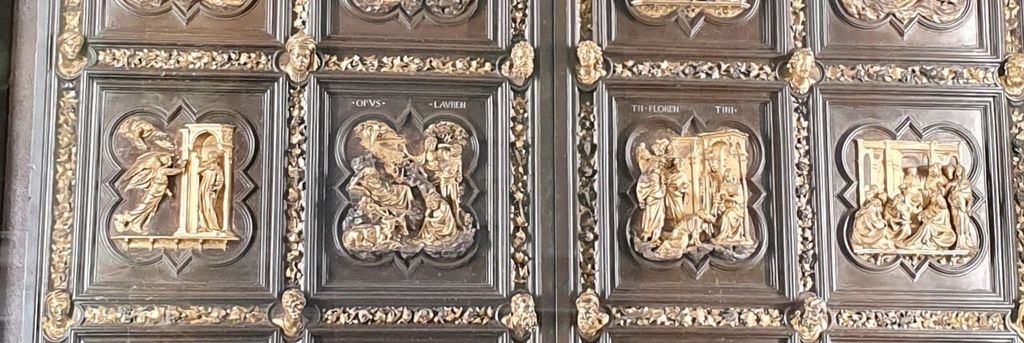
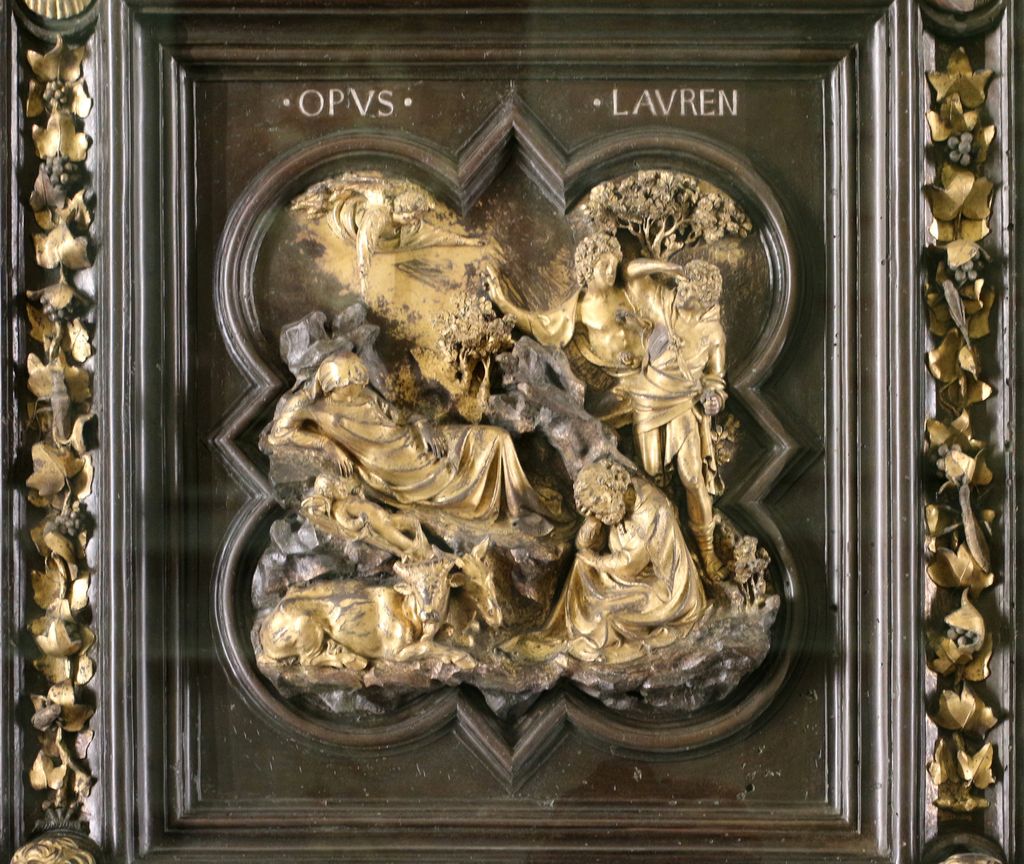
The inscription is closer to the seam. In the photograph of the museum installation, its incised capitals run along the top margins of the Nativity and the Adoration, the two inner fields of the third row. The first part is on the left leaf and the rest on the right. The Opera’s parent record gives the wording, OPVS LAVRENTII FLORENTINI, the work of Lorenzo of Florence, but its analytic location field names the Annunciation and the Nativity.
Its description gives the Nativity and the Adoration, while still referring to the left. The Nativity’s own record transcribes the first part, and the installation shows the continuation across the gap. The error matters to looking: the signature is one more thing the viewer must read across the door. Set on the dark ground above the reliefs, its letters require nearer attention than either the strips of foliage or the gilded groups beneath them. [1] [2] [3] [9]
A fourth scale of ornament appears outside the leaves. The facing of the portal, the mostra, is separately catalogued at approximately 570 by 400 centimetres. That measurement is for the surround. Three broad bronze members cover the two jambs and the lintel, with plants, fruits and small animals worked in relief. In the interior strips the eye can follow a slender growth of ivy and find a creature tucked into it.
On the jamb and lintel there is room for a cluster of grapes or a pine cone, and a bird or squirrel can share a branch without interrupting the broader impression of growth. The range of forms is part of what makes the facing independent of the rhythm of the pictures. A jamb runs past successive registers as one vertical field; it does not have to begin again where the next story starts. The lintel makes that work converge overhead. [1] [2] [26]
Turn to the rear and the rectangular compartment is again the unit of the door, with twenty-eight bronze panels displayed on a wooden support in the museum’s sculpture gallery. Each centres on the relief of a lion’s head. Expressions and angles vary within the repeated design. The museum suggests an allusion to the Marzocco, Florence’s emblematic lion; its front display text describes the heads as lionesses. Whatever name one gives the animal, the important change across the thickness of the door is from a new subject in each compartment to variations on one subject.
The repeated heads on the back keep the divisions of the front legible without carrying its sequence. In the building, a person approaching on one side and turning back on the other would encounter two distinct orders built around the same divisions. In the museum the separate mounting lets each face be seen in its own right, although it takes a walk between galleries to make that comparison. [1] [3] [27]
From a trial relief to doors that could hang
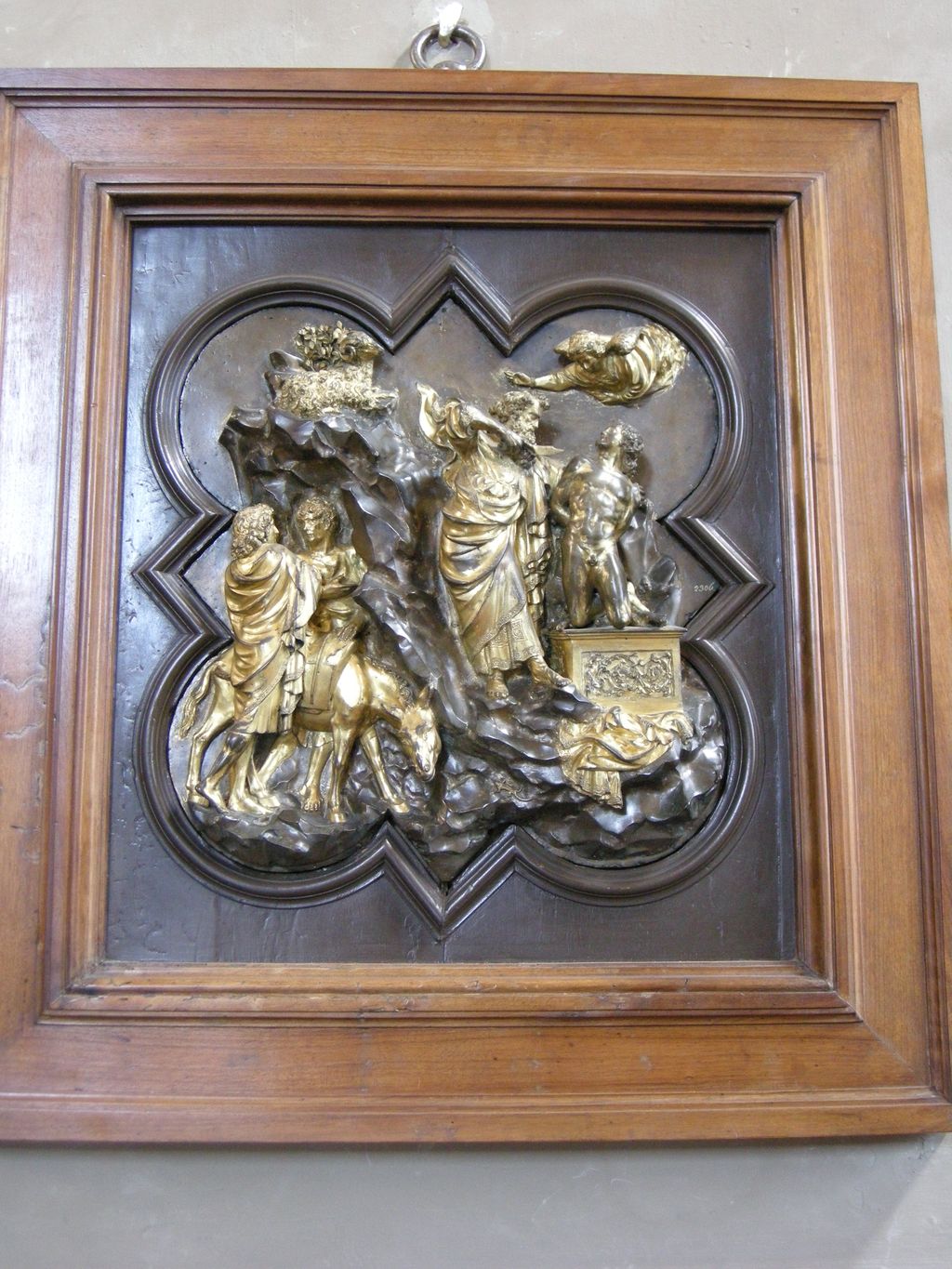
A single field was the measure of the competition, but a door made of many fields was the measure of the commission. The Arte di Calimala set the Sacrifice of Isaac as the trial subject in 1401. The Bargello preserves the submissions by Ghiberti and Brunelleschi. Their figures, the limits of the compartments and the ways the modelled forms take up the available ground let the two solutions be compared under common conditions.
A recorded gilding trial on the Sacrifice also shows its usefulness after the competition. The Old Testament scene did not become the first episode of the new door. Once the New Testament programme was chosen, it remained a demonstration of what could be made in a compartment of that kind. Deciding who should make the work, which stories should occupy it and how its surfaces should be finished were distinct decisions. [1] [5] [17] [28] [29]
The agreement of 23 November 1403 named Lorenzo and Bartolo di Michele and envisaged a rate of three reliefs a year. That was an intelligible way of contracting for a serial work: a panel could be delivered and judged while the others were under way. But a count of delivered panels could say little about the rate at which the large members of a door were being made, or how far the work already cast had been finished. The agreement of 1 June 1407 named Lorenzo alone.
Its provisions for accounting for daily work and for guild control over other commissions made time in the shop a matter of supervision as well as the number of completed objects. Both agreements reserved work on figures, trees and similar features for Lorenzo’s own hand. The requirement can be understood in relation to what the trial enabled the patrons to judge. It gave them a claim on the master’s work in the recognisable parts of the image while the agreement itself made allowance for a staff. [1] [5] [28]
Ghiberti’s retrospective account in the Commentarii moves between the twenty stories, the eight authors, the great number of heads, the ivy and the leaves of many kinds at the jambs. The most useful thing about that inventory is its difference from a list of episodes. It calls attention to what goes between and around the panels, and his estimate of the cost expressly takes the surrounding ornament into account. Yet it is also a first-person claim of diligence and skill made after the event.
It cannot tell us which assistant polished a shepherd’s torso or helped to prepare a mould. Zolli uses the Nativity to make that problem concrete: a workshop with a young Donatello in it could handle the passage from a model to bronze and differentiate the cast surfaces with great care without leaving a distinct, recoverable signature of every person involved. The surviving relief shows how parts of the work reinforce one another; that very coherence makes the division of hands harder to recover. [10] [30]
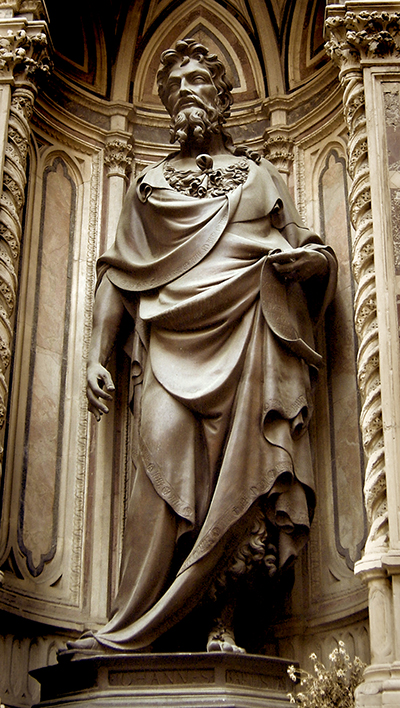
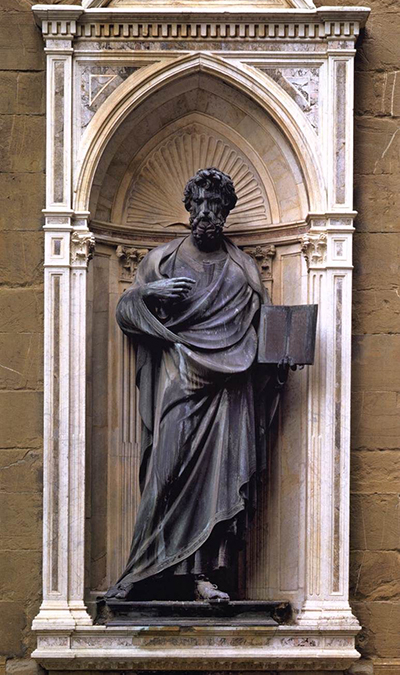
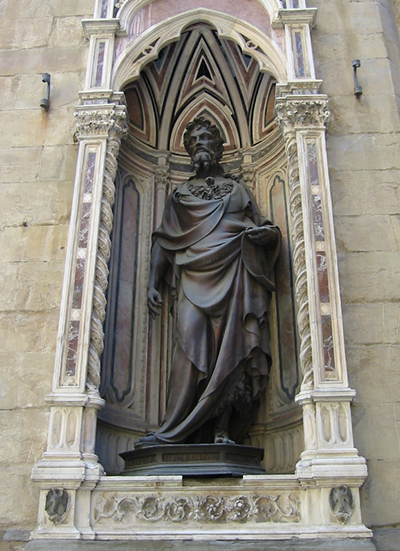
Richard Krautheimer’s relative chronology offers a separate kind of evidence. As the Opera summarises it, the competition Sacrifice and the Orsanmichele bronzes of St John the Baptist and St Matthew supply points of comparison in a career which can be dated in part through documents. The first group of reliefs, about 1403–07, takes in the Annunciation, Nativity, Adoration and Agony in the Garden.
The opening scenes of Christ’s life and one scene from near its end thus come together in this proposed production group. The direction given to the figures by rock in the Nativity and the Agony, or by the sweep of a figure’s drapery in the Annunciation, is worth weighing alongside the date proposal. The first cluster already contains considerable differences in the way the sculptor shares the field between figures and setting. [1] [2] [9] [10] [20] [28]
The second group, from 1407 to about 1413–15, contains all eight authors and a varied set of narratives, including the Baptism, Transfiguration, Last Supper and Crucifixion. The portraits look particularly coherent where they are installed, but no continuous band of the upper door belongs to this group. The third, about 1415–20, groups the Temple Expulsion, Raising of Lazarus, Entry into Jerusalem, Christ before Pilate, Resurrection and Walking on Water.
Its range is clear if one sets Pilate’s built environment beside the boat and water. In the final group, about 1420–24, are the Arrest, Way to Calvary, Flagellation and Pentecost. There is noticeable strength in the big directional forms of those panels, whether a set of shafts in the arrest or the more settled vertical of the punishment. Those distinctions help explain why a chronological proposal is worth having. They do not turn an arrangement of figures into a dated account of a casting. [1] [2] [13] [18] [20] [23] [28]
The great frameworks into which the individual works had to fit posed another problem. In the published abstract of his archival study, Luca Boschetto identifies three Burgundian specialists and at least two attempts at casting the frames between late 1421 and March 1423. The evidence is for the structural work. Separately, the catalogue tradition records the decision in March 1423 to gild selectively. A panel could have its forms well established long before the structure that would keep it in position was ready.
Likewise the finished appearance of the gold could be determined late in a project in which the narratives had long been taking shape. Stepping back far enough to see both leaves brings these different timetables into one view: many casts of pictures, large cast structures to carry them, joined ornament and a treatment of the surface that binds the parts together. None would alone constitute the object that was hung in 1424. [1] [5] [28] [31]
What the cleaning brought into view
The gold visible now had been known before the recent restoration, though it was often difficult to see. Giovanni Poggi’s 1948 account traces the removal of the bronze doors for wartime protection, their shelter in the disused railway tunnel at Incisa in 1943 and their return to Florence in May 1944, when the military sought to reopen the line. The doors were put under the loggias of the Pitti Palace, where people displaced from houses near the Ponte Vecchio saw them. Dismantling made possible a kind of inspection unavailable when the doors stood in the Baptistery.
Poggi surveys older documentary testimony to gilding and describes the postwar work associated with the founder Bruno Bearzi, including tests that found gold under obscuring material. His illustrations furnish views of particular North Door details, including the scene on the water. They are evidence of how the bronze could be examined and photographed in that campaign. The greens and dark areas he describes and the black and white tones of his printed illustrations are different records of the surface, neither an inventory of its original colour. [1] [17]
The Opera’s November 2013 account makes the Baptism and Temptation a useful pair for the next campaign. The Opificio delle Pietre Dure had completed work on them while cleaning of the other fields and ornament continued. The report distinguishes gold on the sculpted forms from bronze grounds and describes the selectivity of laser cleaning. The later account specifies gilding by mercury amalgam, applied to the sculpted work, with the ground left bronze.
That use of a laser belongs to the recovery of the old surface; the laser used to record the shape of the replica belongs to another operation. Poggi’s earlier record also qualifies the announcement’s language of discovery. The modern treatment could establish the survival and extent of the gilding much more clearly; it was not the first evidence that the gilding had existed. [15] [17] [32]
Contrast is easy to see in the 2015 photographs of the Flagellation. Gold gives weight to the architectural members as well as to the bodies. With the background left bronze, the edge between the porch and the field is legible along with the central figure. The contrast also works where there is little modelling, as in foliage or a narrow architectural detail.
Conversely, two adjacent gilded surfaces can be hard to tell apart in a photograph in which both catch the light. The sculptor’s distinctions of depth still matter. The remaining gold varies in visibility from one surface to another, so there is no simple way to look at the brightness of a passage today and infer the importance it originally had. What remains most secure is the choice to set raised, gilded forms against bronze. [2] [15] [32]
The September 2015 account describes treatment as coming to a close and announces transport to the museum. Caudullo dates the transfer to September, while the Opera’s January replica announcement gives October for completion of the restoration. The public opening was on 29 October. Transport, treatment and access to the original have separate dates in these records. The original front is displayed in a controlled case.
Conservator Stefania Agnoletti describes such cases as the alternative to applying a protective coating to the bronzes. Its new location makes it possible to take in the entire face under controlled conditions, although reflections can still interrupt a close view and the upper panels remain high. From a distance, the differences in silhouette survive the move indoors; a closer view makes it easier to see where the surviving gold reinforces them. [2] [3] [4] [32] [35] [37]
Four plasters in Paris and two bronze leaves in Florence
The Paris casts offer another way to approach the pictures. The Cité de l’architecture et du patrimoine traces the group of four to a decision of 2 November 1880, after the architect Ruprich-Robert’s visit to Italy, and to an estimate from Oronzio Lelli dated 25 January 1882. They had still to be delivered when the subcommittee met in May. The selected reliefs were Christ before Pilate, the Temptation, John the Evangelist and Ambrose.
They represent four different heights on the bronze, two from the story and one from each of the ranks below. Put them at a common level and the distinctions between a trial in an architectural setting, a confrontation on open ground and two ways of showing a seated figure become easier to study. The price of this view is the loss of the immediate neighbours: the Temptation is no longer the second step on the left leaf, and the Christ before Pilate no longer closes a crowded row of four. [7] [14] [22] [33]
The inventory dimensions of the patinated plasters of Ambrose and Christ before Pilate are both 58 by 52 centimetres. Ambrose went on deposit to the cast museum in Lyon in 1948 and returned around 1998. Its destination and return are facts about the plaster’s working life, just as the measurements describe the cast and not the door’s opening. Patination can give different parts of a cast some tonal separation, but the plaster cannot tell us where original gold survives.
It does, however, allow the eye to work across the contour of a hand or a fold without relying on the glint of bronze or gold. Paris offers a particular selection rather than a portable version of the ensemble. Another selection, documented by the Museum of Fine Arts in Budapest, included casts of the frame and eight reliefs, one of which was later destroyed. Its record for four scenes credits Giuseppe Lelli. Once the work could travel piece by piece, a collection could put the border within its scope as well as change which episodes a viewer was able to compare. [7] [22] [33] [34]
The bronze replica installed at the Baptistery on 23 January 2016 had to solve a problem the plasters had set aside: separate parts had to fit one another and the building. P. Tiziana Caudullo’s account describes two scales of measurement. An architectural scan established the overall dimensions and the positions of components. A higher-resolution laser scanner recorded the sculpted detail. The bottom rows could be reached from a tripod, whereas a mobile lift was needed to record the upper panels.
Even with changes in the angle of the leaves, the jambs obstructed some views near the outer edges. Capture was completed after the doors had gone to the Opificio, where the leaves could lie flat on supports. The survey there also recorded the border ornament and reverse panels. The digital record thus contains views that could only be obtained once the object ceased to stand as a door. [4] [35]
Caudullo describes the Annunciation as the pilot for the process. The first scan produced a cloud of measured points. Edited and connected into a mesh, these points gave a surface from which a full-size model could be prepared for additive manufacture. The printed intermediate supplied the form for a silicone mould, which led to a bronze made by lost-wax casting.
A second scan of that cast was compared with the starting data. Figure 2 sets out the comparison for this test, which helped the patrons decide whether to go ahead. It demonstrates a way to check the correspondence of form after several transfers from one medium to another. It measures geometry rather than the composition of the bronze or the extent of the surviving gold. [35]
Galleria Frilli and the Ciglia e Carrai foundry carried out the modern bronze work. The foundry’s use of historic casting and finishing techniques is compatible with the digital stages Caudullo describes. The full-size replica preserves the proportions of the panels within the architectural opening and keeps the height, light and approach of the north portal in play. Inside the museum, the original preserves the material record that makes it possible to study what Ghiberti’s workshop finished and what time has since altered. Both can be read from Augustine to Pentecost.
Start from the upper centre again and the difference between the two middle scenes still carries over the break between the leaves. Stand close to a photograph or a cast, and quite another measure of the work comes into view: a tool mark, a support for a book or the narrow margin containing part of a name. The door brings those scales together by putting them in fixed places, where the eye can return to them after it has followed the story to the top. [2] [4] [35] [36]
Lorenzo Ghiberti in context
Sacrifice of Isaac
1401 competitionNorth Doors
1403–1424St John the Baptist
c. 1414–1416St Matthew
1419–1422Gates of Paradise
1425–1452St Stephen
c. 1427–1429Lorenzo Ghiberti sculpture directory
Discussion
Ghiberti rewards slow looking: relief, gilding, narrative structure, workshop practice and conservation evidence can all change how a work is read.
Join the Conversation
Have an observation about North Doors, a source to add, or a comparison that sharpens the reading? Share it below.
References
- Opera di Santa Maria del Fiore, Porta Nord del Battistero, scientific catalogue 3618, measurements, inscriptions, description, historical notes and iconographic sequence; archival references to ASFi, Strozz. L I, I, fols. 79 and 79–79v. View source.
- Yair Haklai, North doors of the Baptistry (Florence) by Lorenzo Ghiberti, original front installed in the Museo dell’Opera del Duomo, photograph, 22 April 2019. View source.
- Opera di Santa Maria del Fiore, Lorenzo Ghiberti, North Gate of the Baptistery, museum record 8623, location field and accompanying description. View source.
- Opera di Santa Maria del Fiore, “La replica eseguita ad arte della Porta Nord del Battistero”, 23 January 2016, manufacture and treatment close; installation confirmation, 4 August 2016. View source 1. View source 2.
- Ministero della Cultura, Scene della vita di Cristo, Evangelisti e Dottori della Chiesa, national catalogue 0900281432-0, historical notes and components. View source.
- Opera di Santa Maria del Fiore, lower register: Augustine, 4289, Jerome, 4294 and Gregory, 4411; see record 3618 for Ambrose’s position. View source 1. View source 2. View source 3.
- Cité de l’architecture et du patrimoine, Relief : Saint Ambroise, MOU.00532, dating, materials, dimensions and deposit history; minutes of 2 November 1880 and 10 May 1882 and estimate AMN 5HH6-5 cited in the record. View source.
- Opera di Santa Maria del Fiore, John, 4281, Matthew, 4283, Luke, 4368 and Mark, 4399. View source 1. View source 2. View source 3. View source 4.
- Opera di Santa Maria del Fiore, Annunciazione, 4256, Natività di Gesù, 4260, including inscription and provenance, and Gesù tra i dottori, 4361. View source 1. View source 2. View source 3.
- Daniel M. Zolli, “Donatello’s Visions: The Sculptor at Florence Cathedral”, in Timothy Verdon and Daniel M. Zolli, eds., Sculpture in the Age of Donatello (2015), pp. 47–48 and fig. 18. View source.
- New American Bible, Revised Edition, Luke 1:26–38 and Luke 2:1–20, 41–52. View source 1. View source 2.
- New American Bible, Revised Edition, Matthew 2:1–12. View source.
- Opera di Santa Maria del Fiore, Battesimo di Cristo, 4246, Tentazione di Cristo, 4254, Cacciata dei mercanti dal tempio, 4345 and Cristo cammina sulle acque, 4351. For the right-leaf positions, compare the photograph and sequence in references 2 and 1. View source 1. View source 2. View source 3. View source 4.
- Cité de l’architecture et du patrimoine, Bas-relief : la Tentation du Christ, cast record, and New American Bible, Revised Edition, Matthew 4:1–11. View source 1. View source 2.
- Opera di Santa Maria del Fiore, “L’oro del Ghiberti torna a splendere”, 29 November 2013, “Battesimo e tentazioni” and “Risultati eccezionali”. View source.
- New American Bible, Revised Edition, John 2:13–22 and Matthew 21:1–17. View source 1. View source 2.
- Giovanni Poggi, “La ripulitura delle porte del Battistero fiorentino”, Bollettino d’arte, ser. 4, 33, no. 3 (1948), pp. 244–257, especially pp. 244–245 and 251–253, figs. 5–7. View source.
- Opera di Santa Maria del Fiore, Trasfigurazione, 4198, Resurrezione di Lazzaro, 4201 and Ultima Cena, 4340. View source 1. View source 2. View source 3.
- New American Bible, Revised Edition, Luke 9:28–36 and John 11:1–53. View source 1. View source 2.
- Opera di Santa Maria del Fiore, Orazione di Cristo nell’orto dei Getsemani, 4076 and Flagellazione, 4323. View source 1. View source 2.
- New American Bible, Revised Edition, Matthew 26:36–56, John 18:1–14, 28–40 and John 19:1–16. View source 1. View source 2. View source 3.
- Cité de l’architecture et du patrimoine, Bas-relief : Le Christ devant Pilate, MOU.00530, description and acquisition history. View source.
- Opera di Santa Maria del Fiore, Crocifissione, 3899; New American Bible, Revised Edition, Matthew 28:1–10 and John 20:1–18. View source 1. View source 2. View source 3.
- New American Bible, Revised Edition, Acts 1:12–14 and Acts 2:1–13. View source 1. View source 2.
- Opera di Santa Maria del Fiore, “6 Self-Portraits of Artists in the Monuments of the Florence Cathedral”, 12 November 2024, Ghiberti’s first door. View source.
- Opera di Santa Maria del Fiore, Mostra di portale della Porta Nord, scientific catalogue 3893, measurements and description. View source.
- Opera di Santa Maria del Fiore, Lorenzo Ghiberti, Back of the North Gate, museum record 9253, mounting and iconography. View source.
- Richard Krautheimer with Trude Krautheimer-Hess, Lorenzo Ghiberti, vol. I, “Documents and Progress of Work”, pp. 103–112 and “The Quatrefoils and Heads”, pp. 113–134; vol. II, Appendix D, docs. 26 and 31, pp. 368–370. View source 1. View source 2. View source 3.
- Musei del Bargello, “Donatello and the Dawn of Renaissance”, introductory comparison of the competition reliefs. View source.
- Lorenzo Ghiberti, I Commentarii, ed. Julius von Schlosser (1912), vol. I, p. 46, description of the first door and its ornament. View source.
- Luca Boschetto, “Ghiberti e i tre ‘compari’. Un nuovo documento sulla fusione dei telai della seconda porta del Battistero”, author’s abstract for Mitteilungen des Kunsthistorischen Institutes in Florenz 53 (2009), pp. 145–149. View source.
- Opera di Santa Maria del Fiore, “La Porta Nord del Battistero”, 9 September 2015, “Il restauro” and “Il trasporto”, with Antonio Quattrone’s Flagellation photographs. View source.
- Cité de l’architecture et du patrimoine, group of four North Door casts and Bas-relief : Saint-Jean l’Évangéliste, MOU.00531. View source 1. View source 2.
- Museum of Fine Arts, Budapest, North Doors (four biblical scenes), Rg.157, cast history and maker field. View source.
- P. Tiziana Caudullo, “Scansione laser 3D: tecnologia al servizio della tutela dei beni culturali”, Archeomatica 3/4 (December 2020), pp. 6–9, especially “Il rilievo”, “Elaborazione dei dati”, “La replica” and fig. 2; also available in the complete issue, pp. 6–9. View source 1. View source 2.
- Galleria Frilli, “Il Battistero”, North Door replica, manufacture and installation account. View source.
- Stefania Agnoletti, Opificio delle Pietre Dure, “Facing a huge conservation project: the three bronze doors of the Baptistery of Florence”, IPERION CH conference abstract, 2019, p. 25. View source.