 by Tom Gurney
Tom Gurney BSc (Hons) is an art history expert with over 20 years experience
Published on June 19, 2020 / Updated on November 17, 2026
Email: tomgurney1@gmail.com / Phone: +44 7429 011000
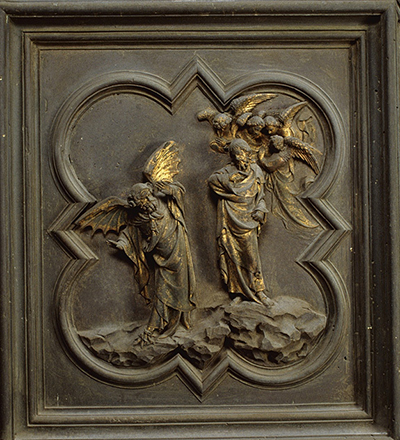
The devil’s hand is already up by his forehead. Below it, a claw rests on the rocky shelf, and behind it a ribbed wing rises against the dark bronze. Across a narrow gap, Christ stands a step higher. His raised right arm gives the lifted hand opposite him the appearance of a shield. The Opera del Duomo describes the devil as recoiling. Lorenzo Ghiberti makes the refusal visible in the body of the figure who has just heard it. The gilded bronze panel belongs to the Florence Baptistery’s North Door. [1] [2]
Contents
- The moment the offer fails
- A hand at the brow
- How much mountain does the scene need?
- On the door and in plaster
- A cast of the panel in Paris
- What the cleaning brought into view
The moment the offer fails
The Opera catalogues the relief as Cristo tentato sul monte, or Christ Tempted on the Mountain. Matthew 4:8–11 gives the closest account. The devil takes Jesus to a high mountain and offers him the kingdoms of the world in return for worship. Jesus orders him away and answers that worship and service belong to God alone. The devil leaves; angels come to attend Jesus. In the bronze, rocky ground raises Christ above the devil, whose feet are still on the ledge even though angels have already gathered behind Christ. The relief can be read as bringing the dismissal and its immediate aftermath into a single scene. [1] [2] [3]
The Gospel accounts help to narrow the identification. Luke puts the offer of the kingdoms before the Temple test and says that the kingdoms appear in an instant. The devil withdraws at the end of the sequence until a later opportunity. Mark names the wild animals and ministering angels but leaves the individual tests undescribed. In Matthew the explicit dismissal comes with the last test. There is no Temple parapet in Ghiberti’s relief, and no object in the devil’s hands that can securely be identified as a stone to be turned into bread. The combination of the raised ground, the rebuff and the angels makes better sense of the image than any single detail can. [1] [2] [3] [4] [5]
Matthew’s answer echoes Deuteronomy 6:13. There the command to serve God comes after a promise of cities Israel did not build, houses full of goods it did not provide and vineyards it did not plant. The passage warns against turning to other gods once those gifts have been received. That context sharpens the terms of the temptation: what matters is who would be worshipped in exchange for the kingdoms. The bronze gives Christ no recoverable words, but the Gospel helps explain why the scene can be built around a gesture that ends the exchange. [2] [3] [6]
Look closely at the Temptation in the Wilderness
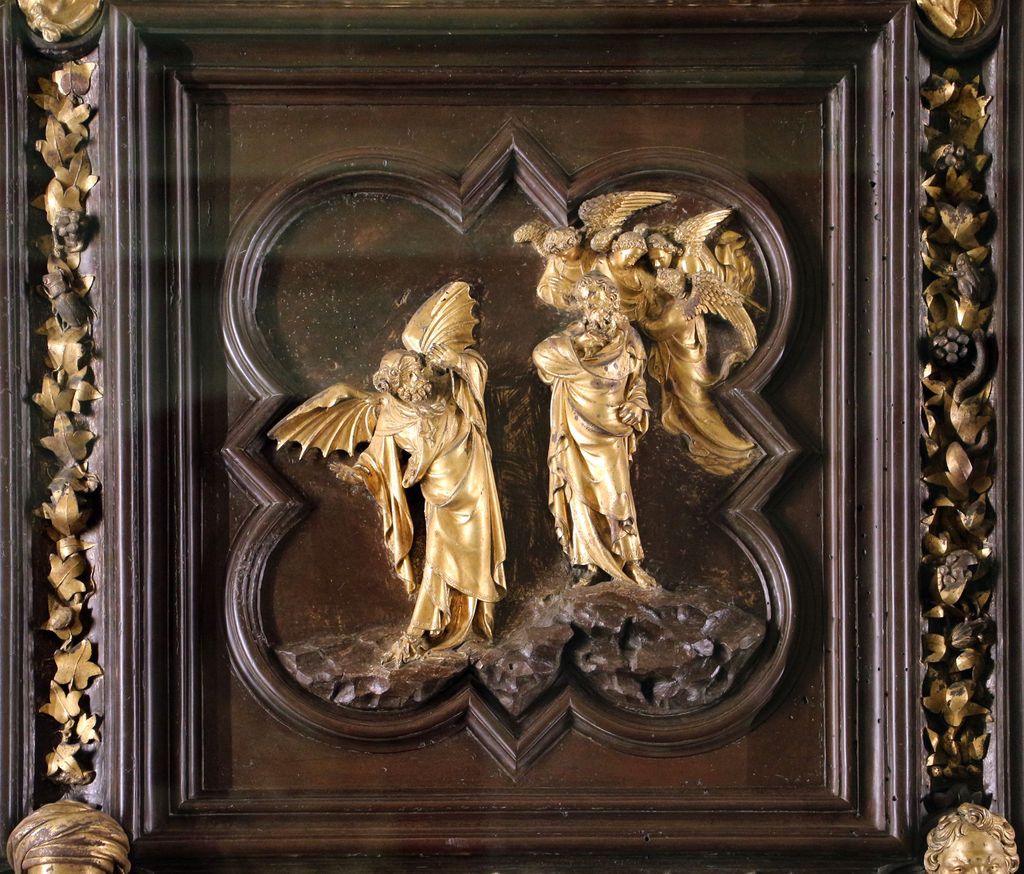
1. The winged tempter
Angular wings and a bent posture mark the approaching figure.
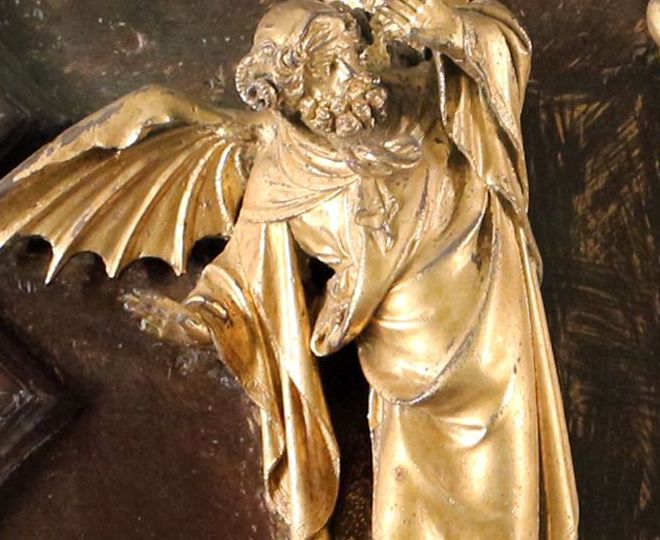
2. Christ and the attendants
Christ stands on the opposite side, framed by the figures behind him.
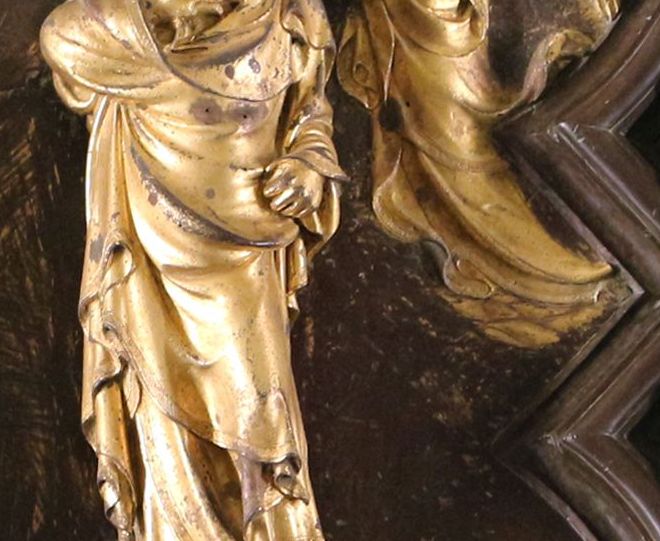
3. The rocky ground
An irregular strip of rock under the figures leaves the central field comparatively open.
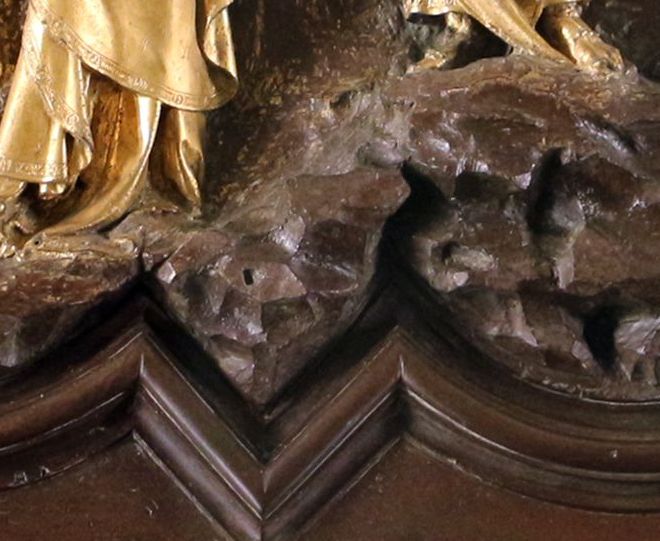
Photograph by Sailko. Source image. CC BY 3.0. Resized for the overview and cropped for detail.
A hand at the brow
The devil’s wings make the turn easier to see. One membrane spreads towards the left point of the frame, its curved edge broken by the tips of the ribs. The other wing rises steeply behind the hand at his brow. His face remains turned towards Christ, which taken alone could suggest a figure still making his case. But the elevated hand interrupts that line of attention, and the lower hand opens towards the edge of the panel. The body seems caught between maintaining contact and breaking off the encounter. The claw still meets the lower shelf. The withdrawal is chiefly an action of the upper body, while the rocks give the viewer a fixed point from which to read it. [1] [2]
From the beard down to the hem, the devil is dressed like a man. The folds of the mantle run over the shoulder, and the sleeve at the raised elbow hangs back on itself. The catalogue identifies curved horns, which are harder to distinguish in the photograph than the raptor’s claw visible under the robe. Follow the edge of the cloth downwards and the claw appears precisely where the eye expects the garment to give way to a foot. The drapery helps hold the disguise together until the figure meets the ground. [1] [2]
Christ’s right arm is raised across the upper part of his body. The bunching at his shoulder makes the action easier to follow; his other hand gathers cloth near his waist. The folds below it run towards a bare foot at the lip of the rock. The upper body turns towards the devil while the foot appears firmly planted. A strip of exposed bronze separates the two figures, but a rocky connection runs below. The distinction matters: their gestures play out across a gap while their feet remain on the same formation, at two different heights. [1] [2]
The angels gather close behind Christ, their heads and wings overlapping inside the upper right lobe. A long fold of robe sweeps towards the right point of the frame and stops well above the shelf. On this side, the rows of feather tips break the outline into short curves. On the other, the devil’s wing is stretched between ribs with much larger intervals. The upper left lobe has room around that single figure, while the upper right is crowded. That distribution makes the two sides distinguishable before the expressions and hands come into focus. [2]
How much mountain does the scene need?
Beneath the devil, the rock begins as a shallow shelf. It thickens under Christ, where darker recesses make the drop below his foot more pronounced. A spur projects into the downward point between the frame’s lower lobes. Ghiberti can use almost the full width for the footing without taking much height away from the figures. There is no distant horizon, and nothing beyond the outcrop to tell the viewer how far above the world the figures have been taken. The climb is measured locally, from the claw on the left to the bare foot on the right. [2] [3]
In Duccio’s earlier Temptation of Christ on the Mountain, painted for the Siena Maestà and now in the Frick Collection, walled cities scatter across the rocky terrain. Their towers and gates are small enough to fit below the main figures but distinct enough to give the offer a visible form. The eye can move from Christ’s gesture down to the places he is being offered. Ghiberti’s shelf gives the eye a different route: it takes the viewer from the two figures’ feet back up to their hands. Both artists give Christ and the devil the largest forms, but Duccio gives the offered kingdoms a place in the scene that Ghiberti leaves to the viewer’s knowledge of the story. [2] [3] [7]
The mountain in Matthew is a vantage point from which the devil can show Jesus the world. In the relief it also works as a stage for the rebuff. The slope raises Christ just enough to put his feet above the devil’s without bringing the two onto separate outcrops. [2] [3]
On the door and in plaster
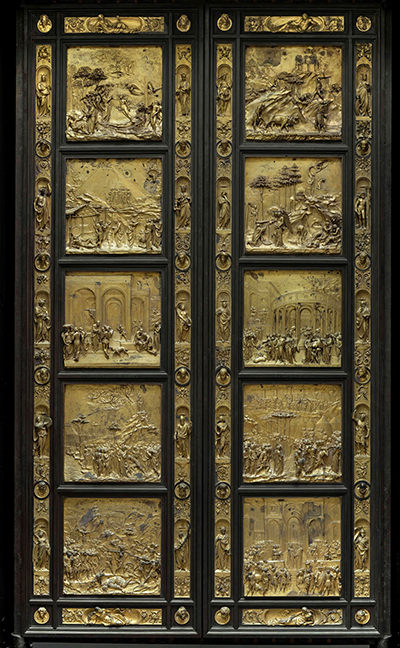
The relief is the sixth scene in the sequence of Christ’s life. On the assembled door it occupies the inner column of the left leaf, four rows up from the bottom, beside the Baptism. The original North Door, made between 1403 and 1424, is now in the Museo dell’Opera del Duomo. The catalogue reports Richard Krautheimer’s proposal that this panel belongs to a group made between around 1407 and 1413–15, a phase inferred from style. In the photograph of the assembled door, the familiar frame helps locate the panel; the open space above the devil and the cluster above Christ help distinguish it from its neighbour. [1] [8] [9]
A cast of the panel in Paris
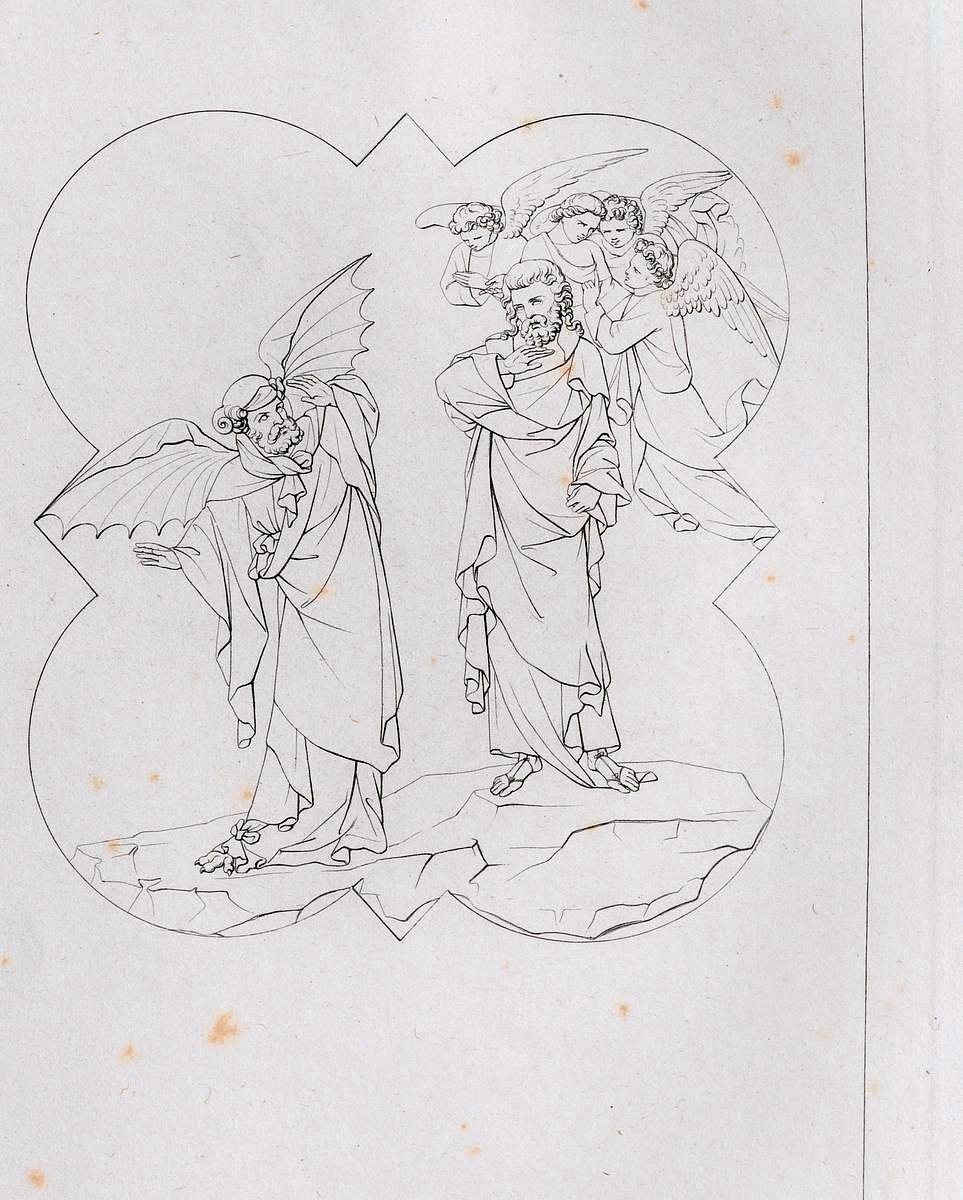
Oronzio Lelli’s patinated plaster cast at the Musée des Monuments français isolates the relief in a rectangular surround. The Paris catalogue records it as 60 cm high, 53.5 cm wide and 9 cm deep, with a border 4 cm thick. Its dates come into focus through three records cited by the museum: the decision of 2 November 1880 concerning casts of four North Door reliefs, Lelli’s submission of 25 January 1882, and the minutes of 10 May 1882, when delivery was still outstanding. The catalogue dates the cast to 1882; the published evidence leaves the date of its arrival open. [10]
In Emily Rawlinson’s photograph of the cast, the rocky ledge and the quatrefoil survive within their own border. The plaster brings the background, drapery and wings into a much narrower range of colour than the bronze photograph. Even so, the notch between the figures stays open and the wing silhouettes remain distinct. In the absence of the surrounding door and the contrast between gold and dark bronze, the change of level and the spacing of the bodies are still enough to make the refusal legible. [2] [9] [11]
What the cleaning brought into view
The Florence catalogue records treatment by the Bearzi workshop in 1946–48 and an intervention by the Opificio delle Pietre Dure in 2013. On 29 November 2013 the Opera named the Temptation and the Baptism as the two panels whose restoration had already been completed, with the others still being cleaned. Its report describes gilded relief against a dark bronze background. In the photograph of the treated Temptation that contrast picks out Christ’s raised arm and the ribs of the devil’s wing against the field. The Paris plaster preserves those forms, but the two photographs cannot tell us how bright the bronze was when Lelli’s cast was made. [1] [2] [11] [12]
Lorenzo Ghiberti in context
Sacrifice of Isaac
1401 competitionNorth Doors
1403–1424St John the Baptist
c. 1414–1416St Matthew
1419–1422Gates of Paradise
1425–1452St Stephen
c. 1427–1429Lorenzo Ghiberti sculpture directory
Discussion
Ghiberti rewards slow looking: relief, gilding, narrative structure, workshop practice and conservation evidence can all change how a work is read.
Join the Conversation
Have an observation about Temptation in the Wilderness, a source to add, or a comparison that sharpens the reading? Share it below.
References
- Opera di Santa Maria del Fiore, scientific catalogue, Cristo tentato sul monte, Porta Nord del Battistero. View source.
- Sailko, detail photograph of the Temptation on the original North Door, Wikimedia Commons. View source.
- United States Conference of Catholic Bishops, Matthew 4:1–11. View source.
- United States Conference of Catholic Bishops, Luke 4:1–13. View source.
- United States Conference of Catholic Bishops, Mark 1:12–13. View source.
- United States Conference of Catholic Bishops, Deuteronomy 6:10–15. View source.
- The Frick Collection, Duccio, The Temptation of Christ on the Mountain, in Director’s Choice, p. 6 and facing image. View source.
- Opera di Santa Maria del Fiore, scientific catalogue, Porta Nord del Battistero. View source.
- Yair Haklai, photograph of the original North Door in the Museo dell’Opera del Duomo, Wikimedia Commons. View source.
- Cité de l’architecture & du patrimoine, Musée des Monuments français, Bas-relief : la Tentation du Christ, MOU.00533. View source.
- Emily Rawlinson, front-view photograph of Lelli’s plaster cast, Cité de l’architecture & du patrimoine. View source.
- Opera di Santa Maria del Fiore, L’oro del Ghiberti torna a splendere, 29 November 2013, “Battesimo e tentazioni”. View source.