 by Tom Gurney
Tom Gurney BSc (Hons) is an art history expert with over 20 years experience
Published on June 19, 2020 / Updated on November 17, 2026
Email: tomgurney1@gmail.com / Phone: +44 7429 011000
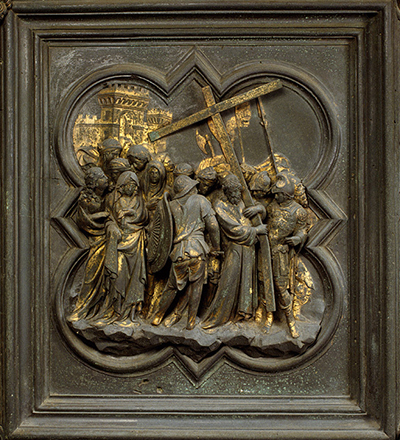
A soldier at the right of Lorenzo Ghiberti’s Way to Calvary turns his helmeted head back towards the procession. At the other end, the people beneath a fortified gate are packed so closely that a shoulder or a veil hides part of a face. Above them the crossbar sweeps up into a dark lobe with room to spare. Follow the longer timber down and it vanishes among the heads, then reappears in front of the soldier’s legs. The crowded passage where it disappears is also where the weight of the cross is hardest to account for. [1]
The Opera del Duomo identifies the episode as Christ’s ascent to Mount Calvary. The gilded bronze relief occupies the far left of the top row of the North Door made for the Florence Baptistery between 1403 and 1424. The catalogue reports Richard Krautheimer’s proposal that it belongs to a late group of panels, dated to about 1420–24 in his reconstruction of the sequence of work. [2]
Contents
- Out through the gate
- Where the cross bears down
- Who is carrying it?
- The women at the gate
- The cross at the top of the door
Out through the gate
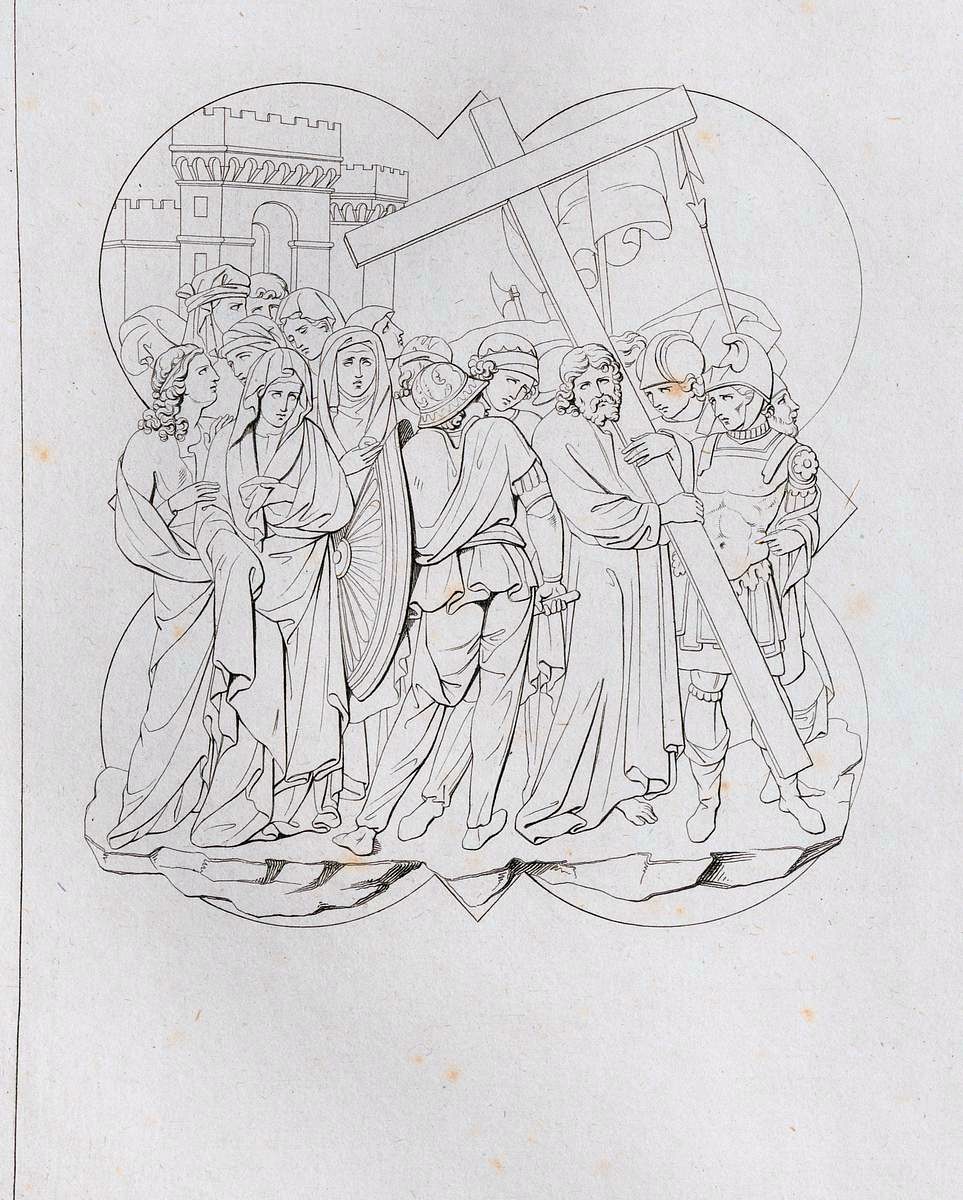
The city takes up surprisingly little room. The tower above the arched gateway rises to the curve at the upper left, and the low stretch of wall to its left follows that lobe down towards the first heads. The 1821 engraving after Ghiberti makes the junction easy to follow. The little rows of battlements step down around the tower, and the arch gives way to a stack of overlapping profiles. Below them, the broken ledge gives the entire group a common footing. Between the gateway and the figure at the far right, that ledge is almost all the road Ghiberti supplies. [1] [3]
Look next at the shield, which divides the procession much more sharply than the gate. Its rim sweeps down alongside a veiled face and hides portions of the bodies behind it. The engraving keeps that rim legible through the nearby folds and elbows. On the bronze it catches a band of light, and the back of the man beside it comes forward abruptly. He plants his feet apart while the heads above his shoulder are nearly touching. The room his stance takes up below makes the press of faces higher in the relief more apparent. [1] [3]
Where the cross bears down
The clear outline above the crowd helps the eye pick up the timber again below. The upper end of the long beam runs into the pointed cusp between the two upper lobes. In the engraving its tip breaks the line of the cusp. Bertha Friedmann, writing in 1913, singled out the cross’s overlap with the frame as part of its effect. The overlap belongs to the inner, four-lobed outline. The rectangular border on the door still encloses the whole scene. Within that border the cross extends from the upper moulding almost to the rocky ledge, setting a scale for the bodies packed around it. [1] [3] [4]
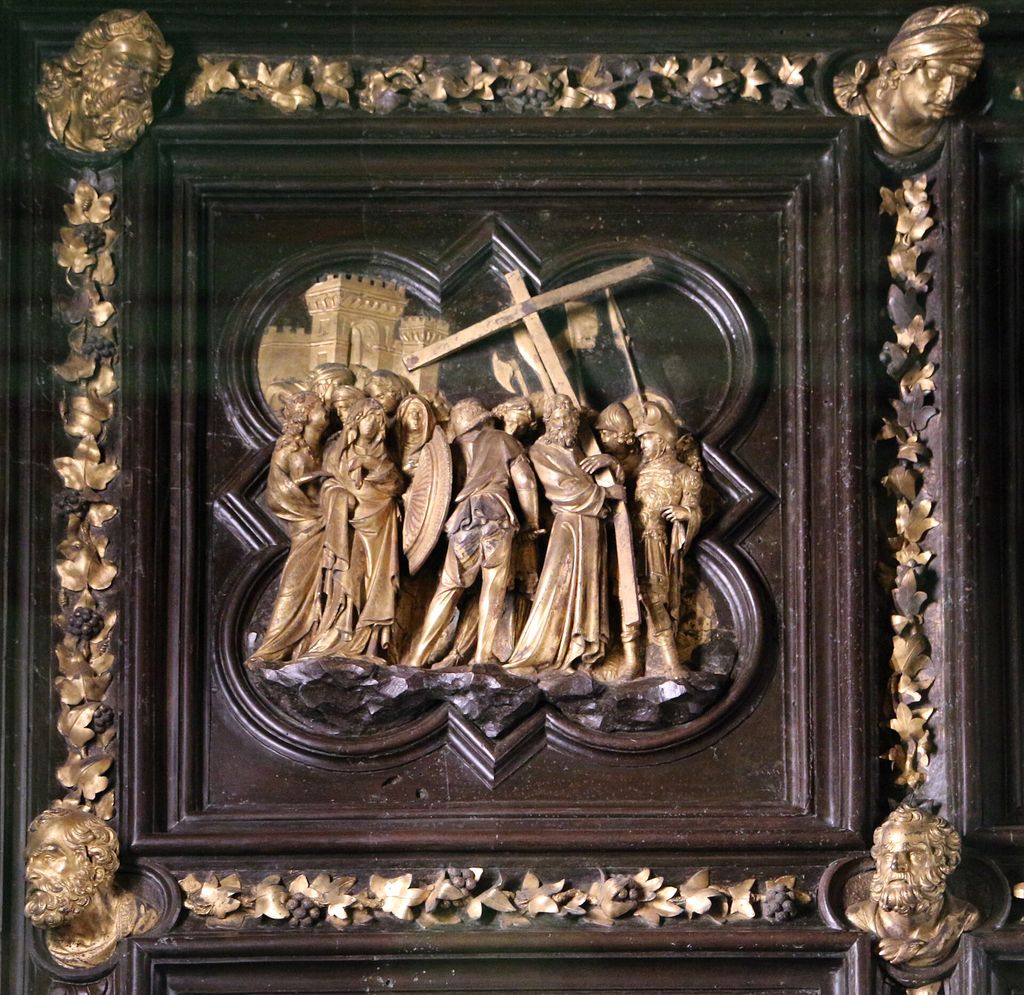
Between the shield and the right-hand escort, a long-robed man grips the beam. The engraving shows individual fingers curling over an edge and the turn of the sleeve on the other bent arm. Behind the man’s head another face remains visible. The photograph of the bronze gives those details a different emphasis. The face behind retreats into shadow, while the cuff and sections of the timber catch the light. The Opera’s restoration account describes the contrast across the door between the gilded relief and the dark bronze ground. Here it helps make the ends of the beam apparent at a glance, even as the narrower shadows between the figures make it difficult to trace the timber’s contact with a shoulder. [1] [3] [5]
Who is carrying it?
Matthew says that Simon of Cyrene was compelled to carry the cross as the party went out. Mark makes Simon a passer-by coming in from the country. Luke puts him behind Jesus with the cross and describes women lamenting in the crowd, to whom Jesus turns and speaks. In John, Jesus goes out carrying the cross himself to the Place of the Skull. The difference affects where a reader looks in the relief. John directs attention to the figure at the beam, while Luke gives a reason to look behind Jesus for a bearer. The grip and the face behind it are both visible in the print. Their proximity leaves a handover to Simon unconfirmed. [1] [3] [6] [7] [8] [9]
Three historical readings give the load to Christ. Vasari saw soldiers whose gestures made them seem to drag Christ along. The commentary published with the 1821 engraving has the cross placed on Christ’s shoulders before he leaves Jerusalem. Friedmann read the strain in his bearing, describing him as almost collapsing under the load and locating the scene’s grief chiefly in the women. Vasari’s account puts the force in the escort’s actions, whereas Friedmann finds it in the burden on the body. Both readings give purpose to the gestures around the timber, where the precise distribution of its weight remains difficult to see. [1] [4] [10] [11]
The women at the gate
The 1821 commentary describes the mourners as the women who had accompanied Jesus and supported him during his preaching. Their tears and sighs express continued participation in his suffering. The commentary’s account of the women’s earlier support recalls Luke 8, while Christ’s departure with the cross recalls John. Luke’s account of the procession itself calls the lamenting group the daughters of Jerusalem in Jesus’s address and gives their lament a place in the journey. The commentary supplies a history for the women at the gate that their dress and gestures alone leave open. [1] [8] [9] [11] [12] [13]
Vasari calls the mourners the Maries. Friedmann goes further, identifying Mary on the far side of the broad soldier and recognising Magdalene beside her by her curled hair, headband and light touch. The engraving makes the turn of the curly-haired head and the reach towards the veiled woman easier to follow. The Opera’s catalogue names the episode without identifying the women. In Ugolino di Nerio’s earlier painted version for Santa Croce, the National Gallery identifies the Virgin through her blue robe and Christ’s backward turn towards her. Ghiberti’s two figures at the gate are legible chiefly through their closeness and the gesture between them, the details on which Friedmann built her reading. [1] [2] [3] [4] [10] [14]
The cross at the top of the door
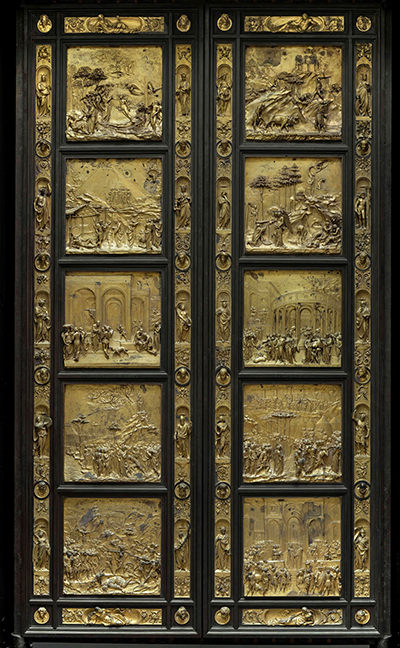
The original North Door is displayed in the Sala del Paradiso at the Museo dell’Opera del Duomo. The door at the Baptistery’s north portal is the replica installed in January 2016. In the photograph of the original, the angled cross picks out the far-left panel. Immediately to its right, on the same leaf, the cross of the Crucifixion stands upright. A vertical band of gilded ornament lies between their rectangular borders. [2] [15] [16]
The 1821 sheet pairs the same episodes. With the door’s ornamental band gone, the change in the cross is easy to see across the blank paper. On the left, the slant carries the eye down among people whose arms and feet are still in motion. On the right, the upright fixes a point between the two seated witnesses. At the museum the band between the bronzes gives the eye a short pause before that change in direction. The print shows how much of the passage from one episode to the next is already carried by the timber’s angle. [2] [3] [16]
Lorenzo Ghiberti in context
Sacrifice of Isaac
1401 competitionNorth Doors
1403–1424St John the Baptist
c. 1414–1416St Matthew
1419–1422Gates of Paradise
1425–1452St Stephen
c. 1427–1429Lorenzo Ghiberti sculpture directory
Discussion
Ghiberti rewards slow looking: relief, gilding, narrative structure, workshop practice and conservation evidence can all change how a work is read.
Join the Conversation
Have an observation about Way to Calvary, a source to add, or a comparison that sharpens the reading? Share it below.
References
- Sailko, Andata al Calvario, photograph of the original North Door relief, Wikimedia Commons. View source.
- Opera di Santa Maria del Fiore, Porta Nord del Battistero, scientific catalogue, record 3618. View source.
- Vincenzo Gozzini (drawing) and Giovanni Paolo Lasinio (engraving), Le tre porte del Battistero di San Giovanni di Firenze, plates XIX and XX, Florence, 1821, ETH Library, e-rara. View source.
- Bertha Friedmann, Ghibertis Verhältnis zur Gothik und Renaissance, 1913, p. 25, section XVII. View source.
- Opera di Santa Maria del Fiore, The Northern Door of the Baptistery, restoration report, 9 September 2015. View source.
- United States Conference of Catholic Bishops, Matthew 27:31–32. View source.
- United States Conference of Catholic Bishops, Mark 15:20–21. View source.
- United States Conference of Catholic Bishops, Luke 23:26–32. View source.
- United States Conference of Catholic Bishops, John 19:16–17. View source.
- Giorgio Vasari, ‘Lorenzo Ghiberti’, Le vite, 1568 edition, Wikisource transcription. View source.
- Le tre porte del Battistero di San Giovanni di Firenze, commentary to plate XIX, Florence, 1821, p. 9, ETH Library, e-rara. View source.
- Le tre porte del Battistero di San Giovanni di Firenze, commentary to plate XIX, continued, Florence, 1821, p. 10, ETH Library, e-rara. View source.
- United States Conference of Catholic Bishops, Luke 8:2–3. View source.
- The National Gallery, London, Ugolino di Nerio, The Way to Calvary, NG1189. View source.
- Opera di Santa Maria del Fiore, Renaissance clonation: the North Door replica. View source.
- Yair Haklai, photograph of the complete original North Door in the Museo dell’Opera del Duomo, Wikimedia Commons. View source.