 by Tom Gurney
Tom Gurney BSc (Hons) is an art history expert with over 20 years experience
Published on June 19, 2020 / Updated on November 17, 2026
Email: tomgurney1@gmail.com / Phone: +44 7429 011000
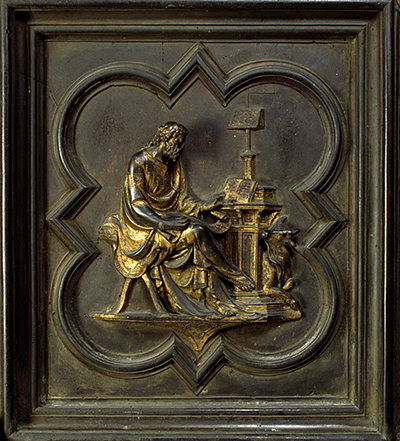
Luke keeps one text open while he reaches for another. His right hand steadies a parchment roll across his lap, and his left goes to the pages of a book on the desk. The turn of his head follows the reach. In Lorenzo Ghiberti’s gilded bronze relief for the Florence Baptistery’s North Door, these actions occupy a small space between a crossed knee and the edge of a sloping bookrest. Below it, the same crossed leg leads the eye towards an ox lying beside the desk. The relief gives the animal a place in the portrait through the way Luke sits. [1] [2]
Contents
- Between the roll and the book
- The ox at desk level
- Why Luke has an ox
- Two desks towards the middle
- Looking at the original
Between the roll and the book
Luke sits on the viewer’s left, with his bearded face turned nearly into profile. His right thigh provides a surface for the parchment, whose free end curls up into the interval between his knee and the desk. A shallow fold of cloth follows the lap beneath his resting hand, then gives way to deeper folds below the seat. The left hand reaches across the gap to the open spread. The Opera del Duomo catalogue describes him as leafing through the book. In the bronze, the position of his fingers at the pages gives that reading its force, while the angle of his face suggests where his attention lies. [1] [2]
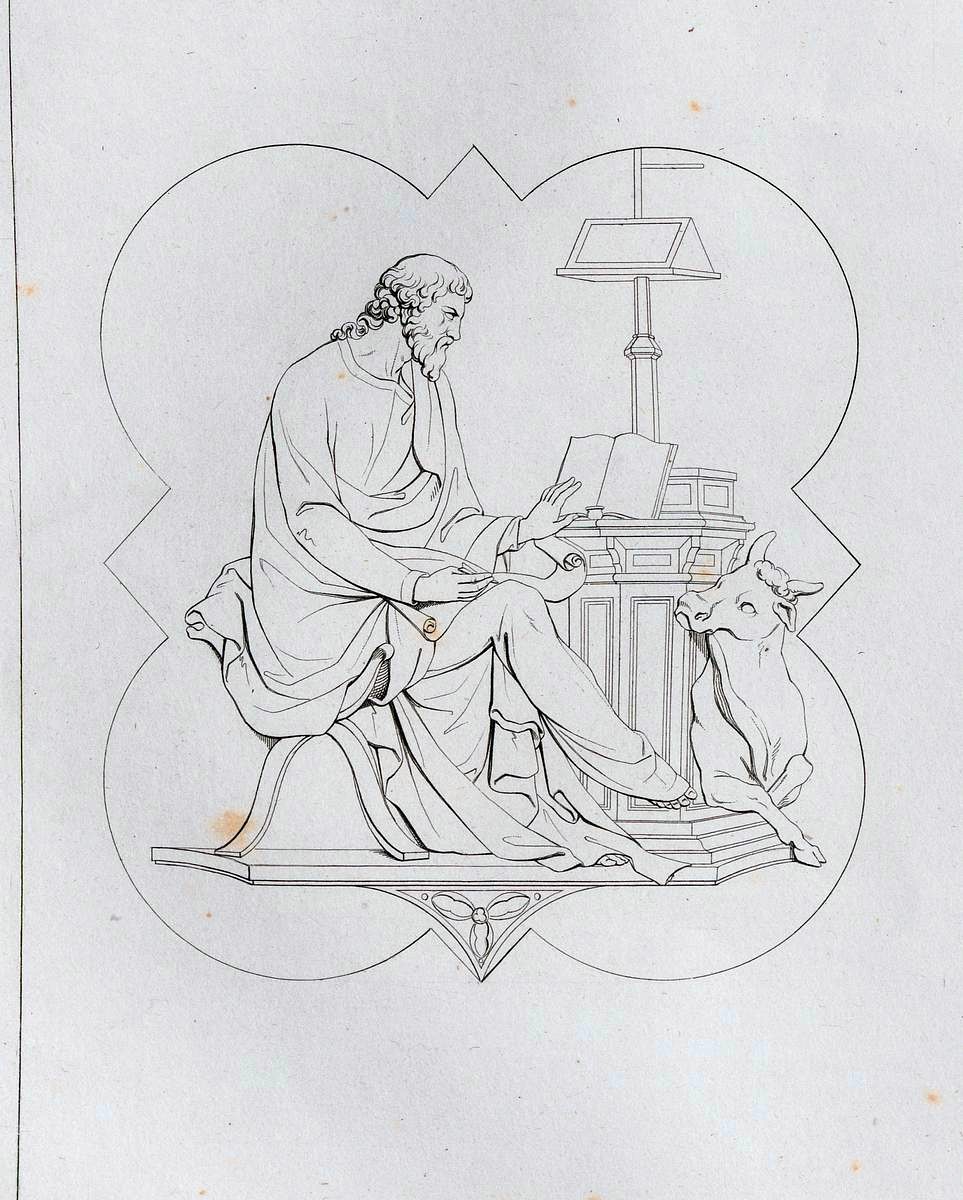
The book Luke touches is low, on the sloping surface immediately above the pedestal. Behind it a slender upright climbs into the upper right lobe and carries a second fitting. The 1821 engraving makes the interval between the two levels particularly clear. Its outlines pick out the division between the lower pages and give the higher fitting a single framed face. In the bronze that face catches the light and carries a pattern of its own. The lower spread shares the level of Luke’s forearm. Above it, the raised fitting brings the upright almost to the curve of the frame, where there is space for its rectangular face to register against the dark ground. [1] [2] [3]
The preface to Luke’s Gospel gives the arrangement a resonance. Writing to Theophilus, the author acknowledges earlier accounts and testimony handed down by eyewitnesses, then describes his decision to investigate and set events down in order. That account of authorship makes room for the kind of attention Ghiberti gives the figure, independent of any identification of the objects. The marks on the lower pages make the book look written in, and the hand on the roll keeps another length of text available. The relief leaves the contents of both open to conjecture. [1] [2] [4]
The ox at desk level
The desk screens much of the recumbent ox. Its head projects to the viewer’s right, and its muzzle turns in towards Luke. Lower down, a forefoot projects by the end of the ledge. Bertha Friedmann drew attention to that hoof in 1913, following the diagonal of the crossed leg to its endpoint in the animal. The 1821 engraving makes the line easy to trace. It runs from the raised knee down across the front of the pedestal, past the stepped base and towards the hoof. In the bronze, light on the folds carries the line across the otherwise emphatic vertical of the desk. [1] [2] [3] [5]
Above the ledge, the ox’s returning muzzle gives the eye a route back towards the working figure. Its place in the composition becomes clearer beside an eleventh-century ivory book-cover plaque in the Walters Art Museum. There a winged ox emerges from a cloud above Luke as he writes. The plaque belonged to a group of four Evangelist portraits, so the animal likewise identified one author within a set. Ghiberti gives the emblem the same ground as the seat and pedestal. The position lets a hoof answer a line of drapery and the head turn in just below the desk. [1] [2] [6]
Why Luke has an ox
In the preface to his Commentary on Matthew, Jerome links the calf in Ezekiel’s vision to the opening of Luke’s narrative with Zechariah the priest. The Gospel describes Zechariah being chosen by lot to burn incense in the sanctuary, where an angel appears to him. The link with animal sacrifice comes through the wider duties of the priesthood, as the Opera catalogue’s explanation of the emblem makes clear. [1] [4] [7]
The commentary published by Luigi Bardi and Company in 1821 looks further into the opening chapters. It names the births of John the Baptist and Jesus and explains the ox through Jesus as the sacrificial victim who redeems humanity. Jerome’s reading begins with the priest and his office. The later commentary gives sacrifice a different emphasis by placing Christ at its centre. Both interpretations give the animal a meaning beyond the scene at the desk. The ox lies beside the Evangelist’s desk as his identifying emblem, while Luke’s hands stay with the roll and book. [1] [2] [4] [7] [8]
Two desks towards the middle
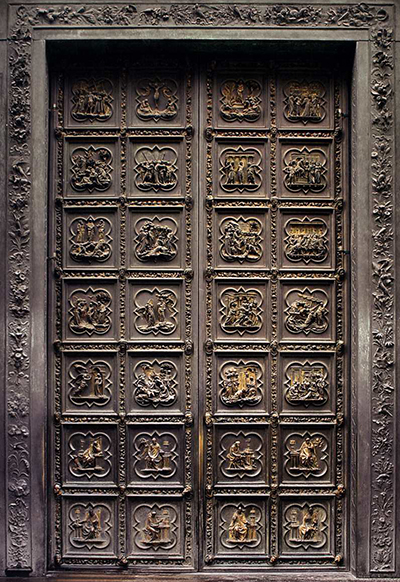
Luke is third from the left in the row second from the bottom. John and Matthew occupy the left leaf, with Luke and Mark on the right. Luke’s panel is directly below the Adoration of the Magi and above Gregory the Great, between the scenes from Christ’s life and the portraits of the Doctors of the Church. Of the four Evangelists, Luke is the most distinctly turned sideways towards his work. The bent head and the long diagonal of the leg give his panel a recognisable outline even when the ox’s head is hard to distinguish. [1] [2] [9] [10]
Luke’s desk is to the right of his seat and Mark’s is to the left, so the furniture faces across the division between their panels on the right leaf. The 1821 print puts the pair on one sheet. Mark’s writing hand reaches towards the lower surface while an open spread sits on the high stand. Its central division is clear in the print, where Luke’s upper fitting has an uninterrupted face.
Luke, by contrast, reaches into a spread at the lower level. The shared arrangement of pedestal and upright makes the difference in the hands easier to see. The animals carry the comparison out to the curves of the frames, with Mark’s winged lion high in the outer lobe and Luke’s ox down by the pedestal. [1] [2] [3] [10] [11] [12]
Looking at the original
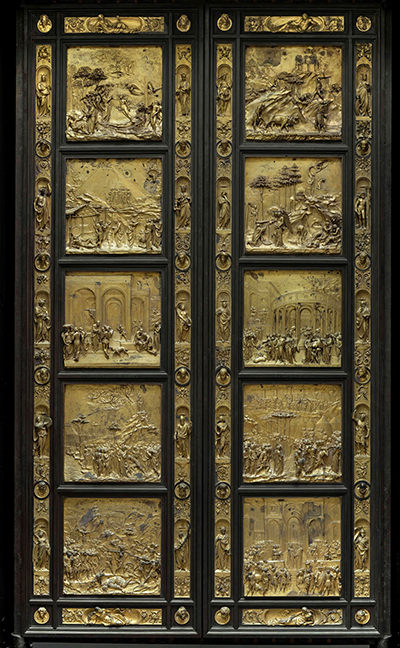
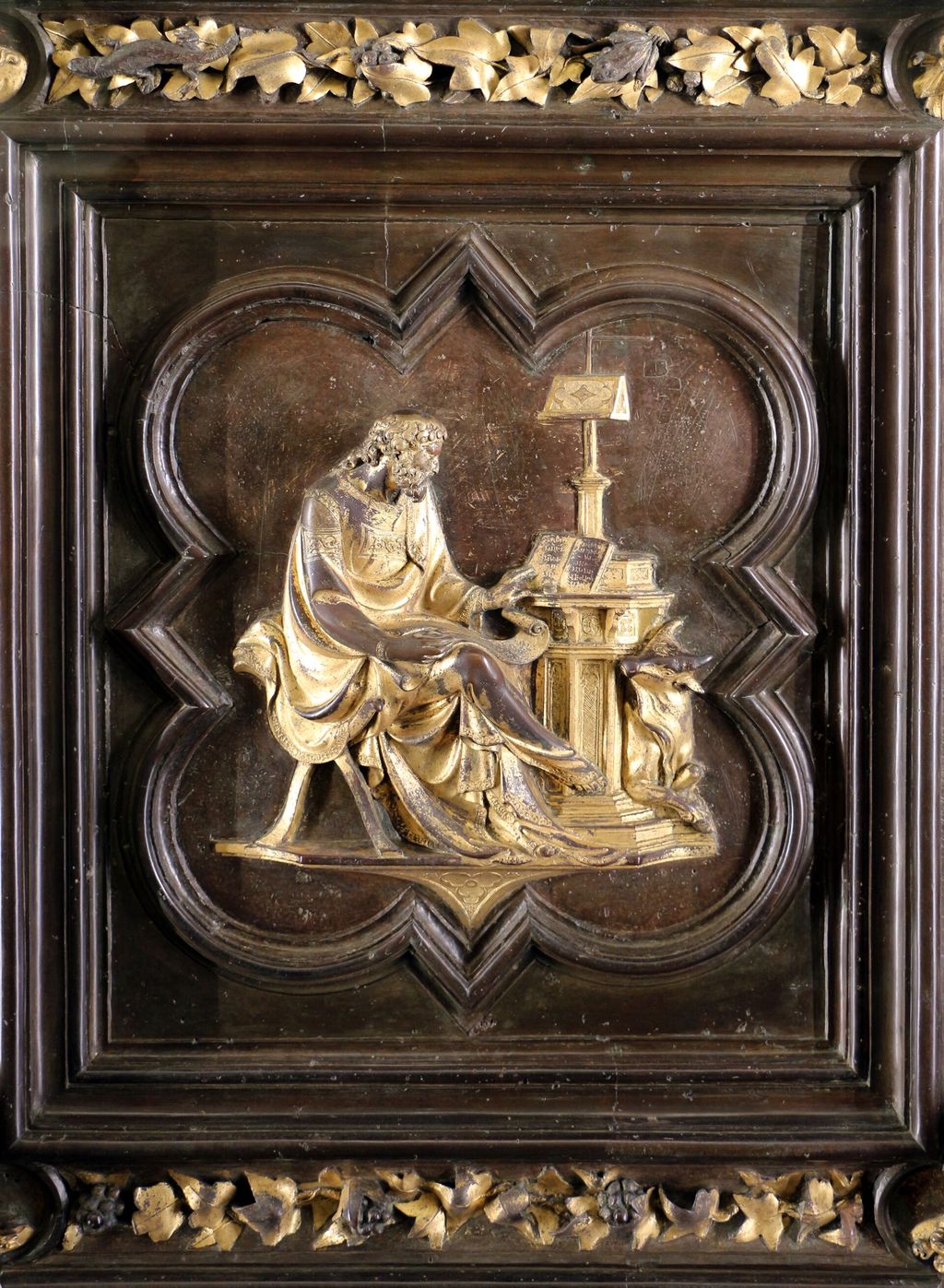
The Opera catalogue dates the North Door to 1403–24 and reports Richard Krautheimer’s proposal that the Evangelist reliefs belong to a phase after 1407 and before about 1415. Luke is visible in the same position on the Baptistery replica and on the original door, which the Museo dell’Opera del Duomo displays in the Sala del Paradiso. At whole-door scale, the shared gilding and four-lobed frames bring the authors together. In a close photograph, the bright edge of the parchment curl and the fingertips at the low bookrest emerge from the larger mass of gilding. The small interval between them is where the portrait locates Luke’s work. [1] [2] [9] [10] [13]
Lorenzo Ghiberti in context
Sacrifice of Isaac
1401 competitionNorth Doors
1403–1424St John the Baptist
c. 1414–1416St Matthew
1419–1422Gates of Paradise
1425–1452St Stephen
c. 1427–1429Lorenzo Ghiberti sculpture directory
Discussion
Ghiberti rewards slow looking: relief, gilding, narrative structure, workshop practice and conservation evidence can all change how a work is read.
Join the Conversation
Have an observation about Luke, a source to add, or a comparison that sharpens the reading? Share it below.
References
- Opera di Santa Maria del Fiore, scientific catalogue: San Luca Evangelista, Porta Nord del Battistero (4368) View source.
- Sailko, photograph of the original Luke relief, Wikimedia Commons View source.
- Le tre porte del Battistero di San Giovanni di Firenze, plates XXV–XXVI, Bardi edition (1821), ETH-Bibliothek View source.
- United States Conference of Catholic Bishops, Luke 1:1–11 View source.
- Bertha Friedmann, Ghibertis Verhältnis zur Gothik und Renaissance (1913), pp. 28–29 View source.
- The Walters Art Museum, Saint Luke the Evangelist, ivory book-cover plaque (71.139) View source.
- Jerome, Commentary on Matthew, preface, trans. Thomas P. Scheck, p. 55 View source.
- Le tre porte del Battistero di San Giovanni di Firenze, commentary to plate XXV, Bardi edition (1821), p. 12, ETH-Bibliothek View source.
- Opera di Santa Maria del Fiore, scientific catalogue: Porta Nord del Battistero (3618) View source.
- Yair Haklai, photograph of the original North Door in the museum, Wikimedia Commons View source.
- Opera di Santa Maria del Fiore, scientific catalogue: San Marco Evangelista, Porta Nord del Battistero (4399) View source.
- Sailko, photograph of the original Mark relief, Wikimedia Commons View source.
- Opera di Santa Maria del Fiore, La replica eseguita ad arte della Porta Nord del Battistero View source.