 by Tom Gurney
Tom Gurney BSc (Hons) is an art history expert with over 20 years experience
Published on June 19, 2020 / Updated on November 17, 2026
Email: tomgurney1@gmail.com / Phone: +44 7429 011000
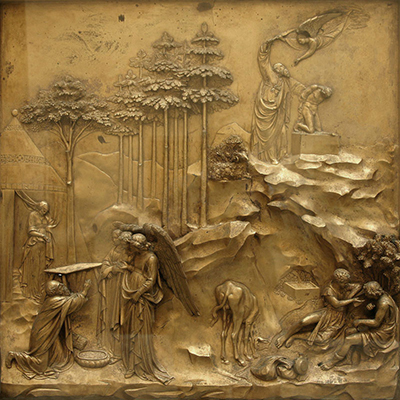
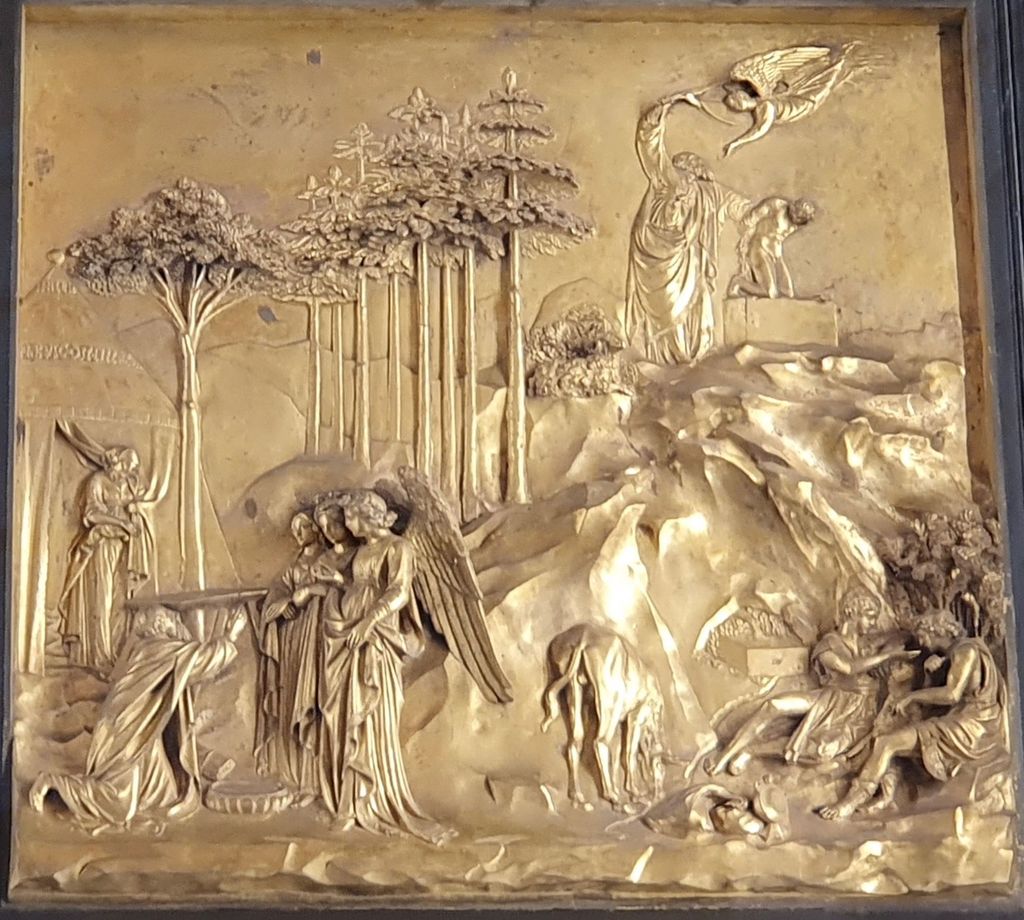
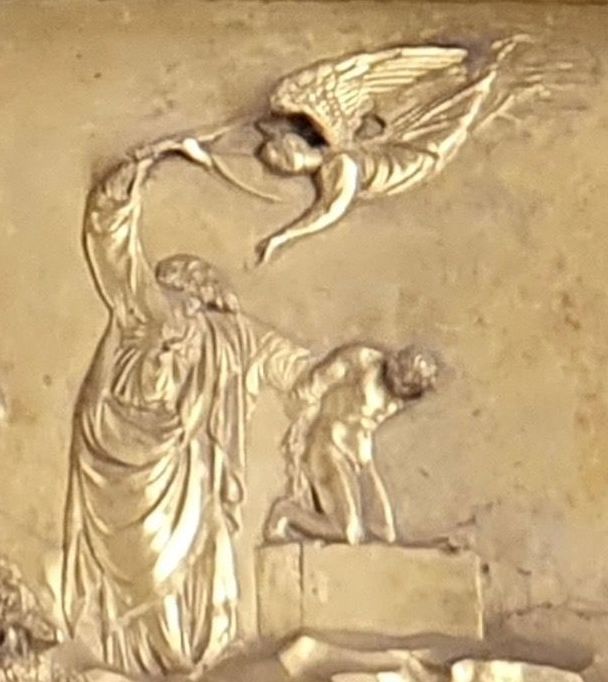
Abraham lifts his hand twice in Lorenzo Ghiberti’s Abraham and Isaac. At the lower left he kneels before three visitors, an open hand raised to greet them. A figure stands apart at the entrance to the tent. At the upper right Abraham stands over his kneeling son with a blade raised, and an angel flies in to stop him. The visitors bring word that Isaac will be born. The angel intervenes when that child is about to die. Ghiberti gives both gestures room to register, with a stand of trees and a rocky slope between them. [1] [2] [3] [4]
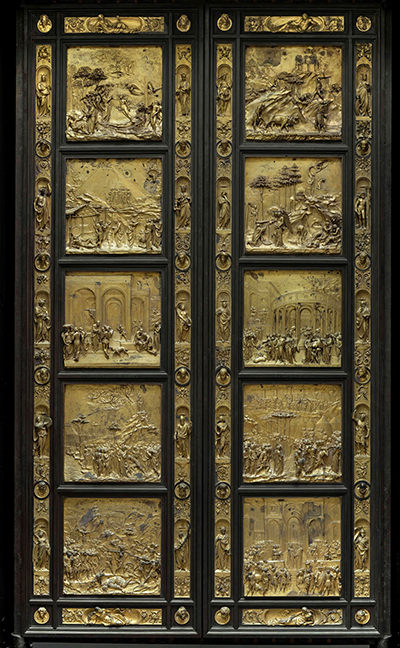
The Opera di Santa Maria del Fiore catalogues this gilded bronze as Stories of Abraham. It occupies the right side of the second row, opposite Noah, in the ten-panel Gates of Paradise. The commission went to Ghiberti in 1425. The doors he made with his workshop took their place at the Baptistery’s east entrance in 1452. The original doors are now in the Museo dell’Opera del Duomo, and a copy stands at the Baptistery. [1] [5]
Contents
- Who hears the promise?
- The people who stay below
- What the angel stops
- Ghiberti’s return to the sacrifice
Who hears the promise?
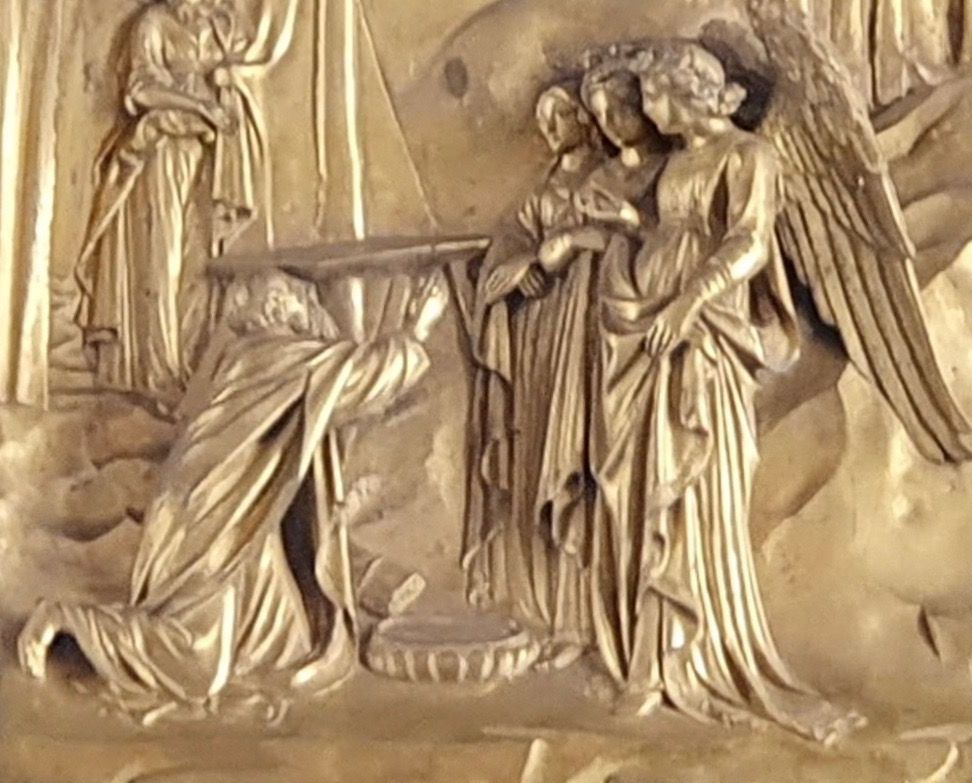
Genesis 18 begins in the heat of the day at Mamre. Abraham sees three men, bows and offers them water for their feet, shade and food. Sarah prepares bread and Abraham serves the meal. When a visitor announces that she will have a son, Sarah overhears at the tent and laughs at the prospect in her old age. Ghiberti has the host still on his knees and the visitors still on their feet, with a table behind Abraham and a shallow round vessel near his knees. The preparations for hospitality and the figure at the opening bring the welcome and the announcement into the same view. [1] [2] [3]
The visitors are tightly grouped. Three heads overlap in a row, and the folds of cloth distinguish the bodies beneath. A long wing sets off the group against the slope. Farther left, the upright edge of the entrance and the folds drawn aside around it pick out a single figure. The relief grows shallower here, and the horizontal trim of the tent reads almost as a line. Alessandro Merlo and Gaia Lavoratti identify a closely fitted fabric cover over a conical roof. The fine border and parted flap make the tent recognisable as a dwelling and give the person at its edge a place from which to attend to the visitors. [2] [6]
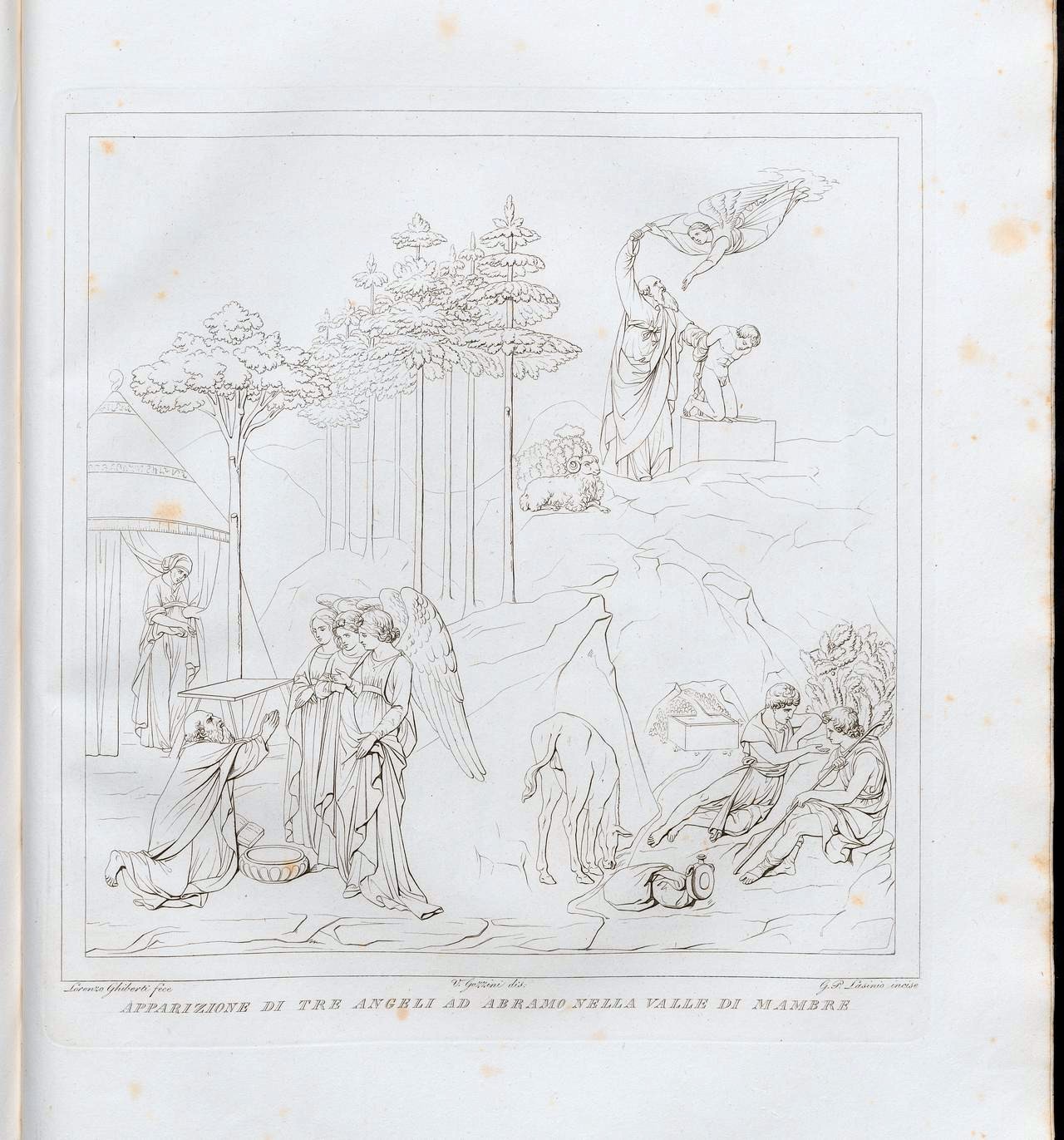
In the Commentarii, Ghiberti says that three angels appear and Abraham worships one of them. His description then moves directly to the attendants and the donkey at the mountain. The national heritage catalogue names Sarah among the subjects of the panel, and Genesis places her at the entrance within earshot. The Opera identifies the figure at the opening as an angel in addition to counting the three before Abraham.
The upward projections beside the figure could be read as part of its outline or as part of the parted fabric. Ghiberti’s account establishes how he counted the visitors at the encounter, while the threshold figure’s identity remains open. The birth is told separately in Genesis 21. On the door, Isaac first appears high on the right, already old enough to kneel on the altar. [1] [2] [3] [7] [8] [9]
The Opera reads the three visitors as a figure of the Trinity and the sacrifice as a prefiguration of Christ’s. A Florentine choir book illuminated in 1392–99 shows how explicitly the first connection could be made. In an initial now at the Morgan Library & Museum, Abraham kneels before the angels in the lower half of the letter, and three figures representing the Trinity sit behind a table in the upper half. Ghiberti gives the visitors a common stance and lets their drapery and wings overlap. The initial makes explicit a Christian association that the grouping in the bronze can suggest. [1] [2] [10]
Look closely at the stories of Abraham
1. Abraham and the visitors
Abraham kneels before the visitors. Overlapping heads and wings make the group read as a close encounter.
2. The moment of interruption
On the summit an angel reaches down to stop Abraham’s raised arm. Isaac kneels at the altar.
3. Below the summit
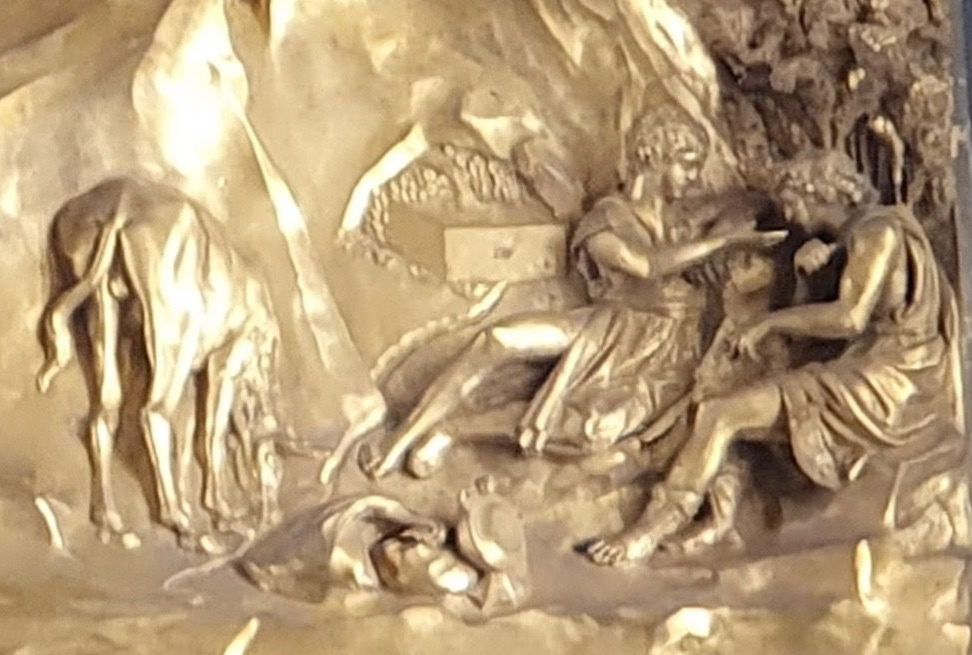
The donkey and seated attendants remain at the foot of the rock. Their position makes the climb to the altar legible.
Photograph by Yair Haklai. Source image. CC BY-SA 4.0. Resized for the overview and cropped for detail.
The people who stay below
In Genesis 22 Abraham sets out for Moriah with Isaac, two servants and a donkey. On the third day he sees the place and leaves the servants with the animal. Isaac carries the wood farther and asks where the animal for the offering is. Ghiberti passes over that question and gives space to the people who have stopped. The narrow trunks behind the visitors draw the eye upwards, while the broad faces of rock to their right catch the light in broken planes. That change of terrain carries the eye across the years between the two episodes. Near the bottom edge the seated men mark a second break, this time in the journey up the mountain. [1] [2] [3] [4] [9]
One attendant extends an arm towards the other, who inclines his head. The Opera describes them as gathering berries, while Jonietz reads an exchange between the two. The gestures make their absorption easier to see than its precise cause. The donkey, which the Opera describes as drinking, is set apart from the pair. Its hindquarters project towards us and its neck drops away into shallower relief. Seen from behind, the animal takes up little horizontal space beside the men, yet its turn towards the ground suggests how far its head extends into the scene.
The men’s bent legs and the donkey’s lowered head keep the eye near the ground while the rock above them rises abruptly to the altar. The seated figures are larger than Isaac, though they belong to his journey. Their scale puts the halt in the foreground even though it is the smallest event in the story. From there the eye must make the ascent that Ghiberti has left out. [1] [2] [11]
What the angel stops
Isaac’s head drops forwards over a plain altar. Abraham’s raised arm describes a wide curve on the other side of his body, and the angel enters across a stretch of open sky. The intervention in Genesis is spoken. An angel calls Abraham by name and forbids him to harm the boy. Abraham then looks up and discovers a ram caught by its horns. Ghiberti describes the episode differently in the Commentarii: the angel takes Abraham’s knife hand and shows him the ram. The sculptor’s account links the interruption to the discovery of the animal by making both the angel’s doing. [2] [4] [7]
The Opera locates the contact at the wrist. Amy R. Bloch draws a distinction between Ghiberti’s account of the knife hand and the sculpted form, identifying the blade as the point of contact. Jonietz likewise describes the angel as seizing the weapon. In the photograph, the incoming arm and the raised weapon meet close to the hand that holds it. The angel’s other arm extends below that meeting, and Isaac keeps his head down. The convergence near the upper margin is easy to see at the scale of the whole panel, even though the precise point of pressure is difficult to distinguish. [1] [2] [7] [11] [12]
The ram is low in the textured growth to the left of Abraham’s feet. The angel arrives in open space, where an outstretched arm is legible at once, while the animal emerges slowly from the rougher surfaces around it. The difference lets the eye encounter the interruption first and find its consequence afterwards. The boy is still kneeling and the ram is still in the thicket. Genesis goes on to describe the substitution and the renewal of the promise of descendants. In the bronze, the two possible victims remain in view together. [2] [4] [7] [11]
The reverse of the panel preserves traces of the work that went into casting it. In their study of the door reliefs, Salvatore Siano and his colleagues report brush marks across all or much of the back of panel IV, Stories of Abraham. They interpret widespread traces of this kind as evidence that liquid wax was brushed on to build up the thickness of the wax relief before casting. The photograph of the face shows how far the visitors and the donkey emerge from their surroundings. The marks on the back preserve evidence of an adjustment to the wax that a viewer facing the door would never see. The identity of the person who applied it remains open. [1] [2] [13]
Ghiberti’s return to the sacrifice
The Sacrifice of Isaac that Ghiberti made for the 1401 Calimala competition is a four-lobed relief in the Bargello, alongside Filippo Brunelleschi’s entry. In Ghiberti’s trial, the servants are on the far side of a rocky ridge, with the donkey between them. Isaac holds his torso upright on a decorated altar whose upper surface tilts into view. The angel reaches towards Abraham across a gap. In Brunelleschi’s version, the attendants occupy the lower part of the field and the angel makes contact with Abraham.
Brunelleschi’s low grouping leaves the sacrifice clear above it, whereas in Ghiberti’s trial the ridge makes the division run diagonally across the relief. On the doors the attendants again have the ground below the altar to themselves, with the visitors occupying a separate space on the left. At the later altar Isaac folds forwards and the angel’s reach meets the raised weapon or hand. The altar is plainer and more clearly seen from the side. [2] [11] [12] [14] [15] [16] [17]
Angela Oberer sees a possible debt to Brunelleschi in the way the later relief makes its figures’ responses intelligible. Isaac turns away from the threat, the angel intervenes bodily, and the servants have a small episode of their own at the foot of the hill. Oberer reads their gestures as conversation. The donkey, which came between the men in Ghiberti’s trial, has moved aside to drink, leaving the two attendants to direct their movements towards each other. The Opera likewise suggests a debt to Brunelleschi in the attendants’ distraction below the sacrifice. Oberer sees the ram, by contrast, as a form Ghiberti carried over from his own trial piece. [1] [2] [16] [17] [18]
Jonietz acknowledges that the later altar resembles Brunelleschi’s in reverse, but disputes making Brunelleschi the main point of reference. He sees Ghiberti reworking his own design and sets the close repetition of the resting ram alongside the extreme foreshortening of the donkey. He also proposes a possible connection between the donkey and Pliny’s account of the painter Pausias rendering a sacrificial bull in foreshortening.
On the door, the familiar ram and the changed donkey occupy different parts of the mountain, and the four-lobed field of the trial has given way to a setting large enough for the servants’ pause and the visit at Mamre. The similarities that interest Oberer and Jonietz concern particular figures and relationships, all now working within that larger span. [2] [11] [16] [17] [18]
The boy’s kneeling body at the summit recalls the man kneeling before the visitors. Abraham’s first raised hand opens an encounter. His second depends on another figure reaching him in time. At the foot of the mountain, the attendants’ eyes stay on the ground and on each other. From in front of the door, the viewer can take in both, across the trees, rock and ground that keep the two moments apart. [1] [2] [3] [4]
Lorenzo Ghiberti in context
Sacrifice of Isaac
1401 competitionNorth Doors
1403–1424St John the Baptist
c. 1414–1416St Matthew
1419–1422Gates of Paradise
1425–1452St Stephen
c. 1427–1429Lorenzo Ghiberti sculpture directory
Discussion
Ghiberti rewards slow looking: relief, gilding, narrative structure, workshop practice and conservation evidence can all change how a work is read.
Join the Conversation
Have an observation about Abraham and Isaac, a source to add, or a comparison that sharpens the reading? Share it below.
References
- Opera di Santa Maria del Fiore, Formella con Storie di Abramo, catalogue record 1324. View source.
- Yair Haklai, photograph of the original Abraham relief in the Museo dell’Opera del Duomo, CC BY-SA 4.0. View source.
- United States Conference of Catholic Bishops, Genesis 18, verses 1–15. View source.
- United States Conference of Catholic Bishops, Genesis 22, verses 1–19. View source.
- Opera di Santa Maria del Fiore, Porta del Paradiso, catalogue record 1320. View source.
- Alessandro Merlo and Gaia Lavoratti, ‘The Representation of Vernacular Architecture in the Gates of Paradise by Lorenzo Ghiberti’, Heritage 7 (2024), section 3.3 and fig. 12. View source.
- Lorenzo Ghiberti, I Commentarii, Book II, ed. Julius von Schlosser, vol. I (1912), p. 49. View source.
- Ministero della Cultura, Storie di Abramo, national catalogue record 0900230039-6. View source.
- United States Conference of Catholic Bishops, Genesis 21, verses 1–8. View source.
- Morgan Library & Museum, Gradual, MS M.653 no. 2 (II.23), initial B. View source.
- Fabian Jonietz, ‘The Burden of Success in Quattrocento Sculpture: Lorenzo Ghiberti, Mino da Fiesole, Donatello’, in Synagonism (Brill, 2024), pp. 238–42 and n. 25. View source.
- Amy R. Bloch, Lorenzo Ghiberti’s Gates of Paradise, introduction, Cambridge University Press, 2016, p. 11. View source.
- Salvatore Siano, Piero Bertelli, Marcello Miccio and Ferdinando Marinelli, ‘Studio sulla tecnica di fusione dei rilievi della Porta del Paradiso’, section 3, PDF leaf 4. View source.
- Musei del Bargello, Donatello and the Dawn of Renaissance, entry on the 1401 competition reliefs. View source.
- Ministero della Cultura, Ghiberti’s Sacrifice of Isaac, national catalogue record 0900287017. View source.
- Francesco Bini, photograph of Ghiberti’s Sacrifice of Isaac in the Bargello, CC BY-SA 4.0. View source.
- MenkinAlRire, photograph of Ghiberti’s and Brunelleschi’s competition reliefs in the Bargello, CC BY-SA 4.0. View source.
- Angela Oberer, ‘Ghibertis Hommage an Brunelleschi’, kunsttexte.de 4 (2014), pp. 3–5 and n. 20. View source.