 by Tom Gurney
Tom Gurney BSc (Hons) is an art history expert with over 20 years experience
Published on June 19, 2020 / Updated on November 17, 2026
Email: tomgurney1@gmail.com / Phone: +44 7429 011000
The marks on Ferdinando Gregori and Thomas Patch’s engravings tell readers how to put a door together. In their 1770s publication, the scenes and ornaments of Lorenzo Ghiberti’s Gates of Paradise occupy separate sheets. The marks show how the pieces fit, and a smaller view shows the result. Someone who knew the doors as an entrance to the Florence Baptistery could now take their design apart on a table. Someone who had never been to Florence could work from the individual strips and squares towards an idea of the whole. [1] [2]
There was another object in between. A letter from 1775 describes the plaster that Patch owned as the model used to engrave the work in copper. To get from the fifteenth-century gilded bronze to the printed image, the engravers could work from a copy with depth and shadows of its own. That distinction matters to anyone looking at a reproduction today. The subject may be Ghiberti’s, while the line you follow, the shadow you see or even the surface the photographer stood in front of belongs to a later object. [1] [2] [3]
Contents
- A door that could be assembled from paper
- A square recut in line
- The entrance on a page of a novel
- What a cast can keep
- When the reproduction is metal
A door that could be assembled from paper
The September 1772 announcement in the Gazzetta Toscana, transcribed by Giulia Coco, offered four sheets in the first instalment and projected ten instalments with thirty-four sheets in all. In 1773 the paper reported that four instalments had appeared and a fifth was in preparation. This makes the case for serial publication more firmly than the dates on the surviving plates alone. It also gives a sense of what a subscriber could have had in hand: a portion of the project while the next part was still being made. Thirty-four sheets was the advertised goal; the notice cannot tell you what is present in a surviving volume. [1] [2]
Sir John Soane’s Museum dates its copy to 1772–74. It takes its catalogue title from the letterpress account of both of Ghiberti’s bronze doors, appended to an address in Italian and English. The plates picture the later pair. Ten plates show the narrative squares, ten the borders on the leaves and another ten the surround; there are also architectural details. A reader can follow the ornament for the length of a sheet and then use the overview to see whether it runs along the moving leaves or around the opening. The arrangement makes that distinction easier to study than it would be in a view framed tightly around the scenes. [1]
The Soane volume lacks an unnumbered plate of cornice and architrave details, and two unrelated prints are bound into it. One precedes the work; the other comes at the end. The overview’s 1774 imprint gives the catalogue a date for that sheet, while the dates on the scene plates reach back to 1772. For a loose print, a dated inscription or a join mark can therefore be more useful than a search under the book’s supplied title. For a bound volume, the sequence advertised in the newspaper and the actual contents of the copy answer different questions. [1] [2]
Caption: Ferdinando Gregori and Thomas Patch, “Elevation And Plan Of The Gate”, 1774, in the publication catalogued as Libro della seconda, e terza porta di bronzo. Sir John Soane’s Museum, ref. 5594. The overview is the guide to the assembled design described in the catalogue. [1]
Coco’s archival evidence also explains what had to happen before a door could become a set of sheets. Anton Raphael Mengs petitioned in 1771 to have moulds made for study. The permission Coco describes named Vincenzo Ciampi as mould maker, under Innocenzo Spinazzi’s direction, and required the work to fit around services. In 1772 a dispute over cleaning the reliefs followed. The access conditions and the dispute both show how closely the possibility of copying depended on decisions about a working entrance and its surface. A newspaper could advertise prints taken from the originals while leaving the stages between the bronze and the paper unstated. [2]
Those stages become clearer in the negotiations over a cast in 1775. Ciampi first offered a plaster that had been cleaned up and oiled. He then arranged to obtain Patch’s unfinished cast. As Coco transcribes it, the correspondence identifies Patch’s plaster as the one used for the copper engravings. The delivery record counts forty-nine pieces of the cast that Ciampi handed over. That count belongs to a plaster delivered for study, just as the newspaper’s thirty-four belongs to the planned publication. A workshop could divide the door for one purpose and a publisher for another. The evidence establishes a plaster intermediary for the engraving project without specifying what stood before the engraver for every plate. [1] [2]
A square recut in line
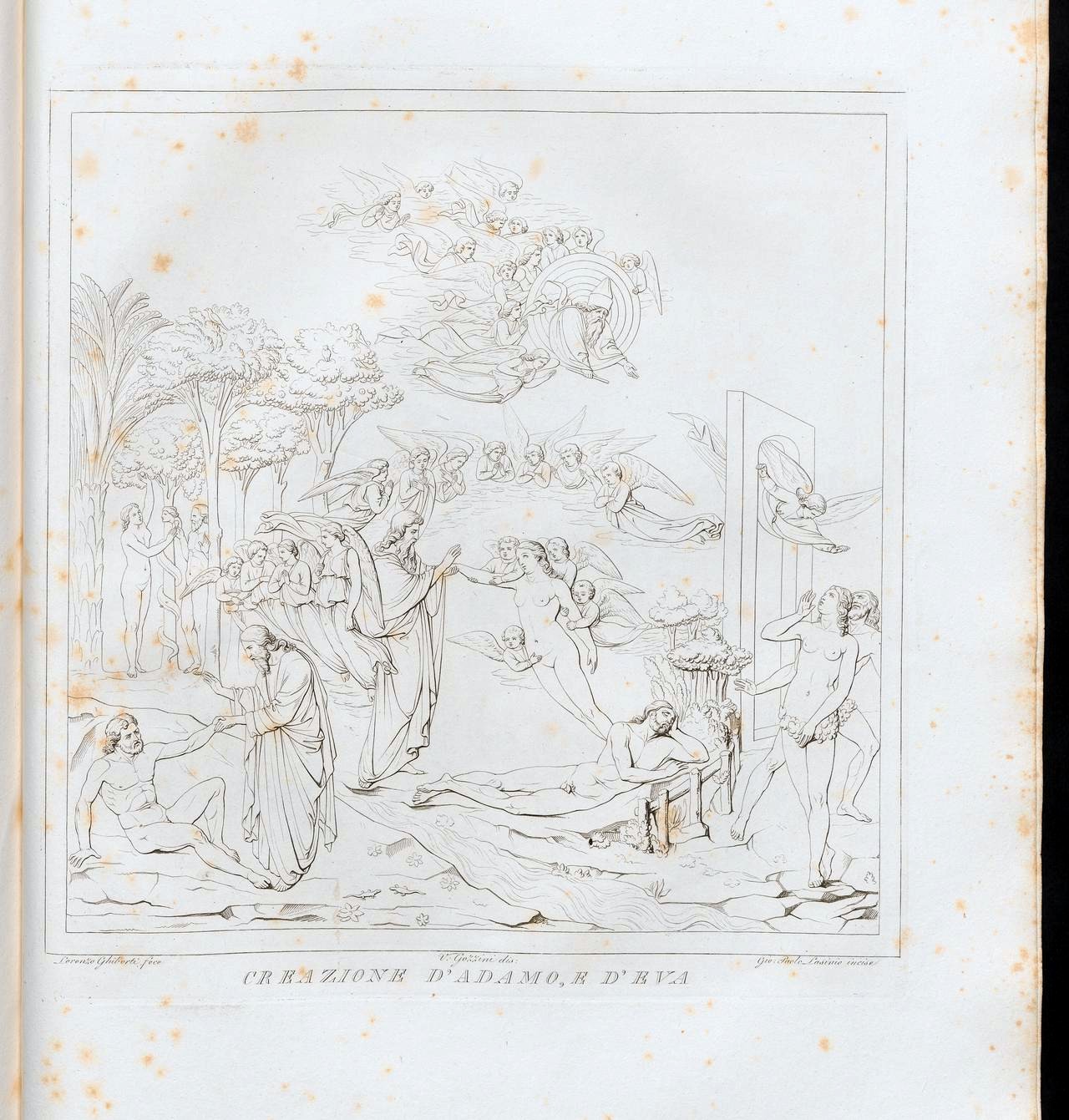
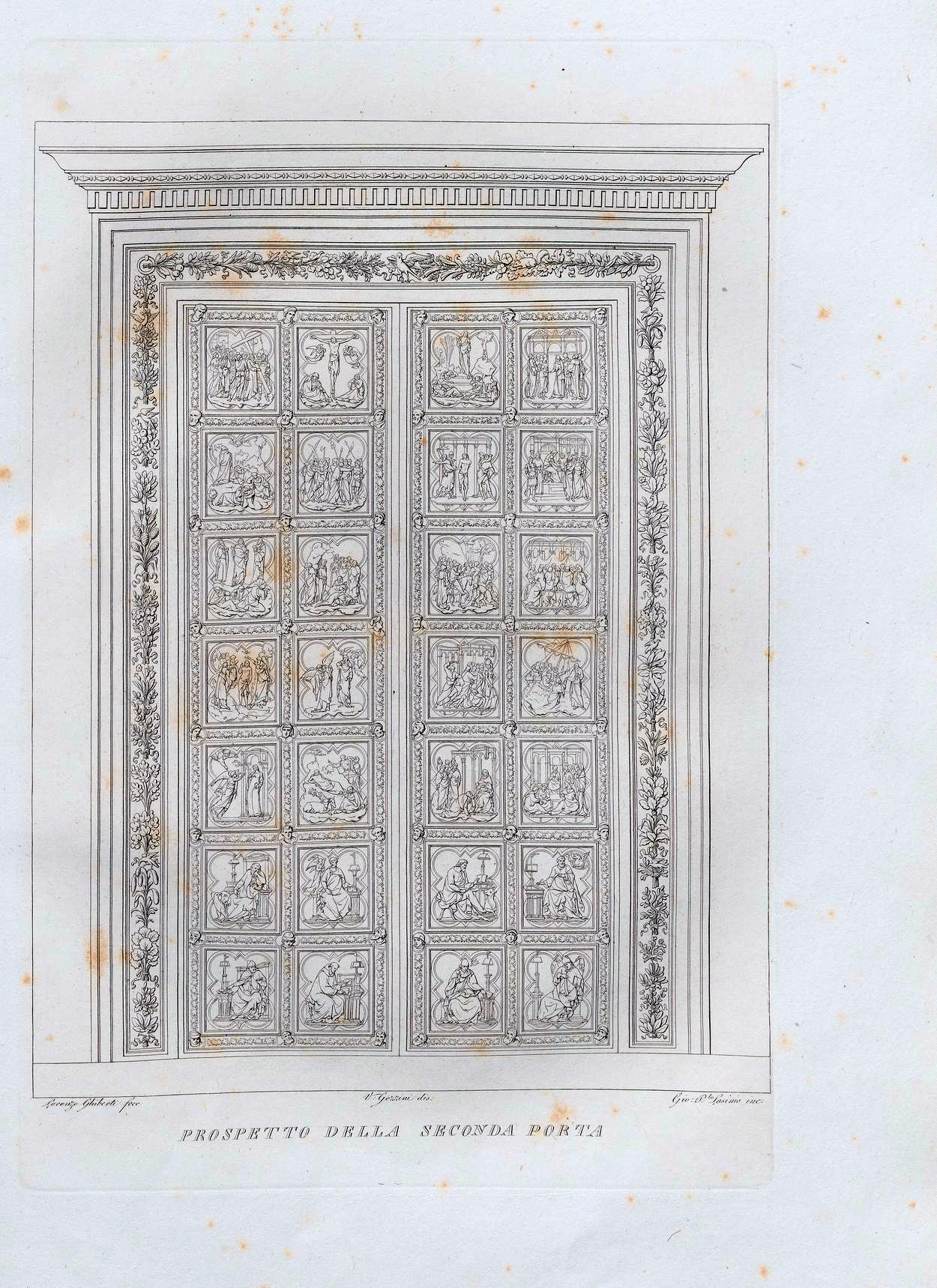
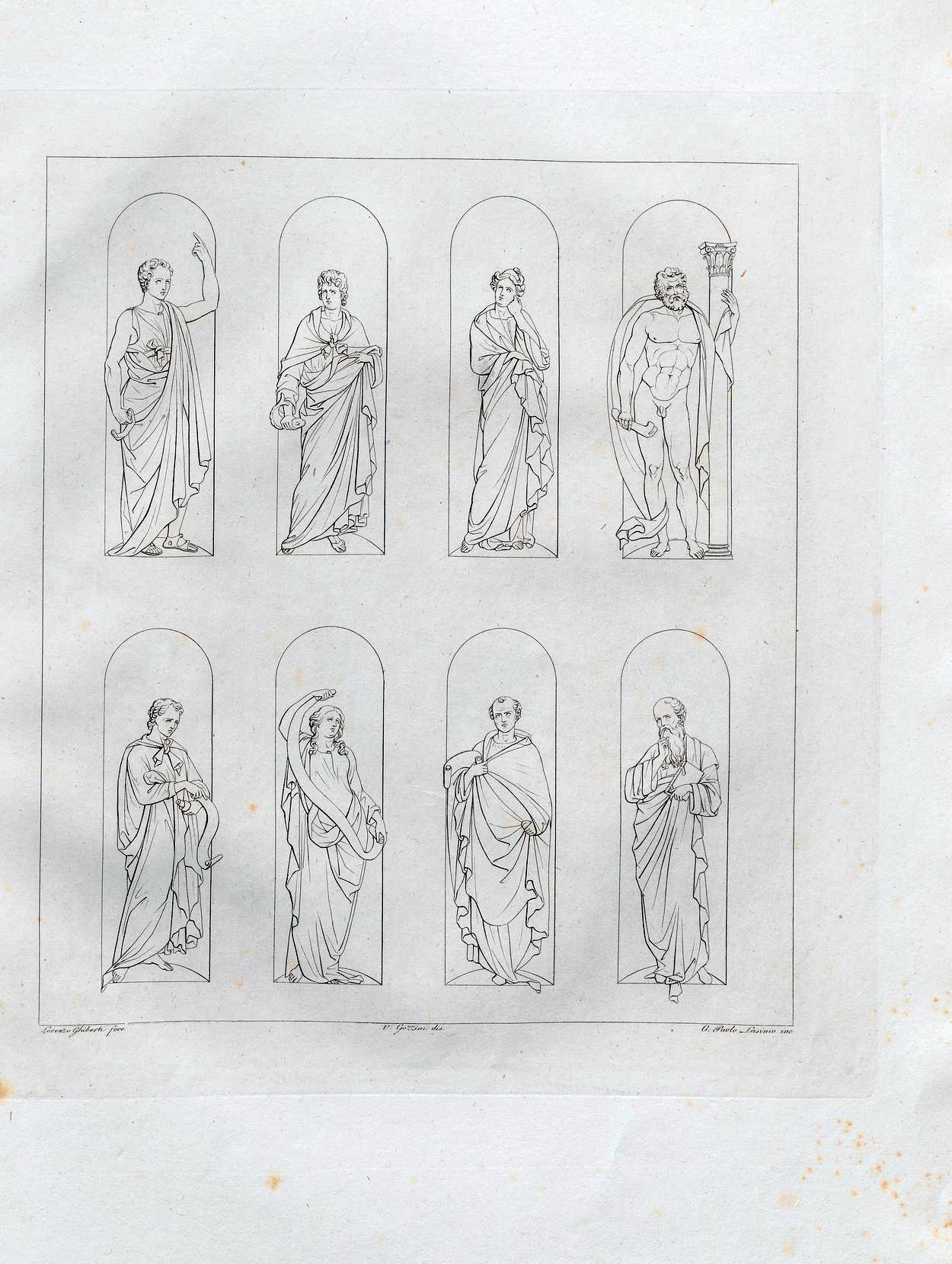
In the Zürich copy of Le tre porte del Battistero di San Giovanni di Firenze, catalogued as dating from about 1821, the three entrances have separate sections. The East Door overview shows the cornice and surround and two columns of five squares. The little scenes can be located in relation to one another, but their figures are compressed into pale clusters of marks. On the separate Creazione d’Adamo, e d’Eva sheet, the upper-left square of the door has a page to itself. Turning from one view to the other gives a reader the position of the relief and then enough room to see its individual episodes. [4] [5] [6] [7]
Start at the lower left of the larger sheet, where Adam wakes. His extended arm leads towards the folds of God’s robe. Farther back on the left, the encounter among the trees is made of much smaller marks, yet the slim trunks and the figures remain distinct. In the centre, the bodies around Eve and the fine strokes of their wings make a busy area of the page. At right, the straight edges of the gate give the Expulsion a different frame from the shifting lines of the ground. The title names the creation of Adam and Eve; the image makes room for all four episodes that the Opera identifies on the original Eden relief. [6] [7]
In the photograph of the original relief, light catches the raised ridge of the robe beside Adam, while the angels towards the top occupy a much shallower field. In the print, a contour can make a small tree or a fold in a robe almost as easy to follow as the edge of a foreground figure. The narrow marks around the stream and the curving lines of the angels help you separate things that would register as changes of level and shadow on the bronze.
The drawn gate still suggests a space one could pass through, although the edge of its opening and the edge of a body are both made with ink. That is the sheet’s particular advantage for studying the design. The darkness of any one line gives no measure of the projection, condition or colour of the bronze. [6] [7]
The Italian national catalogue lists the corresponding Lodi print as an etching on paper, with Vincenzo Gozzini as draughtsman, Giovanni Paolo Lasinio as engraver and Ghiberti as the designer of the original. That division of credit separates the design of the relief from the decisions that made it legible on paper. The Lodi entry dates its print to about 1821 and reports 1822 on the title page of its volume. The Zürich catalogue’s bracketed date is the date supplied for its own copy. When one of these sheets is detached, the apparent precision of a year can conceal exactly the information you need: which volume the date describes. [4] [6] [8]
Caption: Giovanni Paolo Lasinio, from a drawing by Vincenzo Gozzini after Lorenzo Ghiberti’s relief design, Creazione d’Adamo, e d’Eva, in Le tre porte del Battistero, c. 1821. ETH-Bibliothek Zürich, Rar 9941, scan 14923045. The outline print shows the disposition of the episodes within the square. [4] [6] [8]
The Metropolitan Museum of Art’s Gates of Paradise has a different format again. The museum catalogues twelve engravings by Feodor Ivanovich Kalmuk after Ghiberti, issued by Heinrich Keller in Rome in 1798. Each sheet measures 53.1 × 58 cm. On screen a sheet of that size can look no larger than the image on a page of a novel. The dimensions recover something of the scale at which the engravings could be examined. The accession range describes the set; an individual image needs its own identification before it can be compared with the Zürich print or with a relief. [9]
The entrance on a page of a novel
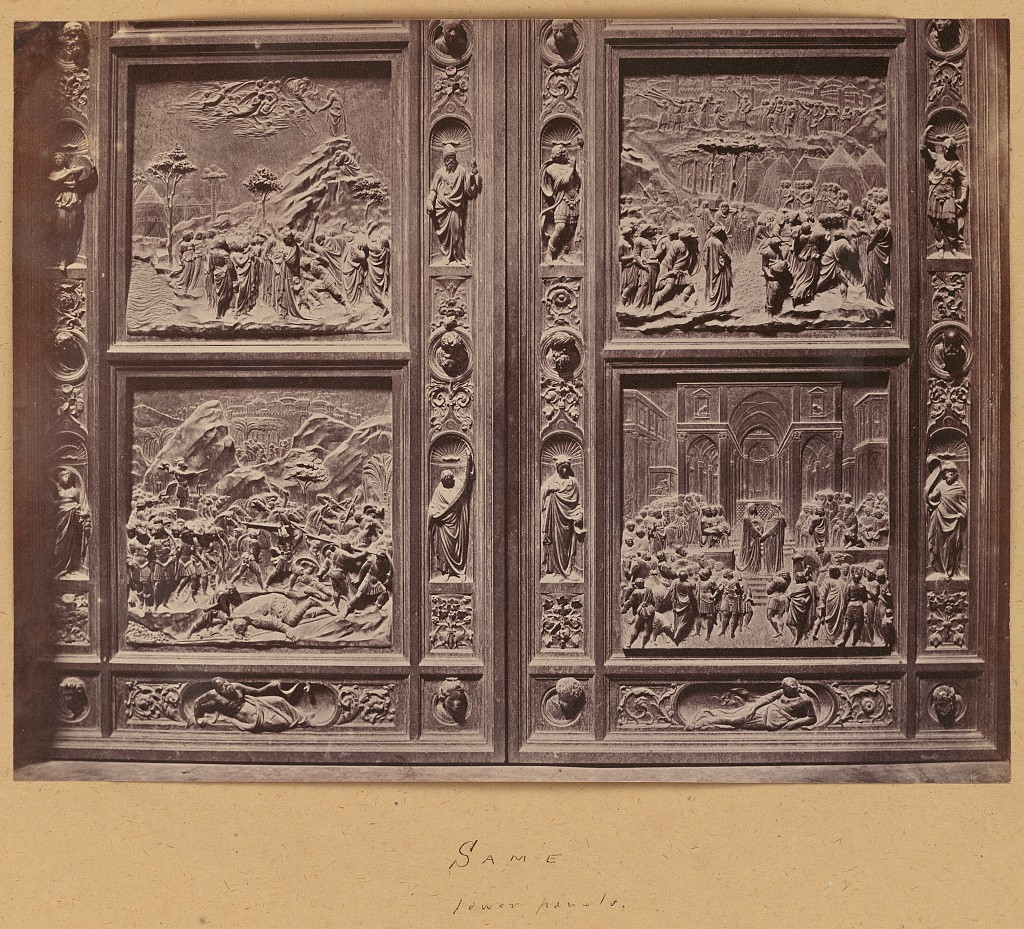
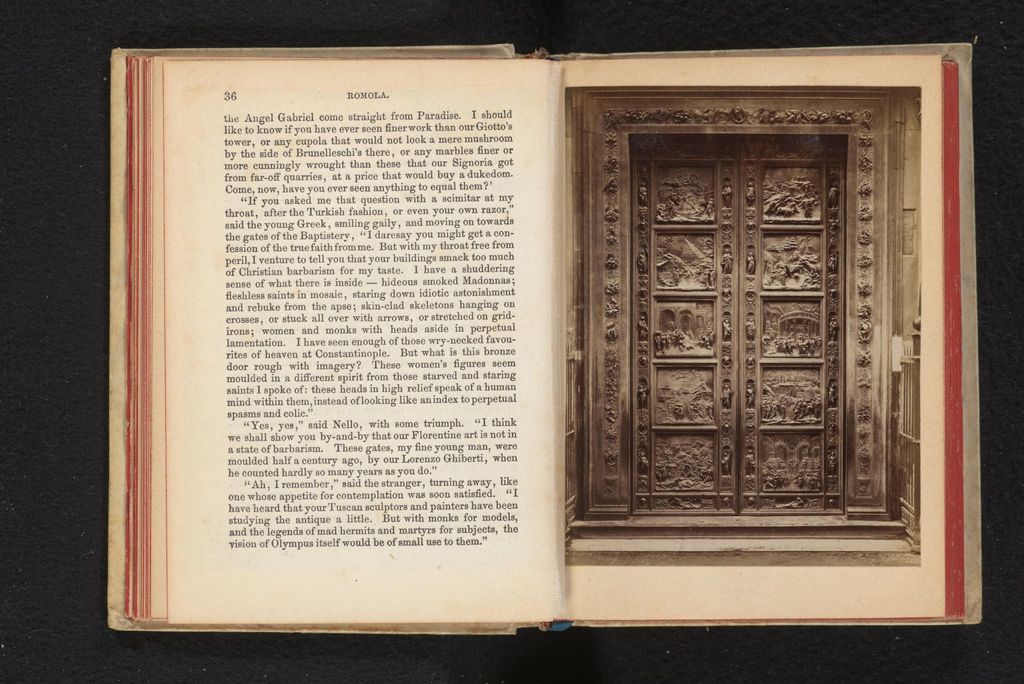
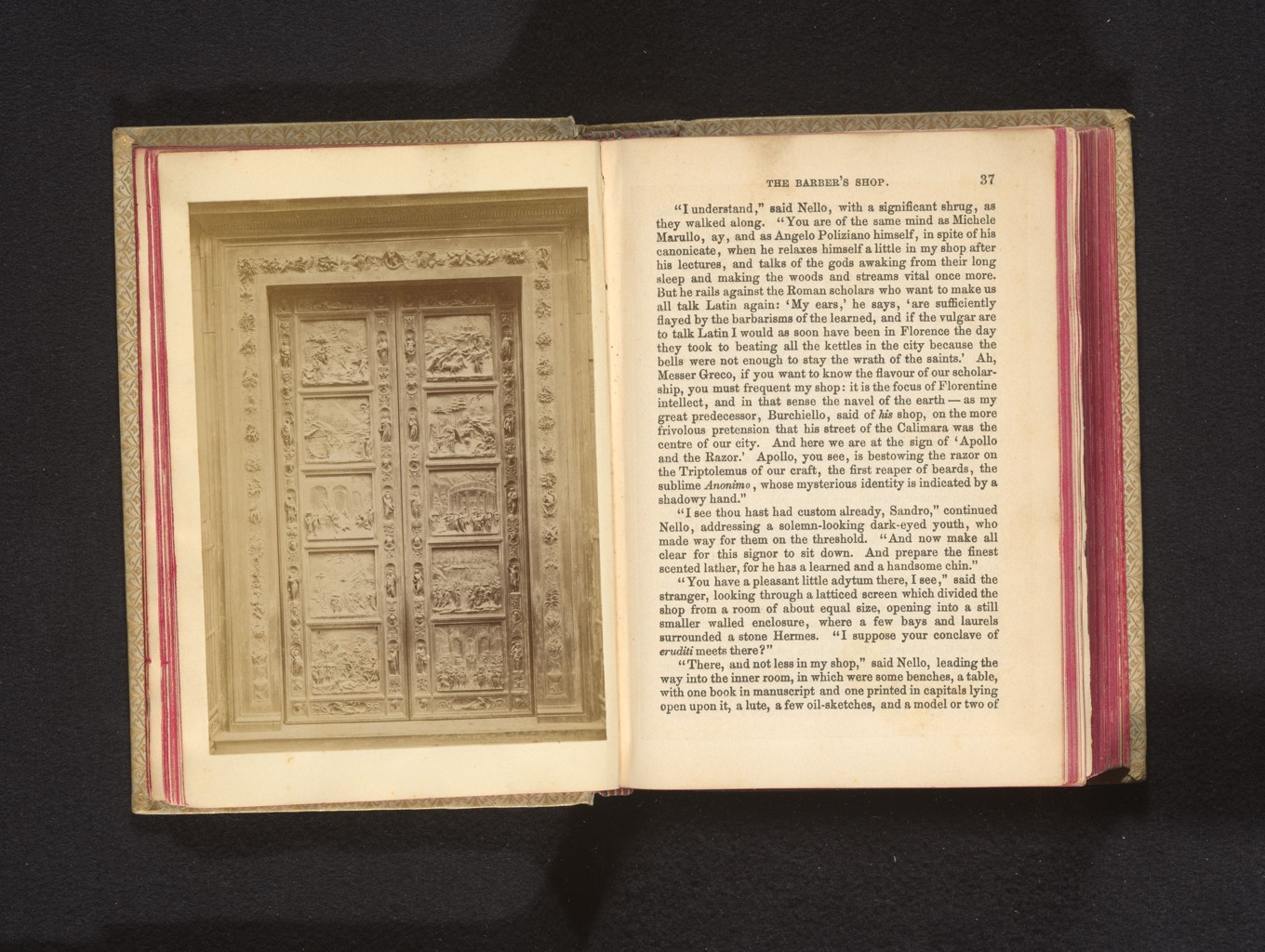
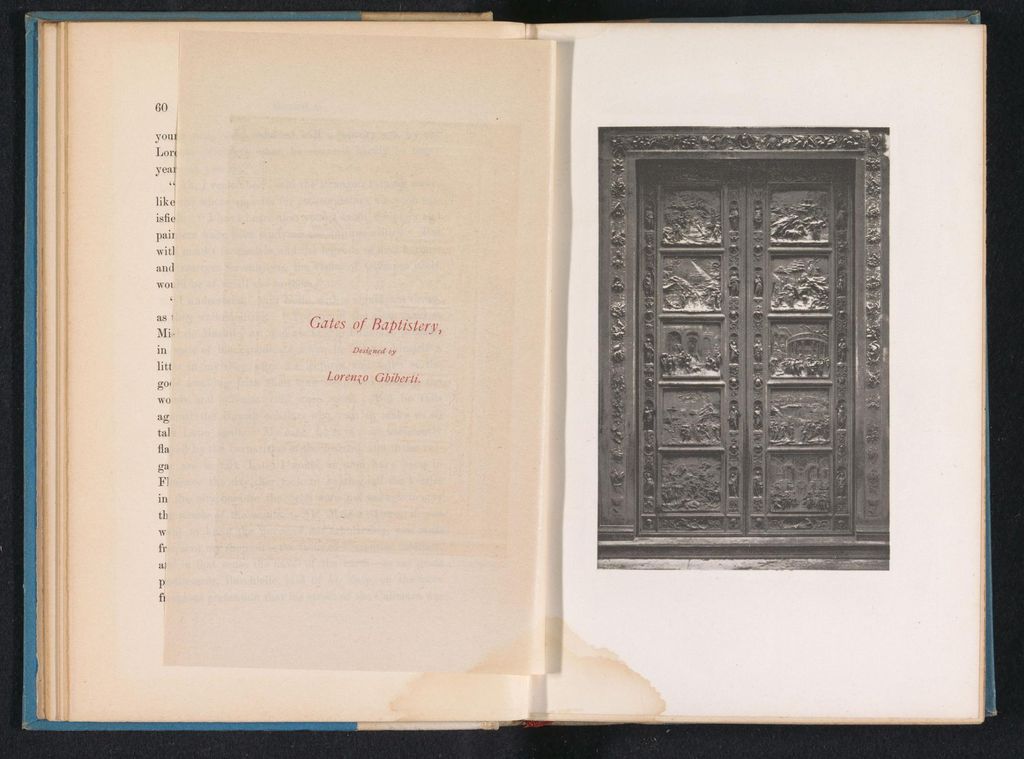
A print can also serve a reader by keeping the door at a distance. In the Rijksmuseum copy of George Eliot’s Romola, an albumen photograph by Giacomo Brogi faces page 36, where the characters approach the Baptistery and talk about the bronze door. The photograph is 132 mm high. You can pick out the arched architecture in one of the central scenes and a rounded building in the other, while the faces in the crowds are too small to read. The railings at the edges, the pale step and the dark top of the opening carry information the individual panel print leaves aside. They place the door in the space the characters are approaching. [10]
Caption: Giacomo Brogi, Gates of Paradise at the Florence Baptistery, catalogued c. 1858 to no later than 1863. Albumen print mounted opposite p. 36 of Romola. Rijksmuseum, RP-F-F25436-J. The mounted spread records the connection between this historic exterior view and the facing passage. [10]
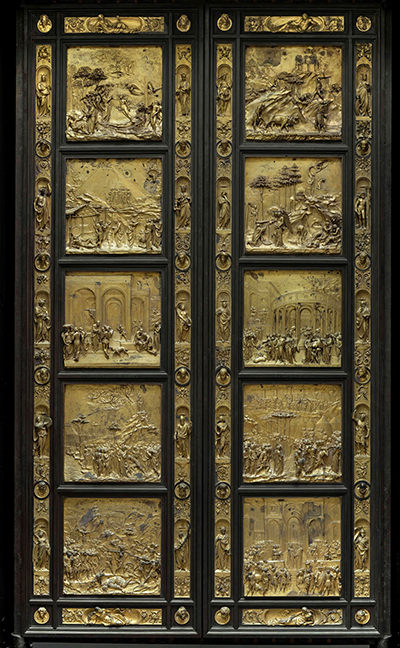
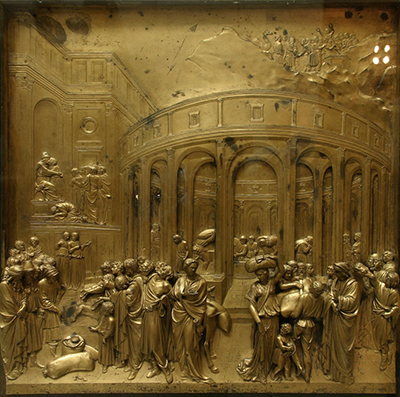
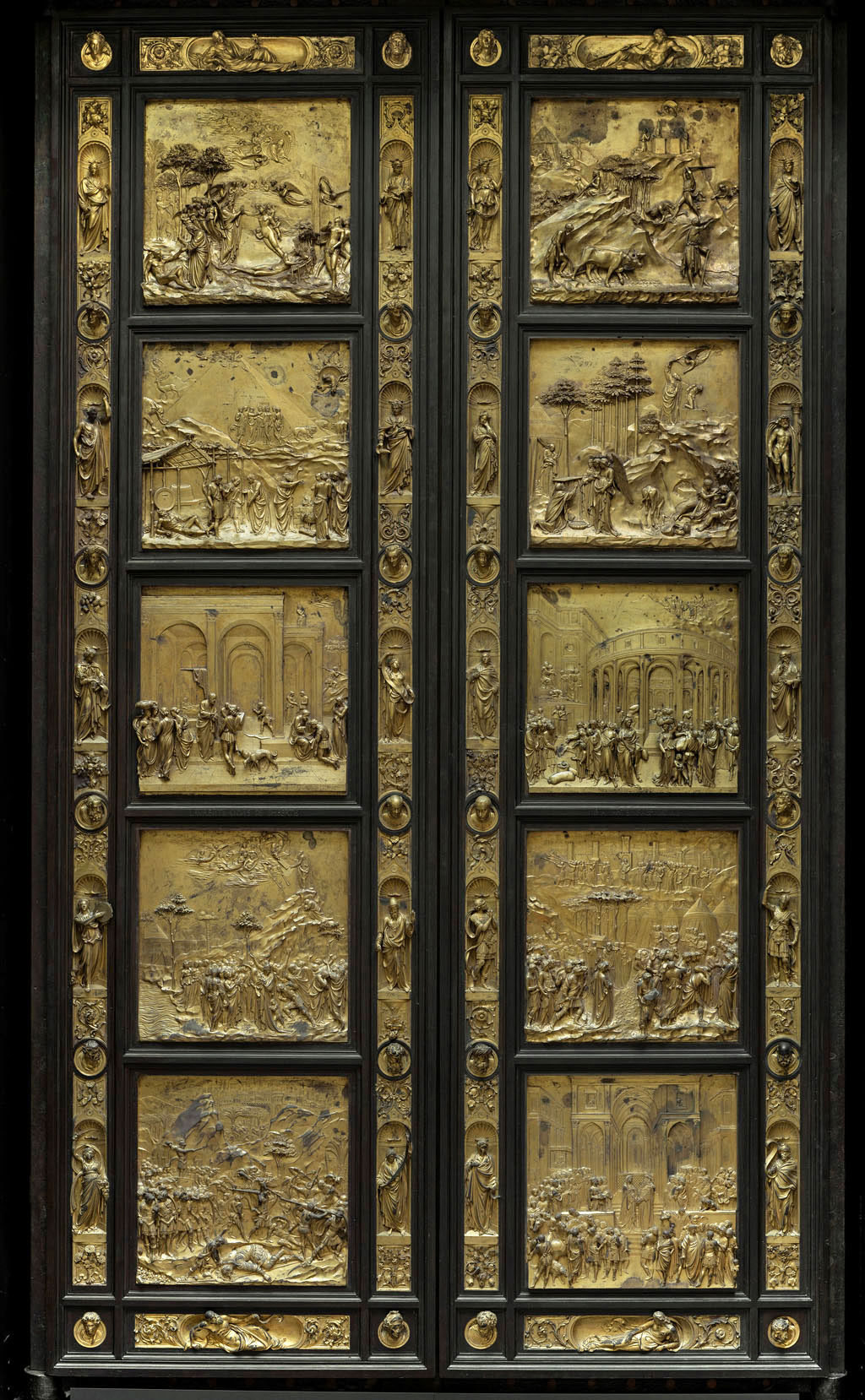
In George M. Groutas’s colour photograph of the original in the Museo dell’Opera del Duomo, a visitor raises a phone towards a lower panel. The visitor provides a measure of height, and the reflections across the glass help explain why some passages are easier to read than others. Brogi’s view shows more of the surround and gives the door a threshold. His albumen print and the colour photograph each carry the effects of their own photographic process and lighting. Comparing the brown of the print with the gold in the museum view will tell you more about the two images than about changes in the gilding. [3] [10] [11]
Caption: George M. Groutas, the original Gates of Paradise in the Museo dell’Opera del Duomo, Florence. Colour photograph through display glass, CC BY 2.0. The visitor establishes scale; the lighting and reflections are those of the museum display. [3] [11]
What a cast can keep
The plaster Cain and Abel in Madrid gives a name and an inventory number to a particular stage in the copying of the door. The Real Academia de Bellas Artes de San Fernando credits Vincenzo Barsotti da Tereglio, records the gift from Mengs and notes an earlier number, 63, painted on the base. The number tells us about the plaster as a collection object. The date needs similar care: Madrid catalogues V-283 as 1771, while Florence’s scientific catalogue places Mengs’s permission to take casts in 1772. Coco documents a 1771 permission naming Ciampi. This does not establish which mould produced Barsotti’s plaster or put the Madrid object in Patch’s production chain. [2] [12] [13]
Caption: Vincenzo Barsotti da Tereglio, after Lorenzo Ghiberti, Cain and Abel, catalogued as 1771. Plaster, gift of Anton Raphael Mengs. Real Academia de Bellas Artes de San Fernando, V-283. The date and painted inventory mark belong to the Madrid object. [12]
When the reproduction is metal
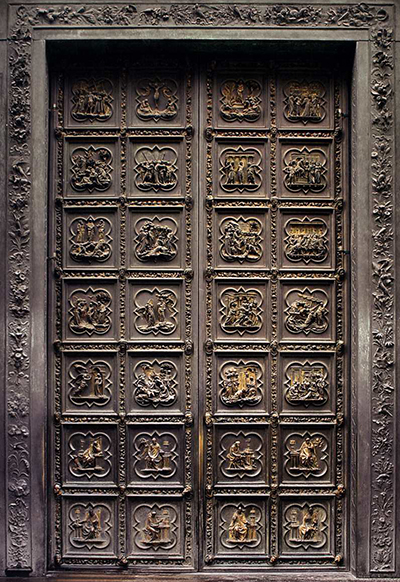
At the Baptistery today, a photograph can show a gilded bronze door at the correct entrance and still depict a modern casting. The Opera credits Enrico Marinelli of Galleria Frilli with making the replacement installed in 1990, using casts made during post-war restoration. The replica was gilded electrolytically; the historical doors were mercury gilded. An exterior view of the replica can show how far above the pavement the upper scenes sit or how the surround fits against the masonry. A caption that calls it simply the Gates of Paradise leaves a reader unable to tell whether a close view is evidence of the Renaissance surface or of a later foundry’s work. [3] [14]
Caption: Enrico Marinelli, Galleria Frilli, after Lorenzo Ghiberti, Gates of Paradise. Gilded bronze replica installed in 1990 at the east portal of the Florence Baptistery. It shows the placement of the doors at the entrance. [14]
The bronze doors on the north façade of the Kazan Cathedral in St Petersburg show how a copy could take on a new architectural role. The Russian Academy of Arts’ conference study traces their making through an alabaster reproduction given by Nikita Demidov in 1776. In the letter quoted by the study, Demidov wanted the copy to serve artists in training and named Giambologna as the maker of the Florentine doors.
The design could therefore travel with a mistaken name, and a teaching object could become a model for another entrance. The study illustrates the same part of the Joseph relief in the Florentine bronze, the toned alabaster and the later bronze. Labelling all three by subject alone would hide the very sequence the comparison makes visible. [3] [15]
Caption: Vasily Ekimov and Pyotr Sokolov, after Lorenzo Ghiberti, Joseph relief, 1805–07. Bronze detail from the north doors of the Kazan Cathedral, St Petersburg. This version belongs to a chain of copying that included Demidov’s alabaster cast. [15]
When choosing a reproduction, start with the question you want the image to answer. A portal view gives you the steps and surround; a loose sheet may give you room to trace a single scene. For a print of one relief, ask how large the image itself is, since the sheet dimensions include its margins. Use the institution and accession number, where available, to find out whether the image was taken from the bronze, from a cast or from another print. The choice is particularly consequential here: an eighteenth-century engraving may itself be an original impression and still give you Ghiberti’s relief by way of plaster and copper. [1] [2] [6] [9] [10] [14]
Lorenzo Ghiberti sculpture directory
Discussion
Ghiberti rewards slow looking: relief, gilding, narrative structure, workshop practice and conservation evidence can all change how a work is read.
Join the Conversation
Have an observation about Ghiberti Prints, a source to add, or a comparison that sharpens the reading? Share it below.
References
- Sir John Soane’s Museum, Gregori and Patch publication, ref. 5594 View source.
- Giulia Coco, “Un inglese con la passione per i primitivi. Thomas Patch a Firenze”, Studi di Memofonte 18 (2017), pp. 5–8 and notes View source.
- Opera di Santa Maria del Fiore, Gate of Paradise View source.
- ETH-Bibliothek Zürich, Le tre porte del Battistero di San Giovanni di Firenze, Rar 9941 View source.
- ETH-Bibliothek Zürich, East Door overview, scan 14923043 View source.
- ETH-Bibliothek Zürich, Creazione d’Adamo, e d’Eva, scan 14923045 View source.
- Opera di Santa Maria del Fiore, Eden relief, scientific catalogue 1332; Yair Haklai, photograph of the original relief View source 1. View source 2.
- Italian national catalogue, Lodi impression of the Eden print, 0300622208 View source.
- The Metropolitan Museum of Art, Kalmuk’s Gates of Paradise, 2008.333.1–.12 View source.
- Rijksmuseum, Brogi’s photograph in Romola, RP-F-F25436-J View source.
- George M. Groutas, photograph of the original doors in the museum, Wikimedia Commons View source.
- Real Academia de Bellas Artes de San Fernando, Cain and Abel, V-283 View source.
- Opera di Santa Maria del Fiore, Porta del Paradiso, scientific catalogue 1320 View source.
- Opera di Santa Maria del Fiore, maintenance of the east portal replica View source.
- Russian Academy of Arts, conference studies including the Demidov cast and Kazan Cathedral doors View source.