

 by Tom Gurney
Tom Gurney BSc (Hons) is an art history expert with over 20 years experience
Published on June 19, 2020 / Updated on July 28, 2026
Email: tomgurney1@gmail.com / Phone: +44 7429 011000
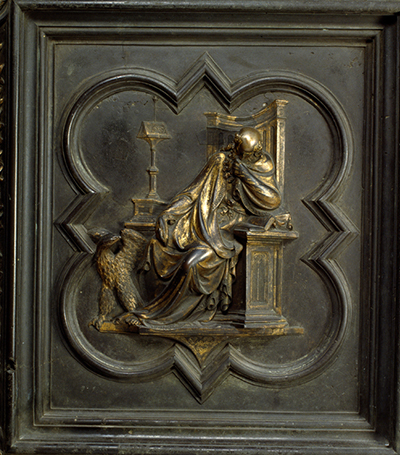
Lorenzo Ghiberti presents John the Evangelist as a figure of inward concentration. John sits at a sloping writing desk, resting his head on one hand. His eagle occupies the lower left, while a tall stand balances the desk. Unlike a public teacher, he seems absorbed in thought before or during composition.
Contents
Position on the North Door
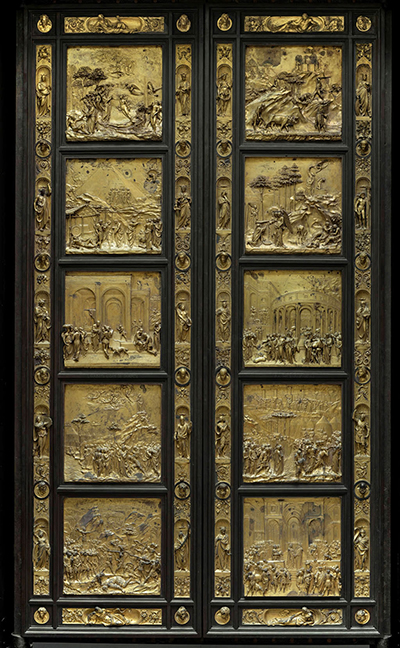
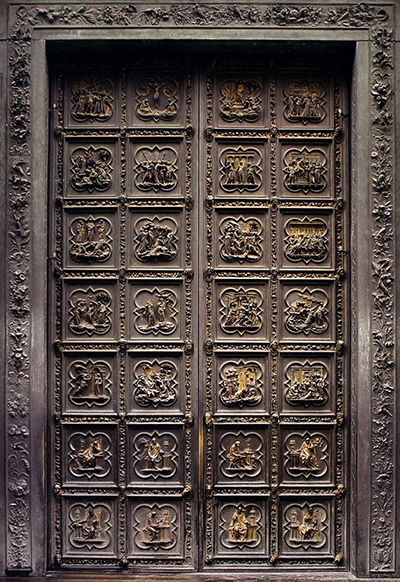
John is on the left leaf in the Evangelist register, directly above Augustine. The four Evangelists occupy the door's penultimate level, beneath the twenty scenes from Christ's life and above the four Latin Doctors.
The North Door was made between 1403 and 1424. The original is displayed in the Museo dell'Opera del Duomo; the Baptistery's exterior door is a copy. Opera del Duomo reports the Evangelists within a proposed Krautheimer phase around 1407–1413/15. This is a stylistic reconstruction rather than a documented date for John's panel.[1][2]
Contemplation and writing
John's head-in-hand pose slows the figure. The body is seated at the desk, but the principal action is mental rather than manual. Heavy drapery settles across the chair and legs, reinforcing the sense of pause.
The eagle identifies John within the traditional fourfold Evangelist symbolism. It also expands the composition beyond a portrait of a writer: sacred authorship is accompanied by an emblem whose alert profile contrasts with John's introspection.
Furniture as enclosure
Desk, chair and stand create a compact working environment inside the quatrefoil. Their verticals and angled surfaces frame the seated body without architectural background. The relief therefore distinguishes intellectual space through objects rather than a room.
Compare John with Matthew, who turns toward his winged human symbol, and Luke, whose hands actively engage the book. John's distinctive mode is suspended attention. Begin with his bent head, follow the arm down toward the desk, and then locate the eagle. The panel makes contemplation—not display—the visible source of authority.
Discussion
Ghiberti rewards slow looking: relief, gilding, narrative structure, workshop practice and conservation evidence can all change how a work is read.
Join the Conversation
Have an observation about John, a source to add, or a comparison that sharpens the reading? Share it below.