 by Tom Gurney
Tom Gurney BSc (Hons) is an art history expert with over 20 years experience
Published on June 19, 2020 / Updated on November 17, 2026
Email: tomgurney1@gmail.com / Phone: +44 7429 011000
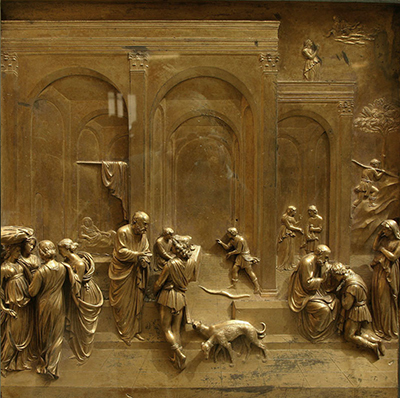
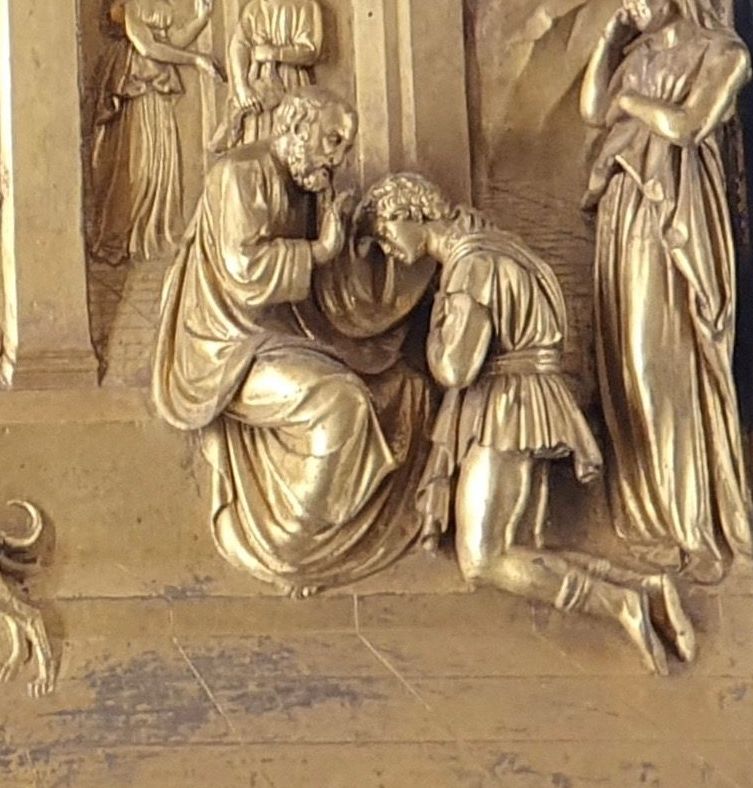
Isaac raises an open hand in front of Jacob’s bowed forehead. His other arm reaches towards the young man’s neck, where it nearly disappears between the sleeve and the bent head. In his second Commentario, Lorenzo Ghiberti describes the moment from the father’s side. Isaac feels for Jacob’s neck, finds it hairy and gives him the blessing. Jacob’s mother has told him what to do and put the kid’s skin at his neck. The two movements that Ghiberti names in succession, feeling and blessing, come close together in the bronze. Rebecca stands by with one hand to her face. From our side of the relief we can see both the gesture she set in motion and the one she hoped would follow. [1] [2]
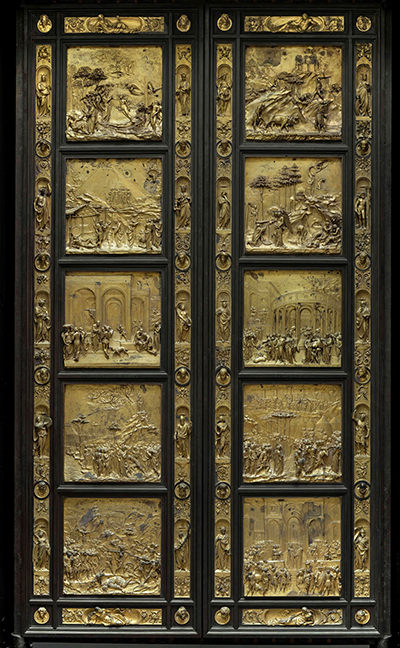
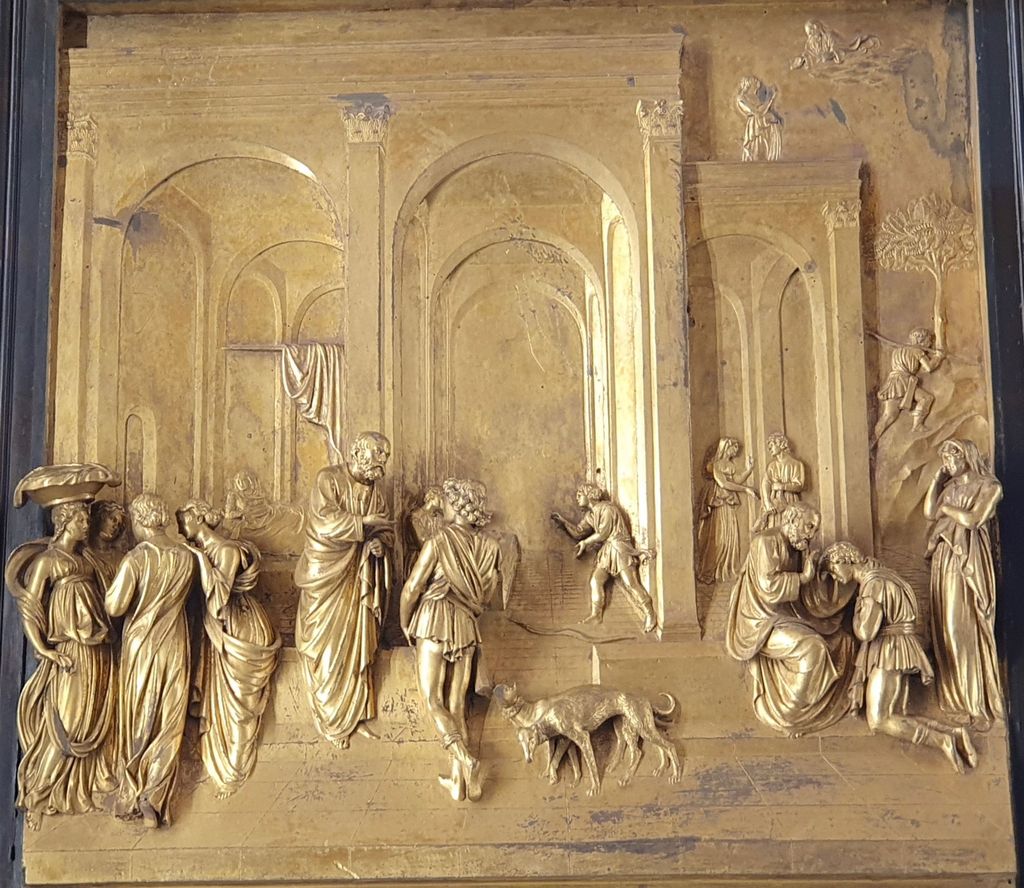
Isaac with Esau and Jacob is the fifth narrative panel of the Gates of Paradise, in the third row down on the left as you face the doors. The gilt-bronze square measures about 80 centimetres across. The doors were made between 1425 and 1452 for the Florence Baptistery and installed at its east entrance. The original relief is now in the Sala del Paradiso of the Museo dell’Opera del Duomo. [1] [3] [4] [5]
In Genesis 27:15–27 Rebecca dresses Jacob in his brother’s clothes and wraps the skins around his hands and the smooth part of his neck. Isaac can no longer see. He hears Jacob’s voice and asks his son to come close enough to be felt. After Jacob comes closer again to kiss him, Isaac smells the clothes and blesses him. Ghiberti’s account concentrates this succession of tests at the neck. In the relief, the raised palm is easy to find because it stands clear of Isaac’s body. The contact implied by his other arm takes longer to pick out, and the photograph leaves the edges of the skin uncertain. [1] [2] [6]
In Ghiberti’s brief account, Rebecca does most of the work of preparing the disguise. She instructs Jacob, gives him the kid and the skin, puts the skin at his neck and tells him to ask for the blessing. In Genesis, Jacob has to answer for the disguise in his own words, even telling Isaac that he is Esau. In the bronze, kneeling brings his head below the old man’s and within reach of his hand. His claim to be Esau is put to the test in a posture that also makes him ready to receive the blessing. [1] [2] [6]
Contents
The hunter at the edge
Two dogs stand beside the young man who has his back to us in the lower middle. Their bodies overlap, but their heads can be picked out separately. One muzzle lifts towards the figures and the other angles towards the paving. The young man turns his head towards the older man, who extends a hand from the fold of his cloak. The lifted foot gives the younger figure the look of someone caught mid-step. The dogs help identify Esau as a hunter. The exchange between the men is harder to place. [2] [3] [7] [8] [9] [10]
The Opera catalogue, the Art Institute of Chicago and Paul Barolsky read this as Isaac sending Esau out. In Genesis 27:1–5 Isaac asks for game prepared the way he likes it and promises to bless Esau after the meal. The father’s gesture can carry the instruction and the turn of the son’s head can register his attention before leaving.
At the far right a smaller Esau, bow in hand, raises his knee to clear a steep bank beneath a tree. The paving and pilasters give way to angled shelves of rock. Barolsky singles out this solitary hunter amid a composition full of encounters between people who speak and listen. A narrow strip of hillside takes Esau out of reach of the conversation at home. [2] [3] [6] [7] [8]
Amy R. Bloch and Gwynne Ann Dilbeck read the group with the dogs as the encounter after the hunt, when Isaac tells Esau that someone else has already received his blessing. Bloch points to the quiver Esau already carries and the tension between the step and the body drawing back. The same pause that can mark a son listening to an instruction can mark a son stopped by a reply.
Genesis 27:30 places Esau’s arrival almost on top of Jacob’s exit. In this reading both sons come before Isaac on the front pavement, where their encounters can be seen side by side. Ghiberti says that Isaac sent Esau hunting but does not give that episode a location. The man climbing alone with the bow is the clearest sign of the hunt itself. [1] [2] [6] [9] [10]
Look closely at Isaac with Esau and Jacob
1. The receding arcade
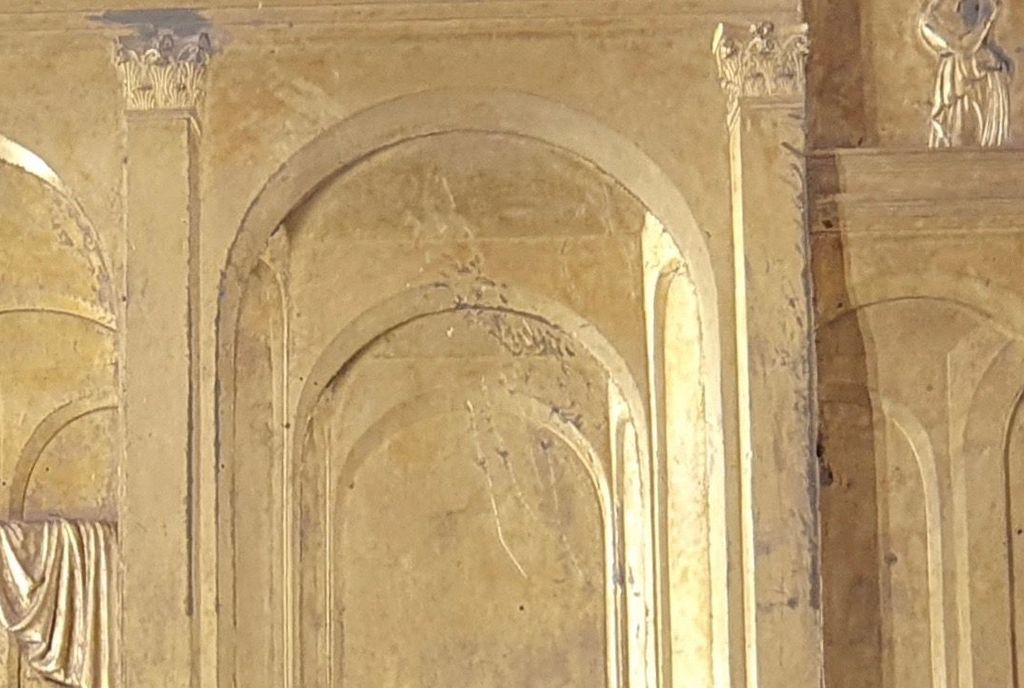
Arches and mouldings carry the eye inward above the foreground figures. Their edges grow finer as the architecture recedes.
2. Figures at the left edge
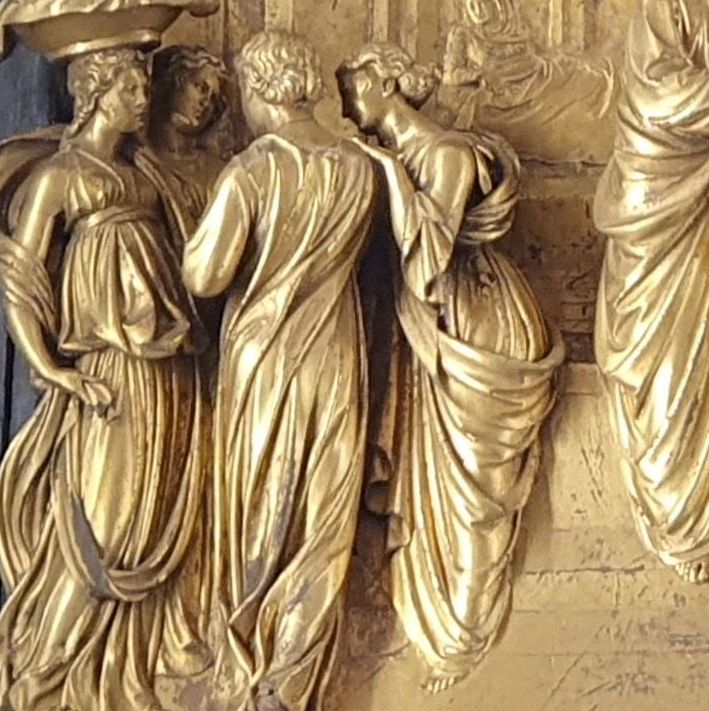
The bodies overlap across the front of the relief. Their deep folds stand out against the smoother walls behind them.
3. Isaac’s blessing at the right
A kneeling figure approaches the seated Isaac. The compact group sits beneath the right-hand arch.
Photograph by Yair Haklai. Source image. CC BY-SA 4.0. Resized for the overview and cropped for detail.
What the porch lets us see
Between the hillside and the main arcade is a smaller, lower arch. Under it, a woman raises a hand towards a young man. Look below his hand for the little animal hanging between them. The Opera’s subject index identifies Jacob bringing the kids to Rebecca, while the descriptive entry names Esau. Genesis 27:9–14 gives the errand to Jacob. Bloch reads the gesture as Rebecca giving instructions and the goat as Jacob already carrying them out. Ghiberti’s account likewise places the kid and the skin within Rebecca’s preparations. [1] [2] [3] [6] [9]
The arch opens just behind the blessing. From the raised hand in the porch the eye drops almost directly to Isaac’s hand at the step. In Genesis, Rebecca has overheard Isaac’s request and can set her plan in motion as soon as Esau is gone. Jacob objects that his father may feel him and bring a curse down on him. Rebecca tells him to let the curse fall on her, prepares the food and dresses him for the encounter. Ghiberti leaves the meal and the change of clothes between the two scenes. With the goat still visible behind the kneeling son, the relief gives us access to the preparation that Isaac has to judge by touch. [1] [2] [6] [9]
Before the hunt
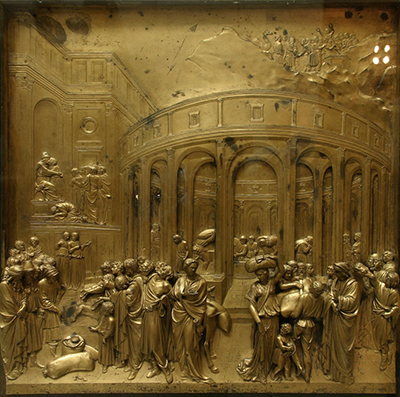
At the far left, a woman balances a broad vessel on her head. The folds across the back of another woman are among the strongest shapes in the foreground group. Look past their shoulders for the hanging cloth and the much shallower bed scene, which the Opera associates with the twins’ birth. A narrow, round-headed doorway beside the bed is easy to miss. Set that plain opening against the wide arches above it and the hall begins to look like a building with rooms around the spaces opened to our view.
On the terrace at the upper right a small standing figure reacts to a figure above her. The Opera’s subject index identifies Rebecca’s inquiry, while its description calls the scene an angel announcing a future pregnancy. In Genesis 25:21–26 Rebecca is already pregnant when she asks about the struggle within her. The Lord tells her that two peoples will come from her and that the elder will serve the younger. The Art Institute identifies the terrace scene with this prophecy. [2] [3] [7] [11]
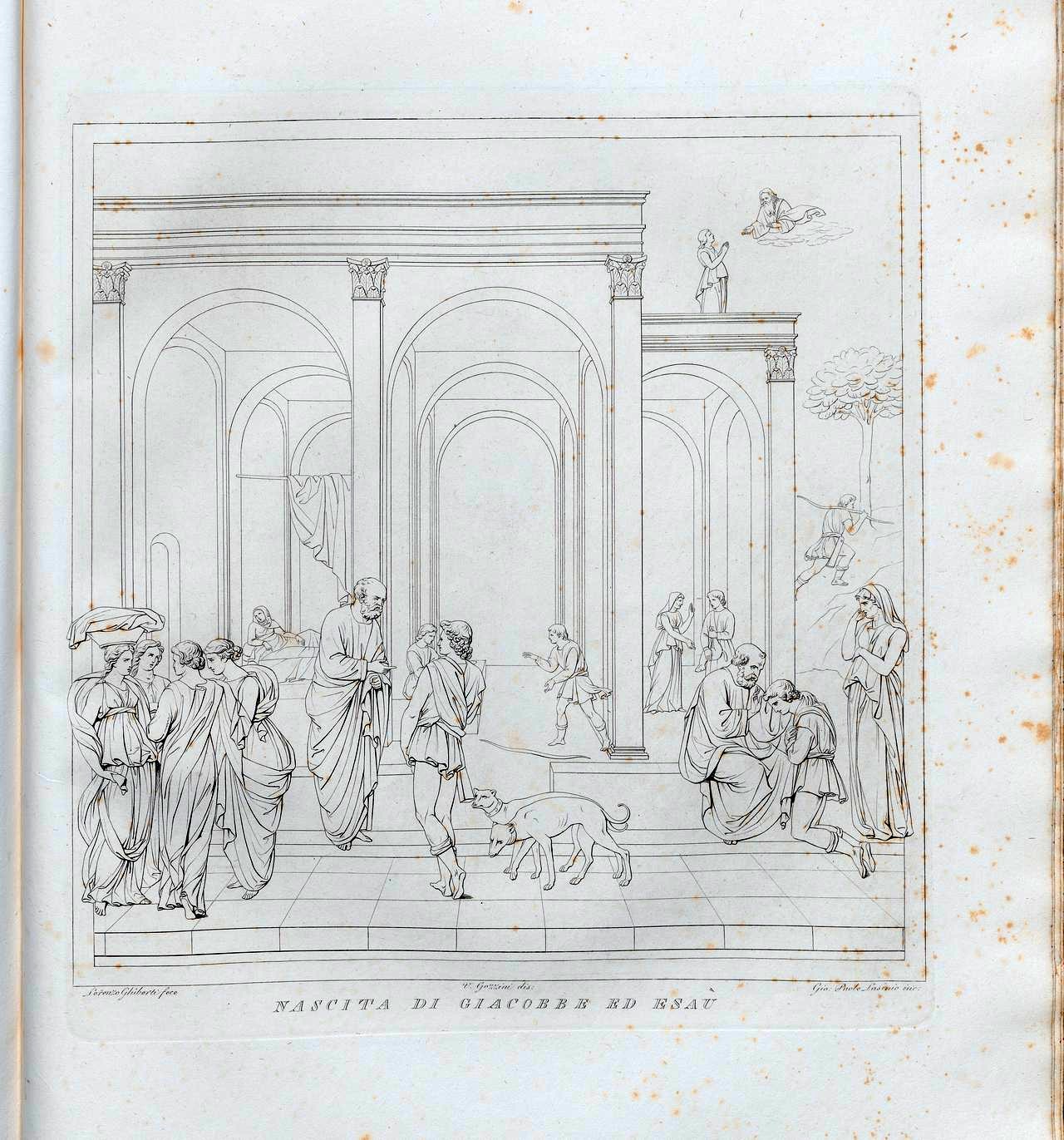
The terrace and the bed occupy opposite sides of the square. Genesis takes us from Rebecca’s question to the birth, and the relief asks us to cross the roofline, descend past the arches and look through the women at the left to make that connection. The birth is one of the events Ghiberti names in the second commentary. The oracle and the birthright bargain have to be recovered from their places in the relief and from the biblical story. Neither is separately described in his account of this panel. [1] [2] [3] [7] [11]
Under the central arch, a small figure bends forward with his arms extended. The bow set down nearby helps identify the hunter in the encounter. The Art Institute reads this as the bargain of Genesis 25:29–34, when Esau exchanges his birthright for food. The exchange is partly screened by the larger figures at the front. Barolsky describes how a more oblique view brings Jacob’s bowl into view and makes the brothers’ extended arms easier to read together.
What Esau agrees to here is his own to give away. Esau is absent during the blessing, when Isaac speaks to someone he takes for his elder son. Both transfers involve food, but in the first the hungry brother knows who is feeding him and what is being asked in return. [2] [6] [7] [8] [11]
Isaac’s words at the blessing also had a place in Florentine worship. Dilbeck traces the Vespers responsory Ecce odor filii to the Florentine Ritus. Its opening evokes Genesis 27:27, where Isaac smells the clothes and compares his son’s scent to that of a field blessed by the Lord. Dilbeck also identifies a painted initial of Isaac blessing Jacob in the Florentine lectionary Edili 145, on the page for the Lenten Sunday readings that recount the deception. The responsory recalls the moment when Isaac takes the smell of the clothes as confirmation. What he recognises is something the other son can put on. Ghiberti’s account dwells on touch, another test whose result Rebecca can arrange in advance. [1] [6] [10]
How far the floor can take us
The central opening suggests more depth than the metal physically has. Round arches sit one inside another, with thin edges catching the light on their inner faces. At their foot the step makes a horizontal break across much of the front, while faint floor joints run away from it. Following one of those joints towards the central arch takes the eye behind the larger figures. The tiles crossing its path let the eye judge the narrowing intervals. The dogs stand far enough out to cast shadows of their own, and the women at the left can interrupt the view of the bed even though the two groups occupy adjacent stretches of bronze. [2] [3] [7] [9]
The Art Institute locates the principal vanishing point within the central arch. Gyula Pápay reconstructs a central projection on the assumption that the pavement is made up of regular square units. That model shows how a grid can account for the impression of going deeper into the hall. Bloch extends a wider selection of lines running into depth and finds that two outer lines meet below the principal convergence. She also finds stretches where the crossing intervals fail to diminish steadily. The amount of regularity a diagram recovers depends on the floor edges it follows and the area of the relief it takes into account. Those reconstructions leave Ghiberti’s exact workshop procedure open. [7] [9] [12]
The reverse preserves evidence of a different kind. Salvatore Siano and colleagues report brush traces at the upper and lower edges of this panel and apparently few signs of manual intervention in the central area. They interpret the brushwork as a trace of liquid wax applied to the back of the model before casting. [13]
The height of the relief also affects what the floor can show. Bloch notes that the panel stood above eye level and argues that viewers would have shifted position to take in individual episodes. Even in a straight-on photograph, a projecting head or shoulder at the front can cover a figure set farther back. The obstacles vary across the square.
The bargain under the central arch is hard to see past the men in front of it. At the right, Rebecca’s raised hand under the smaller arch and Isaac’s raised hand at the step are both visible from the front. A viewer can linger over the preparations in their recess, then return to the projecting group where the father reaches for Jacob’s neck. [1] [2] [8] [9]
Lorenzo Ghiberti in context
Sacrifice of Isaac
1401 competitionNorth Doors
1403–1424St John the Baptist
c. 1414–1416St Matthew
1419–1422Gates of Paradise
1425–1452St Stephen
c. 1427–1429Lorenzo Ghiberti sculpture directory
Discussion
Ghiberti rewards slow looking: relief, gilding, narrative structure, workshop practice and conservation evidence can all change how a work is read.
Join the Conversation
Have an observation about Isaac with Esau and Jacob, a source to add, or a comparison that sharpens the reading? Share it below.
References
- Lorenzo Ghiberti, I commentarii, ed. Julius von Schlosser, vol. I (1912), second commentary, §22, p. 49, Warburg Institute facsimile. View source.
- Yair Haklai, photograph of the original relief in the Museo dell’Opera del Duomo, CC BY-SA 4.0. View source.
- Opera di Santa Maria del Fiore, Formella con Storie di Giacobbe ed Esaù, catalogue record 2779, especially Soggetti, Altre localizzazioni geografiche and Descrizione. View source.
- Art Institute of Chicago, Jacob and Esau Panel, exhibition object photograph and caption. View source.
- Opera di Santa Maria del Fiore, Lorenzo Ghiberti, Gate of Paradise, Sala del Paradiso. View source.
- Genesis 27, New Revised Standard Version, Anglicised. View source.
- Art Institute of Chicago, The Gates of Paradise: Lorenzo Ghiberti’s Renaissance Masterpiece, exhibition themes. View source.
- Paul Barolsky, ‘There is No Such Thing as Narrative Art’, Arion, vol. 18, no. 2 (2010), especially pp. 113–117. View source.
- Amy R. Bloch, ‘Perspective and Narrative in the Jacob and Esau Panel of Lorenzo Ghiberti’s Gates of Paradise’, in Arnold Victor Coonin, ed., A Scarlet Renaissance: Essays in Honor of Sarah Blake McHam (Italica Press, 2013), pp. 1–34, especially pp. 6–9 and 14–20, figs. 9, 11–12. View source.
- Gwynne Ann Dilbeck, Opening the Gates of Paradise: Function and the Iconographical Program of Ghiberti’s Bronze Door, University of Iowa dissertation (2011), pp. 36–38 and fig. A21, pp. 137–138 and nn. 420, 423–424. View source.
- Genesis 25, New Revised Standard Version, Anglicised. View source.
- Gyula Pápay, ‘On the Renaissance Conception of Space in Science and Art’, §2, figs. 1–2, Staatsbibliothek zu Berlin digitisation. View source.
- Salvatore Siano, Piero Bertelli, Marcello Miccio and Ferdinando Marinelli, ‘Studio sulla tecnica di fusione dei rilievi della Porta del Paradiso’, §3, PDF pp. 4–5. View source.