 by Tom Gurney
Tom Gurney BSc (Hons) is an art history expert with over 20 years experience
Published on June 19, 2020 / Updated on November 17, 2026
Email: tomgurney1@gmail.com / Phone: +44 7429 011000
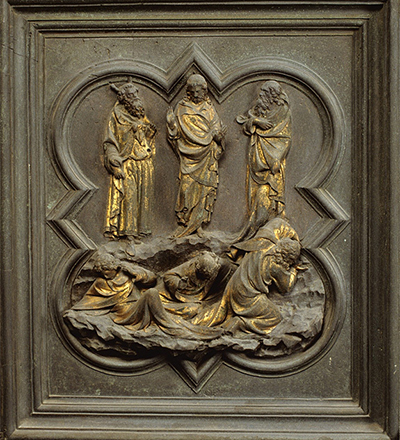
The kneeling disciple at the right turns his back so far that the sweep of his cloak tells us more about his reaction than his face does. His raised elbow comes close to the hem of the standing figure above him. At the centre of Lorenzo Ghiberti’s gilded bronze Transfiguration for the Florence Baptistery, Christ faces out with both hands visible against the field of the relief. The two figures share a narrow stretch of rocky ground. One opens his body to view, while the other twists and folds into the space below the summit. [1] [2]
Contents
- Who stands on the summit?
- Three witnesses on the rock
- What the witnesses hear and see
- Gold on the figure and the ground
- Looking up at the door
Who stands on the summit?
From the viewer’s left the standing figures are Moses, Christ and Elijah. The Opera del Duomo catalogue describes the sides from Christ’s position, so the man at Christ’s right is the one we see on the left. The small horns over his brow identify Moses even where the curve of the frame comes close to his head. One hand lifts towards Christ. The other rests alongside the long folds that fall almost vertically to his feet. Elijah gathers his mantle and his arms close to his chest. He occupies the corresponding curve on the right, where the fabric bunches across his body and the turn of his head directs our attention back towards the middle. [1] [2]
The horns give a figure in a scene of radiance an attribute that comes from another encounter on a mountain. In Exodus, Moses comes down from Sinai unaware that his face shines after speaking with God, and the Israelites are afraid to approach him. The Latin Vulgate describes his face as horned. In the bronze those two short projections are enough to distinguish Moses from the other bearded prophet. The episode in Exodus also gives a point of comparison for the figures below. The Israelites see the change in Moses before he is aware of it. Here Moses himself stands beside the changed figure, while the disciples on the ledge register the shock of the encounter. [1] [2] [3] [4] [5]
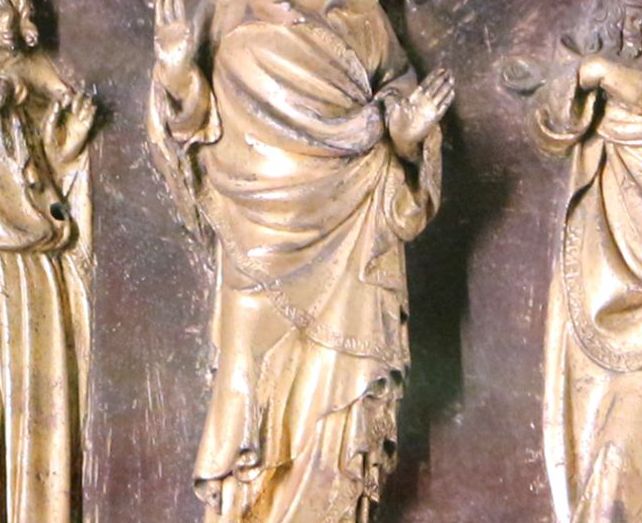
Christ’s head sits just under the sharp point where the frame’s upper lobes meet. The hand on our left rises in blessing, while the other opens lower and closer to his torso. Between them the folds sweep across his chest and turn down towards the trailing end of the garment. The summit reads as a balanced group from a distance, with a standing man in each upper curve and Christ between them. Up close the gaps are unequal in shape. The higher hand rises into a narrow interval beside Christ’s shoulder, while the lower hand opens towards the wider space in front of Elijah’s gathered mantle. The point of the frame fixes the centre even as the gestures pull the eye sideways. [1] [2]
Look closely at the Transfiguration
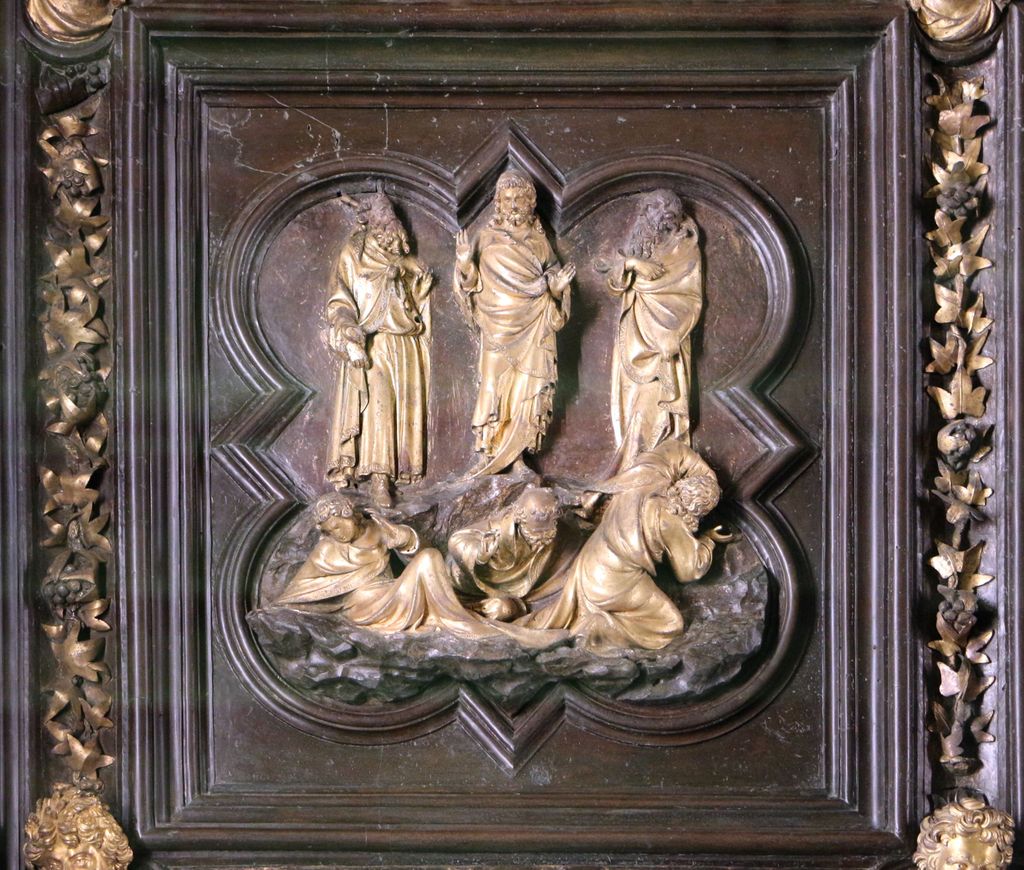
1. The standing figures
Three upright figures occupy the upper part of the relief, with Christ in the centre.
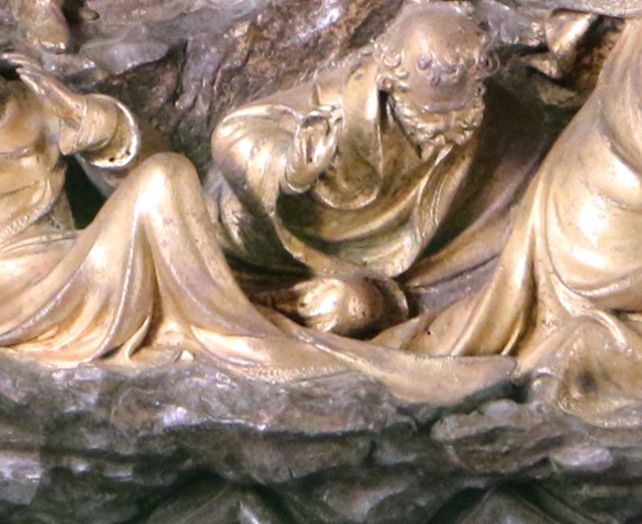
2. The apostles below
The apostles sit and twist against the rocky ground. Their angled bodies set them apart from the figures above.
3. The upper point of the frame
The upper point of the quatrefoil helps draw the eye towards the central standing figure.
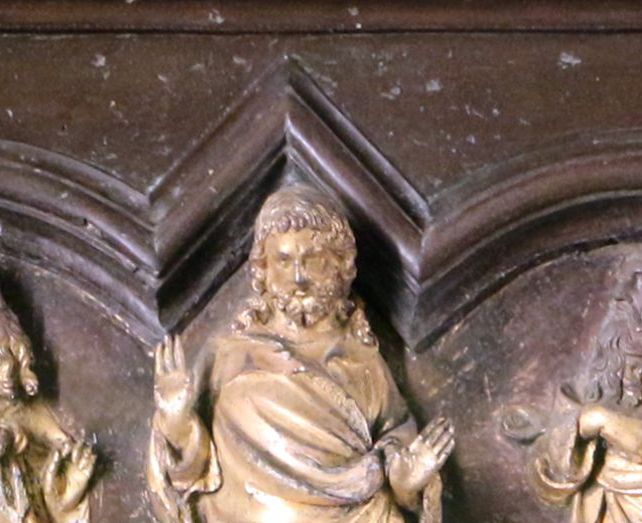
Photograph by Sailko. Source image. CC BY 3.0. Resized for the overview and cropped for detail.
Three witnesses on the rock
The Gospels name Peter, James and John, and the Opera catalogue identifies them as a group. The individual figures are most readily distinguished by their poses. At the left a disciple reclines across the ledge. One knee rises steeply under the cloth and breaks the long sweep of the garment along the front of the relief. The arm raised beside his head makes a smaller interruption higher up, close to Moses’s feet. In the middle, a sleeve projects from the bronze as the disciple pitches forward. His bowed head catches the light in the close photograph, while the position of his shoulders leaves much of his face hidden. [1] [2] [5] [6] [7]
At the right, the turn of the kneeling figure carries the cloth diagonally across his back and round his legs. The raised elbow crosses the line our eye would otherwise follow straight down Elijah’s mantle to the ground. Above that meeting, the prophet’s folds are gathered in front of him. Below it, the disciple’s clothing stretches out across the back he presents to us. The two bodies almost meet in outline, and their different directions remain legible because the folds describe where each figure carries his weight. The standing man’s garment drops towards his feet. The kneeling man’s cloak spreads over a bent body and settles into the ledge. [1] [2]
The broken front of that ledge runs across both lower lobes. Follow the rock back from its rough edge and it rises behind the central witness’s sleeve to the footing under Christ’s trailing hem. Moses’s feet stand just over the head and raised arm of the reclining figure. The height of the summit becomes apparent in these short intervals, where an upright body begins close to where a bowed or turning one ends.
Vasari saw the disciples’ attitudes as the effect of heavenly brightness on mortal sight, and drew attention to Christ’s high head and open arms. His reading gains force from the way the figures are packed together. At the points where the witnesses come closest to the men above them, their own faces are especially hard to see. [2] [8]
What the witnesses hear and see
Matthew describes Christ’s face shining like the sun and his garments becoming white with light. The disciples fall in fear on hearing the voice from the cloud. After Christ touches and reassures them, they raise their eyes and see him alone. The central witness’s bowed head gives a visible counterpart to that fall, while the two prophets still stand on the summit. The relief makes the appearance of Moses and Elijah and the disciples’ distress available in the same view, giving us time to look between the two groups. [1] [2] [5]
Mark measures the whiteness against what a cloth bleacher could achieve and links Peter’s confused speech to fear. Luke begins with the ascent to pray. He gives the conversation between Christ and his companions a subject, the departure Christ is to accomplish at Jerusalem, and has the disciples come fully awake to see his glory. In all three accounts a voice from the cloud identifies Christ as Son and tells the disciples to listen to him.
The raised hands on the summit and the arms drawn towards the disciples’ heads give the relief a way to hold together the encounter above and the reactions below. Matthew supplies the closest parallel for the collapse, and Luke helps us attend to the inward turns of the two men who have come to speak with Christ. [1] [2] [5] [6] [7]
Gold on the figure and the ground
In Duccio’s Transfiguration, from the predella of the Maestà, Moses and Elijah flank Christ in the same order. Dillian Gordon’s National Gallery catalogue distinguishes the panel’s water-gilded background from the gold applied over a mordant, or adhesive layer, on Christ’s clothes. Christ wears the same garments as in the preceding Healing of the Man Born Blind.
The gold on the garment marks a change in the appearance of a figure whose clothing the viewer has already seen. In the close photograph of Ghiberti’s relief, gilding also catches on the two prophets and the disciples, including the back of the man who turns away. Christ’s appearance is made distinct by his upright front, the space either side of his head and the faces that turn towards or away from him. [1] [2] [9]
Looking up at the door
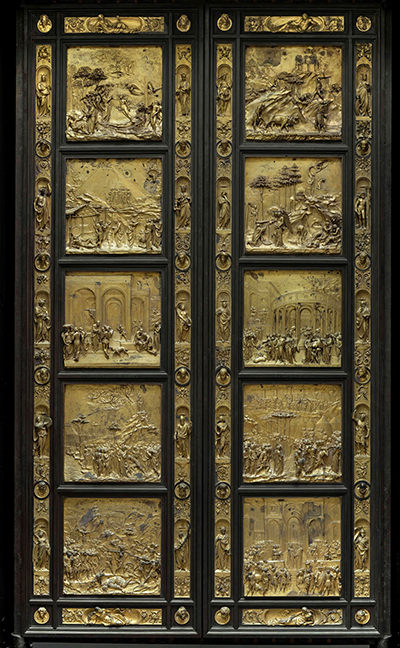
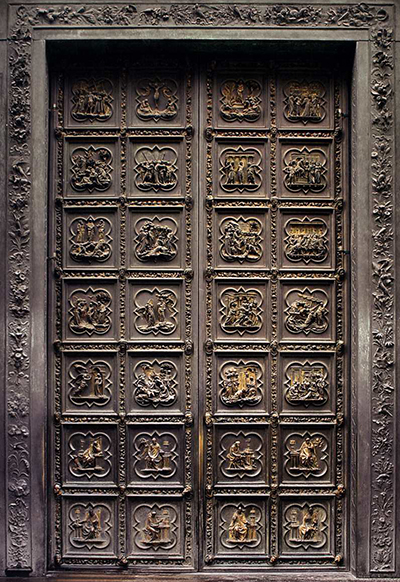
The original North Door, now in the Museo dell’Opera del Duomo, places the Transfiguration third from the top in the outer column of the left leaf, above the Baptism and immediately left of the Raising of Lazarus. The door campaign ran from 1403 to 1424. The Opera’s account of Richard Krautheimer’s stylistic grouping places this relief in a proposed phase from 1407 to about 1413–15. [1] [10] [11]
In the Alinari photograph that takes in the two adjacent panels, the frame’s upper point and the projecting shelf of rock pick up light, while the ground behind Christ stays dark. The shelf reads almost as a continuous edge under the three witnesses. Next door in the Raising of Lazarus, figures gather at several heights and occupy much more of the upper field. With both panels in the same photograph, the open spaces around the Transfiguration’s standing figures make it especially easy to see where one body ends and another begins. [12]
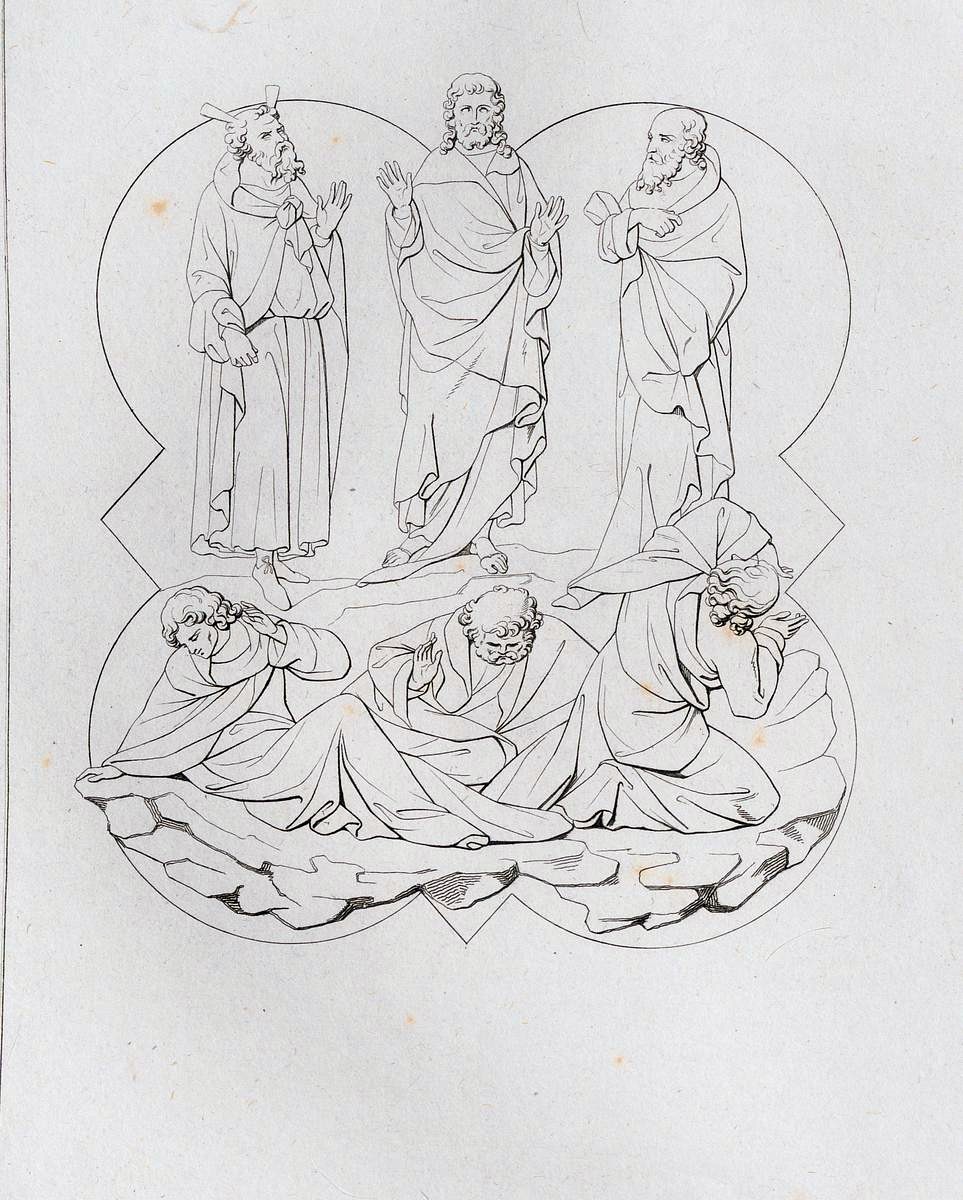
The Fondazione Maria Cosway holds an etching of the same pair of reliefs, dated to about 1821 in the regional catalogue. Giovanni Paolo Lasinio engraved it after a drawing by Vincenzo Gozzini. Its printed title names Mount Tabor, the traditional identification also used by Vasari. Matthew, Mark and Luke leave the mountain unnamed. [5] [6] [7] [8] [13] In the print, the thin frame passes behind the standing figures and there is little shading to distinguish a projecting fold from a recessed one.
The broken edge of the rock and the low, angular outlines of the disciples still gather the lower group. Christ’s head rises above the sweep of the upper curves in the etching, where the contour is thinner than the moulding seen in the photographs. Set beside the Alinari view, the print shows how much of the scene’s height can be carried by the silhouettes alone. [2] [12] [13]
Lorenzo Ghiberti in context
Sacrifice of Isaac
1401 competitionNorth Doors
1403–1424St John the Baptist
c. 1414–1416St Matthew
1419–1422Gates of Paradise
1425–1452St Stephen
c. 1427–1429Lorenzo Ghiberti sculpture directory
Discussion
Ghiberti rewards slow looking: relief, gilding, narrative structure, workshop practice and conservation evidence can all change how a work is read.
Join the Conversation
Have an observation about Transfiguration, a source to add, or a comparison that sharpens the reading? Share it below.
References
- Opera di Santa Maria del Fiore, Trasfigurazione, Porta Nord del Battistero, object 4198, inventory 931.9. View source.
- Sailko, photograph of the original Transfiguration relief, Wikimedia Commons. View source.
- Exodus 34:29–35, New American Bible, Revised Edition, USCCB. View source.
- Exodus 34:29–30, Clementine Vulgate, Bible Gateway. View source.
- Matthew 17:1–9, New American Bible, USCCB. View source.
- Mark 9:2–10, New American Bible, USCCB. View source.
- Luke 9:28–36, New American Bible, USCCB. View source.
- Giorgio Vasari, Vita di Lorenzo Ghiberti, 1568 edition, Accademia della Crusca and Fondazione Memofonte. View source.
- Dillian Gordon, The Transfiguration by Duccio, NG 1330, National Gallery catalogue. View source.
- Opera di Santa Maria del Fiore, Porta Nord del Battistero, object 3618. View source.
- Yair Haklai, photograph of the original North Door in the Museo dell’Opera del Duomo, Wikimedia Commons. View source.
- Fratelli Alinari, photograph of the Transfiguration and Raising of Lazarus, RI 12077, Lombardia Beni Culturali. View source.
- Vincenzo Gozzini and Giovanni Paolo Lasinio, Transfiguration and Raising of Lazarus, Fondazione Maria Cosway, Lombardia Beni Culturali. View source.