 by Tom Gurney
Tom Gurney BSc (Hons) is an art history expert with over 20 years experience
Published on June 19, 2020 / Updated on November 17, 2026
Email: tomgurney1@gmail.com / Phone: +44 7429 011000
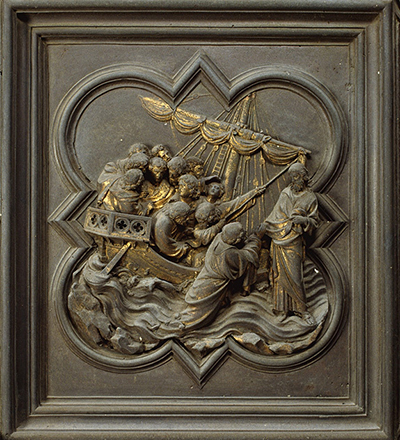
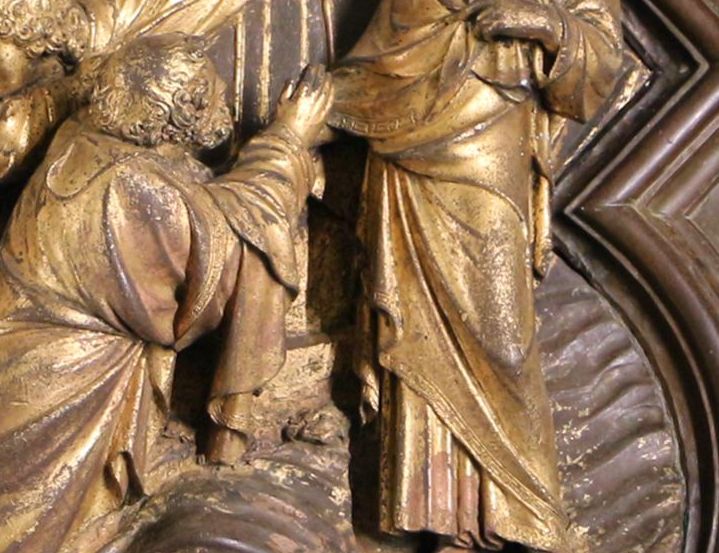
Two arms reach out at different angles in Lorenzo Ghiberti’s gilded bronze for the North Door of the Florence Baptistery. One rises from the crowd in the boat towards a line running up through the rigging. The other belongs to Peter, whose hand comes up from the water to meet Christ’s. The two gestures are close enough to follow in a single glance. Look at where they end and the scene divides. The higher reach belongs to the work of keeping the boat afloat. The lower brings us to a man who has already left it. [1] [2]
Contents
- Beyond the side of the boat
- What the boat is doing
- A shipwreck in name
- A little ship in several versions
- Finding the panel on the door
Beyond the side of the boat
Peter turns much of his back towards us, with his head tipped up towards Christ. The broad fold falling from his shoulder carries the eye down towards the waves, which break across the lower part of his figure. His raised arm takes us back in the opposite direction. The Opera del Duomo identifies Christ’s extended arm as his right, while his left holds his garment. That second hand keeps the drapery close to his body. The sleeve of the outstretched arm opens out towards Peter, where the two hands are harder to distinguish than the lines of the arms that bring them together. Christ inclines towards Peter with his feet still beneath him. The reach changes his posture without taking away his footing. [1] [2]
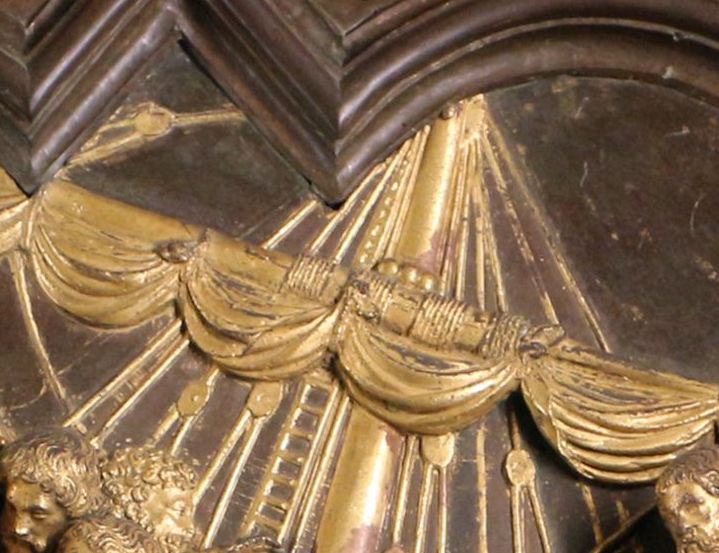
The higher arm is easy to miss among the heads. Start at Christ’s face and follow the fine diagonal back and down into the boat. Near the vessel’s open edge an apostle stretches along that line, his forearm picked out against the darker ground. The arm appears to carry on into the rigging. The photograph leaves the exact grip and purpose of the line uncertain, but the gesture gives part of the crew something to do while Peter is in the water. The man bending forward below it is so close to Peter that their outlines nearly run together. Their postures pull apart again at the shoulders, one folded in towards the vessel and the other lifted towards Christ. [2]
Some of the men aboard are visible chiefly as heads. A nearly frontal face lies between turned profiles, and the raised arm crosses a space where the bodies are already difficult to separate. The vessel holds these different responses within a narrow strip. A line from the bowed head near the edge down to Peter’s back leads out of that crush into the comparatively open space around Christ. From there the eye can drop to his feet and follow the water back underneath both groups. The crew and the rescue remain close all the way down the relief, even where the bronze gives each action its own direction. [2]
Look closely at Christ Walks upon the Water
1. The crowded boat
The figures aboard the boat turn towards the encounter at the right.
2. The encounter on the water
The encounter at the waterline occupies the space between the boat and the edge of the frame.
3. The sail and rigging
The diagonals of the sail cut through the space above the boat.
Photograph by Sailko. Source image. CC BY 3.0. Resized for the overview and cropped for detail.
What the boat is doing
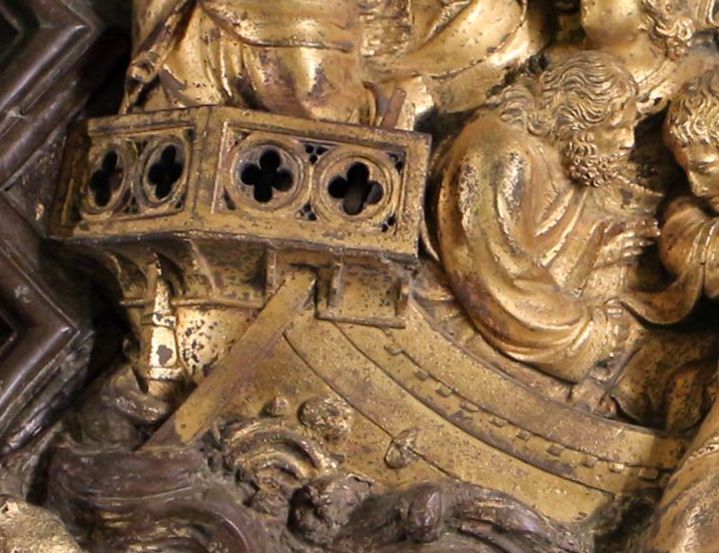
At the left, a railing turns a corner. Its square compartments contain small four-lobed openings, each picked out by a dark hollow. For a moment the boat has a regular pattern as distinct as the moulding of the panel. Below the rail, the long bands of the hull curve diagonally towards Peter. A string of small bosses follows one band, making its course easier to follow before the vessel disappears behind figures and water. The rail provides a fixed edge against which to read the shoulders above it. The hull gives a sense of the angle at which the whole crowded vessel meets the lake. [2]
The rig above the heads widens the boat’s presence. Fine lines fan out from the mast, and a ladder-like run of crosspieces can be made out beside it. Along the sloping yard the sailcloth hangs in gathered loops. Short ties break the cloth into intervals, which remain visible even where the ropes pass behind the crew. The upper right lobe has room for the rigging to spread against the dark ground. The upper left has a wider open patch above the men. This distribution makes the crowd seem all the more compact below the yard. The slant overhead also carries the eye towards Christ’s head, bringing the standing figure into the sweep of the ship without putting him aboard it. [2]
The lowest lobes are full of ridges that turn and rise. Near the left edge they hump in front of the hull, then come between the viewer and the drapery trailing down from Peter’s shoulder. At the right a ridge passes beneath Christ’s feet. Once the eye follows those changes in height, it becomes possible to read how much of Peter has sunk even though the water conceals his legs. The relief gives the lake enough continuity to make the difference between the two bodies startling. [2]
A shipwreck in name
Matthew gives Peter time to ask Christ to call him out, step from the boat and walk towards him. Fear of the wind makes him falter, and Christ catches him as he sinks. The wind drops after they get into the boat, and those aboard acknowledge Christ as the Son of God. Peter’s presence in the water identifies the episode as Matthew tells it.
Mark has the disciples straining at the oars and marvelling when the wind drops, while in John they reach land as they are about to take Christ aboard. Neither account gives Peter a separate encounter on the lake. The relief arrests Matthew’s sequence before the return to the boat, with the reach still in progress and the waves worked up around the hull. [1] [2] [3] [4] [5]
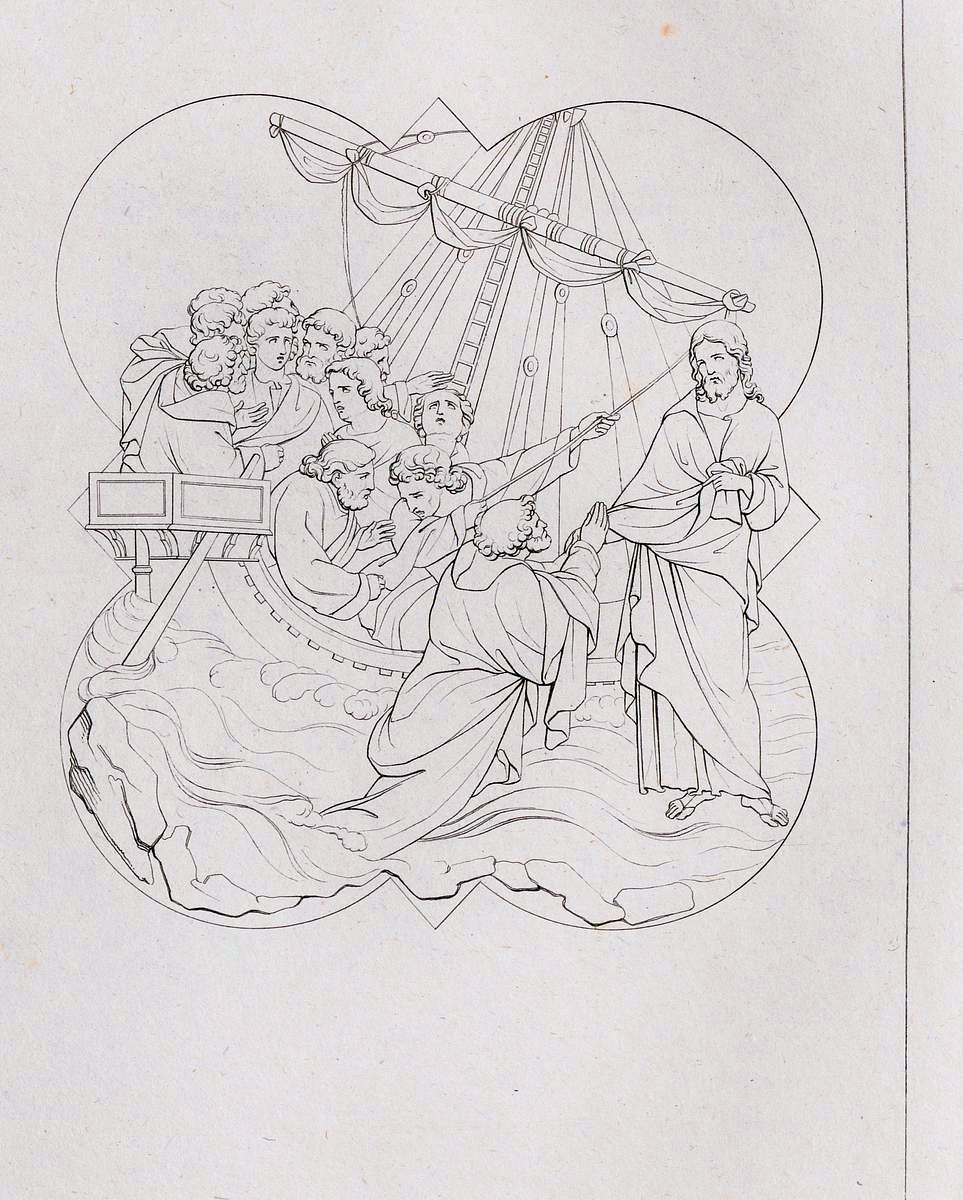
Vasari calls the scene a naufragio, a shipwreck, and singles out the variety of gestures among the apostles helping the boat. He also sees Peter’s faith in his coming towards Christ. Both actions survive under the same title in the 1821 engraving after Vincenzo Gozzini’s drawing. It shows the vessel still carrying the crew and gives the upper reach a long, clear diagonal. The Italian and French commentary follows Peter out of the ship and ends on Christ’s question about his doubt. The title makes the shared danger conspicuous. The point where the commentary breaks off returns attention to the hand held out over the lake. [2] [6] [7] [8]
A little ship in several versions
In the Commentarii, Ghiberti includes the ship mosaic at St Peter’s in Rome among Giotto’s works. His notice names the work and its maker without describing the scene or recording a visit. When he comes to his own Baptistery door, he describes its twenty-eight fields without discussing this panel individually. Ghiberti’s reference establishes that he knew of the Navicella, or ‘little ship’. How its design might have reached his workshop remains open. [9] [10]
The versions show how differently that subject could be arranged. The Metropolitan Museum calls Parri Spinelli’s drawing a free copy and suggests he enlarged Christ and Peter and brought them forward. In the Cleveland drawing the sail billows and airborne figures give the winds bodies of their own. Francesco Saracino notes how the hull comes up against Peter in the Spinelli sheets and compares the shore in the New York drawing with Orcagna’s Strozzi predella, where Christ has dry ground beneath him. Those details change how Peter relates to the ship and where he can expect help. [10] [11] [12] [13]
Andrea di Bonaiuto’s fresco in the Spanish Chapel at Santa Maria Novella gives the open sail room to spread through the vault compartment. Christ and Peter are down to the right, with water visible between Peter and the hull. The painted vessel also has a band of openwork at its high left end, where the rail rises clear of the heads further along the boat.
At the opposite side a fisherman kneels on a rocky point, his basket below him and his rod extending over the water. In the bronze the cloth stays bunched along the yard, bringing the rigging close above the rescue. The lower left lobe gives its clearest lines to the waves meeting the boat. The fresco lets the eye travel from the angler across open water. Ghiberti keeps it close to the vessel until the two reaching arms give it somewhere else to go. [2] [13] [14] [15]
Finding the panel on the door
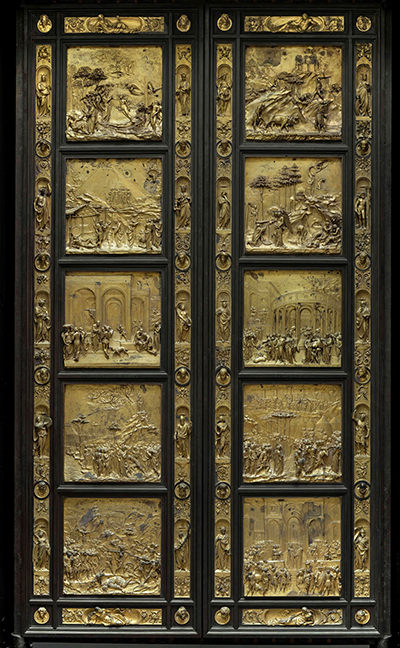
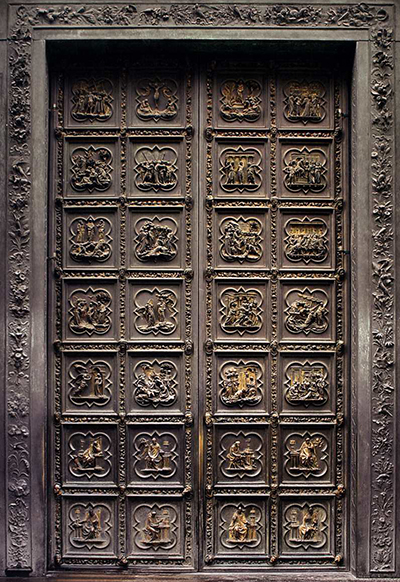
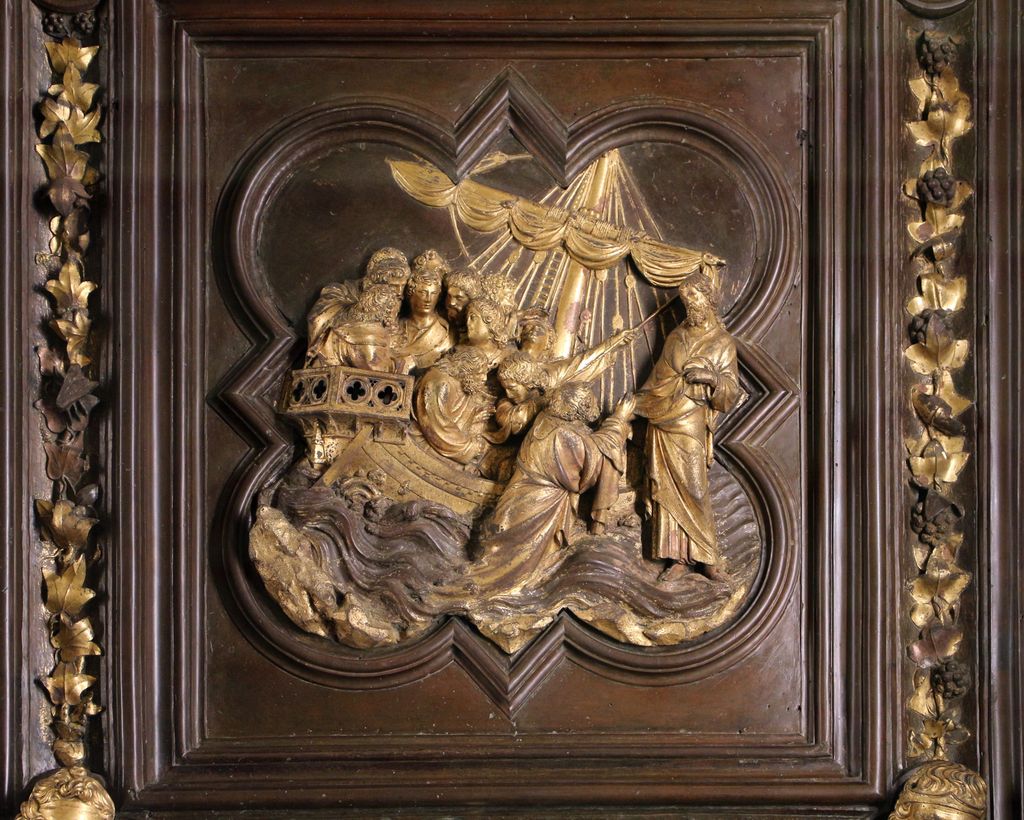
On the original North Door in the Museo dell’Opera del Duomo, look at the right leaf and count four rows down. The Expulsion of the Money-Changers from the Temple is next to the central seam and the water scene is beside it, in the outer column. That is the order in the catalogue’s description of the complete door and in the museum photograph. The catalogue entry for the individual relief places it in the left column of the right leaf. The assembled door shows the mast to the right of the Temple arcade, with the outer border just beyond Christ. [1] [16] [17]
The paired view also survives in a photograph by Fratelli Alinari. It brings the reliefs close enough to compare the short stretch of ship’s railing with the plain rectangles that take its place in Gozzini and Lasinio’s plate. The print helps separate the long reaching arm from the converging lines around it. The photographs show how much finer the actual railing is, with its pierced ornament throwing shadows through the openings. From the distance of the whole door, the yard and mast are the quicker way to find the subject again. [2] [7] [17] [18]
The 1403–24 span in the Opera’s catalogue covers work on the door. The narrower range of about 1415–20 for this relief comes from Richard Krautheimer’s proposed grouping by style. Its place beside the Expulsion, which the catalogue assigns to the same group, can be checked directly on the bronze. The date of either scene within that span remains an estimate. [1] [16] [17]
Lorenzo Ghiberti in context
Sacrifice of Isaac
1401 competitionNorth Doors
1403–1424St John the Baptist
c. 1414–1416St Matthew
1419–1422Gates of Paradise
1425–1452St Stephen
c. 1427–1429Lorenzo Ghiberti sculpture directory
Discussion
Ghiberti rewards slow looking: relief, gilding, narrative structure, workshop practice and conservation evidence can all change how a work is read.
Join the Conversation
Have an observation about Christ Walks upon the Water, a source to add, or a comparison that sharpens the reading? Share it below.
References
- Opera di Santa Maria del Fiore, scientific catalogue, Cristo cammina sulle acque del lago di Tiberiade, Porta Nord del Battistero, inv. 931.8. View source.
- Sailko, detail photograph of Christ Walks upon the Water on the original North Door, Wikimedia Commons. View source.
- United States Conference of Catholic Bishops, Matthew 14:22–33. View source.
- United States Conference of Catholic Bishops, Mark 6:45–52. View source.
- United States Conference of Catholic Bishops, John 6:16–21. View source.
- Giorgio Vasari, Vita di Lorenzo Ghiberti, 1568 edition, facsimile and transcription. View source.
- Vincenzo Gozzini and Giovanni Paolo Lasinio, North Door engraving, scenes IX–X, in Le tre porte del Battistero di San Giovanni di Firenze, 1821, ETH-Bibliothek, Rar 9941. View source.
- Commentary to Tavola X, in Le tre porte del Battistero di San Giovanni di Firenze, 1821, p. 6, ETH-Bibliothek, Rar 9941. View source.
- Lorenzo Ghiberti, I commentarii, book II, ed. Julius von Schlosser, vol. I, pp. 36 and 46. View source.
- Metropolitan Museum of Art, Parri Spinelli, Free Copy of Giotto’s “Navicella” (recto), 19.76.2. View source.
- Cleveland Museum of Art, Parri Spinelli, Two Drawings of Ships (verso), 1961.38.b. View source.
- Catalogo generale dei Beni Culturali, Orcagna, Cristo cammina sulle acque del lago di Tiberiade, Strozzi predella. View source.
- Francesco Saracino, ‘Il peso della Chiesa: Caterina da Siena e la Navicella di Giotto’, Arte Cristiana, no. 939, pp. 455–56, figs. 4–5 and note 42. View source.
- Sailko, photograph of Andrea di Bonaiuto’s Navicella in the vault of the Spanish Chapel, Wikimedia Commons. View source.
- Sailko, fisherman detail in the Spanish Chapel Navicella, Wikimedia Commons. View source.
- Opera di Santa Maria del Fiore, scientific catalogue, Porta Nord del Battistero. View source.
- Yair Haklai, photograph of the complete original North Door on museum display, Wikimedia Commons. View source.
- Fratelli Alinari, paired photograph of the Expulsion and Christ Walks upon the Water, RI 12164, Lombardia Beni Culturali, SIRBeC IMM-3a010-0012494. View source.