 by Tom Gurney
Tom Gurney BSc (Hons) is an art history expert with over 20 years experience
Published on June 19, 2020 / Updated on November 17, 2026
Email: tomgurney1@gmail.com / Phone: +44 7429 011000
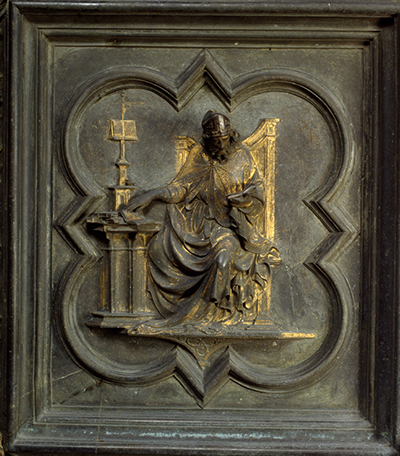
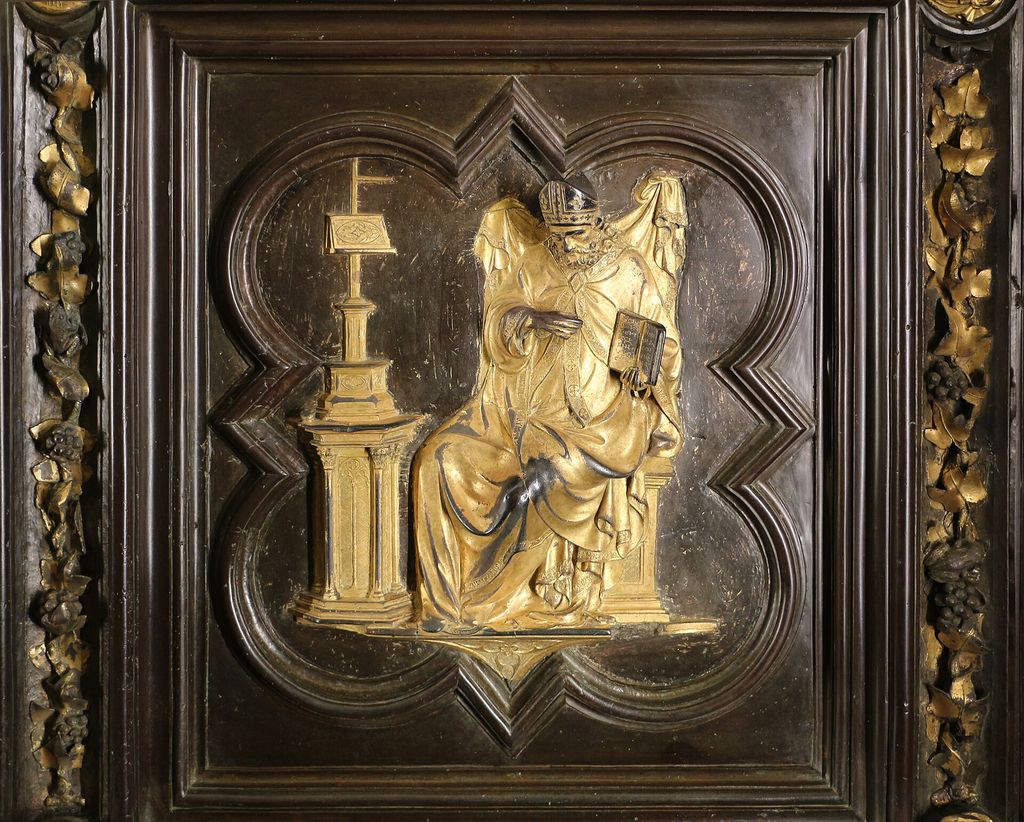
Augustine’s left fingertips curl beneath an open book, holding it almost upright. The gutter and thick lower edge give the spread depth, and small marks on its surface suggest lines of writing. The bishop lowers his mitred head. His right hand crosses the front of his cope and stops well short of the reading stand at the left of the relief. The pages face out far enough for both to be seen. Where his attention falls is harder to tell. [1] [2]
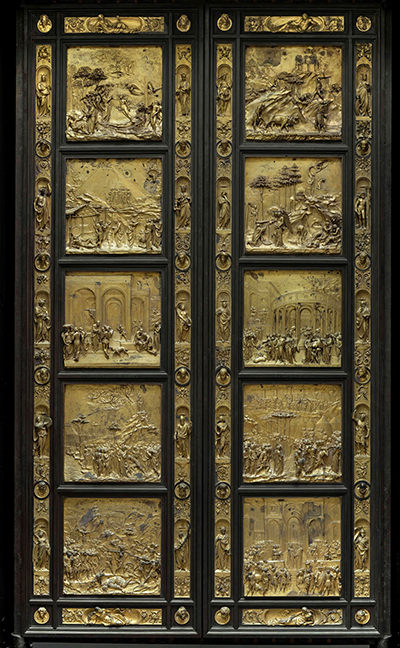
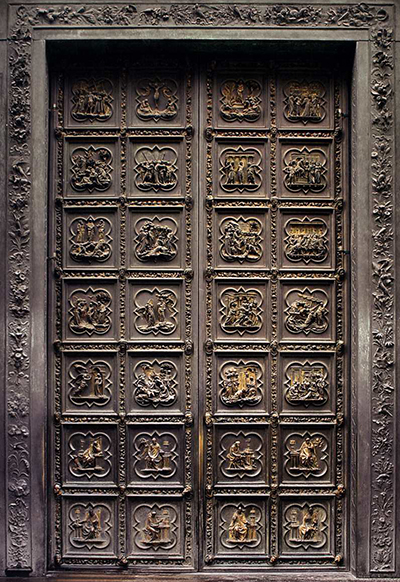
This is Augustine of Hippo (354–430), at the outer left of the lowest row of the partly gilded bronze North Door of the Florence Baptistery. The Opera del Duomo dates the door as a whole to 1403–1424 and catalogues this relief as inventory 931.24. Augustine occupied the same corner when the door faced the cathedral at the east entrance and after it moved north in 1452. To see Augustine in the original bronze, go to the Museo dell’Opera del Duomo’s Sala del Paradiso. At the Baptistery the north entrance holds a replica. [1] [3] [4]
Contents
The bishop’s hands
The Opera catalogue describes Augustine reading from the book in his left hand while leafing through a second volume on the desk with his right. In the photograph of the bronze, the right fingertips project over the cope’s patterned border. A gap separates them from the furniture. The stand has a decorated rectangle tilted on its upper support and a stepped structure below. The rectangle’s ornament is easy to pick out, but its function is harder to establish. The book in Augustine’s hand has an unmistakable central fold and a lower edge that his fingers visibly support. [1] [2]
The same gap appears in the thirtieth plate of the 1821 volume on the Baptistery doors. In the engraving published by Gozzini and Lasinio the forearm curves back across the breast and the fingers end inside the outline of the figure. The separated stand retains its tilted rectangle and stepped support. The interior of the handheld spread is drawn more simply than it appears in the bronze, where the close view picks up the finer surface marks. The agreement gives the hand’s position a record stretching back to 1821. The catalogue’s page-turning action remains difficult to reconcile with either view. [1] [2] [5]
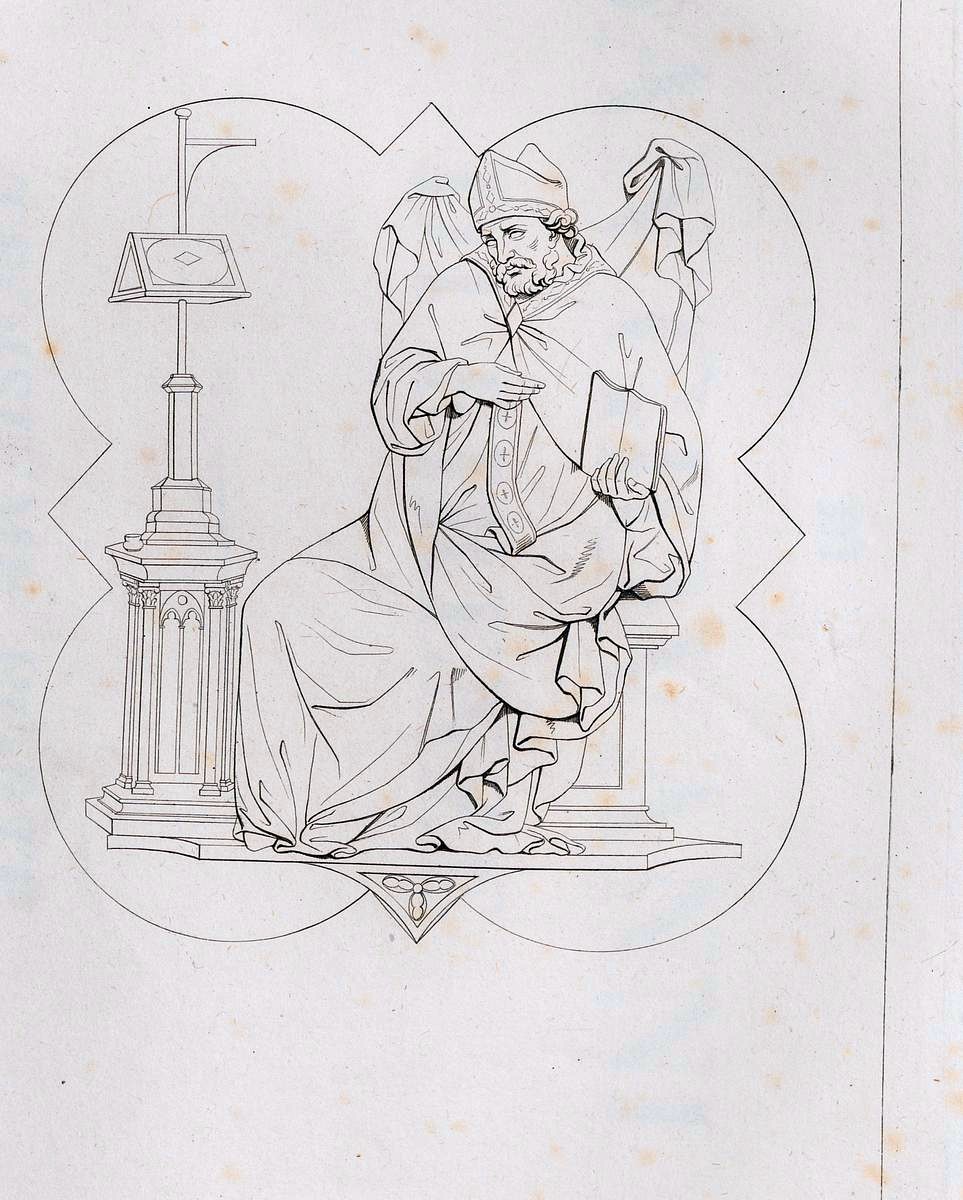
The gap has a role in the composition as well. The slender shaft rises from a broad pedestal into the upper left lobe of the quatrefoil. Across the dark field, the cope opens below its lozenge-shaped clasp and falls into a deep curve between the knees. Near the ledge the cloth swells towards the pedestal, drawing the two masses close. Higher up, the stand and the bishop separate again. That interval makes the turn of the forearm across the chest particularly easy to follow. [2]
Across the row to Ambrose
Ambrose, bishop of Milan, sits at the other end of the row. Both bishops wear mitres and copes and have a stand to the viewer’s left. Ambrose’s right arm reaches down towards a book at the desk, and the open volume cradled in his left hand lies at a shallower angle than Augustine’s. His circular clasp and the straight uprights of his seat offer another way to distinguish the panels. Behind Augustine’s bowed head, draped cloth rises in two peaks. Bertha Friedmann’s 1913 study groups both bishops with Gregory the Great as a fairly uniform type. The shared format and episcopal dress account for the likeness between the bishops, while the handling of the books gives each a distinct posture. [2] [3] [6] [7]
Jerome, Augustine’s immediate neighbour, bends towards a cabinet at the viewer’s right and brings both hands to the books there. The direction of that movement is especially clear beside Augustine, whose raised volume stays within the outline of his body. The connection with Ambrose also reaches beyond the door. Augustine heard him preach in Milan, where Ambrose’s interpretation of Scripture helped him reconsider passages of the Old Testament he had found difficult. Ambrose baptised him in 387. [2] [3] [8] [9]
The work of reading
In Book II of On Christian Doctrine, Augustine gives difficulty a purpose. An obscure passage makes the reader want to understand it, and a plainer passage elsewhere can help disclose its meaning. When Latin versions differ, he advises readers to learn enough Greek and Hebrew to consult the texts from which translations were made. Comparison can help even before that step. In one example from Isaiah, a phrase about one’s own flesh and a rendering that invokes people of one’s own stock help him arrive at the sense of kinship. Each version constrains how the other can reasonably be read. [10]
Book IV returns to a distinction on which the treatise is built. Finding the meaning of a passage is one task, and making that meaning clear to hearers is another. The relief offers a way to consider both tasks at once. The lowered head gives an impression of attention, while the angle of the book exposes its spread to the eye. The faint marks yield no secure wording or title. The conspicuous book and the inward inclination of the head allow the same figure to suggest both the private effort of understanding a text and the possibility of making something of it available to others. [1] [2] [10] [11]
Directly beneath John
In his Commentarii, Ghiberti counted twenty New Testament scenes and placed four Evangelists and four Doctors at the foot of the door. Vasari, writing in 1550, drew attention to the Doctors’ varied poses and clothing and evoked writing, reading and thinking across the group. His account leaves those activities unassigned to individual figures. In the assembled bronze the outer left column puts Augustine below John the Evangelist and John below the Annunciation. The Opera’s reading of the programme gives the vertical sequence a logic. The Doctors interpret the Christian message, the Evangelists bear witness to it, and the episodes above give it narrative form. [3] [12] [13] [14]
John’s stand rises on the same side as Augustine’s. In the upper panel a book rests at the arm of the seat, John supports his chin with his left hand and the pen in his lowered right hand is close to the eagle at his feet. The comparable furnishings let the objects be read through their different positions. John has a pen ready below the resting book. One tier down, the bishop’s fingers take the weight of an already open volume. The upward view carries the eye from the held book to the writer and then to the Annunciation, where Gabriel approaches Mary. [2] [3] [12] [15] [16]
Lorenzo Ghiberti in context
Sacrifice of Isaac
1401 competitionNorth Doors
1403–1424St John the Baptist
c. 1414–1416St Matthew
1419–1422Gates of Paradise
1425–1452St Stephen
c. 1427–1429Lorenzo Ghiberti sculpture directory
Discussion
Ghiberti rewards slow looking: relief, gilding, narrative structure, workshop practice and conservation evidence can all change how a work is read.
Join the Conversation
Have an observation about Augustine, a source to add, or a comparison that sharpens the reading? Share it below.
References
- Opera del Duomo scientific catalogue, Sant’Agostino, Porta Nord del Battistero, inv. 931.24 View source.
- Sailko, close photograph of Augustine on the original North Door, Wikimedia Commons View source.
- Opera del Duomo scientific catalogue, Porta Nord del Battistero View source.
- Opera del Duomo, La replica eseguita ad arte della Porta Nord del Battistero, 23 January 2016 View source.
- Gozzini and Lasinio, plate XXX in Le tre porte del Battistero di San Giovanni di Firenze (1821), ETH-Bibliothek digitisation View source.
- Sailko, close photograph of Ambrose on the original North Door, Wikimedia Commons View source.
- Bertha Friedmann, Ghibertis Verhältnis zur Gothik und Renaissance (1913), p. 29 View source.
- Sailko, close photograph of Jerome on the original North Door, Wikimedia Commons View source.
- Benedict XVI, general audience on Augustine of Hippo, 9 January 2008 View source.
- Augustine, On Christian Doctrine, Book II, especially chapters 6, 11–12 and 14, translated by James Shaw View source.
- Augustine, On Christian Doctrine, Book IV, especially chapters 1, 4 and 11, translated by James Shaw View source.
- Yair Haklai, photograph of the assembled original North Door in the Museo dell’Opera del Duomo, Wikimedia Commons View source.
- Lorenzo Ghiberti, I commentari, Book II, account of the North Door View source.
- Giorgio Vasari, Vita di Lorenzo Ghiberti, 1550 edition View source.
- Opera del Duomo scientific catalogue, San Giovanni Evangelista, Porta Nord del Battistero View source.
- Sailko, close photograph of John the Evangelist on the original North Door, Wikimedia Commons View source.