 by Tom Gurney
Tom Gurney BSc (Hons) is an art history expert with over 20 years experience
Published on June 19, 2020 / Updated on November 17, 2026
Email: tomgurney1@gmail.com / Phone: +44 7429 011000
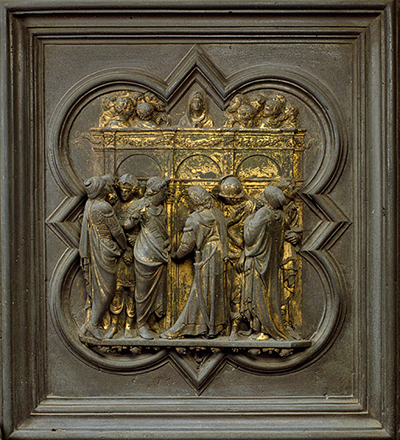
The tallest figures in Lorenzo Ghiberti’s Pentecost are the people who have come to listen. They stand in front of three arches, their feet along a narrow shelf. One turns his back to us; another lifts a hand near his face. Above their heads a decorated cornice runs across the gilded bronze. Look just above it and a second gathering comes into view: Mary at the centre and the apostles crowded into the curved spaces beside her. In this last narrative relief on the Florence Baptistery’s North Door, the coming of the Holy Spirit takes place upstairs, but the first thing a viewer sees is its effect in the street. [1] [2] [3]
Contents
- A gathering above the street
- How the bronze conveys the Spirit
- What the listeners hear
- The last panel on the door
A gathering above the street
Follow the cornice to the middle arch. Directly above it, Mary’s veil encloses her face and falls towards her joined hands. The pointed cusp of the quatrefoil, the four-lobed frame that encloses the scene, gives her a pocket of space that the figures to either side do not have. They turn towards one another, the line of the ledge cutting off most of their bodies. An Alinari print marked 1936 makes the division particularly clear.
Even without the contrasts of colour in a modern photograph, the veil and hands can be picked out above the cornice, and the figures beside Mary are visibly set behind the same ledge. The printed caption names the subject of the whole panel, the descent of the Holy Spirit. Mary’s place in it is legible from her pose and from the company she keeps. Acts names her among those who meet to pray after the apostles return to Jerusalem, before its account of Pentecost begins. [2] [3] [4] [5]
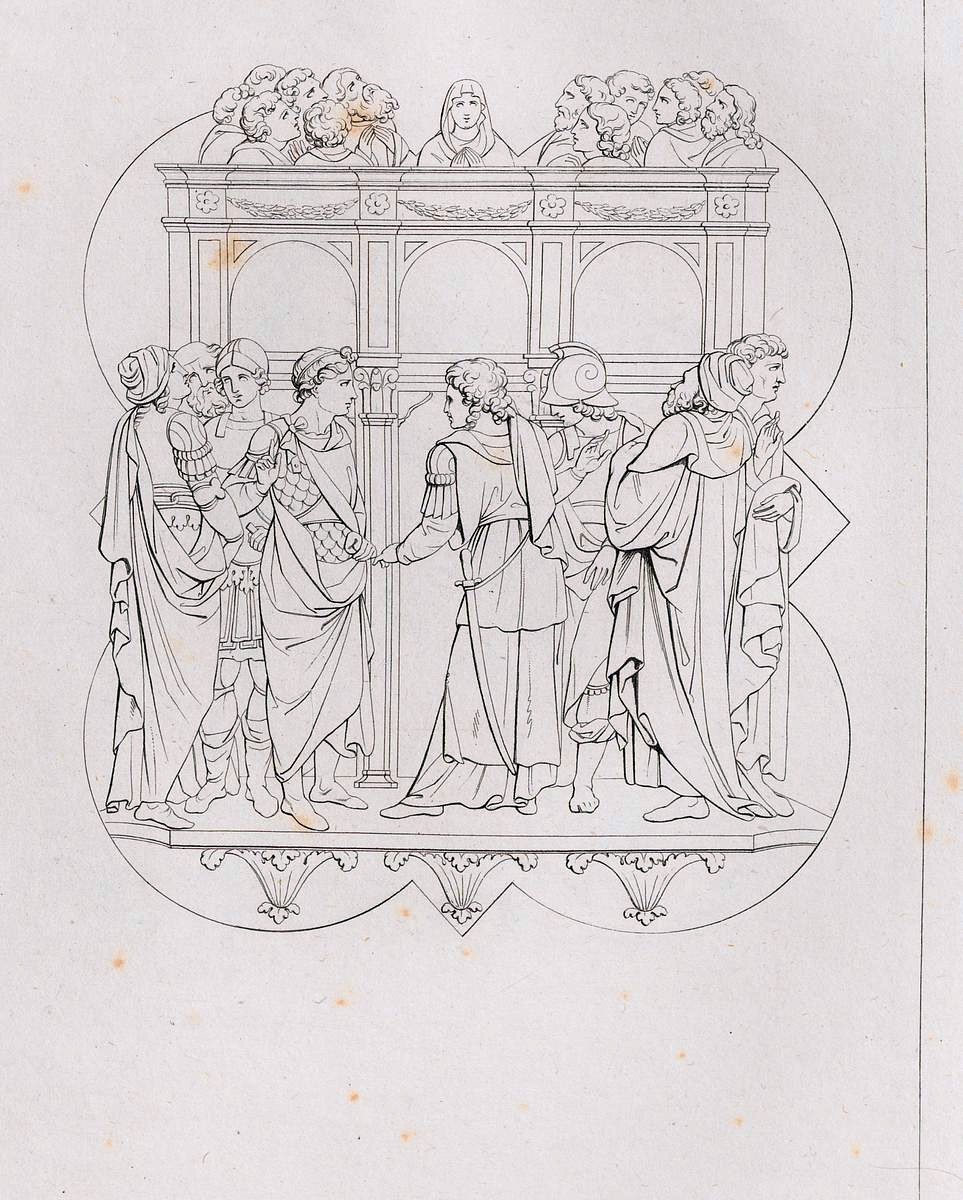
The older photograph also gives a clear view of the crowd below. The back of the man near the middle catches the light between his neighbours, while the shelf under his feet fixes his place in front of the building. The differences in headwear are especially legible: a rounded helmet near the centre and a high wrap at the left break up the crowded profiles. Some faces turn across the group, making it possible to read the gestures as exchanges between people trying to make sense of the same disturbance.
The Guild of the Dome interprets these figures as pagans who will later be evangelised. In Acts, the immediate crowd is Jewish, made up of people from many places who recognise their own languages. The variety of dress suits that account of a mixed audience, although the bronze gives little basis for assigning an origin or a religion to any one figure. [2] [3] [4] [6]
How the bronze conveys the Spirit
The signs in Acts come in quick succession: a sound like a violent wind fills the house, tongues as of fire rest on those assembled, and the recipients begin to speak in other languages. The relief is less explicit. In the modern detail and the Alinari print, the space above Mary’s veil is largely taken up by the pointed moulding and the narrow field inside it. There is no distinct dove, set of rays or flame that can be securely identified there or above the flanking heads.
The 1821 engraving keeps the clusters of heads and Mary’s joined hands but leaves out the pointed moulding between the upper lobes. It shows no clear emblem of descent either, though that omission of the moulding is a reminder of how much a print can simplify. The photographs are better evidence for the area directly above Mary, but they cannot tell us what every surface looked like when the door was new. [2] [4] [6] [7]
The text printed with the engraving supplies what the image leaves hard to see. It recounts the noise, the fire and the sudden speech, then follows Vasari in drawing attention to the attitudes of those who receive the Spirit. Vasari himself praises their expressions and poses without specifying a visible sign. The flames in the 1821 account belong to its retelling of the event; the writer’s description of the relief points the reader back to the bodies.
An earlier Florentine Pentecost, made by Jacopo di Cione and workshop for San Pier Maggiore in 1370–71, shows how literally the signs could be rendered. The painted dove sends golden rays into the upper room, and a red flame marks each recipient. Two people listen at doors left ajar. In Ghiberti’s bronze, the cornice conceals much of the assembly and the full-length listeners carry more of the story. [2] [7] [8] [9] [10]
What the listeners hear
Bertha Friedmann found the division between the groups a fault. Mary, she observed, occupies the principal place, but Friedmann expected Peter to provide the link with the people below. She pointed to a painting in Santa Maria Novella where, in her reading, his address makes the crowd’s listening and varied reactions intelligible. On the bronze it is difficult to assign that role to any one head above the cornice. The figures are so closely packed that even those who turn towards a neighbour have little room for a gesture that could reach across to the crowd. Friedmann’s objection is strongest if we expect to see Peter already delivering his speech. [2] [11]
Acts gives the listeners something to react to before Peter stands up. People gather at the sound and hear the disciples speaking in their own languages. Some people ask what it means; others mock the speakers. Only then does Peter rise with the eleven to answer them, going on to proclaim that Jesus has risen.
That order makes room for the unsettled attention in the bronze: the people below can react to what they hear even if no single voice stands out. The man who turns away from us stands between people looking in different directions. Their gestures suggest they are looking to one another for an explanation. Peter’s proclamation is the next step in the text, and the panel’s place on the door gives it particular force. [1] [2] [6] [11]
The last panel on the door
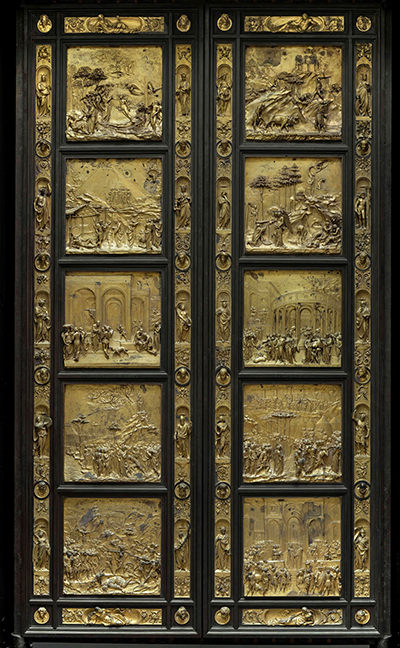
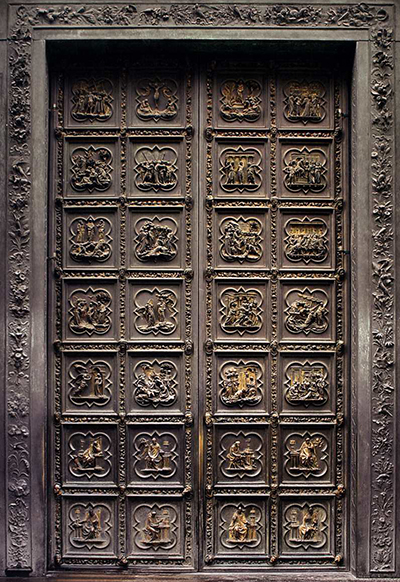
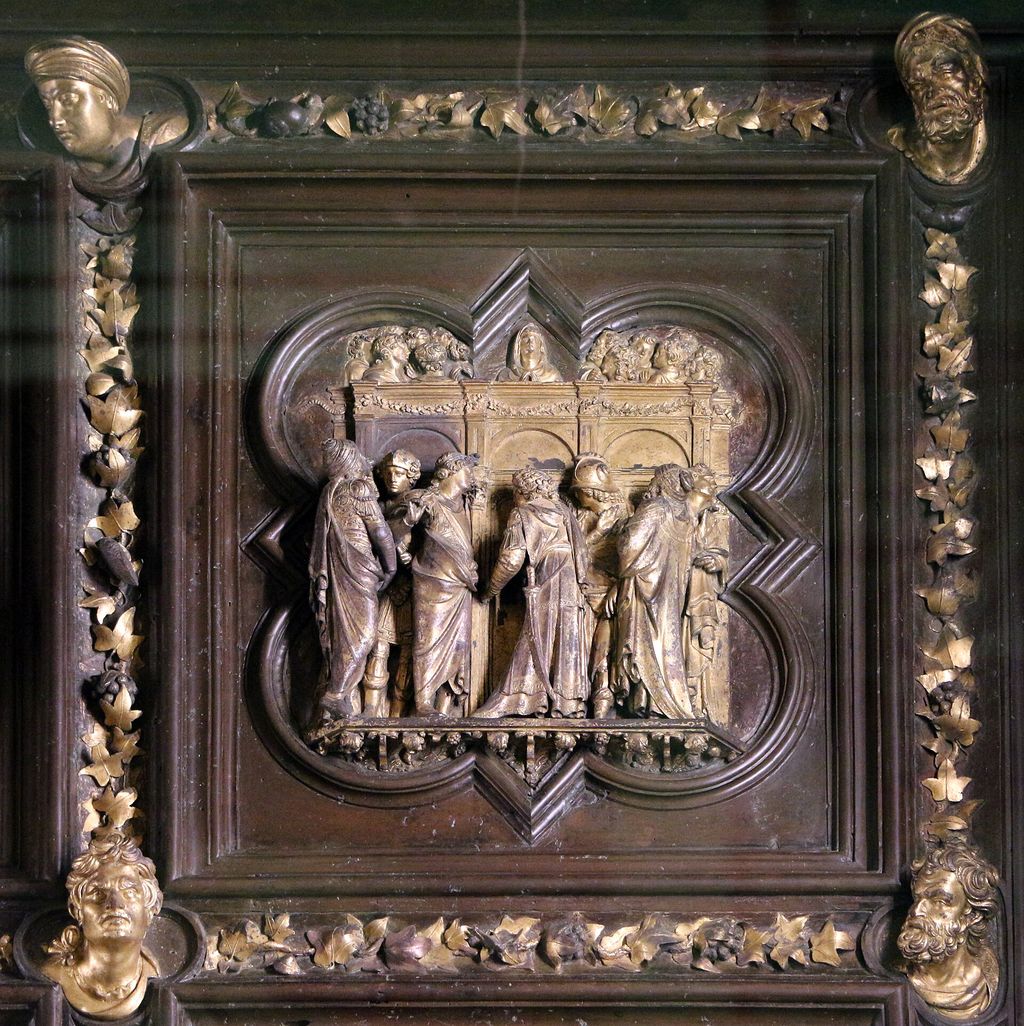
Pentecost occupies the far right of the top row, beside the Resurrection on the same leaf. The narrative begins at the opposite side of the door with the Annunciation in the lowest story row and ends here with people hearing a message that can be carried farther. The Opera del Duomo catalogue reads the final panel as the start of the spread of Christianity and the establishment of the Church. Peter’s proclamation in Acts makes the connection concrete: what the neighbouring relief shows happening at the tomb is what he then tells the gathered crowd. The Evangelists and Doctors of the Church below the narrative rows suggest how that message travels on through writing and interpretation. [1] [6] [12]
The door was made between 1403 and 1424. The Opera catalogue reports Richard Krautheimer’s placement of Pentecost in a group of panels dated about 1420–24 on stylistic grounds. The relief’s position fixes its place in the story; the proposed date rests on comparison with other panels. The Museo dell’Opera del Duomo displays the original in its Sala del Paradiso. A replica stands at the Baptistery’s north entrance. On the complete original, the figures in the street are much easier to make out at the upper corner than the heads behind the cornice. The prominence given to the listeners in the little relief still tells at the scale of the door. [1] [2] [12] [13] [14]
Lorenzo Ghiberti in context
Sacrifice of Isaac
1401 competitionNorth Doors
1403–1424St John the Baptist
c. 1414–1416St Matthew
1419–1422Gates of Paradise
1425–1452St Stephen
c. 1427–1429Lorenzo Ghiberti sculpture directory
Discussion
Ghiberti rewards slow looking: relief, gilding, narrative structure, workshop practice and conservation evidence can all change how a work is read.
Join the Conversation
Have an observation about Pentecost, a source to add, or a comparison that sharpens the reading? Share it below.
References
- Opera di Santa Maria del Fiore, scientific catalogue, Porta Nord del Battistero, record 3618. View source.
- Sailko, Pentecoste, photograph of the original relief, Wikimedia Commons. View source.
- Guild of the Dome, Panel XX – Pentecost. View source.
- Fratelli Alinari, Discesa dello Spirito Santo, print no. 44333, marked 1936, Civico Archivio Fotografico, Milan, RI 12170. View source.
- United States Conference of Catholic Bishops, Acts of the Apostles 1, verses 12–14. View source.
- United States Conference of Catholic Bishops, Acts of the Apostles 2, verses 1–14 and 32–36. View source.
- Vincenzo Gozzini and Giovanni Paolo Lasinio, Venuta dello Spirito Santo, plate XXII, in Le tre porte del Battistero di San Giovanni di Firenze (1821), ETH-Bibliothek, e-rara. View source.
- Commentary to plate XXII, p. 11, Le tre porte del Battistero di San Giovanni di Firenze (1821), ETH-Bibliothek, e-rara. View source.
- Giorgio Vasari, Life of Lorenzo Ghiberti, p. 150, translated by Gaston du C. de Vere, Warburg Institute digital copy. View source.
- National Gallery, London, Jacopo di Cione and workshop, Pentecost: Upper Tier Panel, NG578. View source.
- Bertha Friedmann, Ghibertis Verhältnis zur Gothik und Renaissance, p. 27 (1913). View source.
- Yair Haklai, photograph of the complete original North Door in the Museo dell’Opera del Duomo, Wikimedia Commons. View source.
- Opera di Santa Maria del Fiore, Lorenzo Ghiberti, Porta Nord del Battistero. View source.
- Opera di Santa Maria del Fiore, Renaissance clonation: the North Door replica. View source.