

 by Tom Gurney
Tom Gurney BSc (Hons) is an art history expert with over 20 years experience
Published on June 19, 2020 / Updated on July 28, 2026
Email: tomgurney1@gmail.com / Phone: +44 7429 011000
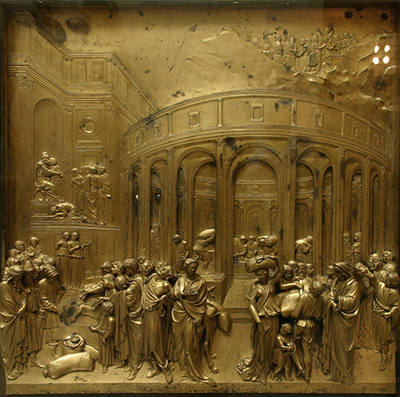
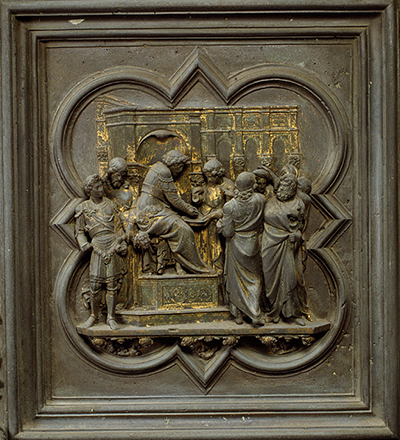
In Lorenzo Ghiberti's Christ before Pilate, authority is constructed through seating, elevation and architecture. Pilate sits beneath an arch at the left of centre, while Christ stands before him amid soldiers and attendants. The crowd is compact, but the architectural grid makes the encounter read as civic judgement rather than uncontrolled violence.
Contents
Position on the North Door
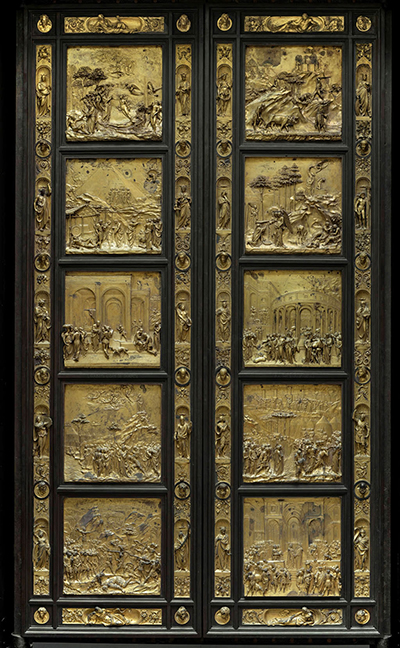
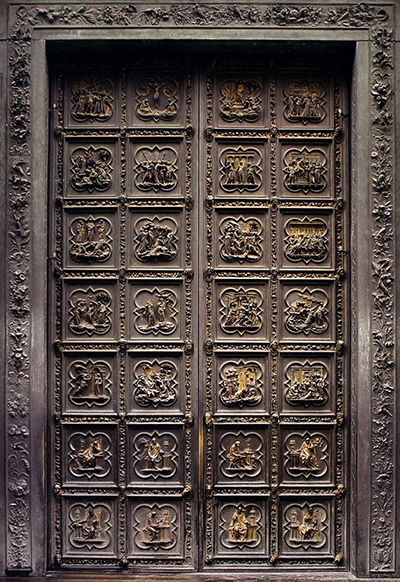
The panel is on the right leaf, paired with the Flagellation. Together, the two reliefs separate judicial presentation from physical punishment. The original North Door, made from 1403 to 1424, is displayed in the Museo dell'Opera del Duomo; a copy stands outside on the Baptistery.[1][2]
Opera del Duomo reports a proposed phase around 1415–1420 for this panel, based on Krautheimer's stylistic reconstruction. It is not an exact documented completion date.
Pilate elevated
Pilate's seat raises him above nearby standing figures. The arch and architectural framework reinforce his institutional position, making status visible before any individual gesture is interpreted.
Christ stands within the group before him. The unequal relation is therefore expressed vertically: one figure judges from a seat, the other is presented upright in the crowded lower space.
Witnesses and procedure
Soldiers and attendants close both sides of the encounter. Their presence turns the exchange into a public proceeding. Matthew 27:11–26, Mark 15:1–15, Luke 23:1–25 and John 18:28–19:16 provide the different Gospel accounts; the relief condenses accusation, interrogation and judgement into a single audience.[3]
Unlike the Arrest, the group does not surge around a betrayal. Unlike the Flagellation, bodies are not organized around physical blows. Gesture, rank and attention carry the action.
Architecture as authority
The background's repeated rectangular and arched forms regularize the crowd. They create a shallow official setting and visually attach Pilate to the structure of power.
A close reading should begin with the contrast between seated and standing bodies, then follow the heads and hands of the surrounding witnesses. The panel's central question is not simply who speaks. It is how institutional judgement becomes visible through elevation, enclosure and the pressure of an assembled public.
Discussion
Ghiberti rewards slow looking: relief, gilding, narrative structure, workshop practice and conservation evidence can all change how a work is read.
Join the Conversation
Have an observation about Christ before Pilate, a source to add, or a comparison that sharpens the reading? Share it below.
References
- Opera del Duomo scientific catalogue, North Door
- Opera del Duomo, North Door
- Matthew 27:11–26; Mark 15:1–15; Luke 23:1–25; John 18:28–19:16.