 by Tom Gurney
Tom Gurney BSc (Hons) is an art history expert with over 20 years experience
Published on June 19, 2020 / Updated on November 17, 2026
Email: tomgurney1@gmail.com / Phone: +44 7429 011000
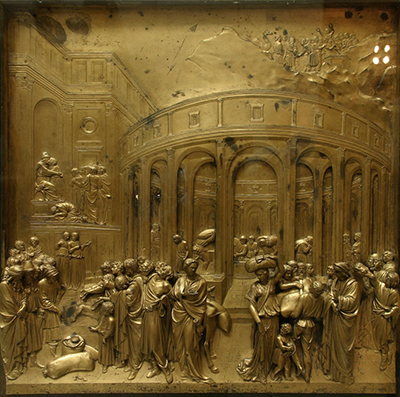
At the upper right of Lorenzo Ghiberti’s Joseph relief, hands reach towards a figure lying low across the edge of a cistern. The straight rim is easy to lose among the sloping rocks and the small bodies pressed together above it. A little farther left, more figures reach towards one another along the ridge. The Opera del Duomo identifies two episodes here, the action at the pit and the sale that sends Joseph to Egypt. Almost everything beneath that narrow strip belongs to the years after the sale. A round granary fills the centre, people shoulder sacks across the foreground and a group at the left has stopped to open a bag. [1] [2]
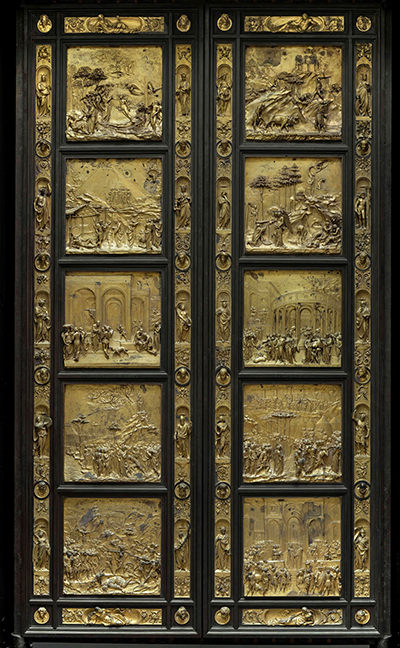
The Opera catalogues the bronze as Formella con Storie di Giuseppe (Panel with Stories of Joseph). It is the sixth narrative relief of the Gates of Paradise, on the right leaf as you face the doors, three rows down. Cast, gilded and chased, it measures 80 centimetres high by 79 wide. The dates 1425–52 span the Baptistery commission carried out by Ghiberti and his workshop. The original is in the Sala del Paradiso at the Museo dell’Opera del Duomo, and a copy stands at the Baptistery’s east entrance. [2] [3] [4]
Contents
- The hand at the cistern
- From a dream to a store of grain
- The sack that must be opened
- When the brothers recognise Joseph
- Keeping the shallow work visible
The hand at the cistern
In Genesis 37, Joseph’s brothers strip him of his tunic and put him in an empty cistern. They sit down to eat and see a caravan on its way to Egypt. Judah proposes selling Joseph, who is then drawn out of the pit and sold. The verses name both Midianite traders and Ishmaelites in the sequence, and their respective roles are difficult to disentangle. In his Commentaries, Ghiberti gives the brothers both actions in succession.
They put Joseph in the cistern, then sell him. The Opera reads the group at the rim as the lowering, while art historian Amy R. Bloch identifies it as the extraction in the caption to her figure 144. The body is still in reach of the surrounding hands in either reading, and its position across the rim leaves the direction open. The neighbouring figures carry the story on to the sale. [1] [2] [5] [6] [7]
The pit has a much more conspicuous place in the Baptistery’s older Joseph cycle, dated by the Opera to about 1270–1305. The fourth register of the vault has fifteen mosaic compartments set out in groups of three. The fourth compartment includes both the lowering and the sale. Between its columns, two groups face each other around a decorated rectangular cistern.
Its front, with a diamond-shaped panel, is almost as prominent as the figure at its opening. In the bronze, the rim is seen obliquely and the ridge itself forms the stage. The figures near it are tiny even in comparison with the people visible through the granary arches. Ghiberti makes the episode that starts the story look remote from the busy place where the brothers will meet Joseph again. [1] [2] [8] [9]
Look closely at Joseph
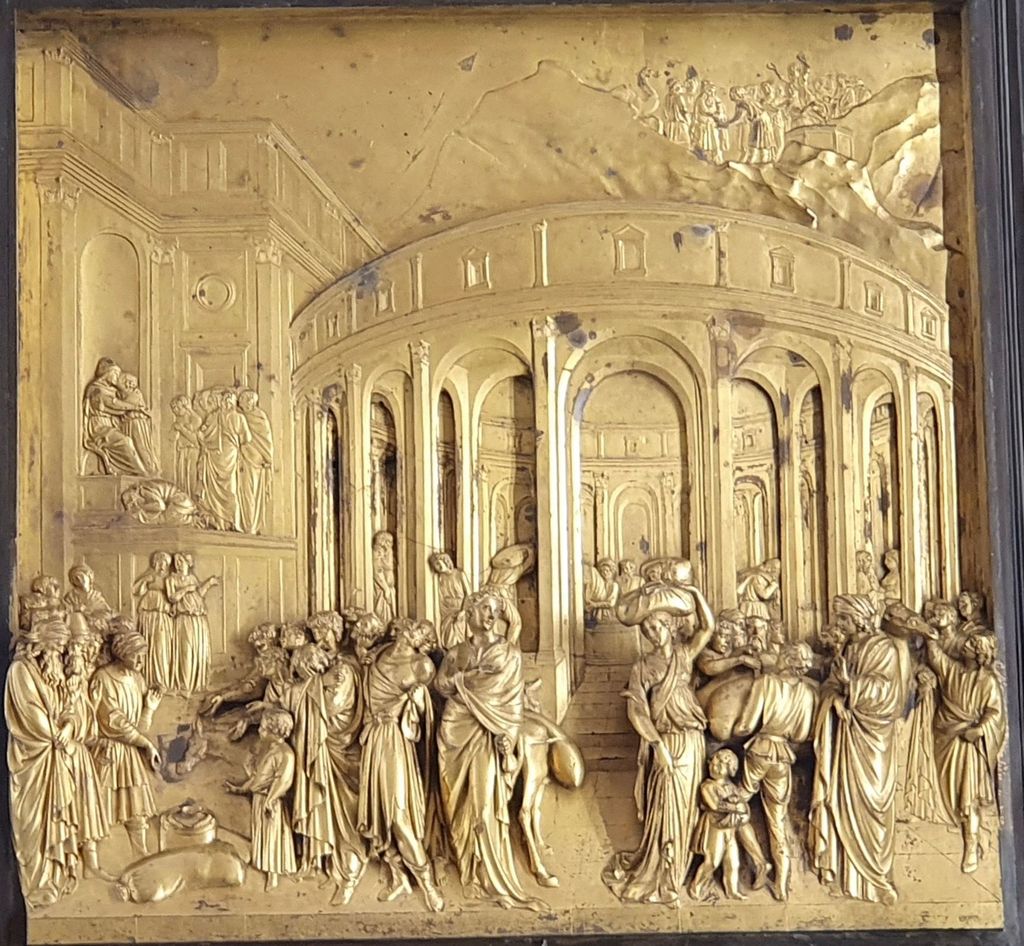
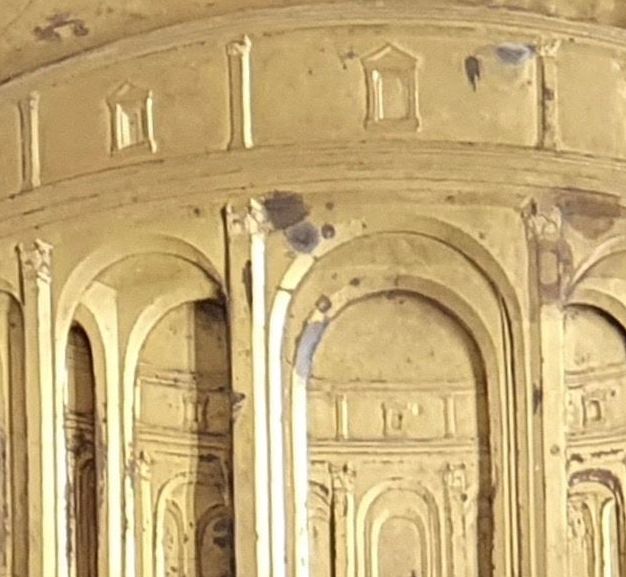
1. The circular storehouse
The curve of the upper wall and the succession of arches establish the round plan. Openings reveal a second set of arches inside.
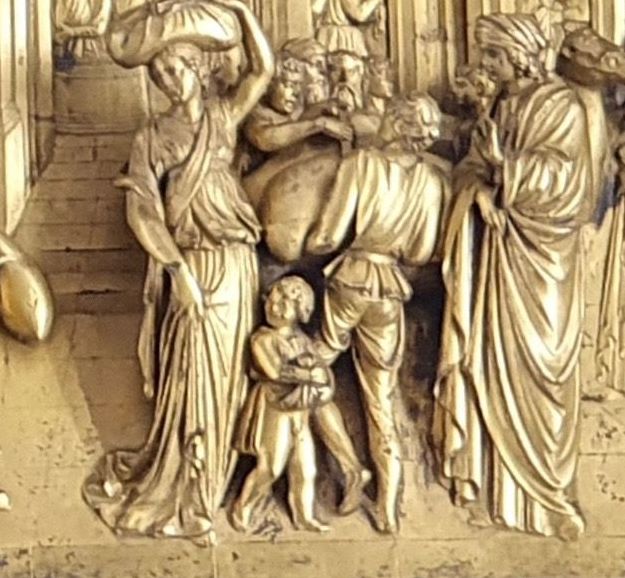
2. Sacks in the foreground
Men at the foot of the building bend and reach around the sacks. Their overlap gives the grain distribution a busy foreground.
3. The small scene above the roof
The figures along the ridge are much smaller and shallower than the figures below. They carry an earlier episode above the main architectural scene.
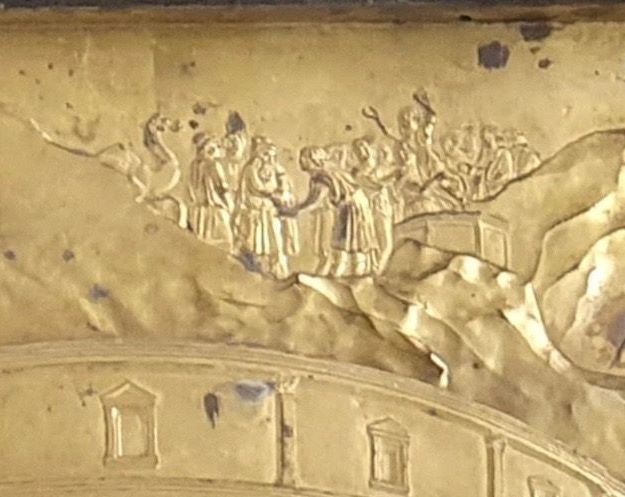
Photograph by Yair Haklai. Source image. CC BY-SA 4.0. Resized for the overview and cropped for detail.
From a dream to a store of grain
Genesis 41 supplies the events that make the granary possible. Pharaoh dreams of cattle and ears of grain. Joseph reads the dreams as a forecast of seven years of abundance followed by seven years of famine and advises Pharaoh to set aside food during the good years. Pharaoh puts him in charge. The vault gives three consecutive compartments to Pharaoh’s dreams, Joseph interpreting them and Joseph’s appointment. A viewer can follow each change of situation by moving to the next compartment. Further round, in the grain-loading mosaic, the store is reduced to a canopy over the men working with the sacks. Joseph stands off to their left, outside the shelter, with room around him to watch. [8] [10] [11]
Ghiberti includes the dream, the remedy for famine and Pharaoh’s honours in his written account of the sixth panel. He begins the Egyptian part by saying Joseph was given to Pharaoh, compressing the story between the sale and Joseph’s rise. He also names Jacob sending his sons to Egypt and Joseph recognising them. Those are distinct incidents on the page. The Opera catalogue places the handover below the sale, the dream and honours on the left and Jacob’s dispatch on the right.
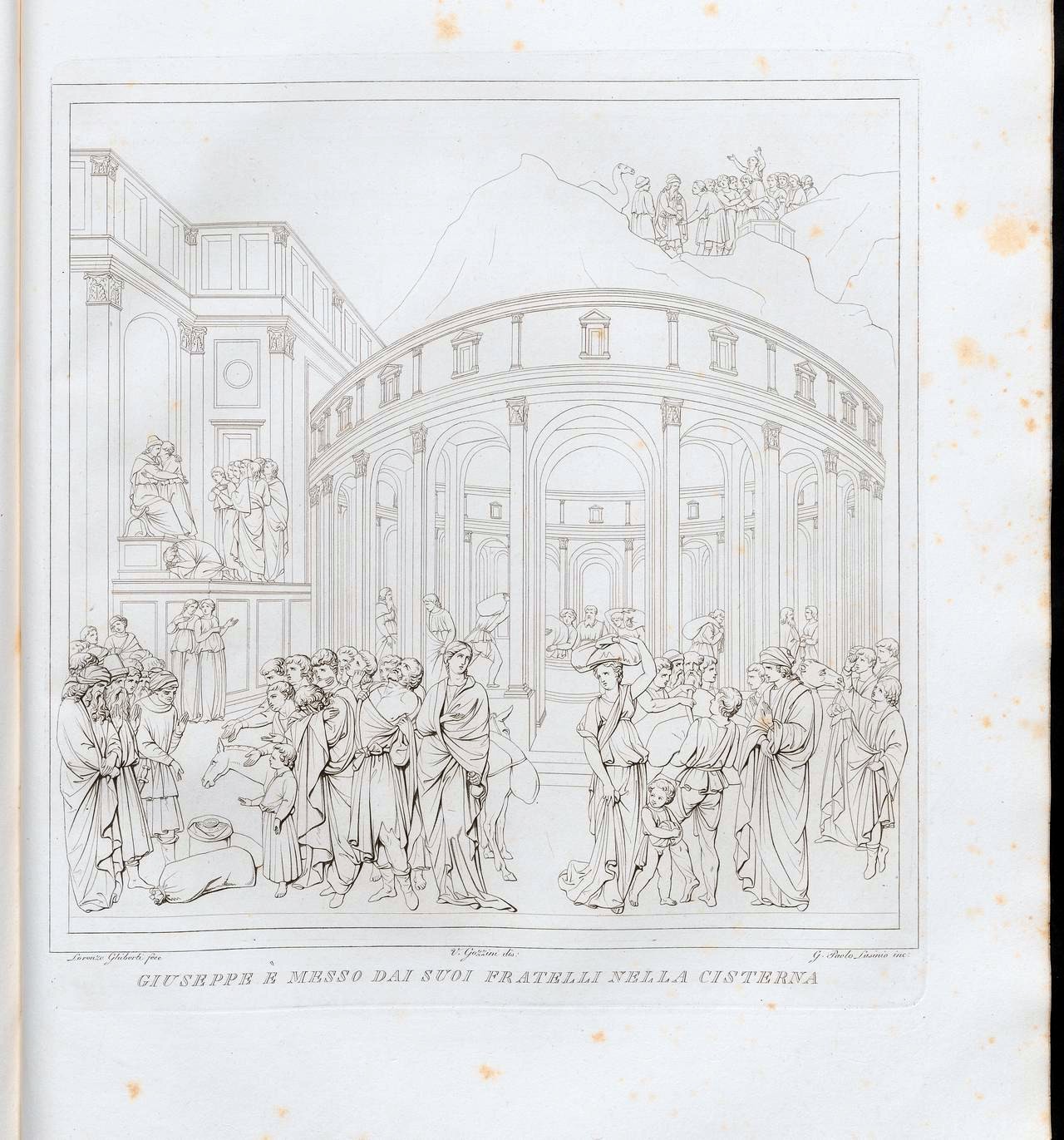
Bloch finds no discrete scene of the delivery to Pharaoh, the dream and prediction, the proposal to store grain, Pharaoh’s praise or Jacob sending his sons out. The crowded groups and raised settings are visible, but there is no equivalent to the vault’s three compartments by which to distinguish the stages of Joseph’s rise. The safest place to pick up the Egyptian story on the bronze is at the store itself, where the consequences of the dream have become visible. [1] [2] [6] [7] [8] [11]
The granary’s upper band curves almost the whole way from the raised terrace on the left to the right edge of the panel. The broad openings at the middle narrow towards the sides as the wall turns. Through the large central arch you can make out a second rank of openings in shallower relief.
Lines scored into the paving run between the crowd and the piers, giving the eye a passage through the lower part of the building. There are people and loads both inside the openings and across their bases. In the mosaic the canopy contains the work of filling sacks. Here that work extends beyond the building, and the architecture lets you follow it from the interior towards the people standing nearest you. [1] [2] [10]
Just right of centre, a carrier lifts an arm to steady a load overhead. Beside the carrier, a worker bends under a bulging sack, with a small child looking up among the adults. The raised load falls across the central opening, where the shallow arch behind it helps the body stand out. Farther in, small figures occupy the gaps between the piers.
The changing depth makes the shallow metal read as the distance between the people working on either side of an entrance. The largest sacks belong to that near space. A viewer can follow their shapes from the crowded traffic in front of the store to two bags lying on the ground at the far left, where the press of bodies leaves them unusually exposed. [1] [2]
The Baptistery’s two cycles offer different paths out of the grain scene. The Opera’s inventory of the vault moves from loading to reconciliation and then to Jacob meeting Joseph. It lists no separate search for the cup. The bronze sets aside some of its clearest foreground space for that search. Gwynne Ann Dilbeck finds another emphasis on the brothers in the Joseph responsories of the Roman Breviary, in contrast to the attention given to Pharaoh in the vault.
The Florentine Ritus she cites also includes the purchase by Potiphar among the lessons. The services and images thus offer several selections from a longer story. Read alongside them, the space Ghiberti gives to the opened sack stands out as a decision about which part of the brothers’ return a viewer needs to see. [1] [2] [7] [8] [12]
The sack that must be opened
In Genesis 42 Joseph recognises his brothers on their first visit, while they fail to recognise him. He accuses them of spying and orders them to bring Benjamin if they come back. The brothers return with Benjamin when the household again needs food. Ghiberti records that demand and their return, then mentions a feast and the placement of the cup.
Those clauses help explain the situation of the travellers about to leave with grain. In the bronze, it is the action around the grounded bags that can be located with confidence. The written account gives a reason to look for a meal or for someone slipping something into a bag, but the visible figures offer firmer grounds for identifying the search itself. [1] [2] [6] [7] [13] [14]
Genesis 44 explains what makes the search so threatening. Joseph has instructed his steward to put his silver cup into Benjamin’s sack. After the brothers set off, the steward overtakes them and searches from the eldest brother’s bag to the youngest’s. Everyone goes back when the cup is found, and Joseph declares that Benjamin alone must stay as his slave. Judah offers to serve in the boy’s place because he fears what the loss will do to Jacob. At the cistern Judah had proposed a sale that let the other brothers leave one behind. Now the incriminating object gives him occasion to offer himself in place of another brother. [5] [15]
At the lower left, a low open sack sits behind a fuller bag. One arm extends from the gathered men, and a smaller figure holds out a hand near the cleared ground. Their gestures direct attention down towards the opening. Bloch’s figure 149 identifies the incident as the cup’s discovery in Benjamin’s bag. That identification rests on the action around the bags and its place in the story. At the store the sacks belong to people who can lift them and go on. Here the bags have come to rest, and the surrounding figures have to wait while the search turns food for the journey into grounds for detaining a brother. [1] [2] [7] [15]
When the brothers recognise Joseph
Above the search, the ledge at the left provides a shallow platform by a tall niche. A seated figure and his neighbour draw so close that their heads nearly meet. A man bends low across the ledge in front of them. Bloch identifies the group as Joseph making himself known to his brothers in her caption to figure 152. The placement makes sense of the change in gesture. Below, the hands reach into a gap around the sack.
Above, they belong to figures drawing close together. The Opera places Pharaoh honouring Joseph on a raised terrace and Joseph recognising his brothers in the left foreground. Its subject index also names the reconciliation. The close pair and low figure support Bloch’s reading of a reunion, though the architecture alone cannot distinguish a welcome from an audience or establish three separate scenes for the dream, the honour and the disclosure. [1] [2] [7]
The distinction between the two recognitions matters here. Ghiberti writes first that Joseph recognised his brothers and later that he made himself known to them. In Genesis 45 Joseph tells the others who he is, asks them to come closer and embraces Benjamin and then the rest. He says that his arrival in Egypt enabled him to preserve life and sends them to fetch Jacob.
Once the group on the ledge is read as that disclosure, it is possible to look across the panel from one moment of bodily contact to the other. At the rim Joseph’s brothers have him in their power. At the ledge he has already shown how much power he has over them, and it is Joseph who asks them to come within reach. [1] [2] [6] [7] [13] [16]
Keeping the shallow work visible
The apparent continuity of the bronze conceals work on the casting itself. Using portable X-ray fluorescence to study five reliefs, Marco Ferretti and Salvatore Siano counted seventeen recognisable repairs on panel VI, the most in their sample. The alloys used for the repairs varied in composition, including in their trace elements. The researchers took that variation as evidence that metal from different stocks had been used and that repairs may have been made over a considerable period.
Their results give a measure of the work this particular relief needed, while the metal compositions do not give dates for individual interventions. In a separate study, Annamaria Giusti and Mauro Matteini record that sample 3 from a recast small figure had a different alloy from the other four samples they tabulated for the Joseph panel. The published sample description gives no secure basis for naming the figure in the story. [17] [18]
The selective cleaning trial reported by Giusti and Matteini belongs to the relief’s modern treatment. The conservators tested neutral Rochelle salt solution on a small area of the Joseph panel to remove harmful deposits and salts while preserving stable oxides that supported the gold. The cleaned relief received protection in a nitrogen-filled case during this early phase. Giusti and Matteini report that the test brought back the sheen of the gilding while leaving the supporting oxides in place.
From far enough away for the curve of the granary and the loaded bodies to register together, the little group at the cistern almost disappears. Move close enough to see the hands at the rim, then look back to the bags. Their size and weight explain how a story that starts in a corner comes to occupy almost the whole square. [1] [18]
Lorenzo Ghiberti in context
Sacrifice of Isaac
1401 competitionNorth Doors
1403–1424St John the Baptist
c. 1414–1416St Matthew
1419–1422Gates of Paradise
1425–1452St Stephen
c. 1427–1429Lorenzo Ghiberti sculpture directory
Discussion
Ghiberti rewards slow looking: relief, gilding, narrative structure, workshop practice and conservation evidence can all change how a work is read.
Join the Conversation
Have an observation about Joseph Sold into Slavery, a source to add, or a comparison that sharpens the reading? Share it below.
References
- Yair Haklai, Joseph on the original Gates of Paradise, photograph, Wikimedia Commons, CC BY-SA 4.0. View source.
- Opera di Santa Maria del Fiore, Formella con Storie di Giuseppe, catalogue 2798. View source.
- Opera di Santa Maria del Fiore, Porta del Paradiso, catalogue 1320. View source.
- Opera di Santa Maria del Fiore, Lorenzo Ghiberti, Gate of Paradise, Sala del Paradiso. View source.
- United States Conference of Catholic Bishops, Genesis 37, verses 21–36 and note on verses 21–36. View source.
- Lorenzo Ghiberti, I commentarii, edited by Julius von Schlosser, vol. I (Berlin, 1912), pp. 49–50, Warburg Institute scan. View source.
- Amy R. Bloch, Lorenzo Ghiberti’s Gates of Paradise: Humanism, History, and Artistic Philosophy in the Italian Renaissance, Cambridge University Press, 2016, pp. 10–12 and figure list, figs. 144, 149 and 152. View source.
- Opera di Santa Maria del Fiore, Mosaic with Stories of the Patriarch Joseph (fourth register), record 9162. View source.
- MatthiasKabel, cropped by Sailko, Baptistery mosaic, scene 4, Joseph at the cistern and sold by his brothers, photograph, Wikimedia Commons. View source.
- MatthiasKabel, cropped by Sailko, Baptistery mosaic, scene 13, Joseph watches his brothers load the grain, photograph, Wikimedia Commons. View source.
- United States Conference of Catholic Bishops, Genesis 41. View source.
- Gwynne Ann Dilbeck, Opening the Gates of Paradise: Function and the Iconographical Program of Ghiberti’s Bronze Door, University of Iowa doctoral dissertation, 2011, pp. 141–142 and nn. 431–432. View source.
- United States Conference of Catholic Bishops, Genesis 42. View source.
- United States Conference of Catholic Bishops, Genesis 43. View source.
- United States Conference of Catholic Bishops, Genesis 44. View source.
- United States Conference of Catholic Bishops, Genesis 45. View source.
- Marco Ferretti and Salvatore Siano, ‘The gilded bronze panels of the Porta del Paradiso by Lorenzo Ghiberti: non-destructive analyses using X-ray fluorescence’, Applied Physics A 90 (2008), pp. 97–100, especially p. 99. View source.
- Annamaria Giusti and Mauro Matteini, ‘The Gilded Bronze Paradise Doors by Ghiberti in the Florence Baptistery: Scientific Investigation and Problems of Restoration’, ICOMOS – Hefte des Deutschen Nationalkomitees 29 (1998), pp. 46–51, table 1 and conservation methodology. View source.