 by Tom Gurney
Tom Gurney BSc (Hons) is an art history expert with over 20 years experience
Published on June 19, 2020 / Updated on November 17, 2026
Email: tomgurney1@gmail.com / Phone: +44 7429 011000
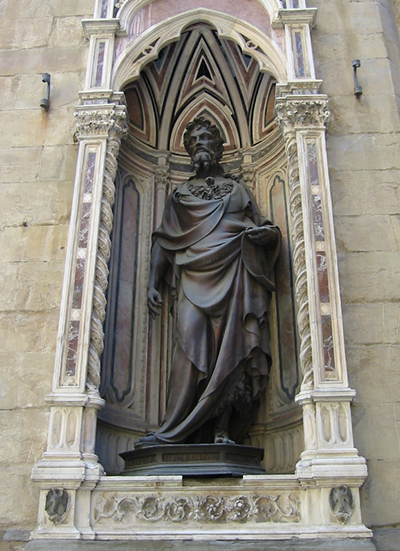
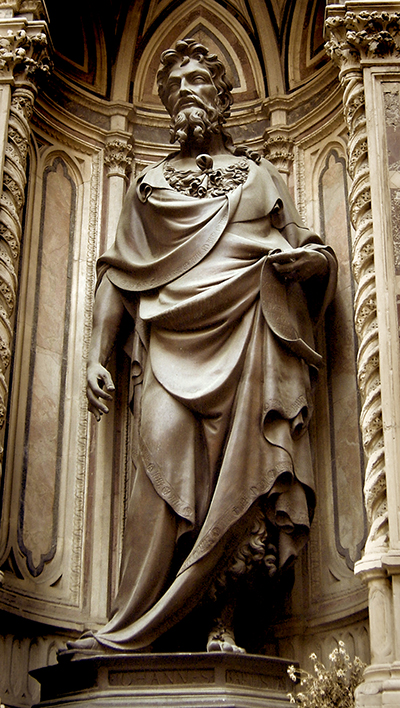
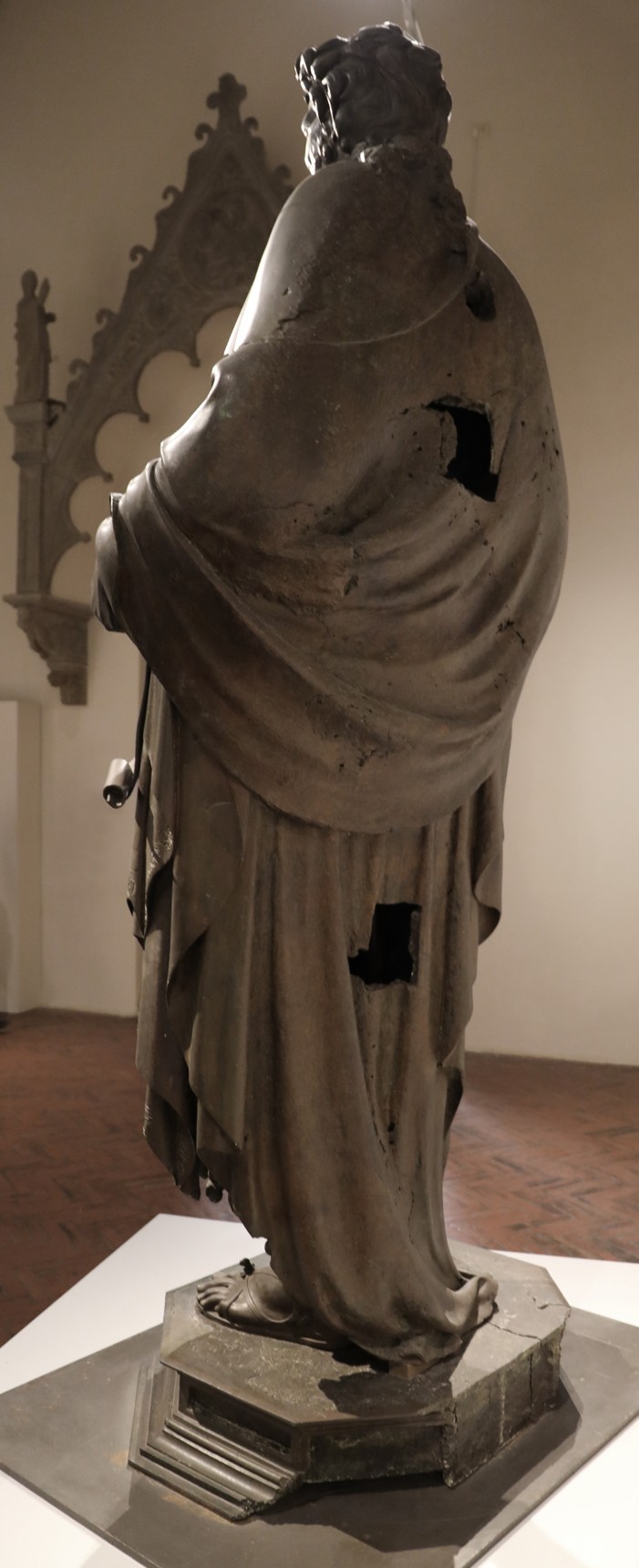
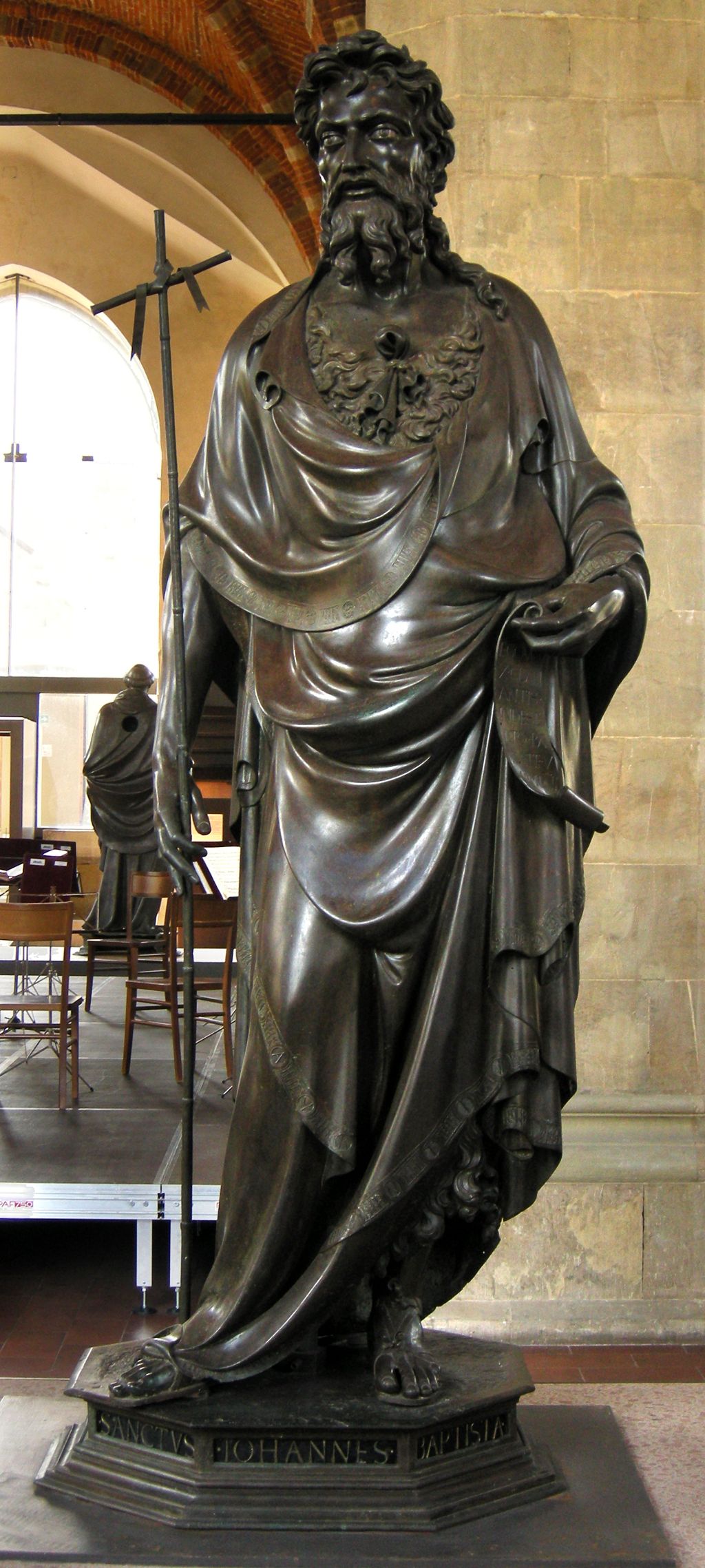
From Via de’ Calzaiuoli, the raised left hand of St John the Baptist seems to open towards the street. Look more closely and a narrow roll appears between the fingers. A strip hangs from it and curls outwards at the bottom. Its shape makes sense of the turned palm. John is holding out a text. The figure in the niche on the east side of Orsanmichele is a replica. Lorenzo Ghiberti’s original is upstairs in the Museo di Orsanmichele, where the folds and lettering are easier to see. Italy’s national catalogue dates the cast, chased and gilded bronze to about 1414–16 and gives its height as 255 cm. [1] [2] [3] [4] [5]
Contents
- The cloth merchants’ saint
- When John took his place
- The hand that shows the words
- The cloak and the hair shirt
- The bronze indoors and the figure in the street
The cloth merchants’ saint
Florence’s guilds commissioned statues of their patron saints for the exterior of Orsanmichele. John was the patron of Florence itself and of the Arte di Calimala, the cloth merchants’ guild. Calimala supervised the Baptistery dedicated to him and commissioned silver furnishings used there for his feast on 24 June. The niche gave that relationship a place in the street. Below the figure, two eagles flank the carved foliage. The eagle grasping a bale of cloth was Calimala’s emblem. The bale identified the merchants by their trade, while the lettering across the front of the bronze base identified the saint to anyone close enough to read it. [1] [2] [3] [6] [7] [8]
The pointed arch and slender columns give the figure a tall, narrow setting. The sweep of the cloak crosses those vertical lines, and the forearm brings the scroll forward against the recess. Albizzo di Piero executed the stonework of the marble tabernacle, whose design the museum attributes to Ghiberti. The niche once had more colour than the stonework shows today. The national record for the tabernacle describes lost mosaic made from glass tesserae that originally covered the arch and recess. [1] [7] [9]
The guild was already paying for work on the setting in 1414. An entry from Calimala’s Libro Grande P, published in part by Richard Krautheimer and Trude Krautheimer-Hess, records twenty florins in part payment to Giuliano di Arrigo, called Pesello, and his fellow painters. The published preview names the tabernacle as the place of their work and leaves the task unspecified. Writing much later, Filippo Baldinucci describes a mosaic half-figure of an apostle still visible above the Baptist in his day and attributes it to Ghiberti. The payment establishes that painters worked on the setting, and Baldinucci gives an idea of what a viewer could once see above the bronze. The mosaic’s authorship remains uncertain. [9] [10] [11]
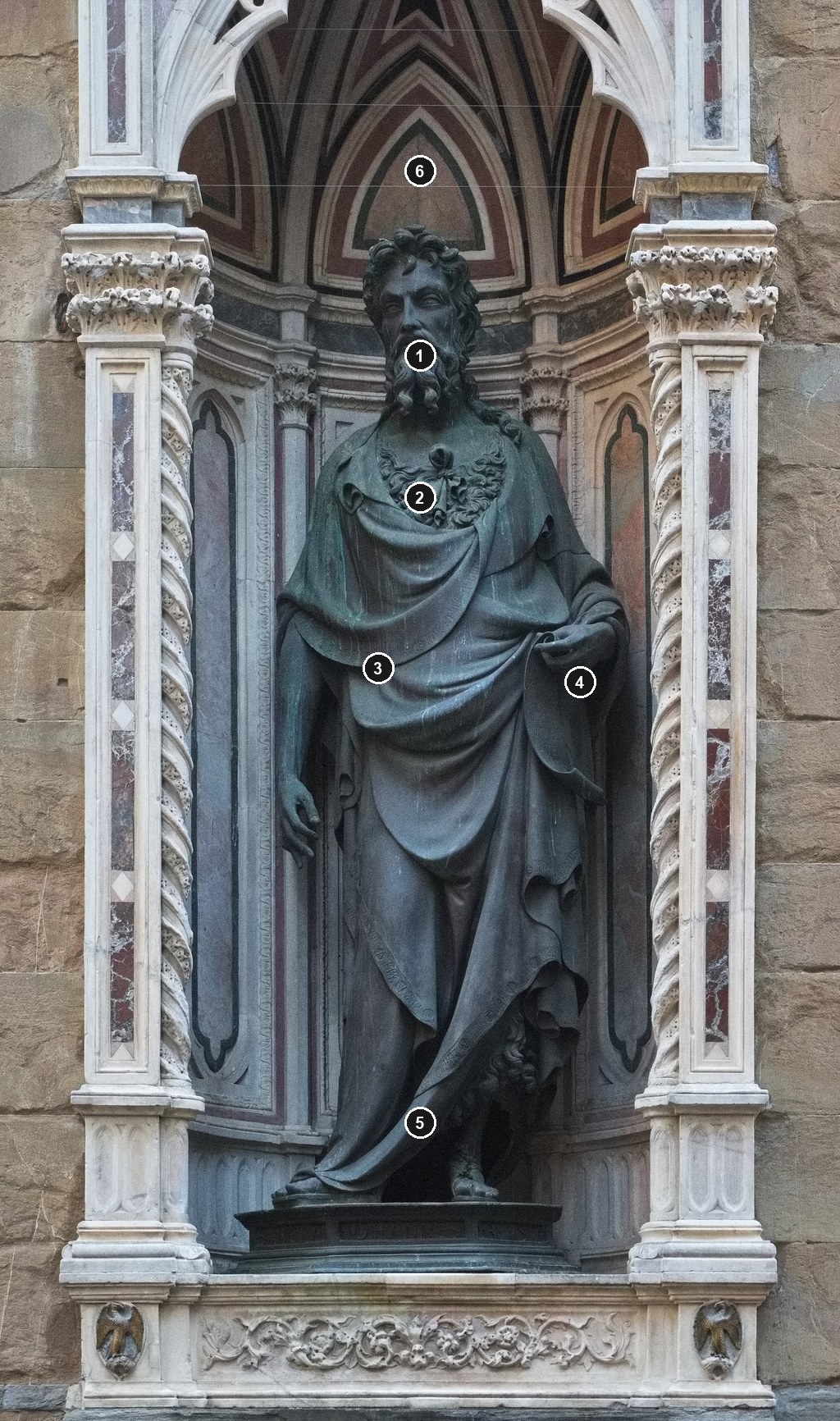
Annotated Close Reading of St John the Baptist
Image note: this photograph shows the exterior replica in Ghiberti’s original Orsanmichele niche; the conserved original bronze is displayed indoors.
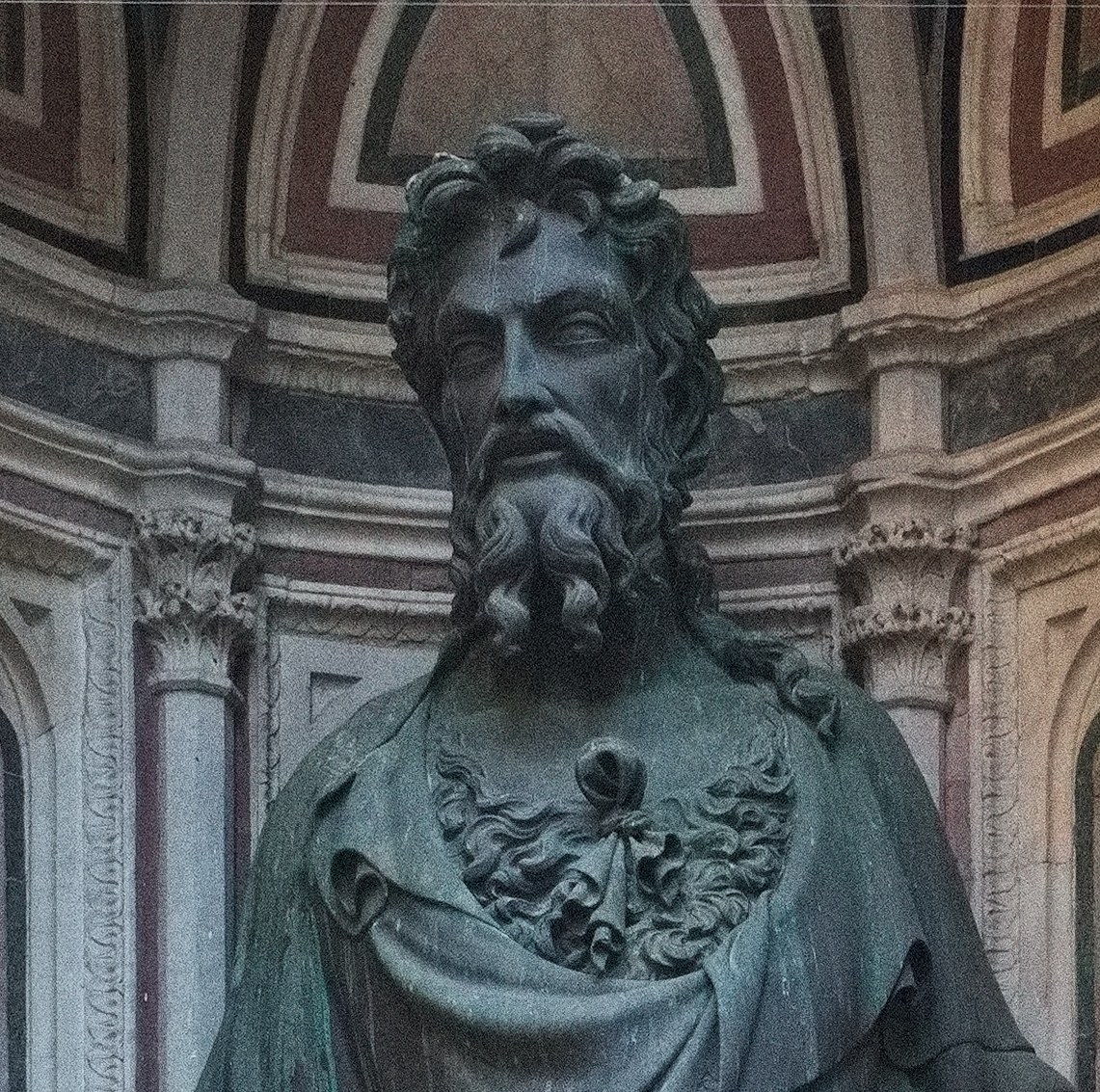
Head and concentrated gaze
The bearded head creates a strong focus within the tall niche and remains legible from street level.
Hair garment and goldsmith detail
Dense hair and garment textures show how fine surface pattern survives within monumental scale.
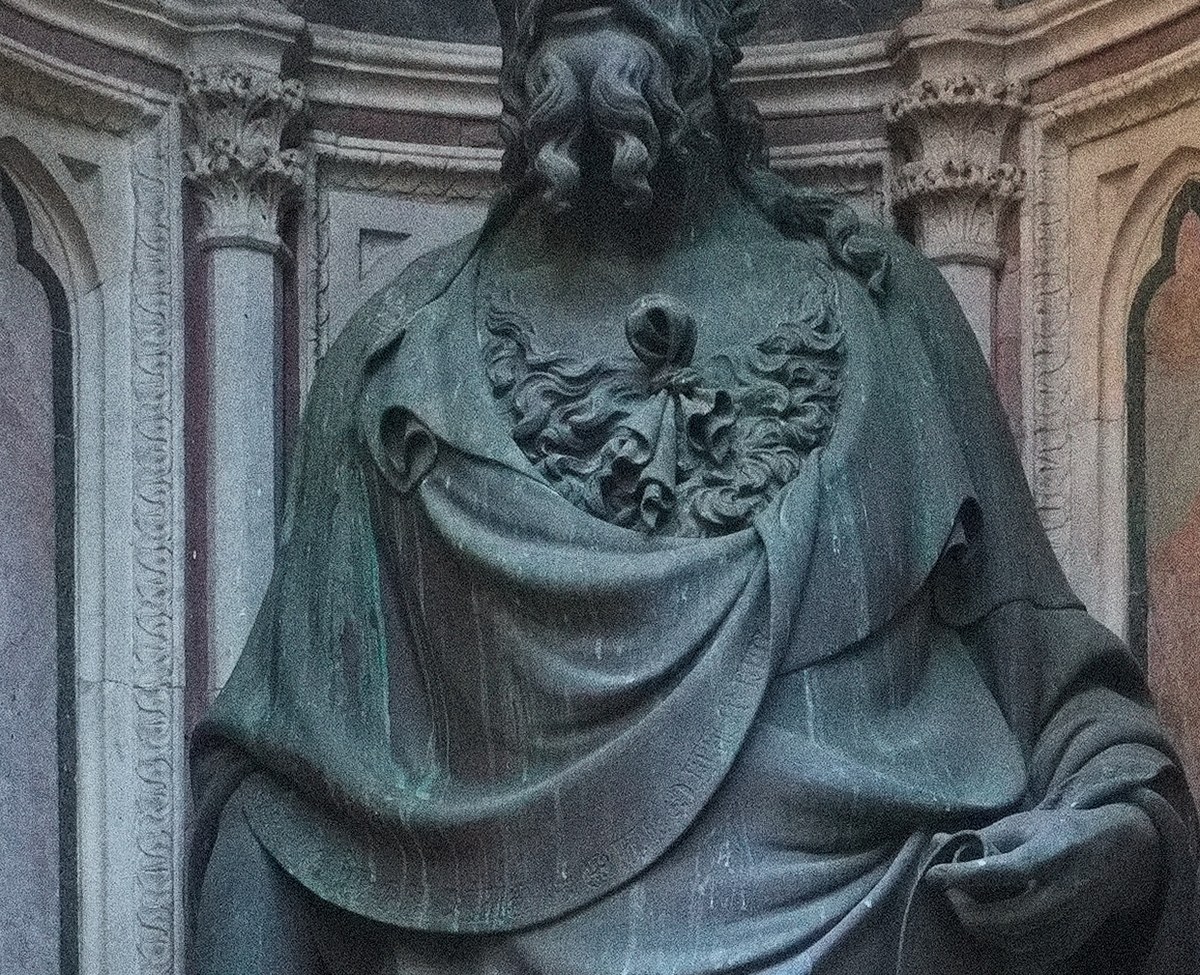
Mantle across the torso
The mantle crosses the torso in a long continuous movement that emphasizes the figure’s vertical form.
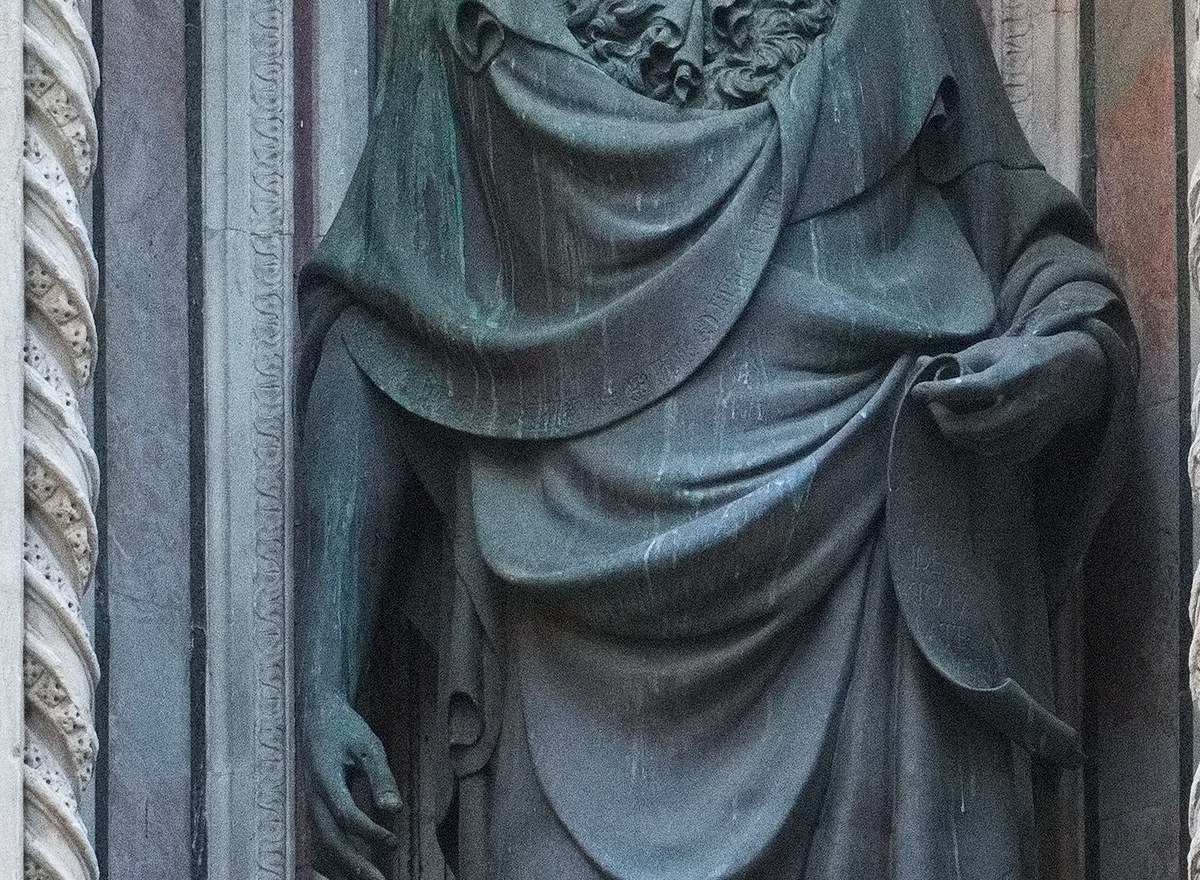
Open left hand
The open hand interrupts the surrounding folds with a small, direct gesture.
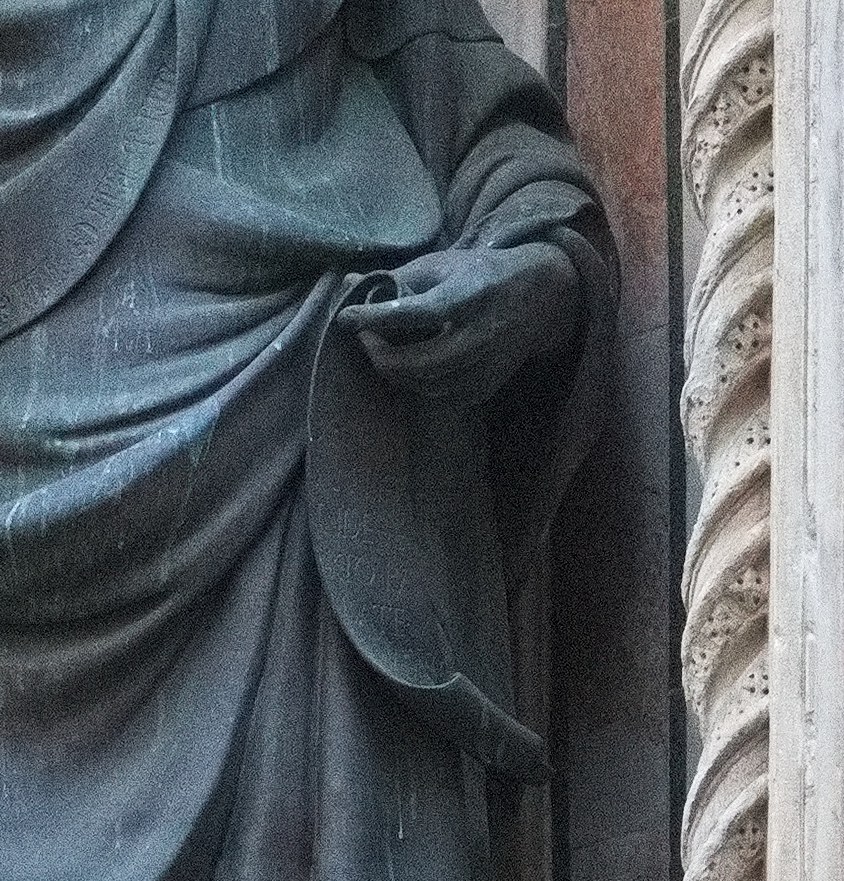
Feet and weighted stance
The exposed feet anchor the elongated figure and clarify its stance above the street.
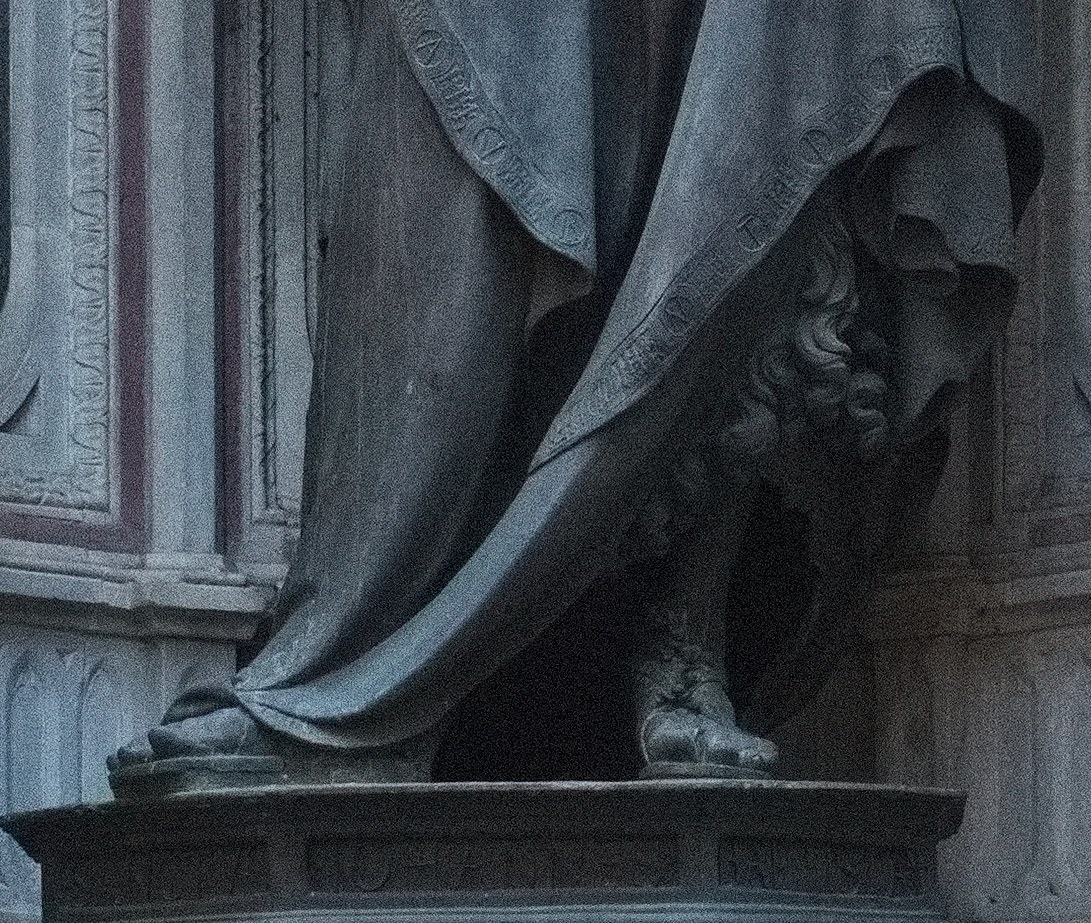
Niche and Calimala setting
Twisted columns, inlay and the painted recess frame the replica within the guild’s original architectural setting.
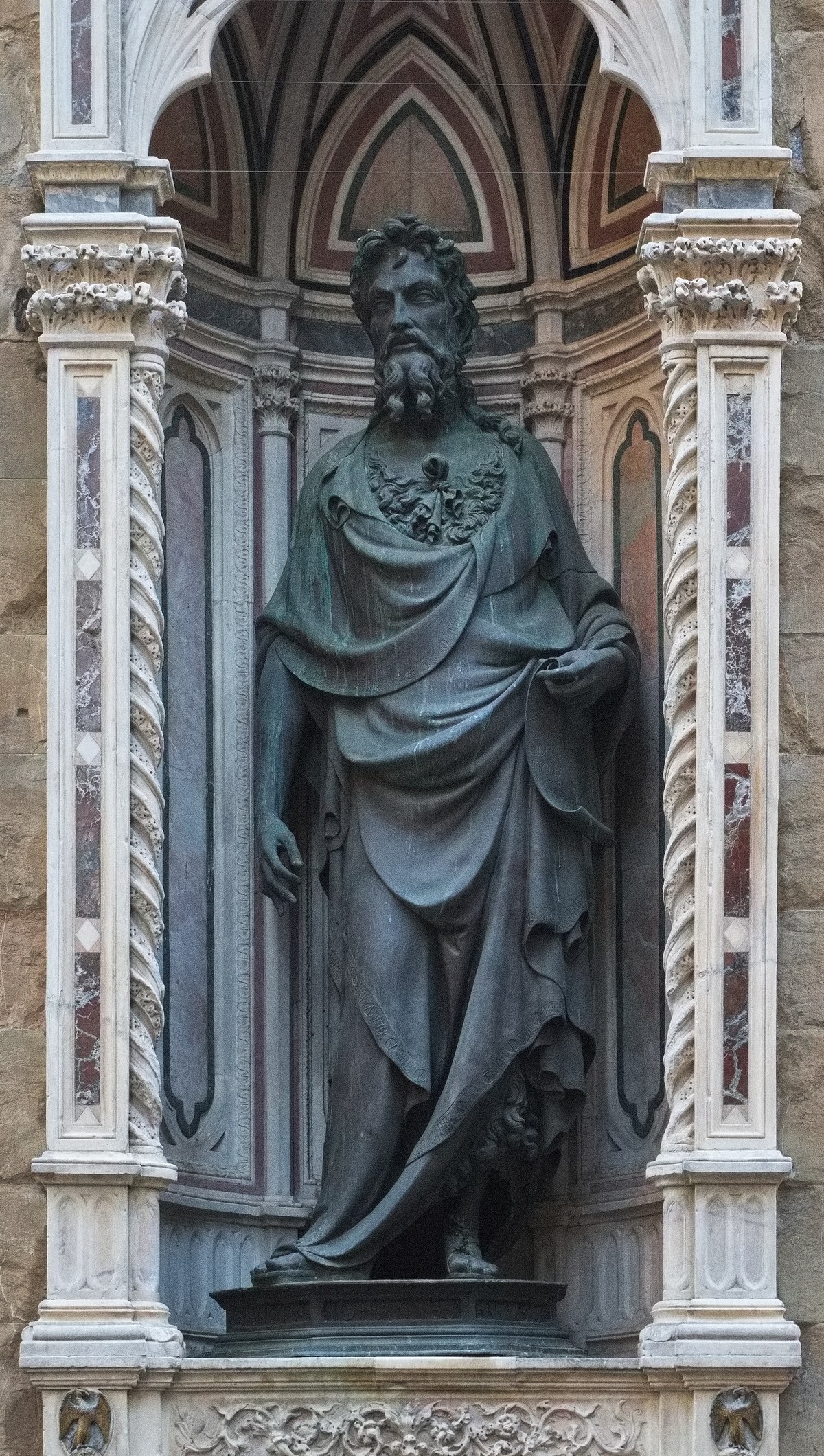
Photograph by Armin Kleiner, CC BY-SA 4.0, via Wikimedia Commons; annotated and cropped. Source. CC BY-SA 4.0.
When John took his place
Calimala’s decision to renew its pier figure dates to 1405 in Joseph Fahey Stanley’s account of the guild records. He places Ghiberti’s appointment in 1407. The museum text reproduced by Palazzo Spinelli gives 1412–16 for the making of the statue, while the Bargello exhibition project dates it 1413–16. Cristina La Bella finds Ghiberti documented on the work by at least 1413. The earliest dates concern the guild’s decision and choice of sculptor. The later ranges describe the period in which the figure took shape. [4] [7] [12] [13]
Baldinucci transcribes an entry dated 1 December 1414 from Ghiberti’s lost journal. It opens a reckoning of expenses for casting the Baptist. In the wording Baldinucci transmits, Ghiberti says that he undertook the casting at his own expense and would lose what he spent if it failed. The passage also recounts success and says that he left the guild’s officers to pay him as fairly as they would another master called in for the job. Ghiberti’s account thus gives the guild a role in deciding what successful work was worth, while putting the cost of a failure on the sculptor. The December date anchors the expense record. The day the metal was poured remains unknown. [11] [13]
La Bella places the statue in its tabernacle in 1416 and records the final payment for gilding in November 1417. Ghiberti, looking back in his Commentarii, gives 1414 for the placement. In Julius von Schlosser’s edition, 1414 is in Ghiberti’s text and 1417 appears in the editorial margin. The documentary chronology gives 1416 as the firmer date for installation. Ghiberti also describes the figure as four and a third braccia high and calls the material ottone fine, literally ‘fine brass’. That is his term for the metal. The national catalogue identifies the sculpture as bronze. [5] [13] [14]
The hand that shows the words
In Sailko’s photograph of the original, the sleeve closes around the left wrist and leaves the palm exposed. The fingers make a shallow cradle for the rolled top of the scroll. Below them, the letters occupy a strip that hangs almost vertically. Its lower end lifts away from the folds and catches the light along the rim. The right arm drops much more directly along the body. A slender cross-staff meets the lowered right hand in this photograph. In Armin Kleiner’s street photograph of the replica, the fingers are visible on their own. The two views establish how the left hand presents the scroll, while the date and status of the photographed staff remain uncertain. [1] [2] [15]
The faint letters on the bronze scroll appear to include vox clamantis in deserto, ‘the voice crying in the wilderness’. In John 1:23 the Baptist uses the phrase to identify himself. It appears on another scroll nearby, in a mosaic of John preaching in the desert inside the Baptistery. That mosaic depicts the act of preaching within a scene from the saint’s life, a life also told in bronze on Andrea Pisano’s Baptistery doors. On the exterior of Orsanmichele, the parted lips and outward turn of the palm suggest a speaker addressing someone in the street. The gesture carries across the distance at which the letters themselves blur. [1] [2] [15] [16] [17] [18]
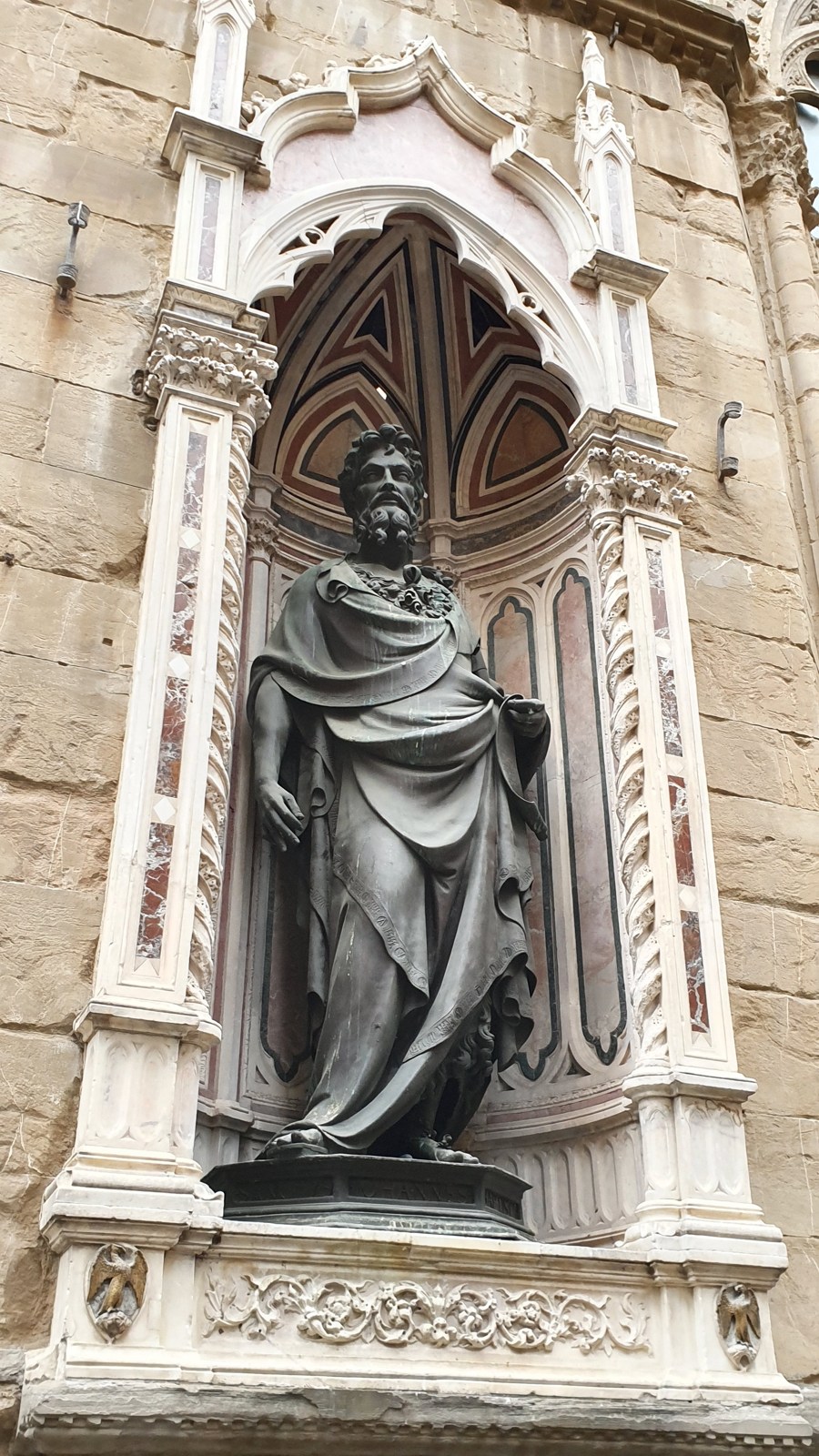
On the original, the words of John’s name occupy three faces of the base. The central face carries IOHANNES, with the other words turning away on either side. It is a formal label below the feet, where the bronze meets the stone of the tabernacle. The scroll is held out at the waist, and a third inscription names the maker on a surface that moves with the figure. The national catalogue records letters incised within circles along the border of the mantle. The museum text gives the central phrase as OPUS LAURENTII, ‘the work of Lorenzo’.
Noah Dasinger reads the longer inscription as OPVS LAVRENTII FLORENTINI, ‘the work of Lorenzo the Florentine’. As the hem sweeps across the body, the letters belong to its ornament. The scroll sets its letters out in lines on a narrow, almost upright surface. Millard Meiss compared those tall, closely spaced capitals with humanist handwriting. The two kinds of lettering ask the eye to move differently, along a hem that dips and rises or down the short lines of a text held out to be read. [2] [5] [7] [15] [19]
The cloak and the hair shirt
A patch of tight curls fills the opening at the chest, parted by the fastening down the centre. The rough texture reappears low down where the mantle lifts above a shin. These glimpses recall the camel-hair clothing described in Matthew’s Gospel. The beard has its own curls. They divide into heavier locks below the mouth, while the hair shirt breaks into short ridges. Between the two is the bare throat. The deep-set eyes and the furrow over the nose give the face a concentration that holds even when the details of the clothing are hard to pick out. [1] [2] [5] [20]
A broad loop of mantle crosses the chest, then smaller folds gather towards the lifted forearm. From there the overlapping edges descend at John’s left side. The longest runs diagonally back towards his right foot, leaving the toes and front of the sandal visible, while the other foot shows beneath the rough undergarment. At street level the deepest fold is easier to follow than the bend of the knees.
Its slope is especially clear against the upright sides of the niche. Seen closer, the change from the wide, smooth run of the mantle to the small curls of the shirt brings two textures into the same piece of sculpture. Above the guild’s carved bales, Ghiberti made the difference between the garments legible in bronze. [1] [2] [8] [20]
The bronze indoors and the figure in the street
John was the first bronze statue installed at Orsanmichele. La Bella describes it as cast in one piece. The museum’s account of restoration reports separately cast sections. Baldinucci’s excerpt concerns the casting of the figure as a whole, and the published accounts leave the arrangement of the joins uncertain. The statue came out of the niche in 1992, was treated by the Opificio delle Pietre Dure in 1994 and was placed in the museum in 1995.
The Opificio published a study of the bronze surface by Gian Piero Bernardini and colleagues. The catalogue and the 1417 payment establish that gilding formed part of the finish. The dark surface of the replica in the street photograph gives little indication of where gold was applied to the original. [1] [5] [7] [11] [13] [21]
In the renewed museum display, the Baptist stands among the original sculptures from Orsanmichele. Indoors, follow the edge of the scroll from the fingers to its lower curl and pick out the small circles in the mantle’s border. Back on Via de’ Calzaiuoli, look at where the hand falls within the tabernacle. The figure stands well above the pavement, but the wrist and hanging strip are clear against the shadow behind them. From that distance, the scroll’s outward curl still gives the gesture its shape. [1] [2] [3] [5] [22]
Lorenzo Ghiberti in context
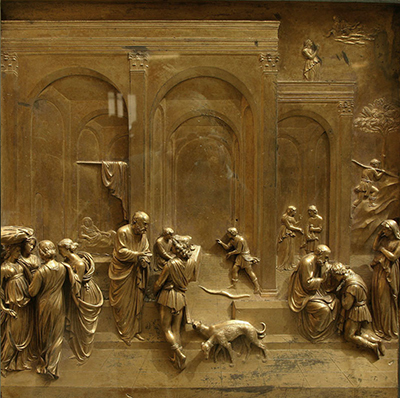
Sacrifice of Isaac
1401 competitionNorth Doors
1403–1424St John the Baptist
c. 1414–1416St Matthew
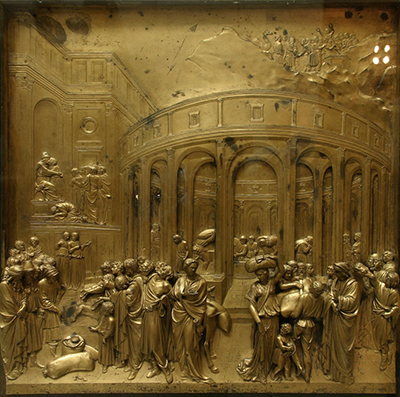
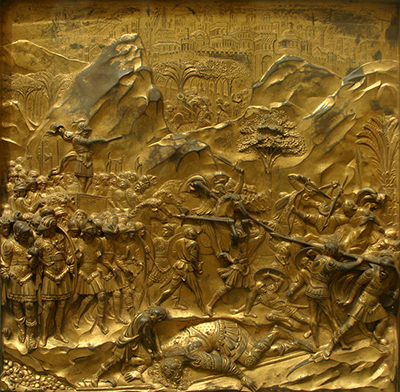
1419–1422Gates of Paradise
1425–1452St Stephen
c. 1427–1429Lorenzo Ghiberti sculpture directory
Discussion
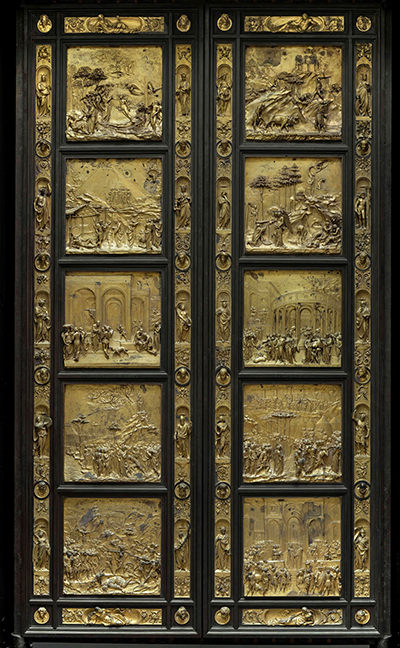
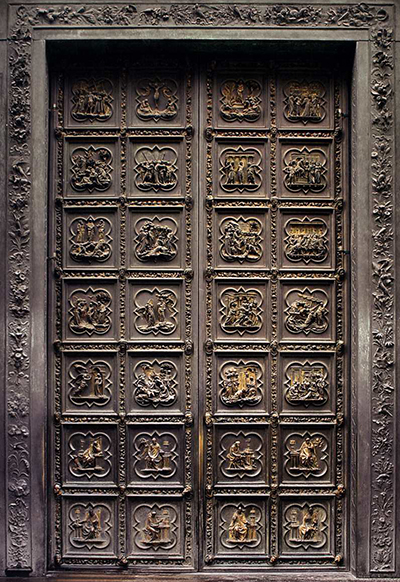
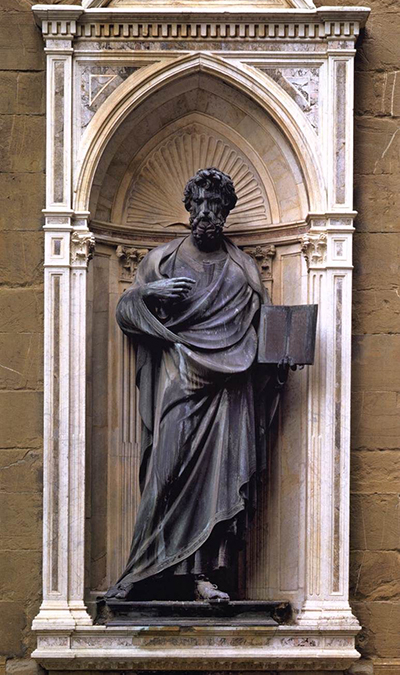
Ghiberti rewards slow looking: relief, gilding, narrative structure, workshop practice and conservation evidence can all change how a work is read.
Join the Conversation
Have an observation about St John Baptist, a source to add, or a comparison that sharpens the reading? Share it below.
References
- Armin Kleiner, photograph of the exterior replica in the Calimala niche, CC BY-SA 4.0. View source.
- Sailko, photograph of the original bronze indoors, CC BY-SA 3.0. View source.
- Musei del Bargello, Orsanmichele. View source.
- Musei del Bargello, Ghiberti, Verrocchio, Giambologna. Ospiti illustri da Orsanmichele, Ministry of Culture project record. View source.
- Catalogo generale dei Beni Culturali, San Giovanni Battista, object 0900291908. View source.
- Opera di Santa Maria del Fiore, Sala del tesoro. View source.
- Palazzo Spinelli, Tabernacolo dell’Arte di Calimala, including the Orsanmichele museum room text by Francesca Nannelli and Claudio Paolini. View source.
- Opera di Santa Maria del Fiore, Eagle of the Guild of Calimala. View source.
- Catalogo generale dei Beni Culturali, Stemma dell’Arte di Calimala, niche 0900291907. View source.
- Richard Krautheimer with Trude Krautheimer-Hess, Lorenzo Ghiberti, vol. II, “Transcript of Documents”, doc. 3 (digests 33 and 37), preview of the 1414 Calimala account. View source.
- Filippo Baldinucci, Notizie de’ professori del disegno, part III, life of Lorenzo Ghiberti, printed p. 6, Accademia della Crusca edition. View source.
- Joseph Fahey Stanley, From Medieval Corporatism to Civic Humanism, PhD dissertation, 2011, discussion of the 1406 provision. View source.
- Dizionario Biografico degli Italiani, ‘Ghiberti, Lorenzo’. View source.
- Lorenzo Ghiberti, I Commentarii, ed. Julius von Schlosser, 1912, vol. I, p. 46. View source.
- Millard Meiss, ‘Toward a More Comprehensive Renaissance Palaeography’, The Art Bulletin, 1960, p. 99 and fig. 4. View source.
- Gospel of John, chapter 1, United States Conference of Catholic Bishops. View source.
- Catalogo generale dei Beni Culturali, San Giovanni Battista predica nel deserto, Baptistery mosaic, object 0900281435-57. View source.
- Catalogo generale dei Beni Culturali, Storie della vita di San Giovanni Battista e allegoria delle Virtù, Andrea Pisano’s Baptistery doors, object 0900281434-0. View source.
- Noah Dasinger, Symbolic Epigraphy and the New Rome, MA thesis, 2022, pp. 12–13 and figs. 10–12. View source.
- Gospel of Matthew, chapter 3, United States Conference of Catholic Bishops. View source.
- Opificio delle Pietre Dure, OPD Restauro 7, 1995, contents, including G. P. Bernardini et al., ‘Il San Giovanni Battista del Ghiberti: studi sullo stato di conservazione della superficie bronzea’, pp. 33–55. View source.
- Soprintendenza Archeologia, Belle Arti e Paesaggio, reopening and new display at Orsanmichele. View source.