 by Tom Gurney
Tom Gurney BSc (Hons) is an art history expert with over 20 years experience
Published on June 19, 2020 / Updated on November 17, 2026
Email: tomgurney1@gmail.com / Phone: +44 7429 011000
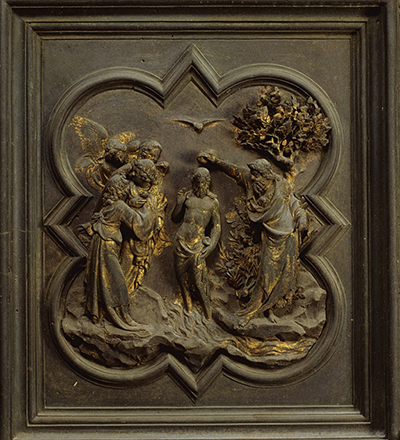
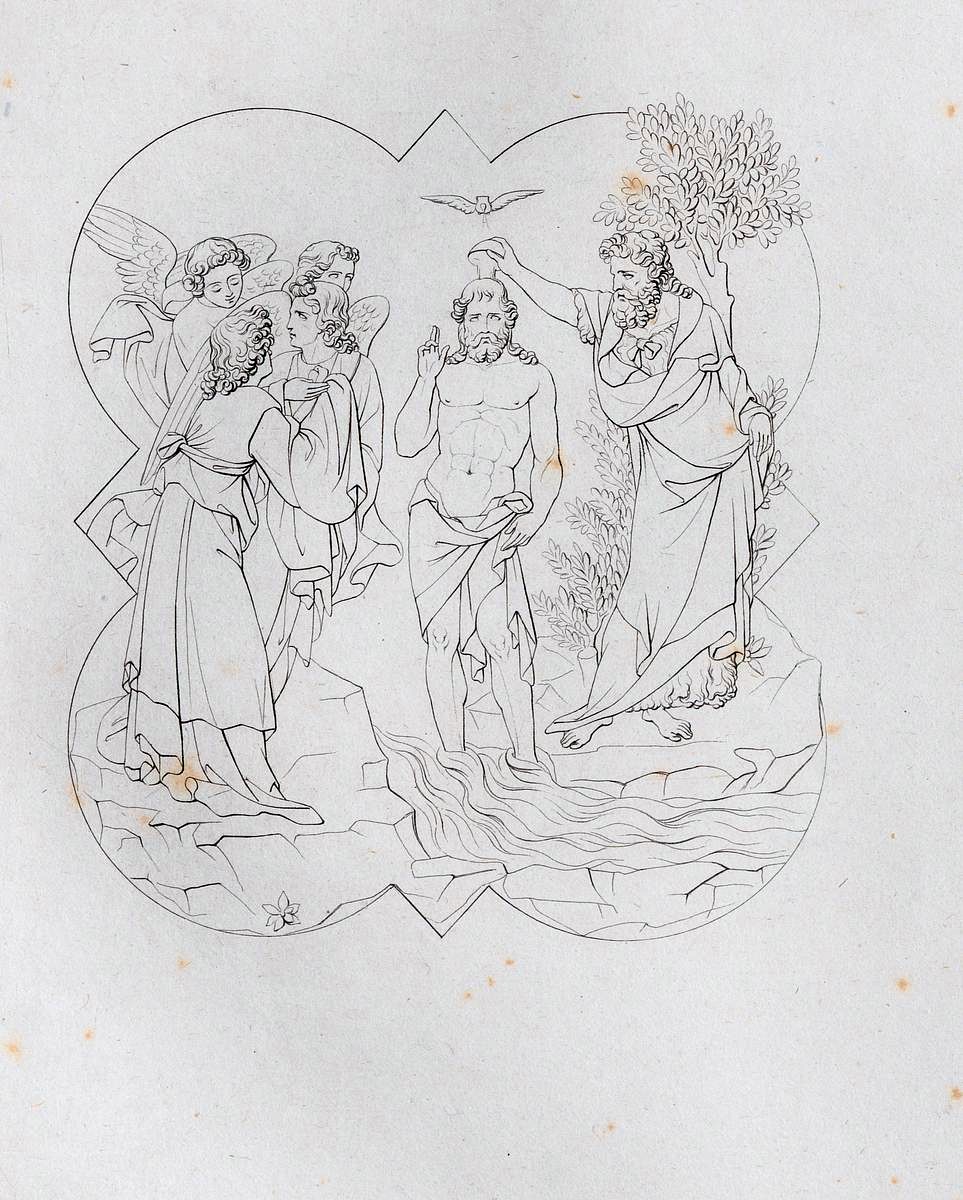
The Jordan takes a sharp turn at Christ’s feet. Its bright ridges bunch around his ankles, then sweep towards the lower right of the frame. At first they look almost like the folds of the cloth he holds at his waist. Follow them outwards and the cloth drops towards his knees while the river keeps going between the rocks. In this gilded bronze relief for the North Door of the Florence Baptistery, Lorenzo Ghiberti uses the direction of those ridges to show us where the ground gives way. Only Christ stands in the water. [1] [2]
Contents
- A river just deep enough
- The space above the hand
- From the east entrance to the museum
- One baptism, several settings
- Above the east portal
A river just deep enough
The bank on the left is a shelf wide enough to hold a group of angels. On the right, the Baptist stands among rocks and plants, with a tree behind him. The lower lobes of the frame give the two banks room to spread. In the middle, the bottom edge rises into a point, close to where the current turns. The river passes above that point and widens again under John’s bank. A narrow channel is enough to separate the figures at ground level and still give the water a course of its own. [1] [2]
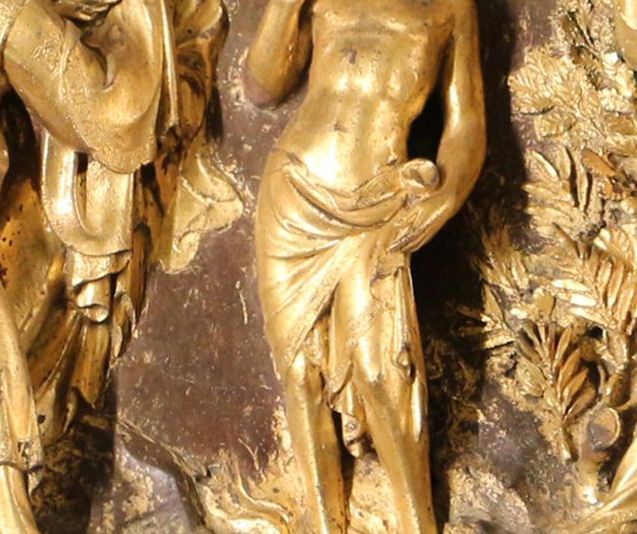
Christ stands almost frontally, with a slight shift through the hips. His left hand gathers the cloth at his waist while his right rises near his shoulder. That parting of the hands leaves his bare torso open to view. The Opera catalogue sees an interest in classical form in the treatment of the body. In the relief the effect also depends on the surfaces alongside it. The chest and abdomen offer broad areas of light beside the broken highlights on the leaves and the folds of the angels’ clothes. The figure is easy to find even before the eye has worked out what the hands are doing. [1] [2]
On the left bank the nearest angel turns into the group, bending an arm towards the folds between the figures. The Opera identifies the angels as holding Christ’s garment and conversing as they attend. The way the heads cluster above the fabric allows them a small exchange of their own, distinct from the officiating gesture on the opposite bank. The three Gospel accounts that narrate the baptism leave the handling of clothes unmentioned. In the bronze, the garment gives the episode a practical before and after. It has been set aside while Christ enters the river, and someone is there to return it when he comes out. [1] [2] [3] [4] [5]
Look closely at the Baptism of Christ
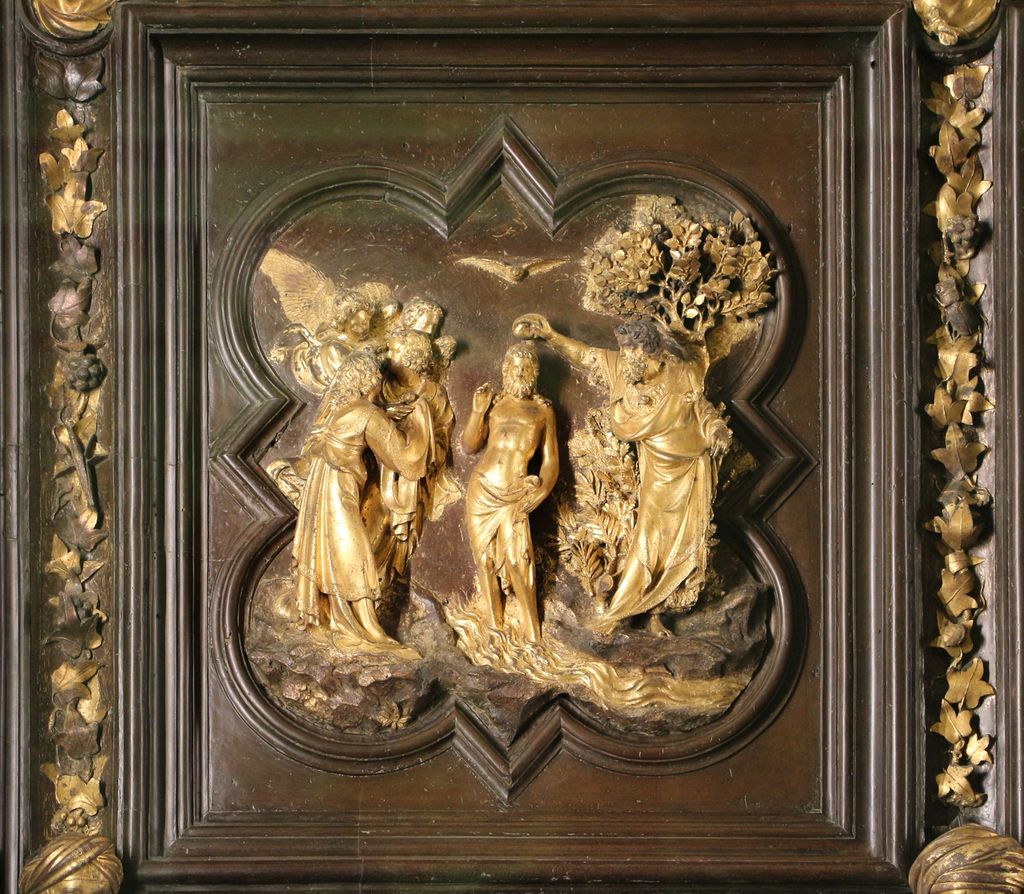
1. Christ in the water
Christ stands almost frontally in the centre, with the river worked across the field below.
2. John on the bank
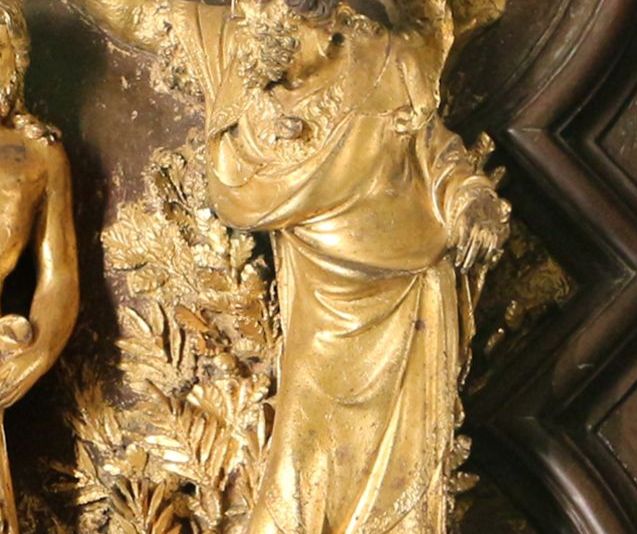
On the right bank, John reaches across the intervening space.
3. The attendants
Overlapping figures fill the bank opposite John.
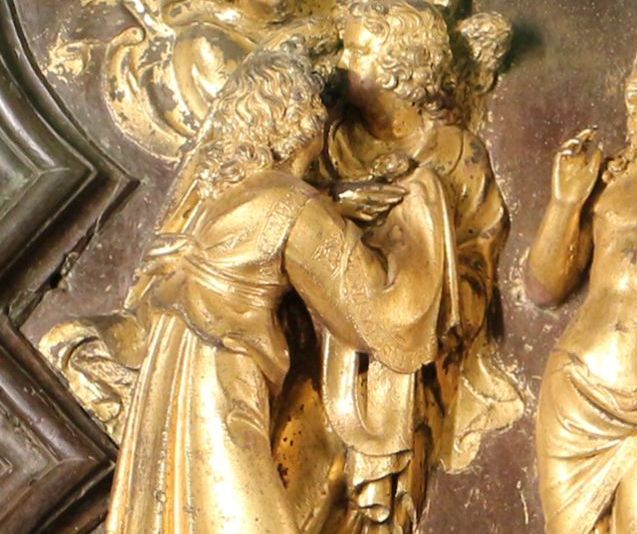
Photograph by Sailko. Source image. CC BY 3.0. Resized for the overview and cropped for detail.
The space above the hand
John has firm ground beneath him, yet his arm reaches so far from it that his hand hangs over Christ’s head. His face inclines towards the action while the mantle falls back along the bank. Beneath it the Opera identifies the rougher texture of a fleece garment, recalling the hair clothing associated with John in Matthew. The catalogue describes him pouring water. The photograph makes the gap between hand and head easier to distinguish than the pour itself. Higher up, the dove opens its wings in a clear interval between the angel’s wing and the crown of the tree. John’s reach crosses the scene from the right and ends almost directly beneath the bird. [1] [2] [3]
Matthew gives John a reason to hesitate before the baptism. He believes Jesus ought to baptise him. Mark places the opening of heaven as Jesus comes up out of the water, and Luke places it while Jesus is praying after being baptised. All three describe the Spirit descending like a dove and a heavenly voice identifying Jesus as the beloved Son. The relief brings the hand and the bird into view together while Christ is still in the stream. The space between the signs is small enough for the eye to take them in together, even though the Gospel accounts give the action at the Jordan and the revelation their own moments. [1] [2] [3] [4] [5]
In the Gospel of John, the Baptist speaks about the descent afterwards. He testifies that he saw the Spirit come down and remain upon Jesus. He had been told that this would identify the one who would baptise with the Holy Spirit. That account gives the man reaching over the Jordan a second role in the episode. He performs the baptism with water and can tell others what the descent disclosed.
In Mark it is Jesus who sees the heavens open. In John it is the Baptist’s account of what he saw that is passed on to the reader. In the bronze his face is angled towards the action under his hand. The dove is visible to us above him, while his posture keeps his attention close to the person he is baptising. [1] [2] [4] [6]
From the east entrance to the museum
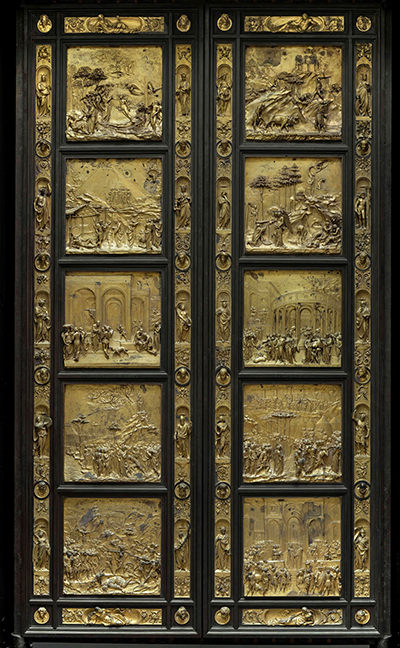
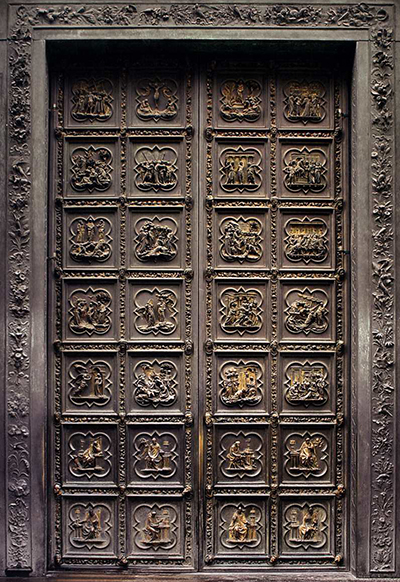
The Baptism begins the second narrative row and is the fifth scene in the life of Christ. It is at the far left of the fourth row from the bottom, with the Temptation alongside. The door went up at the Baptistery’s east entrance in 1424 and was moved to the north side in 1452. The Opera gives 1403–1424 for the door project and reports Richard Krautheimer’s proposal that the Baptism belongs to a group of reliefs made between about 1407 and 1413–15. That narrower dating comes from comparisons of style. [1] [7] [8]
In November 2013 the Opera reported that treatment of the Baptism and the neighbouring Temptation was complete while the other panels were still being cleaned. The report describes the selective use of a laser and the reappearance of gilding on the reliefs against the darker bronze ground. The conservators reported uneven results across the door, owing to differences in manufacture and in local conditions. The photograph shows how this contrast can pick out a detail as small as the dove. The original is now in the Museo dell’Opera del Duomo, and a modern replica occupies the north portal. [2] [7] [9] [10]
One baptism, several settings
The episodes around the Baptism on the North Door carry the story from Christ’s childhood to the declaration of his sonship and then to his temptation. In Siena, where Ghiberti’s later version was cast in 1427 for the baptismal font, the subject belongs to a sequence of six reliefs about the Baptist. Andrea Pisano’s earlier South Door in Florence also includes it within a cycle about John. The Siena relief sits on one side of a hexagonal basin used for baptism. Here the connection is made by the object as well as the narrative. The image of John baptising in the Jordan is set into the basin that holds water for the rite. [3] [4] [5] [7] [11] [12]
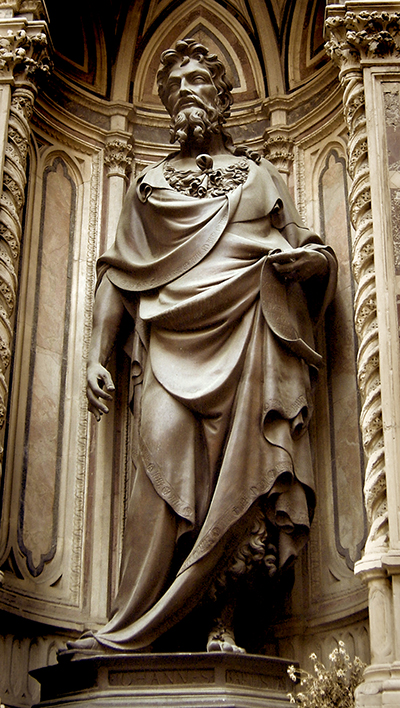
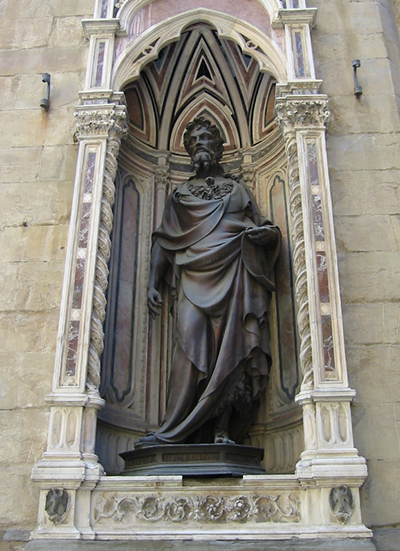
Ghiberti’s St John the Baptist at Orsanmichele gives the saint another setting. Made for the Arte di Calimala’s niche on the Via de’ Calzaiuoli façade, the monumental bronze presents John alone. The hand with the scroll extends towards the space in front of the statue, where a passer-by would have been. On the North Door the arm has a destination inside the frame. It crosses the gap from the bank to the head and makes Christ the focus of John’s action. The scroll gives the saint something to present to the street. The reaching hand on the door gives the viewer someone else to look at. [1] [2] [13] [14]
Above the east portal
The later white marble Baptism brought the subject back to the east side of the Baptistery, this time above the Gates of Paradise. Andrea Sansovino began Christ and John in 1502–05, Vincenzo Danti brought the project to completion in the years around 1569, and Innocenzo Spinazzi added the angel in the late eighteenth century. The group formed part of a cycle on the Baptist’s life distributed over the Baptistery’s three entrances. [7] [15] [16] [17]
In that over-life-size group, Christ stands with both hands clasped at his chest, a compact silhouette beside the forward lean of the Baptist. John extends a small bowl towards Christ across the gap between the statues. The catalogue describes a fragment of a tree trunk beside Christ’s left foot. With the figures on separate bases, the outstretched arm carries the action across open air. Ghiberti uses the enclosed field of the bronze to put more of the setting in view. Christ’s two hands have separate actions, the Jordan is traceable around his feet, and the dove has a dark field behind it. The marble bowl specifies how the water is administered. The bronze lets us follow where the water runs. [1] [2] [15] [16] [17]
Lorenzo Ghiberti in context
Sacrifice of Isaac
1401 competitionNorth Doors
1403–1424St John the Baptist
c. 1414–1416St Matthew
1419–1422Gates of Paradise
1425–1452St Stephen
c. 1427–1429Lorenzo Ghiberti sculpture directory
Discussion
Ghiberti rewards slow looking: relief, gilding, narrative structure, workshop practice and conservation evidence can all change how a work is read.
Join the Conversation
Have an observation about Christ is Baptised by John, a source to add, or a comparison that sharpens the reading? Share it below.
References
- Opera di Santa Maria del Fiore, scientific catalogue, Battesimo di Cristo, Porta Nord del Battistero, object 4246. View source.
- Sailko, photograph of the original Baptism of Christ relief, CC BY 3.0. View source.
- Gospel of Matthew 3:4, 13–17, United States Conference of Catholic Bishops. View source.
- Gospel of Mark 1:9–11, United States Conference of Catholic Bishops. View source.
- Gospel of Luke 3:21–22, United States Conference of Catholic Bishops. View source.
- Gospel of John 1:29–34, United States Conference of Catholic Bishops. View source.
- Opera di Santa Maria del Fiore, scientific catalogue, Porta Nord del Battistero, object 3618. View source.
- Yair Haklai, photograph of the original North Door in the museum, CC BY-SA 4.0. View source.
- Opera di Santa Maria del Fiore, L’oro del Ghiberti torna a splendere, 29 November 2013. View source.
- Opera di Santa Maria del Fiore, Renaissance clonation: the North Door replica. View source.
- Opera della Metropolitana di Siena, Baptistry of San Giovanni, baptismal font. View source.
- Opera di Santa Maria del Fiore, Andrea Pisano, South Door of the Baptistery. View source.
- Musei del Bargello, Ghiberti, Verrocchio, Giambologna, Orsanmichele bronze exhibition. View source.
- Sailko, photograph of Ghiberti’s original St John the Baptist at Orsanmichele, CC BY-SA 3.0. View source.
- Opera di Santa Maria del Fiore, Andrea Sansovino, Baptism of Christ, museum object page 9199. View source.
- Opera di Santa Maria del Fiore, scientific catalogue, Battesimo di Cristo: Cristo, object 3658. View source.
- Opera di Santa Maria del Fiore, scientific catalogue, Battesimo di Cristo: San Giovanni Battista, object 3666. View source.