 by Tom Gurney
Tom Gurney BSc (Hons) is an art history expert with over 20 years experience
Published on June 19, 2020 / Updated on November 17, 2026
Email: tomgurney1@gmail.com / Phone: +44 7429 011000
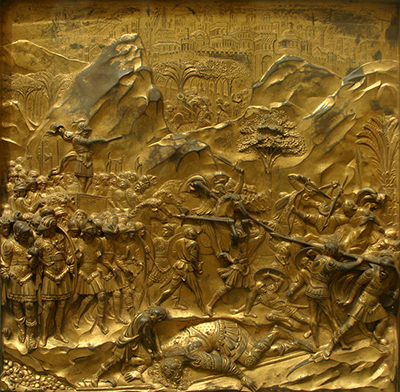
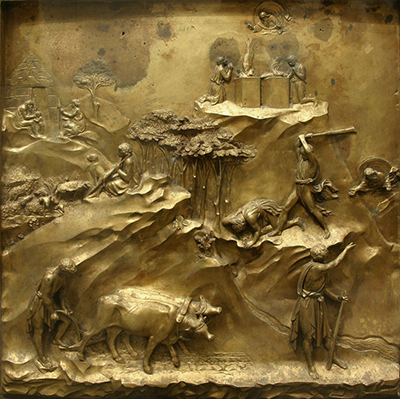
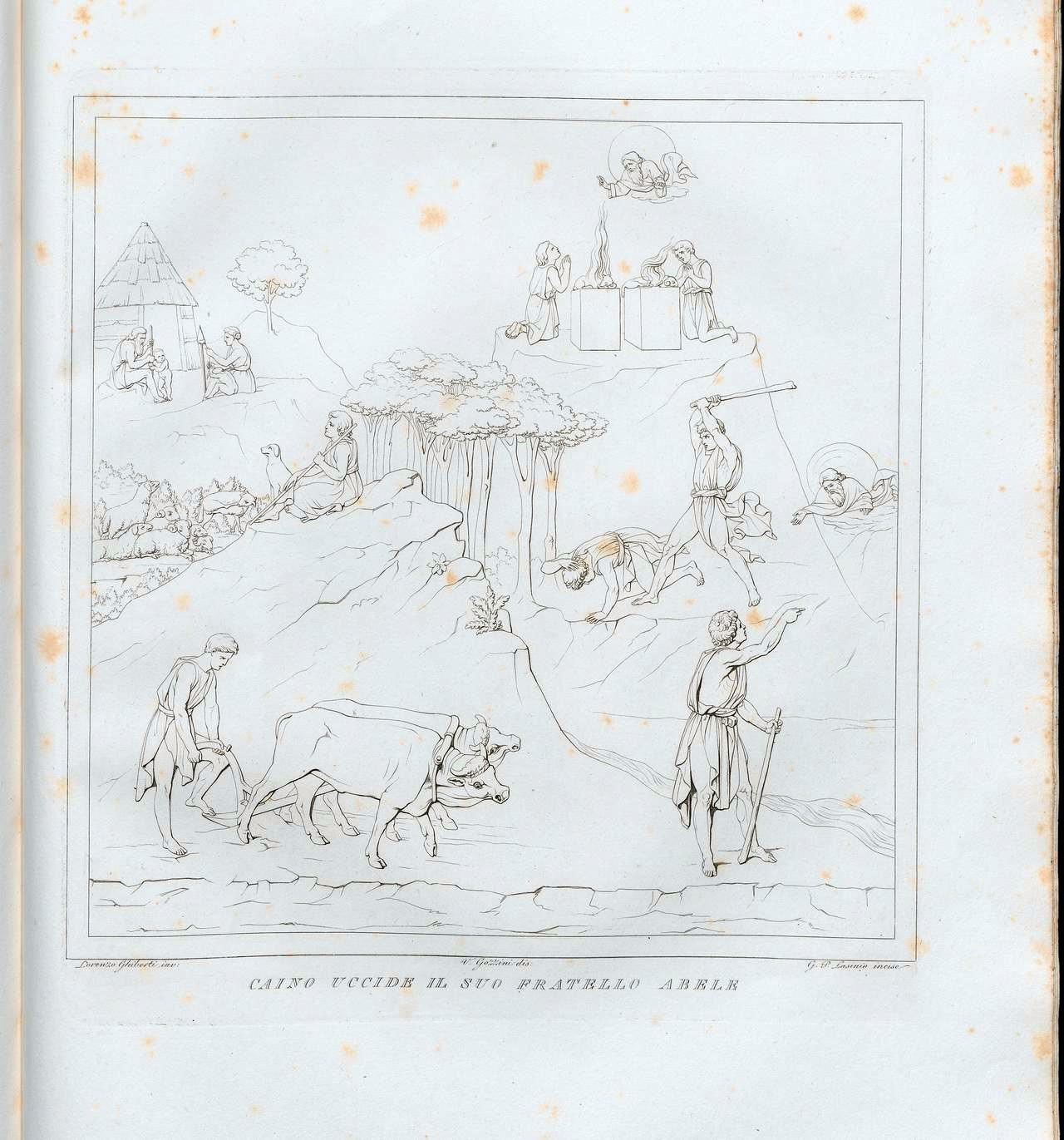
A small roof rises above the hillside at the upper left of Lorenzo Ghiberti’s Cain and Abel. Under its edge, Adam bends around a child standing between his knees. Eve sits a little farther to the right with a spindle and the other child close by. The family takes up far less space than the plough team below. Starting with the roof makes it possible to see the brothers together before the landscape separates them into a keeper of sheep and a man who works the soil. [1] [2]
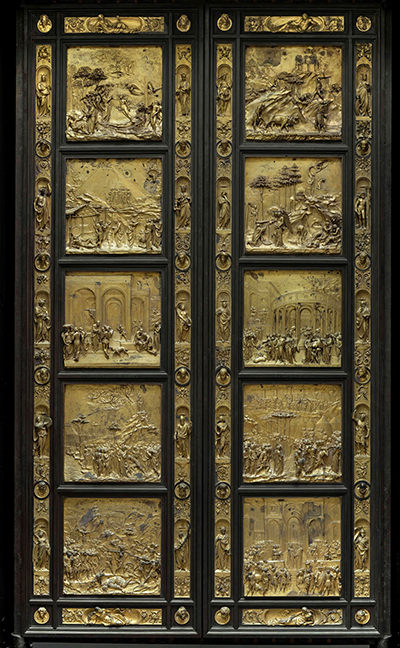
This gilded bronze relief occupies the top right of the Gates of Paradise, made between 1425 and 1452 and installed at the east entrance of the Florence Baptistery in 1452. The original is now in the Museo dell’Opera del Duomo. The museum’s catalogue title includes the first parents as well as their sons. The foreground pairs two appearances of the grown Cain, at the plough and answering God. Between the hut and that last encounter, the land that sustains the household becomes the ground that, in Genesis, receives Abel’s blood and will no longer yield to Cain. [1] [2] [3] [4]
Contents
- What the family lives on
- The shepherd and the ploughman
- What rises from the altars
- From the raised stick to the raised arm
- Behind the altars
- What survives in plaster
What the family lives on
The round outline of the shelter is easier to follow than the little figures. Horizontal bands run across it, and an upright stands at the edge of the opening next to Adam. Alessandro Merlo and Gaia Lavoratti read these features as parts of a circular shelter made with poles and reeds, under a conical thatched roof. They compare it with a type documented in Tuscany and the sub-Apennines, where uprights around the perimeter carry the wall and a central post supports the roof. The bronze gives the viewer the curve of the wall, the bands and the opening. The comparison supplies a way to imagine how those shapes might have stood up at full size. [1] [5]
In the 1427 Florentine land register, Merlo and Lavoratti find entries for huts on supports and huts covered with straw. The terms establish that such light structures belonged to the cultivated landscape of Ghiberti’s time. The bronze also distinguishes one kind of shelter from another. The next panel, Noah, has a rectangular shelter with a roof that slopes on two sides. Here the wall curves behind Adam and its little opening gives the seated figure and child a sheltered place at the edge of the slope. The farming landscape can be recognised through these features without assigning the hut to a particular farm. [1] [5]
The Commentarii name the two children together as Cain and Abel. Which boy stands between Adam’s knees remains uncertain. Ian Ewing proposed that this standing child against a seated adult helped furnish a pose for Michelangelo’s Bruges Madonna. The resemblance concerns the arrangement of the bodies. In Ghiberti’s scene, Adam’s attention is taken up by the boy in front of him while Eve holds the spindle. Her hands give the household its own instance of work before either son appears at his livelihood. [1] [2] [6] [7]
Look closely at Cain and Abel
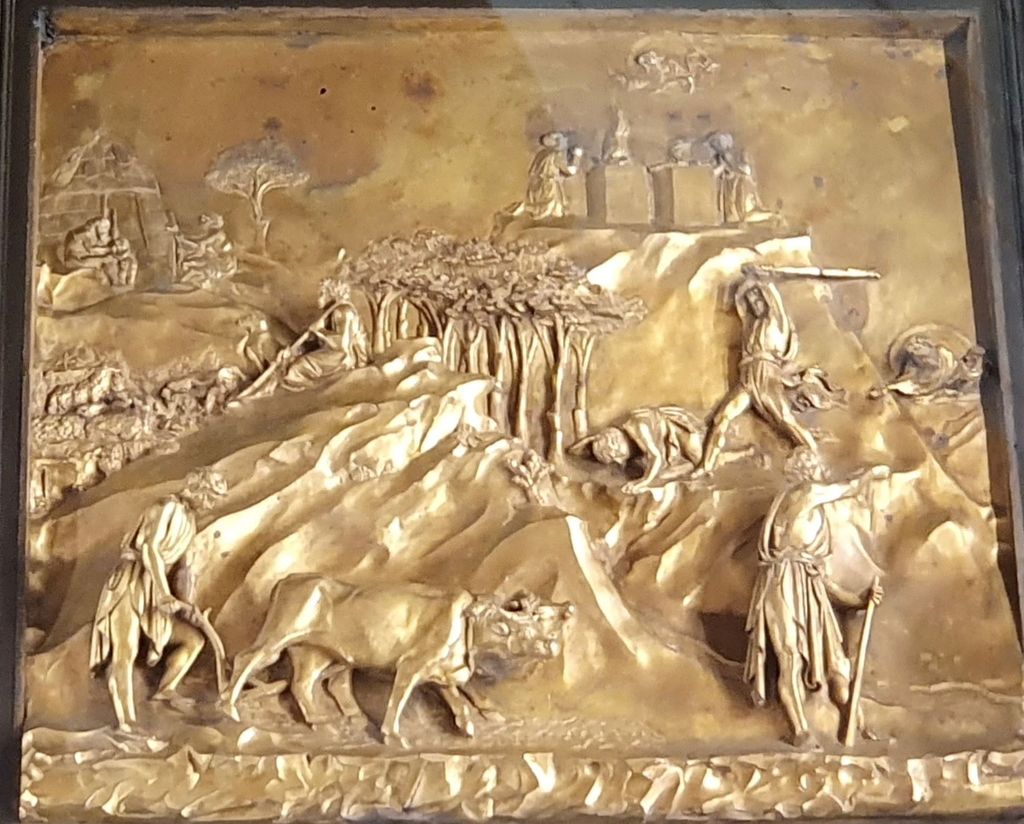
1. The offerings high on the hill
The two figures and their altars sit high above the foreground. The shallow carving keeps this episode at a distance.
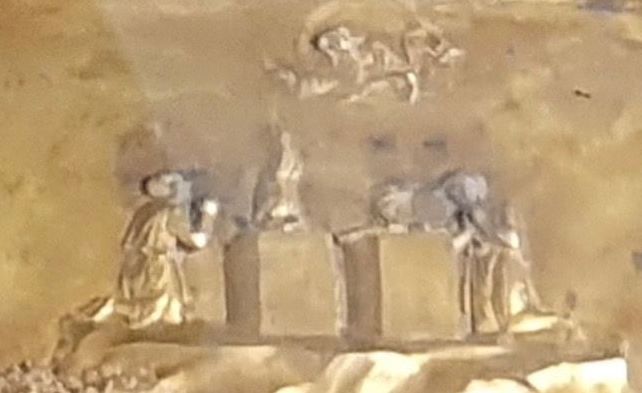
2. Cain raises his weapon
The raised weapon cuts across the slope. Abel lies below Cain’s bent legs, with his head close to the trees.
3. The plough team in the foreground
Two oxen and the ploughman extend across the lowest slope. The heavy forms of the animals stand well forward of the hillside.
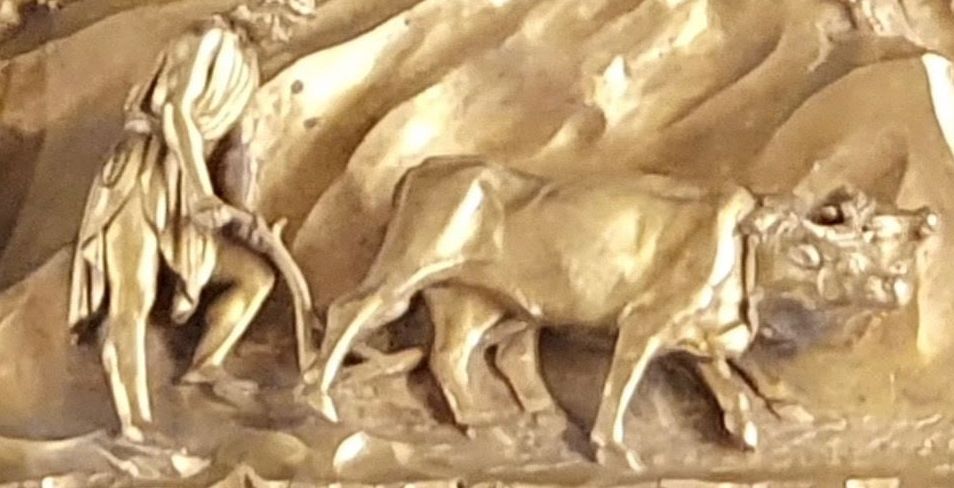
Photograph by Yair Haklai. Source image. CC BY-SA 4.0. Resized for the overview and cropped for detail.
The shepherd and the ploughman
On the west side of Giotto’s Campanile, Andrea Pisano and his assistants gave the work of Adam and Eve a hexagon of its own. It follows the two Creation reliefs and precedes a series of separate occupations. The Opera identifies Adam working the earth and Eve spinning in the same scene. In Ghiberti’s bronze the spindle is still with Eve, while cultivation has its largest figure a generation later, in Cain. The space between mother and son lets the eye pass from work shared within a household to the distinct means by which the brothers make their living. [1] [2] [8] [9]
Below the hut, Abel sits at the edge of the grove. A long diagonal runs from his hands down towards the animals, which occupy several patches of the slope. Trace the spaces between them and the flock spreads out well beyond the shepherd’s knees. The plough team at the lower left is built the other way round. The bodies of the two oxen lie so close together that the nearer flank at first seems to account for the whole group.
The second head appears just behind the first, and a second set of legs shows beneath the projecting flank. Both animals face towards the middle of the panel as Cain follows behind. Behind them Cain bends his knee and leans into the curved handle. The gathered weight of the oxen and the pressure of the man on the handle make the work legible at a glance. [1] [2]
Merlo and Lavoratti place the team alongside the ploughing scene that opens Virgil’s Georgics in the illustrated Riccardiano 492, folio 18r. The miniature gives another instance of the paired oxen and wooden plough in a fifteenth-century image. In the bronze the group makes cultivation recognisable on its own terms. It also gives Cain a body large enough to pick out before the smaller scenes have come into focus. Ghiberti says he used larger figures nearer the eye and very shallow relief farther away. The eye can begin with the oxen, retreat past the shepherd, and reach the family that comes first in the story. [1] [5] [6]
What rises from the altars
The brothers come together again high on the right, kneeling at the outer edges of two blocklike altars. Their straight fronts make a level pair among the irregular banks. Abel, on the viewer’s left, holds his upper body more upright. Cain bows on the right. Ruskin also places the figures in that order. A narrow plume above Abel’s altar leads the eye towards the small figure of God. No equally distinct column rises over the other altar. The paired structures establish the terms of the comparison before the plume and the divine gesture disclose the preference. [1] [2] [10]
The altar gifts come from the work below. Abel brings an offering from his flock and Cain brings produce of the ground, described by the Opera as a bundle of grain. Genesis names the fat portions of the firstlings of Abel’s flock and gives no grade for Cain’s produce. Ghiberti makes the difference explicit in the Commentarii, saying that Cain brought the poorest of what he had and Abel the best. He then invokes Cain’s envy. The difference in quality belongs to Ghiberti’s account. On the bronze the rising plume gives the accepted offering the clearer connection to God. [1] [2] [4] [6]
Amy R. Bloch asks how a relief can make Cain’s changing state of mind visible. Genesis puts anger between the rejection and the killing, and tells of God addressing Cain before the brothers go into the field. Ghiberti makes the rejection and the attack close enough to take in together. The narrow figure folded beside the right altar gives way to a man with his arms up and his legs apart on the slope below. The body supplies much of the change that the text conveys in words. [1] [4] [11]
After describing God’s question, Ghiberti says that each panel shows the effects of four stories. In his description of this panel he mentions the children together, the sacrifice, the murder, the separate occupations and the question about Abel. His wording leaves room for an action to be understood through more than one group. The two brothers work far apart, yet the gifts close together on the shelf derive from what each does on his own. Someone following the story across the bronze has to join those parts of the account across the slope. [1] [6]
From the raised stick to the raised arm
Cain’s stick runs nearly level across the open slope below the altars. The upright trunks of the grove bring out that line. His stride is wide and his cloth lifts behind him. Abel is already low by the trees, with his head near the bank and a hand braced against the ground. Genesis specifies no weapon. The raised stick and the hand still taking Abel’s weight give the scene its tension without fixing the instant of impact. Look down from the altars and Abel has gone from kneeling beside his gift to barely holding himself up. [1] [2] [4]
The lower-right Cain raises an arm towards God, who appears farther back near the edge. Cain’s back is turned and the long folds of his clothing fall towards his feet. Above him the attacker’s cloth follows the force of the stride. The difference makes the figure below feel planted as he answers. The two encounters with God also differ in scale and distance. At the sacrifice, the small divine figure is above the pair and the plume leads towards him. Here God and Cain face one another across open ground. Abel, who appeared with the flock, at the altar and at the foot of the grove, is absent when God asks where he is. [1] [2] [4]
Genesis moves from Cain’s denial to the blood crying out from the ground and to the sentence that the soil will no longer yield to him. He must wander. The protective mark comes later in the text. The Opera identifies the final encounter as the questioning and curse, and that is enough to make sense of the space across the bottom of the relief. Follow it from Cain’s feet back to the plough. The close, projecting figure at each end is the same man. At one end he has the team and the handle in front of him. At the other, the ground separates him from the speaker who is taking away his livelihood. [1] [2] [4]
Behind the altars
Salvatore Siano and his colleagues compared the front of the bronze with its reverse. Their photograph and diagram align hollows on the back with the oxen and the two projecting foreground figures of Cain. They report a correspondence even for the low relief of the sacrifice. From the front, the little group is easy to miss after the oxen have caught the light. From the back, its place can be traced in the metal.
The study also records brush traces over much or all of the reverse of this panel. The authors use such traces and the rough correspondence of the two sides to argue that the workshop formed an intermediate wax in a mould taken from a model. They allow for areas subsequently worked with tools. The correspondence is an observation on this bronze, and the moulded wax is their explanation for how it arose. [1] [12]
What survives in plaster
In Madrid the plaster cast V-283 entered the collection of the Real Academia de Bellas Artes de San Fernando as a gift from Anton Raphael Mengs. The Academy credits the moulding to Vincenzo Barsotti da Tereglio. In the inventory begun in 1804 the title translates as Adam and Eve and the Death of Abel. The first names in that entry send the eye back to the upper left, where the figures under the little roof are easiest to lose among the events on the hillside. [1] [13]
Lorenzo Ghiberti in context
Sacrifice of Isaac
1401 competitionNorth Doors
1403–1424St John the Baptist
c. 1414–1416St Matthew
1419–1422Gates of Paradise
1425–1452St Stephen
c. 1427–1429Lorenzo Ghiberti sculpture directory
Discussion
Ghiberti rewards slow looking: relief, gilding, narrative structure, workshop practice and conservation evidence can all change how a work is read.
Join the Conversation
Have an observation about Cain and Abel, a source to add, or a comparison that sharpens the reading? Share it below.
References
- Yair Haklai, photograph of the original Cain and Abel relief in the Museo dell’Opera del Duomo, 2019, CC BY-SA 4.0. View source.
- Opera di Santa Maria del Fiore, Formella con Storie dei Progenitori e di Caino e Abele, catalogue record 1330. View source.
- Opera di Santa Maria del Fiore, Porta del Paradiso, catalogue record 1320. View source.
- United States Conference of Catholic Bishops, Genesis, chapter 4, verses 1–16. View source.
- Alessandro Merlo and Gaia Lavoratti, ‘The Representation of Vernacular Architecture in the Gates of Paradise by Lorenzo Ghiberti’, Heritage 7 (2024), §§3.1–3.2 and 4, pp. 5092–5095, 5099, figs. 8–11. View source.
- Lorenzo Ghiberti, I Commentarii, ed. Julius von Schlosser, vol. I, §22, p. 49, 1912. View source.
- Ian Ewing, ‘Further Observations on the Bruges Madonna: Ghiberti Sources for Michelangelo’, Revue belge d’Archéologie et d’Histoire de l’Art 48 (1979), pp. 77–78 and fig. 1. View source.
- Opera di Santa Maria del Fiore, Lavoro di Adamo ed Eva, catalogue record 962. View source.
- Opera di Santa Maria del Fiore, Andrea Pisano, Formelle dal lato ovest del Campanile di Giotto. View source.
- John Ruskin, The Schools of Art in Florence, lecture VI, p. 246 and plate XXI, in The Works of John Ruskin, vol. 23. View source.
- Amy R. Bloch, introduction to Lorenzo Ghiberti’s Gates of Paradise: Humanism, History, and Artistic Philosophy in the Italian Renaissance, p. 8, Cambridge University Press, 2016. View source.
- Salvatore Siano, Piero Bertelli, Marcello Miccio and Ferdinando Marinelli, Studio sulla tecnica di fusione dei rilievi della Porta del Paradiso, §3, PDF pp. 3–4, especially fig. 1. View source.
- Real Academia de Bellas Artes de San Fernando, Puerta del Paraíso. Caín y Abel, plaster cast V-283, especially ‘Inventarios’, fol. 102v, item 63. View source.